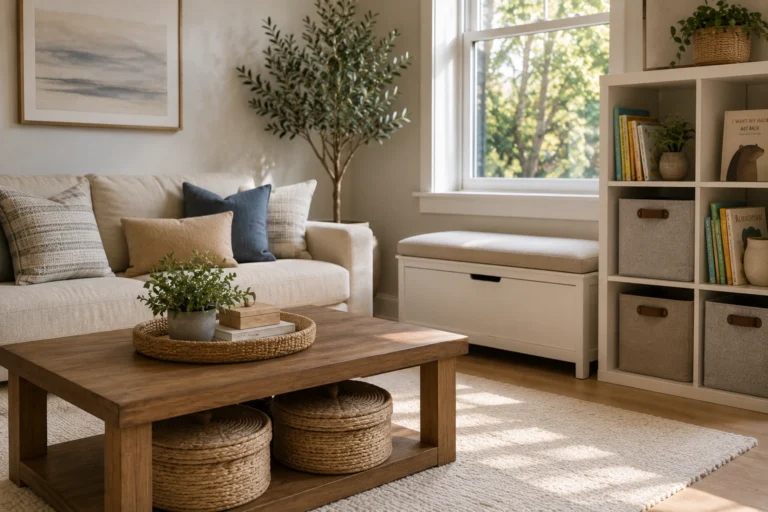
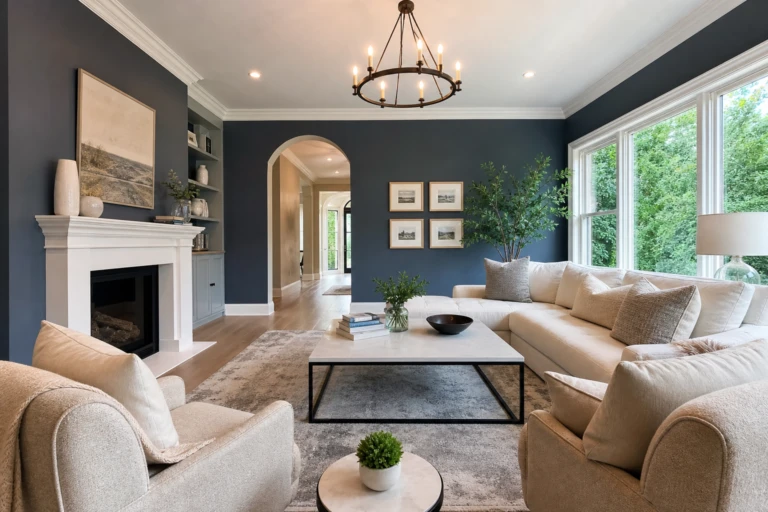
There is something about a beige, black, and white living room that just holds up over time. Not because it is popular right now, but because the combination genuinely works in real homes, with real furniture budgets and real families who need a space that functions as much as it looks good. Beige grounds everything with warmth, white keeps the room breathing, and black adds enough contrast to stop the space from looking washed out or boring. When you get the balance right, the result feels pulled together without looking like it came straight out of a catalogue.
The tricky part is knowing how to distribute those three tones without the room leaning too beige and flat, too stark, or too scattered with no clear anchor. The ideas below are organized by style so you can find the direction that fits your home, your budget, and the feeling you actually want to walk into at the end of the day. This palette scales to any room size, so start with the ratio that feels right and adjust from there.
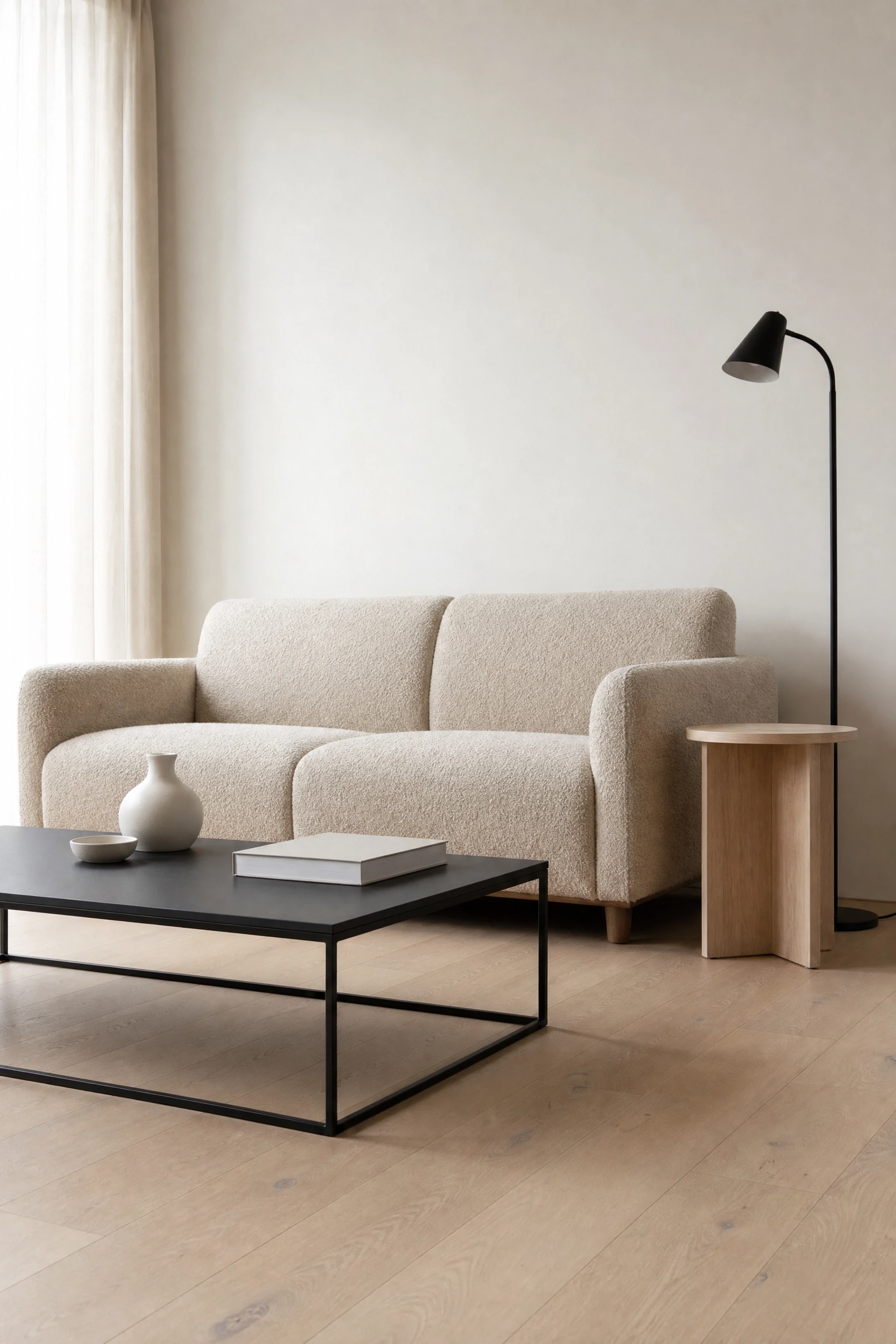
If you have ever walked into a room that felt genuinely calm the moment you stepped inside, there is a good chance it followed something close to this formula: a low-profile beige boucle sofa, white walls, a matte black coffee table, and almost nothing else competing for attention. The boucle fabric does a lot of the heavy lifting here because its soft, looped texture adds visual warmth even when the overall palette is very restrained. Pair it with a simple black powder-coated steel coffee table, a white oak side table, and a single oversized floor lamp in black. The floor should ideally be a pale natural wood or a light concrete-effect tile to keep the base of the room airy. One thing that works really well here is keeping decor to three objects maximum on any surface, a small ceramic vase, a single book stack, and maybe a trailing plant, so the room never tips into feeling cluttered. This look is mid-range in terms of cost, since boucle sofas are widely available now from high-street retailers, but be aware that the fabric can snag if you have pets.
Quick Tip: Keep your wall art to one large piece rather than a gallery wall. A single black-framed abstract print in muted beige and charcoal tones ties the palette together without adding visual noise.
Japandi-Inspired Calm with Black Low-Profile Furniture
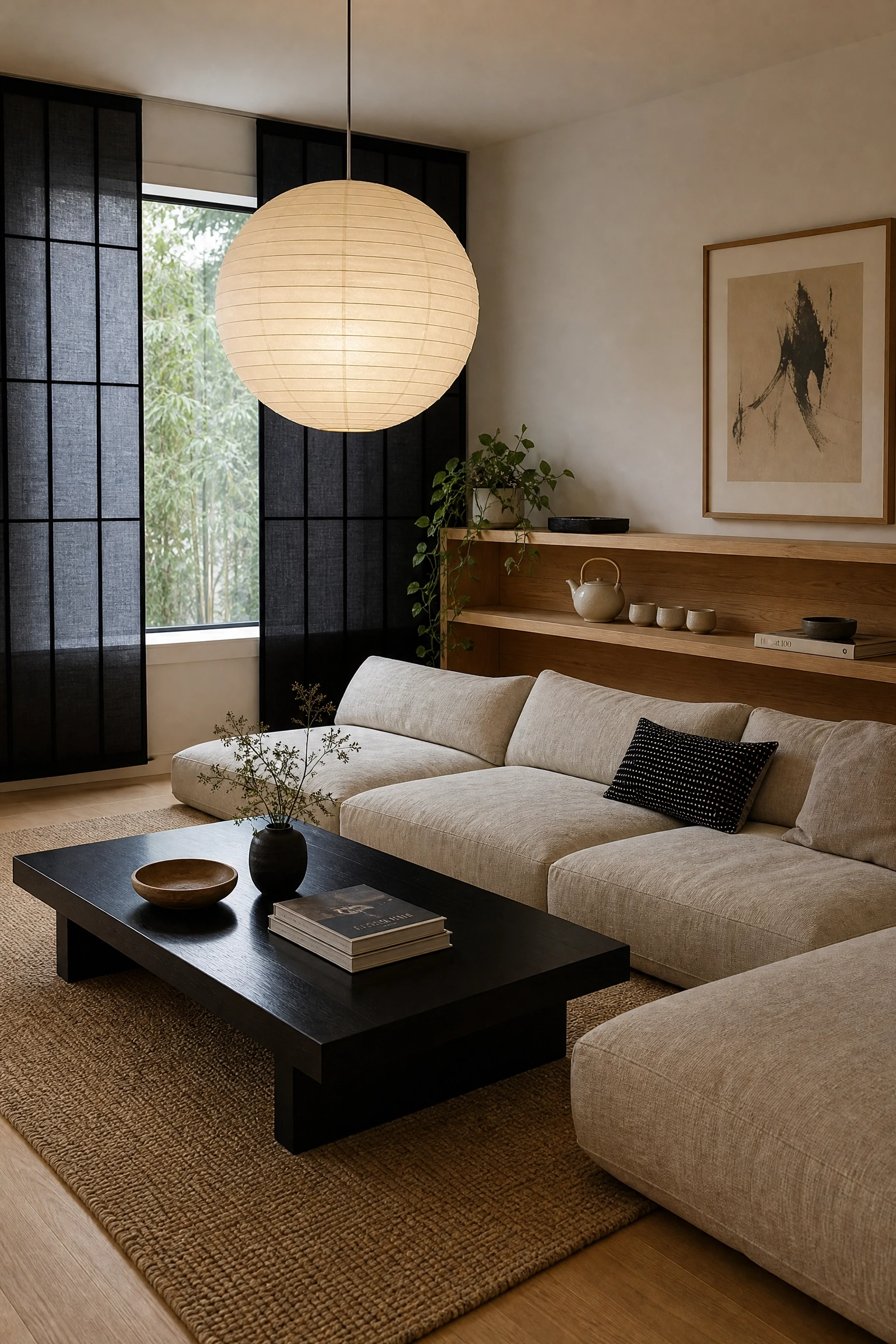
Japandi design, the blend of Japanese minimalism and Scandinavian functionality, is one of the most requested looks from professional interior designers right now, and it works particularly well in the beige, black, and white palette. The defining characteristic is low-profile furniture, floor-level or close-to-floor pieces with clean, undecorated edges. A beige linen sectional sitting very close to the ground, a rectangular black lacquered coffee table, and black shoji-inspired panel curtains give the space its signature horizontal quality. Walls should be white or very pale off-white, but the real texture comes from layering natural materials: a woven jute rug, linen cushion covers, and raw wood like a small shelf in unfinished ash or walnut. Lighting is subtle and warm, a paper pendant in off-white or a slim matte black floor lamp with a warm-toned bulb. In practice, this look comes together best when you resist adding anything with no function. A bamboo tray on the coffee table, a ceramic tea set in white, and one low plant are all you need. This style works best in rooms with good natural light since low furniture can make a dark room feel heavier.
Designer Advice: Choose bulbs with a color temperature of 2700K to 3000K throughout. Cooler white light fights against the warmth of beige and makes the whole room feel clinical rather than calm.
White-Wall Minimalism with a Single Black Statement Piece
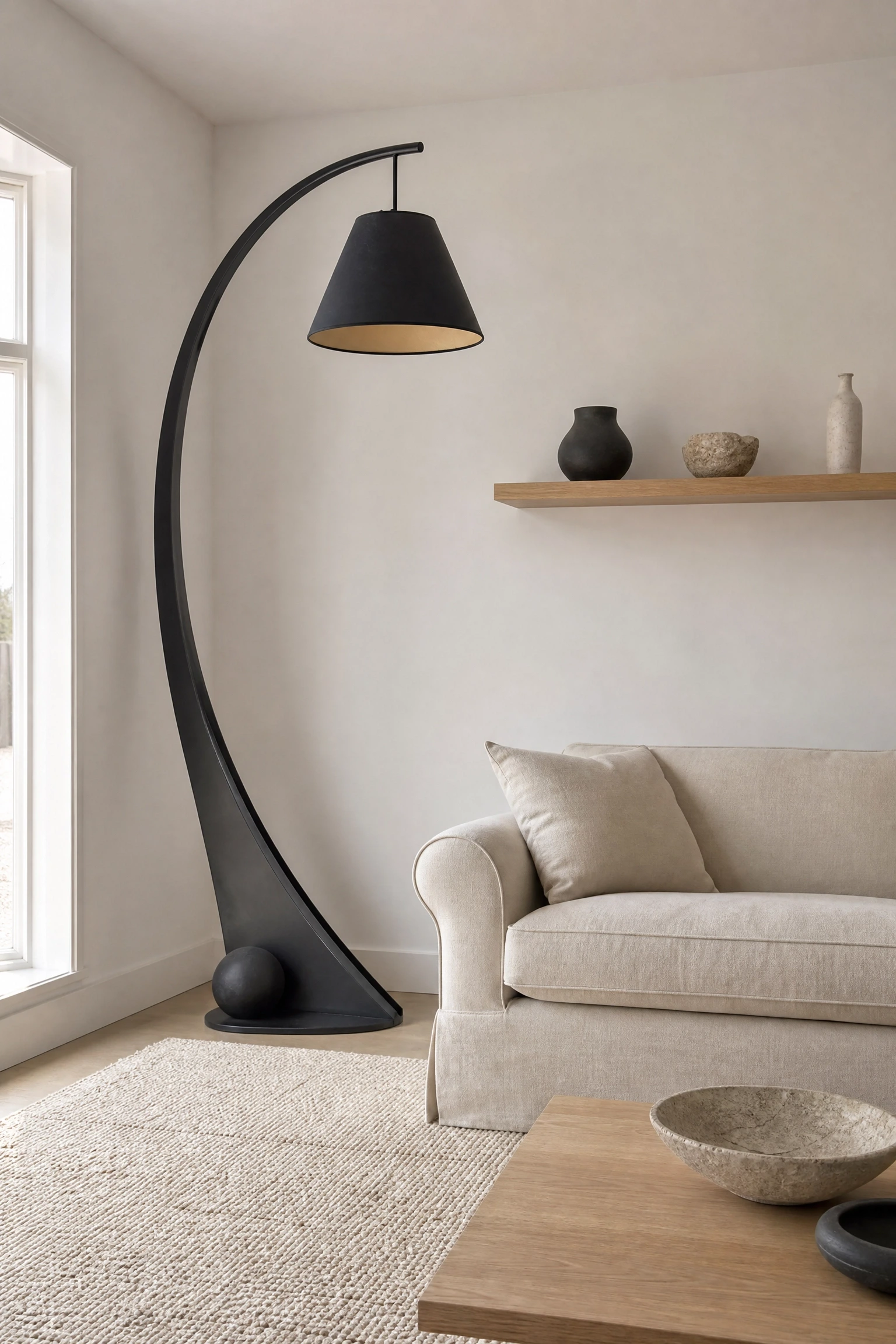
Sometimes the most effective approach is the simplest one: white walls, a warm beige sofa in a classic silhouette, and one deliberate black statement piece that anchors the whole room. That statement piece could be an oversized black metal floor lamp with a sculptural base, a black marble fireplace surround, or a large black-framed architectural mirror leaning against one wall. The key is that there is only one of them doing the heavy lifting, not three or four competing for attention. The rest of the room should be kept genuinely quiet: beige linen curtains pooling slightly on the floor, a cream-colored textured rug, a simple white oak bookshelf with only a few objects on it. In a room like this, the negative space is the decoration. Budget-wise this is very achievable since you are deliberately buying less, though the single statement piece is worth spending on properly because it carries everything else.
Reality Check: This approach only looks intentional if the one black piece is genuinely striking. A generic black side table will not have the same effect as a proper sculptural piece. Invest here and save elsewhere.
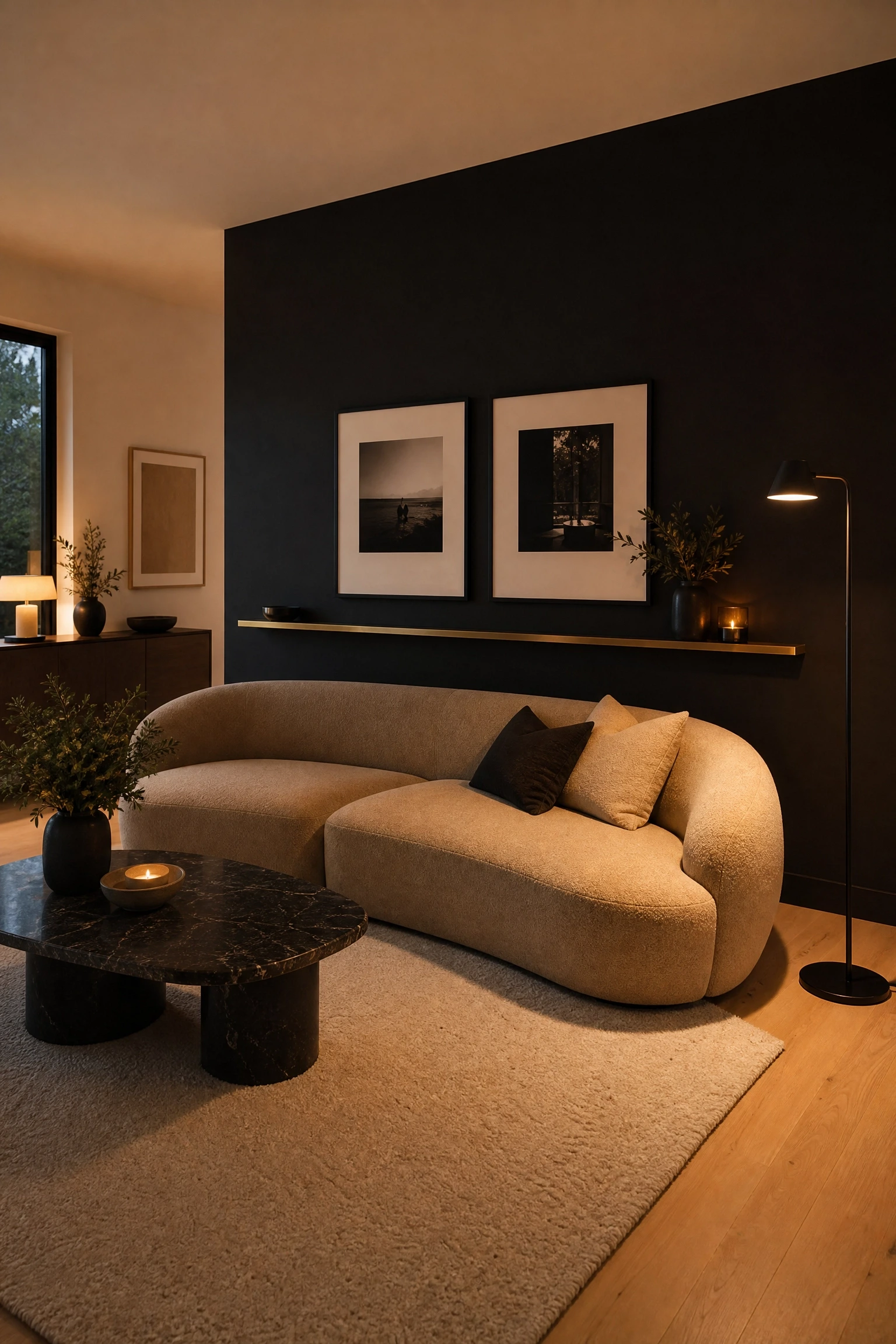
One of the most practical ways to add drama to a beige and white room without it feeling heavy is to paint one wall in a deep matte black or near-black charcoal and anchor the room with a curved beige sofa in front of it. The curve of the sofa softens the hard geometry of the wall, and the warm beige sits beautifully against the dark backdrop in a way that feels grounded rather than cold. Around the sofa, keep everything else light: white walls on the remaining three sides, a pale wool rug, and white or gold-toned accessories. Framed black-and-white photography or an abstract piece in black, beige, and white makes a natural gallery on the accent wall without adding new color. Lighting is important here, because a matte black wall absorbs light, so you need layered sources: a ceiling fixture for general light, a floor lamp behind the sofa, and maybe a small table lamp on a side table. The room should feel moody but not dark. In practice, this look works best when the accent wall sits behind the main seating rather than opposite it. This is a budget-friendly update since a can of paint is the main investment.
Pro Move: Add a slim brass or antique gold shelf along the black wall to break its visual weight and give the eye somewhere to land without interrupting the dramatic effect.
Black Cabinetry with White Walls and Beige Upholstery
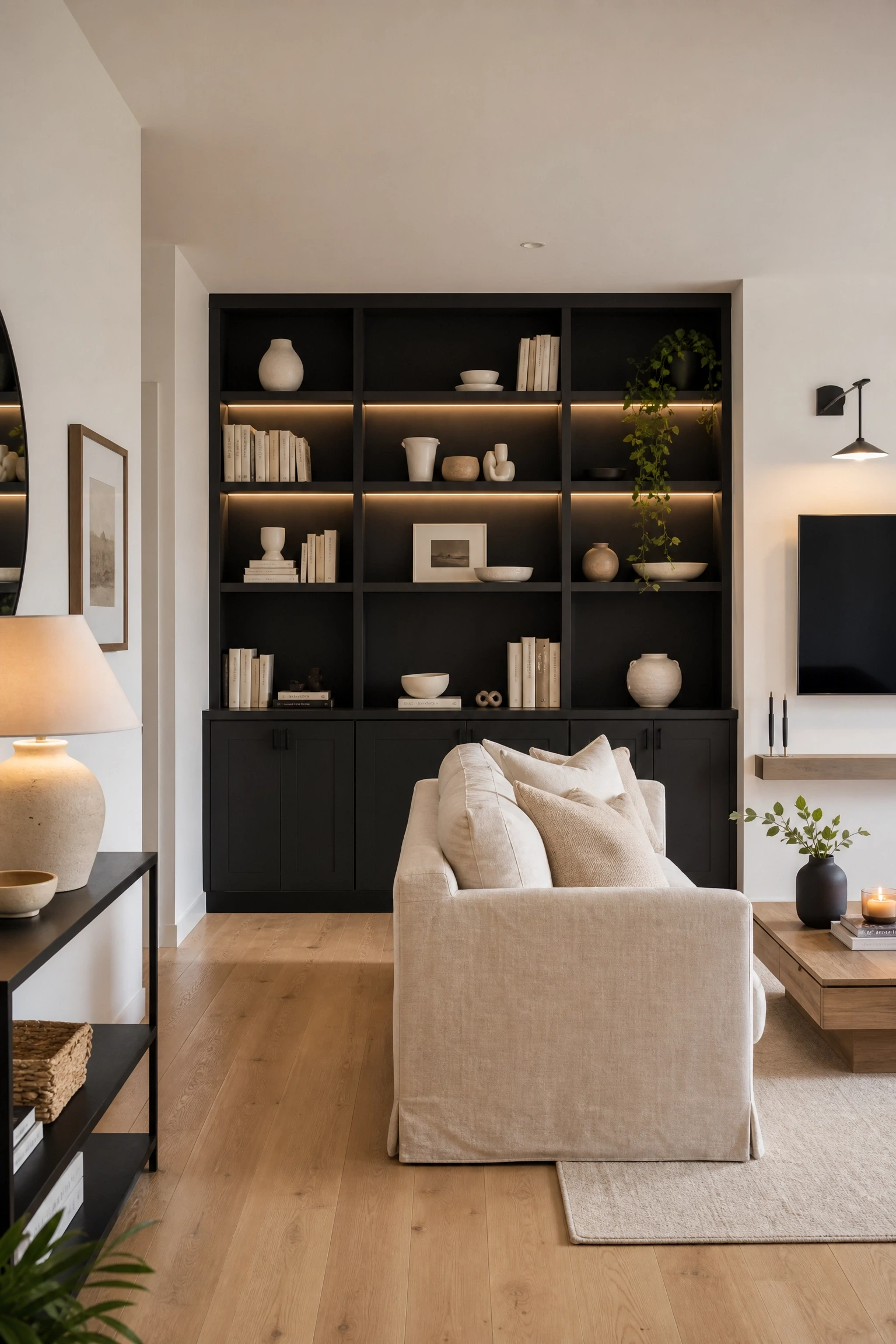
Built-in black cabinetry running along one wall of a living room still reads as considered and intentional rather than dated, even after several years as a popular recommendation from professional designers. The deep black creates a visual anchor that makes white walls look crisper and beige upholstery look warmer by contrast. Choose beige sofas with clean lines and good seat depth, linen or velvet both work here, and keep the cushions in white, off-white, and warm sand so the upholstery does not go flat. Light oak flooring bridges the black and the beige without adding another tone to manage. Inside the cabinetry, a mix of closed storage and a few open shelves styled with white ceramics, neutral books, and a trailing plant keeps it from looking like office furniture. Small LED strip lights inside the open shelves make the whole unit feel intentional rather than heavy. This is an investment-level addition, especially if you go the custom built-in route.
Heads Up: If your room gets limited natural light, go for a satin or semi-gloss finish on the black cabinetry rather than full matte. It reflects just enough light to prevent the wall from feeling oppressive.
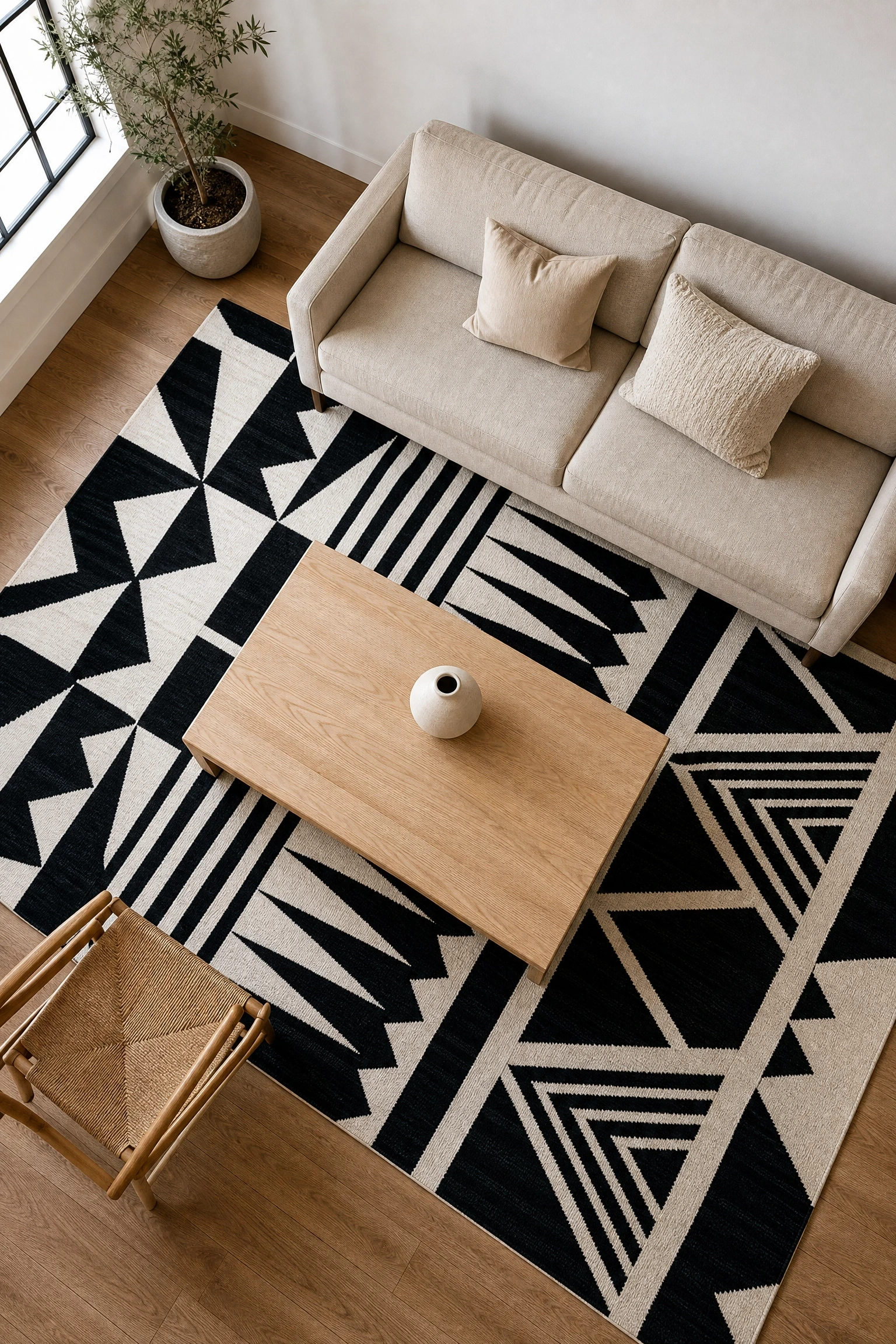
One approach that actually works really well in practice, and that most people overlook, is to start your room design with the rug rather than the sofa. A large geometric rug in black, white, and a warm ivory or beige brings the whole palette together in one piece and tells you exactly how much black and how much white to use everywhere else. If the rug is mostly white with black geometric lines, keep your furniture beige and let the walls be soft white. If the rug is bolder with roughly equal black and white, pull back on dark accents elsewhere and let the rug do the work. The furniture should be quieter: a beige upholstered sofa, simple side tables in pale wood, and minimal wall decor. The geometric pattern creates enough visual interest that you do not need much else. This approach is particularly useful in rental spaces where you cannot paint the walls, because the rug becomes the statement. Budget-wise, quality geometric rugs in this palette are available at a wide range of price points.
Designer Advice: Size matters more than people expect. The rug should be large enough that at least the front legs of all your main seating pieces sit on it. A rug that floats in the center of the room with furniture around it makes the space feel disconnected.
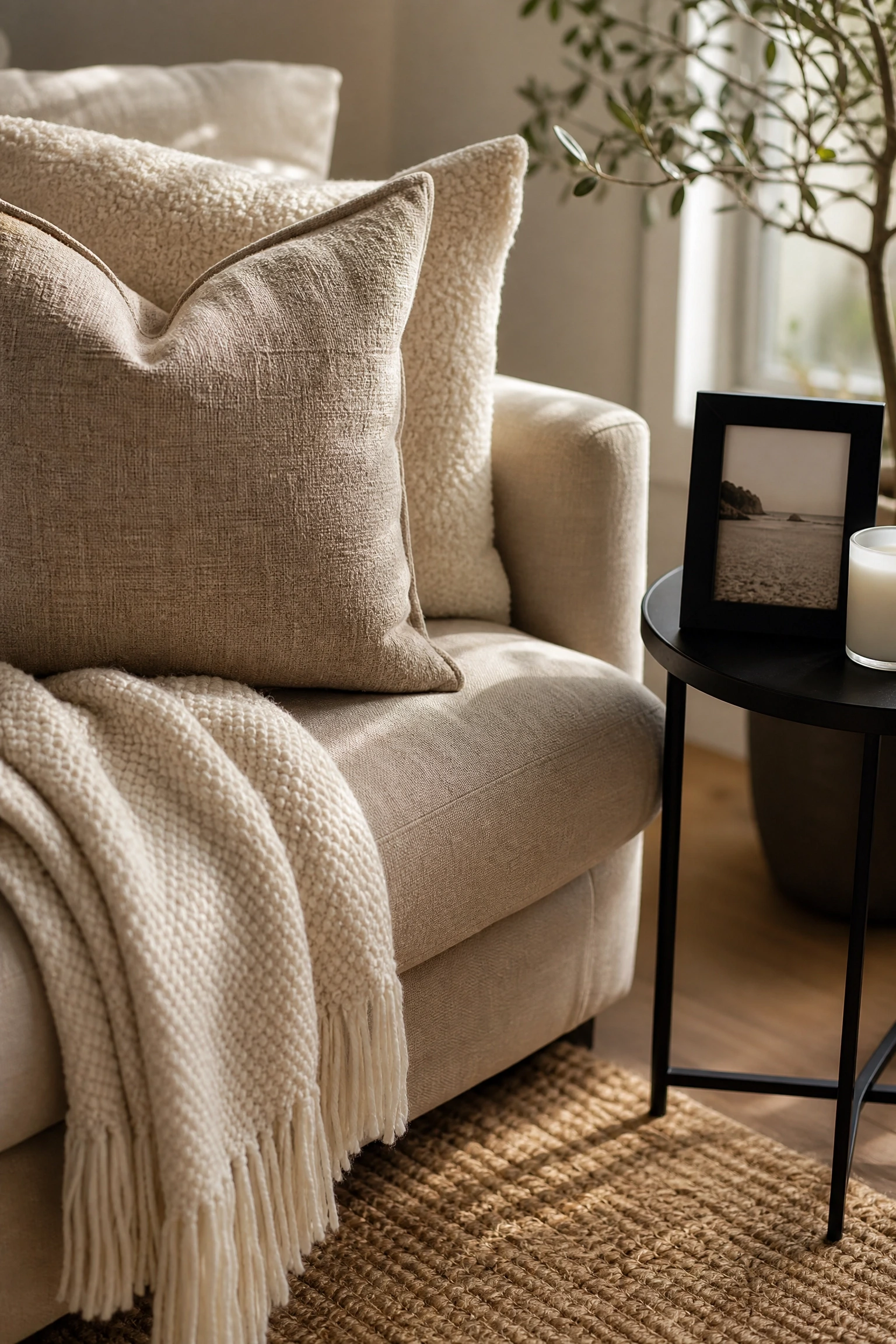
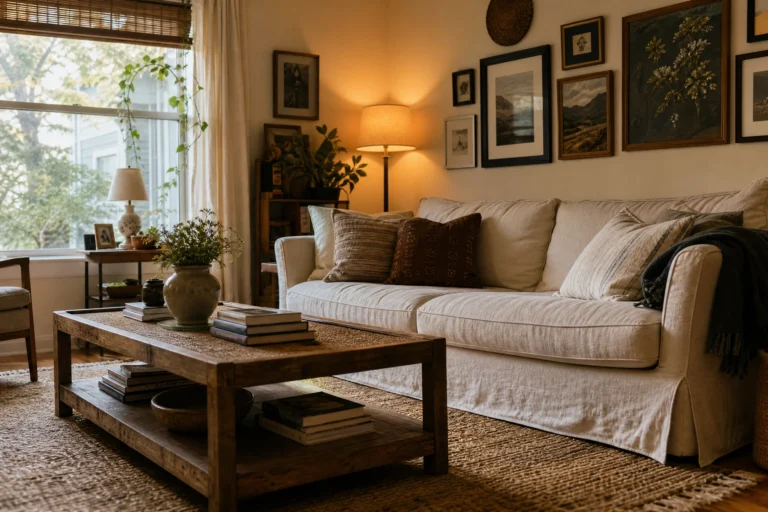
A room that relies purely on the palette without layering texture tends to feel flat and a bit safe. The fix is to treat beige as a full range rather than a single shade: a sand-toned sofa, a warm cream-colored linen throw, ivory cushion covers with a subtle woven texture, and a natural jute rug that reads slightly darker and earthier. When you layer multiple beige and cream tones together like this, the room picks up depth and warmth that a single flat beige simply cannot deliver. The black comes in through metal: a matte black floor lamp, black metal picture frames, a slim black side table, or a black powder-coated planter. These small dark moments are enough to stop the room from looking washed out without ever feeling heavy. White keeps the whole thing from closing in: white walls, white window frames, maybe a white linen roman blind. This is one of the most accessible and budget-friendly ways to work the palette because you are building gradually with textiles rather than making big structural changes.
Quick Tip: Vary the texture of your beige elements more than the color. A woven cushion, a smooth ceramic, a fuzzy throw, and a matte linen curtain all in similar beige tones create more interest than four different shades of beige in the same fabric.
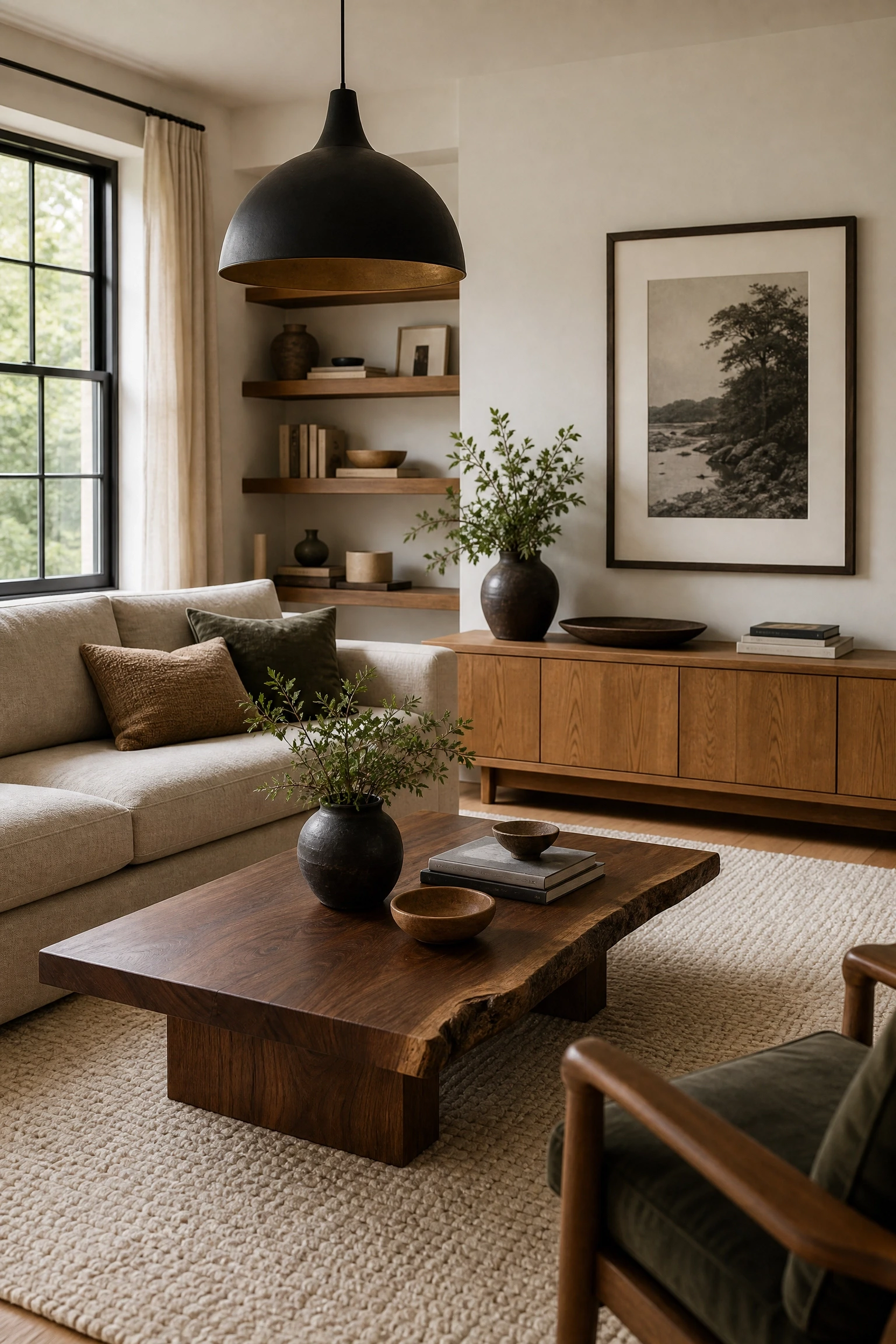
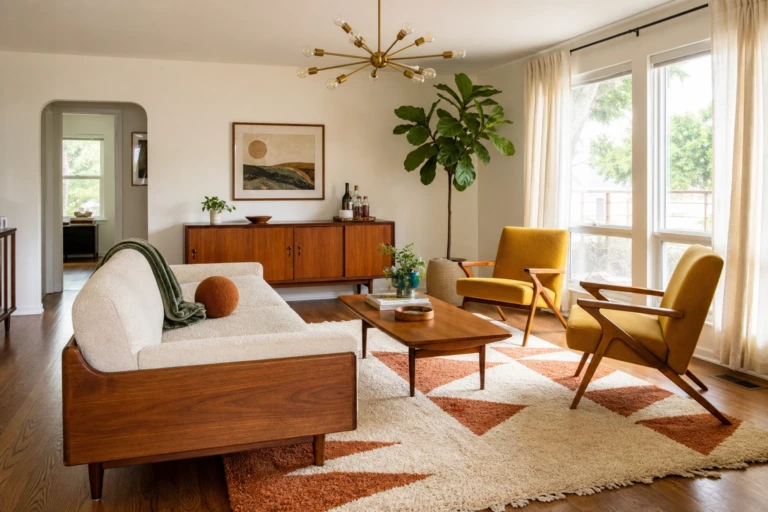
Adding natural wood into a beige, black, and white room does something that no other material quite manages: it makes the whole palette feel warm and lived-in rather than styled. Dark walnut, warm oak, and even lighter ash all work, though the tone you choose matters. Lighter oak reads more Scandinavian and airy; darker walnut leans more mid-century and grounded. In a room where the main palette is already quite neutral, a walnut coffee table, an oak media console, and a few wooden frames add organic warmth that ties the black and beige together. Keep the walls white and the sofa in a warm beige linen or velvet. The black should be measured: a black pendant lamp over the seating area, a black iron side table, or black window frames if your architecture allows it. Natural materials like this also improve with age, which makes them worth investing in properly. In practice, mixing wood tones works better than most design guides suggest, as long as they are all warm-toned and you do not introduce anything with a cool gray or blue undertone.
Pro Move: Place your largest wood piece, usually the coffee table, at the center of the room. It becomes the visual anchor that holds the black above and the beige around it in a natural relationship.
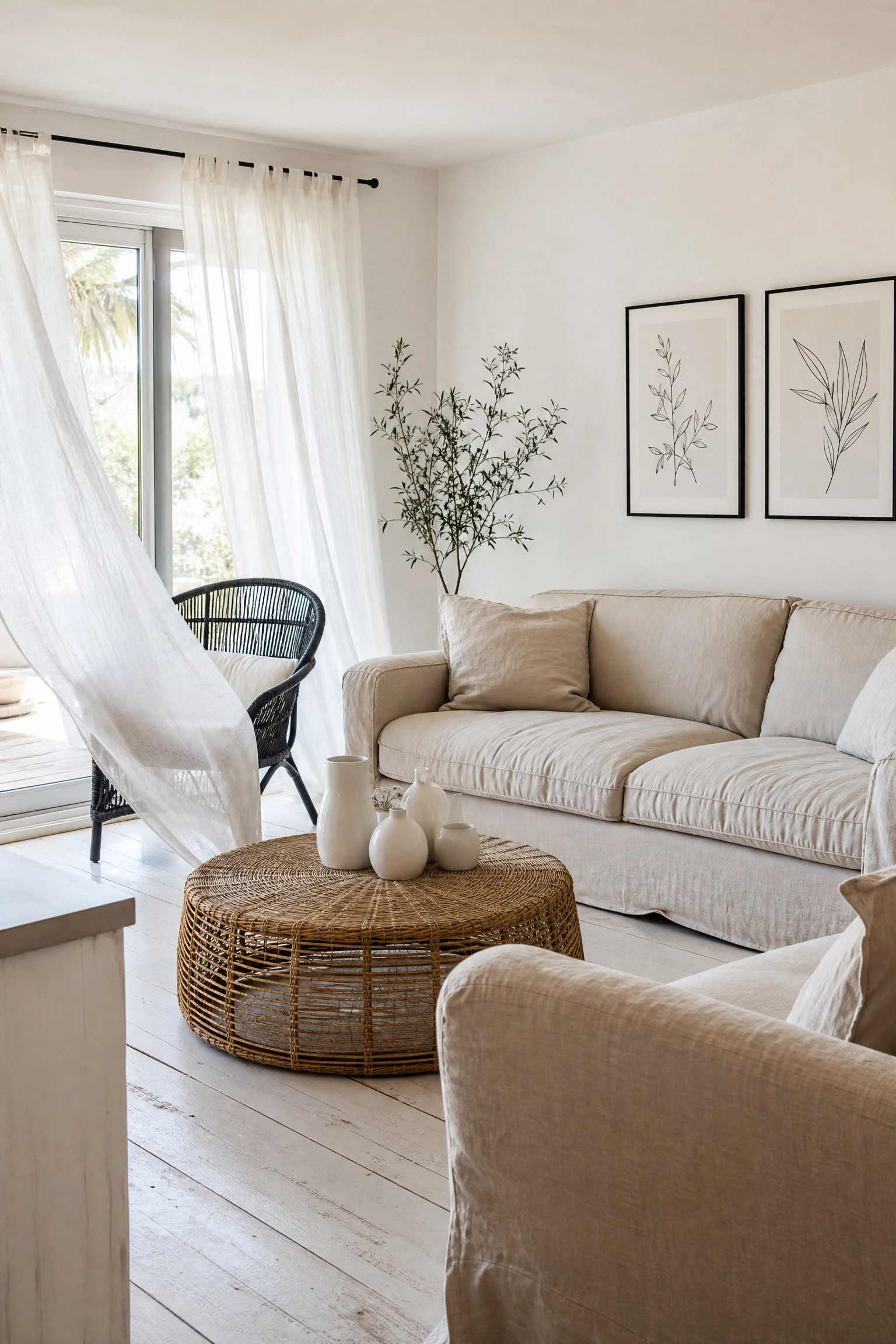
Coastal design gets dismissed sometimes as too casual or too theme-specific, but a refined version of the look using wicker, white-washed surfaces, beige slipcovered seating, and black accent pieces has a genuine elegance to it that works in rooms well beyond beach houses. The key to making it feel sophisticated rather than souvenir-shop is restraint: choose one or two pieces with wicker or rattan texture, a coffee table, a side chair, or a pendant light shade, and keep everything else very clean. Walls and ceiling in the same soft white make the room feel airy and tall. Slipcovered sofas in a washable natural cotton blend are honest choices here: they have good visual texture, they are practical, and they give the space a relaxed quality that still reads as put-together. Black enters through thin metal frames, a black wicker accent chair, or simple black-framed prints of architectural drawings or abstract botanical line art. Sheer white linen curtains filtering natural light are almost non-negotiable in this version of the look. It is one of the more affordable approaches since wicker and slipcover pieces tend to be priced accessibly.
Reality Check: This look can tip into “beach rental” territory quickly if you add too many coastal motifs like shells, anchors, or obvious seaside art. Keep the coastal references textural, not thematic.
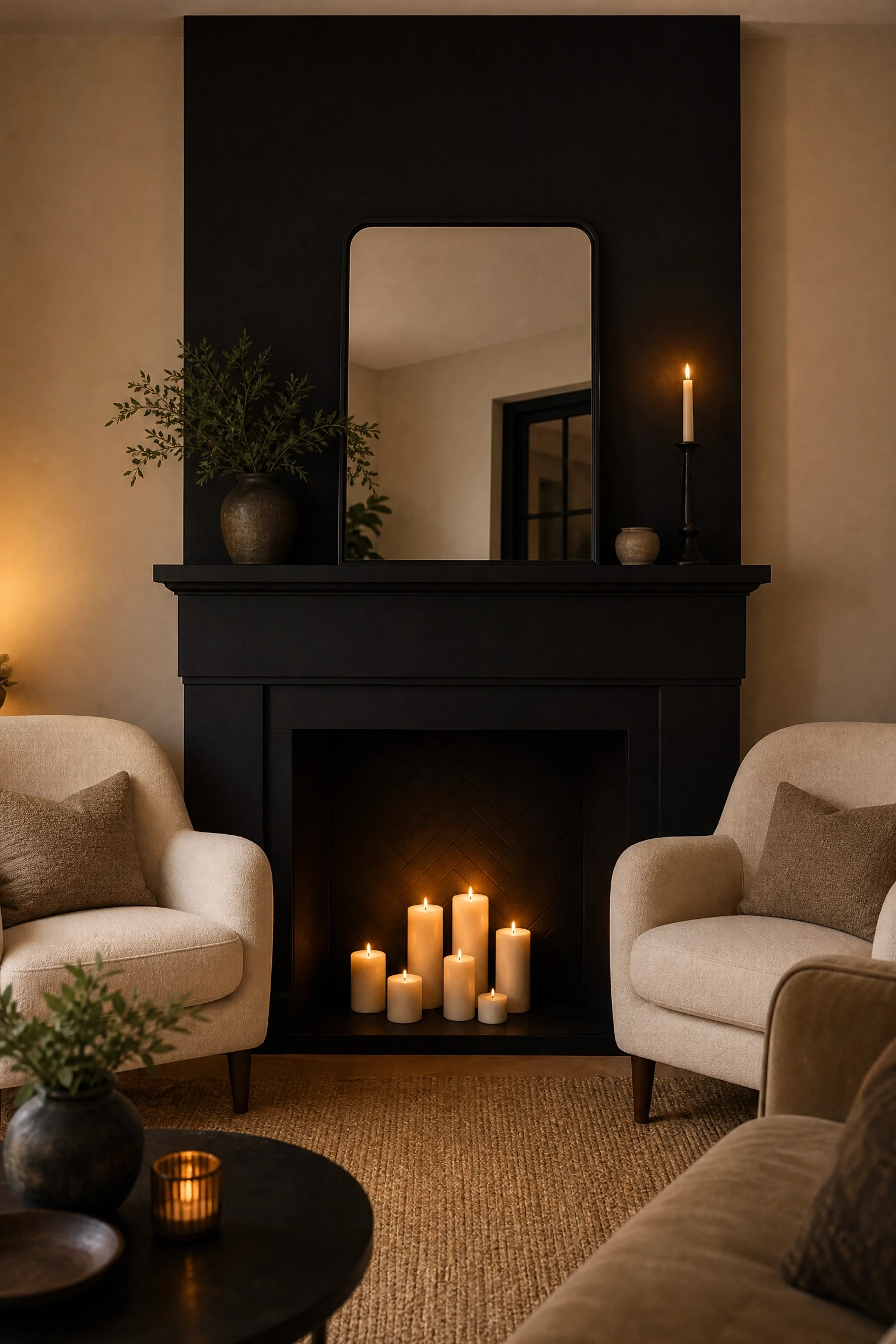
If your living room has a fireplace, making it the room’s focal point through a black surround or black painted chimney breast is one of the most effective design decisions you can make in this palette. The black surround reads as a sophisticated architectural detail that frames the fire and grounds the room. Pair it with cream or warm off-white walls, and the contrast is dramatic without being aggressive. The furniture should be soft and warm in response: a deep beige velvet sofa, cream upholstered armchairs, and a natural jute or wool rug in warm neutral tones. A large mirror above the fireplace, especially in a simple black frame, reflects the room back and makes the space feel taller and wider. Candles in white and off-white grouped inside the fireplace when it is not in use extend the palette into that architectural feature even in warmer months. From a budget standpoint, painting an existing fireplace surround black is a very low-cost intervention with a high visual return.
Designer Advice: If your fireplace is surrounded by brick, consider painting both the surround and the brick the same matte black so the whole feature reads as one cohesive element rather than competing materials.
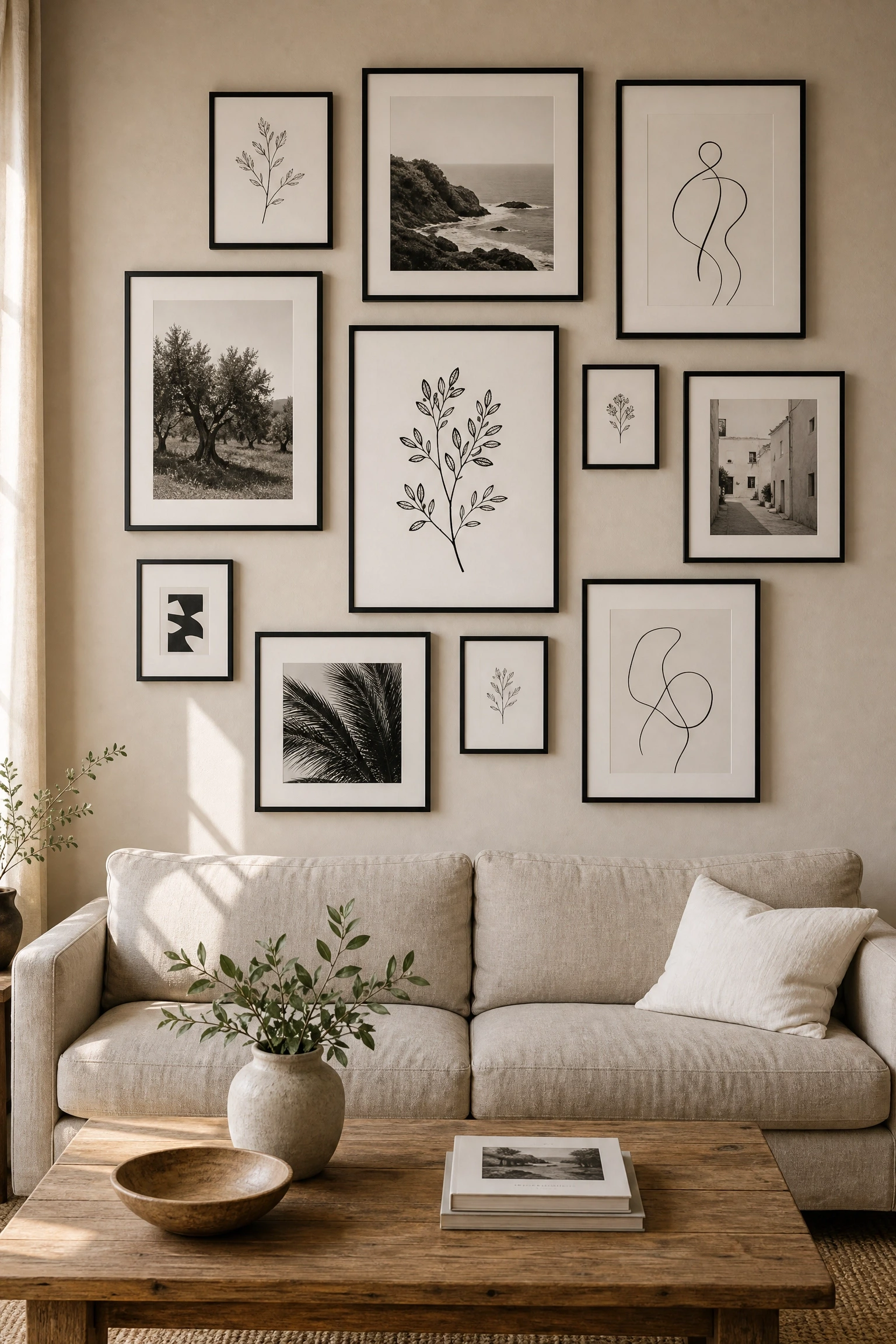
A gallery wall in a beige, black, and white living room works beautifully when every frame is black and the art inside uses only those three tones: monochrome photography, black-ink botanical prints, architectural drawings, or abstract line art on white or cream backgrounds. Frames can all be the same size for a clean look, or deliberately varied in size with the same black finish for something more collected. Beige-toned walls are the better backdrop here because they make the black frames read as warmer and more intentional. White walls can make the same arrangement feel harsh. Keep the furniture quiet: a simple beige linen sofa, a natural wood coffee table, no additional pattern. The gallery wall carries the visual weight and needs room to breathe. Budget-wise this is one of the most accessible ideas on this list since you can build the wall gradually, adding pieces over time.
Quick Tip: Lay your gallery wall arrangement out on the floor before putting a single nail in the wall. Photograph it from above, then use that photo as your guide. It saves an enormous amount of patching and repainting.
Striped or Patterned Cushions as the Only Pattern in the Room
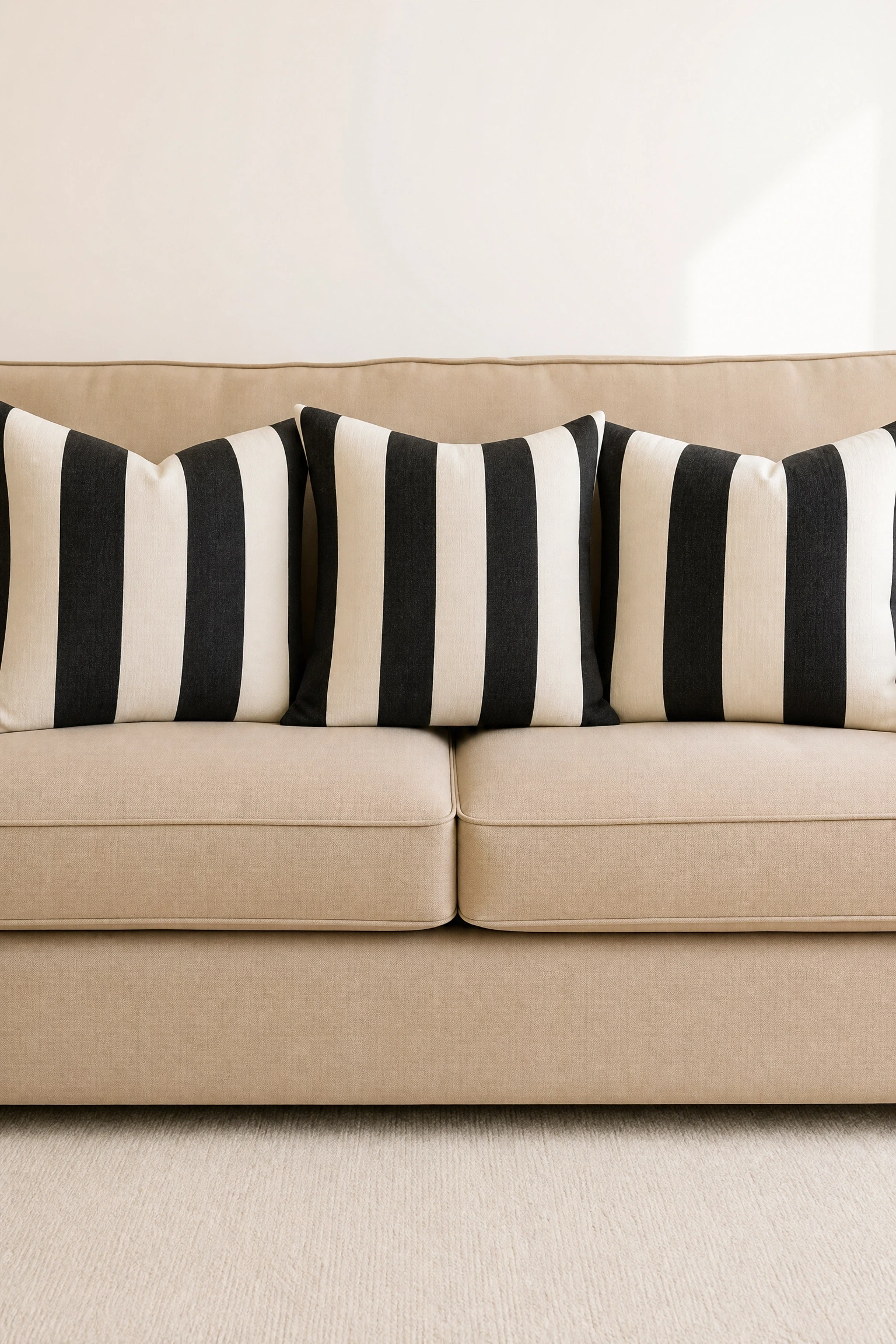
Keeping an entire room pattern-free except for the cushions is a quieter strategy than it sounds, and in practice it creates a really settled, considered atmosphere. The idea is to use black and white striped cushions, or a small geometric print in the same three tones, as the sole source of pattern in an otherwise solid-color room. Everything else: the rug, the curtains, the upholstery, the wall art, reads as solid. Because the pattern is concentrated in one place, the eye goes straight to it without bouncing around the room searching for a resting point. A beige sofa with three or four cushions in classic black and white stripes, or a Moroccan-inspired black and white geometric print, paired with a plain cream rug and white walls, is a complete and confident look. This approach also makes updating the room extremely easy since swapping cushion covers refreshes the space without needing to change anything structural. Very affordable and very low-commitment, which makes it a great starting point if you are still figuring out the room’s final direction.
Heads Up: Four cushions is usually the maximum for a three-seater sofa before it starts looking like you are hiding the furniture. Two or three well-chosen pieces land better than a dozen.
Abstract Art in Beige, Black, and White as the Room’s Anchor
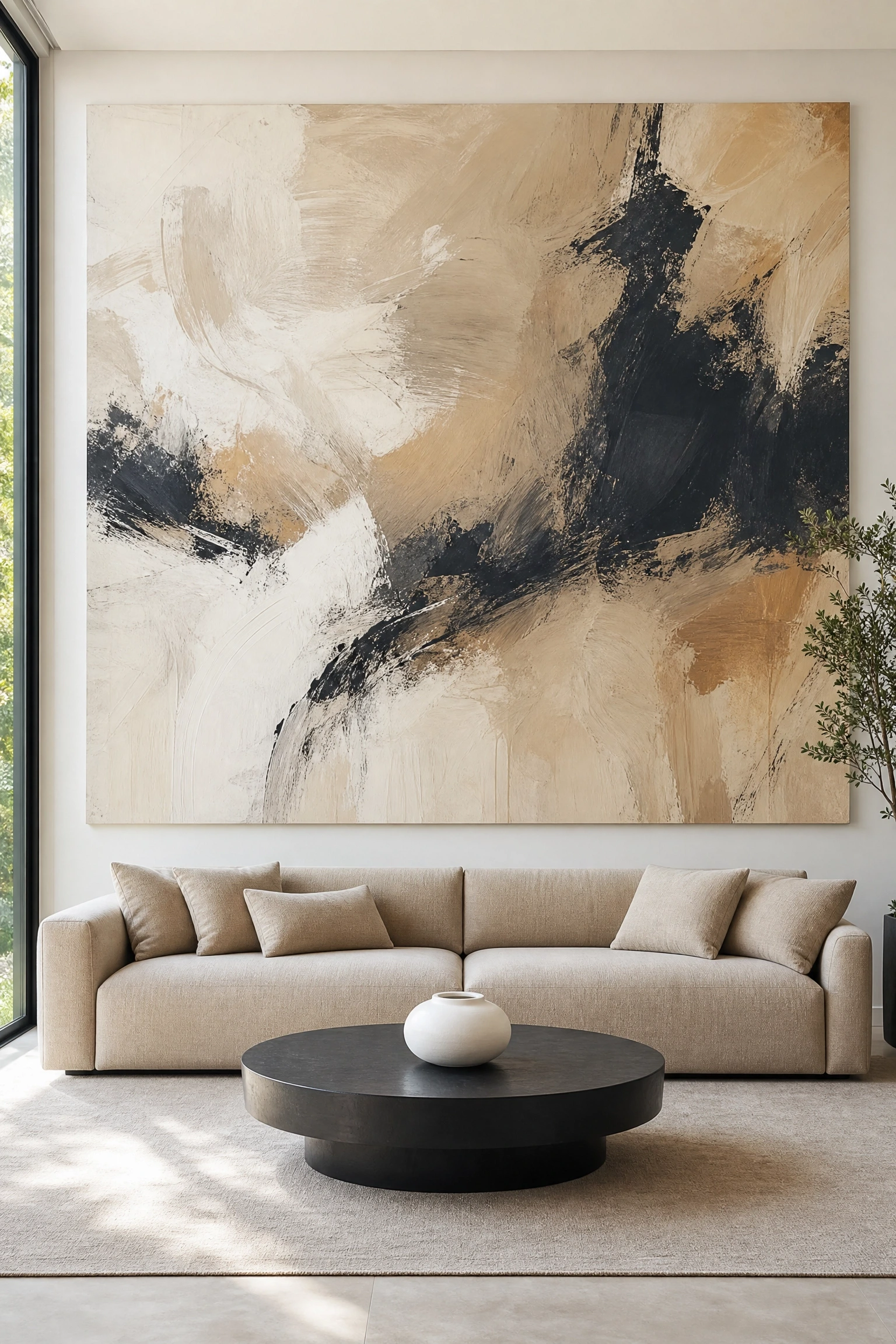
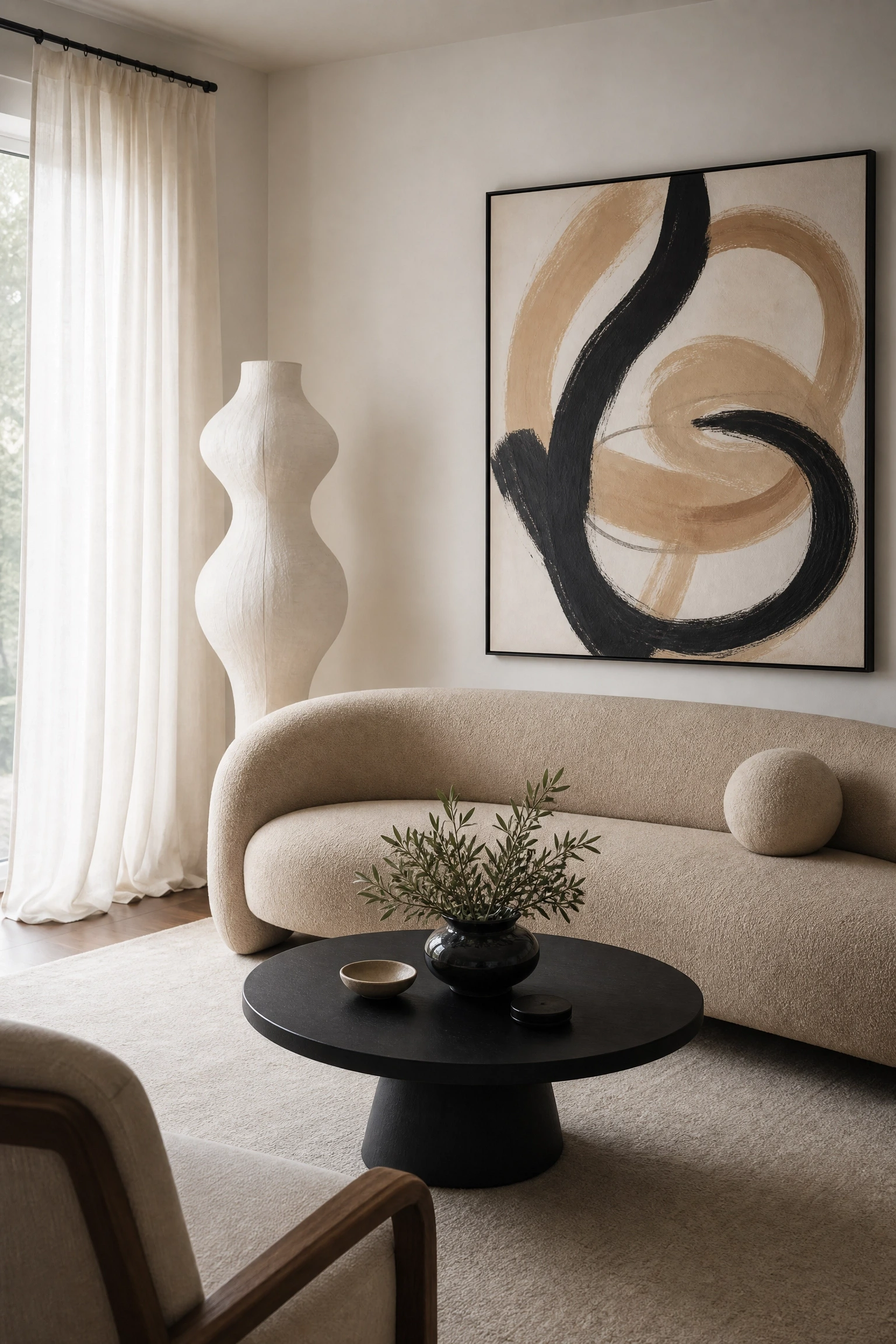
One large piece of abstract art in beige, charcoal, and white, hung on an otherwise bare white wall, is a design move that interior designers in the know rely on heavily. The art becomes the room’s personality and palette reference point. Everything in the room responds to what is in that painting: the warm beige tone in the art matches the sofa; the deepest black echoes in the lamp base; the white in the canvas matches the wall. This deliberate tonal matching is what separates rooms that feel designed from rooms that feel assembled. The furniture should be classic and restrained: a beige upholstered sofa, a round black coffee table, pale wood side tables. No other art, no additional pattern. The painting carries everything. Mid-range to investment-level depending on whether you commission an original or buy a quality large-format print, both can absolutely hold a wall when properly framed.
Pro Move: When hanging a large piece of art, the center of the painting should sit at approximately eye level, which for most rooms means 57 inches from the floor to the middle of the frame. Most people hang art too high.
Moody and Dramatic Takes
Dark Drama with Black Velvet Armchairs and Beige Walls
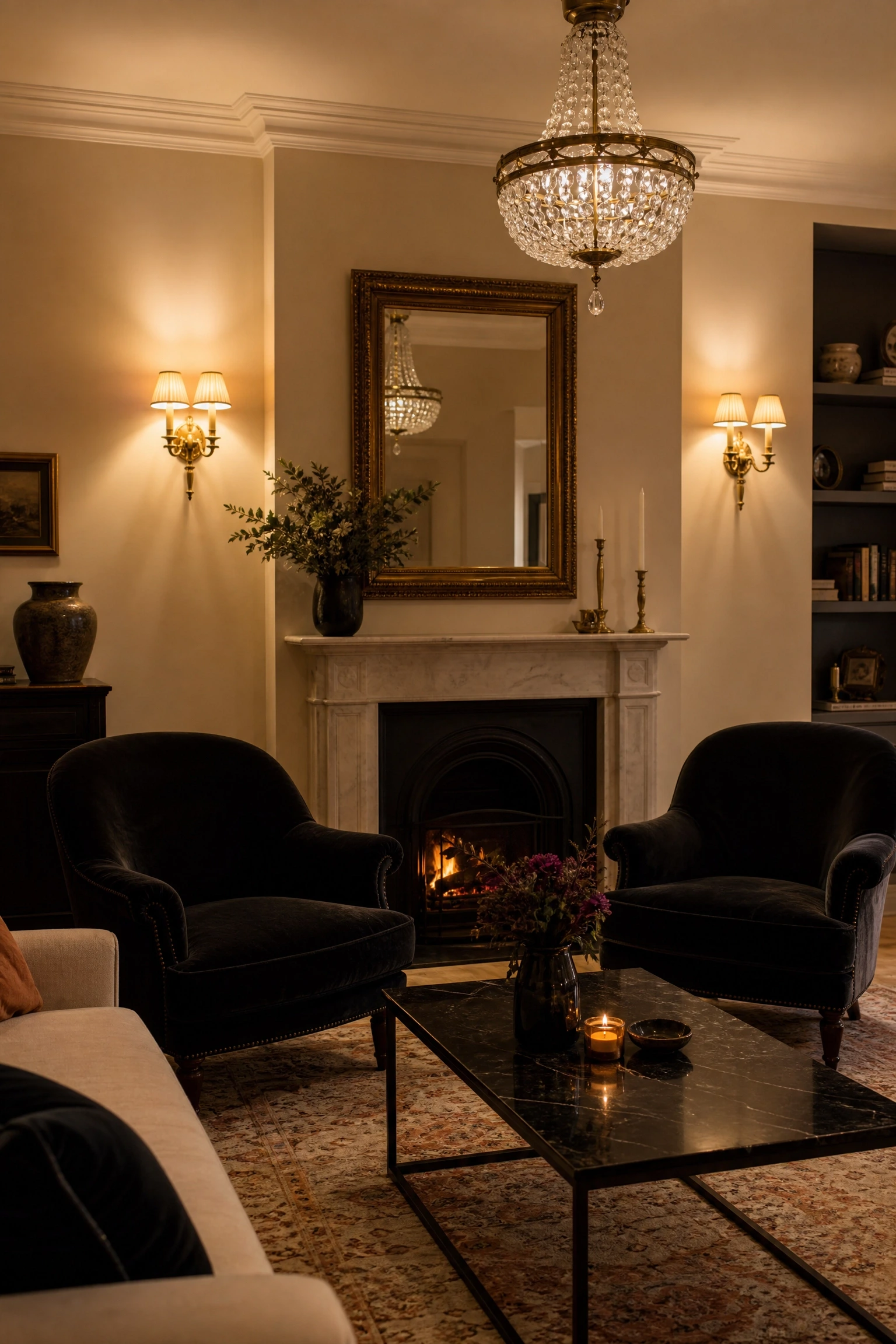
Pairing two black velvet armchairs with warm beige walls and a white sofa is one of the more considered ways to create a living room that feels genuinely rich rather than simply neutral. The velvet fabric adds a luxurious, light-catching quality to the black that matte fabrics simply do not have. Arrange the armchairs opposite the sofa with a black marble-top coffee table between them. Beige walls rather than white make the black velvet feel warm rather than severe, and a white or cream sofa balances the chairs without fighting them. Lighting should be layered and warm: a crystal pendant above the seating area for drama, black wall sconces on either side of a fireplace, and a small brass or antique gold table lamp on each side table. The warm metal ties the beige to the black in a way that feels deliberate. Mid-range to investment-level depending on the quality of the velvet chairs.
Designer Advice: Velvet marks easily with water spots, so choose a velvet with a tight pile and a performance-grade finish if this room gets regular use. It is worth asking specifically about water and stain resistance before buying.
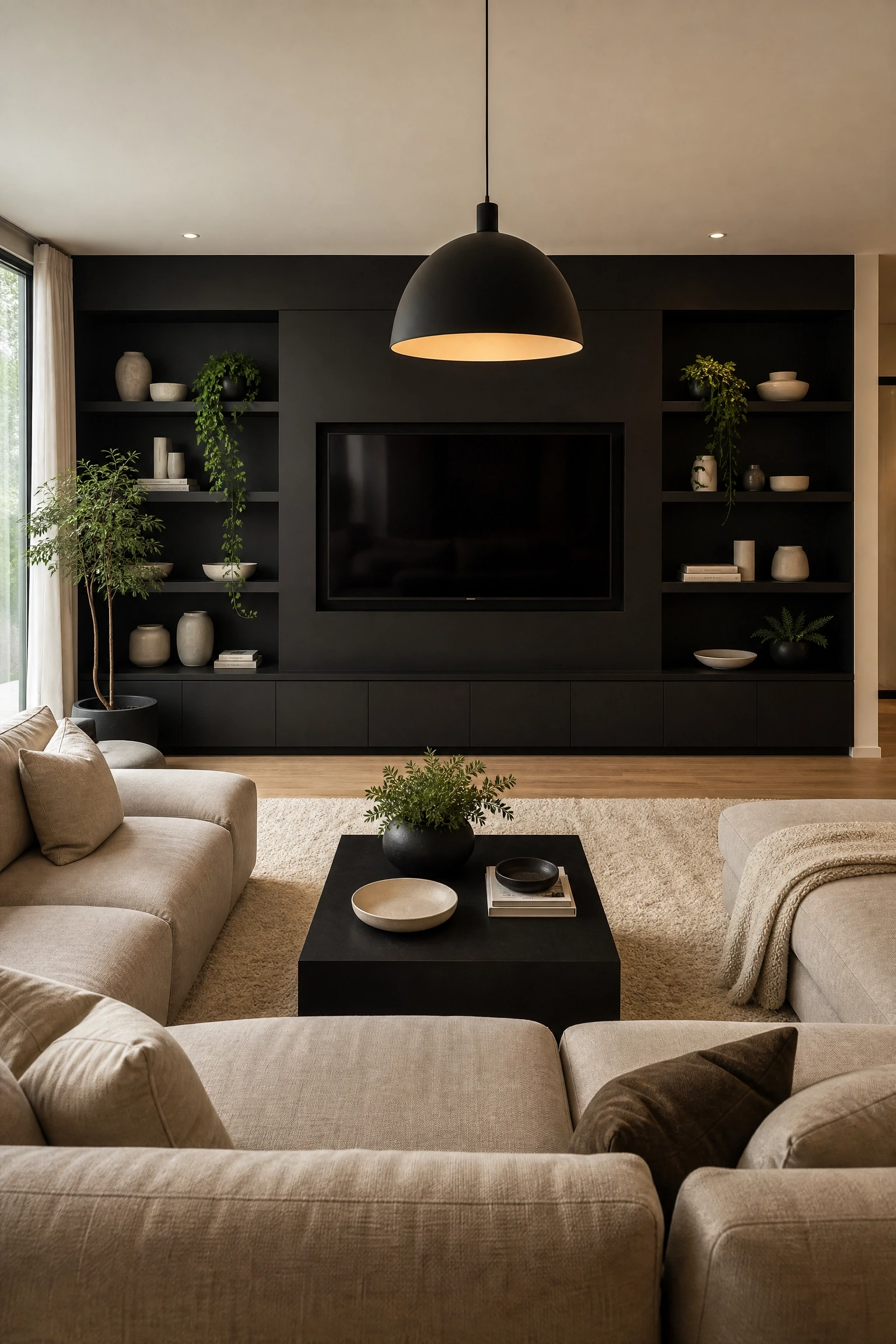
A matte black media wall running the full width of a living room with floating shelves on either side is a format that has become extremely popular in contemporary home design because it solves a real problem: how to integrate a television without it feeling like an afterthought. The matte black surface makes the dark screen disappear into the wall rather than sitting in front of it, a small but genuinely effective visual trick. Balance the weight of this dark feature with lightness elsewhere: soft beige upholstered seating, white walls on the remaining sides, and a large cream or natural wool rug. Style the floating shelves with white ceramics, neutral books spines facing out, and trailing plants in black or white pots. A statement pendant in black or brushed antique brass above the seating area completes the look. This tends to be an investment-level project if you go the custom or paneled route.
Reality Check: Matte black surfaces show dust and fingerprints consistently. If your household includes children or frequent use, factor in the cleaning commitment before choosing this as your main feature.
Painted Black Ceiling with White Walls and Beige Furnishings
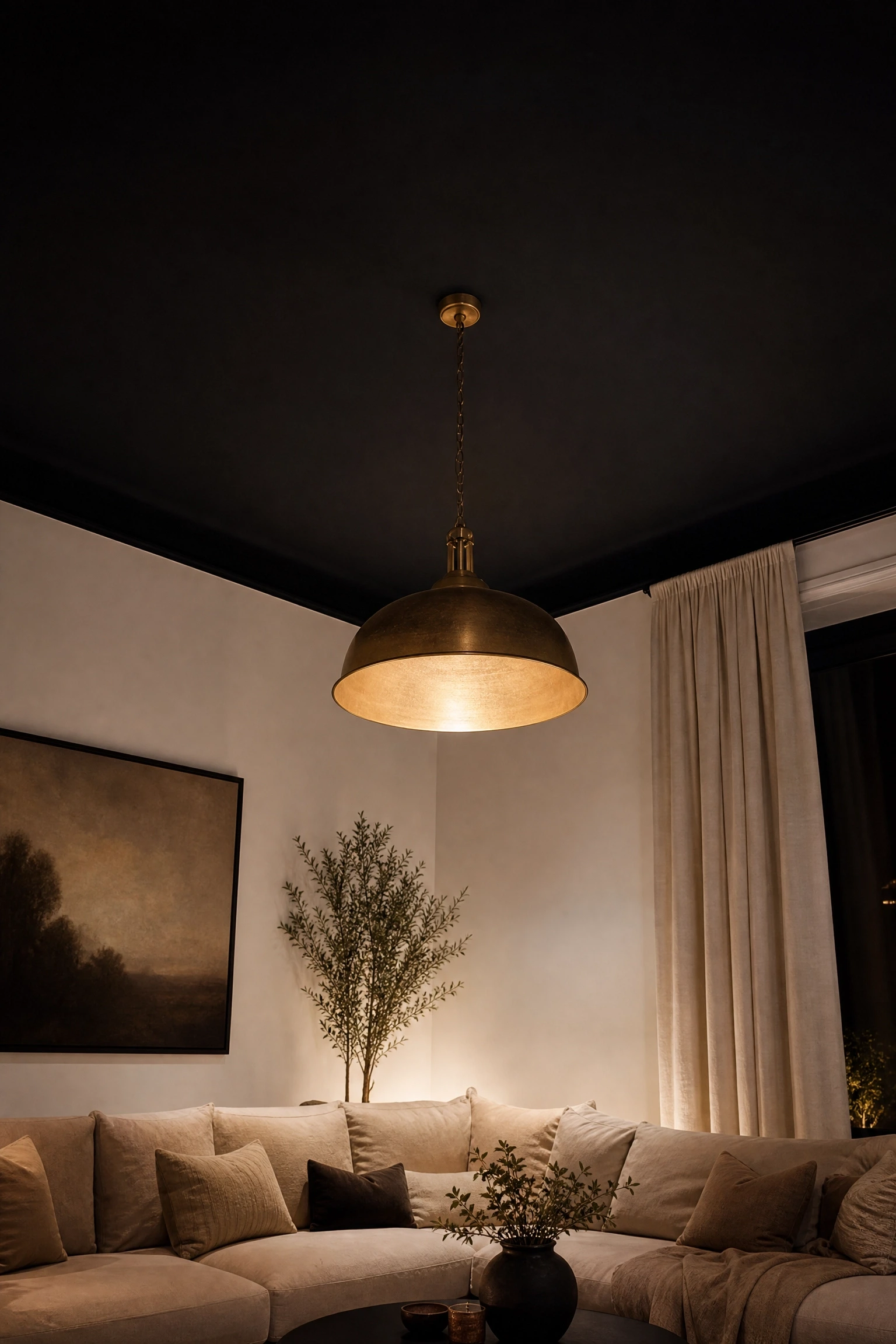
Painting a ceiling black is one of those interior design suggestions that makes people nervous until they actually see it done well, and then they almost always become converts. A matte or flat black ceiling in a living room with white walls, natural wood flooring, and a full beige furniture palette creates a cocooning effect that makes the room feel intimate and genuinely different from anything else on the street. The ceiling visually lowers, which is a disadvantage in a room with low ceilings but an asset in tall rooms where the height can feel cold. Keep the furnishings warm and generous: a large beige sectional, cream linen curtains from ceiling to floor, a woven natural rug. A large round pendant light in brass or off-white linen hanging from the black ceiling becomes a genuine design moment. In practice, this works best when the room has at least one large window and a reasonable ceiling height, somewhere between nine and twelve feet ideally. Budget-wise, the paint is low-cost, but preparation and a professional paint job on a ceiling will add time and expense.
Quick Tip: Use an eggshell or flat finish on the black ceiling rather than satin. Any sheen on a ceiling reflects overhead light in a way that actually makes the room look smaller, not bigger.
Nature-Influenced and Organic Styles
Biophilic Details with Black Planters and Beige Textures
Biophilic design, which brings natural elements into interior spaces, is consistently recommended by professional designers as one of the most effective ways to make a room feel genuinely livable rather than just attractive in photographs. In a beige, black, and white living room, natural elements come through plants, organic textures, and raw materials. Choose large-scale plants with interesting leaf shapes, fiddle-leaf figs, monstera, or olive trees, placed in matte black planters that tie into the dark accents elsewhere. A beige linen sofa, a natural jute rug, and white walls form the backdrop. Accessories in raw ceramics, unfinished wood, and woven baskets add texture without adding color. One thing that works really well is grouping plants at different heights in one corner rather than spacing them individually around the room. A cluster of three plants at varying heights has more presence than six scattered around the space. Very accessible budget-wise since plants are one of the most affordable ways to add life to any room.
Heads Up: Large plants in indoor pots need saucers and occasional checking to prevent water damage to rugs and wooden floors. Budget for proper plant stands with drainage in mind from the beginning.
Raw Materials: Linen, Stone, and Matte Black Hardware
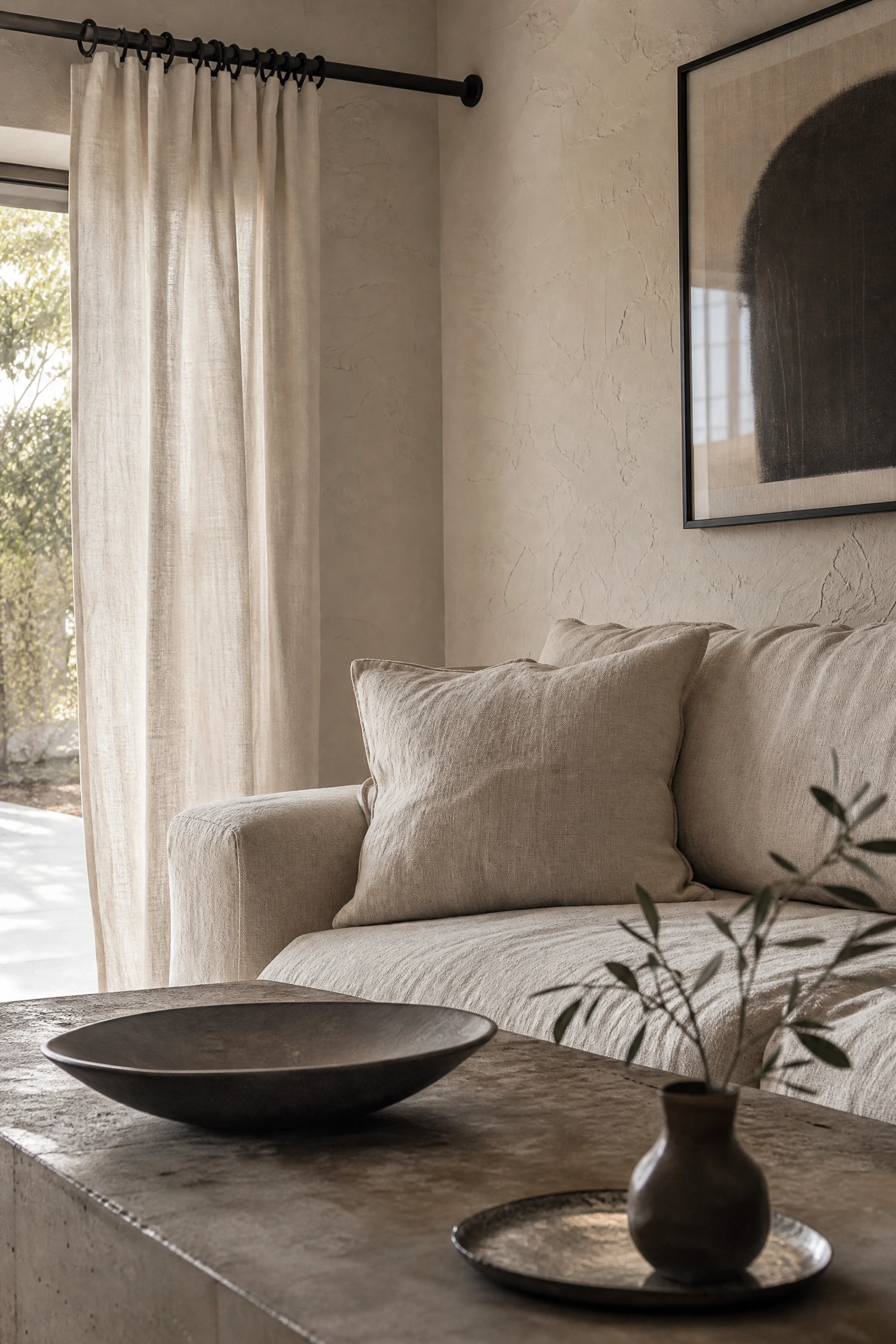
There is a specific kind of living room that designers sometimes describe as “quiet luxury,” and the combination of raw linen upholstery, a stone or concrete coffee table, white plaster walls, and matte black hardware fits squarely into that category without requiring a huge budget. Linen as a sofa fabric sits beautifully in the beige and off-white range and brings a natural, slightly rumpled texture that velvet or cotton simply does not match. A stone or concrete coffee table in grey-beige anchors the center of the room with natural variation and weight. Matte black hardware comes through in the curtain rod, the lamp base, the picture frames, and the plinth legs of occasional furniture. These are small moments, but when they are consistent they create a through-line in the room that makes everything feel chosen rather than accumulated. White plaster walls, slightly textured if possible, are the ideal backdrop because they have more warmth and depth than standard painted drywall. This is a mid-range approach overall, with the stone table being the main investment.
Designer Advice: Linen sofas wrinkle and wear with genuine use, which is part of their charm, but they do require covers or specific upholstery-grade linen fabric to hold up long-term. Ask your retailer about the fabric weight before buying.
Rooms that rely entirely on straight lines can start to feel rigid regardless of how good the palette is. Introducing organic, curved shapes into a beige, black, and white living room softens the composition in a way that makes the space feel more human and inviting. A curved beige sofa with a continuous arm that flows into the back, a round black coffee table with a solid pedestal base, and a sculptural white ceramic floor lamp with an irregular silhouette all introduce movement without adding new color. Wall art with rounded, gestural brushstrokes in black and beige carries the theme vertically. Curtains in soft white that puddle slightly on the floor rather than breaking cleanly at the sill add another flowing element. This look is popular right now in contemporary interior design and works across a range of room sizes. Be aware that curved sofas tend to be priced higher than standard rectilinear options because of the frame construction required, so treat this as a mid-range to investment-level commitment.
Reality Check: Rounded sofas are fashionable right now but can be harder to reposition or style around once placed. Make sure you love both the color and the shape before committing, since neither is as easy to update as a standard sofa silhouette.
Conclusion
A beige, black, and white living room genuinely rewards attention to proportion and balance. The palette itself does not make the room. What makes it work is how much of each tone you use, where you place the contrast, how many textures you layer in, and whether the lighting brings warmth to the neutrals rather than draining it. Start with what you already have and build from there: a can of black paint for an accent wall, a new beige throw, one large piece of art in the three tones. You do not need to redo everything at once to see a real difference.
The ideas here cover a wide range of styles and budgets, from genuinely minimal to layered and dramatic, so there is a version of this palette that fits almost any starting point. The consistent thread is that the details matter: the finish on a paint, the temperature of a bulb, the scale of a rug, the number of cushions on a sofa. These small decisions separate a room that looks right from one that looks almost right. Pick one idea, try it honestly, and see how the room responds.
Frequently Asked Questions
How do I stop a beige, black, and white living room from looking boring?
Texture is the main answer. When the palette is this restrained, interest has to come from the feel of materials rather than variety of color. Layer a boucle cushion next to a smooth ceramic, a jute rug under a velvet sofa, a linen curtain against a plaster wall. The combination of rough and smooth, matte and slightly shiny, makes a neutral room feel genuinely rich.
How much black is too much in a beige and white room?
A useful rule of thumb is to keep black to no more than 20 to 25 percent of the overall visual space. If black appears on the sofa, the walls, the rug, and the cabinetry all at once, the room will feel heavy regardless of how much beige and white surrounds it. Pick one or two meaningful black moments and let everything else stay light.
What type of lighting works best in a beige, black, and white living room?
Layered lighting with warm-toned bulbs in the 2700K to 3000K range works best. Avoid harsh overhead-only lighting, which makes neutral tones look flat and cold. Use ambient light from a ceiling fixture, task light from floor or table lamps, and accent light from shelf or wall-mounted sources for depth and flexibility across different times of day.
Can I add color to a beige, black, and white room without ruining the palette?
Yes, but keep it to warm tones: terracotta, warm olive green, dusty rose, or deep rust all sit naturally alongside beige. One or two accent pieces in a muted warm tone, a cushion, a vase, a throw, is usually enough. Avoid cool colors like bright blue, emerald green, or purple, which tend to fight the warmth of beige.
What rug works best in a beige, black, and white living room?
A rug that bridges all three tones, a geometric in ivory and charcoal, a natural jute, or a cream wool flatweave with a subtle dark pattern, works better than a single solid tone. The rug should be large enough that the front legs of all main seating pieces sit on it, in a natural or washable fiber for practicality.
Is this palette suitable for small living rooms?
Yes, with adjustments. Keep walls and ceiling white or very light beige to maximize space. Use black sparingly, one or two accent pieces only. Choose furniture with exposed legs rather than pieces that sit flush to the floor, since legs visually lift furniture and make floor space read larger. A black-framed mirror on one wall also expands the perceived size significantly.