There is something about a bedroom accent wall that feels both more exciting and more permanent than any other decor decision. A throw pillow is easy to swap. A rug can go back to the store. But a wall you have limewashed, paneled, or covered in botanical wallpaper? That is a commitment, which is exactly why so many people spend weeks scrolling ideas and never actually pick one. The goal of this article is to cut through that paralysis by grouping ideas the way you actually think about them, by mood and aesthetic, rather than tossing 25 unrelated suggestions into a flat list and calling it done.
Each group here represents a distinct design direction, so you can find the one that matches the feeling you are going for in your bedroom and then choose the specific idea within it that fits your skill level, budget, and space. Pick the mood you want to wake up to, then commit to one wall and one approach. The honest notes on what works and what does not are included because an accent wall that fights the rest of your room is worse than no accent wall at all.
Texture-Driven Accent Walls
This group is for bedrooms where you want depth and dimension without relying on pattern or color. These walls reward slow looking because they change with the light throughout the day.
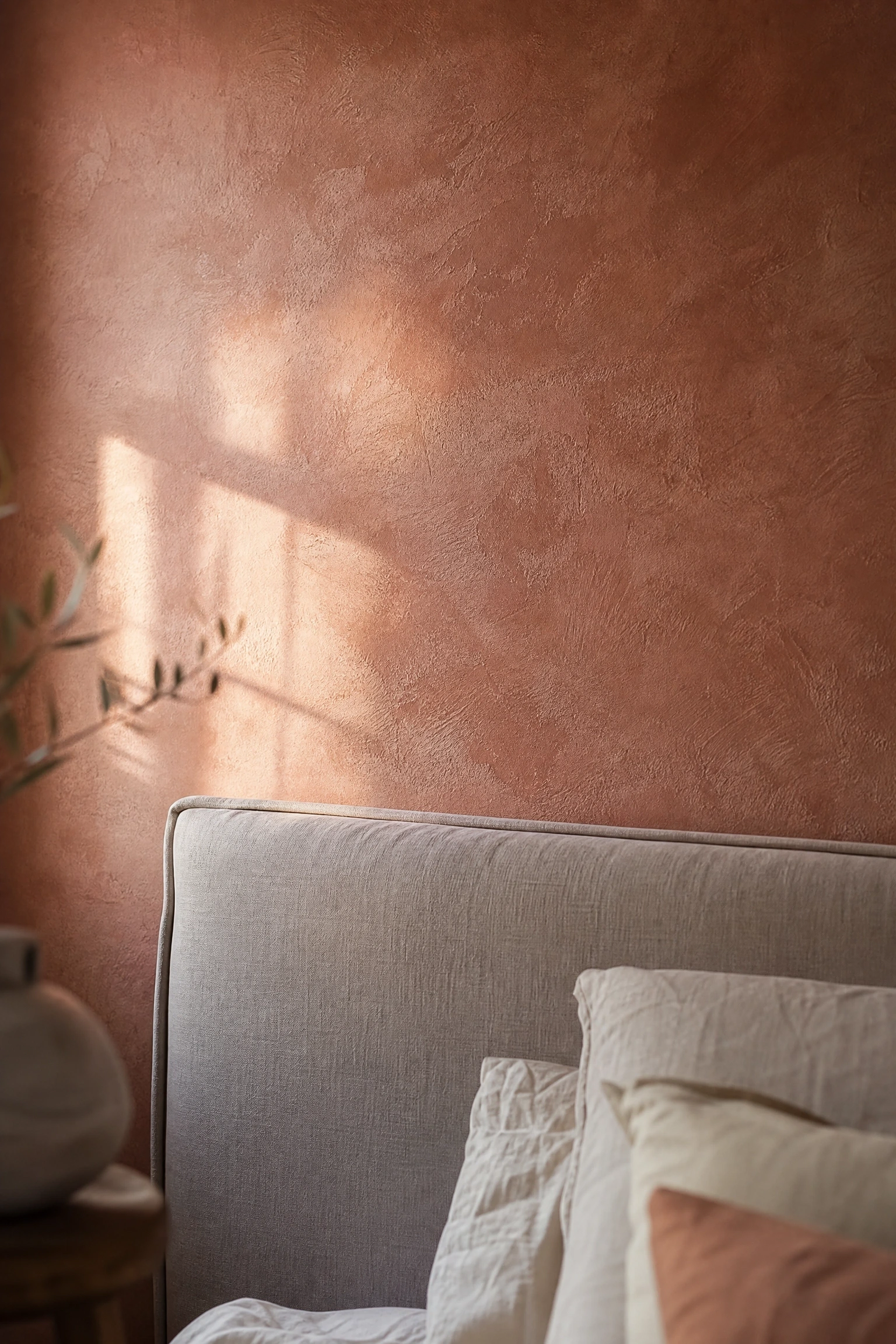
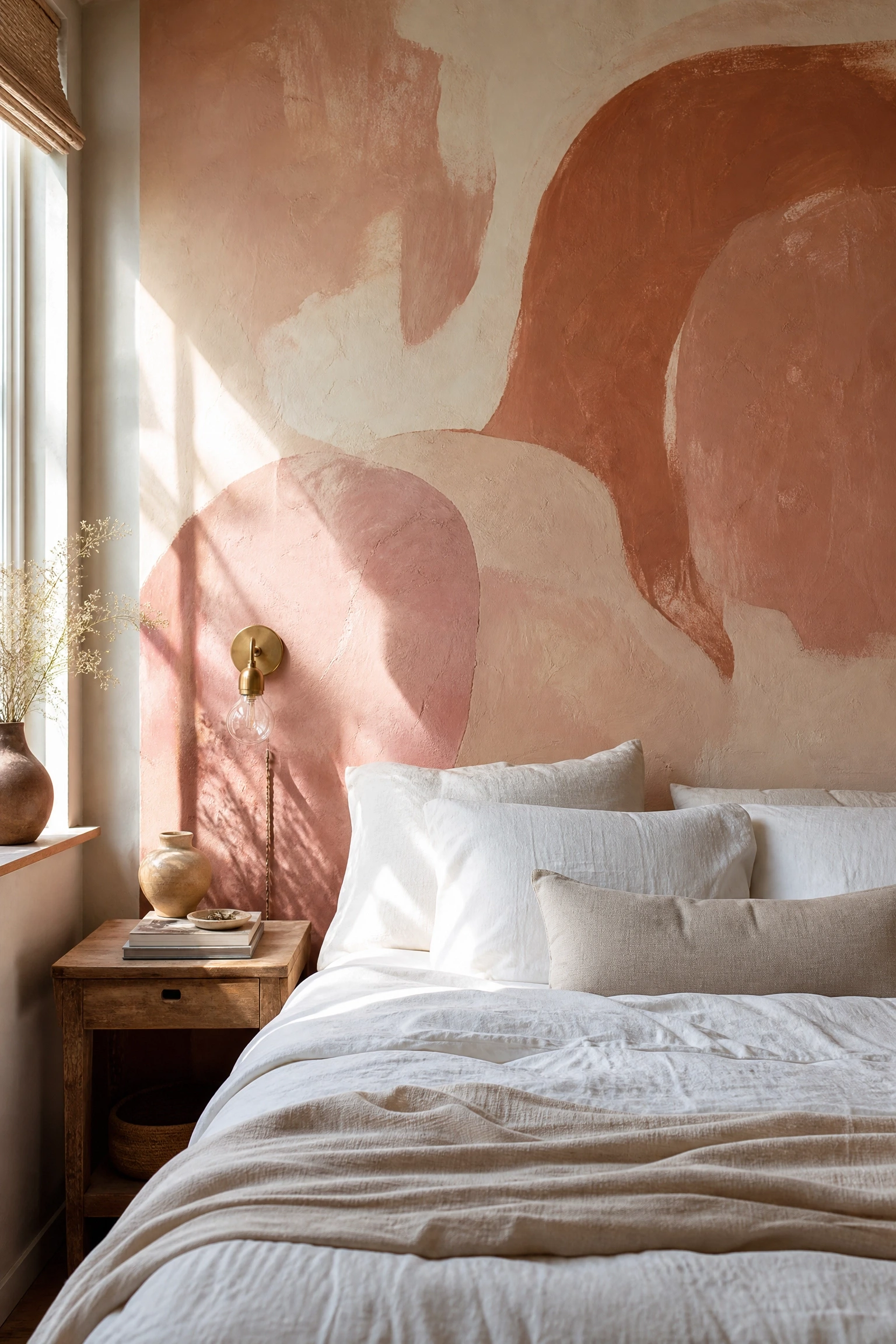
Limewash is arguably the most talked-about accent wall treatment of the past two years, and for good reason. Applied with a damp brush in overlapping strokes and then partially wiped back while wet, it creates a mottled, layered surface with natural variation in tone that flat paint simply cannot replicate. In a bedroom, limewash reads differently at 7am with morning sun hitting it sideways than it does at 10pm under a warm bedside lamp, and that constant shift is what makes it feel so alive. Colors that work particularly well include terracotta, slate blue, warm putty, and aged white. The honest note: limewash is achievable as a DIY project and purpose-made limewash paints formulated for drywall (brands like Portola Paints or Romabio) mean you do not need a plaster substrate, but application technique matters enormously. Watch tutorials before you start, do a test patch, and budget for the fact that the first quarter of the wall will look terrible before you get your rhythm.
Pro Move: Paint the limewash wall in the morning when natural light is hitting it, not at night under artificial light. The shadows the texture creates shift completely with different light sources and you want to see what you are working with in real time.
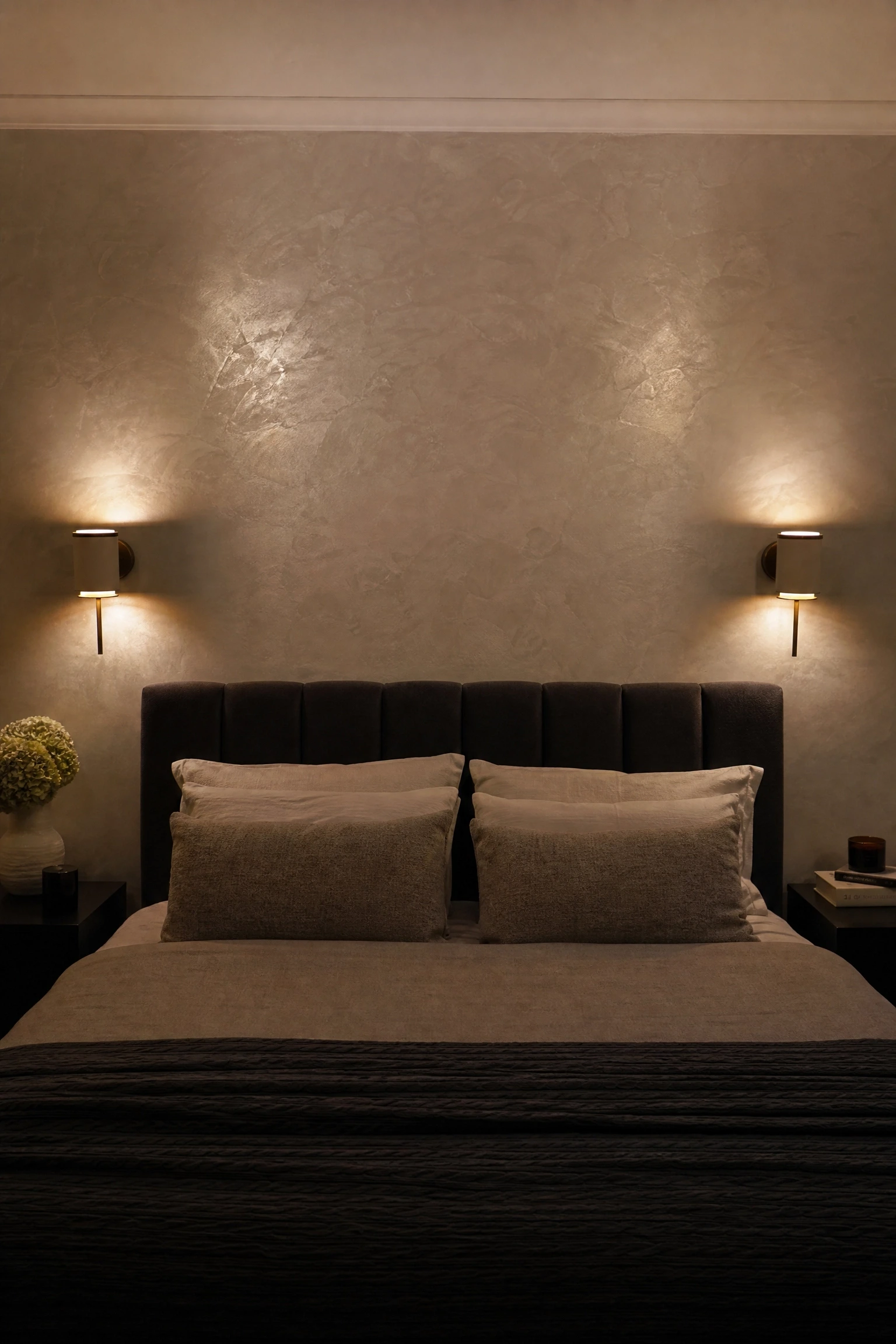
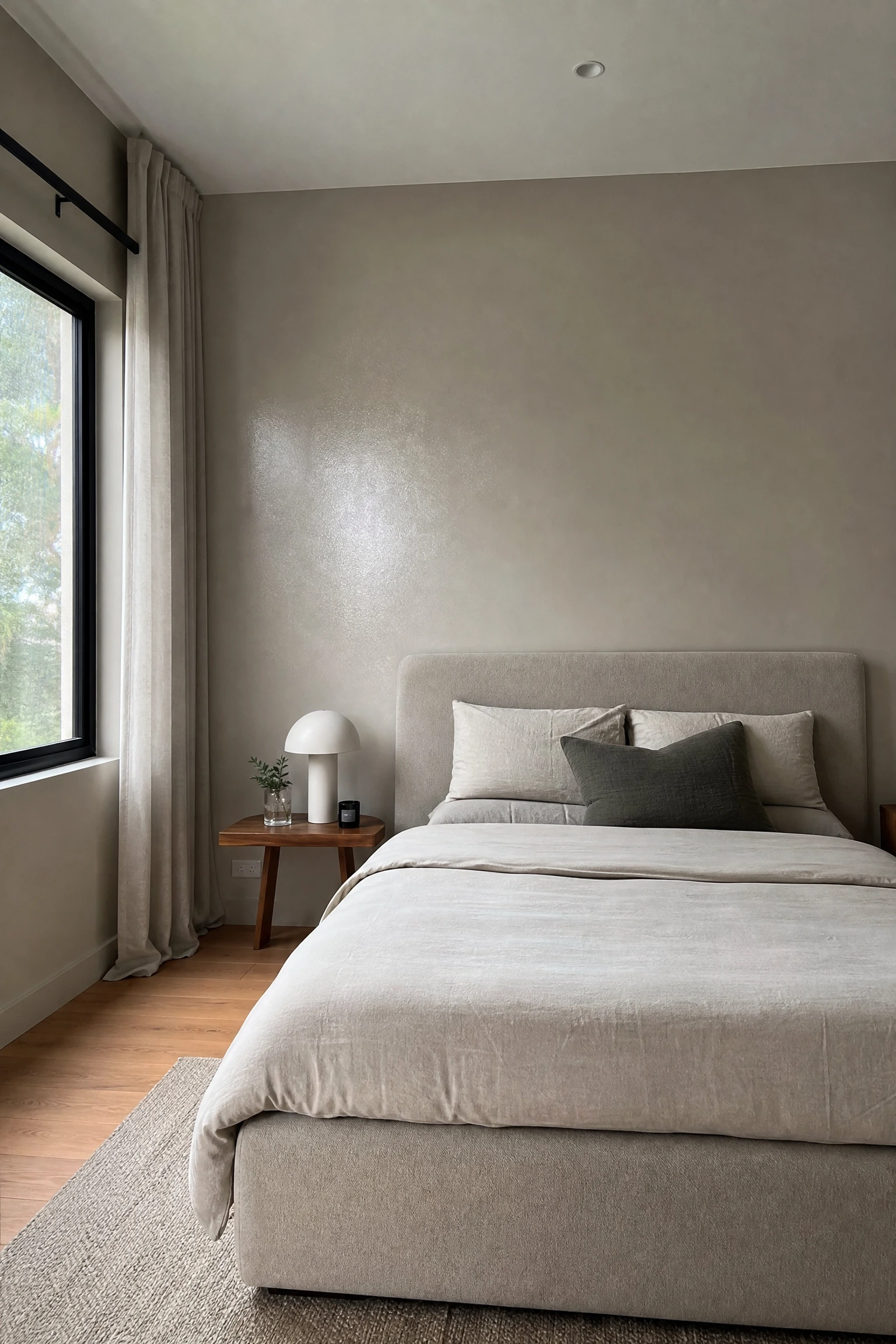
Venetian plaster is the polished cousin of limewash: a multi-coat application of lime putty mixed with marble dust that is burnished to a smooth, polished finish with a steel trowel. The result is a surface with an almost silky luminosity that reflects light in a way that feels both ancient and completely contemporary. In a bedroom, it works especially well on the wall directly behind the bed where the burnished surface catches light from wall sconces on either side and creates a subtle glow at night. Authentic Venetian plaster is a specialist job and the cost reflects that, typically running between $8 and $15 per square foot for professional application. DIY Venetian plaster products exist at a lower price point but the finish is noticeably different. If budget is a concern, limewash gives you the textured look at a fraction of the cost.
Heads Up: Venetian plaster is not a forgiving surface to drill into after the fact. Plan your sconce and artwork placement before the wall goes on, not after.
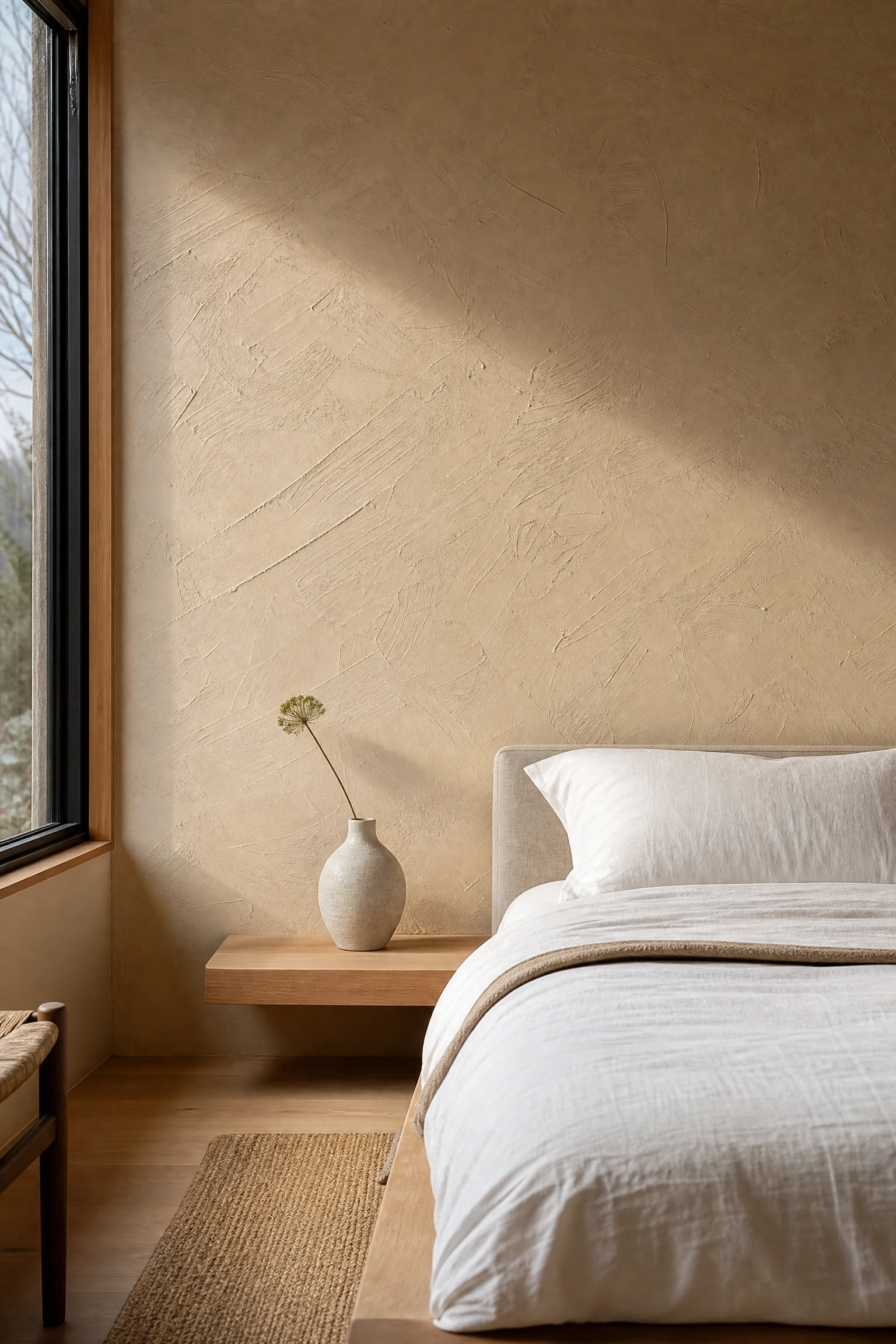
Sitting between limewash and Venetian plaster in both technique and finish, troweled mineral plaster is applied in thin layers with a flat trowel and left with visible trowel marks that create a quiet, directional texture across the surface. Unlike Venetian plaster it is not burnished to a shine, so the finish is more matte and earthy, which suits bedrooms going for a Japandi or wabi-sabi aesthetic particularly well. Mineral plasters are also highly durable and naturally breathable, which makes them a genuinely practical choice beyond the visual appeal. Several brands now offer pre-mixed mineral plaster in a range of colours, including Bauwerk, Kalk and Stone, and Pure and Original, all of which can be applied by a confident DIYer with practice.
Designer Advice: Trowel in one consistent direction across the full wall for a cleaner, more intentional result. Random multi-directional marks can look unfinished rather than textural.
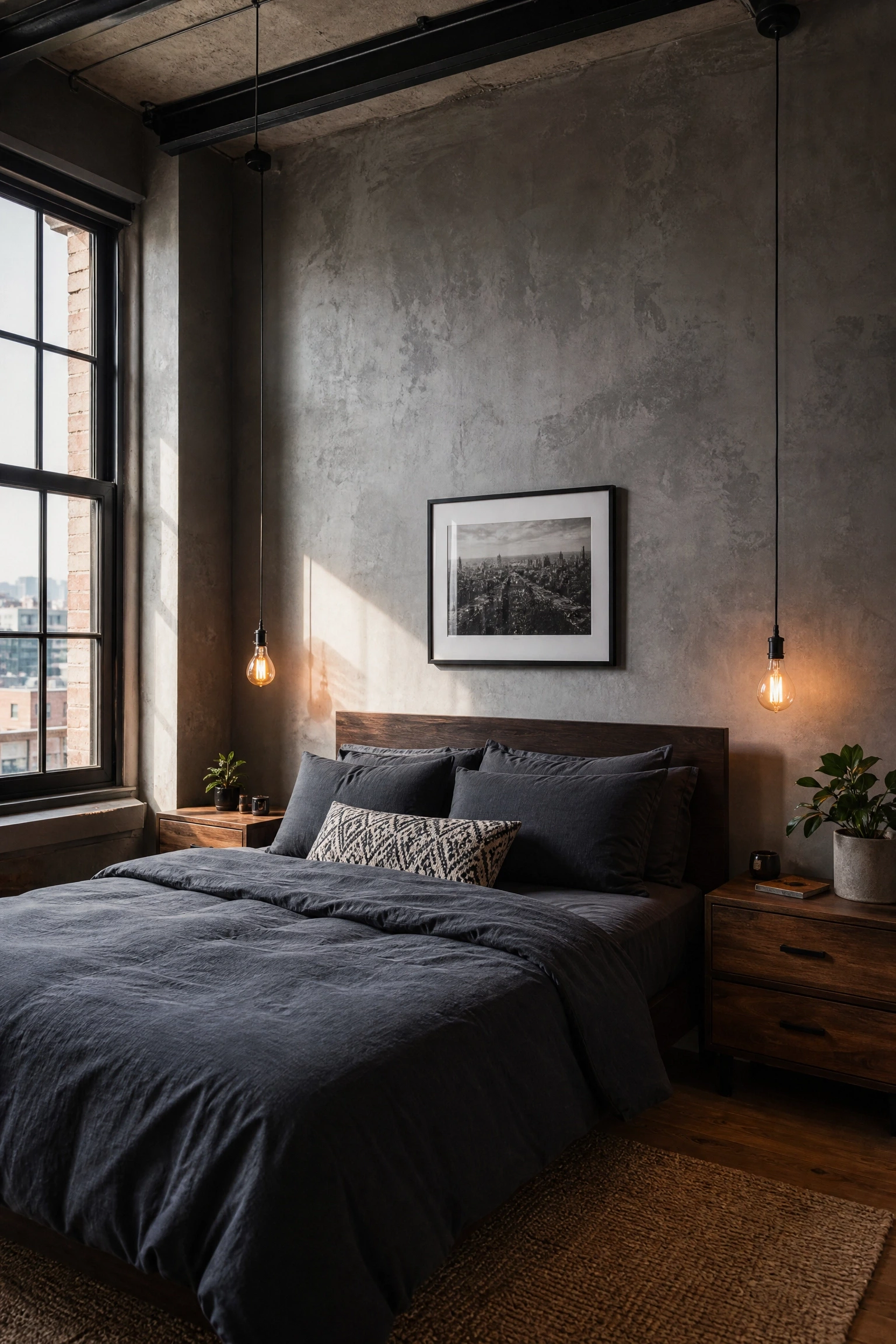
Full poured concrete walls are rarely feasible in a domestic bedroom, but concrete-effect paint and overlay products give a convincing result at a fraction of the cost and complexity. Applied in two to three thin coats with a sponge or trowel and finished with a sealer, these products create a cool, matte, slightly uneven surface that suits urban and industrial bedroom aesthetics well. The key to making it look intentional rather than accidental is restraint in the surrounding decor: warm timber furniture, linen bedding, and soft lighting do the work of making the wall feel grounded rather than cold. Concrete walls work better in larger bedrooms with higher ceilings than in compact rooms where the cool grey can start to feel oppressive.
Reality Check: Concrete effect is one of the easier texture treatments to apply but one of the harder ones to love long-term if your bedroom style shifts. It is very specific in the mood it creates.
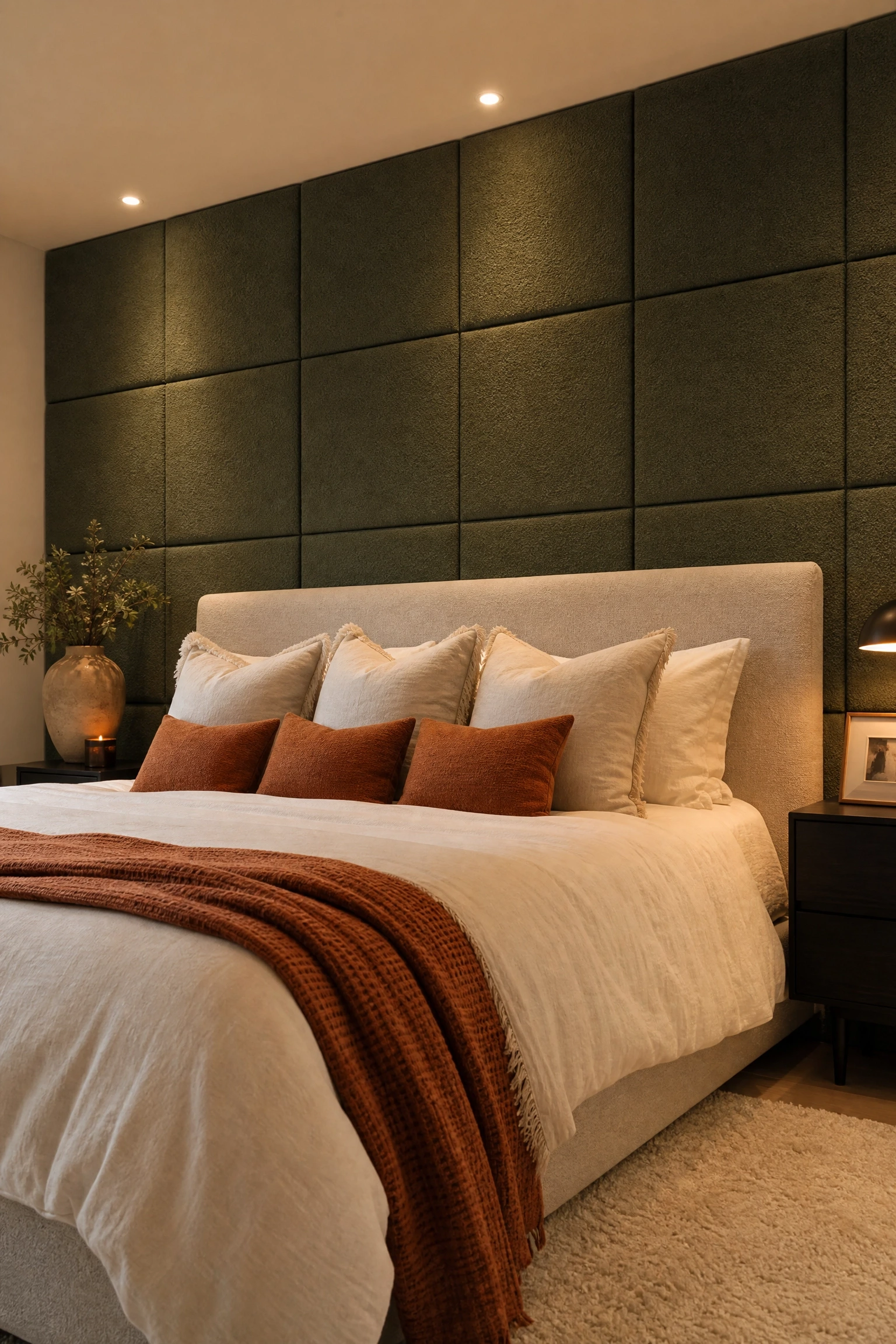
An upholstered panel wall involves stretching fabric over timber frames and mounting them directly against the bedroom wall, either covering the full wall surface or arranged in a geometric grid pattern. The visual effect is soft and layered, with the added practical benefit of acoustic absorption, which makes the bedroom noticeably quieter. This approach works especially well in master bedrooms because the warmth and tactility of the fabric makes the room feel genuinely cosy rather than just styled. Fabric choices that tend to read well at wall scale include linen, boucle, velvet, and heathered wool. Avoid anything with a very busy pattern because the repeat rarely lines up perfectly across multiple panels and the result can look chaotic. Upholstered panel walls are among the more achievable DIY projects on this list, with timber battens, batting, and a staple gun doing most of the work.
Quick Tip: Mount the panels with a small gap between each one rather than butting them edge to edge. The thin shadow line created by the gap makes the whole wall look more considered and intentional.
Paint and Color Accent Walls
Paint is the most accessible starting point for a bedroom accent wall, but the gap between a flat coat of bold colour and a genuinely well-executed painted wall is larger than most people expect. These ideas go beyond just picking a dark shade.
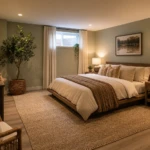
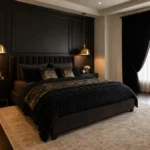
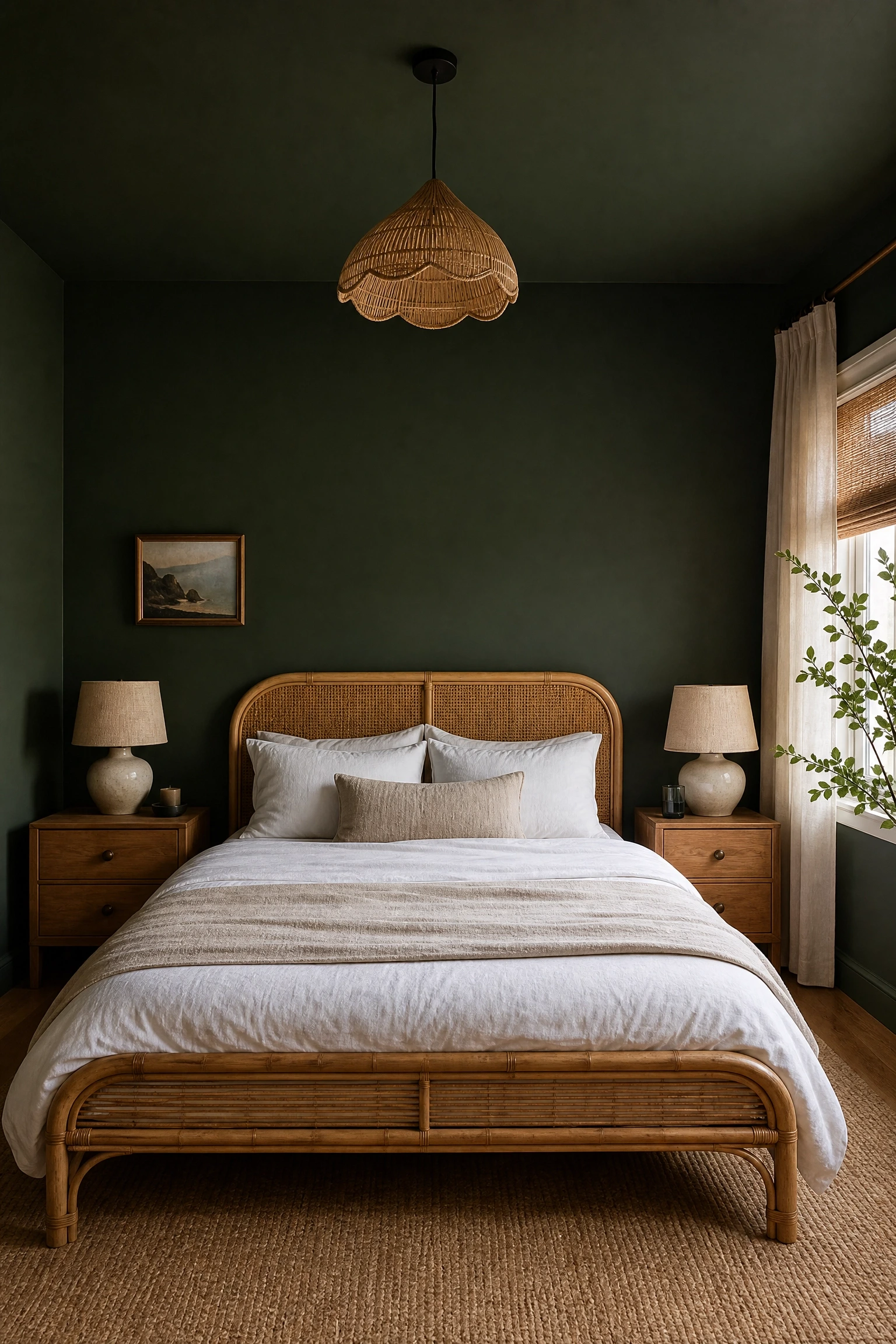
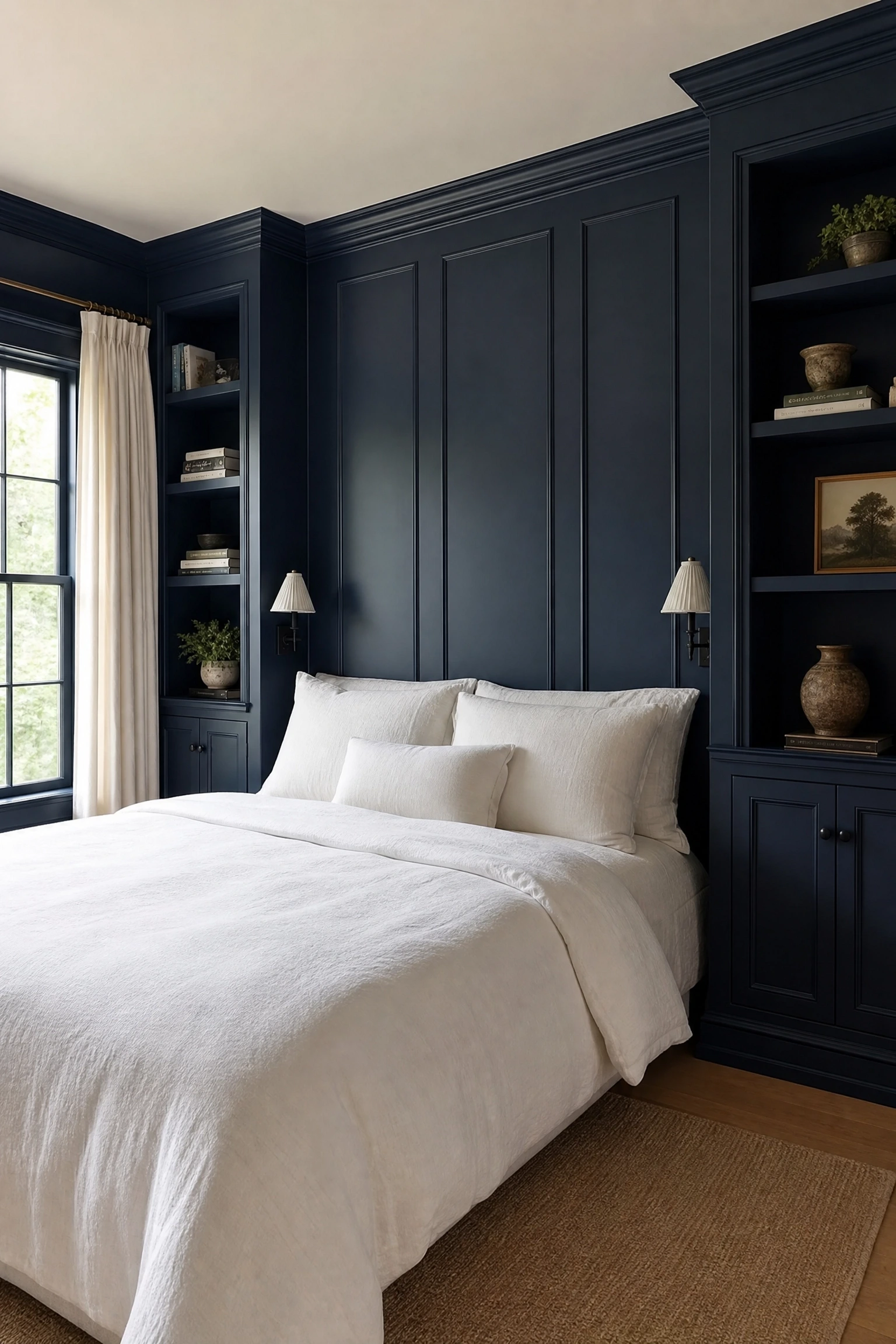
A single deeply saturated colour on the wall behind the bed remains one of the most reliable accent wall approaches in bedroom design because the principle is so sound: the bed is already the visual anchor of the room, and a strong colour behind it reinforces that focal point while adding depth and mood. Colours that consistently work well at scale in bedrooms include forest green, navy, charcoal, deep terracotta, plum, and inky teal. The design principle to keep in mind is undertone: a navy with a green undertone will read very differently alongside warm timber furniture than a navy with a purple undertone. Order sample pots and live with them on the actual wall for at least two days in different light conditions before committing to a full can.
Designer Advice: Paint the ceiling the same deep colour as the accent wall to enclose the space and create a genuinely immersive, cosy atmosphere. It sounds alarming but in practice it makes the room feel intentional rather than heavy.
Colour drenching goes one step further than a standard accent wall by painting not just the wall itself but the skirting boards, architrave, window frames, and any built-in joinery on that wall in the same shade, or a closely related tone from the same family. The effect is richer and more architectural than a simple painted wall because the colour feels embedded in the structure of the room rather than applied to the surface. This approach is particularly effective in older homes with decorative mouldings because the colour makes the architectural detail much more visible. In bedrooms without strong architectural features, drenching works best when the wall colour is also picked up in the bedding or cushions so the room reads as deliberate rather than accidental.
Pro Move: Use a slightly lighter version of the wall colour on the ceiling within the same colour family rather than white. The tonal shift keeps the ceiling feeling airy while the room stays cohesive.
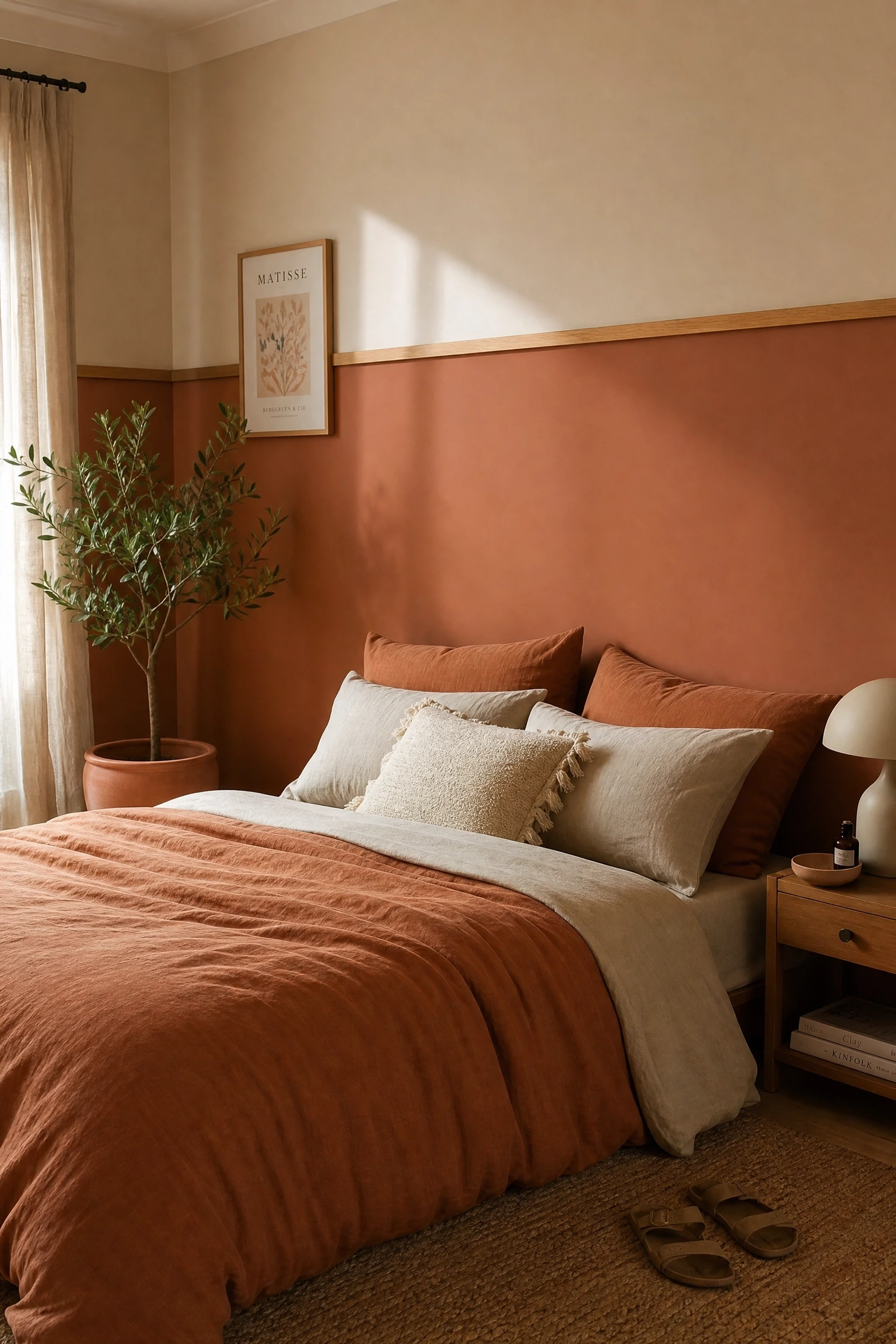
Colour blocking on a bedroom wall involves dividing the surface into two distinct colour sections, most often with a horizontal line roughly two thirds of the way up, with a darker shade below and a lighter or contrasting shade above. The dividing line can be a clean painted edge, a thin timber batten, or a strip of picture rail moulding that creates a physical transition between the two tones. This approach is particularly useful in bedrooms with high ceilings because it visually anchors the lower half of the room and prevents the space from feeling too lofty and cold. It also works well in small bedrooms as a way to introduce a bold colour without fully committing to it on an entire floor-to-ceiling wall.
Heads Up: The placement of the horizontal dividing line matters enormously. At chair rail height (around 90cm from the floor) it looks traditional. At two thirds of the wall height it looks contemporary. Avoid splitting the wall exactly in half because equal proportions rarely look as intentional as an asymmetric split.
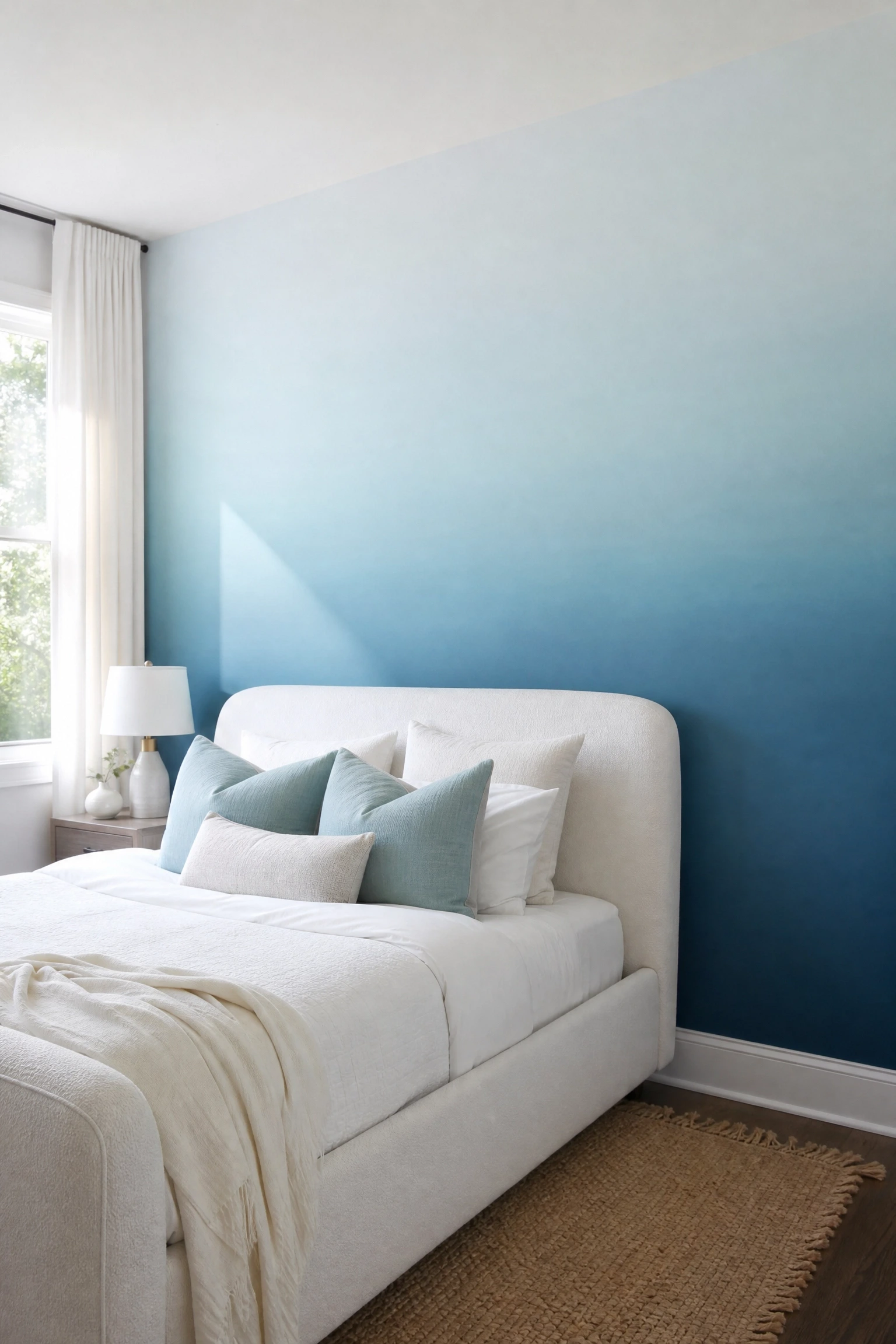
An ombre wall transitions gradually from one colour to another across the wall surface, typically moving from a deeper shade at the base to a lighter or cooler shade toward the ceiling. In a bedroom this creates a soft, atmospheric effect that is particularly calming, especially in blue and green families where the gradient mimics natural shifts in light and horizon. Achieving a convincing gradient requires blending wet paint at the transition zone while both colours are still workable, which means working quickly in sections and having a dry roller to blend the boundary. The result is forgiving because some variation in the transition reads as intentional rather than accidental. This is a genuinely achievable DIY project for a confident painter, though the finish is never quite as precise as a digital rendering suggests it will be, and that organic imperfection is actually part of the appeal.
Quick Tip: Choose colours from the same paint family or neighbouring spots on a colour wheel for the smoothest gradient. Very different hues tend to create a muddy middle zone where they blend that looks unintentional.
“The best accent wall does not announce itself. It makes the whole room feel different without you immediately knowing why.”
One of the quietest and most sophisticated painted accent wall ideas involves painting the feature wall in exactly the same colour as the rest of the room but in a different sheen, such as a full gloss or satin finish on one wall while the other three walls remain in a flat or eggshell finish. In natural light the wall appears subtly different, almost as though it is a different material, and at night the gloss surface reflects light in a way that adds visible depth. This is an especially good option when you want a more distinctive bedroom without committing to a dramatically different colour, and it works particularly well in neutral rooms where the restraint of the approach suits the overall palette. It is also one of the most renter-friendly accent wall approaches since it requires no special products and is entirely reversible.
Reality Check: Gloss paint shows every imperfection in the wall surface underneath it. Sand, prime, and fill the feature wall carefully before applying the high-sheen finish or the texture of the drywall will be visible in raking light.
Pattern and Wallpaper Accent Walls
Wallpaper has had a complete resurgence in the past several years and the range of options available now, from peel-and-stick removable prints to textured grasscloth and hand-printed designs, is wider than it has ever been. These ideas cover how to use pattern well on a single bedroom wall.
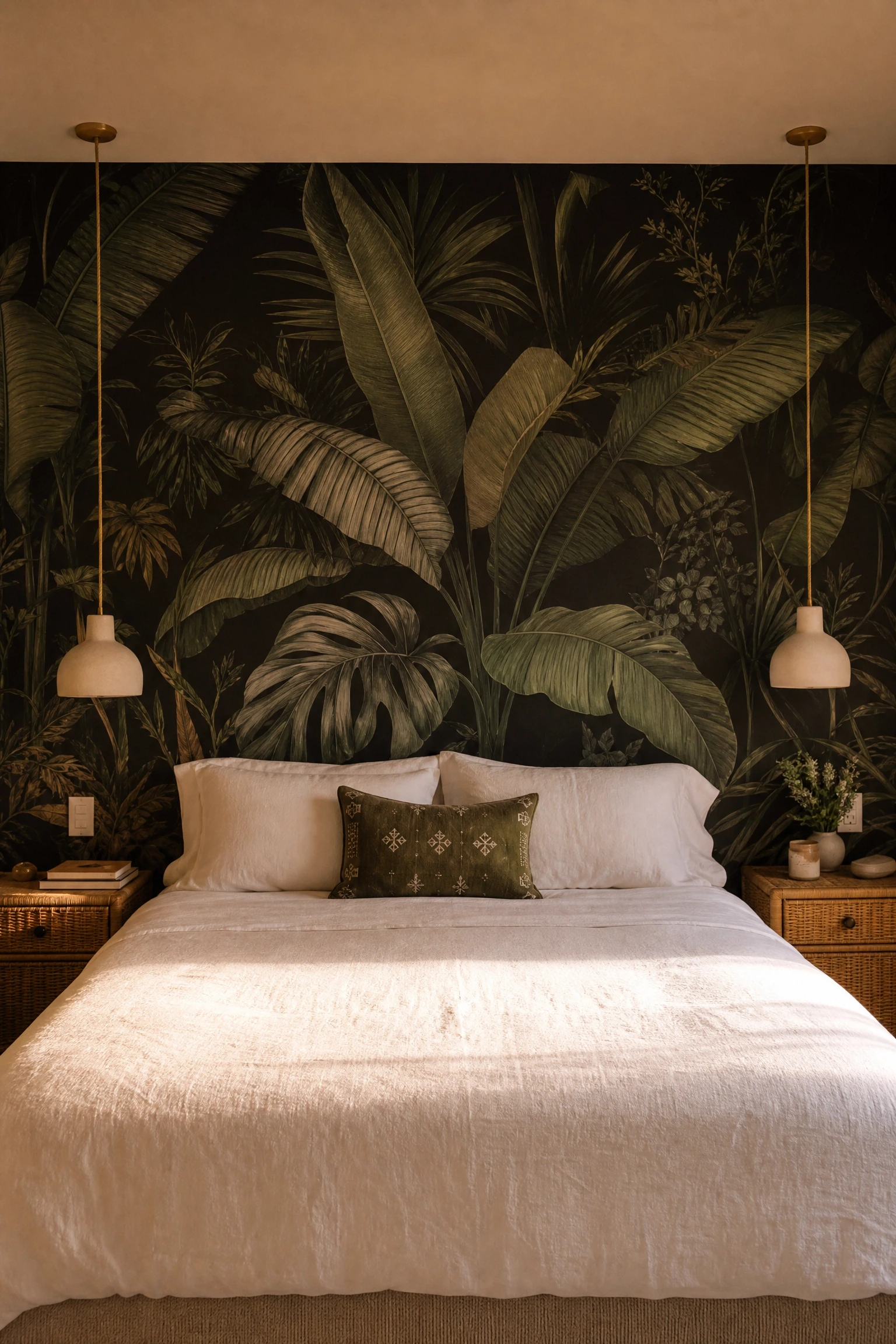
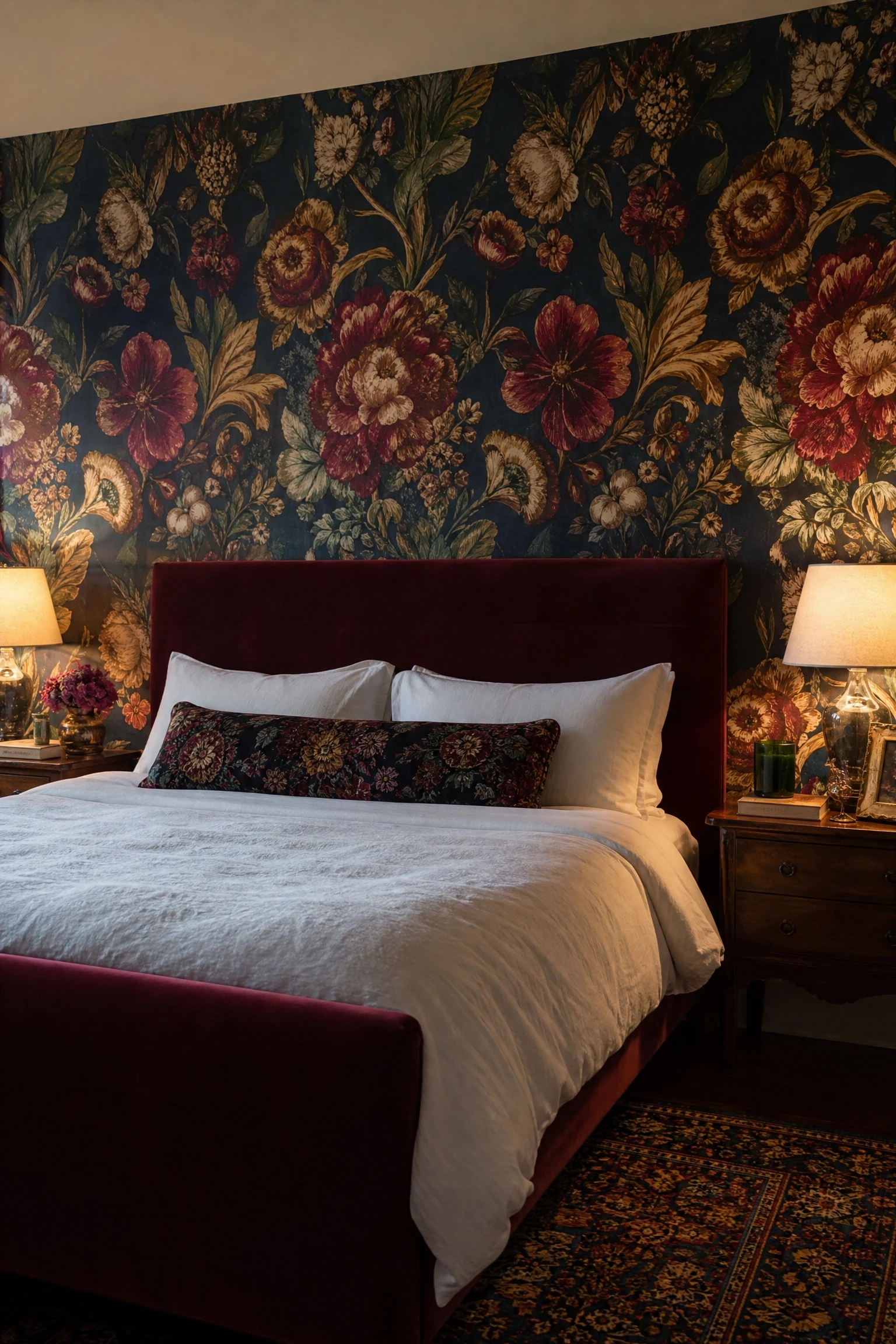
A large-scale botanical print on the wall behind the bed is one of the most consistently popular wallpaper choices for bedroom accent walls, and the reason is straightforward: large organic forms at this scale create a sense of being surrounded by nature that is genuinely calming in a sleep space. The prints that work best in bedrooms are the ones that stay within a controlled colour palette of two or three tones rather than multi-colour botanicals that compete with the bedding and textiles. Dark backgrounds with lighter botanical forms (deep green or navy with cream leaves, for example) create an enveloping, cosy effect. Light backgrounds with botanical outlines read more quietly and work better in bedrooms that already have a lot of visual texture from their furniture and soft furnishings.
Designer Advice: Let the wallpaper be the most visually complex thing in the room. Pair it with plain bedding in one of the wallpaper colours, simple bedside tables, and restrained lighting so the wall remains the focal point rather than competing with everything around it.
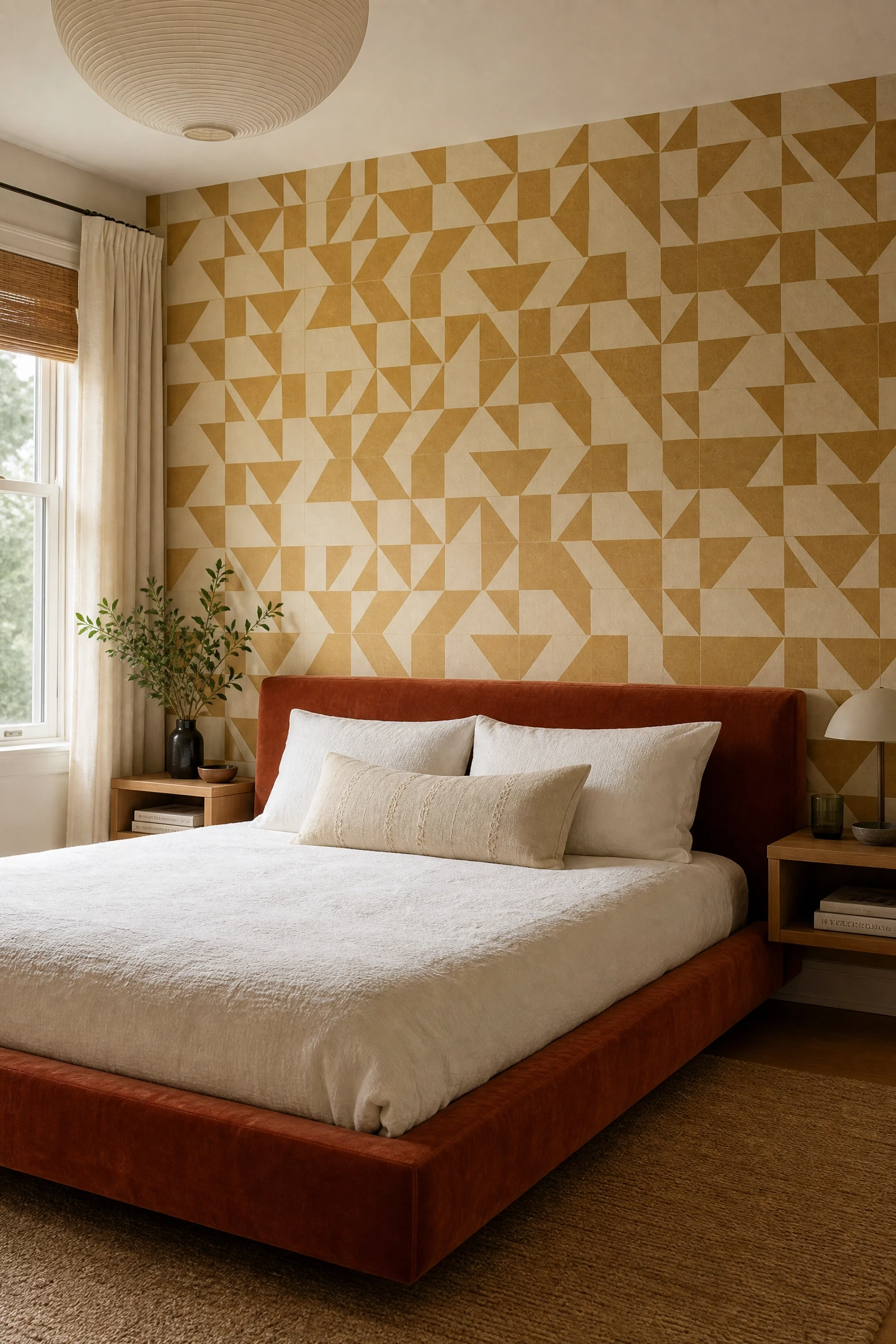
Geometric wallpaper on a bedroom accent wall works differently to organic botanical prints because geometry creates energy rather than calm, which makes the choice of bedroom and wall position more important. A geometric print works well behind the bed when the pattern is medium-scale and the colourway is relatively restrained, because the regularity of the geometry provides its own sense of order. Larger-scale geometric shapes in bold contrasting colours work better in more architecturally generous bedrooms where the wall has room to breathe. In smaller bedrooms, smaller geometric repeats in tonal colourways (tone-on-tone or colours within the same family) add pattern interest without making the room feel busier than it is.
Heads Up: Check the repeat size of any geometric wallpaper before buying. Large horizontal repeats on a standard bedroom wall can result in a pattern that is cut awkwardly at the ceiling or skirting. Most wallpaper websites now include repeat information on the product page.
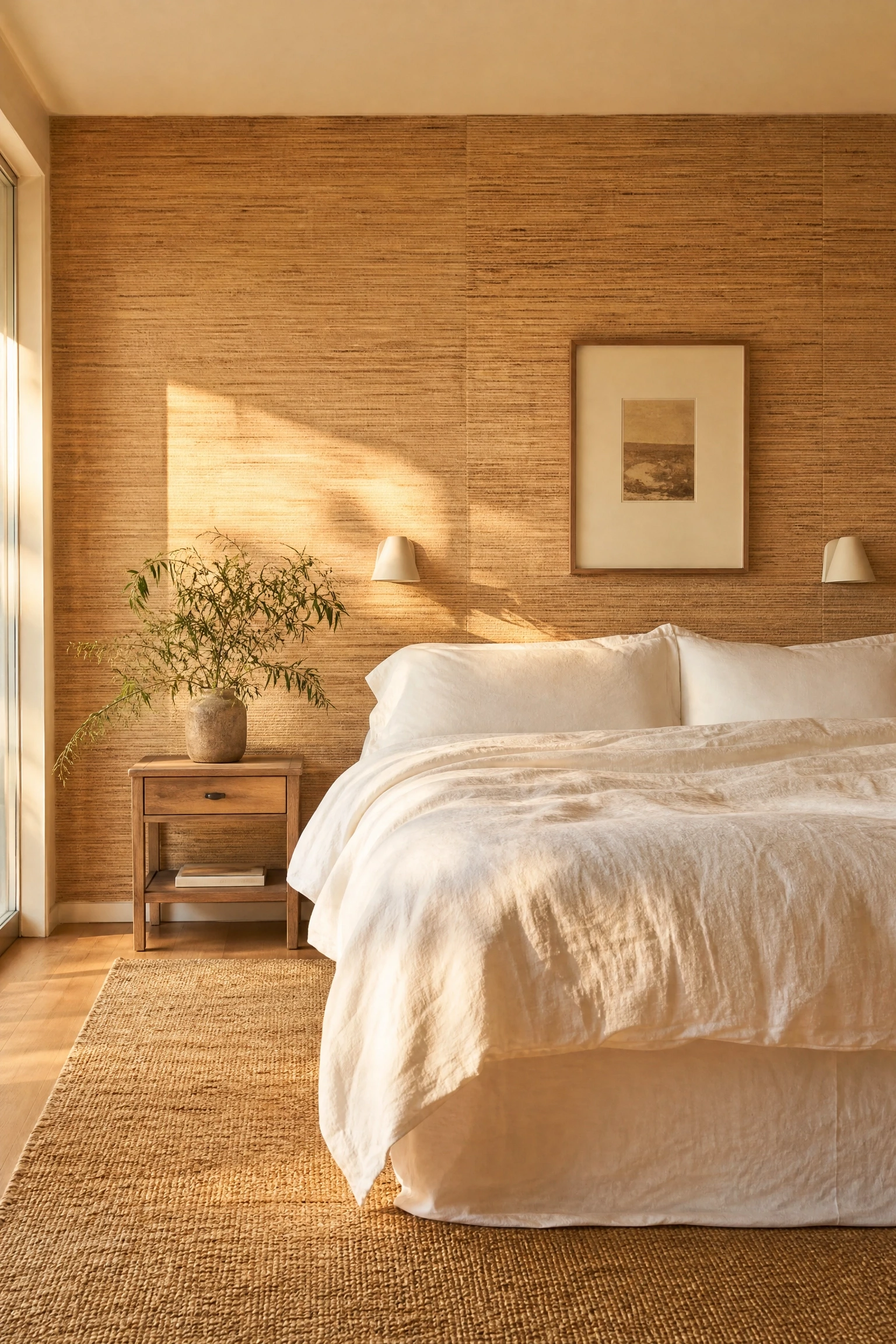
Grasscloth wallpaper is woven from natural plant fibres including seagrass, jute, sisal, and bamboo, and mounted on a paper backing for application. The result is a textured, warm, and genuinely natural-feeling wall surface that photographs beautifully and feels quite different to anything printed or painted. In a bedroom, grasscloth is one of the most calming wallpaper choices because the organic texture reads quietly and the natural colour variation within the weave (no two panels are identical) gives the wall a subtle depth without pattern. The limitation to be aware of is that grasscloth is not washable and is difficult to repair smoothly if damaged, so it suits low-traffic bedroom walls well but is not the right choice for anyone with children or pets who share the bedroom space.
Quick Tip: Grasscloth and natural fibre wallpapers are typically sold by the single roll and the colour can vary between dye lots. Order all the rolls you need at the same time from the same lot number and add at least one extra roll for mistakes and future repairs.
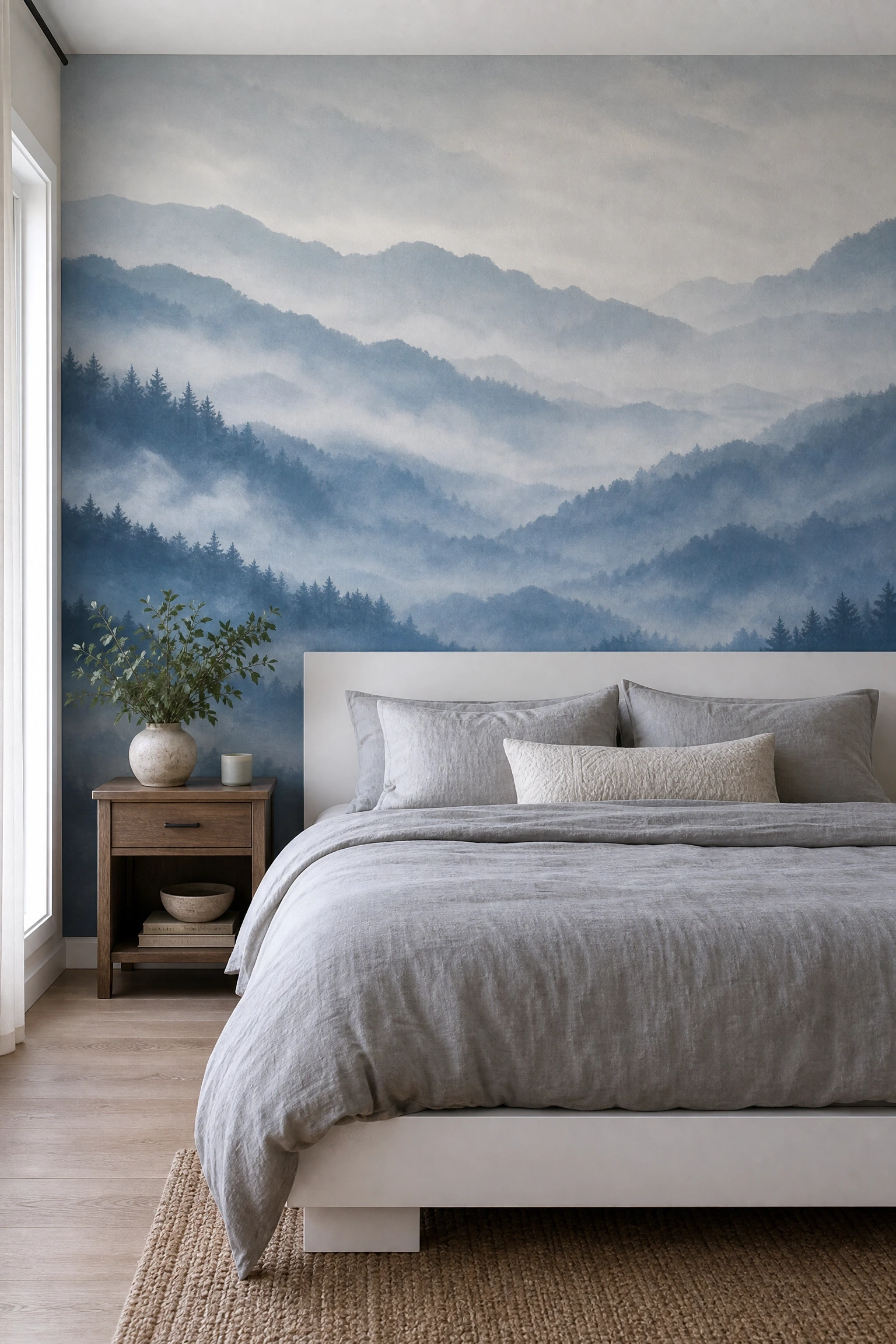
A mural wallpaper is a single image printed across multiple panels that together create one large-scale picture on the full wall surface. In a bedroom the most popular mural subjects are landscapes (mountains, forests, misty horizons), abstract painterly compositions, and architectural scenes. The design advantage of a mural over a repeat pattern is that it is entirely customisable to the exact wall dimensions, so there is no awkward cut at the ceiling or corners. Quality matters enormously here: cheap mural wallpapers with low print resolution look flat and unconvincing at close range, while premium options from suppliers like Rebel Walls, Mr Perswall, or Feathr print at high enough resolution to hold up to close inspection. Peel-and-stick mural wallpapers have improved considerably in quality and are now a viable option for renters or anyone who wants the flexibility to change the look.
Pro Move: Choose a mural with a natural horizon line or horizon placement that aligns with the top of your headboard rather than cutting awkwardly through the middle of the image. Many mural suppliers will adjust the crop to match your wall dimensions exactly.
A bold, maximalist floral wallpaper on a bedroom accent wall is the approach most likely to divide opinion, and also the one most likely to make the room feel genuinely distinctive and personal when it is done confidently. The key to making a maximalist floral work is committing to it completely rather than hedging: pair it with bedding in one of the dominant colours from the print, choose simple unfussy furniture that lets the wall remain the centre of attention, and resist the urge to add decorative elements that compete with the complexity of the pattern. Maximalist florals work better on bedroom walls that are uninterrupted by windows or doors because any break in the pattern draws attention to the cut and makes the wallpaper feel fragmented. If the headboard wall has a window in it, a different wall or a simpler pattern may be more practical.
Reality Check: Maximalist wallpaper in a bedroom is a polarising long-term commitment. If you are someone who redecorates every few years you may find the visual intensity tires more quickly than a simpler choice. Peel-and-stick options exist for this reason and have improved substantially in quality.
Wood and Architectural Detail Accent Walls
This group covers applied wall treatments that add physical dimension and architectural character to a flat bedroom wall. Most of these ideas are achievable as DIY weekend projects and have a long design life because they are material rather than trend-dependent.
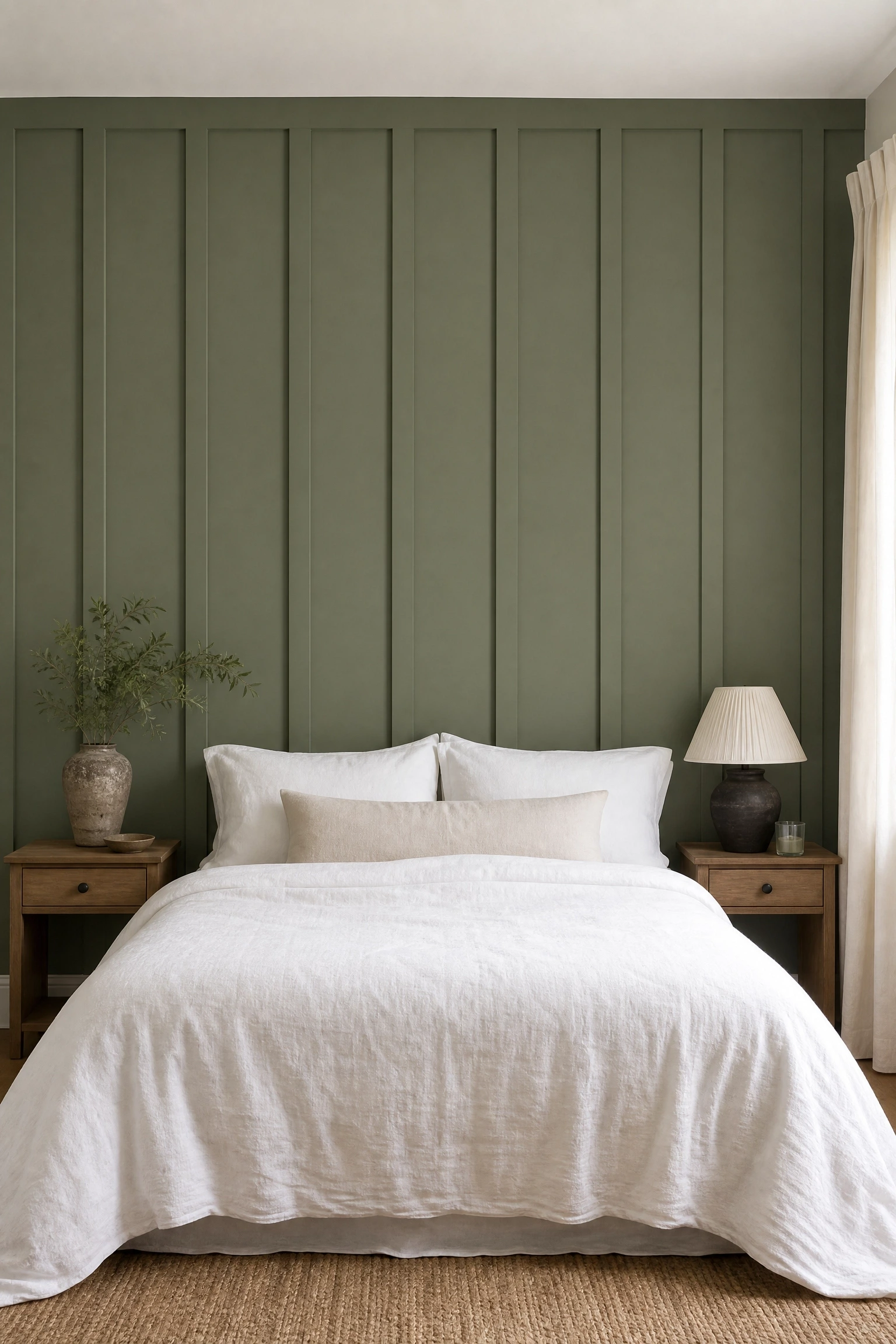
Board and batten is a wall treatment consisting of wide vertical boards fixed to the wall with narrower strips of timber (the battens) placed over the joints between them. Applied to the full height of a bedroom wall or to the lower half as a wainscoting, it adds genuine architectural depth and makes even a plain-walled bedroom feel like it has been well-considered. Painted in a single colour, board and batten reads as crisp and contemporary. Painted in a deep shade like forest green, navy, or charcoal it becomes dramatically moody. In a natural timber finish it reads warmer and more organic. This is one of the most achievable DIY accent wall projects because it requires only basic cutting and fastening skills, though getting the spacing consistent across the full wall is worth taking extra time over.
Designer Advice: Paint the wall behind the boards and the boards themselves in exactly the same colour and finish for the most polished result. The tonal variation between a painted flat wall and a painted timber surface is subtle enough to add depth without creating a colour contrast that fights the rest of the room.
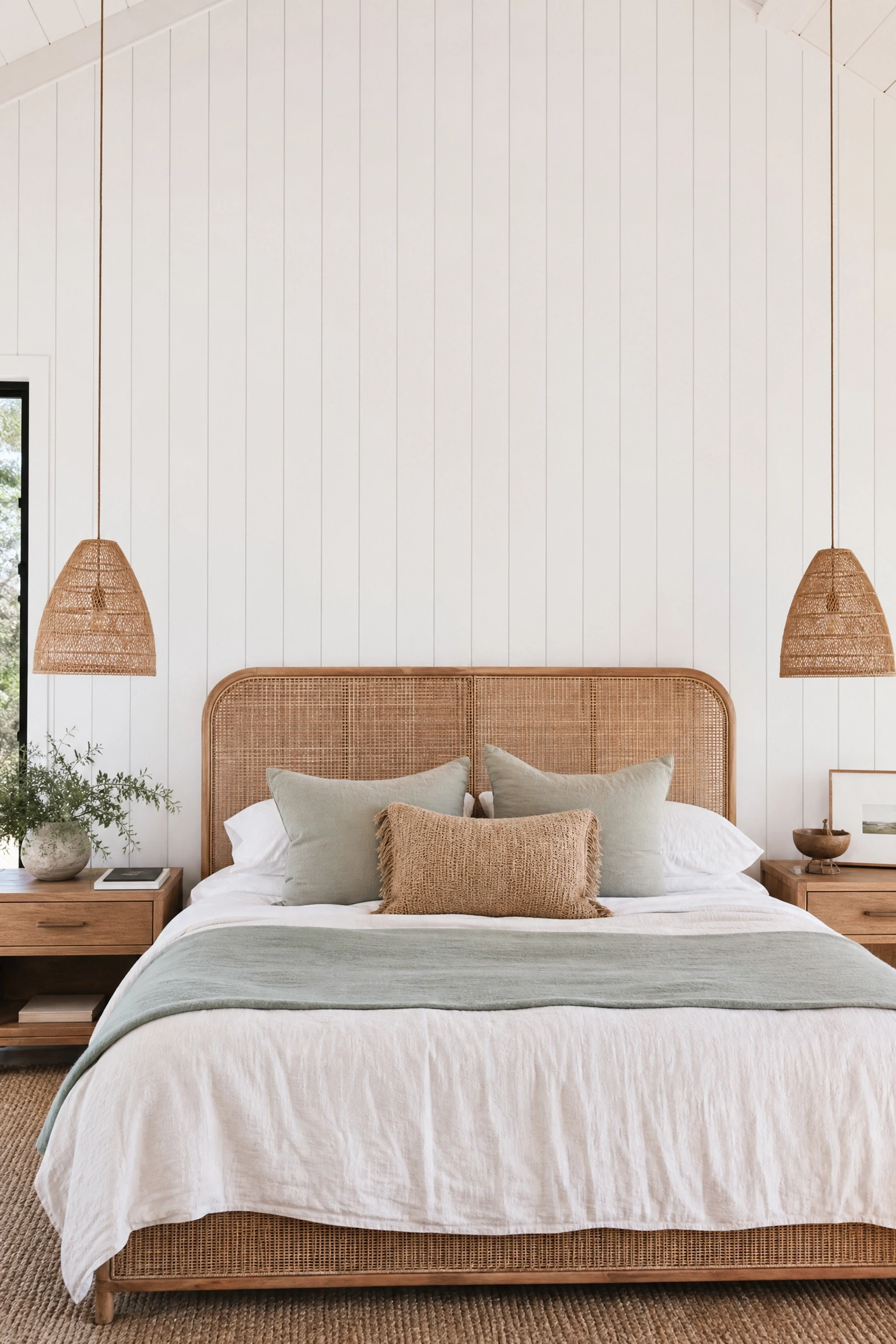
Shiplap consists of horizontal timber boards with a small recessed channel between each plank, creating a clean, regular horizontal line pattern across the wall. In its natural or white-painted form it reads coastal and relaxed. Painted in a deep colour it becomes something more contemporary and architectural. Shiplap has been enormously popular for the better part of a decade and while it is starting to feel familiar, a well-executed shiplap wall in an unexpected colour or with a finer plank width than the standard still looks considered rather than generic. Vertical shiplap is worth considering as an alternative to horizontal: running the boards floor to ceiling draws the eye upward and makes low-ceilinged bedrooms feel noticeably taller.
Heads Up: Standard shiplap boards are around 15 to 20cm wide. Choosing a narrower 8 to 10cm board creates a finer, more refined look that tends to age better as the treatment becomes more widespread.
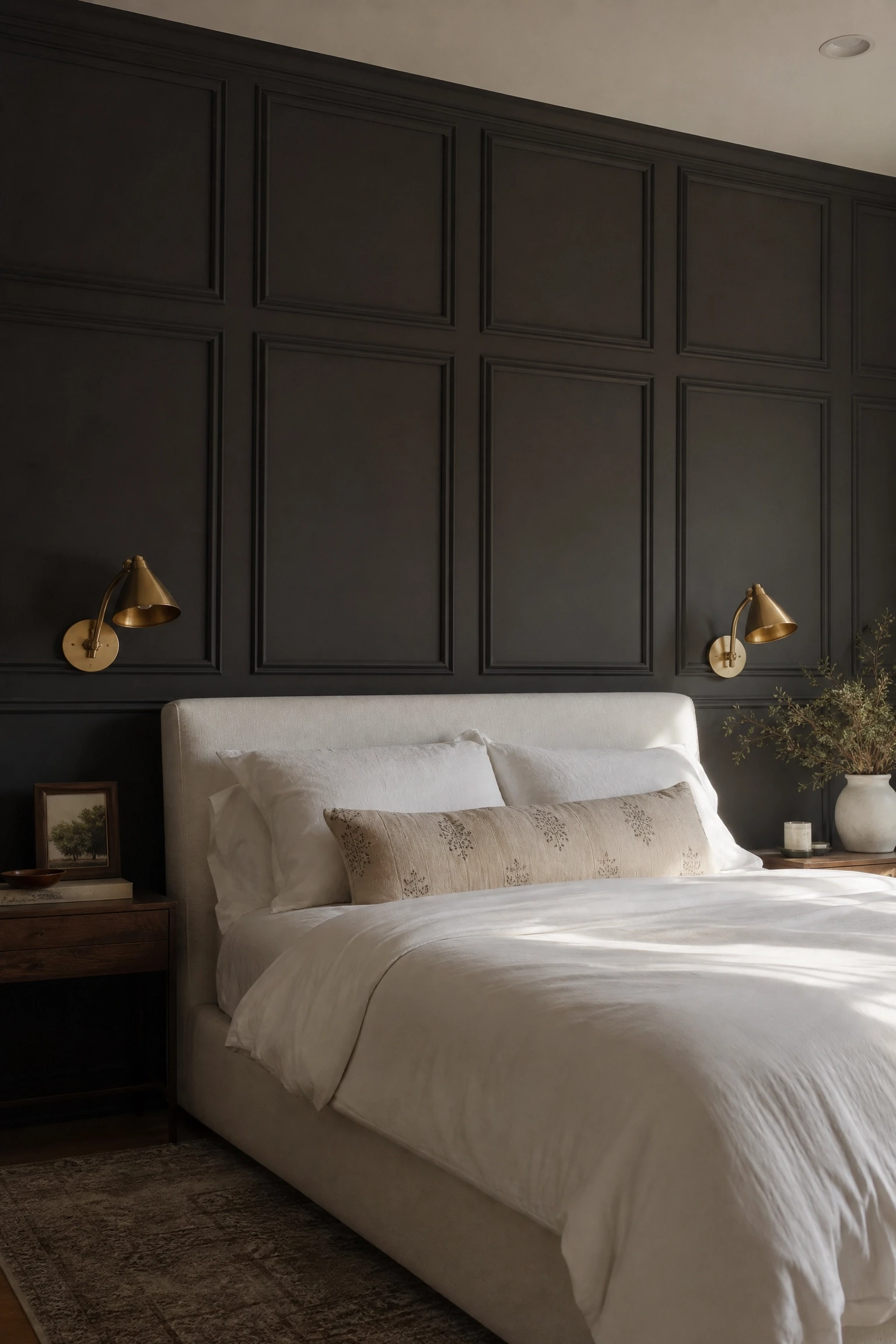
Picture frame moulding involves applying rectangular frames of timber profile directly to the bedroom wall in a regular grid pattern, creating the effect of recessed panels without any actual structural work. The visual effect is formal and elegant, and works particularly well in bedrooms going for a classic, transitional, or quietly luxurious aesthetic. Painted white on a white wall it adds subtle texture. Painted the same deep colour as the wall it creates bold geometric shadow lines that read as almost architectural. In a bedroom, picture frame moulding works well on the headboard wall at full height, or on a half-wall section above a low headboard where the framed panels echo the proportions of the bed. The DIY difficulty level is moderate: the framing profiles are inexpensive and widely available, but achieving perfectly level and evenly spaced frames across the full wall requires careful measuring and a good laser level.
Quick Tip: Plan the frame layout on paper before cutting anything. Work out the number of panels, their proportions, and the spacing between them so that the arrangement is balanced within the full wall width, accounting for any skirting boards, coving, or ceiling height variations.
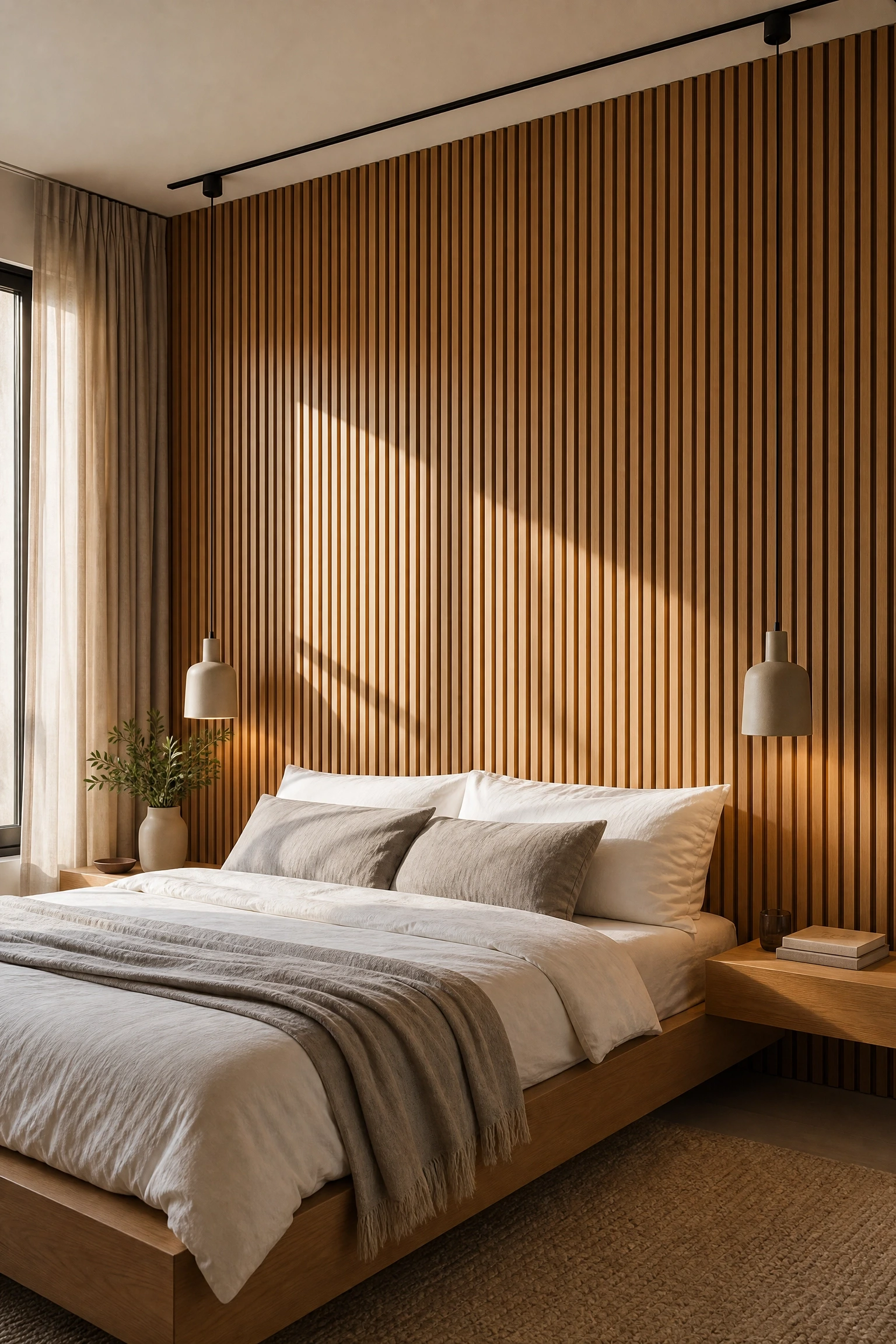
A slatted wood panel wall consists of thin vertical timber strips mounted at regular intervals over a backing board, creating a wall surface with visible shadow gaps between each slat. The effect is Scandinavian in origin but has become a versatile look that suits a range of bedroom aesthetics from contemporary minimal to warm natural. The shadow gaps between slats create a genuine three-dimensional quality that changes through the day as the light angle shifts, making it one of the more visually dynamic wall treatments in this list. Slatted panels are now available as pre-made acoustic panel products from suppliers including Luxalon and various online retailers, which makes installation considerably simpler than building a custom version from scratch. The acoustic benefit is real, as the air gap and timber surface do absorb some sound, which can noticeably improve the quietness of the bedroom.
Pro Move: Run slatted panels from floor to ceiling rather than stopping them at the height of the headboard. Full-height slats make the room feel taller and the treatment feel like an architectural decision rather than a decorative addition.
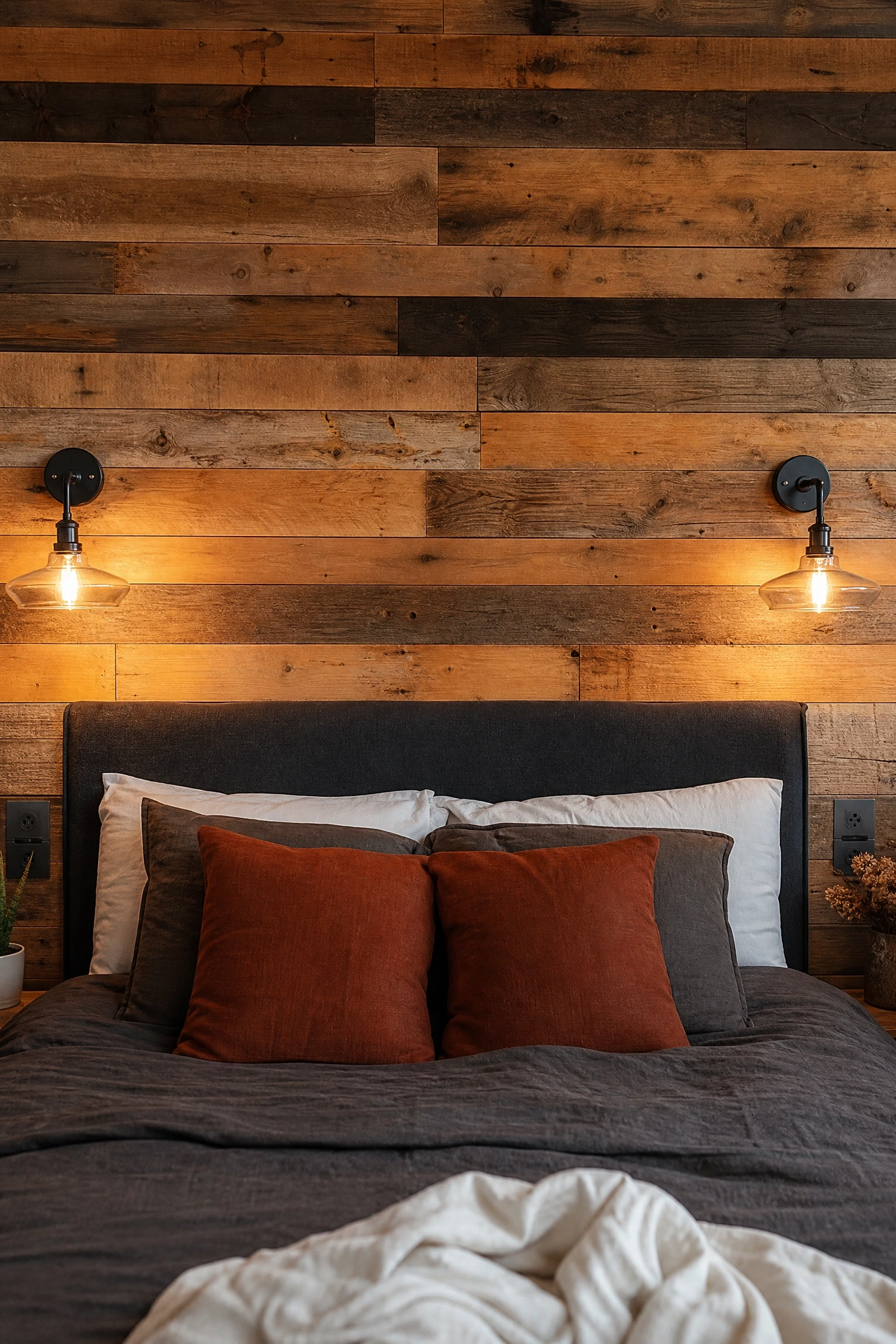
A reclaimed wood accent wall uses salvaged timber boards, each with its own history of grain pattern, knot, weathering, and colour variation, to create a wall surface that cannot be replicated or manufactured. In a bedroom the visual warmth of aged timber is genuinely distinctive, and the tonal variation between boards means the wall has an organic complexity that new timber or paint cannot match. Sourcing authentic reclaimed timber from architectural salvage suppliers gives the most genuine result, though reclaimed-look engineered boards are widely available for those who want the aesthetic with less sourcing work. The honest caveat: a full reclaimed wood wall is a strong visual statement that suits bedrooms with a specific aesthetic direction, primarily rustic, lodge-style, or warmly eclectic rooms. In a pared-back contemporary bedroom it can read as incongruous.
Reality Check: Reclaimed timber boards vary in thickness, which means the wall surface will have slight variations in projection. Check that your planned sconce or artwork mounting positions work with the uneven surface before committing to the installation.
Artistic and Decorative Accent Walls
This group covers approaches where the wall itself becomes the art, either through applied decoration, lighting integration, or the use of materials in ways that go beyond standard finishes.
A hand-painted mural directly on the bedroom wall is the most personal of all accent wall approaches, and also the one that requires the most commitment because it is not easily reversed. The range is wide: from a simple abstract wash of colour in two or three shades applied loosely with a large brush, which is genuinely achievable for anyone comfortable with painting, to a detailed figurative or landscape mural that requires real artistic skill. For those without confidence in their own hand, commissioning a local artist to paint a mural tailored to the room is an increasingly popular option, and the result tends to be more personal and original than any wallpaper. The intermediate option is a projector method, where a chosen image is projected onto the wall and traced in pencil before painting, which makes complex designs accessible to non-artists.
Designer Advice: Brief any artist thoroughly with images of the room, the palette of the bedding and furniture, and examples of the style you are drawn to. A mural that fits the room is dramatically more successful than one painted without that context.
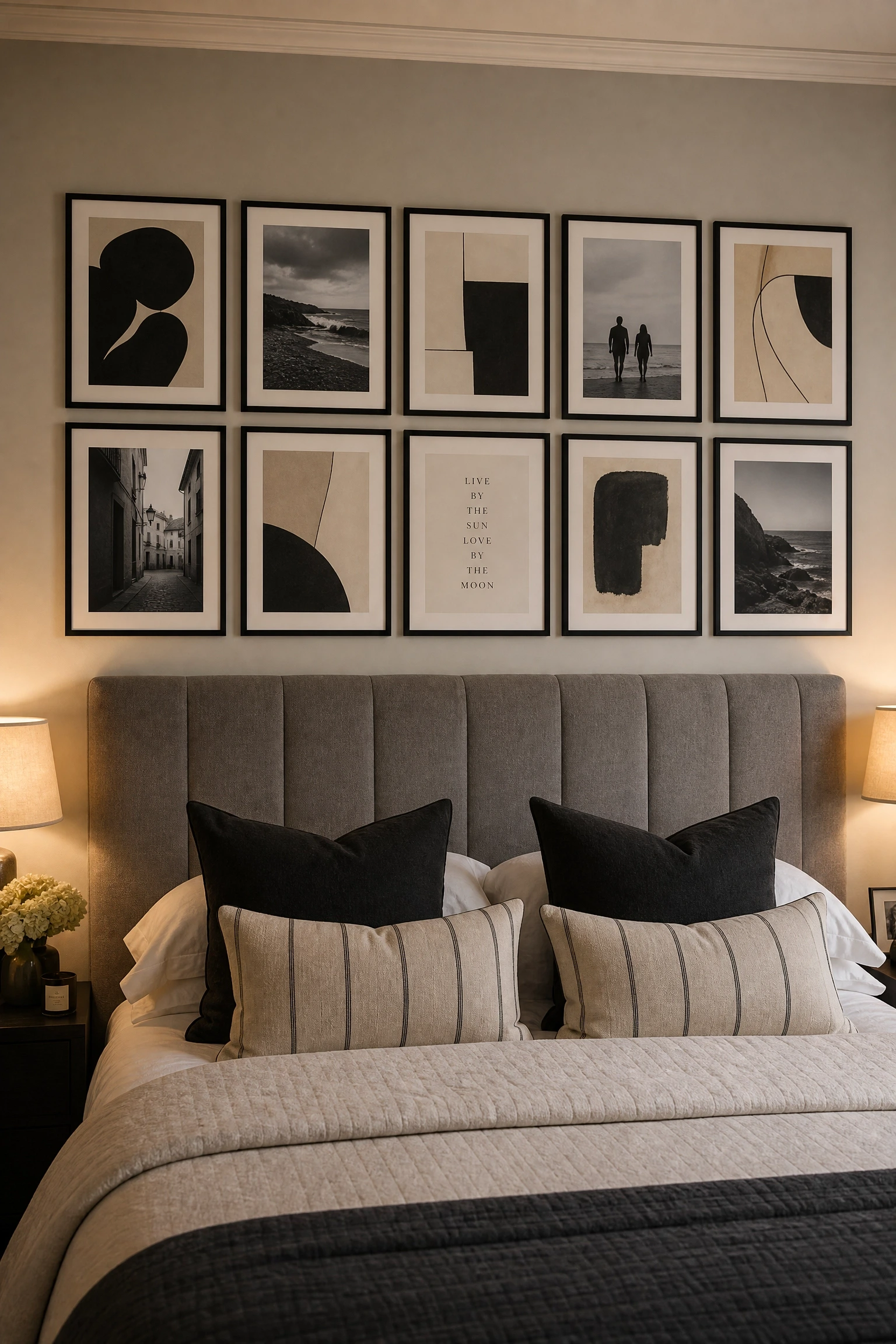
A gallery wall used as a bedroom accent wall works differently from a scatter of frames on a spare wall because the arrangement is deliberately composed to fill and anchor the headboard wall rather than decorating it incidentally. The most successful bedroom gallery walls have a unifying logic: all frames in the same finish (all black, all natural timber, all white), or all artwork in the same colour family, or all prints from the same era or artist. A gallery wall without this kind of editing logic tends to look accumulated rather than considered. Leaving equal spacing between every frame (10 to 15cm is a commonly used gap) and planning the full arrangement on the floor before any nail goes into the wall are the two most important practical steps.
Heads Up: A gallery wall works best when the bed sits away from the wall with a proper headboard providing visual separation. Gallery walls directly above a bed with no headboard can look unsettled because the artwork floats without an anchor below it.
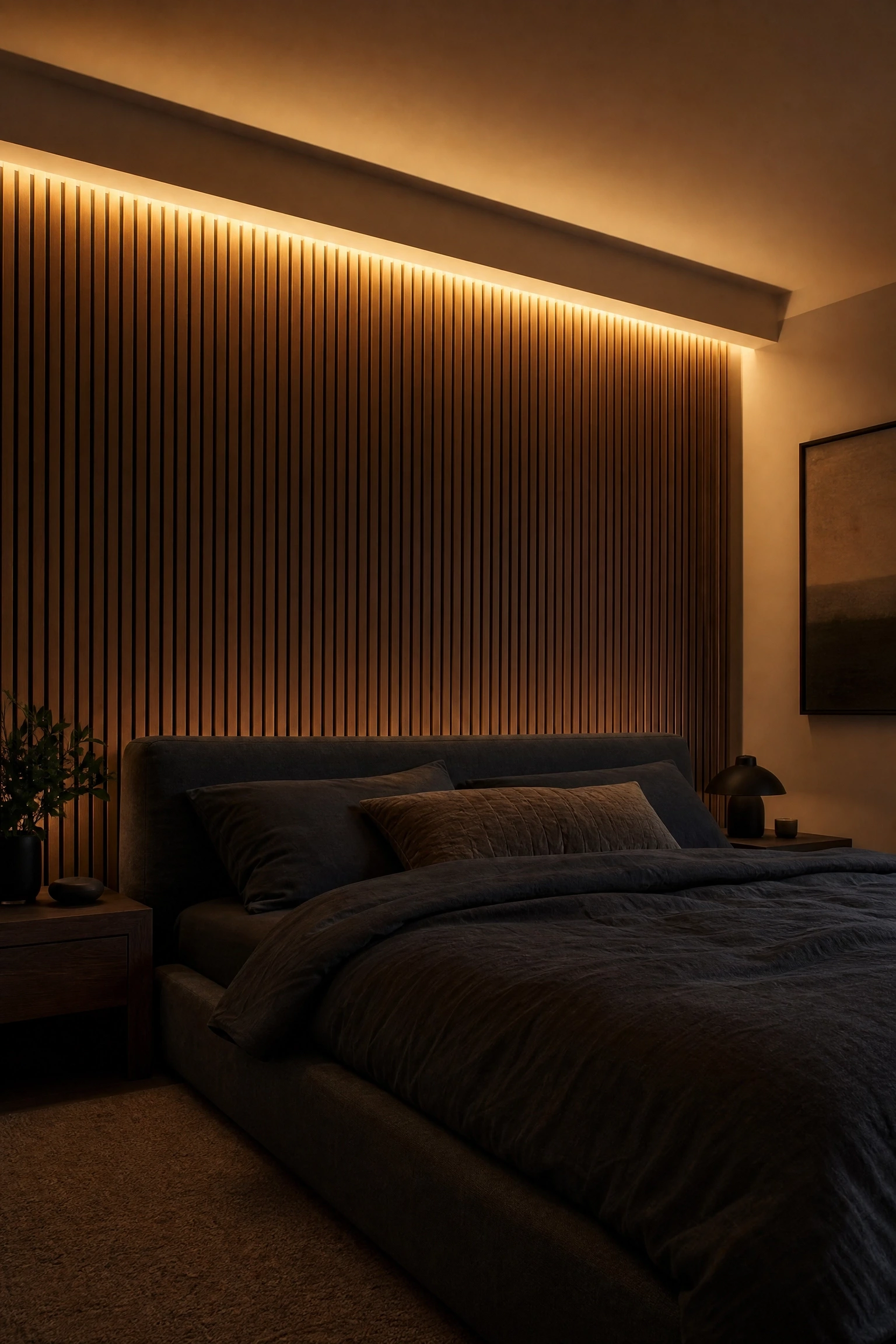
An LED backlit accent wall uses indirect lighting integrated into or behind a wall panel, niche, or architectural element to create a glowing surface that reads completely differently during the day and at night. The most refined version of this approach involves recessed timber slat panels or plaster niches with LED strip lighting concealed behind a lip, so that the light source itself is never visible and only the glow on the wall or ceiling above is seen. In a bedroom this creates an atmosphere that is genuinely difficult to achieve with conventional lighting: soft, enveloping, and adjustable through a dimmer. The approach requires some planning and electrical work, but the result is one of the most dramatic and liveable accent wall outcomes in this list, because the wall looks one way during the day and changes the mood of the room completely at night.
Pro Move: Use a warm white LED strip rated between 2700K and 3000K for bedroom backlighting. Cool white or daylight LEDs at this distance create a clinical, flat light that works against the relaxed atmosphere a bedroom needs.
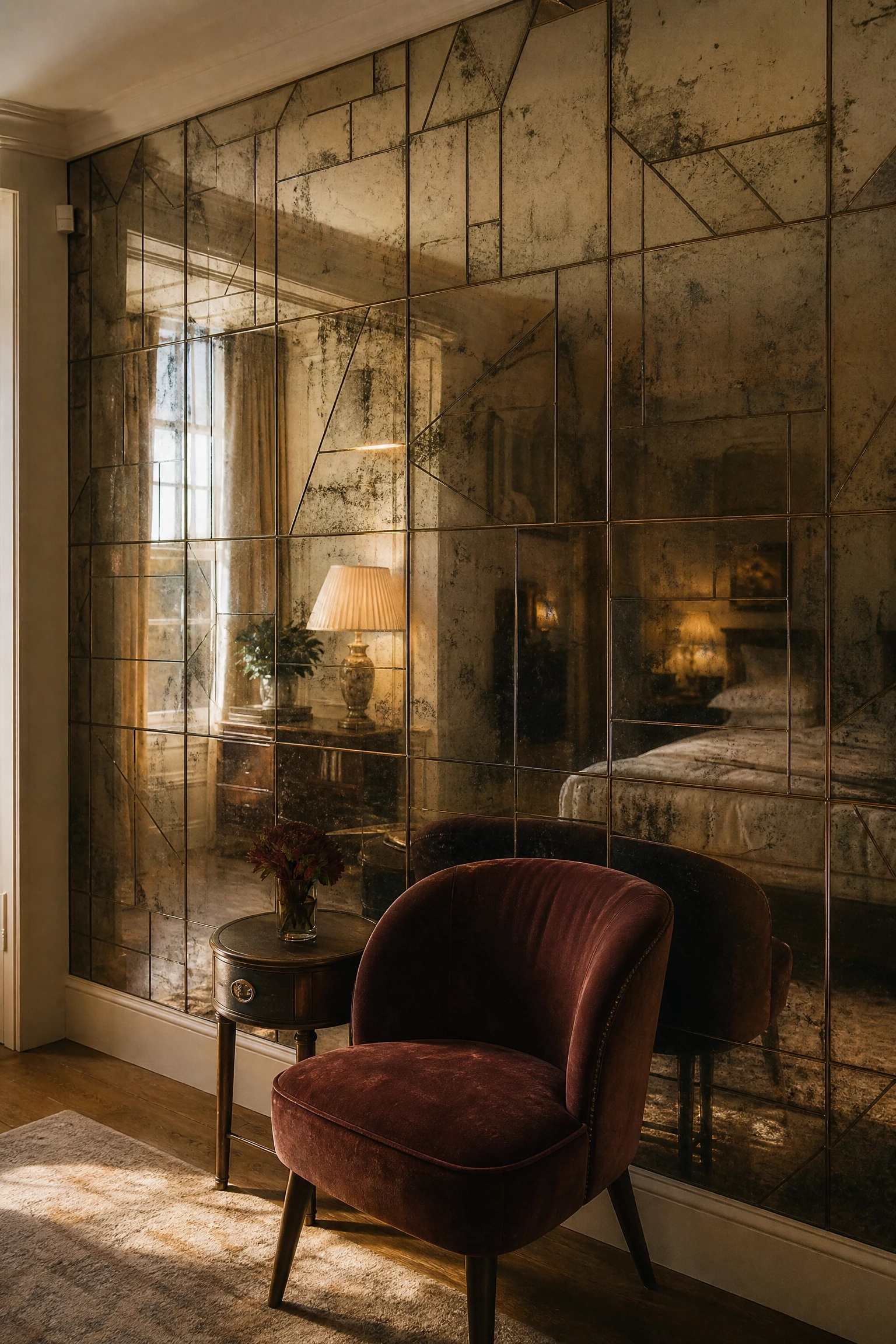
A wall covered in mirror, whether as a full-width antique mirror panel, a collection of individual mirror tiles in varying sizes, or a custom-cut geometric mirror arrangement, does something no painted or wallpapered wall can do: it makes the room feel larger while simultaneously adding light and visual interest. In a bedroom this approach works best on a side wall rather than directly behind the bed, where a full mirrored wall can feel disorienting when waking up. Antique mirror with its slightly darkened, foxed surface is a particularly good choice for bedrooms because it reflects light without the clinical brightness of a standard mirror, and the aged patina gives the wall a material richness that feels genuinely luxurious. Cut to a custom geometric arrangement and mounted in a frameless configuration, antique mirror panels create a wall that functions as both a practical surface and a piece of decorative art.
Quick Tip: Avoid a full-height floor-to-ceiling mirror wall directly opposite a window in a bedroom. The direct reflection of natural light can make the space uncomfortably bright in the morning and reduce the sense of privacy in the room.
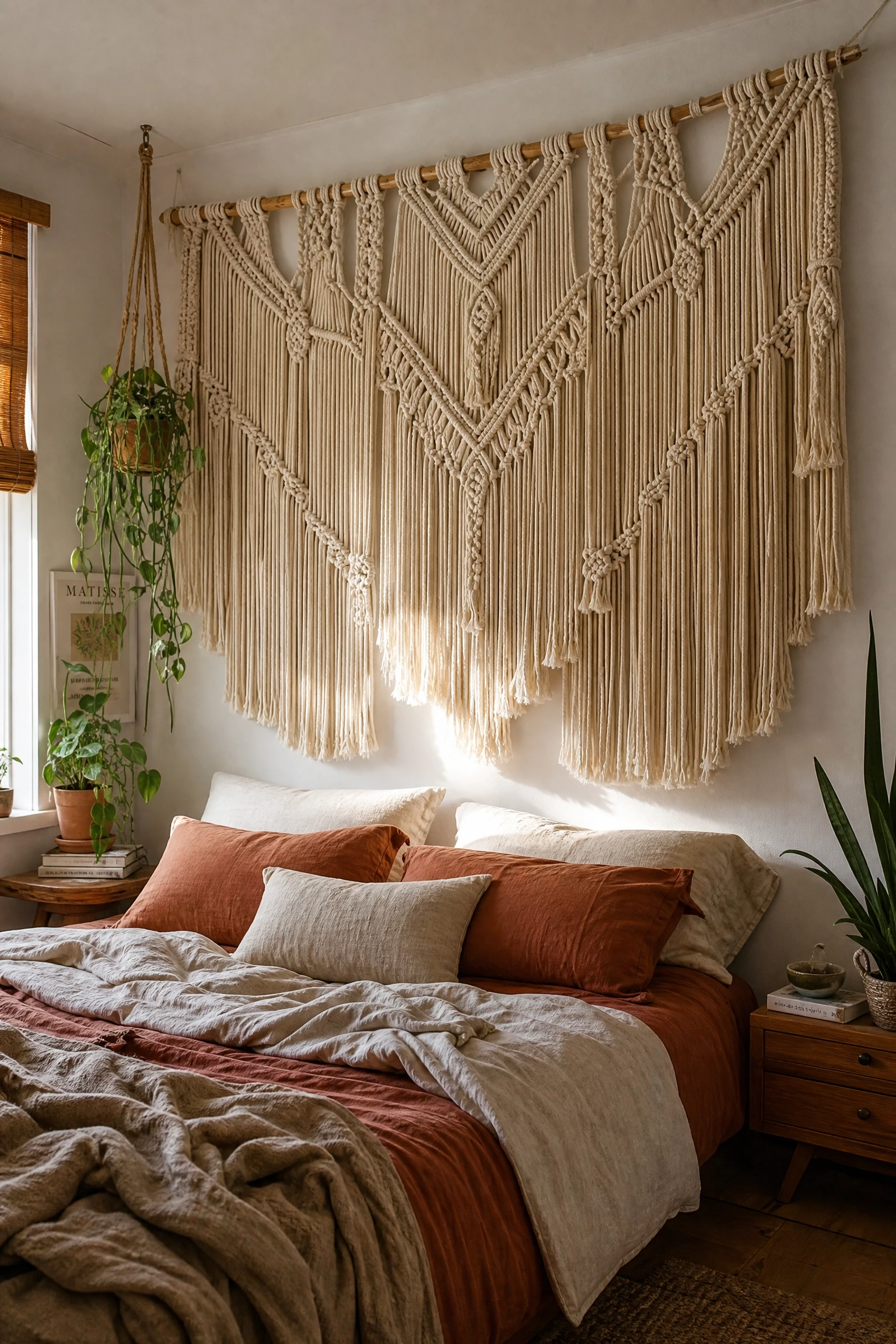
A large woven textile, macrame wall hanging, or mix used as the primary visual element on the bedroom headboard wall is technically not a wall treatment but functions as one: it fills the wall, anchors the bed, and defines the aesthetic of the room in the same way that paint or wallpaper does. The advantage over hard wall treatments is flexibility. A textile can be swapped out seasonally or as your taste changes without any repair or repainting. Woven and macrame pieces work particularly well in bohemian, natural, or eclectic bedrooms, and handmade or artisan-crafted pieces give the bedroom an authenticity that a mass-produced print rarely achieves. For the textile to read as a considered accent rather than a large decorative item, it needs to span most of the width of the wall above the headboard and have enough visual presence to hold its own at scale.
Reality Check: Large woven wall hangings and macrame pieces can shed fibres and collect dust more readily than painted or wallpapered surfaces. Consider this if you have allergies or a strong preference for low-maintenance bedroom spaces.
The most successful bedroom accent wall is not the most technically impressive or the most on-trend. It is the one that fits the room you have, the furniture you already own, and the atmosphere you are genuinely trying to create in your sleep space. Before committing to any of these ideas, spend a few minutes looking at your bedroom with fresh eyes: which wall naturally draws your attention when you walk in? What is the light like at different times of day? What is the dominant mood you want the room to have? Those answers will narrow the field considerably faster than any amount of scrolling.
The ideas in this list span a wide range of budgets, skill levels, and design commitments. A limewash treatment and a slatted wood panel wall are both achievable weekend projects. A hand-painted mural and custom Venetian plaster are longer-term investments. A mural wallpaper and an LED backlit niche sit somewhere in between. None of them are wrong choices, as long as they are chosen for the right room and the right reason. The rooms that feel most genuinely designed are always the ones where the accent wall looks like it belongs rather than like it arrived from somewhere else. Pick the idea that makes you feel most like yourself, not the one that had the most likes.
“Which of these accent wall directions actually matches the feeling you want in your bedroom? Drop your pick in the comments below.”
Frequently Asked Questions
Which wall in a bedroom should be the accent wall?
The wall behind the headboard is almost always the right choice in a bedroom because the bed is already the focal point of the room and the accent wall reinforces and frames it. Avoid choosing a side wall as the first option unless the headboard wall has an awkward window or door placement that makes it difficult to work with. The accent wall should be the first thing you see when you walk into the room.
Can I do a bedroom accent wall if I am renting?
Yes, with the right approach. Peel-and-stick wallpaper has improved significantly in quality and is now a genuine option for renters in most finishes including botanical prints, geometric patterns, and mural wallpapers. Large-scale woven wall hangings and textile installations require only a few small nail holes. Some removable adhesive panel systems also exist for timber slat and picture frame moulding looks. Always check your tenancy agreement before any wall treatment and photograph the original condition before starting.
How do I choose the right colour for a painted bedroom accent wall?
Start with the undertone of your existing furniture and bedding rather than picking a colour in isolation. Warm-toned rooms with timber furniture and cream textiles suit accent walls with warm undertones: terracotta, forest green, warm navy, and deep ochre. Cool-toned rooms with grey or white furniture suit cooler accent shades: slate blue, charcoal, sage, and cool teal. Order sample pots in your shortlisted colours and live with them on the actual wall for two to three days in different lighting conditions before buying a full tin.
Is wallpaper on just one bedroom wall a dated look?
Not at all, when it is done well. The dated version of the wallpaper accent wall involved a single busy feature wall in an otherwise completely plain room with no connection between the wallpaper and the rest of the decor. The current approach is much more considered: the wallpaper colourway connects directly to the bedding, cushions, or rug, and the other walls are in a tone pulled from the wallpaper rather than default white. That connection between the feature wall and the rest of the room is what makes a wallpaper accent wall feel designed rather than added as an afterthought.
How much does a bedroom accent wall typically cost?
The range is extremely wide. A painted accent wall using a quality paint like Farrow and Ball or Little Greene costs $40 to $80 in materials including brushes and masking tape. A limewash treatment runs $60 to $150 in materials for an average bedroom wall. Peel-and-stick wallpaper typically costs $80 to $200 for a standard headboard wall. Paste wallpaper from a design brand runs $150 to $400 depending on the pattern and roll size. Board and batten or shiplap DIY projects typically cost $150 to $350 in materials. Professional plastering or Venetian plaster finishes start at around $500 and can run considerably higher.
What are the most common mistakes people make with bedroom accent walls?
The most frequent mistake is choosing a wall that is not actually the natural focal point of the room, so the accent wall fights the layout rather than reinforcing it. The second most common issue is not connecting the accent wall to the rest of the room through colour, material, or tone so it looks like it belongs to a different space. Choosing a treatment that is too busy for the scale of the room is also common, as is not testing colours in the actual room with actual light before committing. And finally, forgetting to plan sconce, artwork, and shelf placement before a textured or plastered wall goes up, which makes drilling and mounting considerably more difficult after the fact.