Most articles about black accent walls show you what the wall looks like. This one tells you what to put with it. Because the decision to paint the headboard wall black is usually the easy part. What stops people from going through with it, or what makes them regret it after the fact, is everything that happens around the wall: the bedding that ends up looking washed out against the dark surface, the furniture that disappears into the colour rather than contrasting with it, the lighting that makes the whole wall feel like a ceiling in a car park rather than a moody and considered bedroom.
The ideas in this article are organized by pairing partner. Every idea starts with the black accent wall as a given and tells you specifically what to place alongside it, why that combination works, and what the honest risk is if you get the balance wrong. Pick the mood you want the wall to set, then work backward to the right finish and accent pieces. The black wall is the canvas. These are the decisions that turn it into a finished room.
Pairing Black With Warm Naturals
Warm natural materials are the most reliable antidote to a black accent wall that risks reading as cold or oppressive. Timber, rattan, linen, jute, and unglazed ceramic all share an organic warmth that softens the graphic quality of black and makes the bedroom feel genuinely liveable rather than aggressively styled.
1. Black Wall Paired With a Natural Timber Headboard
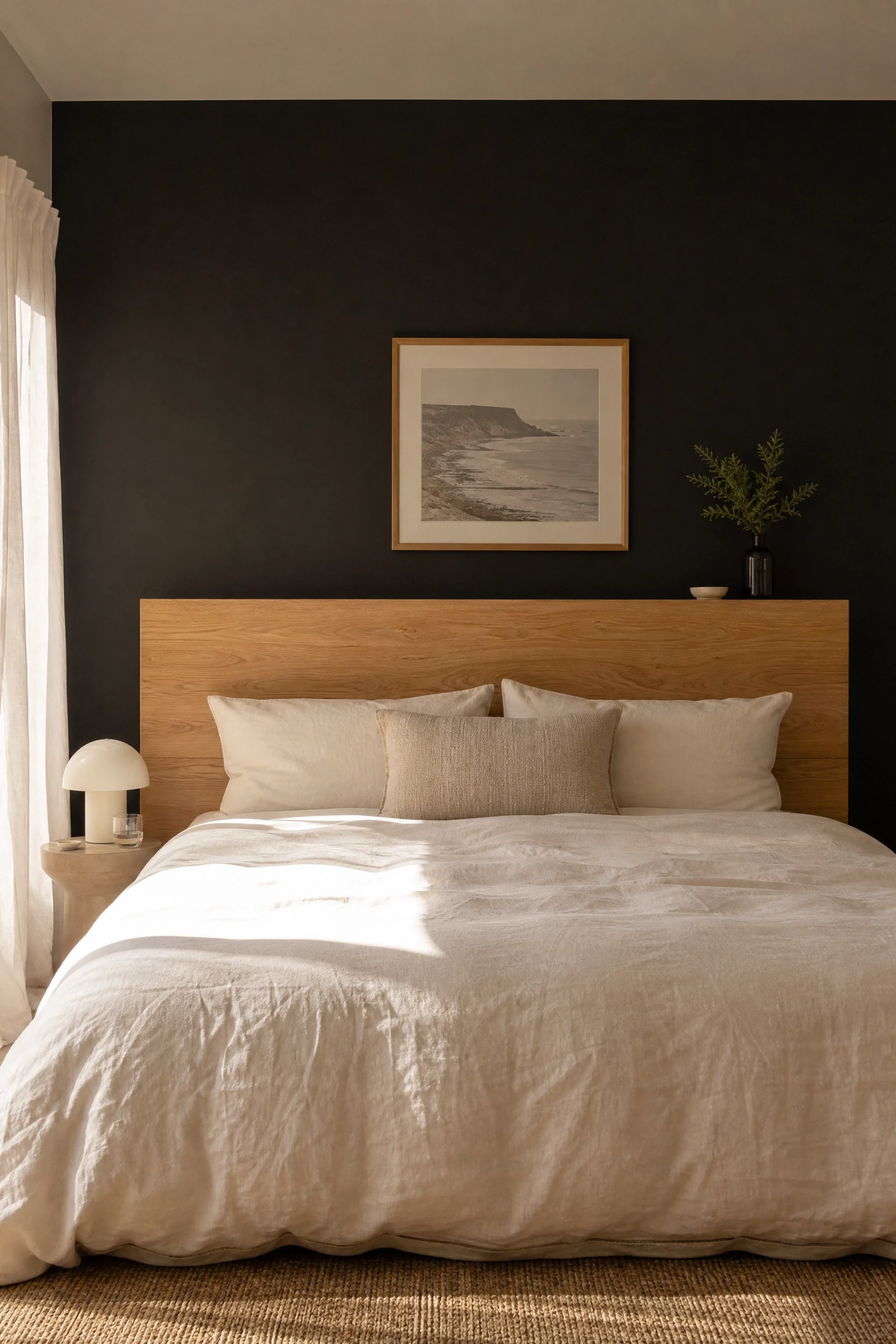
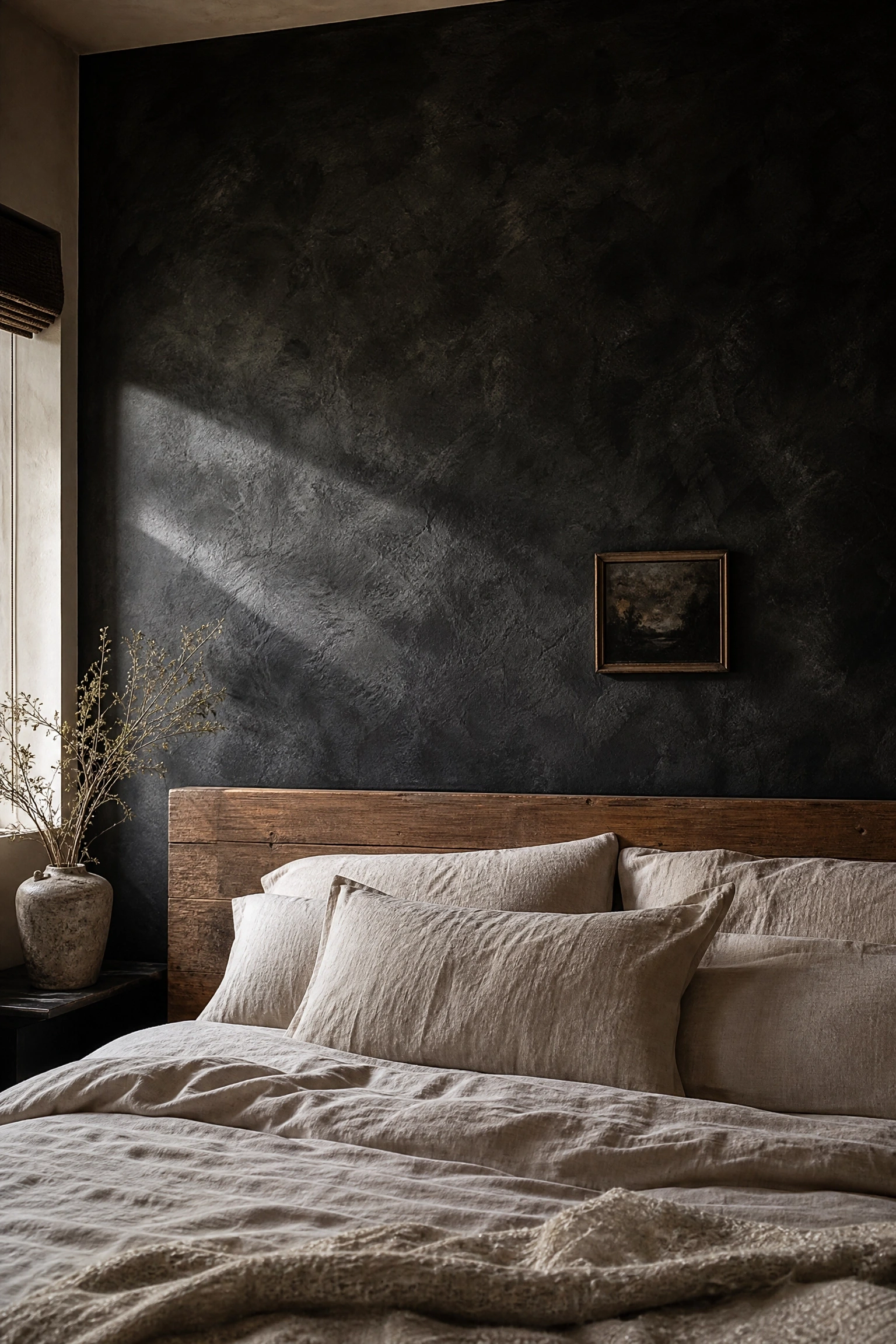
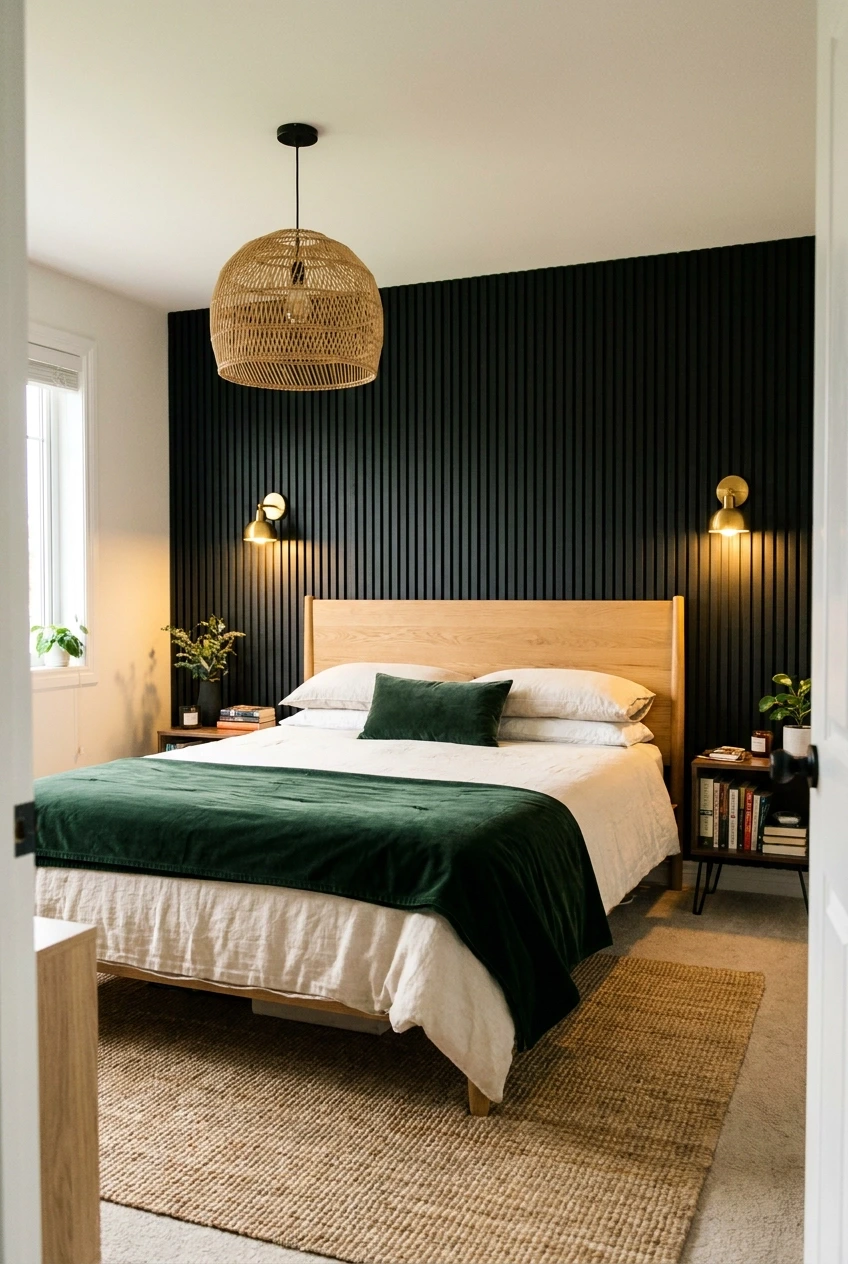
A natural timber headboard against a matte black accent wall is the combination that interior designers return to most consistently because the warmth of raw or lightly finished wood creates the exact counterpoint the dark surface needs. The grain pattern and tonal variation of timber means it reads very differently from the flat, light-absorbing quality of matte black paint, and the visual contrast between the two surfaces is sharp enough to make both elements register strongly without either overpowering the other. Oak, walnut, and light ash all work well, with the specific wood tone affecting the mood significantly: pale ash or blonde oak keeps the bedroom feeling light and Scandinavian, while darker walnut creates a more dramatic, richly tonal combination. Avoid heavily lacquered or very glossy timber finishes against a matte black wall, as the shine difference between a very glossy surface and a very matte one creates a visual dissonance that makes both finishes look unintentional.
Pro Move: Choose a timber headboard with a simple, clean profile rather than an ornate carved or upholstered design. Against a black wall, the silhouette of the headboard is what reads most clearly, and a clean geometric form creates the strongest visual relationship with the flat dark background.
2. Black Wall Paired With Cream and Oatmeal Linen Bedding
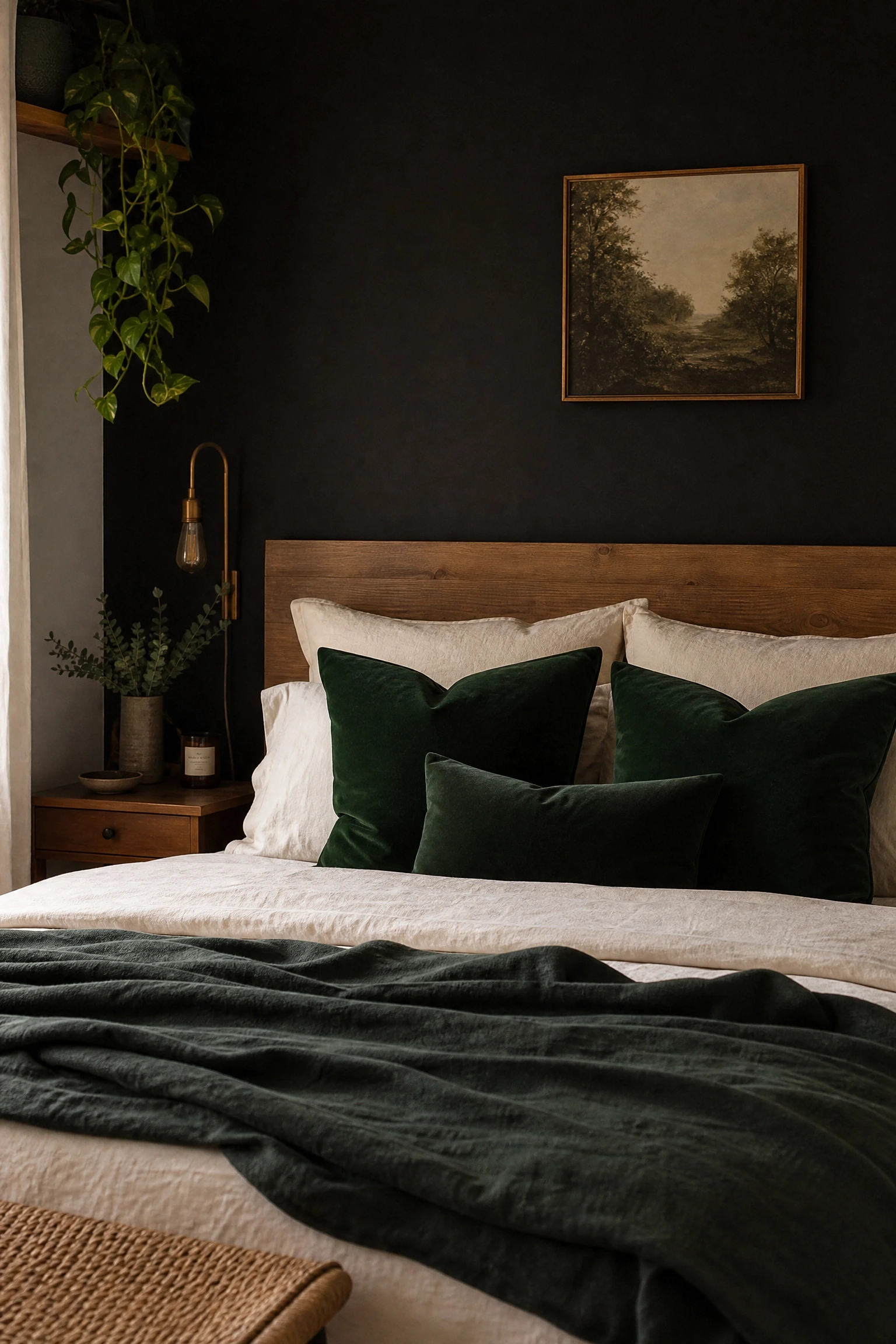
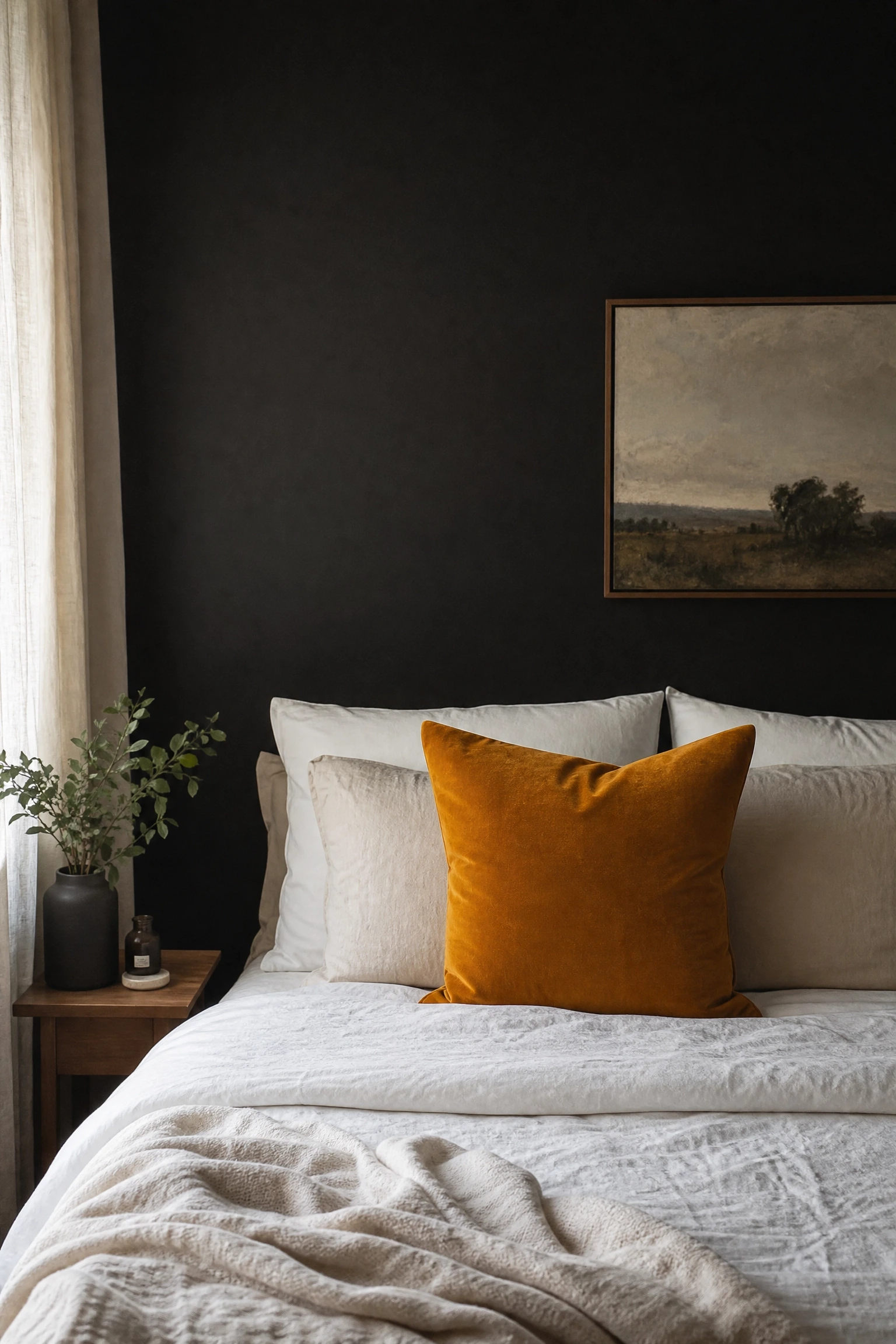
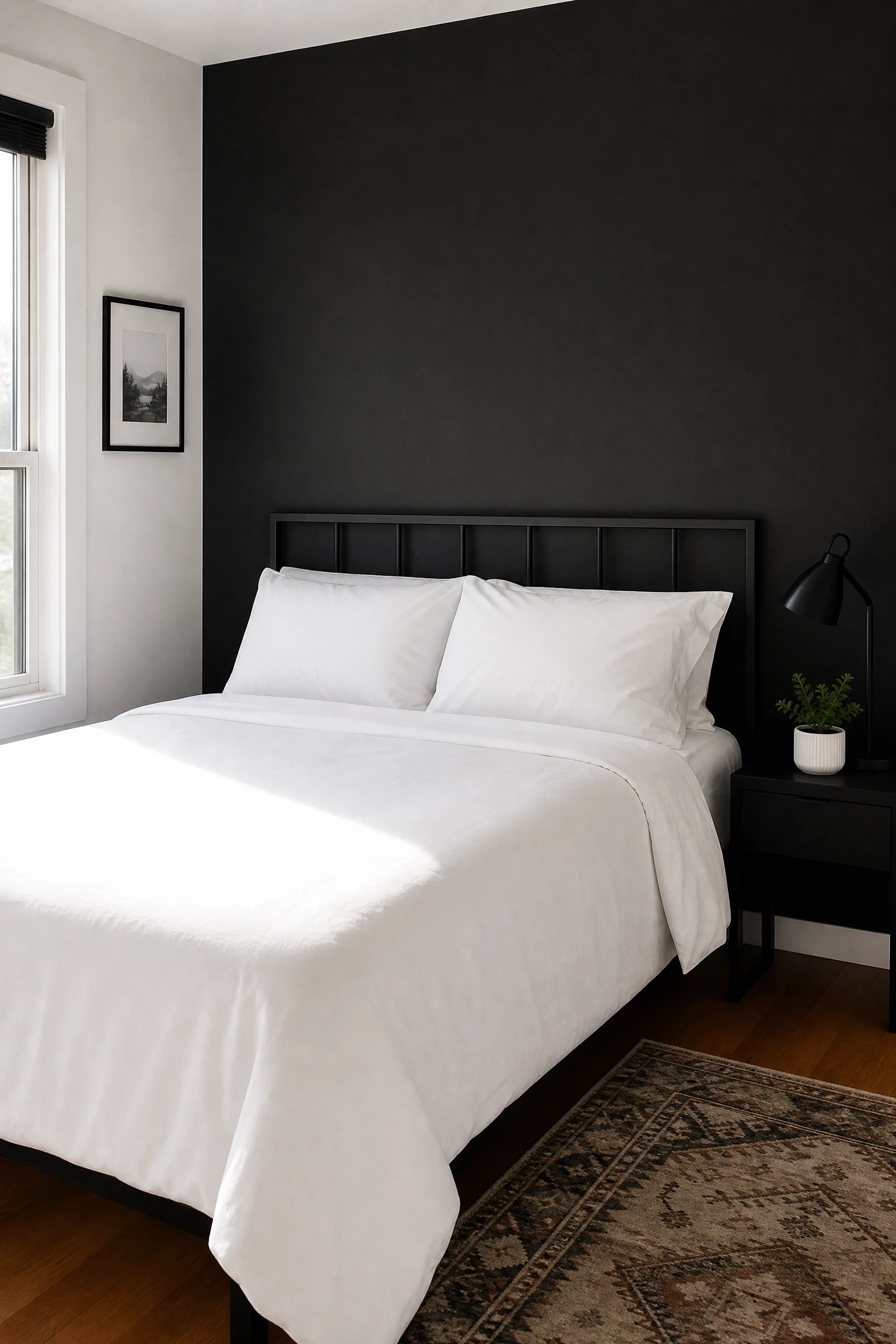
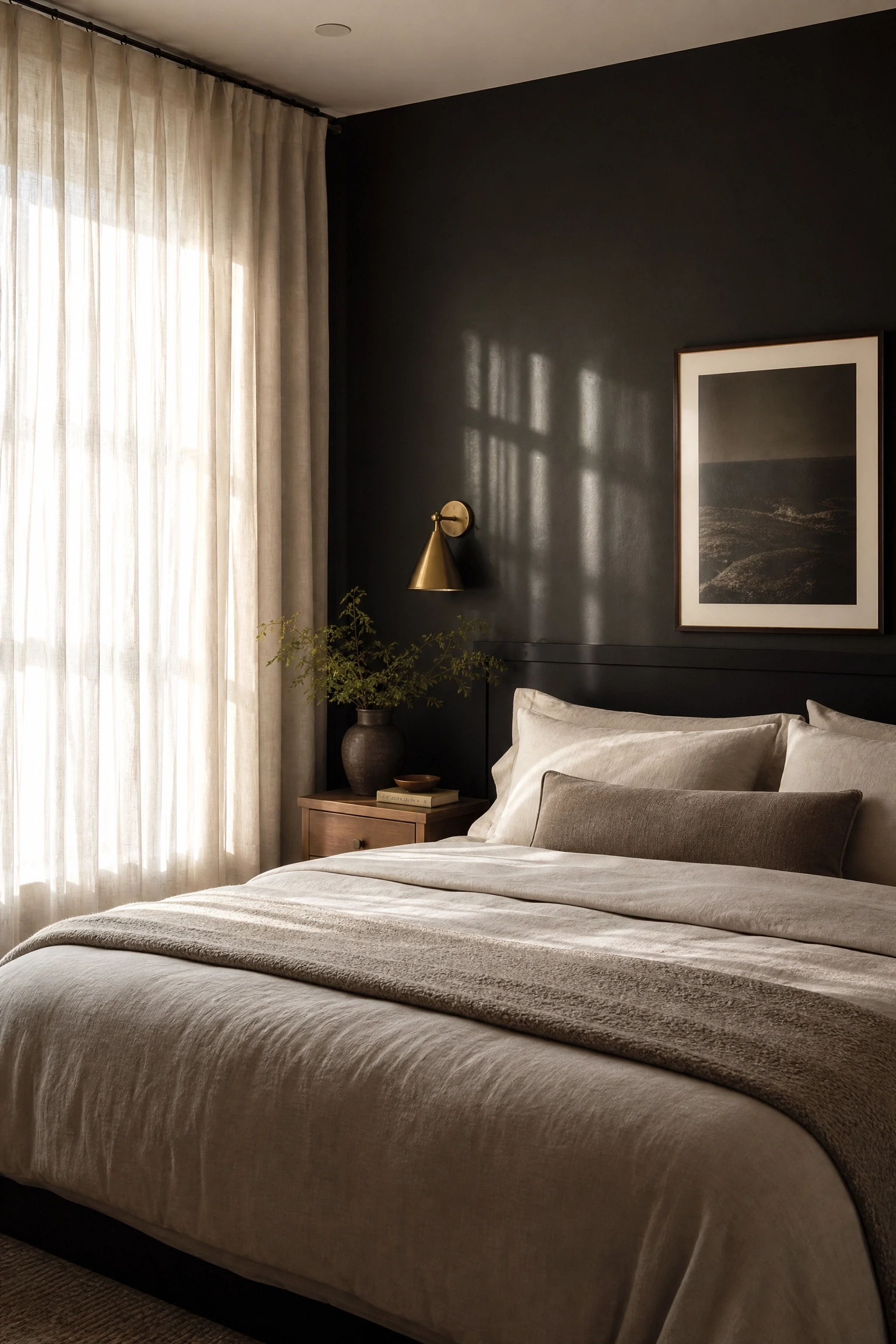
The most common mistake people make after painting a headboard wall black is choosing bedding that is too close in tone to the wall, which makes the bed disappear into the dark surface rather than standing out against it. Cream, oatmeal, and warm off-white linen bedding provides the contrast that makes a black accent wall work at its best: the pale bedding reads as luminous against the dark background and draws the eye to the sleeping surface in a way that darker bedding tones never achieve. Linen specifically is the right fabric choice because its natural texture, slight variation in tone, and characteristic relaxed crumple all read as warm and organic alongside the precise darkness of a black wall. A bed made with cream linen in front of a black accent wall has an editorial quality that is simultaneously dramatic and comfortable, which is the specific combination that makes this palette so visually satisfying when it works.
Designer Advice: Layer two or three shades of cream and warm white in the bedding arrangement rather than using a single flat tone. A cream duvet cover with a slightly warmer oatmeal pillow and a white cotton flat sheet visible at the fold creates depth and tonal variation that reads as considered and intentional against the flat dark background of the black wall.
3. Black Wall Paired With Warm Oak or Walnut Bedside Tables
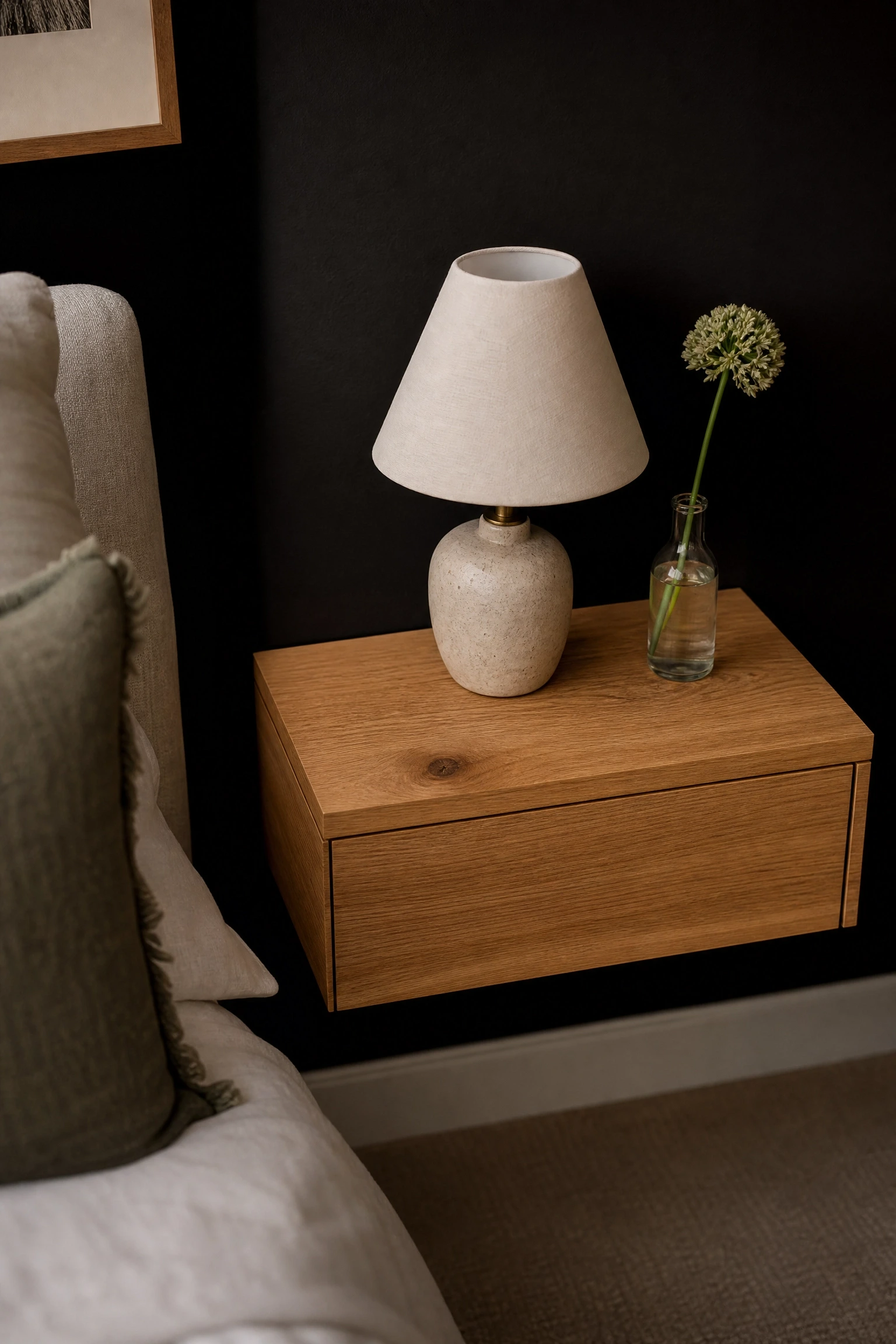
Bedside tables in warm timber, whether in a natural oak with an open-grain finish, a rich walnut with a subtle oil treatment, or a light ash with a simple wax, provide the material warmth that prevents a black accent wall from feeling stark at the ground level where the eye settles when sitting or lying in bed. The bedside table is the object you look at most when in the bedroom, more than the wall itself, and its material communicates the warmth or coldness of the whole arrangement. A floating or slim-legged timber bedside table at eye height when lying down creates a warm material anchor immediately in front of the black wall without obscuring the dark surface: the wall reads behind the table and the table sits in front of it as a separate element. The combination of the black wall receding behind the warm timber surface of the bedside table is one of the most consistently compelling visual relationships in bedroom design.
Quick Tip: Keep the timber on the bedside table in an open-grain or oiled finish rather than a very glossy lacquer when using it against a black accent wall. A very glossy timber surface reflects the dark wall back into itself rather than providing the material contrast that makes the pairing work.
4. Black Wall Paired With a Rattan or Woven Pendant Bedside Light
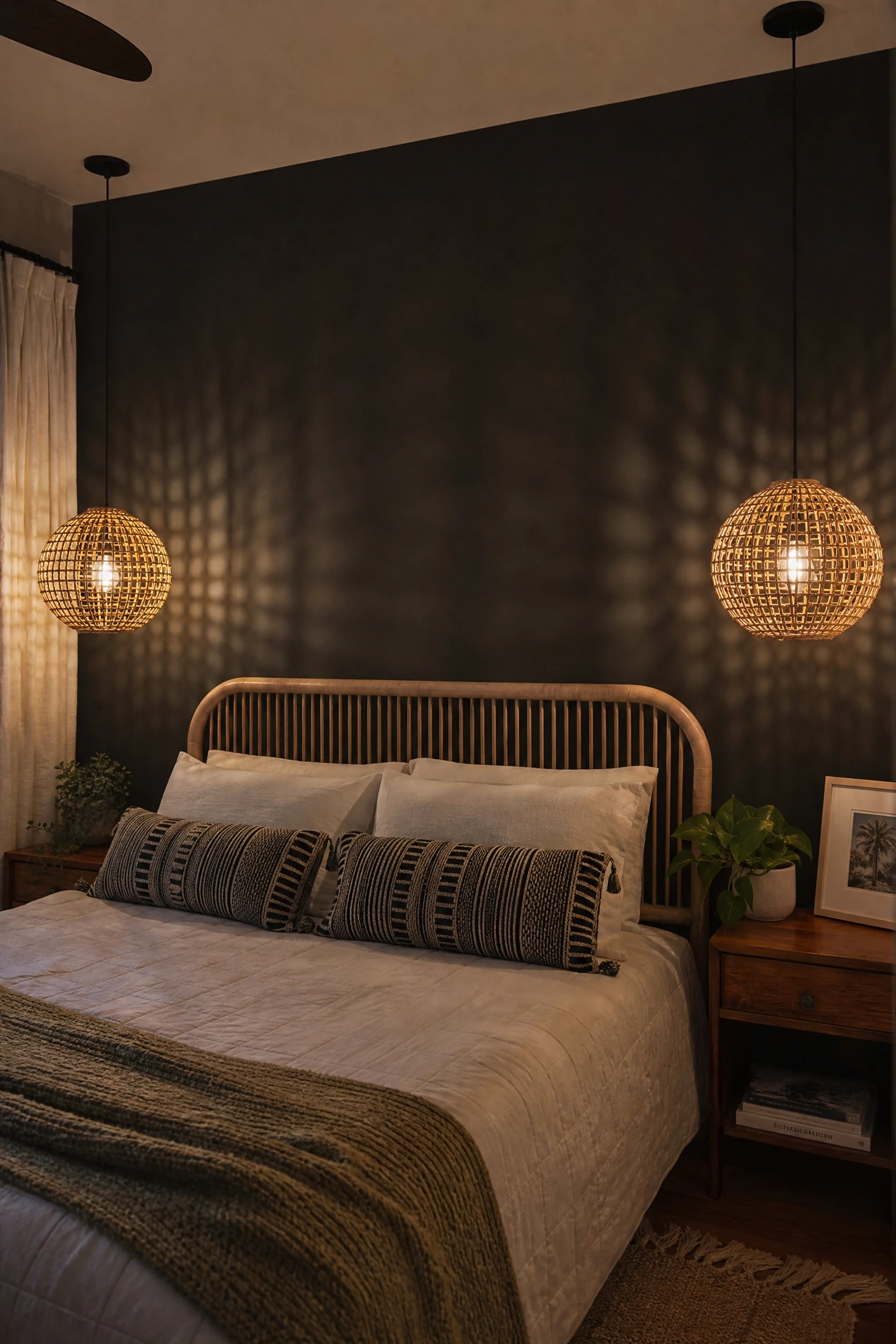
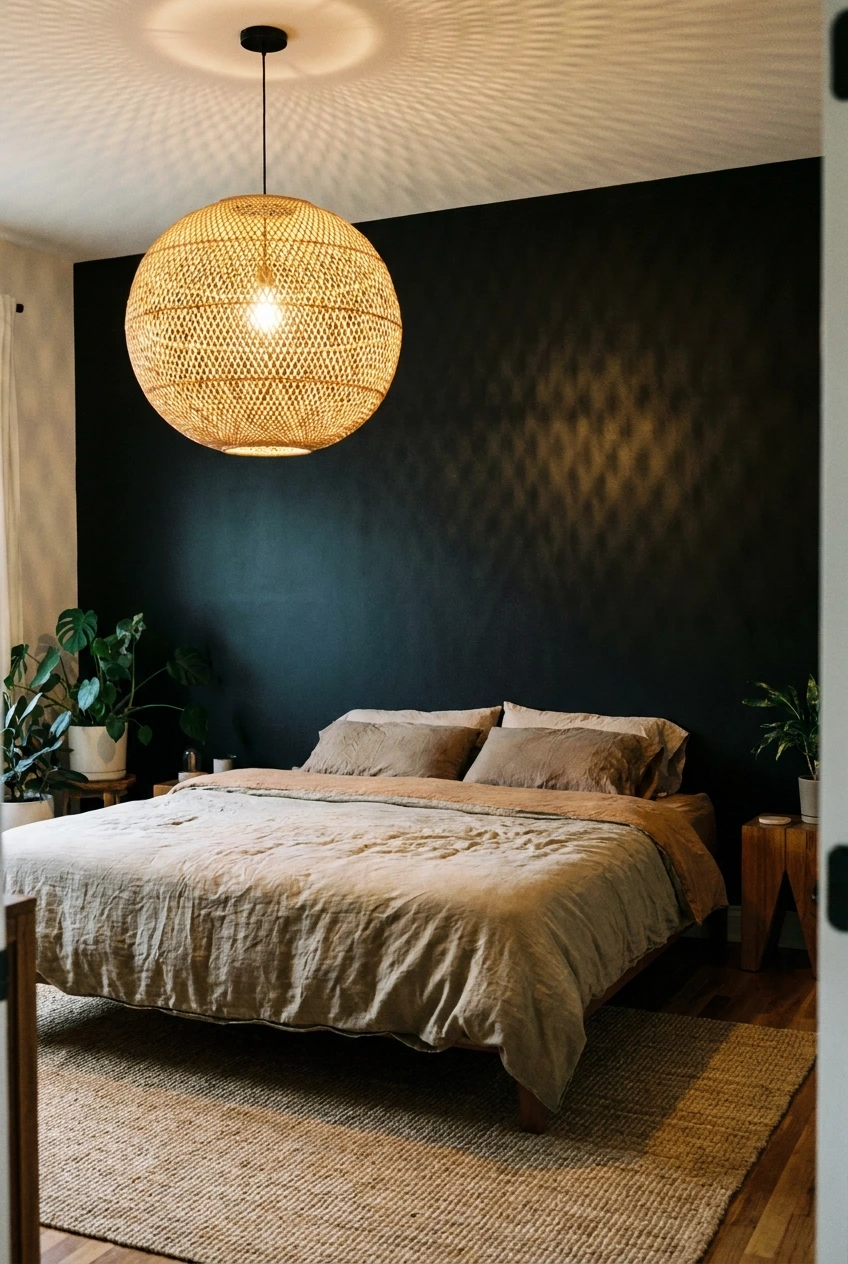
Rattan, woven bamboo, or paper pendant lights hung either side of the bed instead of or alongside table lamps introduce natural fibre texture at eye level against the black accent wall and create a warm, dappled light quality that suits a dark backdrop far better than any metal or ceramic shade. The open weave of a rattan pendant casts a pattern of light on the surrounding black wall surface when switched on, creating a gentle, organic shadow pattern that gives the dark wall a living quality it does not have when lit from a standard opaque shade. Two matching rattan pendants hung symmetrically either side of the bed against a black accent wall is one of the most widely replicated bedroom lighting arrangements in current interior design, and the reason it is reproduced so consistently is that it works reliably across a wide range of bedroom styles from coastal to farmhouse to contemporary minimal.
Heads Up: Rattan pendants hung against a black wall need warm-toned bulbs at 2700K to read as inviting rather than stark. A cool white or daylight bulb inside a rattan shade against a black wall creates a clinical quality that cancels the warmth of the natural material. Warm filament-style LED bulbs are the right choice.
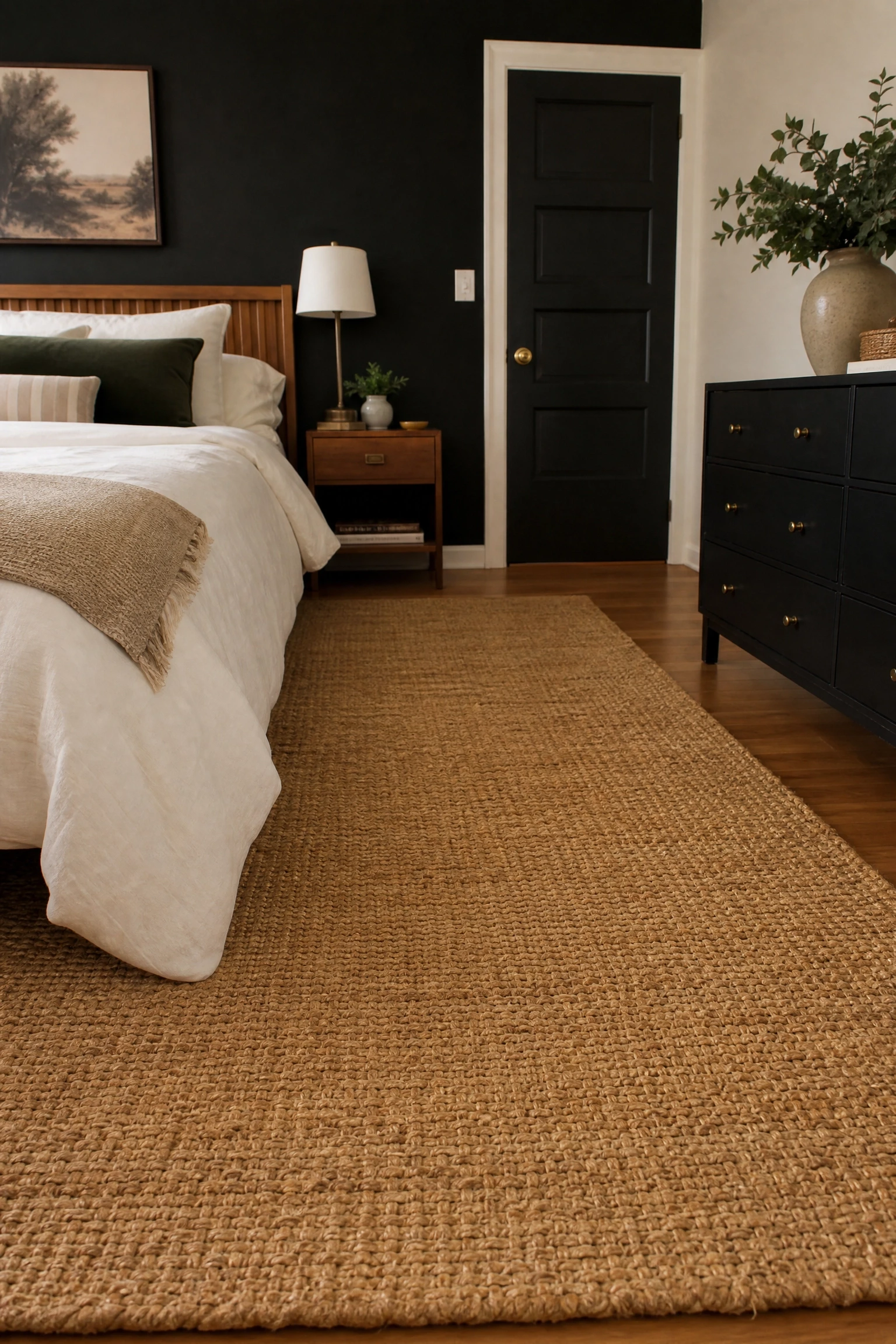
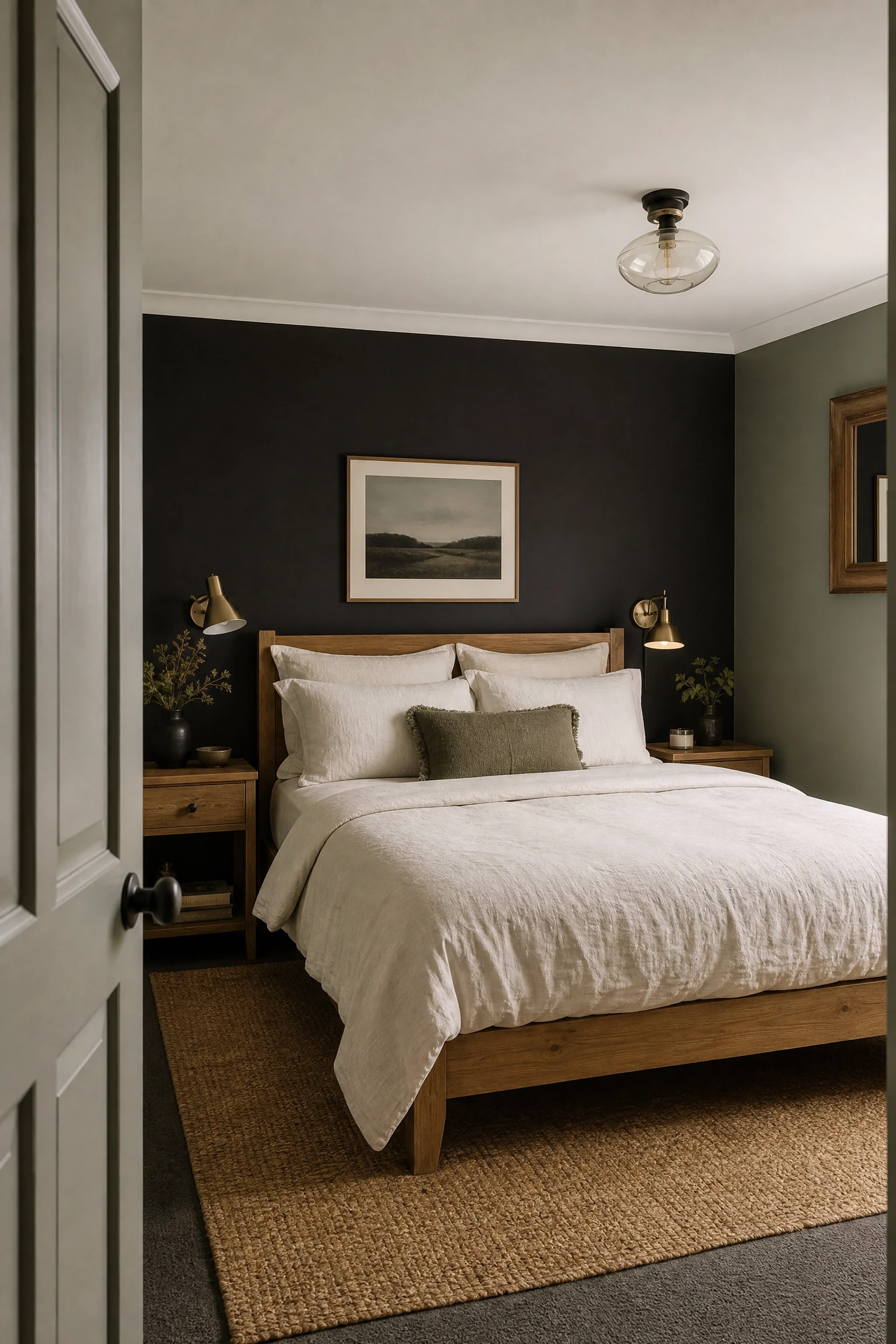
The floor in front of a black accent wall is part of the visual composition of the headboard wall arrangement, and a flat-weave jute or sisal rug in that zone introduces a warm, natural material at the lowest level of the room that grounds the whole design and prevents the dark wall from feeling as though it is floating in isolation above a hard, cold floor. The honey and natural-tone fibres of a jute rug reflect warmth at floor level that rises toward the black wall above it, creating a tonal gradient from warm and organic at the floor through the mid-tones of timber furniture and cream bedding up to the darkest point at the wall surface. In a bedroom where the floor is already a warm timber, the jute rug reinforces and concentrates that warmth directly in front of the bed. On a cooler grey tile or pale stone floor, the jute rug provides the warm material that the floor surface itself does not.
Reality Check: Natural fibre rugs including jute and sisal are not well-suited to bedrooms where people are barefoot regularly because the coarse weave is uncomfortable underfoot compared to a wool or cotton pile rug. A cotton flatweave in a warm natural tone achieves a similar visual effect with considerably better comfort underfoot for a bedroom environment.
6. Black Wall Paired With Terracotta and Earthy Accent Pieces
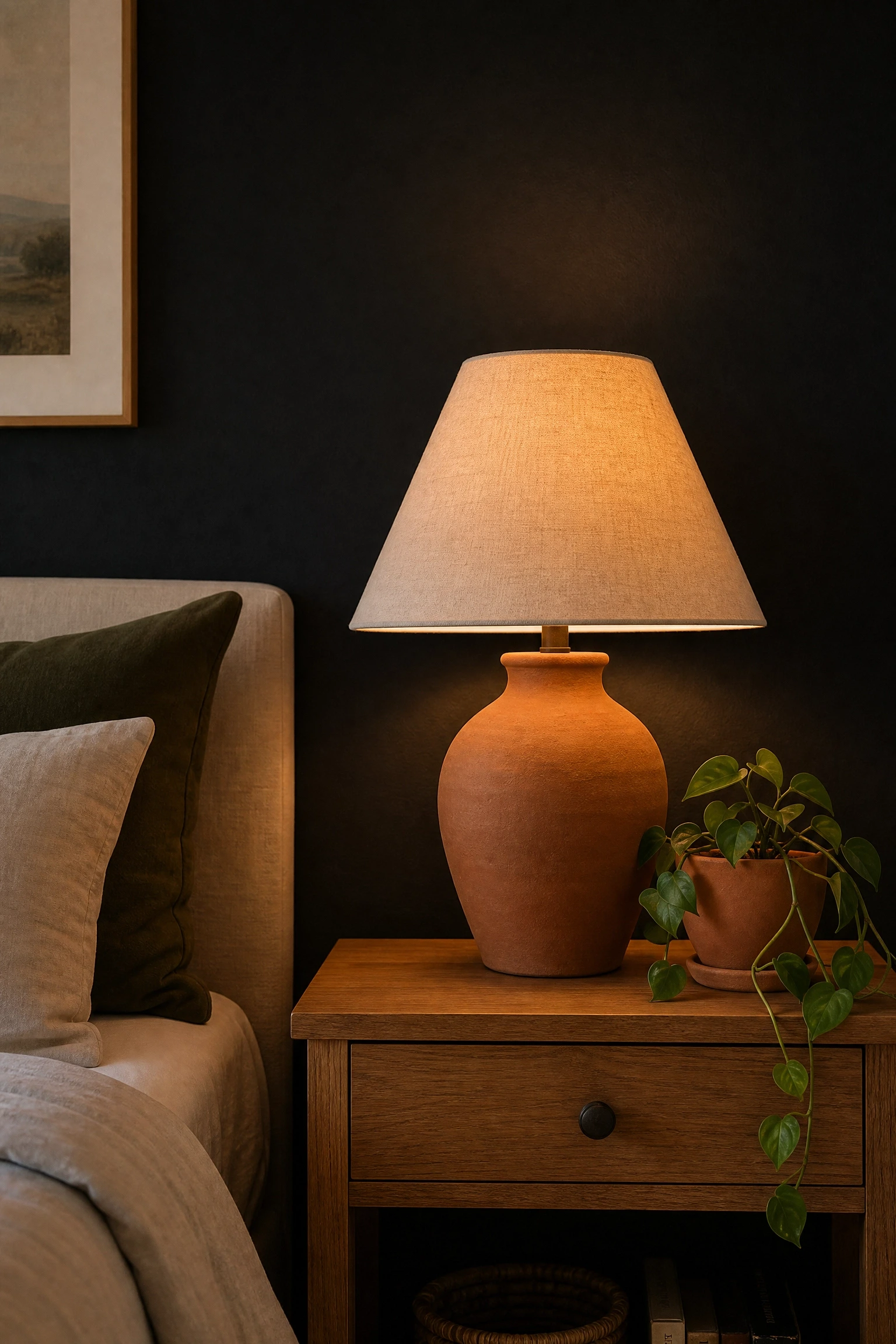
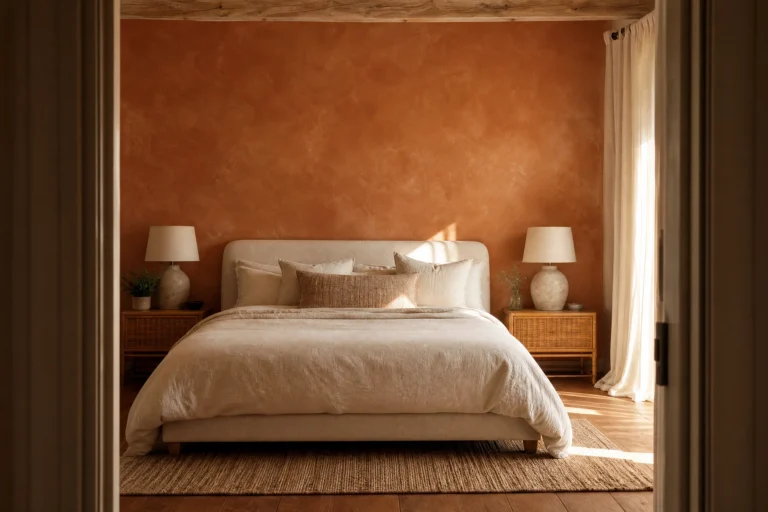
Terracotta toned accessories, a ceramic table lamp base in an unglazed terracotta finish, a small terracotta pot with a trailing plant on the bedside table, a terracotta-toned ceramic vase on the dresser, or a rust-orange throw folded at the foot of the bed, provide the warmest possible colour accent against a black headboard wall because the earthy orange-red of terracotta sits at the furthest colour distance from black on the warm side of the spectrum. The combination of matte black and terracotta is one of the most visually grounded pairings in current bedroom design, reading as simultaneously earthy, architectural, and deeply personal. A single well-chosen terracotta piece does more to warm a black accent wall than multiple neutral accessories combined, because the warmth of the colour is specific and precise in a way that cream and beige accessories, however well chosen, are not.
Designer Advice: Use terracotta in the bedroom accessories rather than in larger fixed elements like a rug or curtains when pairing it with a black accent wall. A terracotta rug alongside a black wall can tip the combination from warm and earthy toward something that reads as overly warm and heavy. Terracotta in accessories and small textiles is the right scale for this combination.
Pairing Black With Colour
A black accent wall is one of the best possible backgrounds for introducing colour into a bedroom because the dark surface makes every colour placed in front of or alongside it read more vividly than it would against white or pale walls. These pairings use that quality deliberately.
7. Black Wall Paired With Deep Forest Green Bedding and Textiles
Forest green alongside a black accent wall is the combination that repeatedly appears in the most considered bedroom interiors of the past few years, and the reason is that the two colours share a depth and richness that makes them feel like natural companions rather than contrasting elements. A deep, slightly muted forest green in bedding, cushions, and a throw against a matte black wall creates a bedroom that reads as dark and atmospheric but not cold, because the green introduces a living, organic quality that prevents the black from becoming oppressive. Velvet forest green cushions against black are particularly effective because the pile of the velvet changes tone in different light conditions, creating a richness that flat cotton in the same colour does not have. The combination works across a wide range of bedroom styles: in a minimal contemporary bedroom it reads as crisp and graphic, while in a more eclectic room with natural materials and plants it reads as lush and almost botanical.
Pro Move: Introduce forest green in three different textiles at three different scales: a large throw or duvet cover, a medium cushion, and a small accessory like a candle holder or a ceramic pot. The repetition of the colour at different scales creates a cohesive palette that reads as designed rather than accidental.
8. Black Wall Paired With Warm Mustard or Ochre Accents
Mustard yellow or ochre against a black accent wall creates one of the most energetic and visually confident bedroom colour combinations available because the yellow sits at a maximum colour distance from black and registers very vividly against the dark surface. This is not a subtle pairing and it works best in bedrooms where the intention is a bold, personality-led design rather than a calm, neutral resting space. A mustard velvet cushion, an ochre linen throw, or a warm yellow-toned lamp shade against a black wall each create a strong focal point of colour that draws the eye immediately. The key to making this combination work without it feeling jarring is keeping the mustard or ochre confined to one or two elements rather than spreading it across multiple surfaces: a single large mustard cushion against black is striking, while three different mustard-toned accessories of different sizes in the same space starts to read as chaotic rather than intentional.
Quick Tip: Choose a muted or earthy version of mustard rather than a bright, clean yellow. Warm ochre or dusty mustard tones have enough brown in their composition to sit comfortably alongside the deep darkness of black. A bright lemon or primary yellow against matte black can read as too high-contrast and visually uncomfortable in a room intended for sleep.
9. Black Wall Paired With Dusty Rose or Blush Pink
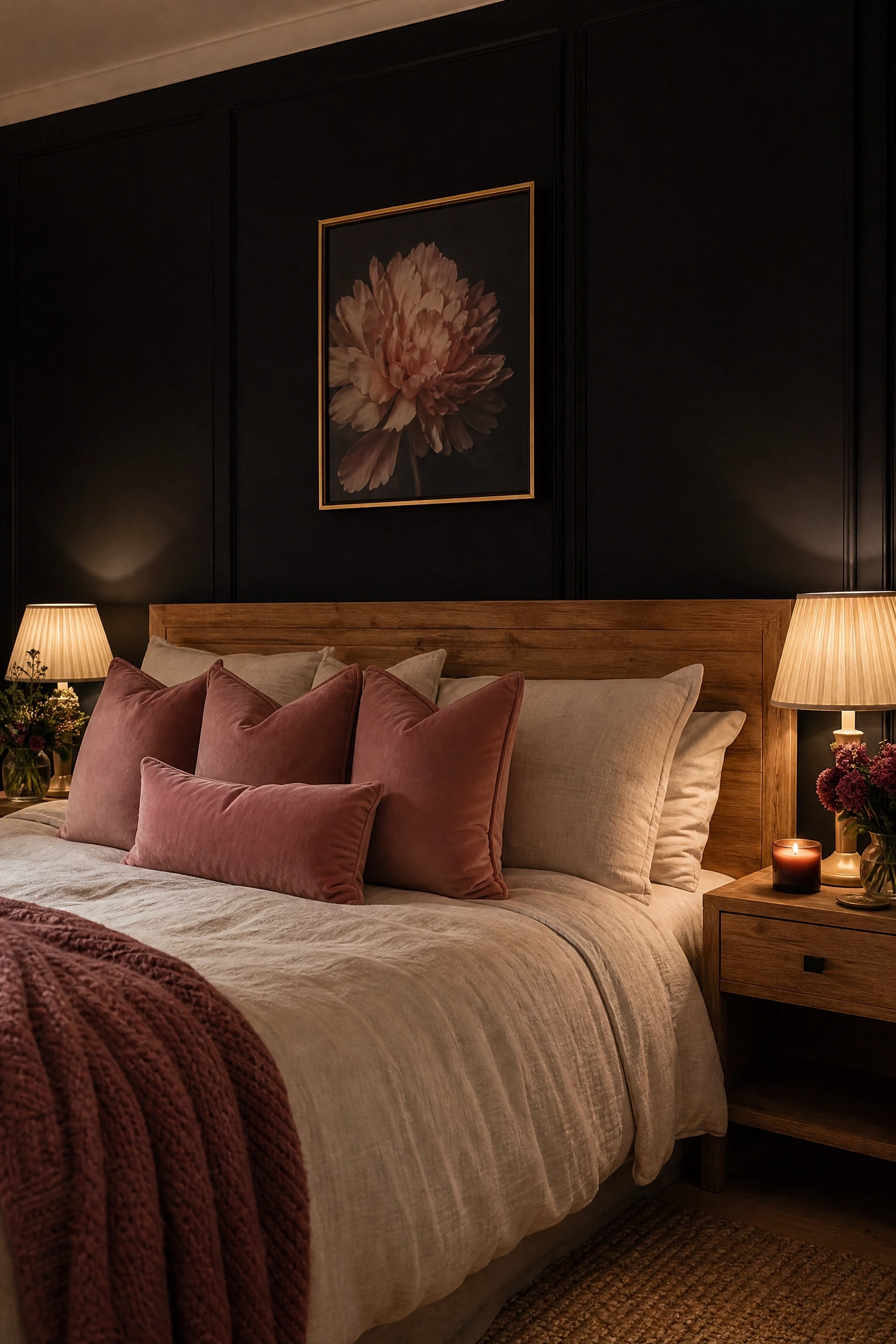
Blush pink or dusty rose alongside a matte black accent wall is a pairing that works specifically because of the tonal and temperature contrast between the two colours: the cool precision of black sits against the warm, flushed quality of blush and the resulting combination feels simultaneously bold and romantic in a way that neither colour achieves alone. This pairing is particularly effective when the blush appears in a velvet fabric, where the pile creates a softness and luminosity that intensifies the warmth of the colour against the cool dark wall. Blush linen bedding, a dusty rose velvet headboard cushion, and a small pink ceramic accessory on the bedside table create a layered blush presence that builds gradually across the bed arrangement rather than arriving all at once. The risk is an excess of pink that makes the combination feel more feminine than the rest of the bedroom’s design direction intends: keeping the blush to the textile and accessory layer while the furniture remains in black, timber, or a neutral keeps the balance more gender-neutral.
Heads Up: Blush pink fades visibly in direct sunlight over time, particularly in velvet and linen fabrics. In a bedroom with south or west-facing windows that receive sustained direct sun, choose fade-resistant fabrics and consider lining any blush curtains to protect the colour.
10. Black Wall Paired With Sage Green Walls on the Three Remaining Sides
Rather than keeping the three non-accent walls in white or a neutral, painting them in a muted sage green alongside a black headboard wall creates a bedroom where the two wall colours work together to produce an atmosphere that is darker and more enveloping than a standard white-and-black combination but warmer and more organic than an all-dark room. The sage green connects the black wall to the idea of nature and living material, and the tonal relationship between a dusty, slightly grey-toned sage and a matte black is one of the most harmonious in current bedroom design. In practice, this combination reads differently in different light conditions: in morning daylight the sage walls are visually dominant and the black wall recedes as a dark background element, while in evening lamplight the black wall becomes the atmospheric anchor and the sage reads as a warm, neutral backdrop. Both readings are satisfying.
Reality Check: Painting all four walls in two distinct colours in a bedroom is a significant commitment that requires careful colour selection and testing. A sage green that has too much yellow in its undertone will fight the cool tone of black. A sage with too much blue will read as teal rather than green alongside a very dark wall. The right sage for this combination is one that sits in the grey-green range with a warm but not yellow undertone.
11. Black Wall Paired With Navy or Inky Blue Bedding
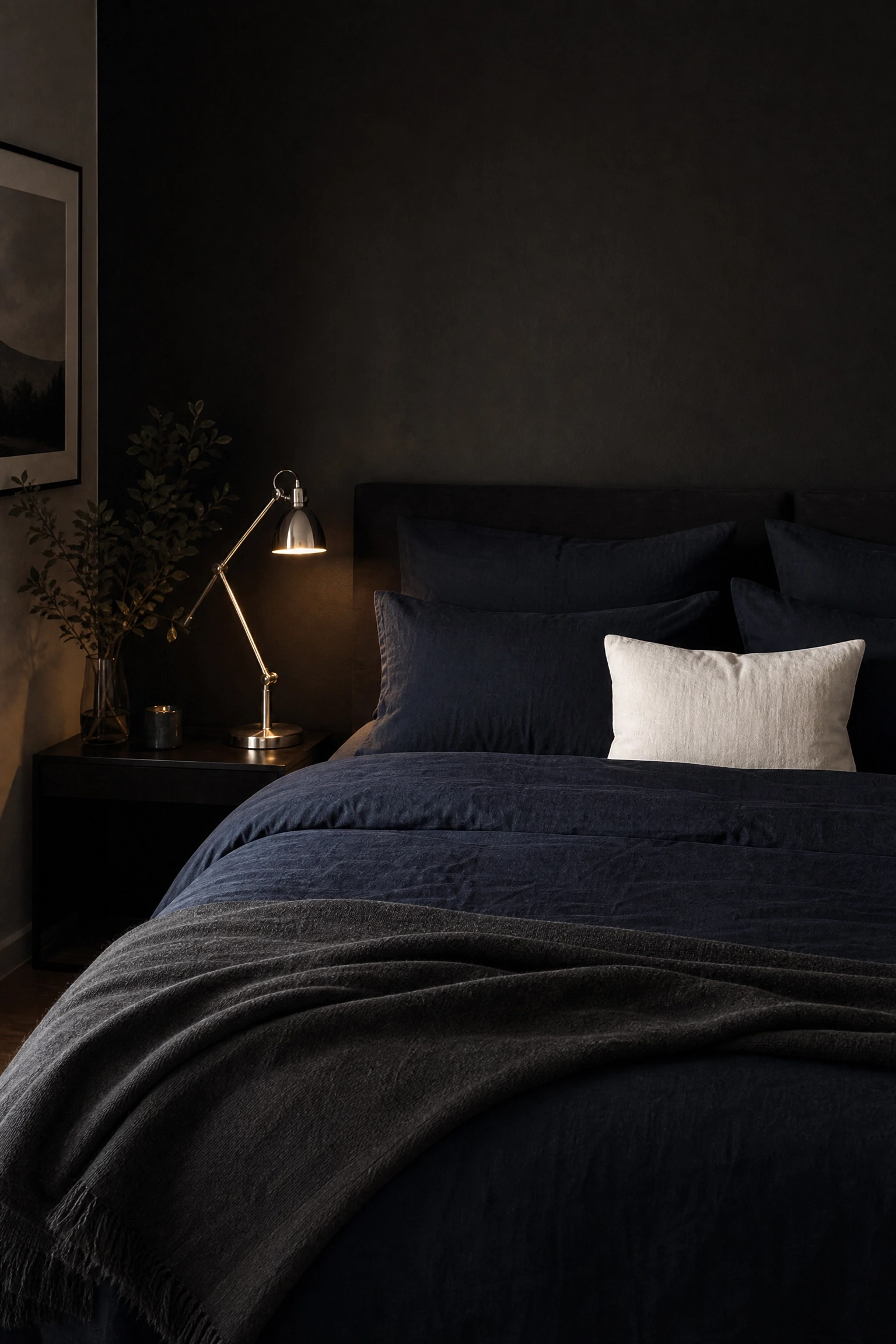
Navy blue or deep inky blue bedding alongside a black accent wall is one of the most monochromatic dark bedroom combinations available and it works because the two colours are close enough in tone to create a layered, textural composition rather than a high-contrast one. The effect is more like a tonal still life than a two-colour combination: the black wall provides the darkest point, the navy bedding sits in the mid-dark range, and lighter accent elements (a white pillow, a silver lamp, a brass fitting) provide the brightest notes at the top of the arrangement. This combination suits bedrooms that want drama and depth without the stark graphic quality of a black-and-white pairing, and it works particularly well in smaller bedrooms where the layered dark tones create a cocooning effect rather than a sense of constriction. The honest note is that a predominantly dark bedroom with dark walls and dark bedding requires more deliberate and more warmly toned lighting than a lighter bedroom to prevent the space from feeling genuinely oppressive.
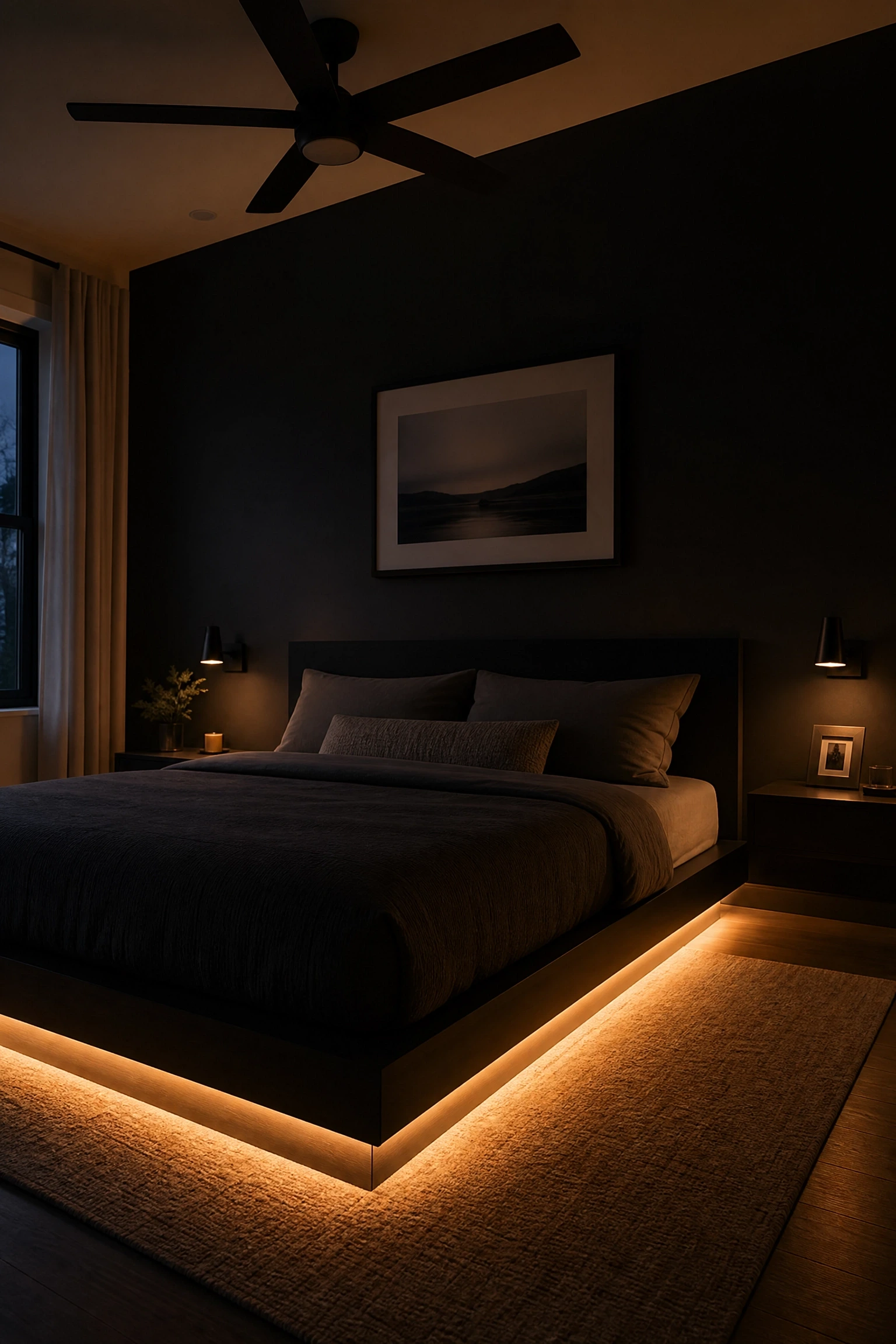
Designer Advice: In a dark-toned bedroom with a black wall and deep blue or navy bedding, position at least one warm light source at a height below the top of the headboard wall. A light source at mattress level or below, whether a low bedside lamp, a floor lamp in the corner, or under-bed lighting, creates a warm ground-level glow that makes the dark layers above it feel intentional and atmospheric rather than simply dark.
12. Black Wall Paired With Warm White and Crisp Bright White
The most classic version of the black accent wall bedroom is the one paired with crisp white bedding, white furniture, and white or pale grey walls on the remaining three sides. The contrast is maximum and the statement is unambiguous: the black wall does all the dramatic work and the white elements do all the brightening work, and the relationship between the two is so well-established in design history (think Art Deco, mid-century modern, contemporary minimal) that it never reads as dated. The critical decision in this combination is the shade of white: a warm white with a cream undertone creates a softer, more liveable contrast with the black wall, while a cool bright white creates a crisper, more graphic effect. Both are correct but they feel different: the warm white version feels more like a bedroom, the cool white version feels more like a design statement. Which one you choose depends on which quality you want your bedroom to lead with.
Reality Check: A black accent wall alongside very bright white walls and crisp white bedding requires both surfaces to be in excellent condition. Every mark on the white surfaces and every variation in the black paint application is more visible in this high-contrast combination than in any other. The wall needs to be well-prepared and properly painted, and the white linens need to be genuinely white rather than washed white.
“The black accent wall is already making the statement. The rest of the room just needs to decide whether it is going to answer warmly, boldly, or quietly.”
Pairing Black With Texture and Finish
A flat matte black wall is striking. A textured or finished black wall is extraordinary. These ideas address both the wall treatment itself and what pairs with different textural approaches to the black accent wall.
13. Black Limewash Wall Paired With Warm Linen and Raw Timber
Limewash paint applied in overlapping strokes and partially wiped back on a black or deep charcoal base creates a mottled, layered wall surface that reads as simultaneously ancient and completely contemporary. The variation in tone across a limewashed black wall, from near-black in the deepest areas to a warm grey in the highlighted areas, creates a surface that changes through the day as the light angle shifts and catches different facets of the applied texture. Paired with warm linen bedding in cream or oatmeal, raw or naturally oiled timber furniture, and simple ceramic accessories, a black limewash accent wall creates a bedroom with a depth and warmth that a flat painted wall in the same colour never approaches. The combination is particularly effective in older homes with textured plaster walls where the limewash picks up the underlying surface variation and adds an additional layer of aged, organic quality.
Pro Move: Apply black limewash in two layers for the deepest and most complex result: a first layer in a very dark charcoal left to dry completely, then a second layer in true black applied with a damp brush and partially removed while still wet. The two-layer technique creates the most visible tonal range across the surface and produces the most atmospheric finished result.
14. Black Shiplap or Horizontal Panelling Paired With Warm Farmhouse Elements
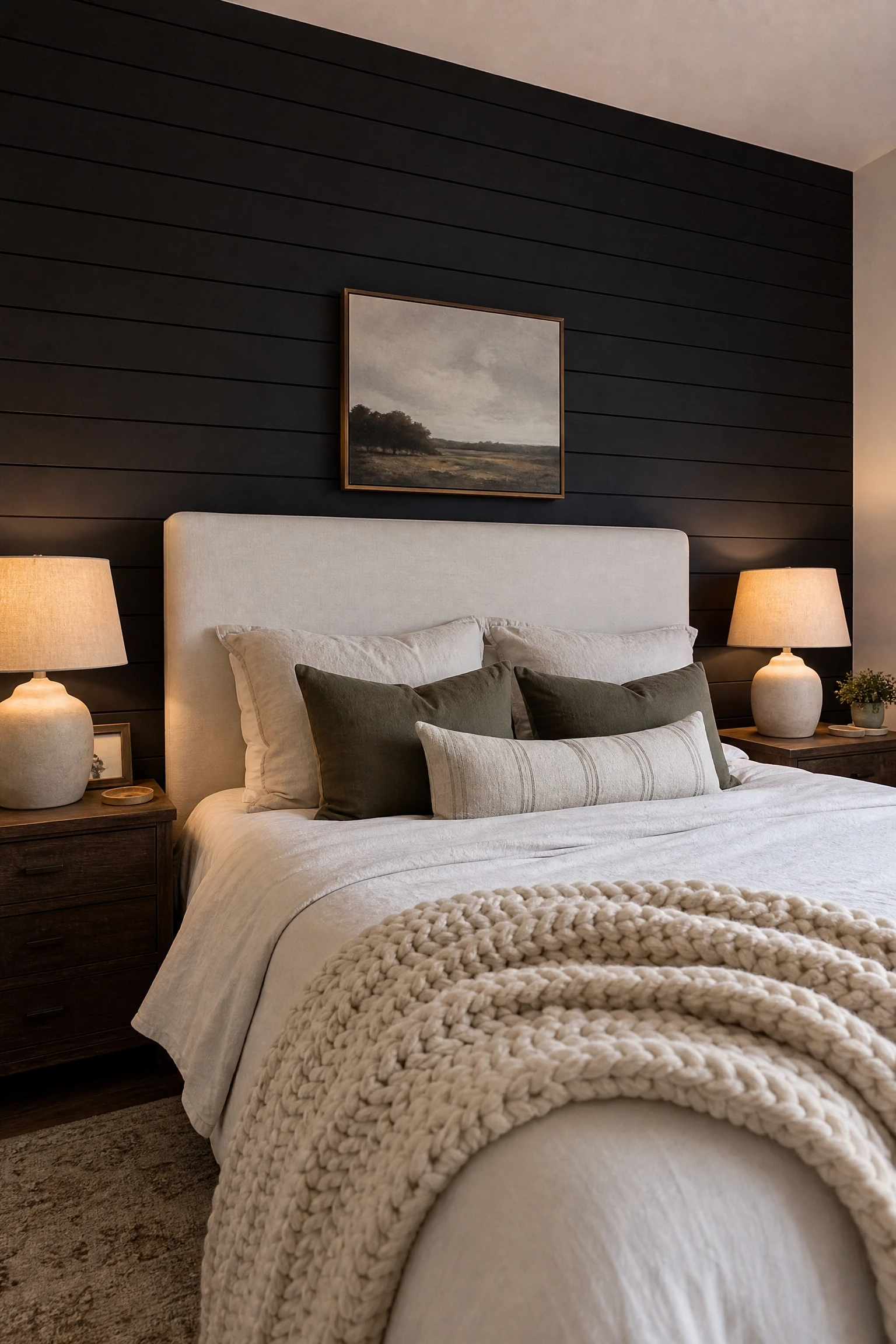
Shiplap or horizontal timber panelling painted in matte black on the headboard wall creates a surface with a strong horizontal rhythm and a regular shadow line between each plank that gives the black wall genuine texture and dimensional depth. The recessed channel between each plank creates a line of darker shadow that makes the wall read as layered rather than flat, and the horizontal direction of the planks makes the bedroom wall feel wider and more expansive rather than the closing-in quality that can result from a flat painted black wall. Against this textured black backdrop, warm farmhouse-style elements, a cream upholstered headboard, a chunky knit throw in natural white or oatmeal, ceramic bedside lamps with warm linen shades, and a woven jute rug, create a combination that is earthy, textural, and surprisingly soft despite the bold dark backdrop.
Heads Up: Black paint on timber panelling requires a primer coat and at least two finish coats to achieve a truly even and deep coverage, because the grain of the timber absorbs paint differently than a plaster or drywall surface. Skipping the primer or stopping at one finish coat typically results in a coverage that looks thin and patchy, particularly at the plank edges where the paint builds up slightly differently.
15. Black Fluted Panels Paired With Brass Hardware and Warm Lighting
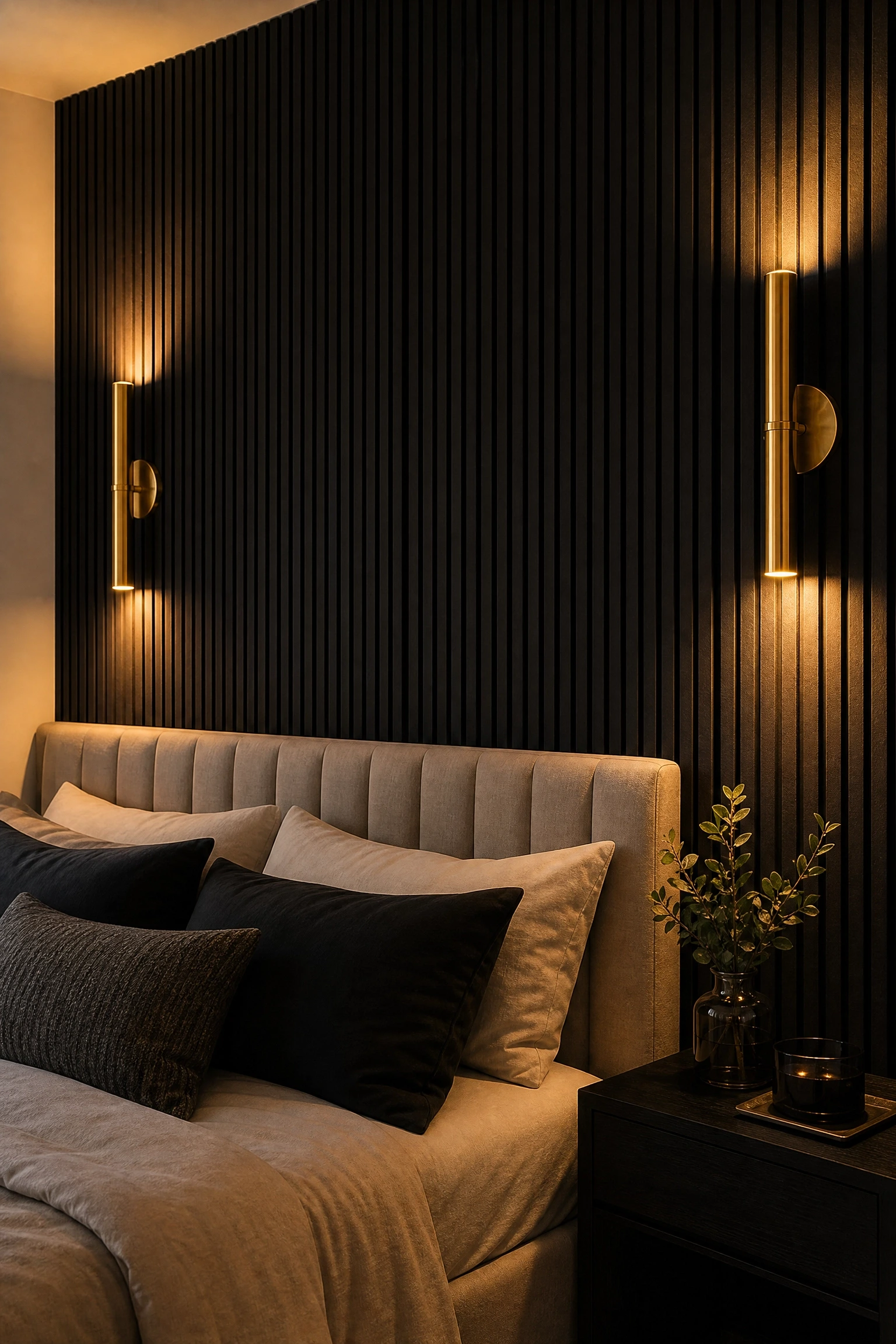
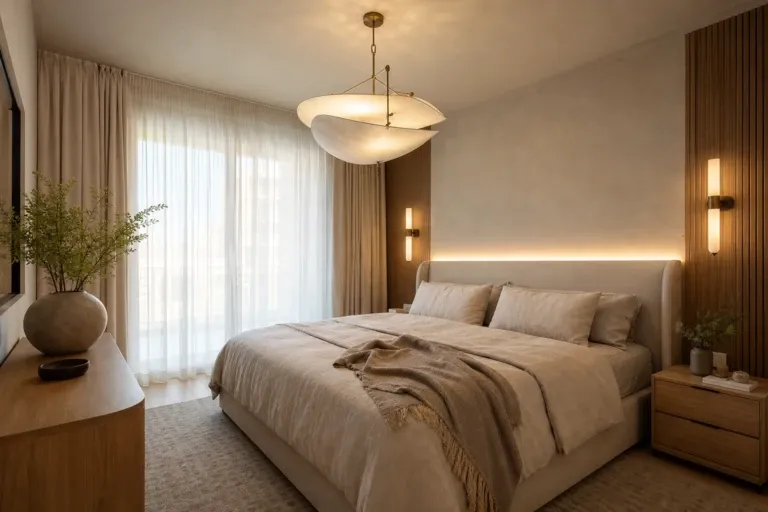
Black fluted MDF or timber panels on the headboard wall create a surface with a continuous vertical rhythm of light and shadow that changes visibly as the room light shifts through the day and evening. The narrow ridges of the fluted surface catch light at their outer faces and fall into deeper shadow in their recesses, creating a wall that has genuine three-dimensional texture visible from across the room. Paired with warm brass hardware, brass bedside sconces that mount directly onto the panel surface, and warm-toned bedding in cream or soft gold tones, a black fluted panel wall creates the most luxurious and hotel-like version of the black accent wall bedroom. The fluted surface amplifies the quality of the light from any fitting mounted on it: a warm brass sconce on a fluted black panel creates a pattern of warm light across the ridged surface that flat paint never produces.
Quick Tip: Run the fluted panels from floor to ceiling rather than stopping them at a mid-wall height for the most architectural result. Full-height fluted panels make the bedroom ceiling appear taller and give the treatment a genuinely built-in quality. Half-height fluted panels risk looking like a wainscoting decision that ran out of ambition rather than a complete design choice.
16. Black Matte Paint Paired With Picture Frame Moulding in the Same Colour
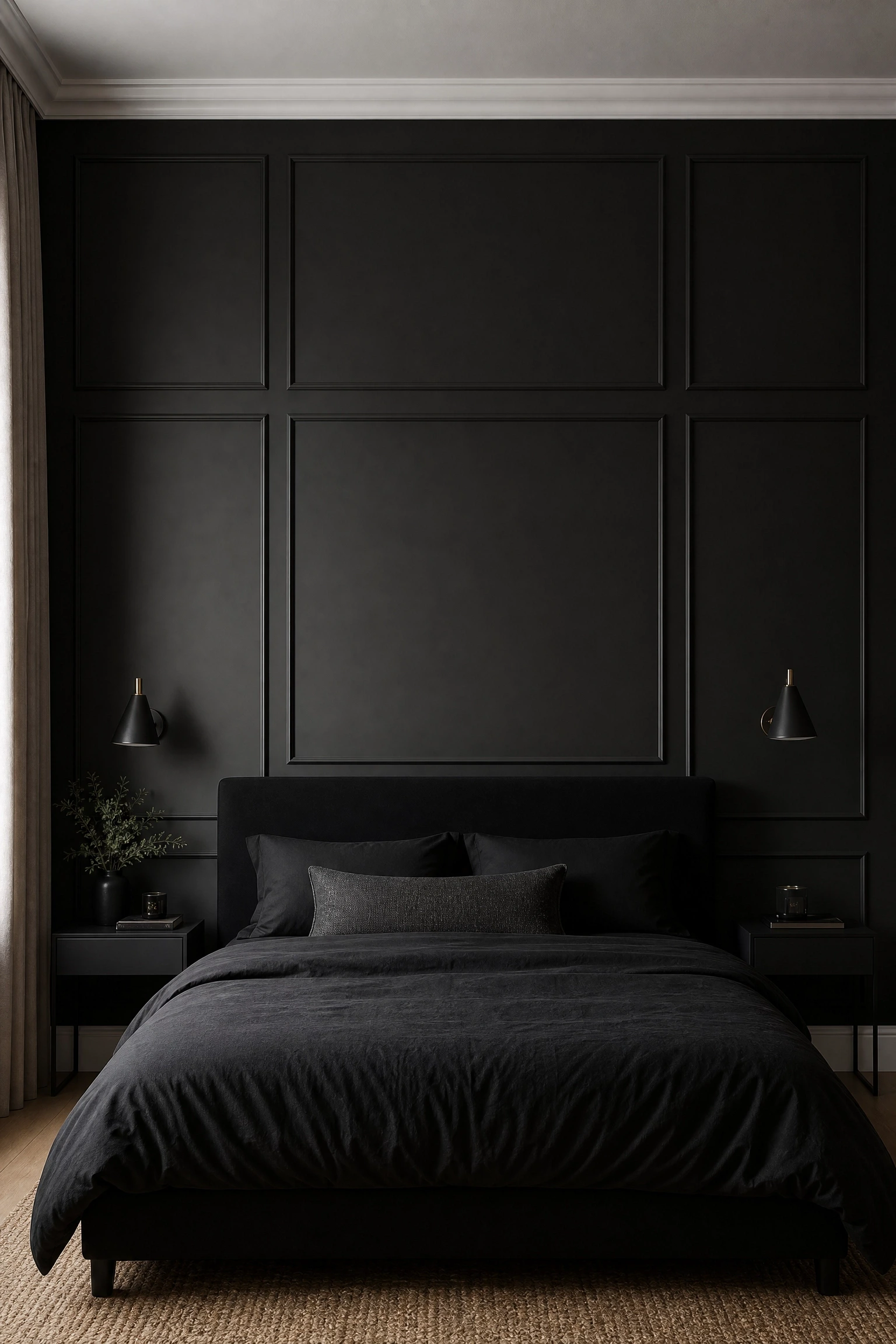
Painting the headboard wall in matte black and then applying picture frame moulding profiles in the same black colour, creating a tonal panel effect where the moulding reads through shadow rather than colour contrast, produces a wall that has the architectural depth and detail of a panelled wall without any visible colour break or paint change. The moulding is visible because the three-dimensional profile catches light differently from the flat wall surface around it, creating subtle shadow lines that reveal the panel structure when viewed from an angle. This approach is more refined and more grown-up than the standard painted accent wall and suits bedrooms that want drama with an architectural quality rather than simply a dark surface. Paired with white crown moulding at the ceiling and white skirting at the base, the black-on-black panel wall sits within a clean white frame that gives it visual definition and prevents it from reading as a flat dark mass.
Designer Advice: Use a satin or eggshell finish for the moulding profiles rather than the same matte finish as the wall itself, even in the same black colour. The subtle sheen difference between the matte wall and the slightly glossier moulding makes the panel geometry more visible in changing light conditions and adds a layer of sophistication that the same matte finish throughout does not provide.
17. Black Wallpaper Paired With Natural Wood and Botanical Elements
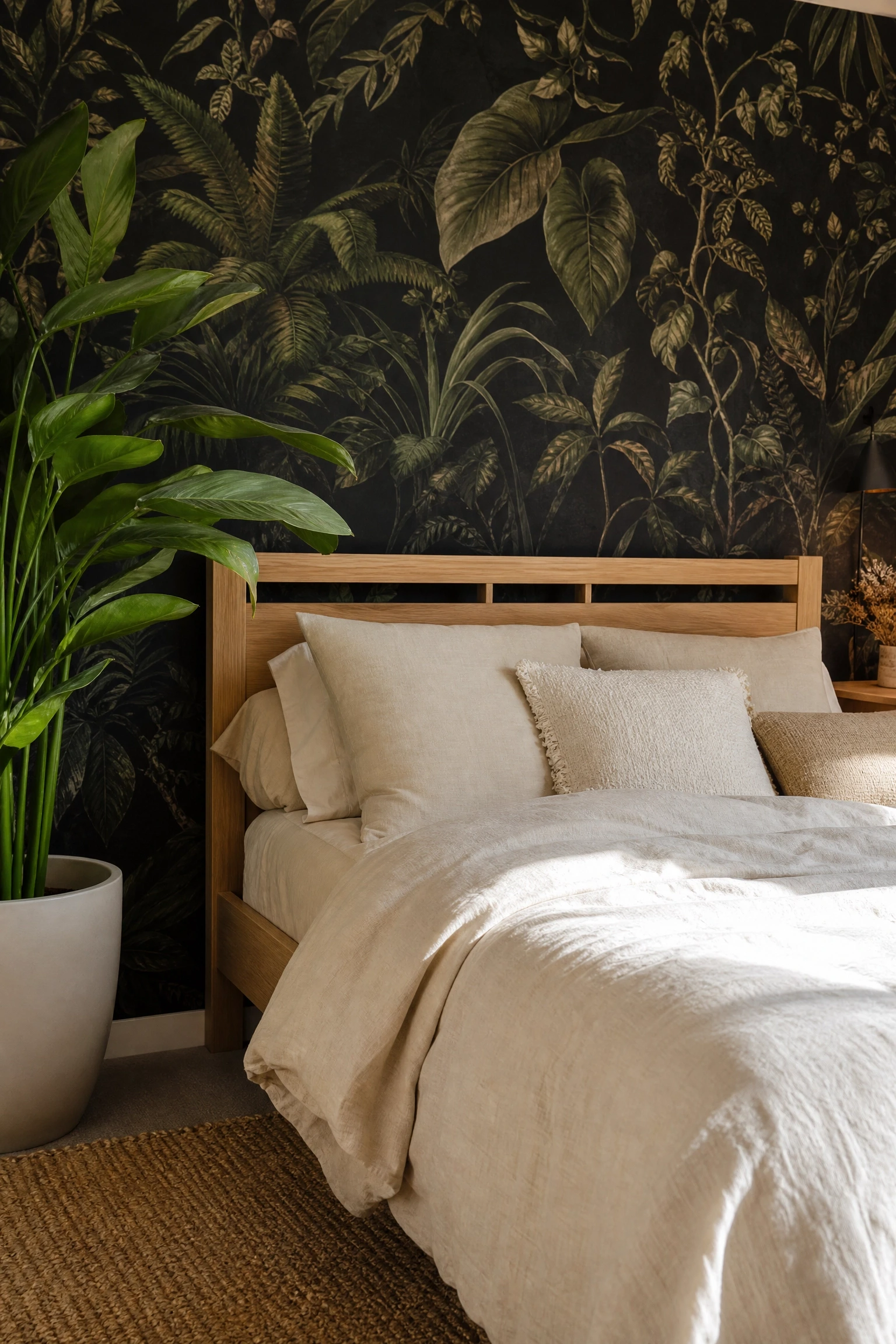
A black wallpaper on the headboard wall, whether in a botanical print with dark foliage on a black ground, a textured grasscloth-style in deep charcoal, or an abstract painterly design in dark tones, creates a wall surface that is both dark and complex in a way that flat paint cannot achieve. The pattern or texture of the wallpaper adds a layer of visual information to the black surface that makes the wall read as designed and layered rather than simply dark. Paired with natural light timber furniture, a bed frame in pale ash or bleached oak, warm linen bedding, and one or two actual plants positioned beside or in front of the dark patterned wall, a black botanical wallpaper creates a bedroom that reads as lush and deeply atmospheric. The plants in front of the dark botanical wallpaper create a visual dialogue between the printed and the real that makes the room feel genuinely alive.
Reality Check: Black wallpaper in a bedroom with limited natural light can create a room that feels very enclosed during the day even with all artificial lights on. Before committing to a dark wallpaper on the headboard wall, spend time in the bedroom during the middle of the day with the lights on and assess whether the existing light level is sufficient to make a dark wall feel atmospheric rather than oppressive.
18. Black Textured Paint Finish Paired With Metallic Accessories
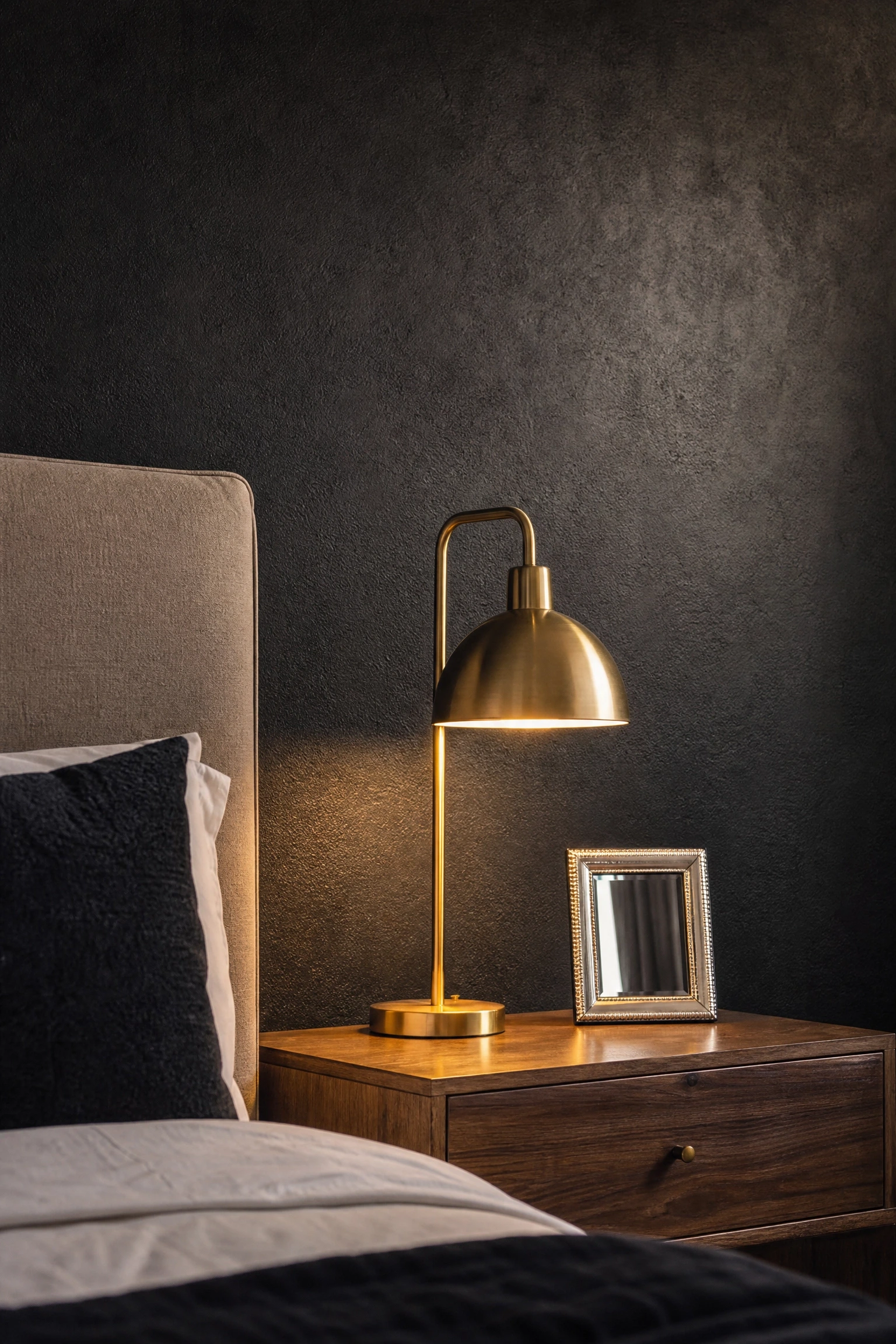
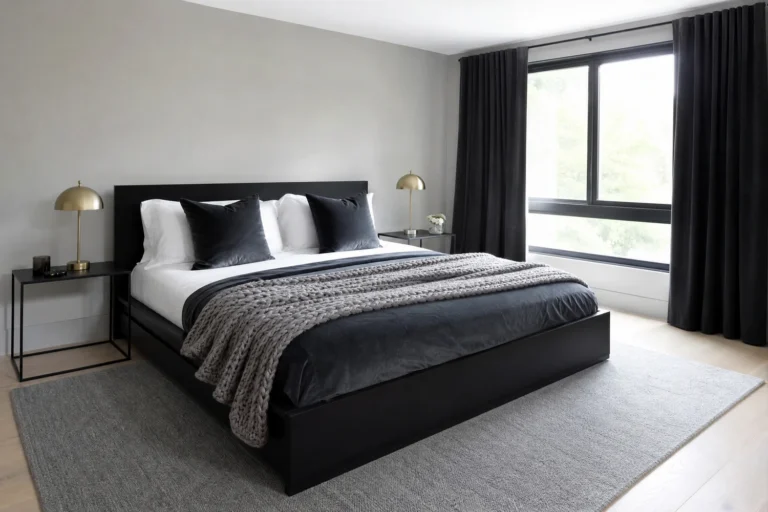
A textured paint finish in black or very deep charcoal, whether a suede-effect, a sand-texture, a plaster-effect, or a rough stone-effect product, creates a wall surface that is significantly more interesting at close range than flat matte paint and that responds to light in ways that activate the atmosphere of the bedroom in a way that a smooth surface does not. The microvariation of a textured black surface catches ambient light across its irregular face and creates a subtle shimmer and depth that reads as richness without being obviously metallic or reflective. Paired with metallic accessories, a brushed brass beside lamp, a silver framed mirror, polished chrome bedside table legs, or a warm gold-toned throw cushion, a textured black wall creates the most sophisticated version of the dark bedroom aesthetic: precise metallic elements against a rich, textured dark ground.
Quick Tip: Test any textured paint product on a primed sample board before applying to the actual wall. Textured paint products vary enormously in how the finished result looks at scale and in real room lighting conditions compared to the product swatch or website photograph. A sample board of at least 50 by 50 centimetres in the actual room is the minimum test before committing to a full wall application.
19. Black Painted Brick Paired With Industrial and Warm Elements
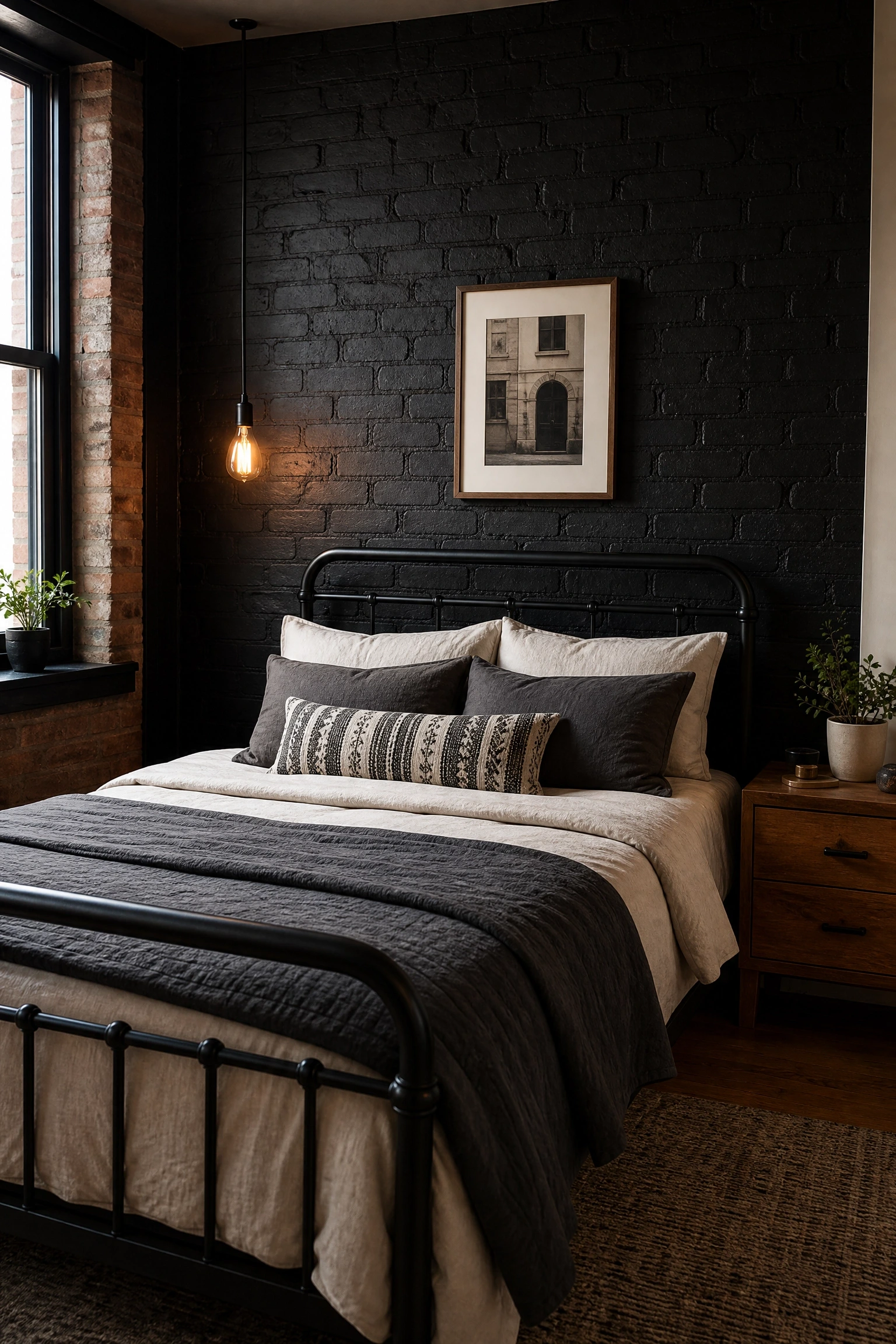
Where the headboard wall of a bedroom is exposed brick, painting it in matte black creates a wall surface with an inherent texture and depth that manufactured flat surfaces cannot replicate. The mortar joints between the bricks create a regular pattern of recessed horizontal and vertical lines that, when painted in the same black as the bricks, produce a relief pattern of light and shadow across the wall that is visible in any directional or raking light. Paired with both industrial and warm elements, a metal bed frame in matte black, a warm timber bedside table, an Edison bulb pendant, and a chunky wool throw in cream or charcoal, a black painted brick accent wall creates a bedroom with an urban, warehouse-style character that feels both rough-edged and genuinely comfortable. The texture of the brick ensures that the black wall never reads as flat or oppressive regardless of the light level.
Pro Move: Seal black painted brick with a penetrating masonry sealer before painting to prevent the brick from absorbing multiple coats of paint and producing a patchy result. Unsealed brick can require four or five coats of paint to achieve an even, deep black coverage, while sealed brick typically achieves full, even coverage in two coats.
Pairing Black With Light and Reflection
The most common failure of a black accent wall is a lighting strategy that was not updated when the colour was added. These ideas address what to do with light alongside a black wall specifically, and why different light sources create different effects on a dark surface.
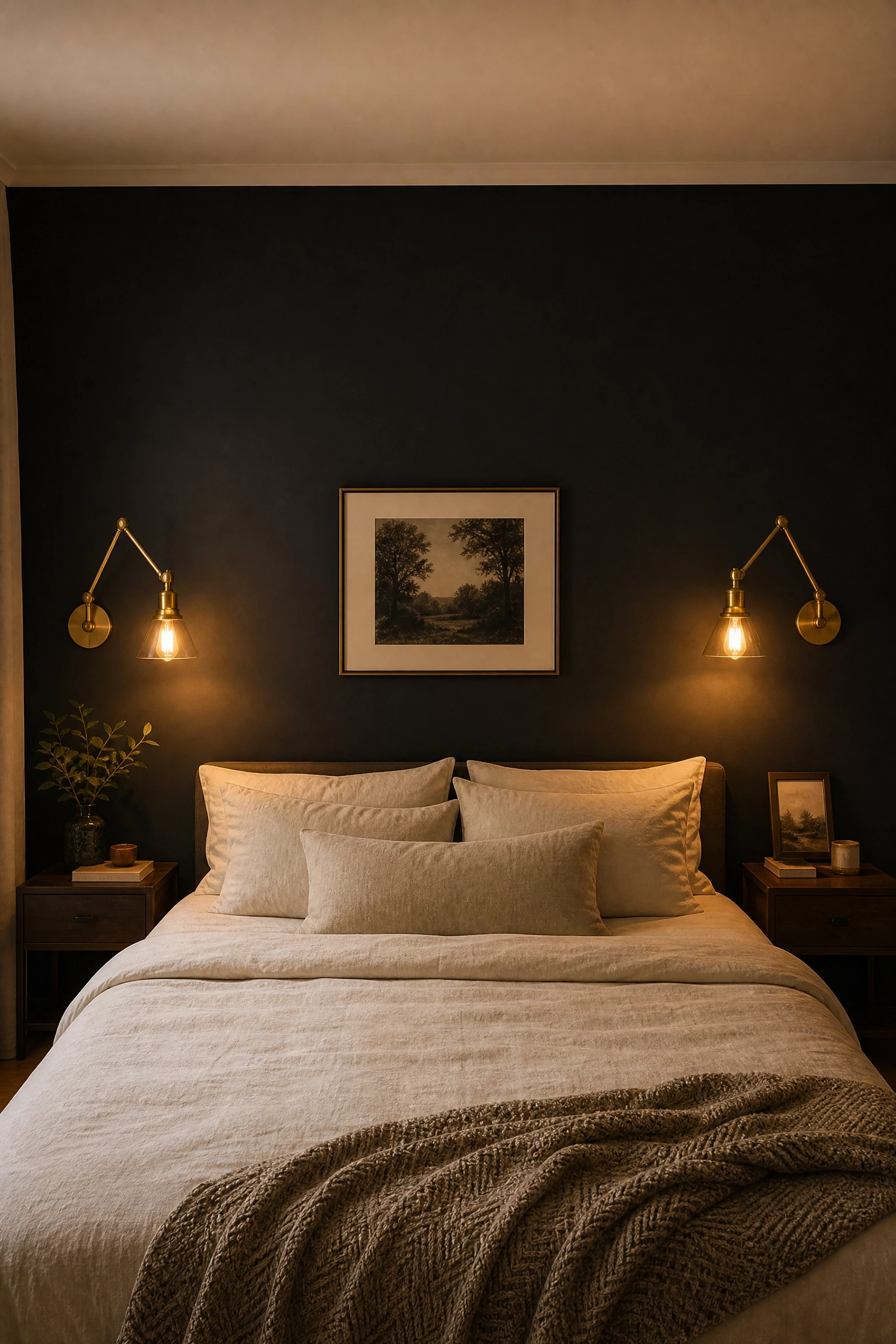
Wall sconces mounted directly on a black accent wall are the most effective single lighting change for a dark bedroom because they place the light source at the level where it matters most, which is at eye height when lying in bed, and because the contrast between the warm glow of the fitting and the dark wall surface behind it creates a visual drama that a ceiling fitting or bedside table lamp never achieves. The position of the sconce on the black wall means that the wall itself becomes the backdrop to the light, rather than the light simply illuminating the wall from elsewhere in the room. Warm brass arm sconces with upward or downward shades are the most widely used choice: the brass fitting reads as a warm metallic element against the dark wall surface when switched off, and creates a warm pool of directional light on the black wall when switched on. The specific position, typically at shoulder height when seated in bed, rather than at standing eye height, is the detail that most matters for how comfortable the light is for reading.
Designer Advice: Mount bedroom sconces at 150 to 160 centimetres from the floor rather than at the standard 180 centimetre standing eye level. In a bedroom where the primary use position is sitting or lying in bed, the lower mounting height places the light source at a position that illuminates the activity without shining directly into the eyes from above.
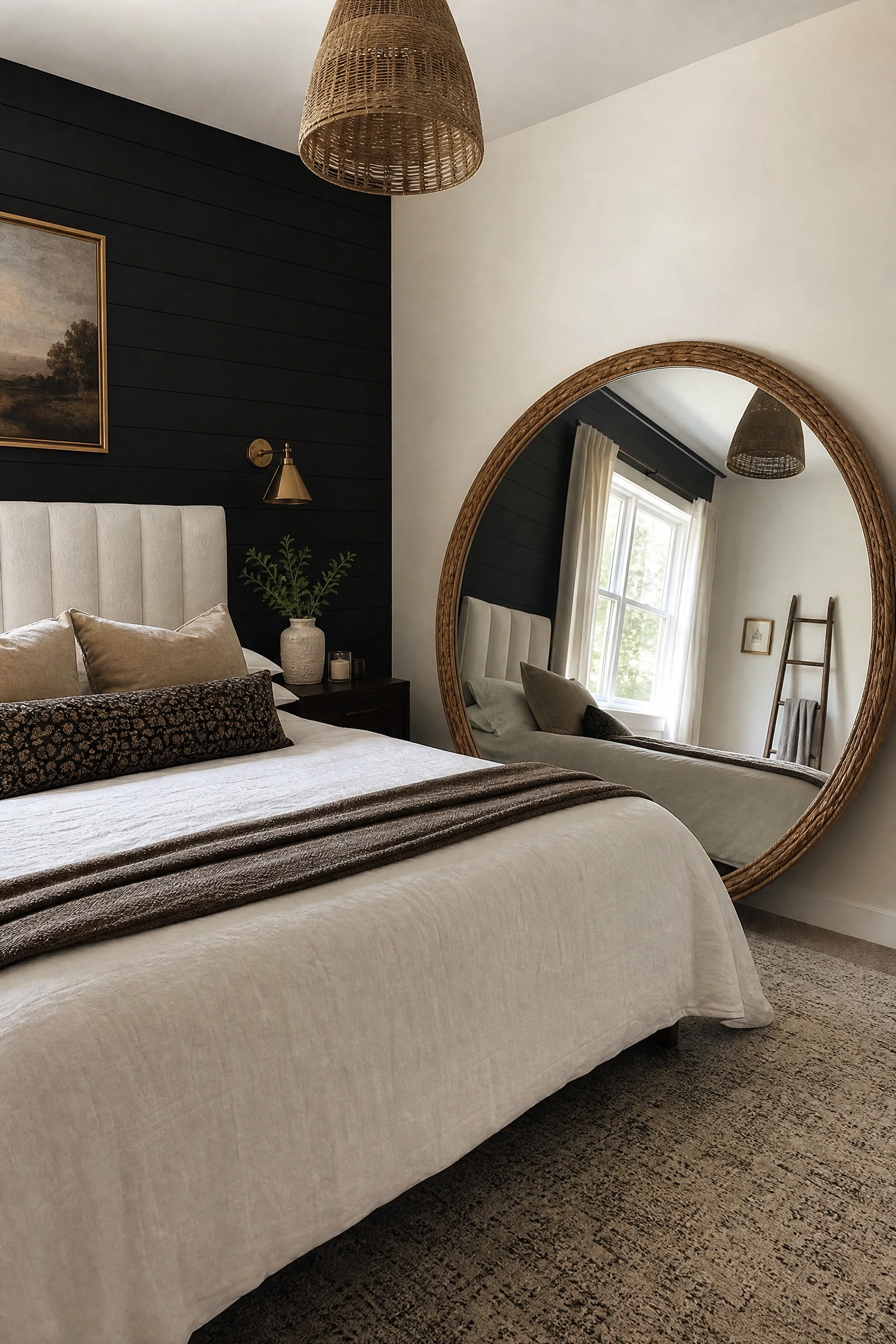
An oversized mirror on or adjacent to a black accent wall is the most effective single element for managing the light-absorption quality of a dark painted surface. A large mirror reflects whatever light is available in the room back into the space, which offsets the light-absorbing quality of the black wall and prevents the dark surface from making the bedroom feel smaller or darker than it actually is. Positioned on the wall directly opposite the main window, the mirror reflects natural daylight across the room and into the dark surface behind the bed. Positioned on the same black wall as the accent wall, at a slight angle to catch the opposite window, it creates a depth within the dark surface that makes the wall read as a window into another space rather than a flat dark plane. The mirror frame contributes to the design: a raw timber or rattan frame softens the graphic quality, while a thin metal frame in brass or matte black maintains the precision of the dark palette.
Quick Tip: A leaning floor mirror beside the black accent wall rather than a hung wall mirror is the most flexible and renter-friendly option. A leaning mirror at a slight angle to the wall reflects a diagonal view of the room that is more dynamic and more interesting than the straight-on reflection of a mirror hung flat, and it requires no wall fixings on the black surface.
22. Black Wall Paired With String Lights or LED Strip Lighting
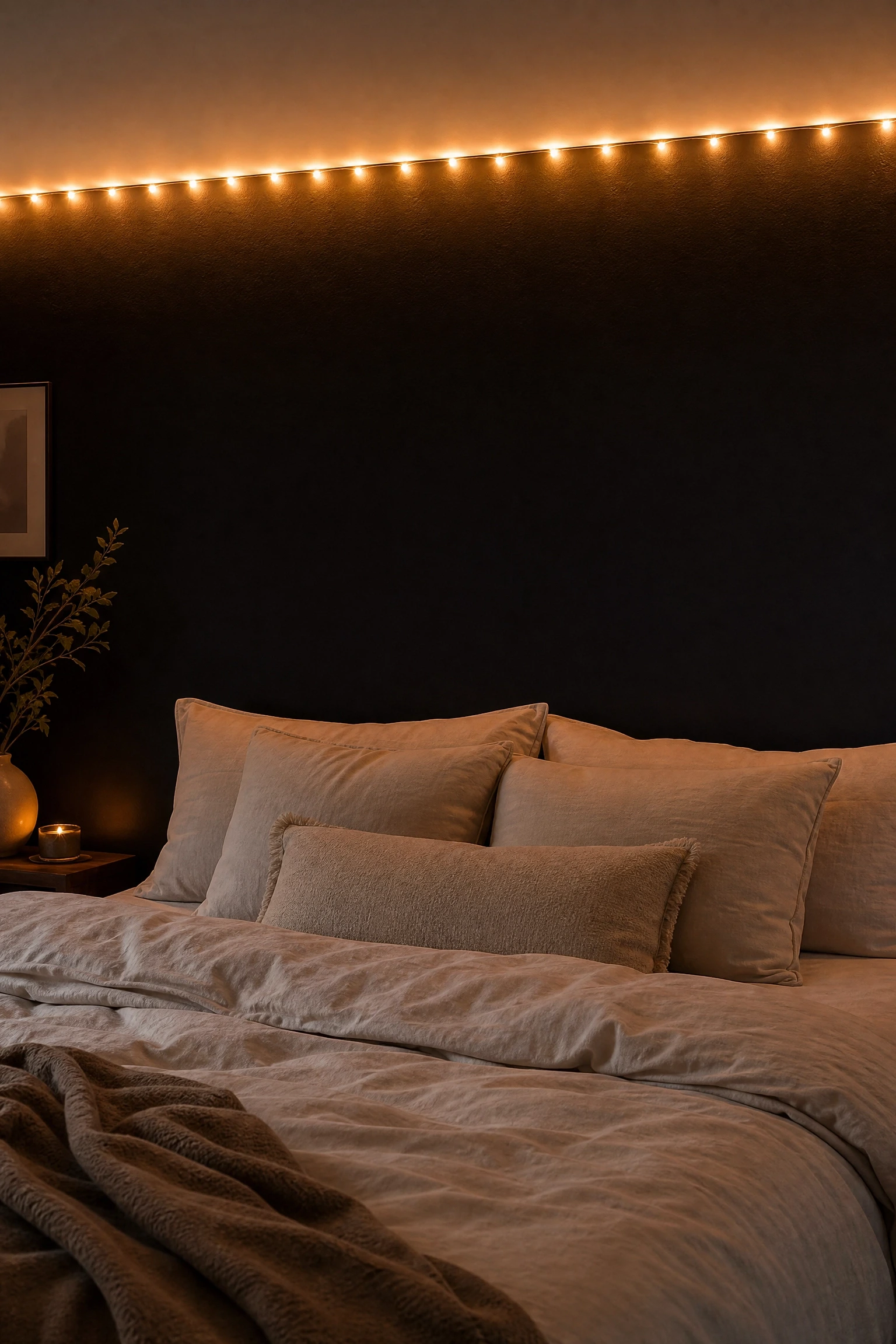
String lights or warm LED strip lighting installed along the headboard wall, either running along the top edge where the wall meets the ceiling, around the perimeter of a headboard niche, or draped along the wall in a deliberate arrangement, create a lighting effect on a black surface that is completely different from any standard fixture. The warm points of light from individual LED bulbs or the continuous warm strip of an LED tape create a glowing quality against the dark background that reads as both dramatic and deeply atmospheric: the kind of light that makes a bedroom feel like a room that is genuinely pleasurable to be in. The black wall absorbs the ambient light and makes the warm points of the string lights or the LED strip glow more vividly against it than they would against a white or pale background. This is one of the most affordable lighting upgrades for a bedroom with a black accent wall and one of the most impactful.
Reality Check: String lights in a bedroom look best at a single consistent height or in a deliberate arrangement rather than casually draped. Randomly draped string lights on a black wall look like they arrived at a party and never left. A deliberate linear arrangement along the top edge, a precise cascade, or a grid arrangement looks considered and permanent rather than temporary.
23. Black Wall Paired With a Statement Pendant or Chandelier
A statement light fitting above a bed with a black accent wall behind it, whether a raw rattan globe, an industrial metal pendant, a cluster of glass bulbs, or a more elaborate chandelier form, creates a visual centrepiece that draws the eye upward from the dark background wall and connects the bed zone to the ceiling in a way that a recessed spotlight or a standard ceiling rose never does. The black wall behind the bed creates the ideal dark background against which the form of the hanging light fitting is most visible: a rattan pendant above a black wall looks like it is suspended in space with the dark background receding behind it, and the warm light it casts creates a pool of warmth directly above the sleeping surface that makes the bed feel like the most considered and most comfortable position in the room. The scale of the pendant matters: a fitting that is too small for the scale of the wall behind it looks tentative and out of proportion, while a generously sized pendant reads as a confident design decision.
Pro Move: Position a statement pendant directly above the centre of the bed rather than at the centre of the ceiling. In a bedroom where the bed is against one wall and the centre of the ceiling is some distance from the headboard, a pendant centred on the ceiling feels disconnected from the bed below it. A pendant centred above the bed creates the most direct visual connection between the hanging light and the sleeping surface beneath it.
Under-bed LED strip lighting installed along the lower edge of a bed frame creates a warm glow at floor level that does two things in a bedroom with a black accent wall: it provides a gentle ambient light source at the lowest level of the room that offsets the visual weight of the dark wall above it, creating a lit baseline from which the dark wall rises, and it creates the floating bed effect where the bed appears to hover above a warm pool of light rather than resting heavily on the floor. In a dark bedroom, this floor-level warmth is particularly effective because it prevents the combination of a dark wall and a dark floor from creating an entirely enclosed, heavy visual environment. The under-bed light needs to be warm-toned at 2700K and directional enough that the LED strip itself is not visible, only the glow it creates on the floor beneath and around the bed base.
Designer Advice: Use a warm amber or warm white LED strip under the bed rather than a neutral white or cool white strip. Under-bed lighting at a cool colour temperature creates a clinical, nightclub atmosphere that a bedroom should never have. At 2700K or warmer, the same position creates a genuinely inviting and atmospheric floor-level glow.
25. Black Wall Paired With Sheer or Semi-Sheer Curtains
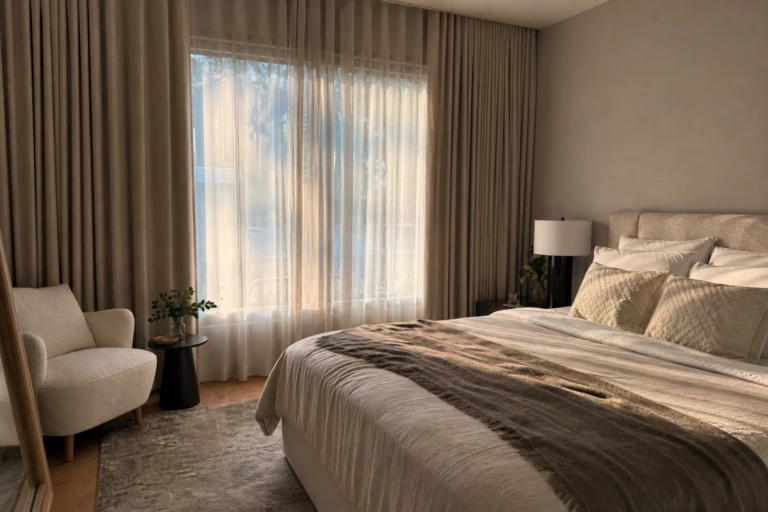
The window treatment choice on or adjacent to a black accent wall has a significant effect on whether the bedroom feels atmospheric or oppressive during the day. Heavy blackout curtains alongside a dark wall make the bedroom feel sealed and enclosed even when the curtains are open, because the weight and mass of the fabric adds to the visual density of the dark wall. Sheer or semi-sheer curtains in a natural white, ivory, or light linen tone create the opposite effect: the soft, diffused light that comes through a sheer curtain alongside a black accent wall makes the dark surface appear luminous rather than light-absorbing, because the diffused daylight from the curtain reflects across the surface of the dark wall in a way that direct sunlight or complete absence of daylight does not. The sheer curtain in this combination is doing as much work as the wall paint itself in determining whether the bedroom reads as dramatic and atmospheric or simply dark.
Quick Tip: Use a double curtain track alongside a black accent wall window: a sheer panel on the inner track for daytime diffused light and atmosphere, and a blackout roller blind on a separate system behind for complete darkness when needed. This approach gives the bedroom the best of both conditions without requiring a decision about which quality takes precedence.
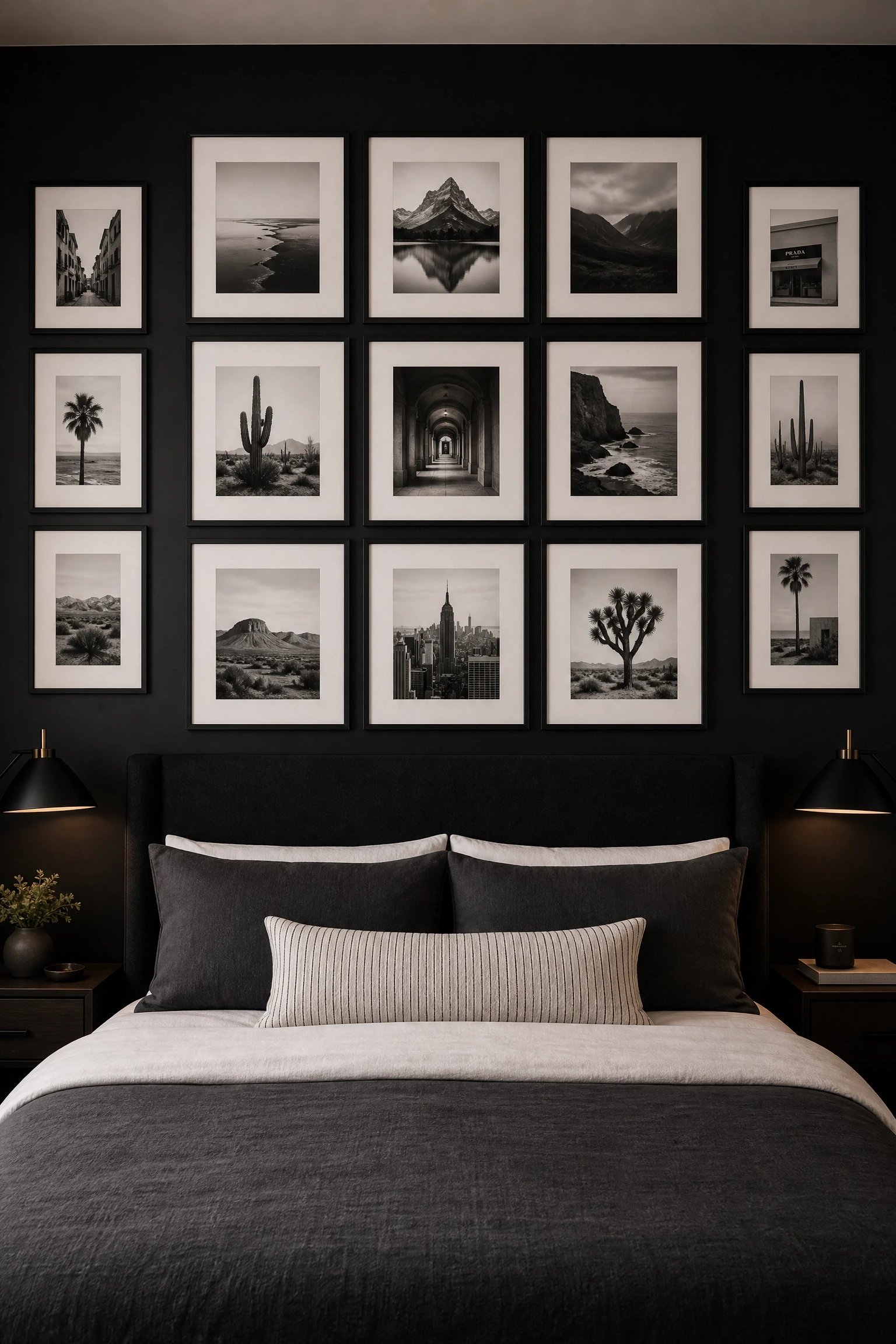
The black accent wall behind the bed is the best possible gallery wall surface in a bedroom because the dark background makes every framed piece read with the visibility and presence of an exhibition space. Black and white photography in simple black or natural timber frames against a matte black wall creates a composition where the prints appear to float in space, their tonal range from bright white to deep black visually connected to and contrasted against the dark wall behind them. Colour artwork on a black wall, whether botanical prints, abstract paintings, or expressive watercolours, appears more vivid than the same work would on a white wall because the surrounding darkness increases the perceived saturation of the colours by contrast. The gallery arrangement should be planned carefully: a random assortment of frames in different styles on a black wall reads as more chaotic than the same arrangement on a white wall, because the dark background amplifies every inconsistency in the arrangement.
Reality Check: A gallery wall on a freshly painted black accent wall requires wall fixings that are placed precisely and do not require adjustment after installation, because every filled hole in a dark painted wall requires careful touch-up paint to be invisible. Plan the arrangement in full before making the first fixing, using paper templates taped to the wall to simulate the final positions without creating holes.
27. The Complete Black Accent Wall Bedroom: Balancing All Four Approaches
The black accent wall bedroom that feels genuinely complete rather than just dramatically dark is the one where all four pairing categories are represented simultaneously: a warm natural material grounds the palette (a timber headboard or a jute rug), a colour element gives the room personality (a sage green or forest green accent in the bedding or cushions), a textured finish on the wall itself adds depth beyond flat paint (limewash, fluted panels, or picture frame moulding in the same black), and a deliberate lighting arrangement activates the dark surface rather than simply illuminating the room from a single overhead point (sconces on the wall, a statement pendant above the bed, and warm-toned bulbs throughout). When all four elements are present and working together, the black accent wall becomes the most sophisticated design decision in the room rather than its most risky one. The combination of warmth, colour, texture, and light is what changes a bedroom with a dark wall into one that genuinely feels considered and genuinely feels good to be in.
Pro Move: Before painting the headboard wall black, spend one evening in the bedroom with all the lights off and a single warm lamp switched on at mattress level, and observe how the room feels. If it feels oppressive and enclosed in that condition, add a second warm light source before adding the dark wall. If it feels atmospheric and comfortable, the existing lighting is likely sufficient for a black accent wall to work well in that specific room.
A black accent wall in a bedroom is one of the highest-stakes single decisions in a room refresh, and the difference between the version that people regret within a year and the version that photographs beautifully and feels genuinely good to live with every day almost always comes down to what was placed alongside it rather than to the wall itself. The black is rarely the problem. The bedding that was not considered, the lighting that was not updated, the furniture that blended into the dark background rather than standing out against it: these are the decisions that determine whether the wall reads as a design triumph or an expensive mistake.
Start with one pairing from one of the four groups in this article, whichever feels most natural to the existing direction of the bedroom, and add the wall once that pairing is in place. Looking at the warm natural material, the colour element, the lighting arrangement, or the textured finish in the context of the current room before committing the dark colour to the wall will tell you more about whether it will work in your specific bedroom than any inspiration image of someone else’s space can.
“What would you pair your black accent wall with? Drop the combination you are planning in the comments below.”
Frequently Asked Questions
Will a black accent wall make my bedroom feel smaller?
A black accent wall specifically on the headboard wall, rather than three or four dark walls, typically does not make a bedroom feel smaller. The headboard wall recedes visually behind the bed, which actually increases the perceived depth of the room by making the wall feel further away. What does make a bedroom feel smaller is a black wall combined with heavy dark window treatments, dark furniture that blends into the wall, and insufficient lighting. A black headboard wall with light-toned bedding, warm lighting, and at least one large mirror in the room reads as atmospheric rather than claustrophobic in most bedroom sizes.
What sheen should I use for a black accent wall in a bedroom?
Matte or flat finish is almost always the right choice for a bedroom black accent wall because it absorbs light rather than reflecting it, which creates the depth and atmospheric quality that makes black walls so appealing. A satin or eggshell finish on a black wall is acceptable but the slight sheen can make the surface read as slightly glossy in directional light, which can feel harder and more commercial than the soft depth of a truly matte surface. Eggshell is practical in a bedroom that needs a washable surface. Full gloss black on a bedroom wall is a very deliberate statement that suits specific high-contrast design directions but reads as too hard and reflective for most bedroom aesthetics.
How many coats of paint does a black accent wall need?
A properly prepared and primed wall typically needs two to three coats of a quality black paint to achieve a truly even, deep coverage. The most common failure in DIY black accent walls is stopping at one coat over an inadequately primed surface, which produces a coverage that looks thin and patchy in raking light. Apply a grey tinted primer before the black topcoats to reduce the number of black coats needed for full coverage. Allow each coat to dry fully before the next, and assess the coverage in natural daylight rather than under artificial light, which can make thin coverage look more even than it actually is.
What colours work best with a black accent wall in a bedroom?
Warm naturals including cream, oatmeal, warm white, and timber tones are the most reliable companions for a black accent wall. Earthy colours including terracotta, forest green, dusty sage, and warm mustard all create strong and considered combinations. Navy and deep blue create a tonal, layered dark palette. Blush pink and soft dusty rose create a romantic and unexpected contrast. White in any shade creates the most graphic and high-contrast combination. The colours that work less well alongside black are very bright primary tones, cool greys without warmth, and anything in a neon or highly saturated palette, all of which can feel jarring rather than dramatic against a matte dark surface.
Can I paint a black accent wall in a rented apartment?
Painting any wall in a rented apartment requires permission from the landlord, and permission for a black accent wall specifically requires a conversation about repainting on move-out. Many landlords will permit dark accent walls if the tenant agrees to return the wall to the original colour when leaving, and some landlords actually appreciate the improvement. If permission is not available, a peel-and-stick wallpaper in a dark botanical or geometric print on the headboard wall achieves a similar atmospheric quality to a black painted wall and is fully removable without any repainting work. Alternatively, a large-scale dark wall art panel or a collection of dark-framed artwork arranged across the headboard wall creates a dark focal point without touching the wall colour at all.
How do I make a black accent wall feel cosy rather than cold?
The single most important factor in making a black accent wall feel cosy is the warmth of the lighting. Warm-toned bulbs at 2700K in every light source in the bedroom, including bedside lamps, ceiling fittings, and any wall sconces, create the warm amber glow that changes a dark wall from cold and clinical into atmospheric and enveloping. Beyond lighting, natural materials including timber, rattan, linen, jute, and unglazed ceramic all contribute warmth that synthetic or metal alternatives do not provide. A bedroom with a black accent wall that has warm-toned lighting, a natural timber headboard, cream linen bedding, a rattan pendant, and a jute rug will feel genuinely cosy regardless of how dark the wall is.