Getting dressed in the morning should be simple. But for most people, the bedroom closet is the first source of stress they encounter before the day has even started. Clothes pile up on the floor. Shoes disappear under bags. That one shirt you know you own somehow never surfaces when you need it. The problem is rarely a lack of space. It is that the space has not been set up to match how you actually live, get dressed, and put things away. Once you understand what is going wrong in your closet, fixing it becomes a lot more straightforward.
This list is organized around real problems that real people experience in their bedroom closets. Each idea starts with the frustration, moves into the fix, and ends with what your closet and your mornings actually look like on the other side. No vague tips, no suggestions to “declutter and start fresh” without any guidance on what that means in practice. Just specific, honest, actionable ideas that work in real homes, whether you have a generous walk-in or a single reach-in rod with barely enough room to breathe.
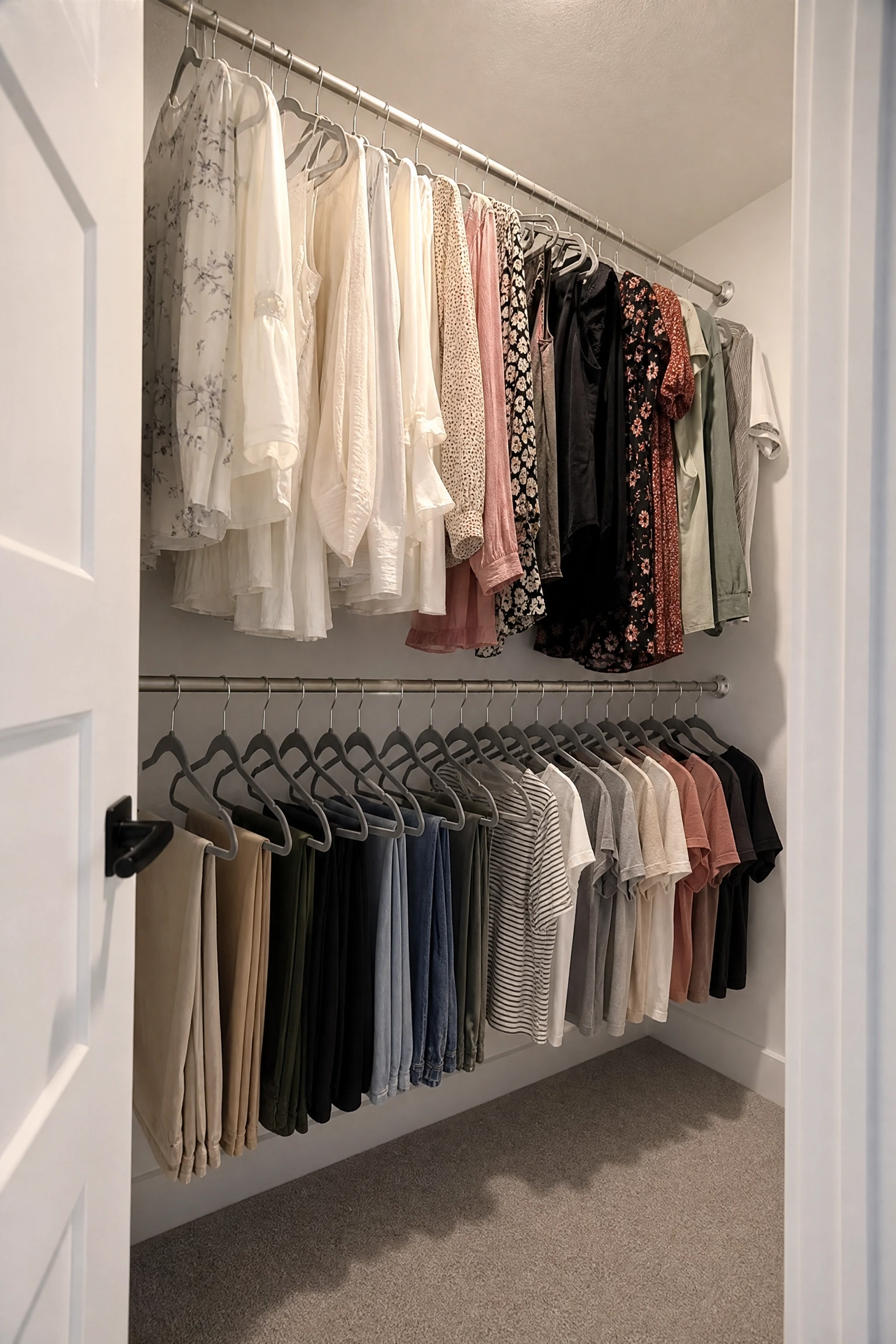
1. The Floor Pile That Never Goes Away: Add a Double Hang Rod
The problem is almost always the same: one rod, not enough hanging space, so everything that does not fit lands on the floor and stays there. The fix is a second rod hung below the first one, which instantly doubles your hanging capacity without touching a single wall. A closet doubler rod clips onto your existing rod and hangs down to create a lower level, perfect for shirts, folded pants, or jackets. In practice, this works best when you separate clothing by length first. Keep long items like dresses and coats on one side of the rod and use the double-hang configuration on the other side where shorter pieces live. It costs almost nothing, most doubler rods run between $15 and $30, and the difference it makes to floor space is immediate and dramatic.
Pro Move: Use the lower rod specifically for your most-worn items so the pieces you reach for daily are always at eye level and easy to grab.
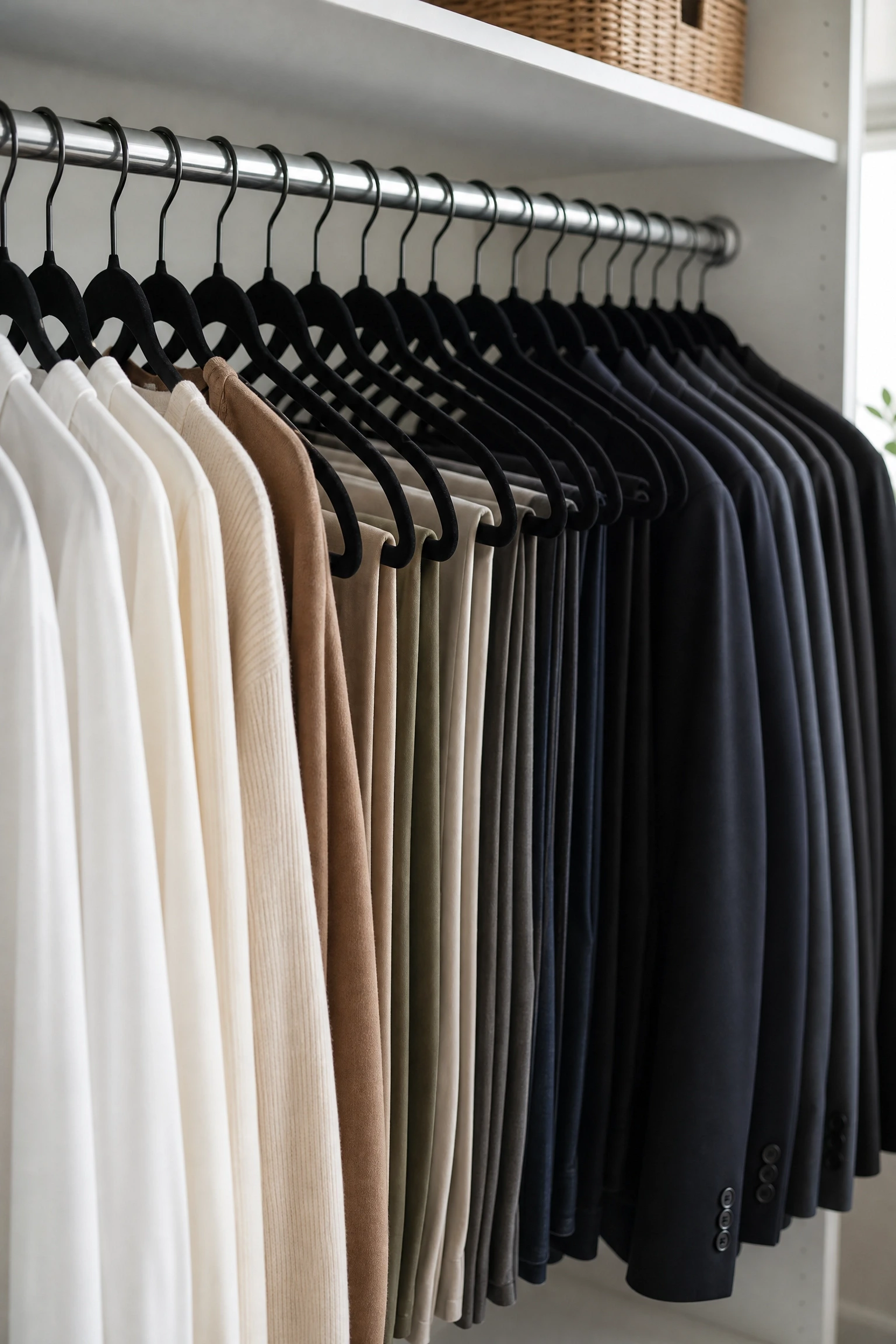
2. You Can Never Find Anything: Switch to Uniform Velvet Hangers
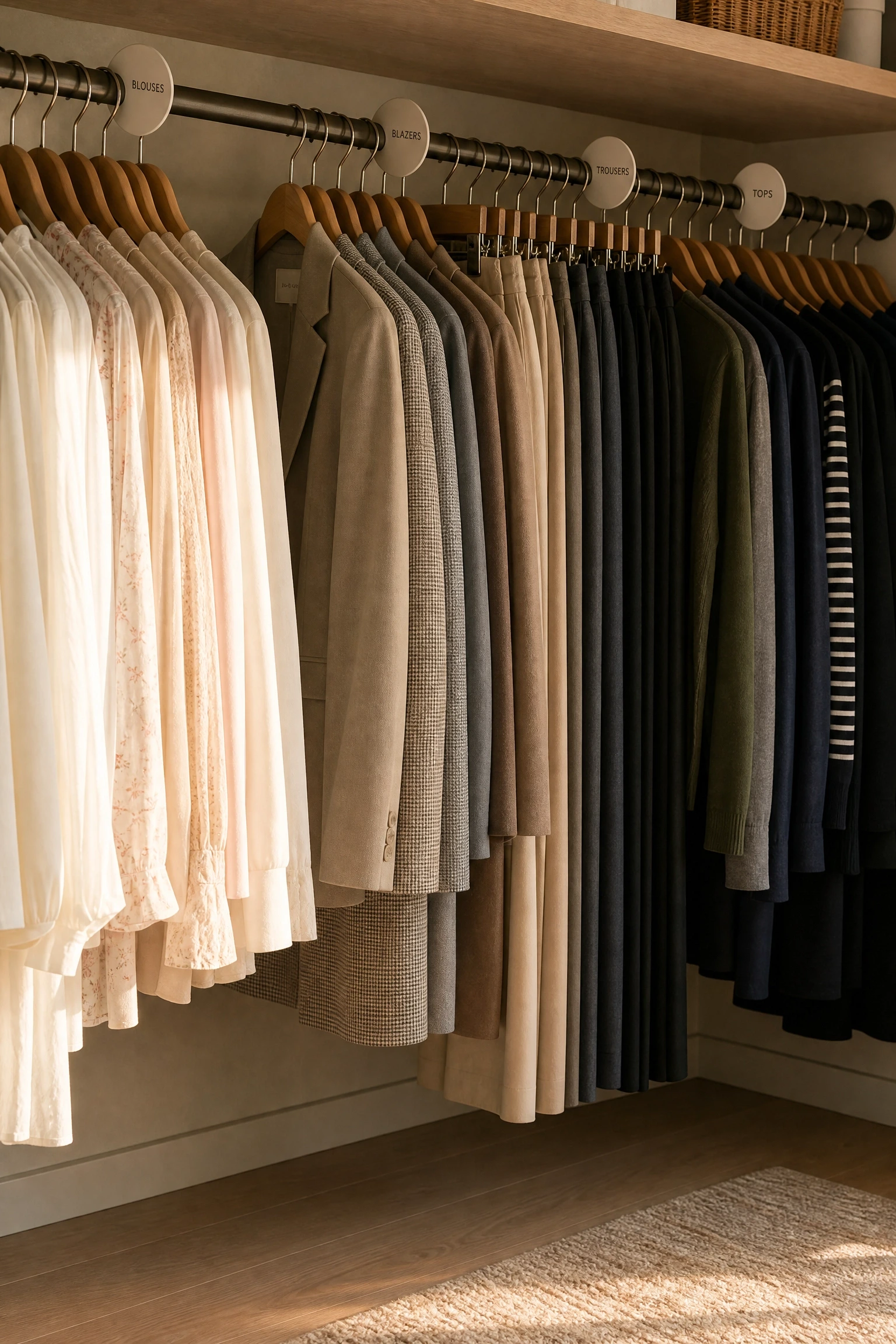
The mix of chunky plastic hangers, wire dry-cleaning hangers, and random wooden ones from three different sets does not just look chaotic. It actually makes your closet harder to navigate. Different thicknesses mean clothes hang at different heights, creating a visual mess that makes it nearly impossible to scan quickly for what you need. Switching to slim velvet hangers across the board does two things at once: it creates visual consistency so your eye can move through the closet without interruption, and it frees up a surprising amount of rod space, sometimes enough to fit an entirely extra section of clothing. Velvet hangers also grip fabric so nothing slides off and piles up in the corner. A set of 50 typically costs under $20 and is one of the highest-return investments you can make in a closet of any size.
Designer Advice: Hang everything facing the same direction and group by category, tops together, bottoms together, outerwear together, so scanning becomes instinctive.
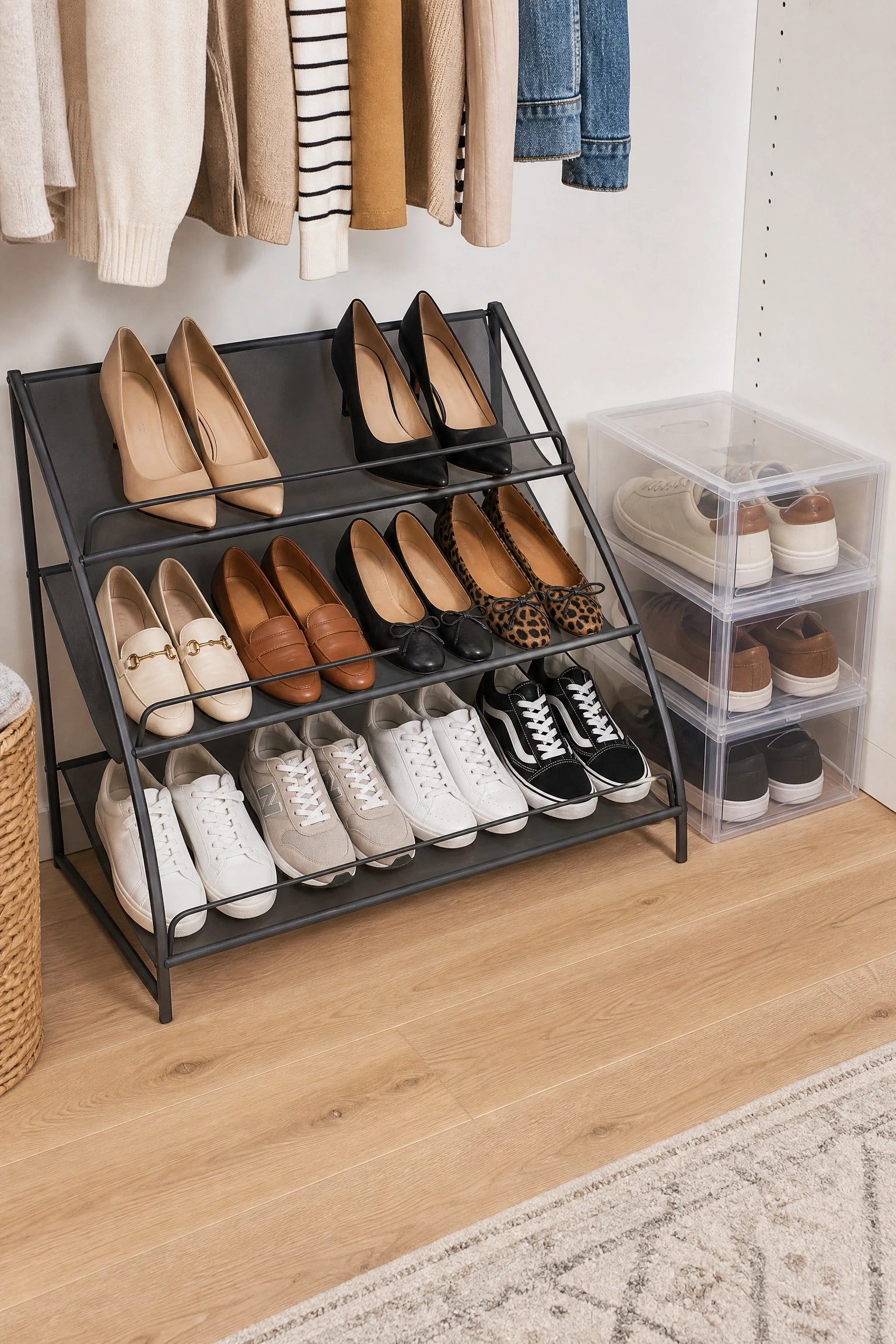
3. Shoes Take Over Everything: Build a Tiered Shoe System
Shoes on the floor of a closet are one of the fastest ways to lose usable space, and they also make the whole closet feel disorganized even when everything else is in order. The fix depends on how many pairs you have and how much floor or shelf space is available. A tiered shoe rack that sits on the floor and angles pairs slightly backward uses vertical space efficiently and keeps everything visible at once. For smaller closets, an over-the-door clear shoe organizer with individual pockets is a better choice. It moves the shoes entirely off the floor and onto the back of the door. For a more permanent and polished look, dedicated shoe shelves built into the closet at varying heights accommodate boots, heels, and flat shoes separately and give you the most flexibility over time. The honest trade-off with tiered floor racks is that they can become dust collectors, so they work best for shoes you wear regularly rather than seasonal or occasional pairs.
Heads Up: Store out-of-season shoes in clear stackable boxes on a high shelf so they are off the floor entirely without disappearing into the abyss.
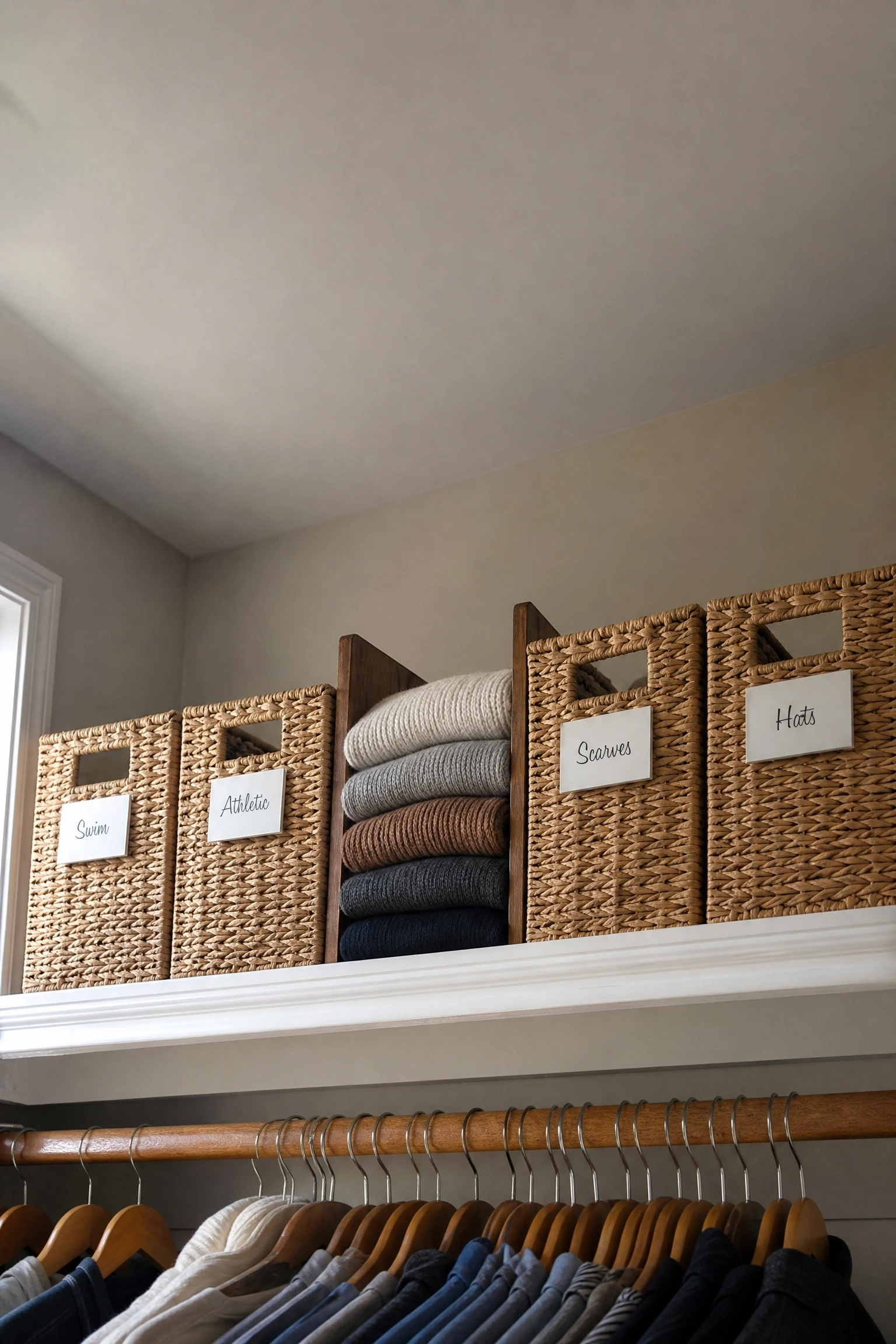
4. The Shelf Above the Rod Is Useless: Use Baskets and Shelf Dividers
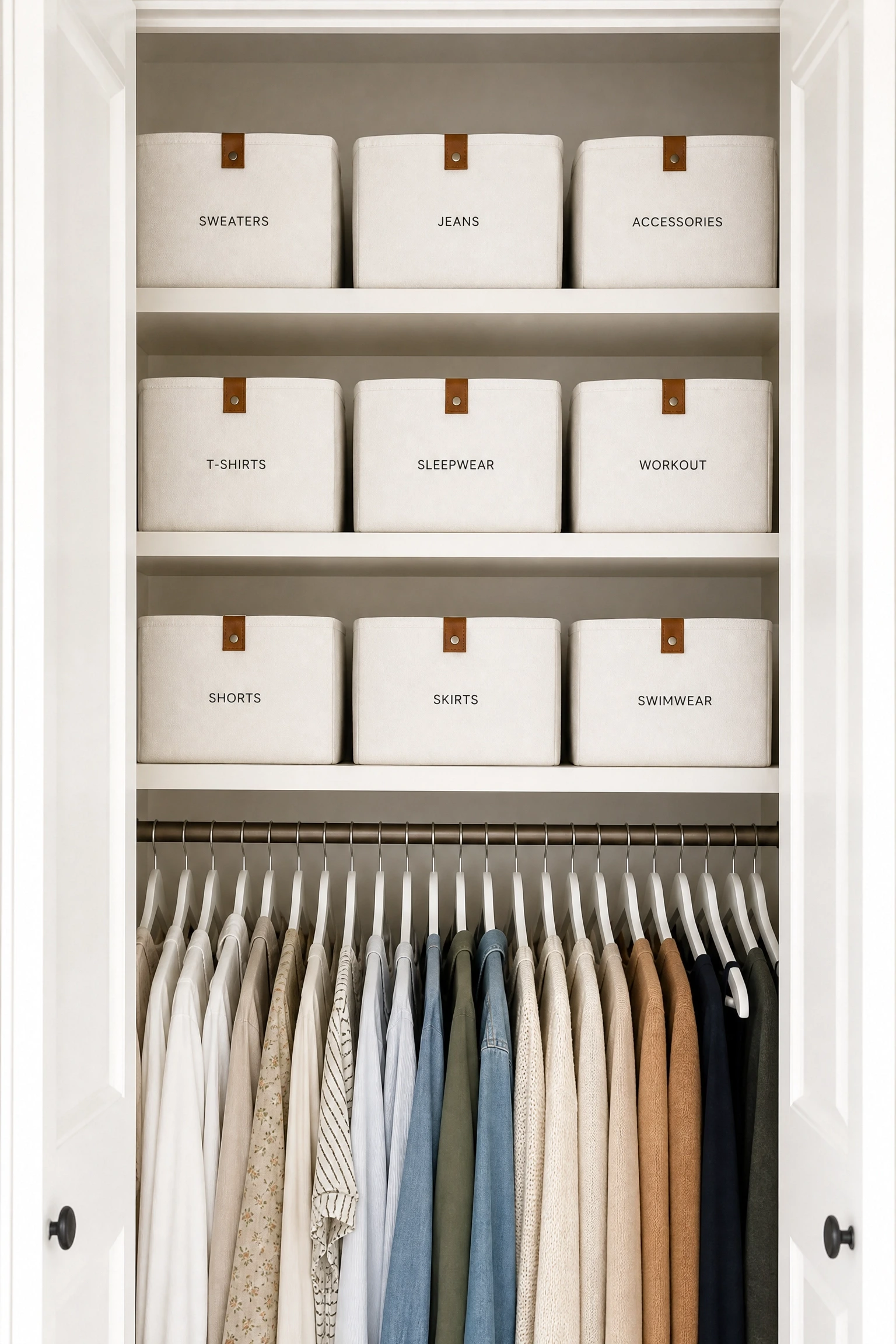
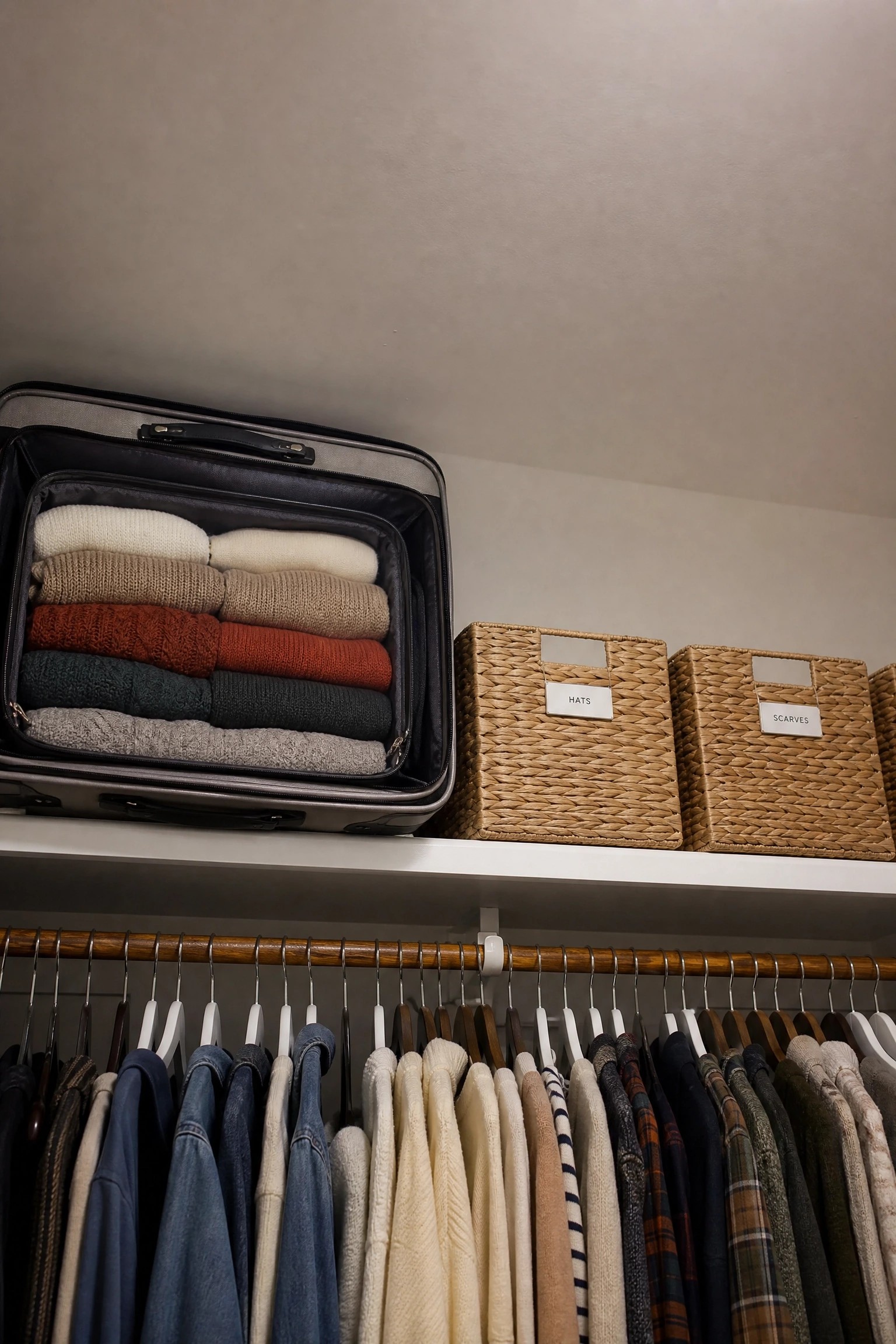
Most bedroom closets have one high shelf running the width of the space, and most people use it as a dumping ground for things they never look at again. In practice, that shelf is some of the most valuable real estate in the closet. It just needs to be organized in a way that makes things retrievable. Fabric bins and woven baskets work well here for grouping items by category: one basket for seasonal accessories, one for bags you do not use daily, one for gym gear. Shelf dividers are a quieter but equally useful addition. They prevent sweater stacks from toppling sideways and help you maintain neat piles without having to refold everything every few days. The key is labeling. A basket without a label becomes a mystery box within a month. Keep labels simple and honest about what is actually in there.
Quick Tip: Use the rule of one basket, one category. The moment a basket starts holding two unrelated things, it needs to be split into two.
5. Folded Clothes Always End Up a Mess: Try the Vertical Fold Method
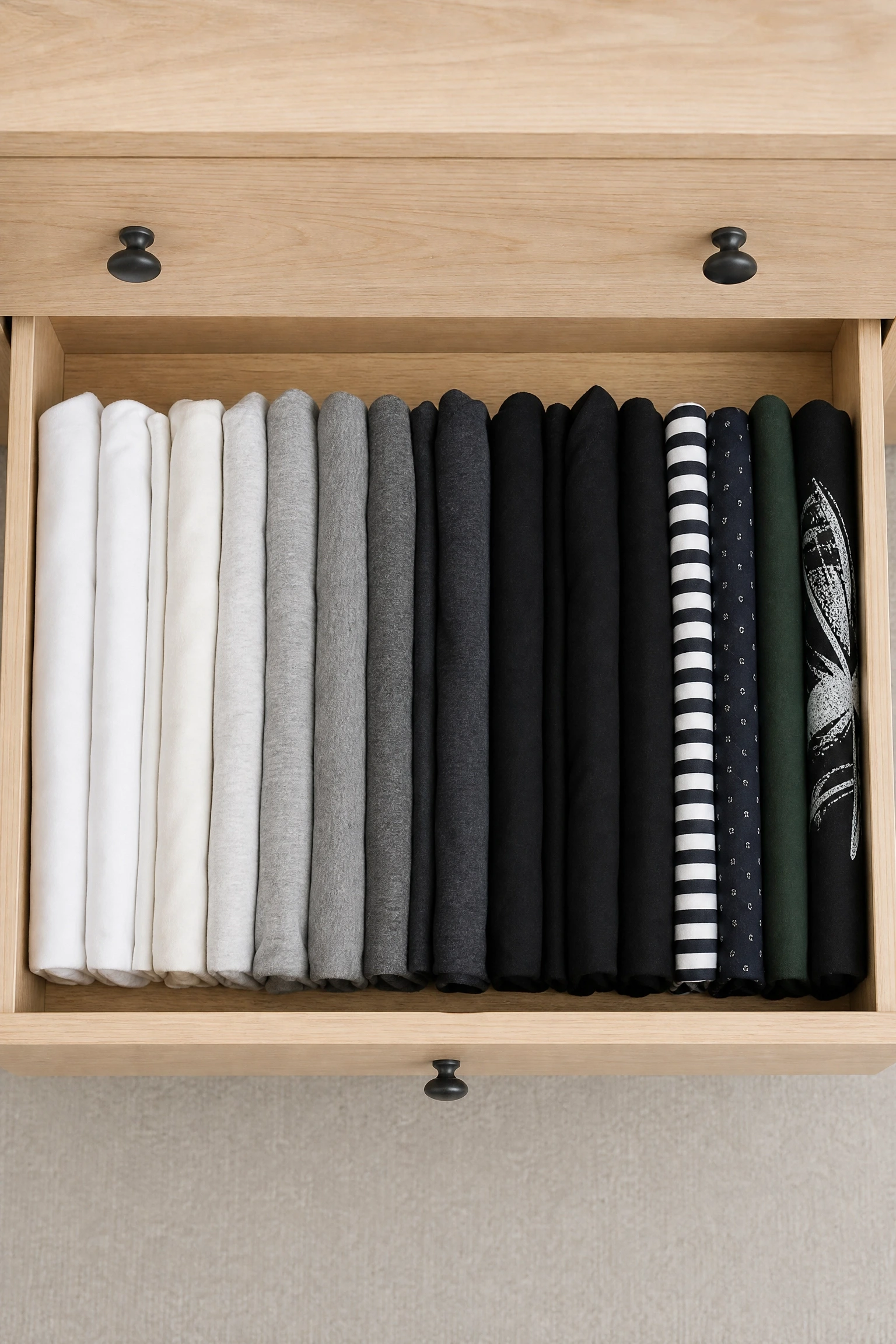
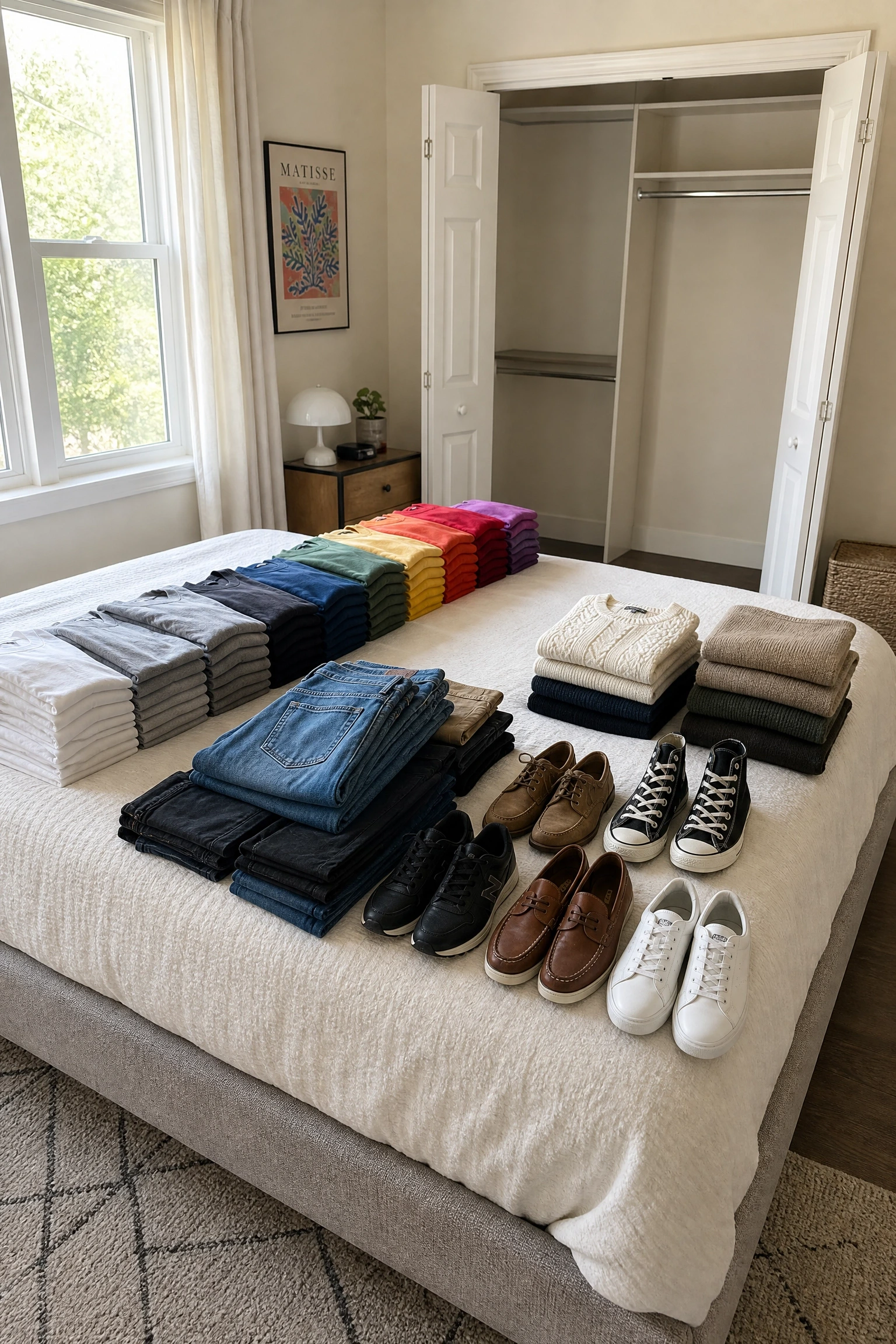
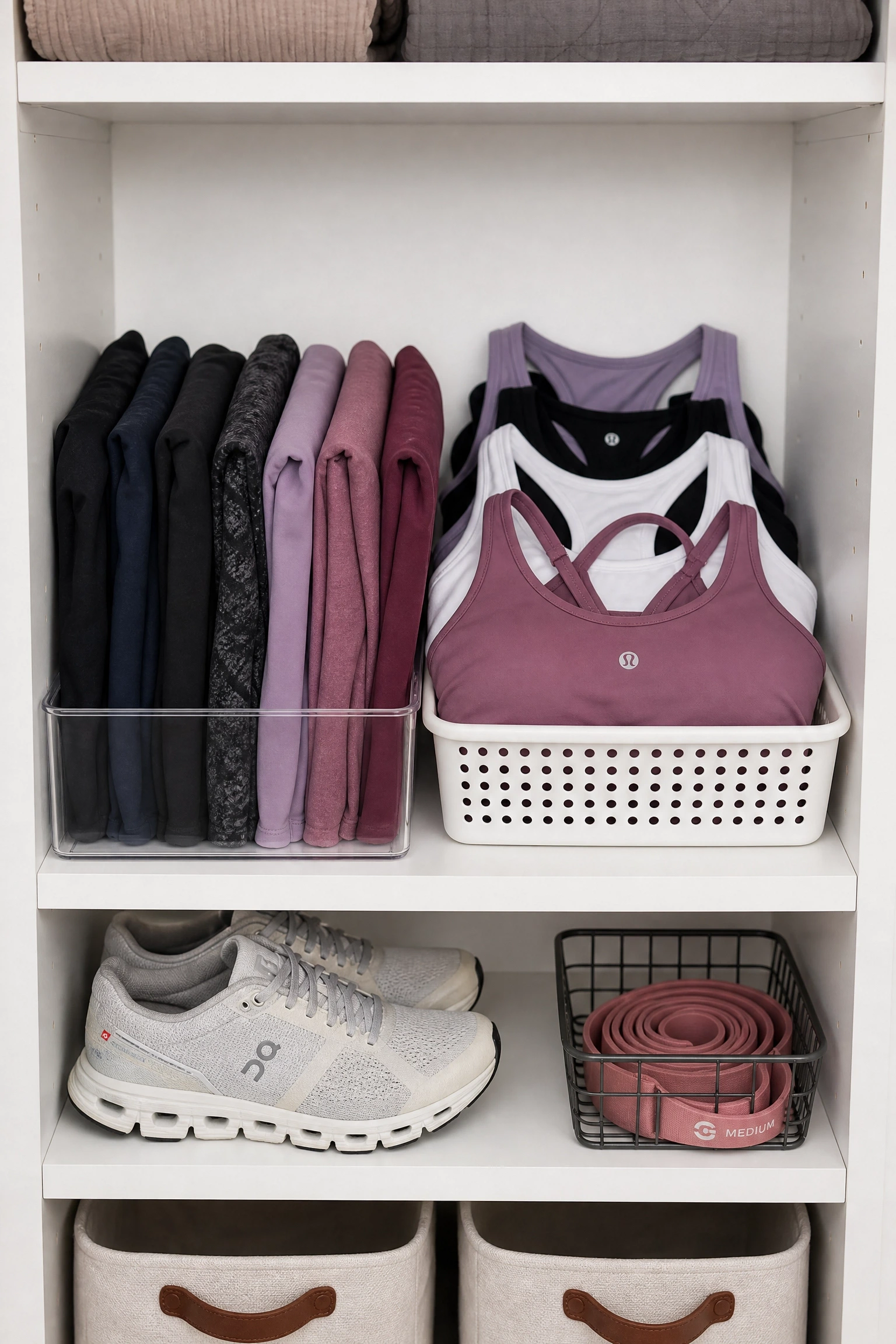
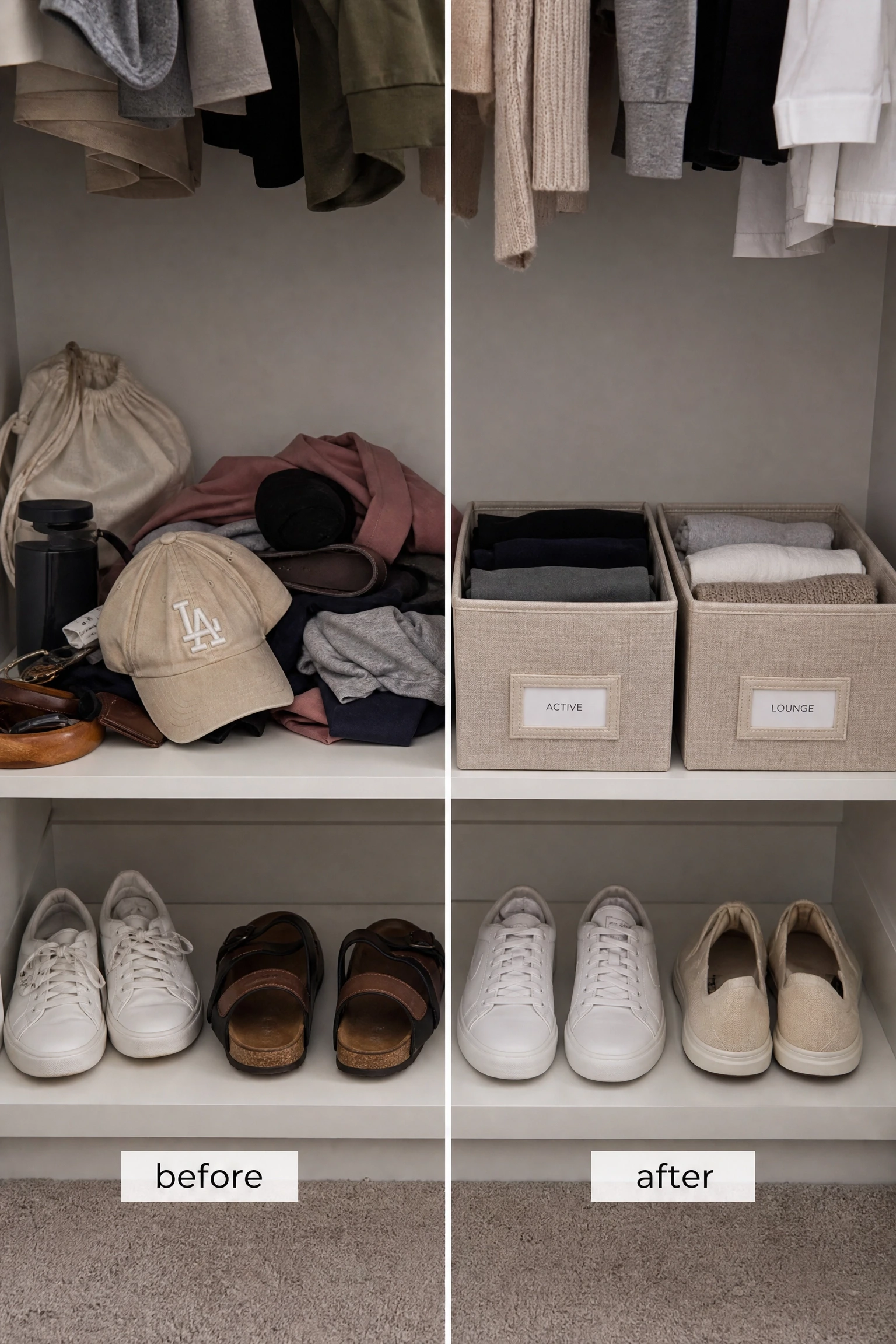
The way most people fold and store clothes in a closet, stacking items horizontally in a pile, means you can only see the top item, and reaching for anything underneath destroys the whole stack. The vertical fold method involves folding each item into a small rectangle and standing it upright in a drawer or bin so every piece is visible at once from above, like files in a filing cabinet. This works especially well for t-shirts, jeans, activewear, and knitwear. Once you have made the switch, you can see every item you own at a glance, and pulling one piece out does not disturb anything around it. It takes a few extra minutes when first folding, but the system maintains itself far better than horizontal stacking because there is nothing to topple.
Reality Check: This method works beautifully for folded items but does require consistent folding habits. Be honest with yourself before committing to it.
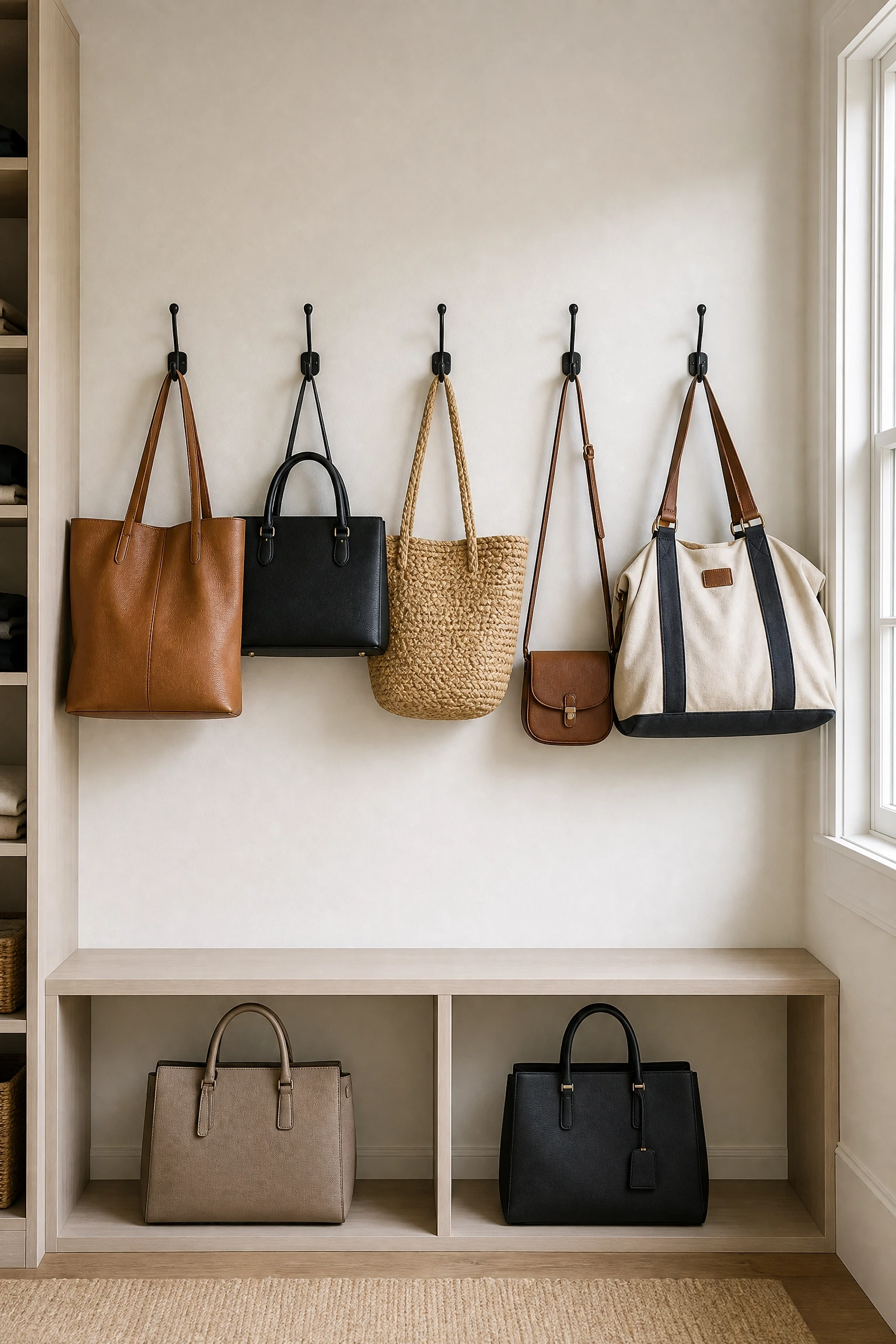
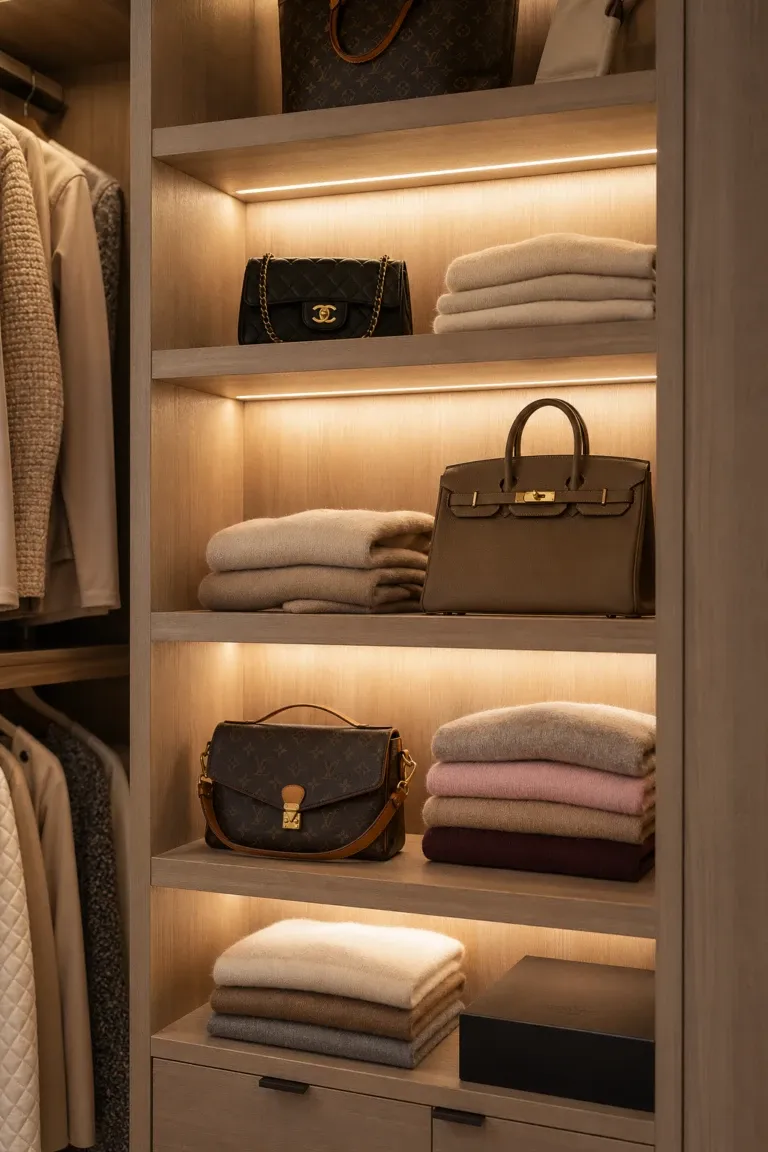
Bags are one of the most spatially awkward things to store in a bedroom closet because they are all different shapes and sizes, they do not stack well, and they tend to end up piled on top of each other in a way that damages the ones on the bottom. A dedicated bag zone solves this. For smaller bags and clutches, a row of hooks on the closet wall or inside the door keeps them accessible and visible without taking up shelf space. For larger totes and structured handbags, a shelf with enough vertical clearance to store them upright rather than on their sides is the best approach. If you have bags that need to hold their shape, like leather totes or structured satchels, stuff them lightly with tissue paper and store them with a small gap between each one so the sides do not press together and crease over time.
Designer Advice: Group bags by frequency of use. Daily bags near the front at eye level, occasional or seasonal bags toward the back or on a higher shelf.
7. The Closet Looks Cluttered Even When It Is Clean: Use Consistent Storage Containers
This is a common problem in closets that have been organized functionally but not visually. When every bin, basket, and box is a different material, color, and size, the space reads as chaotic even when everything is technically in its place. The fix is visual consistency. Choosing one or two container styles and sticking with them across the whole closet creates a sense of order that goes beyond just having things sorted. Neutral tones like natural wicker, white canvas bins, or matte black wire baskets all work well in bedroom closets because they recede visually and let the clothing become the focus. You do not need to replace everything at once. Start with one section and work outward, and the difference in how the whole closet feels will be noticeable almost immediately.
Pro Move: Shop one collection or one product line for all your bins so sizing and finish stay consistent throughout the whole closet.
“A closet that looks organized is easier to keep organized. Visual calm creates behavioral calm.”
8. Belts and Scarves End Up in a Tangled Drawer: Use Dedicated Accessory Hooks
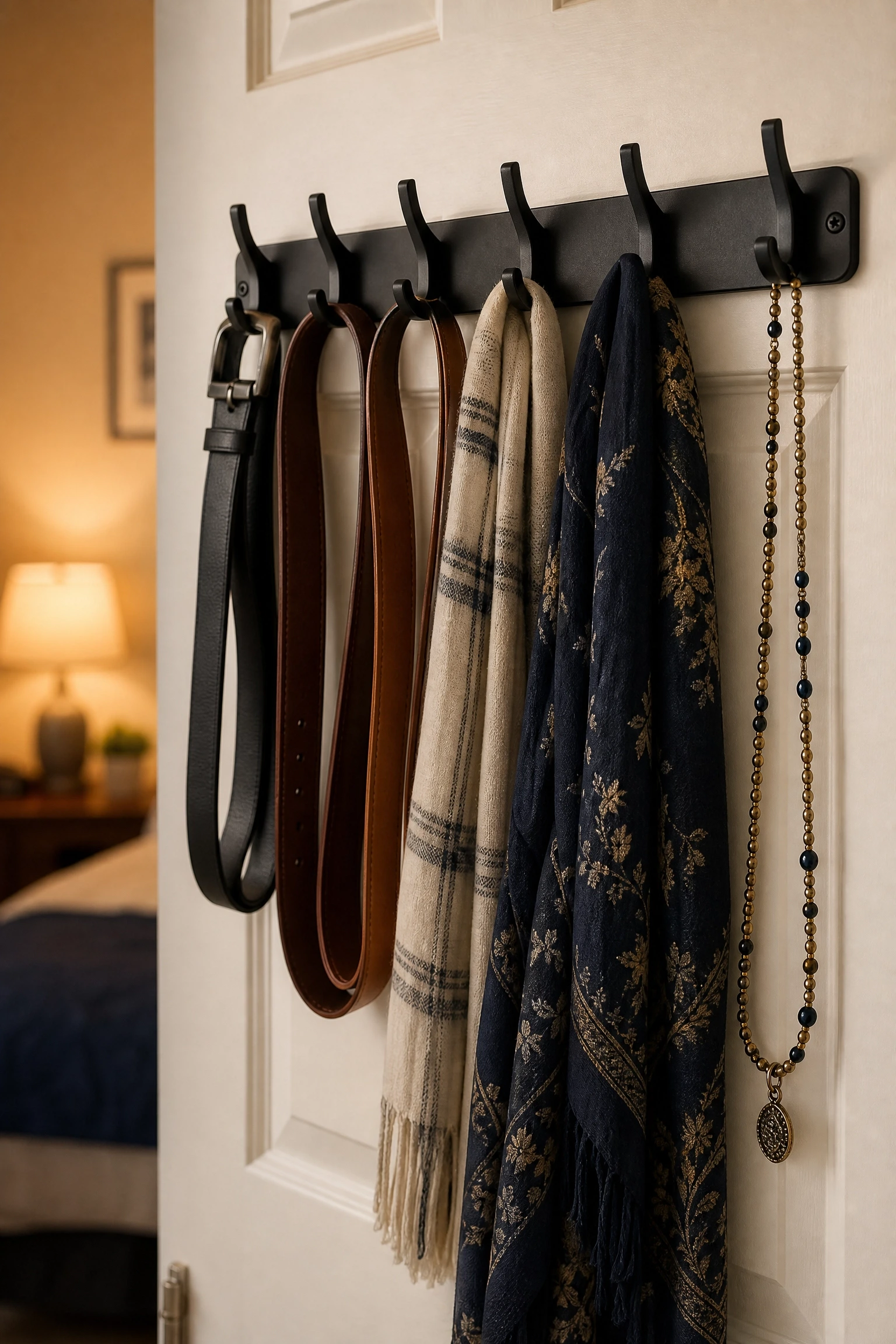
Belts, scarves, ties, and long necklaces are the accessories most likely to end up tangled in a drawer or draped over a shelf edge because they do not have a natural home in a standard closet setup. A row of simple hooks installed on the inside wall of the closet, or on the back of the door, solves this immediately. For belts specifically, a rotating belt hanger that drops from the rod keeps them together and lets you see every one at a glance without digging. Scarves do well folded over a multi-tiered scarf hanger or hung through individual rings on a dedicated hook rail. The key principle here is that anything long, thin, or easy to tangle needs a vertical hanging solution rather than a folded or stacked one.
Quick Tip: Install adhesive hooks on the inside of your closet door for scarves and bags. No drilling needed and they hold more weight than most people expect.
9. You Keep Buying Things You Already Own: Do a Category Audit First
One of the most common closet problems that never gets named in organization articles is this: people reorganize without first understanding what they actually have. The result is a beautifully organized closet full of duplicates, things that do not fit, and items kept out of guilt rather than use. Before touching a single bin or hanger, pull everything out by category and count. How many black t-shirts do you own? How many pairs of jeans? Most people are genuinely surprised. This is not about minimalism for its own sake. It is about making sure the closet you build is sized to what you actually wear, not to everything you have ever purchased. A smaller, honest wardrobe in a well-organized closet is dramatically easier to maintain than a large one crammed into the same space.
Reality Check: If you have not worn something in twelve months and cannot name a specific occasion coming up where you will, it is probably safe to let it go.
10. Jewelry Gets Lost or Tangled: Bring It Into the Closet
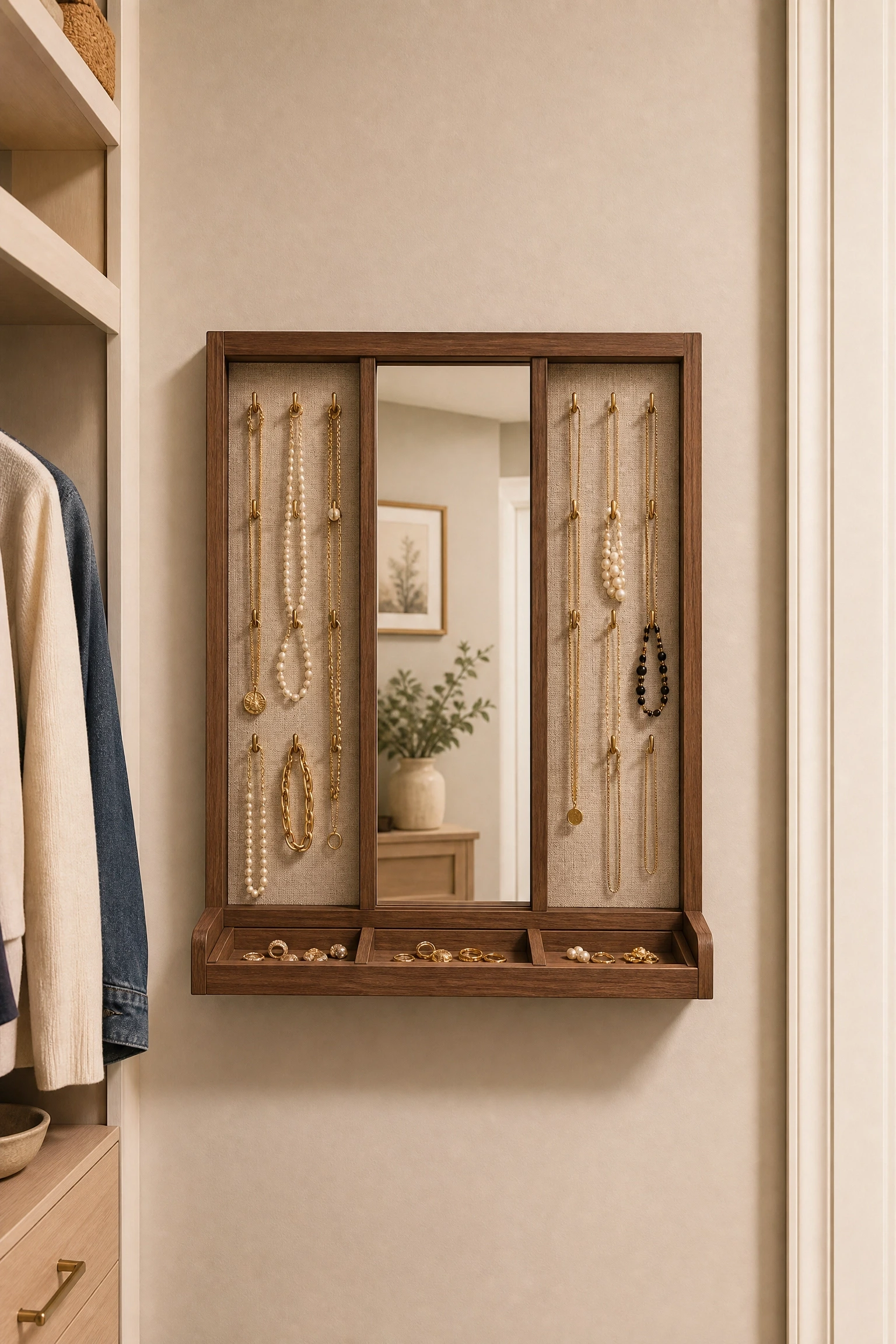
Most people store jewelry on a dresser, in a bathroom drawer, or in a jewelry box that quickly turns into a tangled mess. Moving jewelry storage into the closet, right where you get dressed, is a simple change that makes a big difference to your morning routine. A wall-mounted jewelry organizer with hooks for necklaces, small trays for rings and earrings, and a few larger compartments for bracelets can be mounted on the inside of the closet door or on the wall beside the rod. Clear acrylic stackable trays are another option that works well on a shelf and gives you full visibility of everything at once. The goal is to keep jewelry in the same place where you are making outfit decisions, so the whole process of getting dressed happens in one spot rather than across three different rooms.
Heads Up: Store fine jewelry and pieces you do not wear daily in a lidded tray or small box rather than on open hooks, where they are more likely to tangle or collect dust.
11. The Closet Floor Is Dead Space: Add a Low Shoe Bench or Drawer Unit
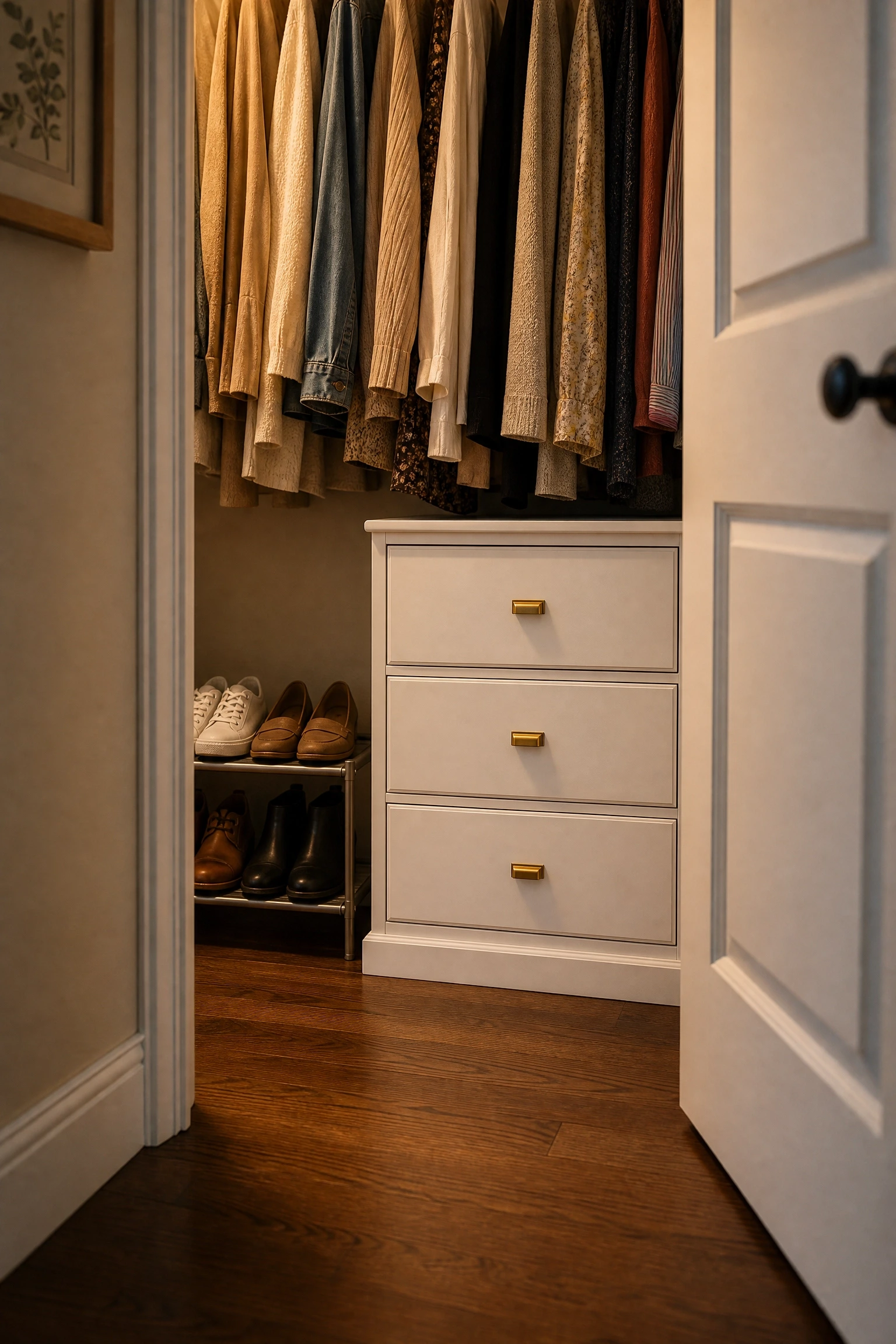
In reach-in closets especially, the floor tends to collect shoes, bags, and random items that have no better home. Rather than leaving that floor space undefined, placing a low bench, a small chest of drawers, or a shallow rolling drawer unit on the closet floor turns it into intentional storage. A small two or three-drawer unit is particularly useful for items that are awkward to hang or shelf: swimwear, workout gear, pajamas, or undies. Some people also use this floor-level spot for a single layer of shoe storage with a slim angled rack. The key is keeping whatever you place on the floor low enough that it does not cut into the hanging space above it. Anything under about 24 inches of height typically keeps the clearance intact.
Designer Advice: Choose a drawer unit that matches or complements your other closet storage for a built-in feel without the built-in price tag.
12. You Cannot See Anything in the Dark: Improve Closet Lighting
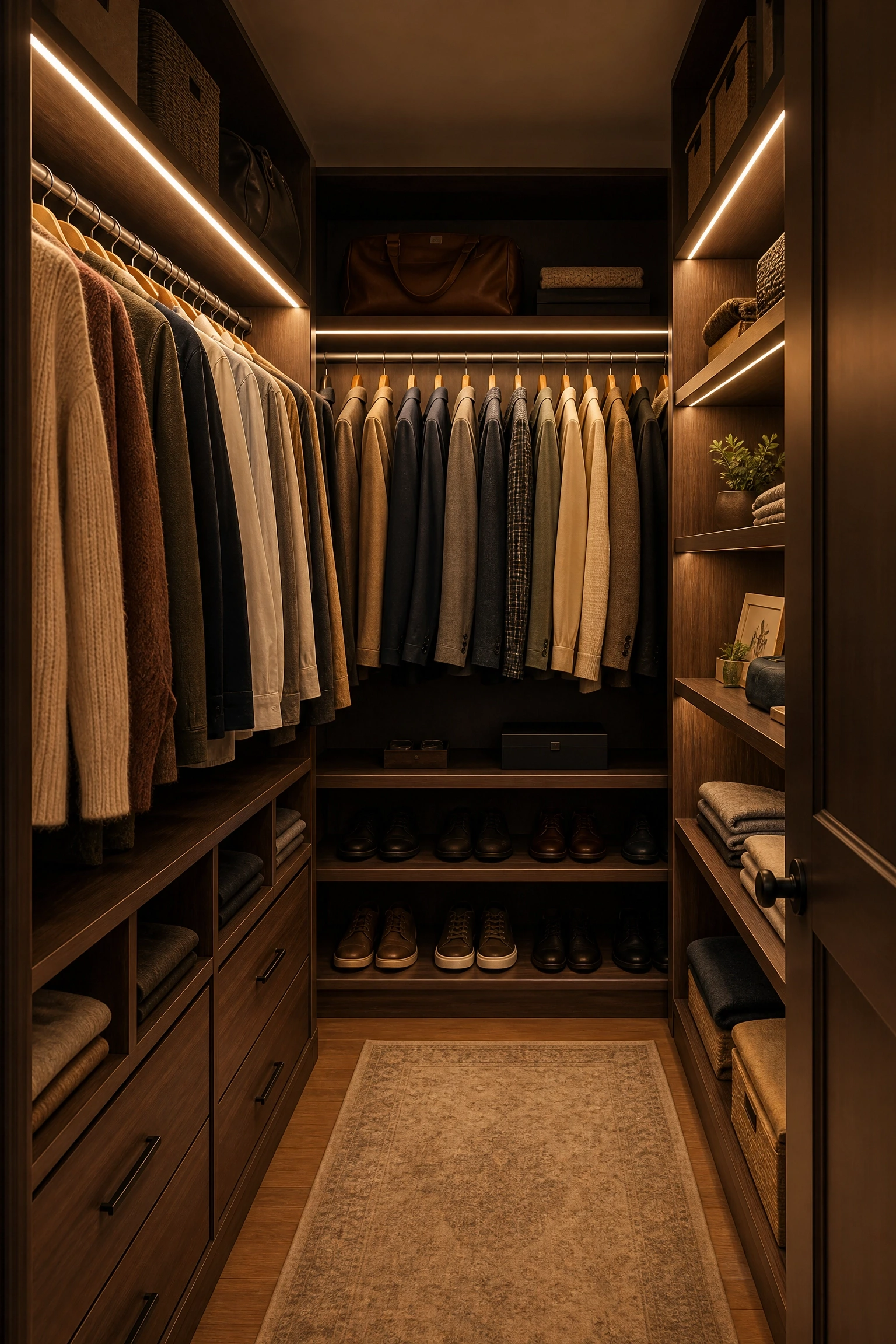
A surprising number of bedroom closet problems come down to one thing: you cannot actually see what is in there. Standard overhead bedroom lighting rarely reaches inside a closet properly, which means you are always pulling items out into the room to check colors or details. Battery-powered LED strip lights installed along the underside of the top shelf, or a plug-in puck light mounted in the center of the ceiling, completely change how usable the space feels. Motion-activated options are especially practical because you do not have to fumble for a switch with your hands full. For walk-in closets, a properly wired overhead fixture with warm white bulbs (around 3000K color temperature) gives you the most accurate color rendering, which matters more than most people realize when you are trying to match outfits in the morning.
Pro Move: Choose LED bulbs or strips rated at 3000K to 3500K for closet lighting. Cool white or daylight bulbs can make colors look slightly different than they will in natural light, which creates frustrating outfit surprises.
13. Sweaters Get Ruined on Hangers: Fold Heavy Knits Instead
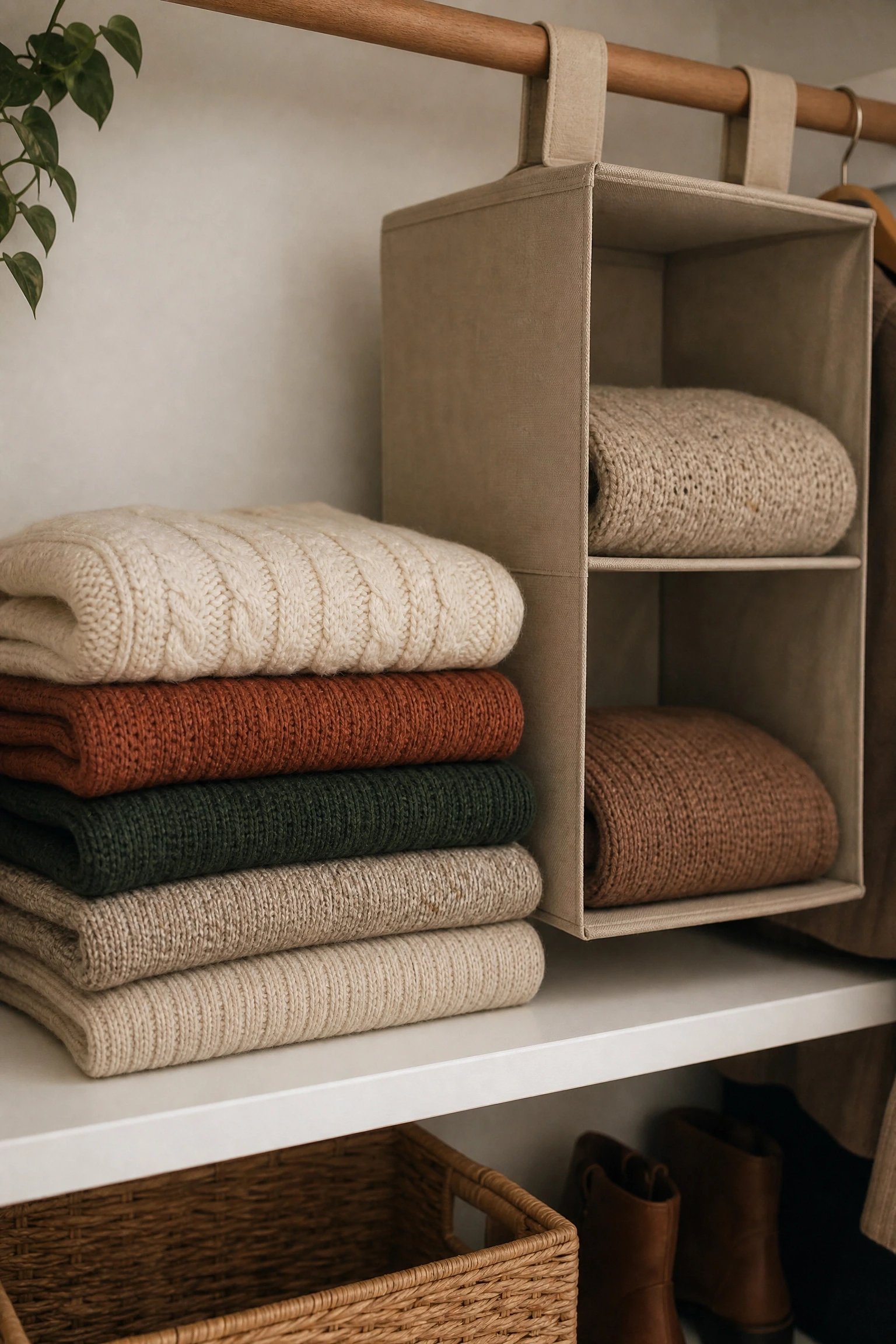
Hanging heavy knits and sweaters is one of the most common wardrobe mistakes, and it shows up as that telltale stretched-out shoulder point that makes even an expensive sweater look worn out. Heavy knitwear, cashmere, wool, and thick cotton knits should always be folded rather than hung because the weight of the fabric causes it to stretch and distort over time when suspended from a hanger. In the closet, this means dedicating shelf space or a drawer specifically to folded knitwear rather than trying to hang it alongside everything else. If shelf space is limited, a simple hanging fabric shelf insert that drops from the rod gives you several horizontal levels for folded sweaters without taking up any floor space. Fold sweaters in a way that keeps the body flat and the sleeves tucked neatly inside so they stack without slipping.
Quick Tip: If you do need to hang a delicate knit temporarily, fold it in half over the hanger bar rather than putting the hanger through the neck opening. It distributes the weight far more evenly.
14. Seasonal Items Crowd Out What You Actually Wear Right Now: Rotate Your Wardrobe
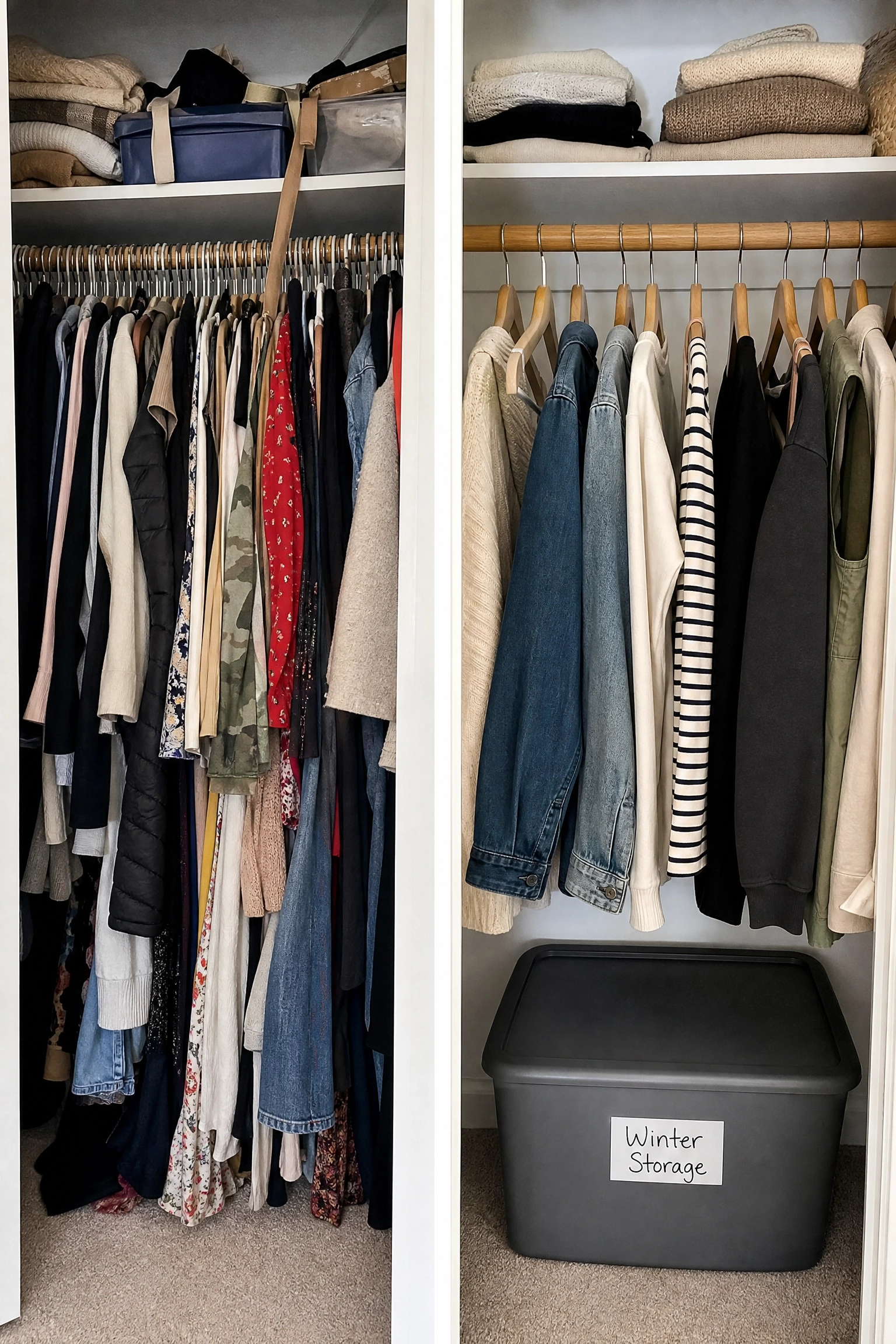
Keeping a full four-season wardrobe in one bedroom closet is one of the main reasons closets feel perpetually overcrowded. A seasonal rotation system fixes this by keeping only the current season’s clothing in your main closet and moving everything else to longer-term storage. Out-of-season clothes can go into vacuum storage bags under the bed, into labeled bins on a high shelf, into a spare closet, or into flat storage containers that slide under other furniture. The practical benefit is significant: when only in-season pieces are in your closet, everything fits with room to spare, you can actually see what you have, and getting dressed takes less time because every choice is relevant. Twice a year, usually at the spring and fall transitions, you swap the two wardrobes over. Most people who try this for the first time are shocked by how much calmer their closet immediately feels.
Heads Up: Wash or dry-clean seasonal items before packing them away. Storing clothes with body oils or light stains can set the marks permanently over months of storage.
15. The Closet Rod Is the Only Storage: Add a Hanging Fabric Organizer
Reach-in closets often have nothing but a single rod and a shelf, which means every item that is not a hangable garment has nowhere logical to go. A hanging fabric organizer with multiple shelves or compartments clips directly onto the rod and creates instant vertical storage for folded items, shoes, bags, or accessories without requiring any drilling or permanent changes. These are especially useful in rental apartments where you cannot modify the walls. They come in a range of configurations, from simple three-shelf cubbies to more elaborate units with a mix of hanging pockets, shelves, and rods. The main limitation is weight: fabric organizers work well for lighter items like t-shirts, underwear, or shoes, but they will sag or tip if overloaded with heavy items like boots or stacked denim.
Reality Check: Measure your rod height before buying a hanging organizer. Many standard units are too long for closets with low ceilings and will bunch up at the bottom.
16. The Door Is Wasted Space: Make the Most of Over-the-Door Storage
The back of a closet door is consistently one of the most underused surfaces in a bedroom. An over-the-door organizer, whether a full pocket panel, a hook rail, a shoe rack, or a mirror with built-in storage, turns that dead vertical surface into genuinely useful space without competing with anything else in the closet. For clothing closets, the door works well for accessories, bags, shoes, or small baskets holding folded items. A full-length mirror mounted on the back of the door is also a practical addition for smaller bedrooms where floor space for a freestanding mirror is tight. Before buying any over-the-door product, check whether your closet door opens inward or outward and whether there is enough clearance between the door and the closet rod for the organizer to hang without jamming.
Designer Advice: Limit the door to one type of storage rather than mixing several organizers. A single well-chosen piece looks intentional; multiple layered organizers on one door quickly start to look as chaotic as the problem you were solving.
17. Everything Falls to One Side: Balance the Rod with Category Zones
A closet where everything is crammed to one end of the rod while the other end sits nearly empty is a common but fixable problem. It usually happens because items were hung in order of arrival rather than in any logical arrangement. Category zoning fixes this by dividing the rod into dedicated sections: one zone for tops, one for bottoms, one for dresses or jumpsuits, one for outerwear. Within each zone, you can further organize by color, going from light to dark, which makes scanning for a specific piece much faster. The result is a rod that is used evenly across its full length, which also helps clothes hang without bunching against each other and wrinkling. Adding a simple rod divider, a small ring or clip that separates one zone from the next, makes the boundaries visible so the system does not drift over time.
Quick Tip: Put your most-worn categories at the center of the rod at natural reach height, not at the ends where they are harder to access.
18. Small Items Always Get Lost: Use Clear Drawer Dividers
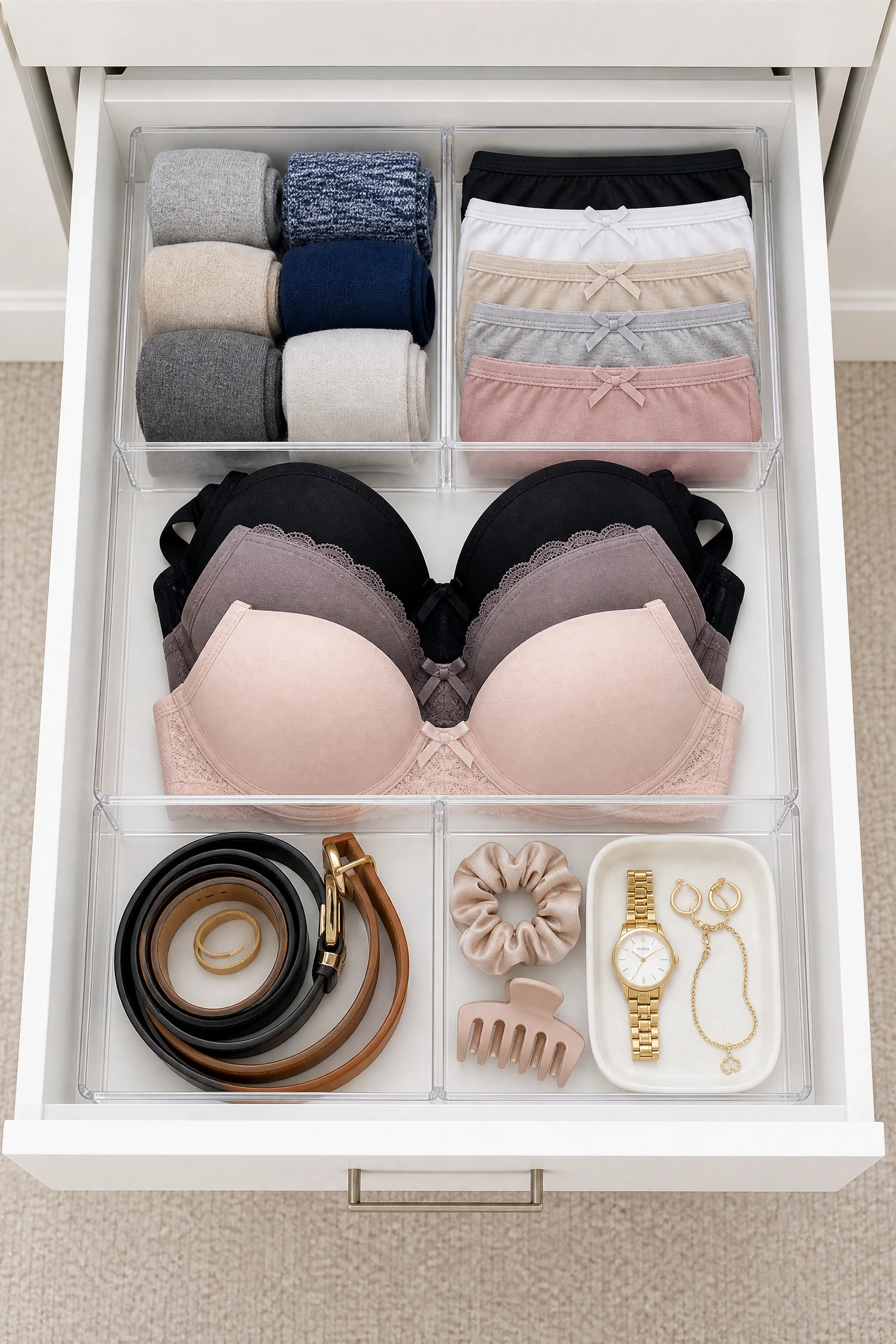
Socks, underwear, bras, and small accessories are the items most likely to turn a drawer into a chaotic pile within days of organizing it. Clear adjustable drawer dividers section the drawer into dedicated compartments that keep each type of item in its own lane. The clear material means you can see everything at a glance without lifting anything out. Bamboo or acrylic expandable dividers are the most practical options because they adjust to fit the exact width of any drawer rather than leaving awkward gaps. For bras in particular, storing them cup-to-cup in a row rather than folding them inside each other preserves the shape of the cups far better over time. Socks stored in matching rolled pairs or folded flat also stay organized far longer than loose socks tossed in a pile.
Pro Move: Before buying dividers, measure the interior of the drawer, including the depth, because most dividers are designed for shallower kitchen or office drawers and may not give you the right proportions for a deeper clothing drawer.
19. There Is No Room for a Dresser: Use a Modular Closet System
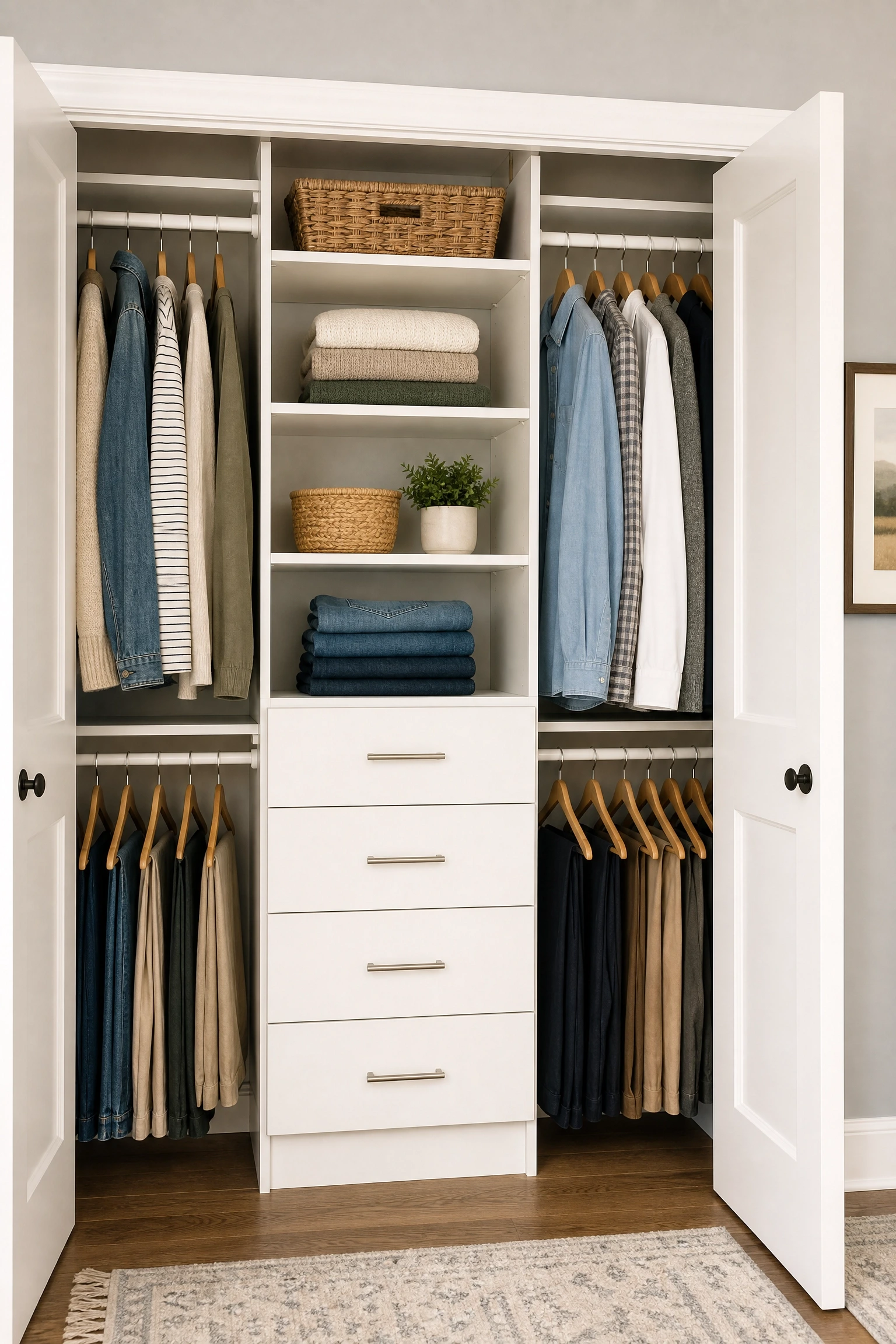
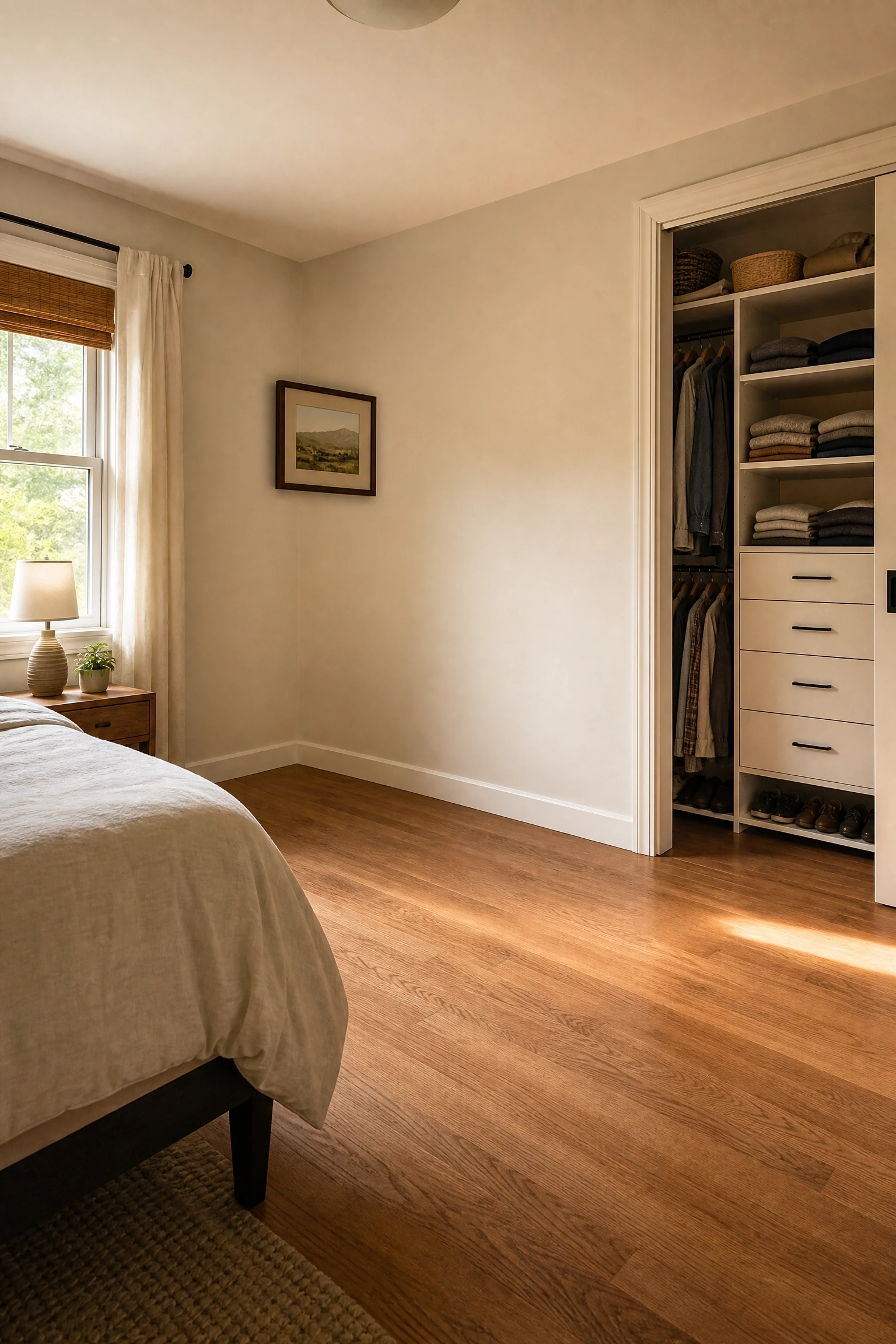
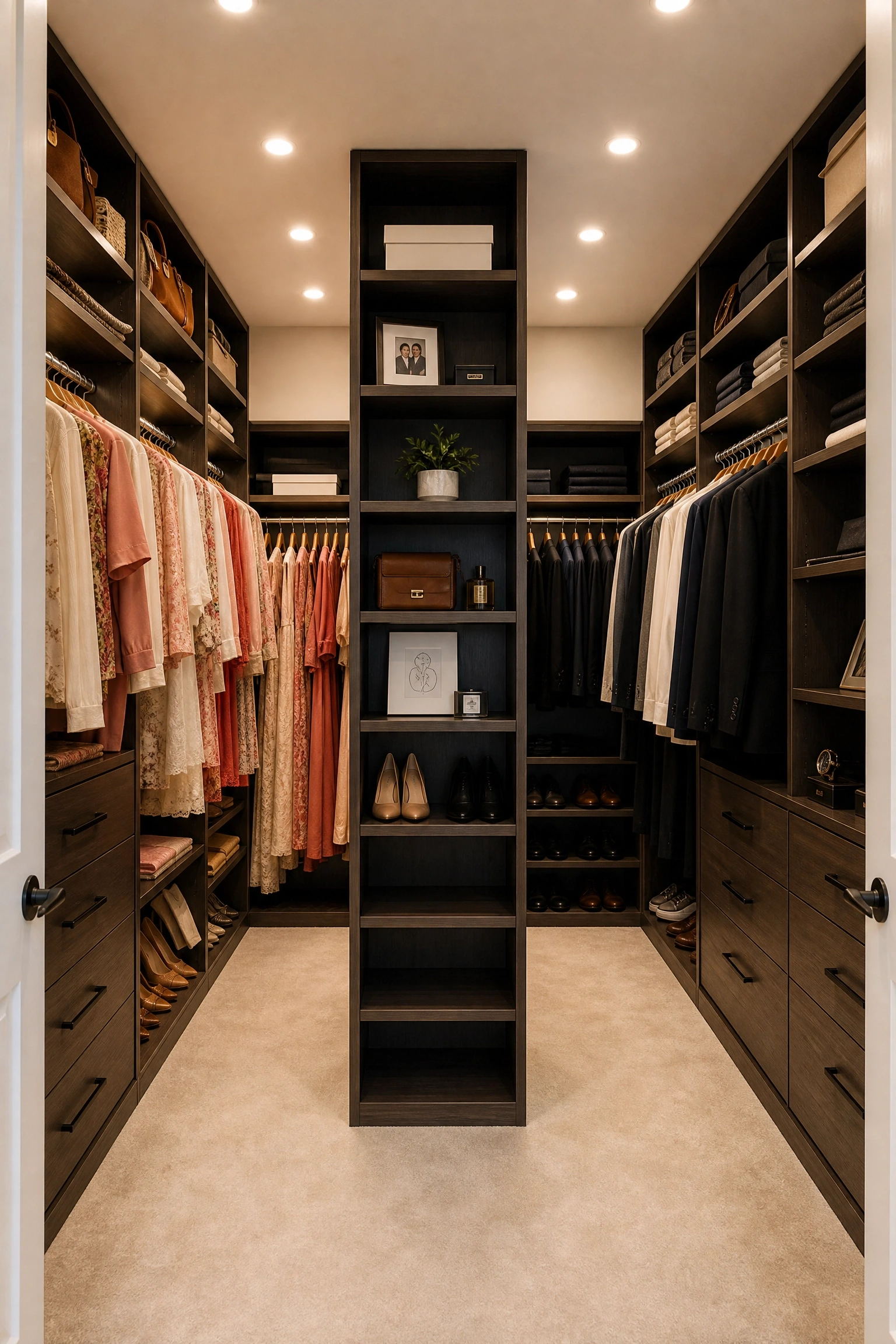
In smaller bedrooms, the dresser often takes up more floor space than it is worth, especially when the bedroom closet is nearby and could be doing the same job with some structural help. A modular closet system from brands like IKEA PAX, Elfa at The Container Store, or ClosetMaid adds shelves, drawers, and hanging sections inside the existing closet footprint, essentially building a functional dresser into the closet itself. These systems range from around $150 for basic configurations to well over $1,000 for a full custom-feeling setup, but even a mid-range modular system can eliminate the need for a standalone dresser entirely, freeing up meaningful floor space in the bedroom. The trade-off is that installation requires some planning and basic tools, and getting the configuration wrong means wasted shelves or awkward gaps.
Heads Up: Before investing in a modular system, map out exactly what you need to store, hanging items, folded items, shoes, accessories, and calculate the minimum space for each category before choosing a configuration.
20. Workout Gear Has No Home: Give It a Dedicated Section
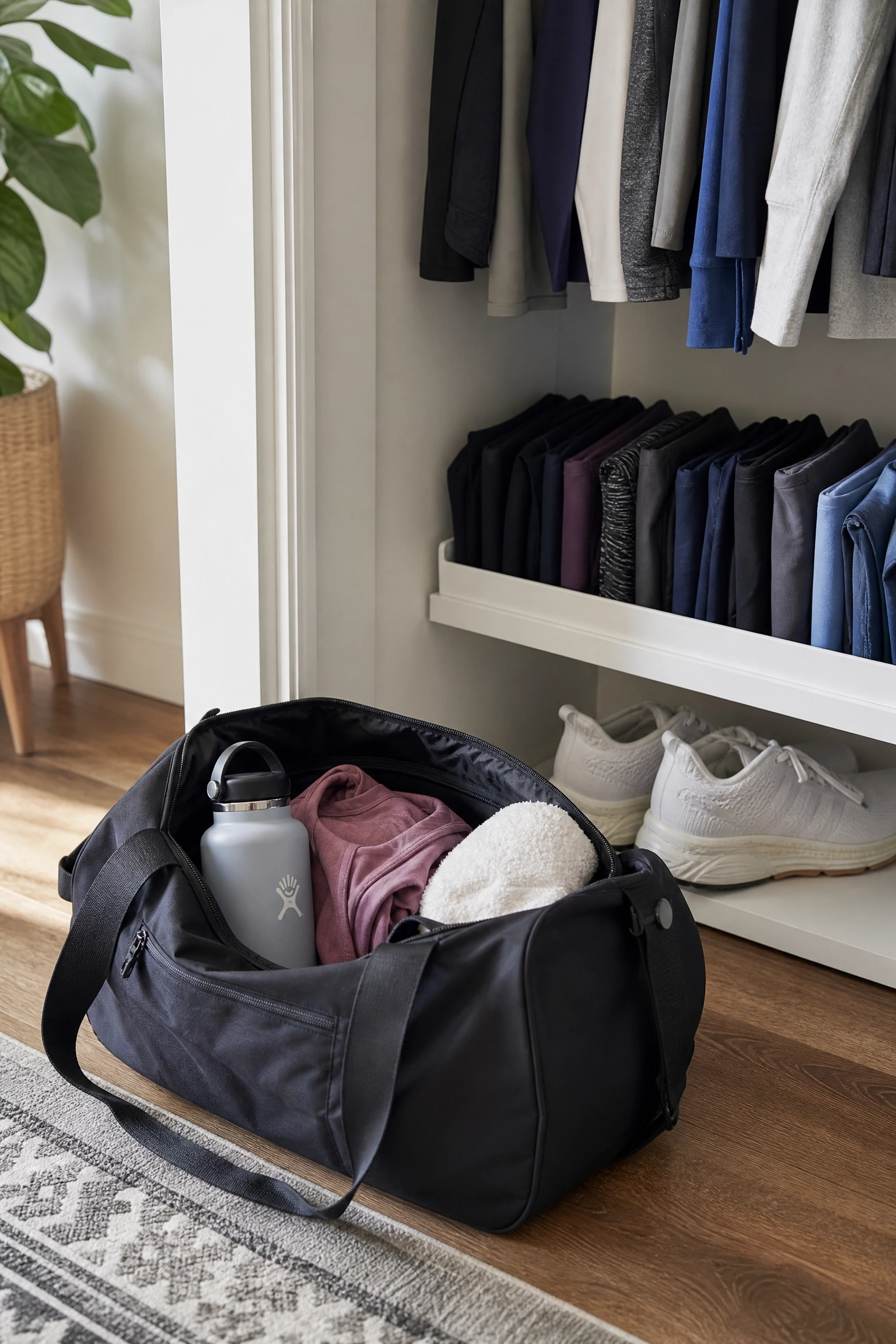
Gym clothes, yoga mats, resistance bands, and athletic shoes tend to end up scattered because they do not fit neatly into the usual categories of a clothing closet. Giving activewear its own dedicated zone within the closet, even just one section of shelving or one drawer, prevents it from bleeding into everything else. Because most workout gear is made from synthetic stretch fabrics that wrinkle easily and do not hang well, the vertical fold method works particularly well here. A small open basket or wire bin at floor level for yoga blocks, resistance bands, and jump ropes keeps the non-clothing gym items contained without cluttering up the hanging or shelf zones. Athletic shoes can be stored on a low shelf or in a separate section of the shoe rack closest to the closet door for quick grab-and-go access.
Designer Advice: Keep activewear grouped together even if your closet is organized primarily by clothing type. A dedicated workout zone makes packing a gym bag infinitely faster.
21. The Closet Is Shared and Always a Battle: Divide the Space Clearly
Shared closets are one of the most common sources of household friction, and the problem is almost never about one person being messier than the other. It is about undefined territory. When two people share one closet without a clear spatial agreement, things naturally drift and overlap until resentment builds. The fix is a physical boundary: dividing the rod and shelving clearly into two sides, or two sections, one per person, with each side configured to suit that persons wardrobe. If one person has more clothes, negotiate the allocation honestly rather than defaulting to a straight 50-50 split. Within each persons section, each individual can organize however works best for them, which also removes the friction of having two different organizational styles competing for the same space.
Reality Check: A shared closet only stays organized if both people buy into the system. Spend fifteen minutes talking through the layout together before setting it up rather than one person organizing and expecting the other to adapt.
22. Luggage Takes Up Half the Closet: Find It a Better Home
Large suitcases and duffel bags are some of the most space-inefficient items a bedroom closet has to accommodate because they are bulky, rarely used, and tend to push everything else out of the way. If you have a spare closet anywhere in the home, a garage, a basement, or under-bed space that can accommodate a flat suitcase, moving luggage out of the bedroom closet entirely is the single fastest way to free up significant space. If the bedroom closet is the only option, store suitcases on the highest shelf or nested inside each other with the largest on the outside, and use the interior of a stored suitcase to hold seasonal items like heavy sweaters or holiday gear. That way the suitcase is still taking up space but it is doing double duty as storage at the same time.
Quick Tip: Store a packing list, a few travel-size toiletries, and a set of travel adapters inside your suitcase so you are always ready to pack quickly without hunting for those items separately.
23. The Closet Gets Disorganized Within Days: Build a Return-to-Home System
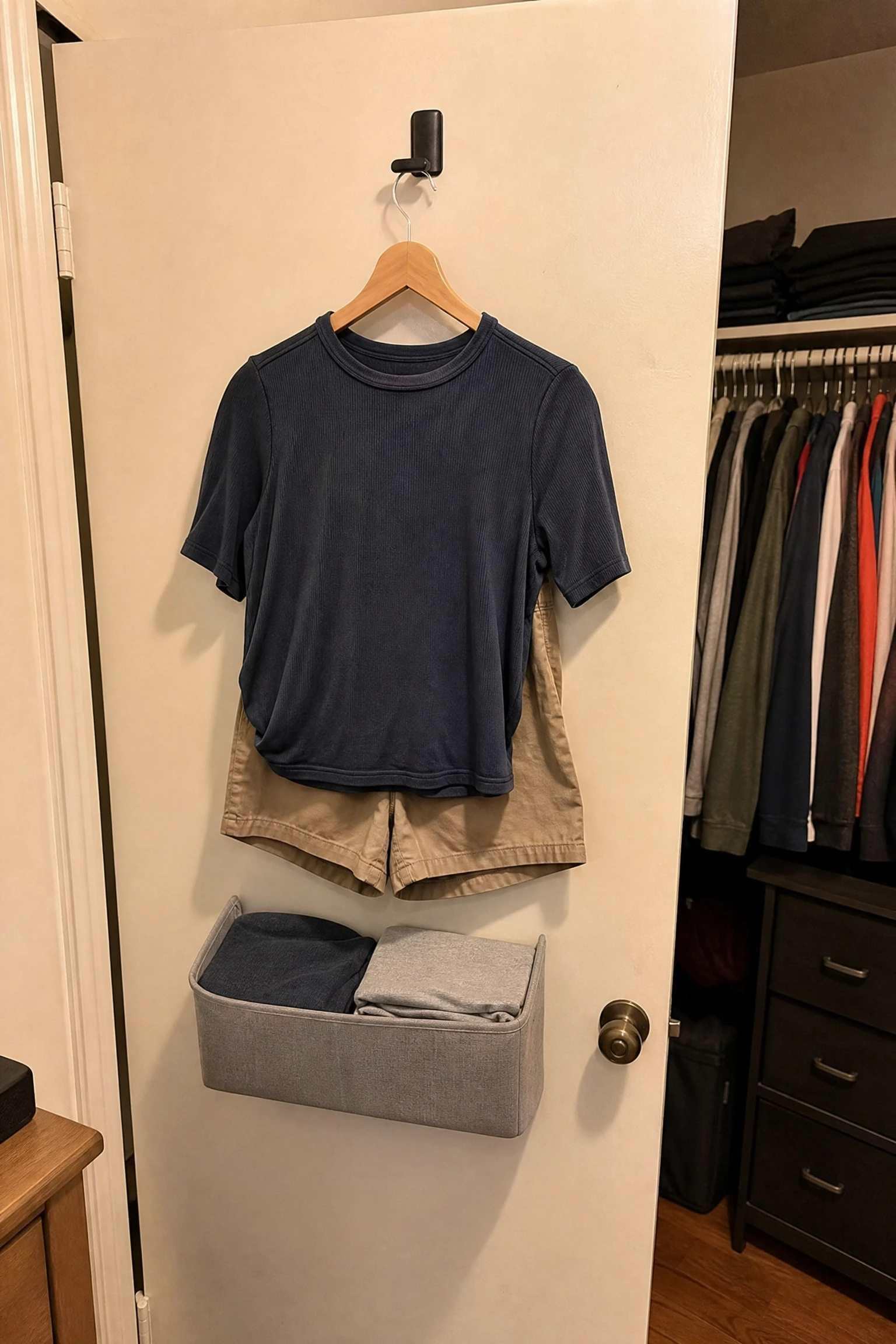
The reason most organized closets fall apart within a week or two is not a lack of discipline. It is a lack of what professional organizers call a “return-to-home” habit: a clear, easy, low-effort path for putting things back where they belong. If returning an item takes more than a few seconds, it will end up on a chair or the floor instead. The best-organized closets are ones where everything has a single, obvious, easy-to-reach home. This sometimes means accepting a slightly less perfect organizational system in favor of one that is genuinely frictionless to maintain. A small hook inside the closet door for tomorrows outfit, a single open basket for “worn but not dirty” items, and a clear drop zone for accessories you are not putting away yet all reduce the gap between the ideal and the reality of daily life.
Pro Move: The five-minute closet reset, putting things back in their places every night before bed, is the single habit that keeps an organized closet organized. No system survives without it.
24. There Is No Space for Bags and Backpacks Near the Door: Use the Closet Strategically
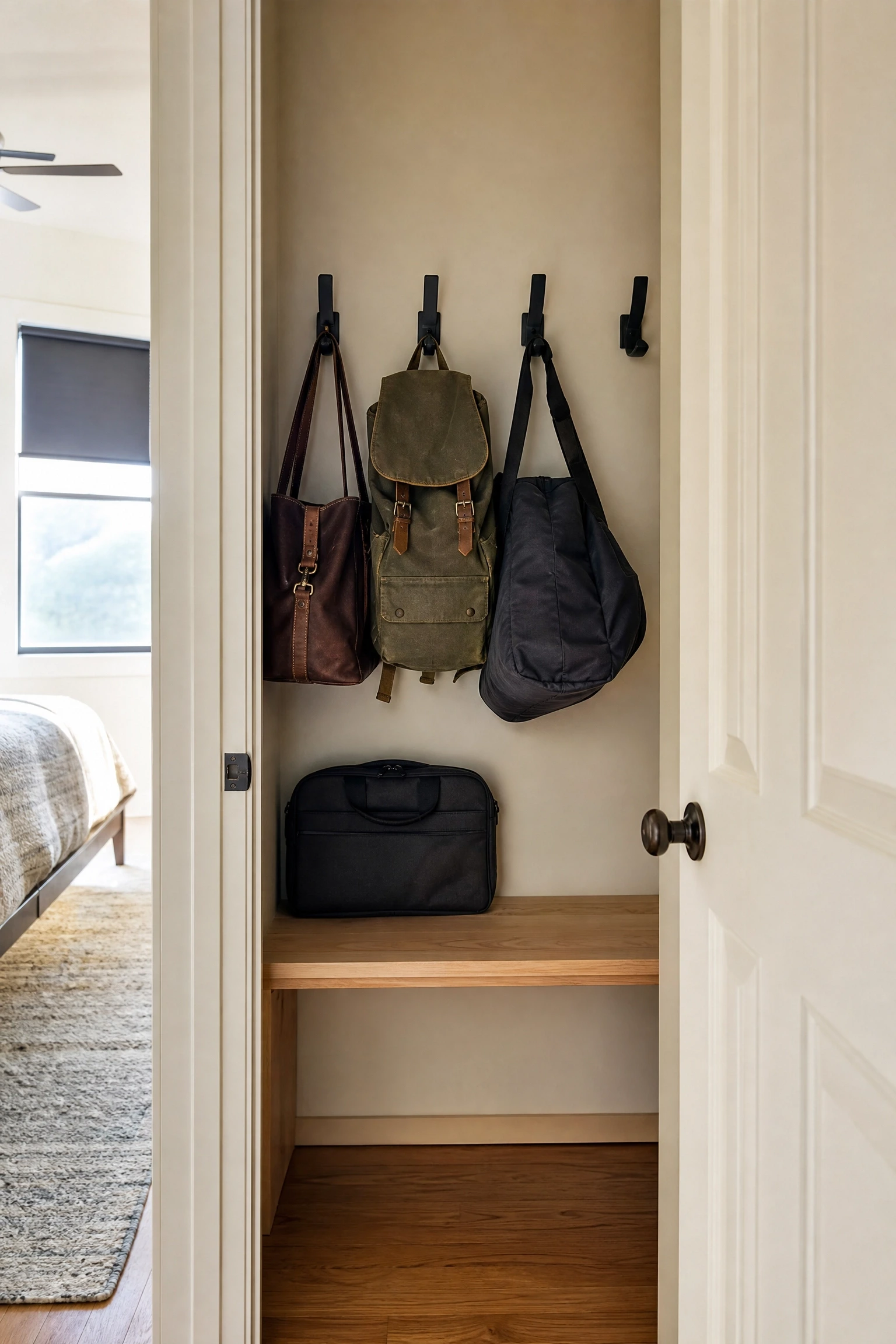
Everyday bags, school backpacks, and work totes are items people need to access quickly when leaving the house, but they often end up on the floor by the front door or thrown over a chair because the bedroom closet does not make them easy to grab. Reserving the most accessible spot in the closet, the section closest to the door or the most visible hook at eye level, for daily-use bags creates a proper home for them without requiring a separate entryway storage solution. A single row of strong hooks at the front of the closet or just inside the closet door handles this well. For backpacks with laptop compartments or bags that need to stay upright to protect their contents, a low shelf at floor level with enough height clearance for the bag to stand naturally works better than a hook.
Heads Up: Do not store everyday bags at the back of the closet behind everything else, even if that is where the logical space is. Convenience beats neatness when it comes to items you need to grab every single morning.
25. The Whole Closet Feels Overwhelming: Start with One Small Section
One of the biggest reasons bedroom closets stay disorganized is that the project of sorting the whole thing feels too large to start. The fix is deliberately not doing the whole thing at once. Pick the one area causing the most daily frustration, whether that is the shoe situation, the tangled accessories, or the shelf above the rod, and do only that section first. Get it working well, let the improvement sit for a week or two, and then move to the next problem area. This approach works because each small win builds momentum and gives you confidence in the system before you extend it. It also means you are not spending an entire Saturday reorganizing a closet only to find the system you set up does not quite work for your actual habits. Small, deliberate changes that stick are worth far more than a full overhaul that falls apart in two weeks.
Reality Check: Organization is not a one-time event. It is an ongoing relationship with the space you have. Starting small and adjusting as you go is not laziness. It is the most practical approach there is.
Closing Thoughts
A well-organized bedroom closet is not about having the most storage products or the most Instagram-worthy setup. It is about building a system that actually matches how you live, what you own, and how much time you realistically want to spend maintaining it. The ideas in this list are not meant to be applied all at once. Think of them as a toolkit: pick the ones that address the specific problems causing the most friction in your daily routine, put them in place one at a time, and give each change a few weeks to settle before deciding whether it is working.
The closets that stay organized longest are not the most elaborate ones. They are the ones built around honest habits rather than aspirational ones. You know whether you are someone who returns things immediately or lets them pile up for a few days. You know whether you fold carefully or shove things in quickly when you are in a rush. The best closet organization system is the one that works with those habits rather than against them, because a system you can actually maintain is worth ten systems you cannot. Start with the problem that bothers you most, fix it well, and build from there.
“Which of these ideas would actually make the biggest difference in your closet right now? Drop it in the comments below.”
Frequently Asked Questions
How do I start organizing a bedroom closet when it feels completely overwhelming?
Start with just one problem area rather than the whole closet at once. Identify the single thing causing the most daily frustration, whether it is the shoe pile, the jammed rod, or the shelf that has become a dumping ground, and fix only that first. Once that section is working well, move to the next. This approach is more sustainable than a full overhaul and tends to produce systems that actually stick.
What is the most affordable way to organize a small bedroom closet?
Switching to matching slim velvet hangers, adding a second hang rod with a $15 to $25 doubler clip, and using cardboard boxes labeled by category on the top shelf are all genuinely effective and cost almost nothing. You do not need to buy a full modular system to make a significant improvement. Most small closets benefit most from better use of vertical space and visual consistency, both of which can be achieved on a tight budget.
How do I keep a bedroom closet organized after I have set it up?
The key is reducing friction in the put-away process. If returning an item to its home takes more than a few seconds, it will end up on a chair or the floor. Build your system around your actual habits. A single open basket for “worn but not dirty” items, a hook for tomorrow’s outfit, and a five-minute nightly reset are more effective at maintaining organization than any elaborate product system.
Is it worth investing in a custom closet system, or will a DIY approach work just as well?
For most people, a well-planned modular system from a retailer like IKEA, The Container Store, or ClosetMaid delivers most of the benefit of a fully custom setup at a fraction of the cost. True custom closets are worth the investment in primary closets that will be used daily for many years in a home you own and plan to stay in. For renters or those who are still figuring out their organizational needs, a modular or DIY approach is smarter because it can be adjusted without losing the investment.
How often should I reorganize or edit my bedroom closet?
A seasonal review twice a year, once in spring and once in fall, is enough for most people. Use those moments to swap out seasonal clothing, donate items you did not reach for during the past season, and check whether your storage system is still matching how you actually use the space. Full reorganizations are rarely needed if you are doing small resets regularly and editing your wardrobe as you go rather than letting things accumulate unchecked.
What should I never store in a bedroom closet?
Anything that creates moisture, like damp towels or wet gym gear, should never sit in a closed closet because it can lead to mildew on the surrounding clothes. Bulky items used only once or twice a year, like luggage, holiday decorations, or camping gear, are better stored elsewhere if any alternative exists. And anything you are keeping purely out of guilt rather than genuine use should be donated rather than taking up closet space that your actual wardrobe needs.