Avocado green is having a moment, and this time it is not the same shade that made 1970s kitchens look like they were decorated in guacamole. The colour has returned in more considered, more sophisticated forms, paired with materials and finishes that the original kitchens of the era never had access to. The result is a kitchen colour that is warm, earthy, distinctly characterful, and genuinely liveable in a way that all-white kitchens stopped being about a decade ago.
But avocado green is still a commitment. It is bolder than sage, more specific than olive, and more loaded with cultural history than almost any other kitchen colour you could choose. The ideas in this article are organized around the actual decisions you face when planning an avocado green kitchen: which element to go green on, what to pair it with, how much colour to bring in, and what approach gives you the look you want without the kitchen ending up feeling dated before you even finish unpacking the boxes. Every idea comes with the real story of why it works, what it pairs with best, and what to watch out for.
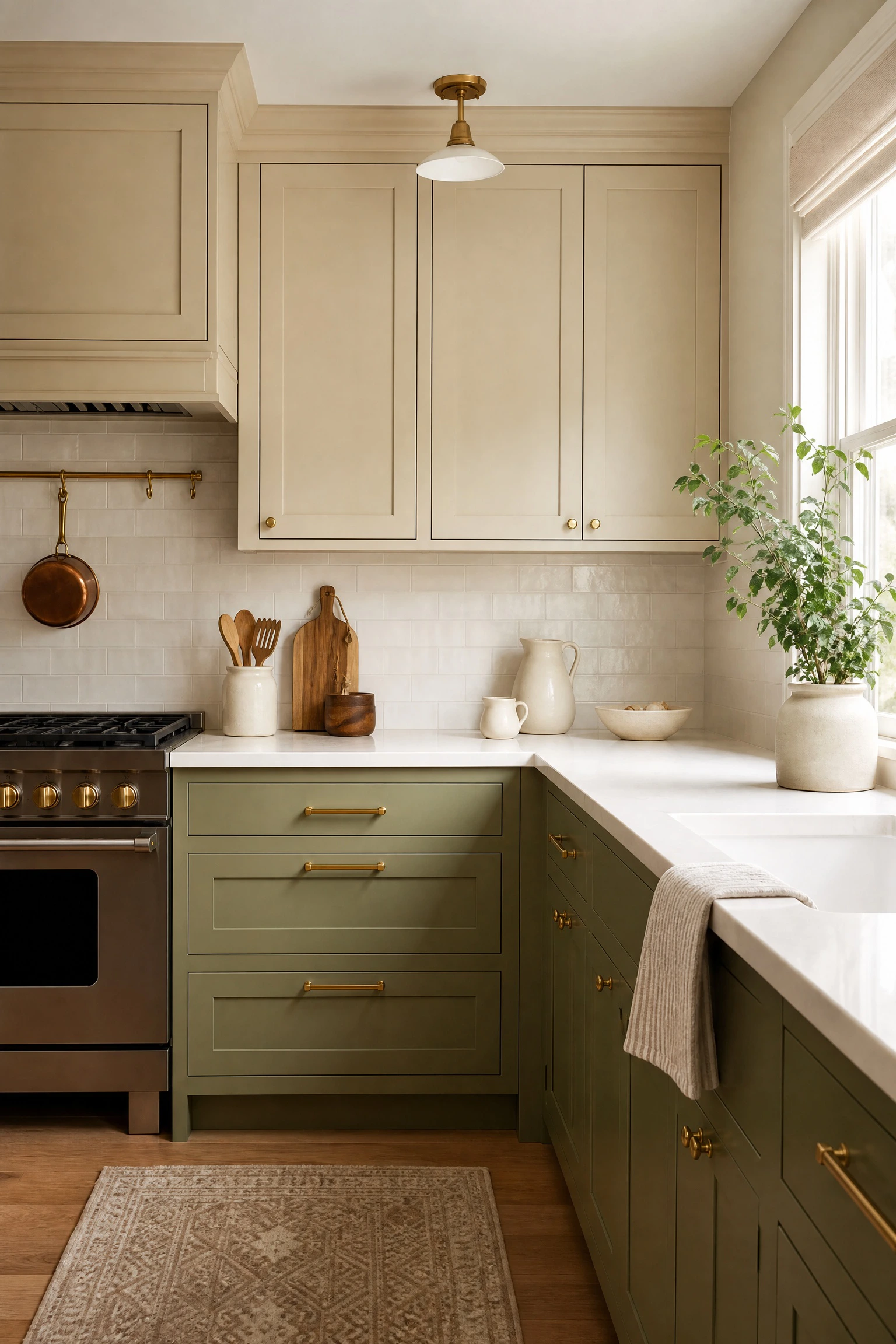
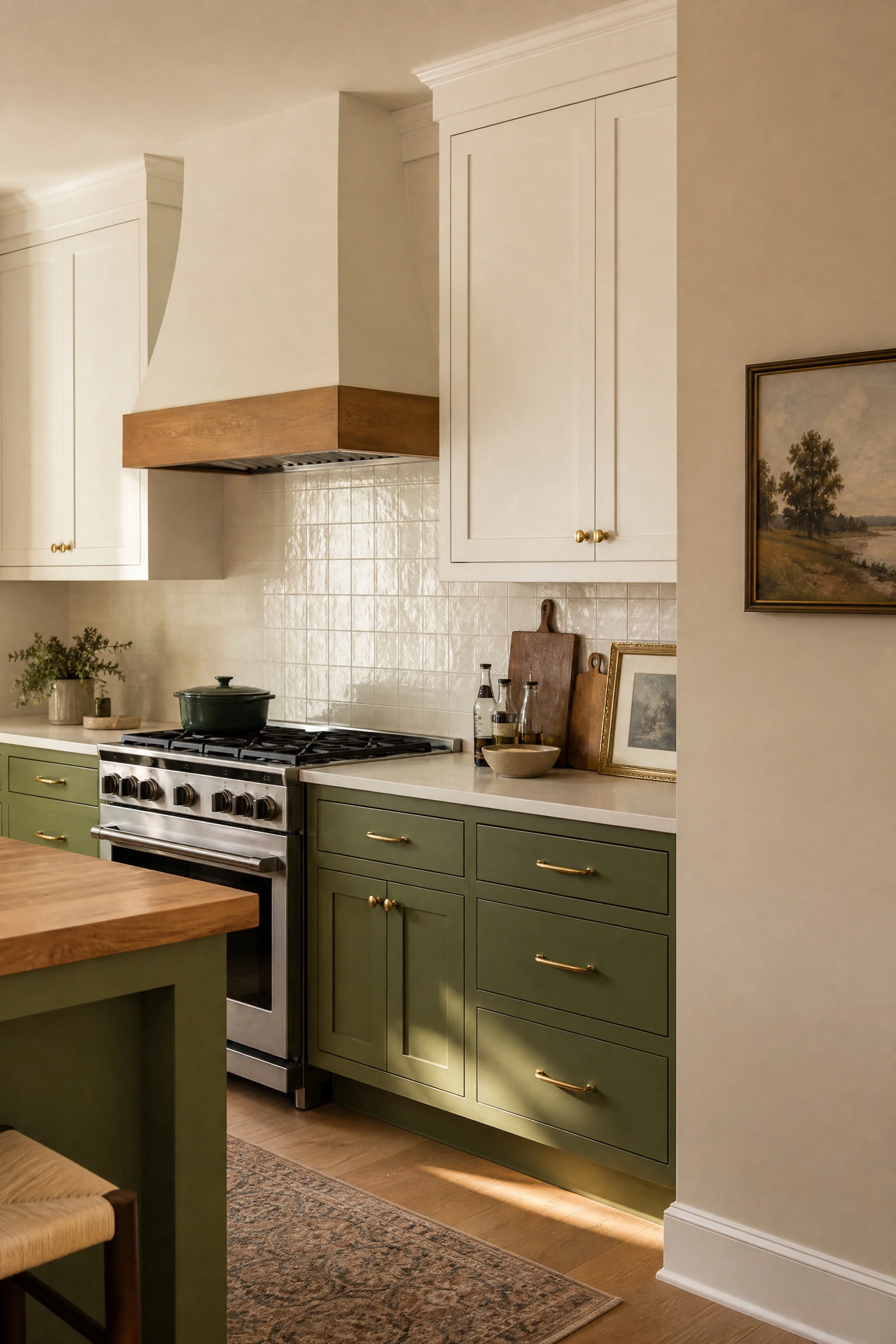
The most approachable way to bring avocado green into a kitchen is to limit it to the lower cabinets and keep the upper cabinets in a lighter neutral, either white, cream, or a warm off-white that picks up the green undertone without matching it directly. This two-tone approach does several things at once: it grounds the colour in the lower half of the kitchen where it anchors visually without overwhelming the space, it keeps the upper walls and ceiling feeling open and bright, and it gives you a way to introduce a bold colour with a clearly defined exit strategy if you ever want to change it. In practice, avocado lower cabinets with cream uppers look warmer and more considered than the same combination done with white, because white can read slightly clinical against the earthy green tone.
Pro Move: Paint the inside of the upper cabinets the same avocado green as the lowers. When the doors are open, the colour peeks through and ties the two halves of the kitchen together without making the upper cabinets feel too heavy from the outside.
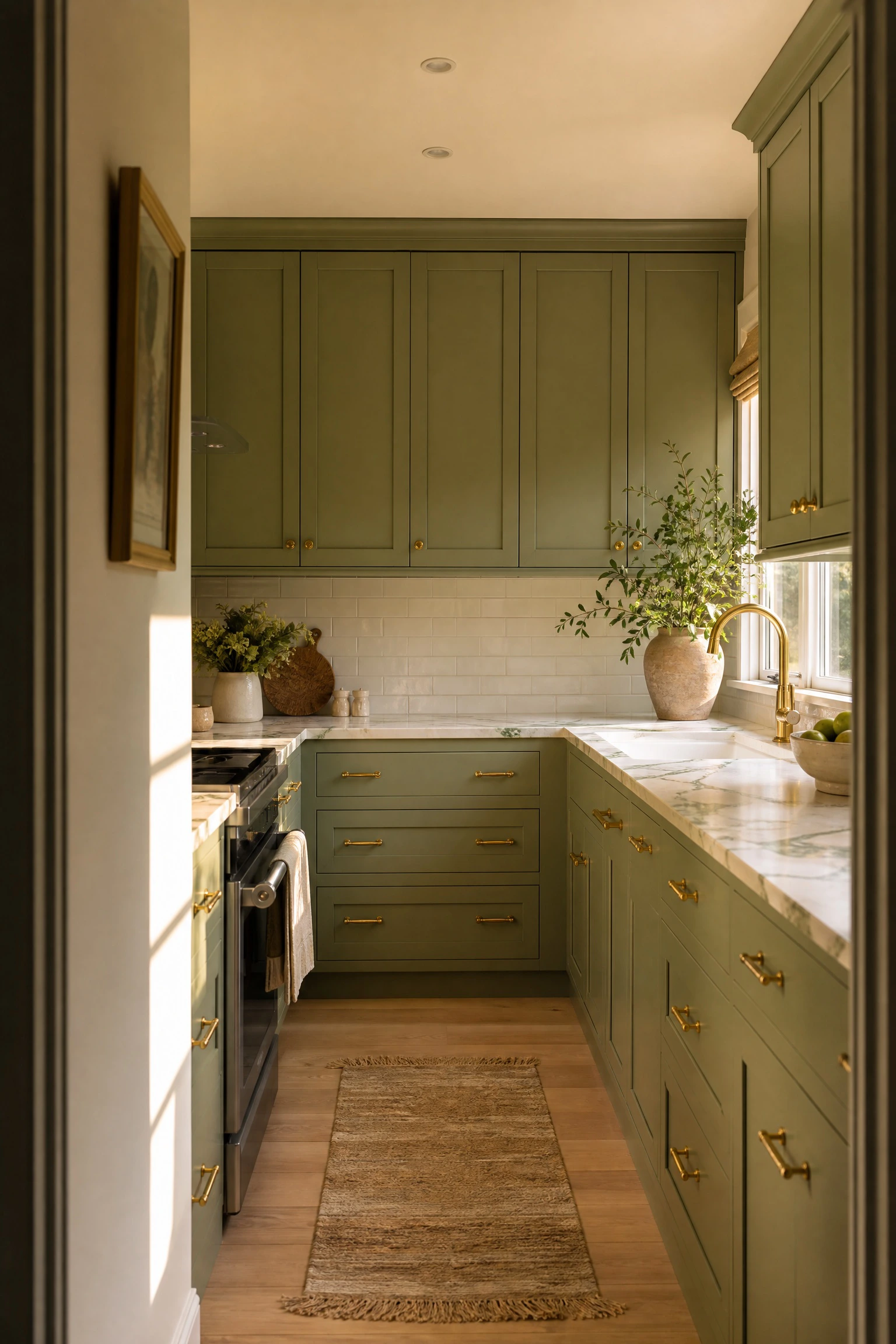
A full-height avocado green kitchen, with both upper and lower cabinets in the same shade from floor to ceiling, is a bolder and more committed approach that only works when the kitchen has enough natural light to absorb the colour without going dark and oppressive. In a well-lit kitchen with white or stone countertops and a light backsplash, full avocado cabinetry creates a warm, enveloping atmosphere that feels genuinely distinctive. The key pairing decisions that make this work are hardware and countertop: brass or brushed gold hardware lifts the green and stops it looking muddy, and a light marble, quartz, or cream stone countertop provides the visual relief the colour needs. Where full avocado cabinetry goes wrong is when it is paired with dark countertops and minimal lighting, which creates a colour mass that makes the kitchen feel smaller and heavier than it actually is.
Heads Up: Order your cabinet colour sample in both matte and satin finishes and look at them in your actual kitchen at different times of day before committing. Avocado green changes significantly under artificial light and a matte finish can read darker and more olive in the evening than it appears on a paint card.
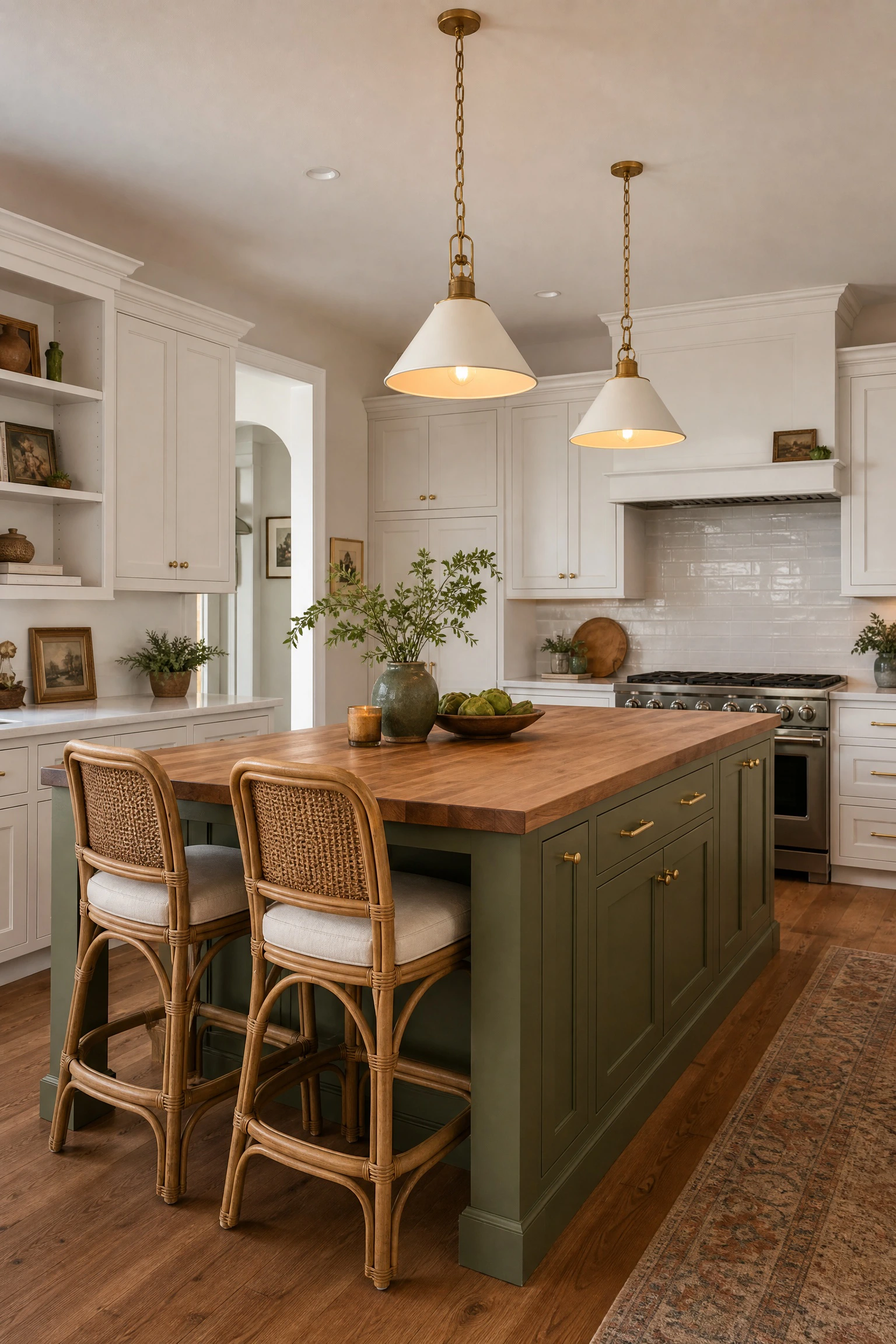
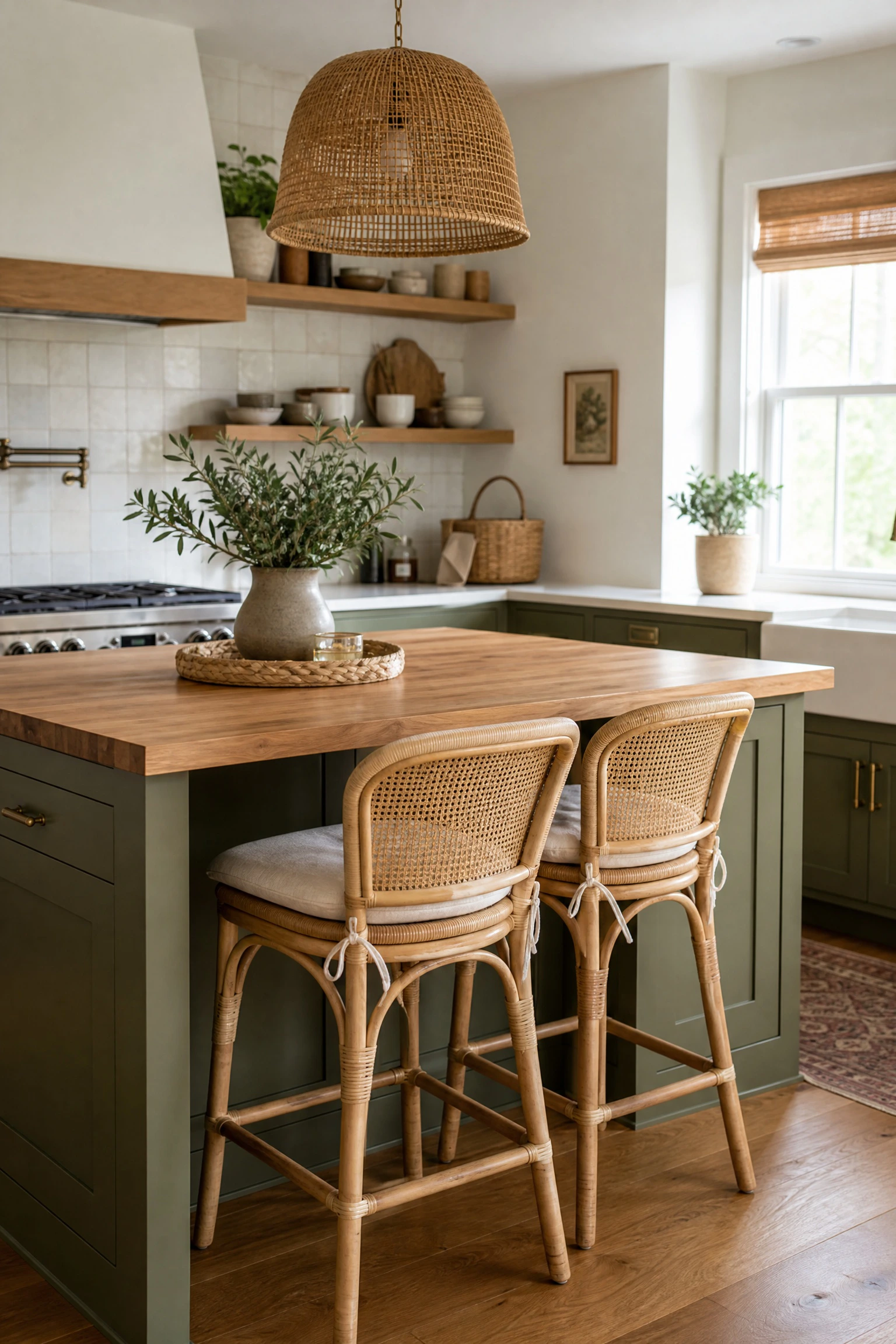
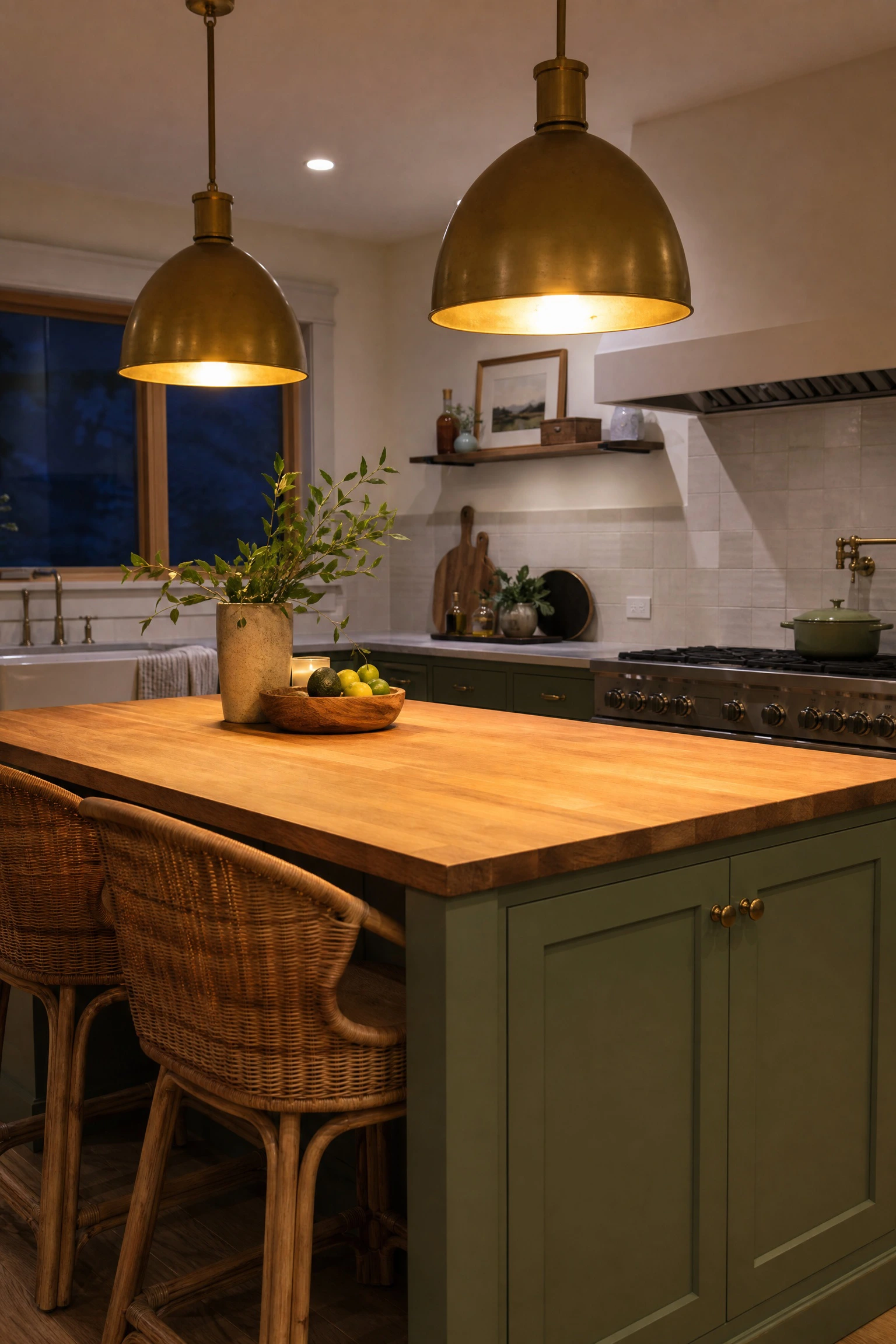
Painting or finishing just the kitchen island in avocado green while keeping the perimeter cabinets in a neutral is one of the most design-forward approaches on this list, and it is also one of the most manageable because the island is a contained, defined element that can hold a bold colour without the rest of the kitchen needing to match it. In practice, an avocado island with white or light grey perimeter cabinets acts as a visual anchor for the whole space, particularly if the island has a contrasting countertop like butcher block, dark stone, or a warm marble with cream and green veining. This approach is also the easiest to revisit later: an island can be repainted or refinished without touching the rest of the kitchen at all.
Designer Advice: Choose a countertop for the island that is different in material from the perimeter countertops. A butcher block island top against white quartz perimeter counters, for example, reinforces the idea that the island is a deliberately distinct design element rather than something that did not quite match.
4. Pair Avocado Green Cabinets With Brass Hardware
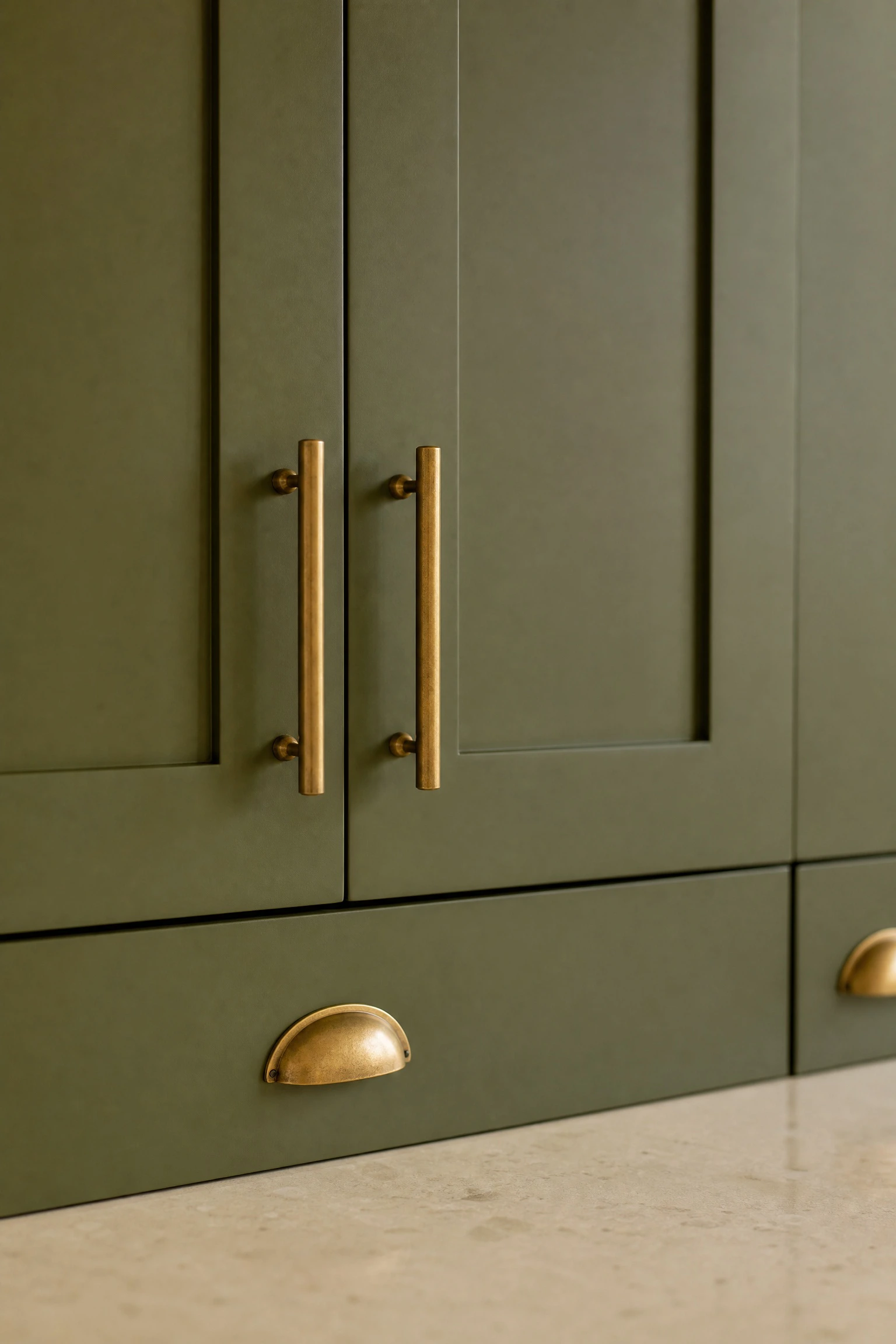
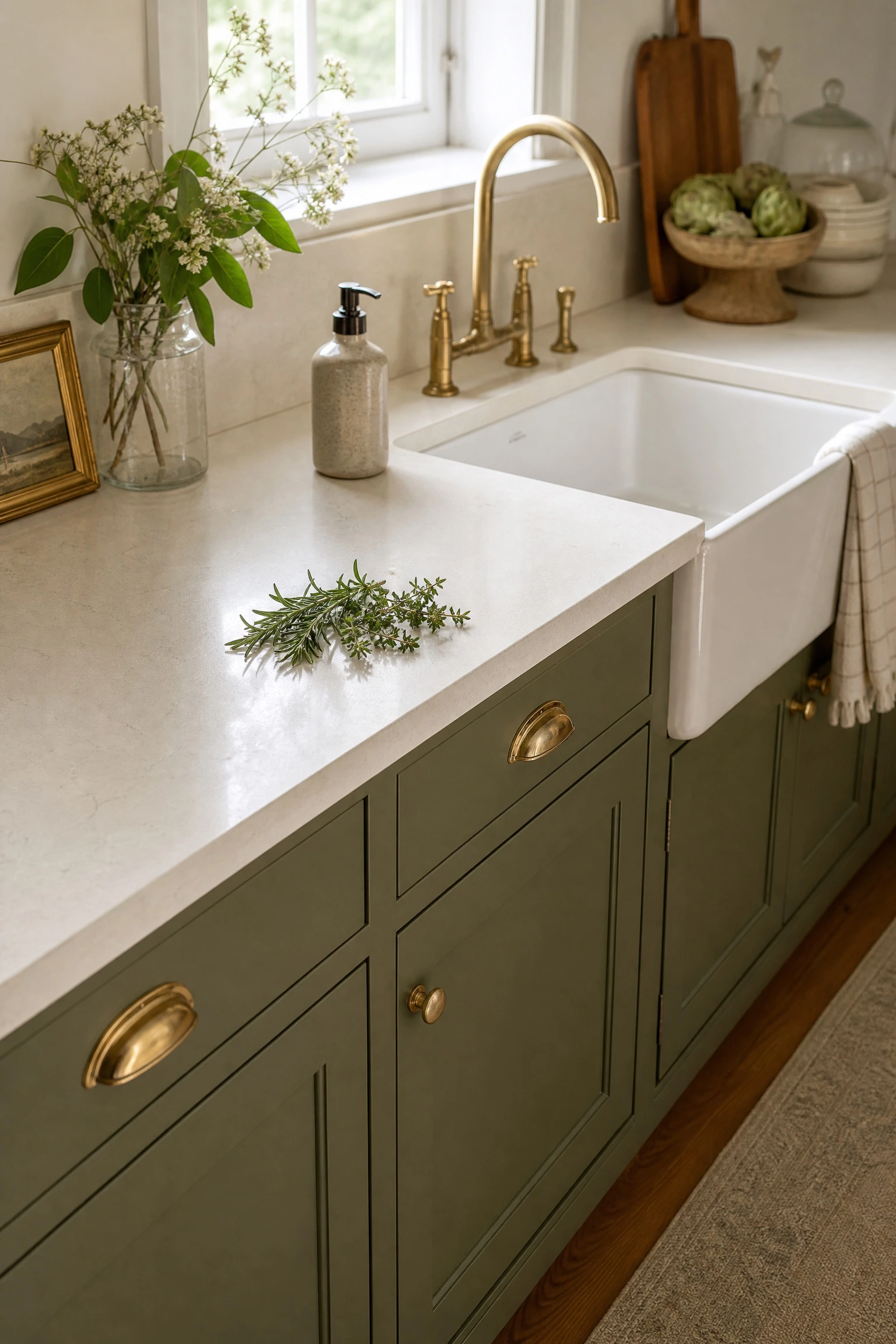
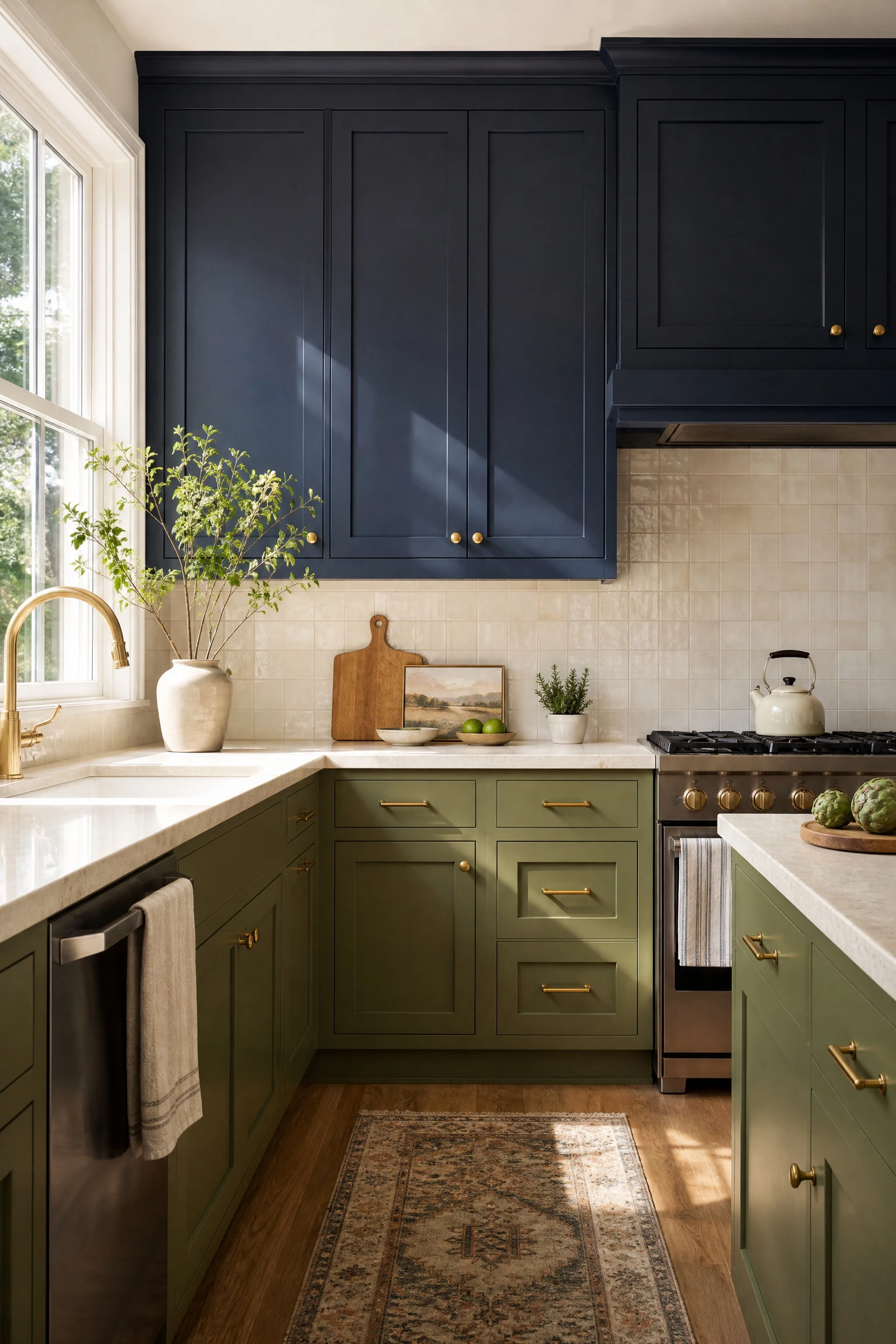
Brass hardware is the single most effective pairing for avocado green cabinets, and the reason is colour theory: the warm yellow undertone in unlacquered brass or brushed brass sits on the opposite side of the tonal scale from the cool earthy green, creating a contrast that feels rich rather than jarring. In practice, this combination reads as simultaneously retro and current, which is exactly the territory avocado green occupies right now. Unlacquered brass will develop a patina over time that deepens the warmth of the pairing. Brushed brass stays more consistent and is easier to maintain. Avoid polished brass, which tends to look more costume-like against an already characterful colour. Matte black hardware is the alternative for anyone who wants a crisper, more contemporary feel, though it loses some of the warmth that makes avocado green kitchens feel genuinely inviting.
Quick Tip: Keep hardware consistent across the whole kitchen. Mixing brass cup pulls with brass bar handles in the same kitchen is fine as long as the finish matches. What breaks the look is switching between brass and brushed nickel partway through because one or the other ran out of stock.
The countertop choice in an avocado green kitchen is the decision that most affects whether the overall look reads as sophisticated or dated. Warm white quartz, cream-toned quartzite, or a marble with soft green and gold veining all work exceptionally well because they share the warm undertone of the avocado colour without matching it. This avoids the problem that made 1970s avocado kitchens feel so suffocating: every element the same colour with no visual relief. A cream or warm white countertop does the heavy lifting of providing contrast without introducing a competing colour. Butcher block is another strong option that brings warmth and texture while grounding the kitchen in natural materials. Avoid cool grey countertops, which fight the warm earthiness of avocado green and make the colour look dull rather than rich.
Reality Check: Honed or leathered stone finishes tend to suit avocado green kitchens better than high-polish surfaces. The matte quality of a honed countertop reinforces the earthy, organic character of the green rather than introducing a slick modernity that can feel at odds with the colour.
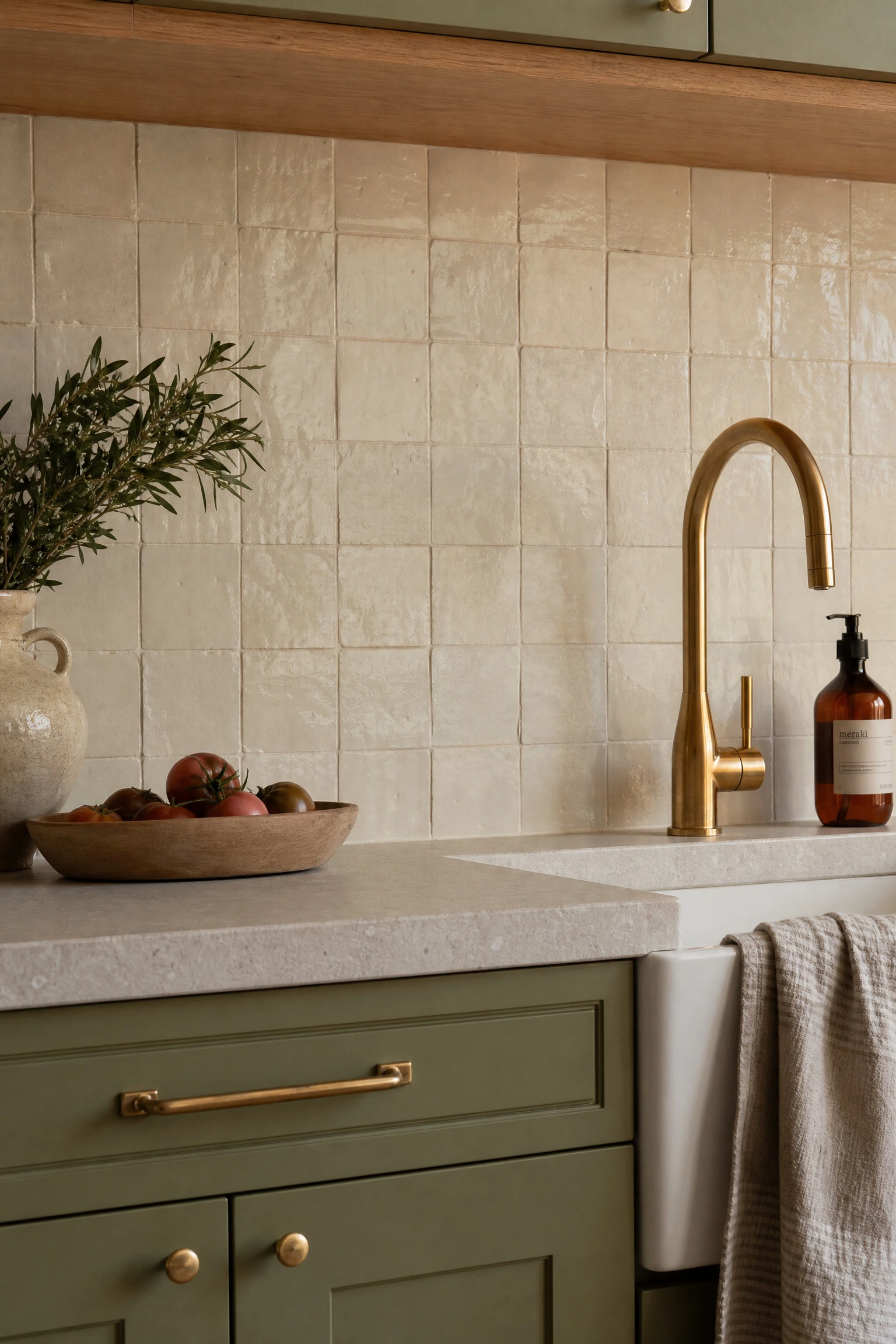
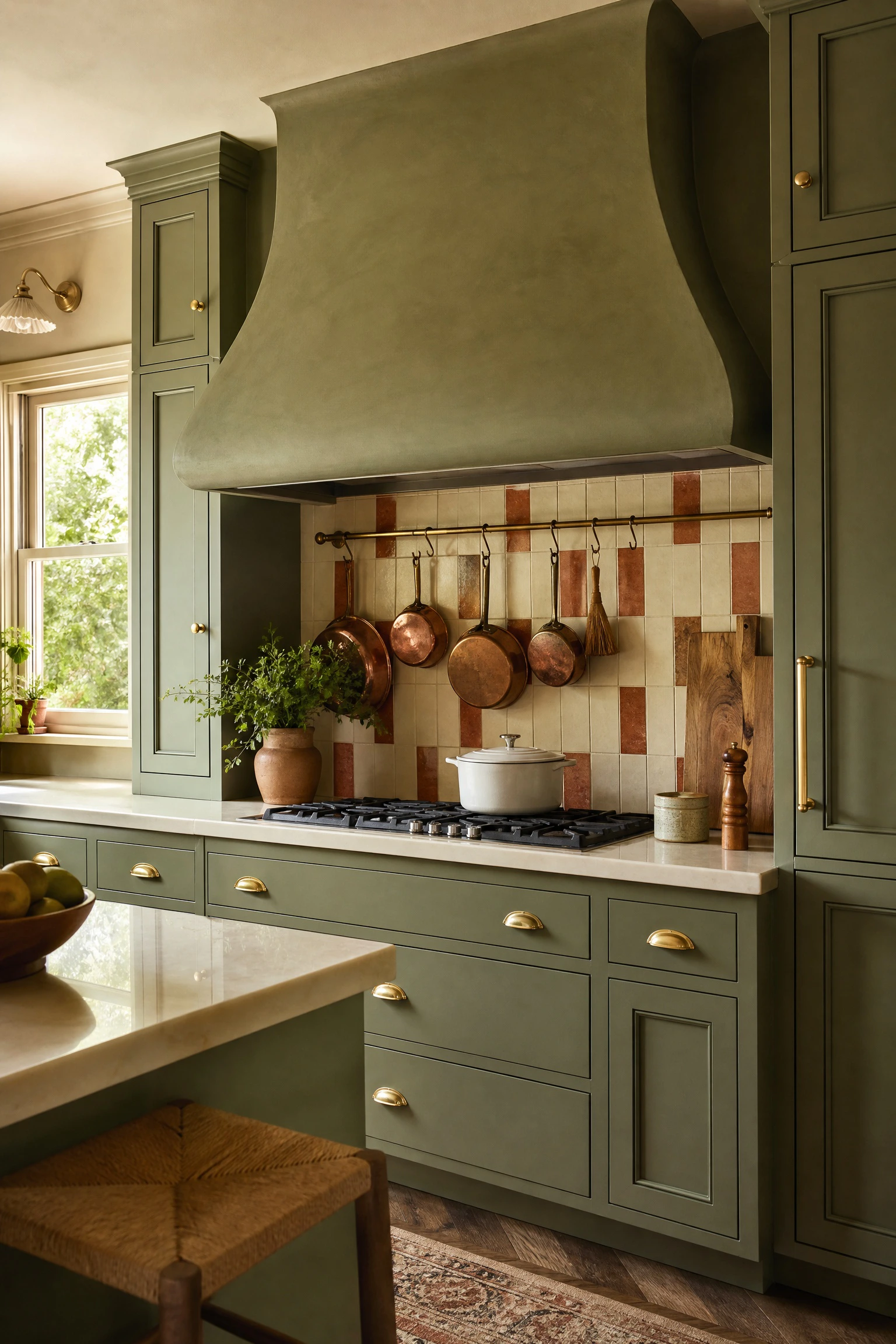
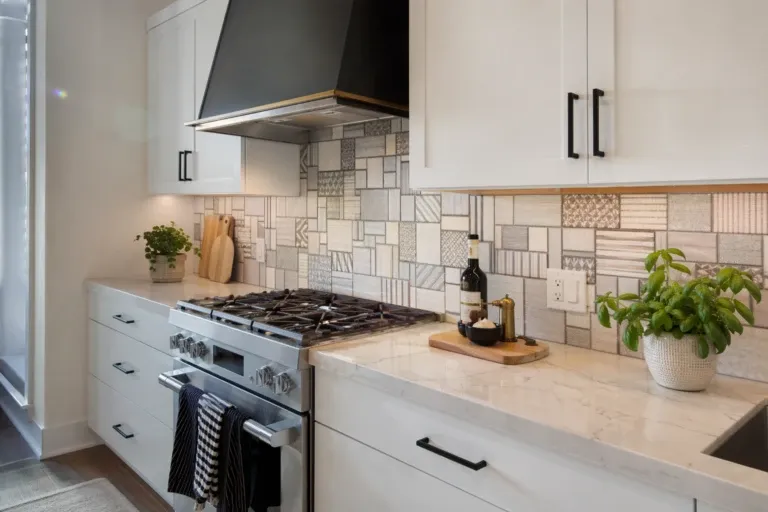
The backsplash is where an avocado green kitchen gains texture and personality, and the choices that work best are the ones that lean into the handmade, organic quality of the colour rather than fighting it with something slick or graphic. Zellige tiles, the small irregularly shaped Moroccan tiles with a slightly uneven glaze, are particularly well-suited to avocado green kitchens because their variation in colour and surface gives the backsplash a lively, artisanal quality that complements the warmth of the green. Cream and off-white zellige is the safest pairing. Terracotta-toned zellige pushes the kitchen toward a warmer, more Mediterranean feeling. Green zellige in a slightly different tone to the cabinets adds depth without creating a flat, monochromatic effect. Standard white subway tile also works but tends to look more generic alongside a colour as specific as avocado green.
Designer Advice: Run the backsplash tile all the way to the ceiling rather than stopping at the bottom of the upper cabinets. A full-height tiled section behind the hob or range makes a strong design statement and prevents the kitchen from feeling like the tile was an afterthought.
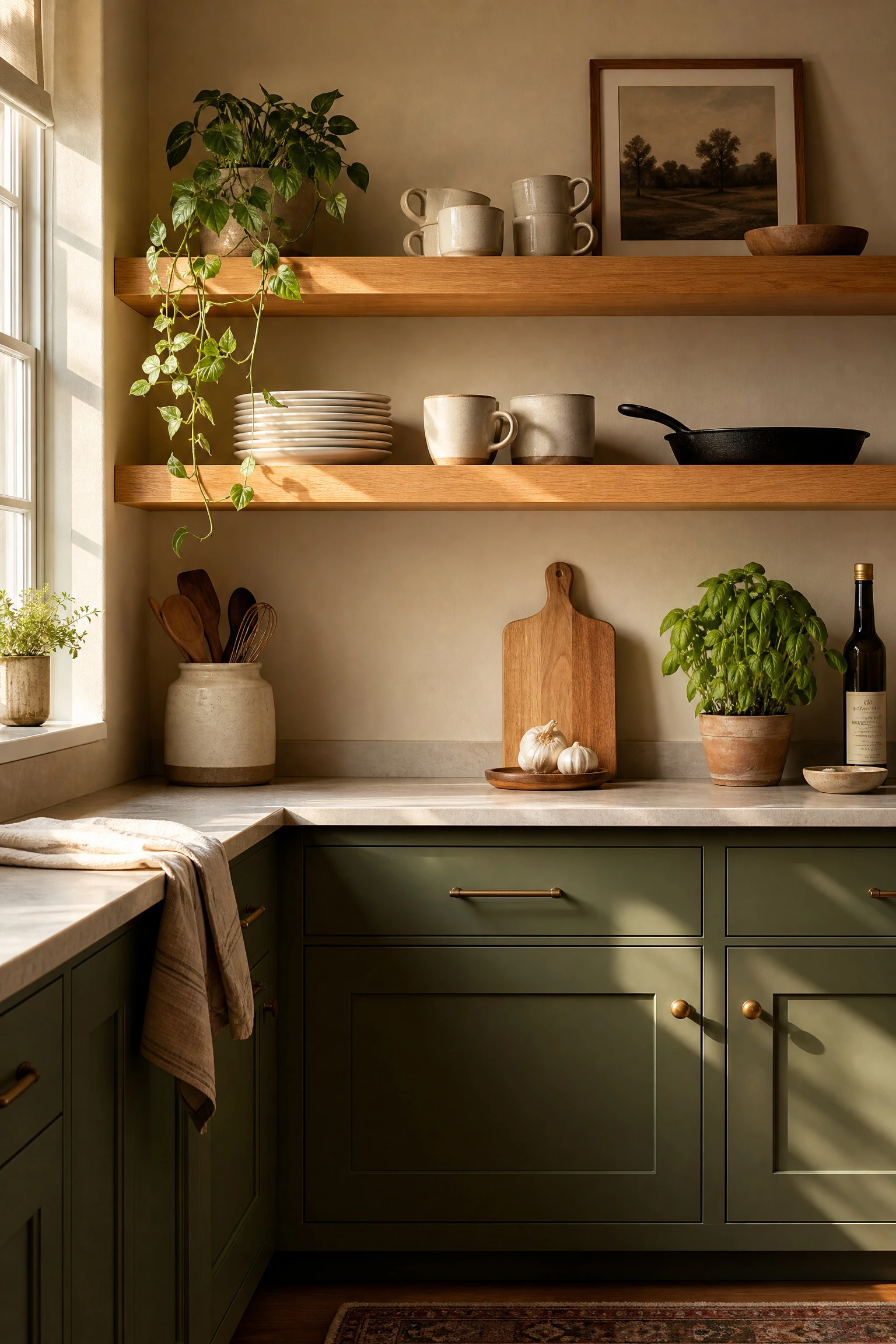
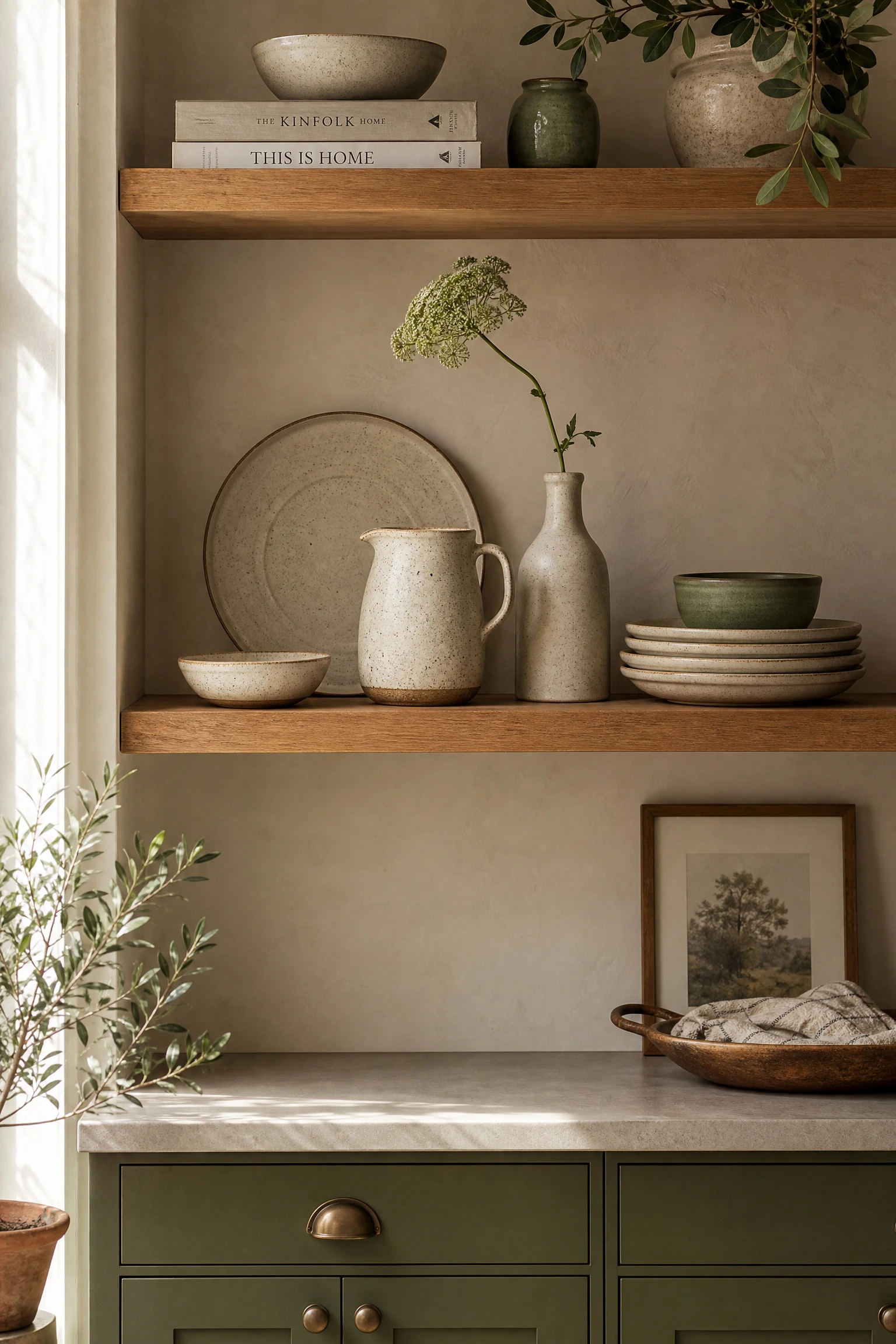
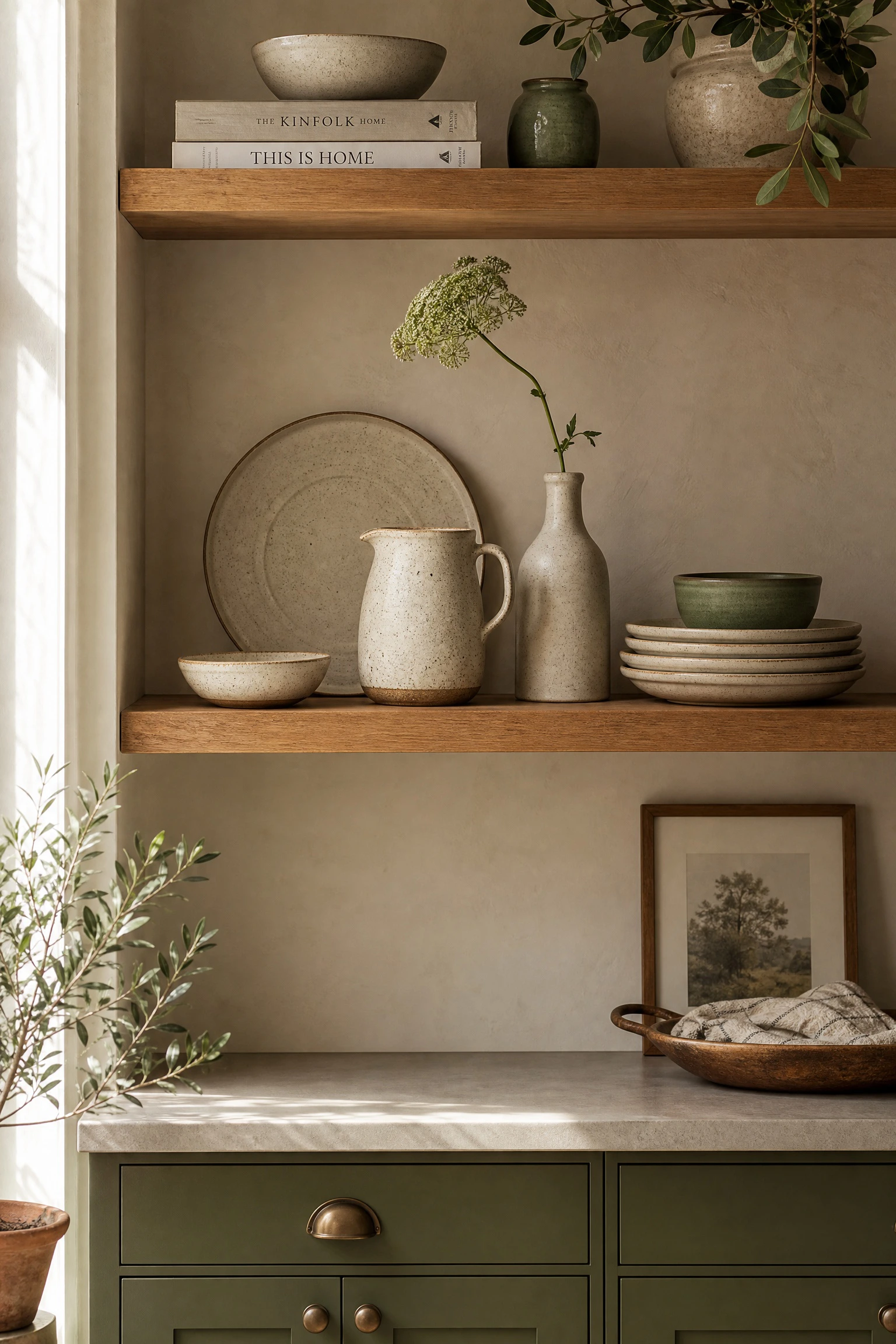
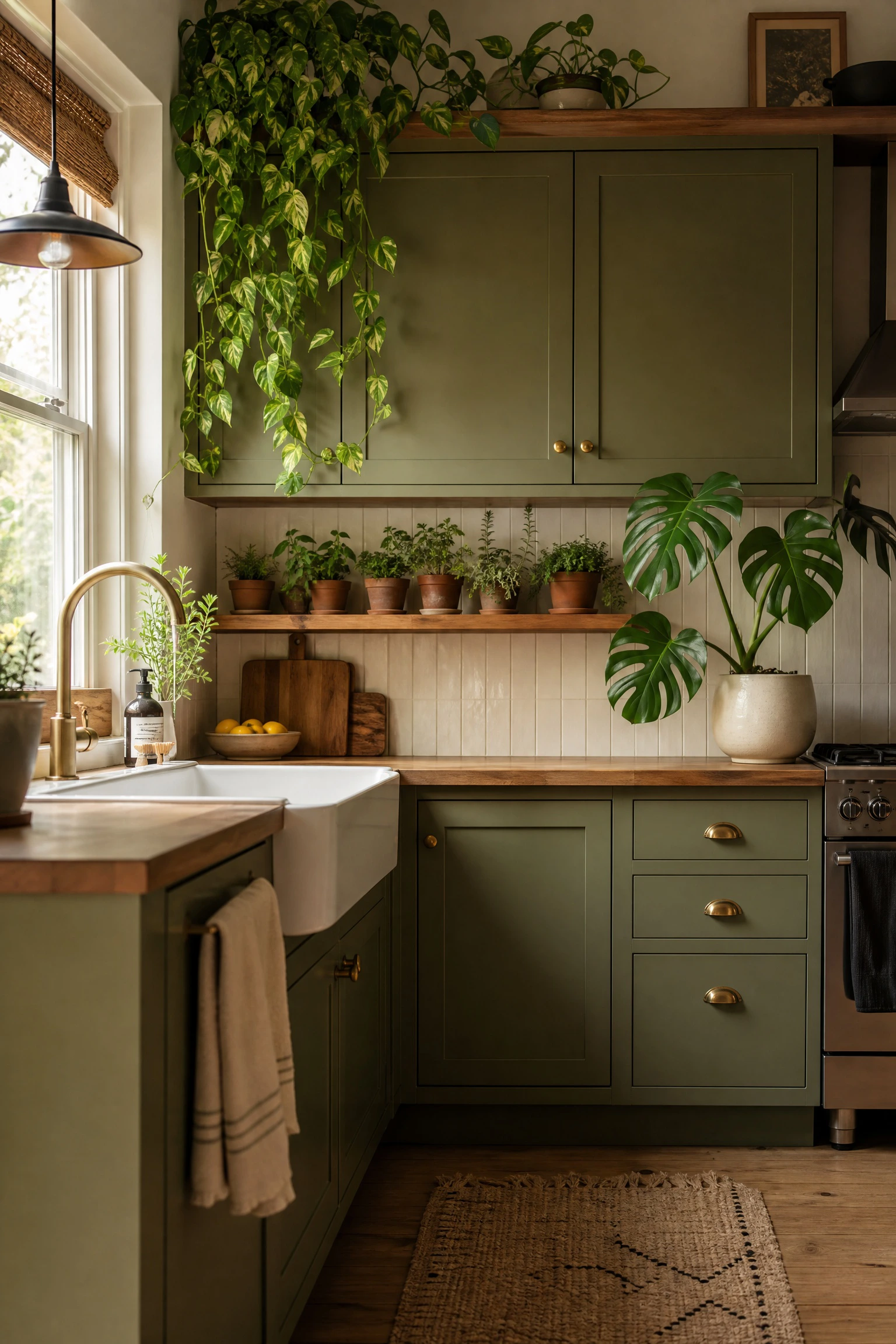
Open shelving in warm timber alongside or instead of upper cabinets is one of the most effective ways to stop an avocado green kitchen feeling heavy or overly retro. The natural grain and warm tone of oak, walnut, or pine introduces a material contrast that grounds the kitchen in the natural world without competing with the green. In practice, floating shelves in a medium-to-warm oak finish sit beautifully above avocado lower cabinets and create a visual layer that makes the kitchen feel more designed than a standard cabinet-only layout. Displaying everyday ceramics, cookbooks, and a few plants on those shelves reinforces the connection to nature that makes avocado green feel current rather than nostalgic. The practical trade-off with open shelving is that it requires discipline to keep tidy, and grease and steam near the hob can affect both the items on the shelves and the timber itself over time.
Heads Up: Position open shelving away from the hob and sink where possible. The areas above cooking and washing are the hardest to keep clean, and open shelves in those locations require significantly more maintenance than closed cabinetry.
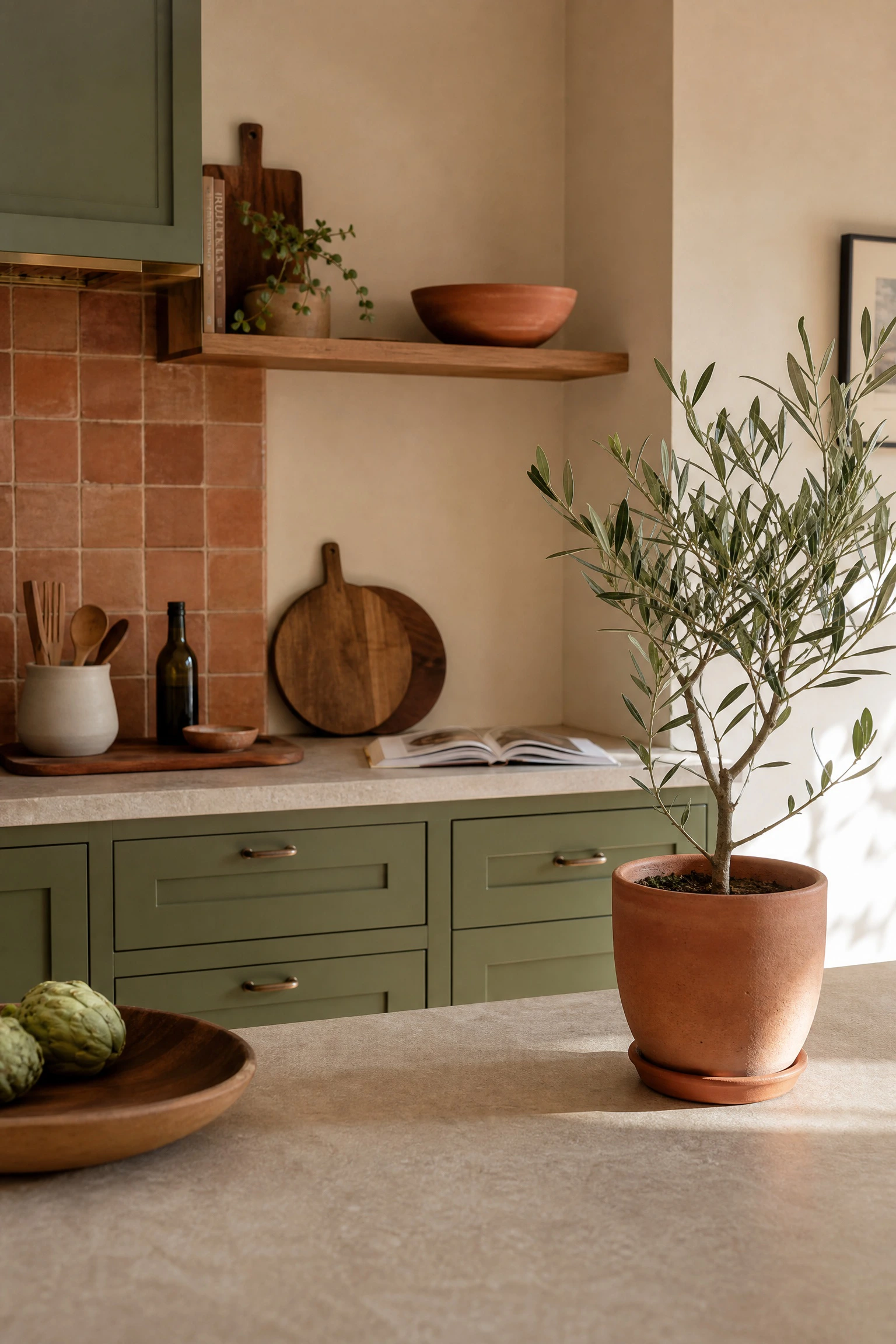
Avocado green and terracotta are a natural pairing rooted in the same earthy, sun-warmed palette, and the combination works beautifully in a kitchen when it is introduced through accessories and surfaces rather than by painting the walls terracotta to match the cabinets green. Terracotta can come in through unglazed floor tiles, a terracotta-toned zellige or ceramic backsplash, handmade pottery displayed on open shelves, or even a terracotta-painted ceiling in a kitchen with enough height to absorb a bold overhead colour. The key is restraint: terracotta as an accent reinforces the warmth of the avocado green and creates a cohesive earthy palette. Terracotta as a dominant second colour pushes the kitchen into territory that requires very careful balancing to avoid looking like the set of a 1970s farmhouse television programme.
Quick Tip: Introduce terracotta through ceramics and accessories first before committing to it in a fixed element like tile or flooring. A set of terracotta pots, a ceramic serving bowl on the counter, and a terracotta-toned vase on the shelf will tell you quickly whether the pairing works in your specific light conditions.
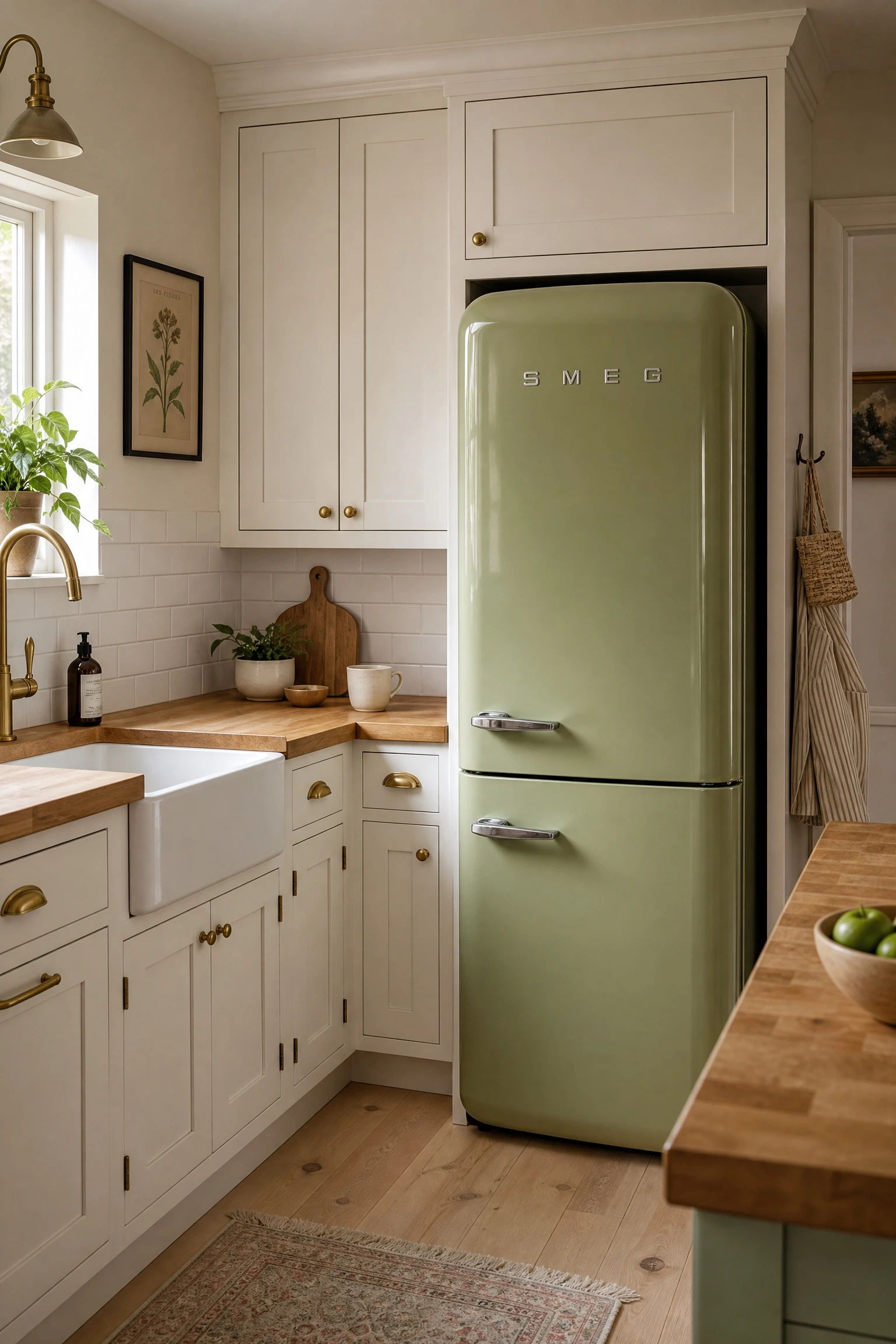
KitchenAid and several other appliance brands now produce ranges and refrigerators in a shade they call Avocado Cream, a softened, slightly muted version of the original 1970s colour that reads as a deliberate design choice rather than an unrenovated relic. A retro-styled avocado green fridge or range in an otherwise contemporary kitchen is a highly effective approach because the appliance becomes a focal point that anchors the colour story without requiring you to repaint or refit the entire kitchen. Paired with white or cream cabinets, warm timber shelving, and brass fittings, a single avocado appliance gives the kitchen enormous personality while keeping the surrounding elements clean and flexible. This is also the most reversible approach on this list: an appliance can be replaced without any structural or cosmetic work to the rest of the kitchen.
Pro Move: If you go for a retro avocado appliance, keep the surrounding kitchen relatively pared back rather than layering on additional retro elements. One well-chosen vintage-inspired piece reads as intentional. Three or four competing retro elements start to feel like a theme park.
“Avocado green is not a colour that asks for permission. The kitchens that use it best are the ones that commit to it with confidence and pair it with materials that feel just as considered.”
10. Use Avocado Green Paint on the Walls Instead of the Cabinets
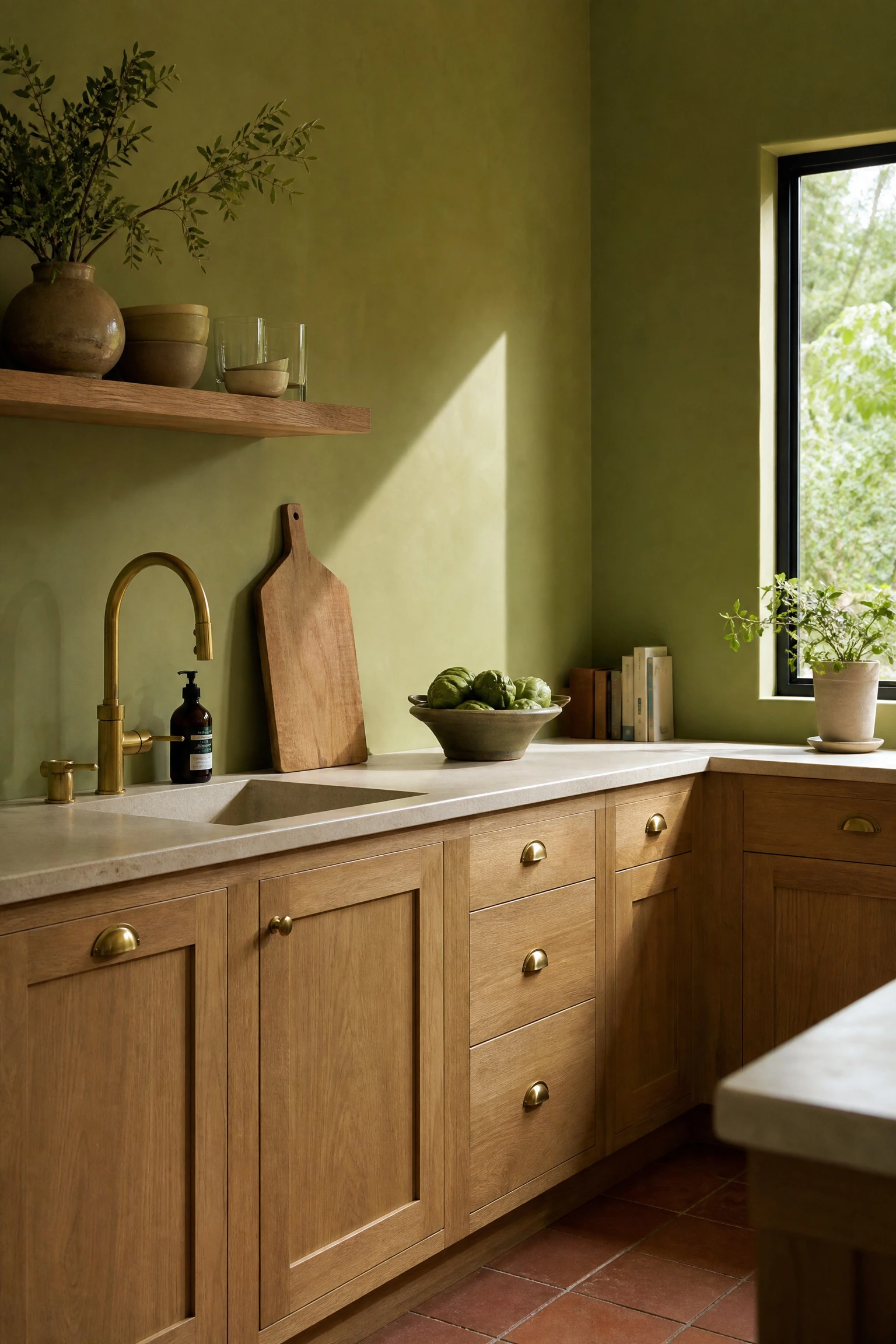
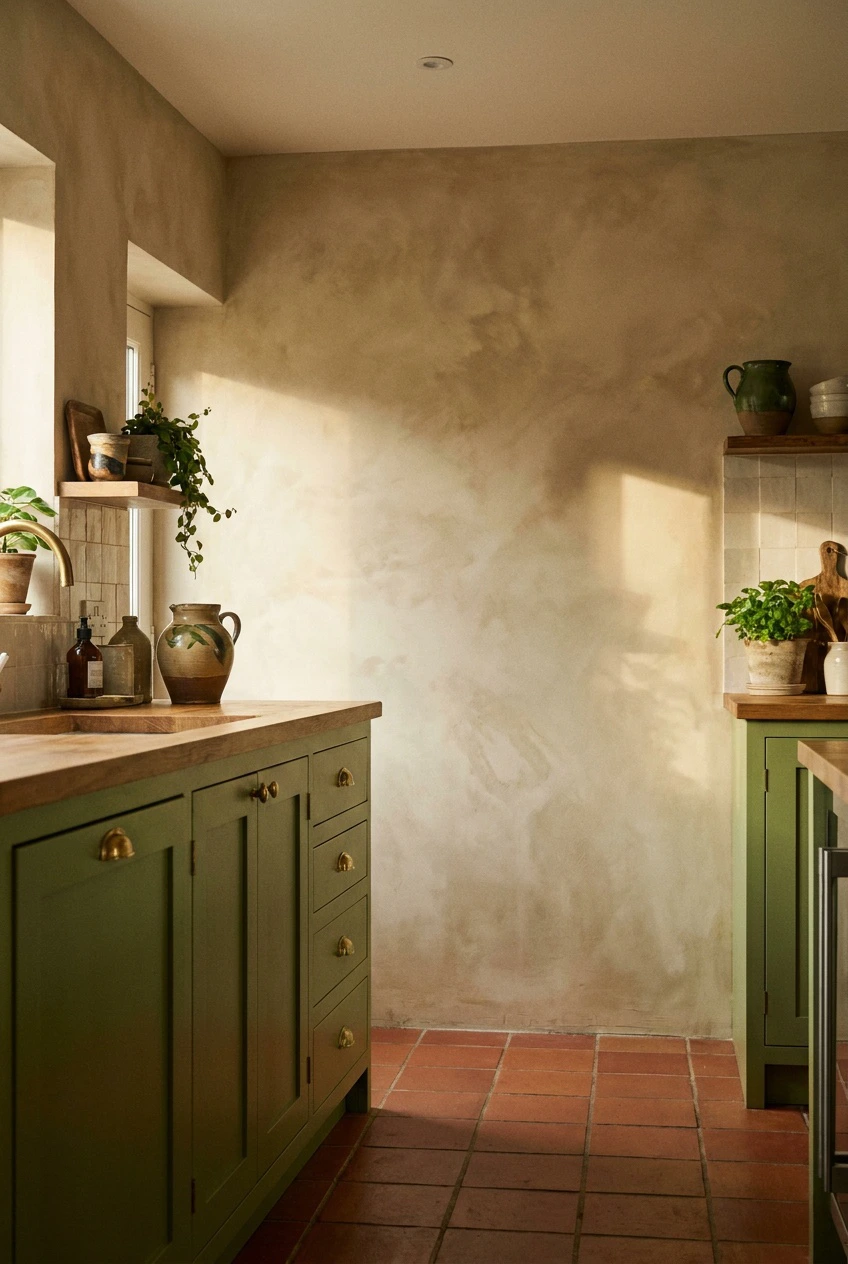
Painting the kitchen walls in avocado green rather than the cabinets is a less common but genuinely interesting approach that works particularly well in kitchens with natural timber or cream-painted cabinetry. The effect is softer and more atmospheric than green cabinets because paint-covered walls read differently to lacquered or painted cabinetry: the texture of a painted plaster wall absorbs light rather than reflecting it, which makes the colour feel more ambient and less solid. In a kitchen with white shaker cabinets, terracotta floor tiles, and warm brass fittings, avocado green walls create a cohesive earthy interior that feels completely different from the standard all-white kitchen while still being practical and liveable. This approach is also significantly cheaper than repainting or replacing cabinets, and is the easiest to reverse if the colour does not work as expected.
Reality Check: Kitchen walls are exposed to steam, grease splatter, and condensation more than almost any other room in the home. Use a durable, washable paint finish at minimum eggshell and ideally satin on kitchen walls. Flat paint in a kitchen, however beautiful the colour, will not last.
11. Combine Avocado Green With Matte Black Details
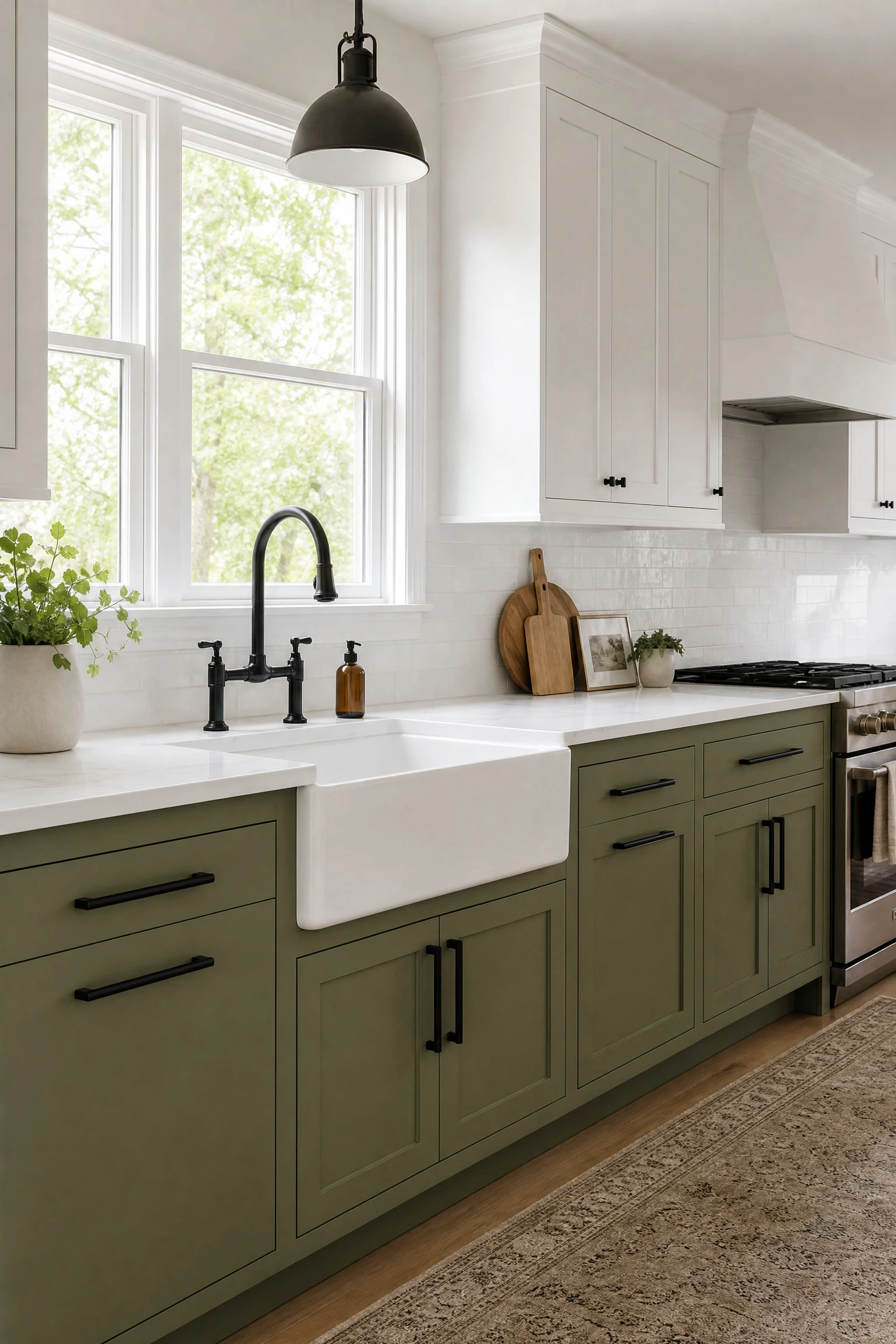
Matte black in an avocado green kitchen creates a crisper, more contemporary contrast than brass and suits homeowners who want the warmth of the green without the retro warmth of gold tones. Matte black works through hardware, tap fittings, light pendants, and range hood details, and the combination reads as more graphic and considered than the earthy brass pairing. In a kitchen with avocado lower cabinets, white uppers, a white quartz countertop, and matte black hardware throughout, the result is a kitchen that feels modern and intentional rather than nostalgically retro. The honest limitation of this pairing is that matte black shows water marks and fingerprints readily, particularly on tap fittings and hardware around the sink, so it requires more routine wiping down than brass or brushed finishes.
Designer Advice: Balance matte black details with something warm in the kitchen, such as a timber shelf, rattan bar stools, or linen window treatments. Without a warm counterpoint, matte black and avocado green together can start to feel slightly stark and industrial.
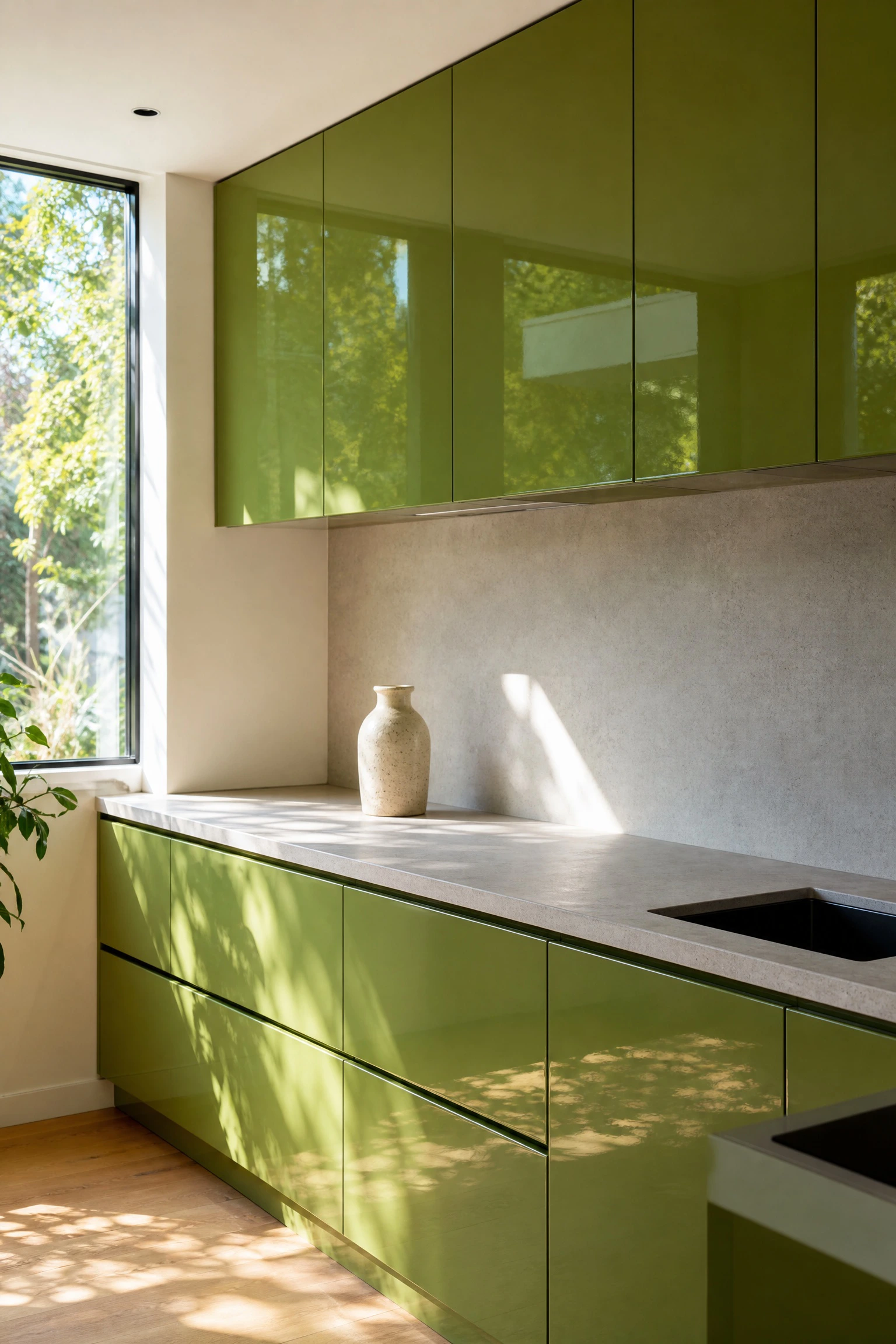
Most avocado green kitchens in current design references use a matte or satin cabinet finish, but a high-gloss avocado lacquer cabinet is a completely different proposition. Glossy avocado green cabinets are bold, unapologetically retro, and genuinely dramatic in a kitchen that can carry the confidence of that choice. The light-reflective quality of a gloss finish makes the colour appear brighter and more saturated than the same shade in matte, so the avocado reads more vividly. In a kitchen with plenty of natural light, concrete countertops, minimal hardware, and clean-lined doors with no visible hinges, a gloss avocado cabinet looks luxurious and intentional. In a darker kitchen with smaller windows, the same gloss finish can become overwhelming. Gloss finishes are also more durable and easier to wipe clean than matte, which is a practical advantage in a heavily used kitchen.
Quick Tip: If you want the gloss effect without the full commitment, consider a gloss finish on the island only while keeping the perimeter cabinets in a satin or matte finish. The contrast between the two finishes adds dimension and lets the island pop as a distinct focal point.
13. Pair Avocado Green With Warm Checkerboard Flooring
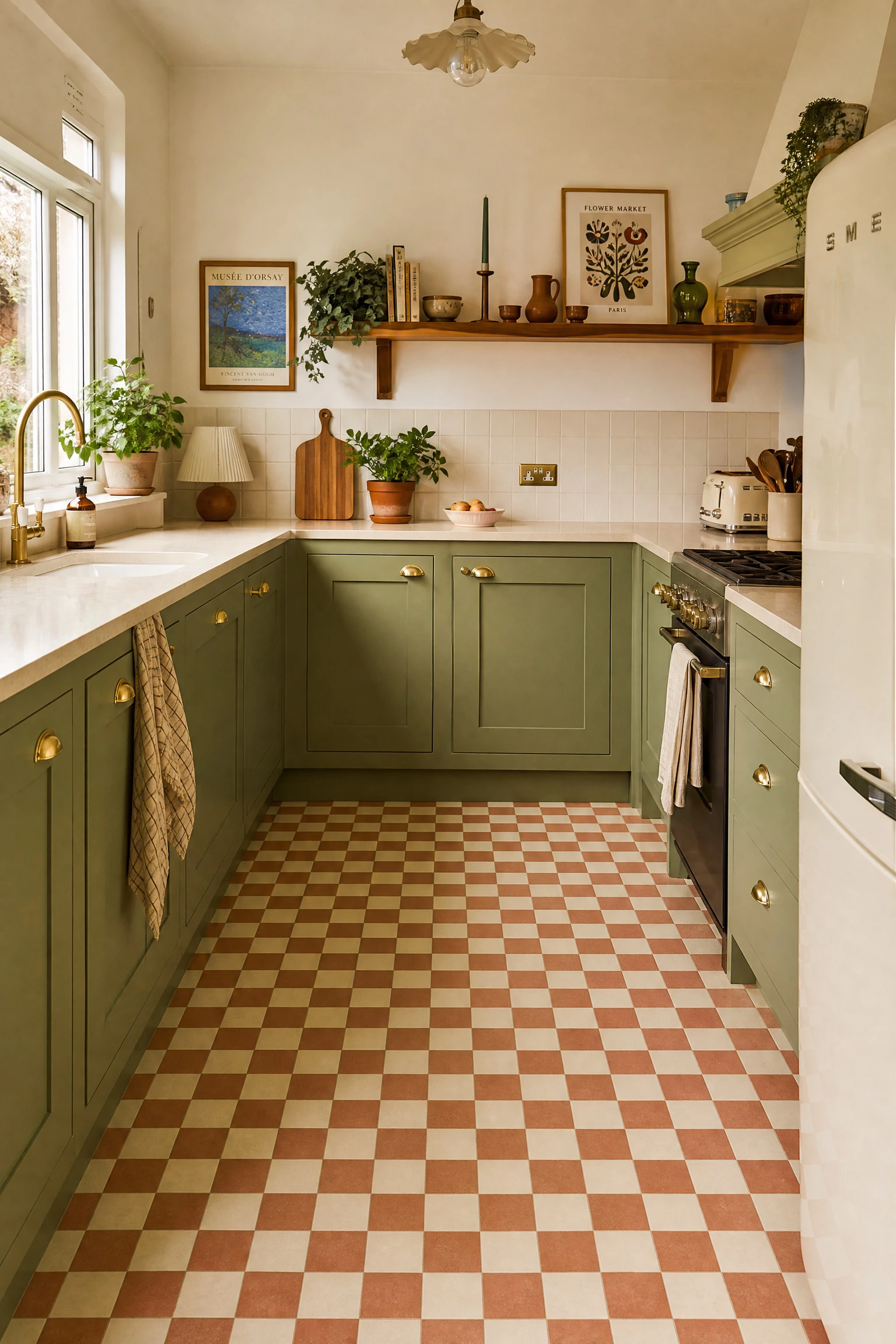
A black and white or terracotta and cream checkerboard floor in a kitchen with avocado green cabinets is a pairing rooted in mid-century and retro design history and it still looks extraordinary when executed well. The graphic quality of the checkerboard floor provides a strong visual foundation that the avocado green cabinets sit comfortably above. The key to making this work in a contemporary context is scale: smaller tile checks (around 10 to 15 centimetres per square) feel more refined and less theme-heavy than large format checks that can dominate the entire floor. Vinyl checkerboard tiles are a budget-friendly and renter-friendly option that achieves the look with minimal commitment. Porcelain or stone checkerboard tiles installed by a professional deliver a more durable and premium result.
Pro Move: A cream and terracotta checkerboard floor with avocado green cabinets and brass hardware is one of the most cohesive retro kitchen combinations available. All three elements share the same warm earthy palette and the result feels completely considered rather than assembled from separate trends.
14. Use Avocado Green in a Small Kitchen to Create Character
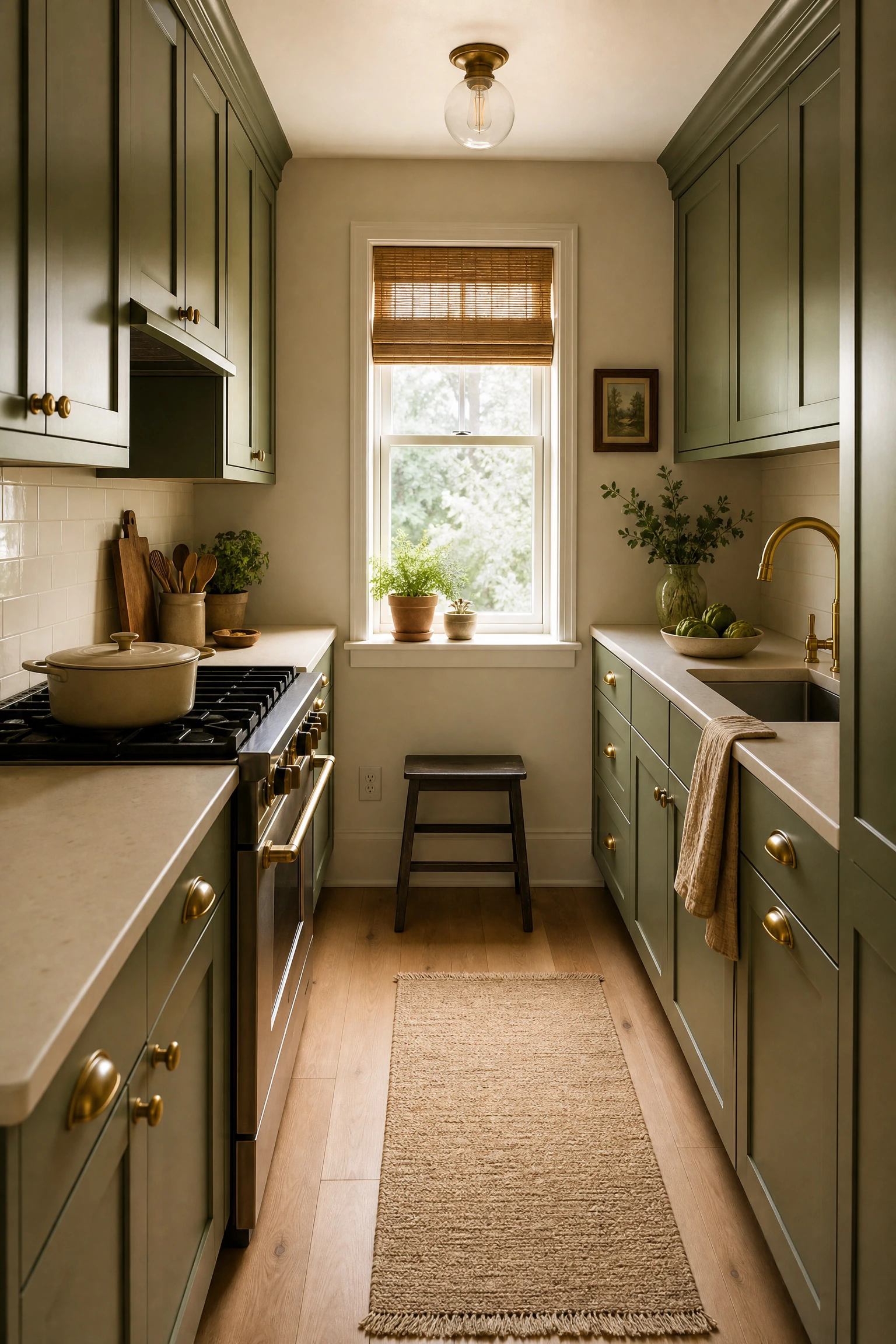
Conventional advice on bold colours in small kitchens is to avoid them, but avocado green is one of the colours that actually benefits from a compact space because the kitchen becomes a richly coloured room rather than a wall of colour that needs a large footprint to breathe. A small galley kitchen entirely in avocado green with warm timber shelving, brass fittings, and a single run of light countertop can feel like one of the most considered and characterful spaces in the home. The trick in a small kitchen is to keep the ceiling and floor lighter than the cabinets so the room does not feel like a box, and to use reflective surfaces like brass hardware and a slightly lighter-toned backsplash to bounce what light is available around the space.
Heads Up: Avoid very dark countertops and backsplashes in a small avocado green kitchen. The combination of dark green cabinets and dark countertops in a compact space will absorb light and make the room feel considerably smaller than its actual dimensions.
15. Introduce Avocado Green Through Open Cabinetry With Glass Doors
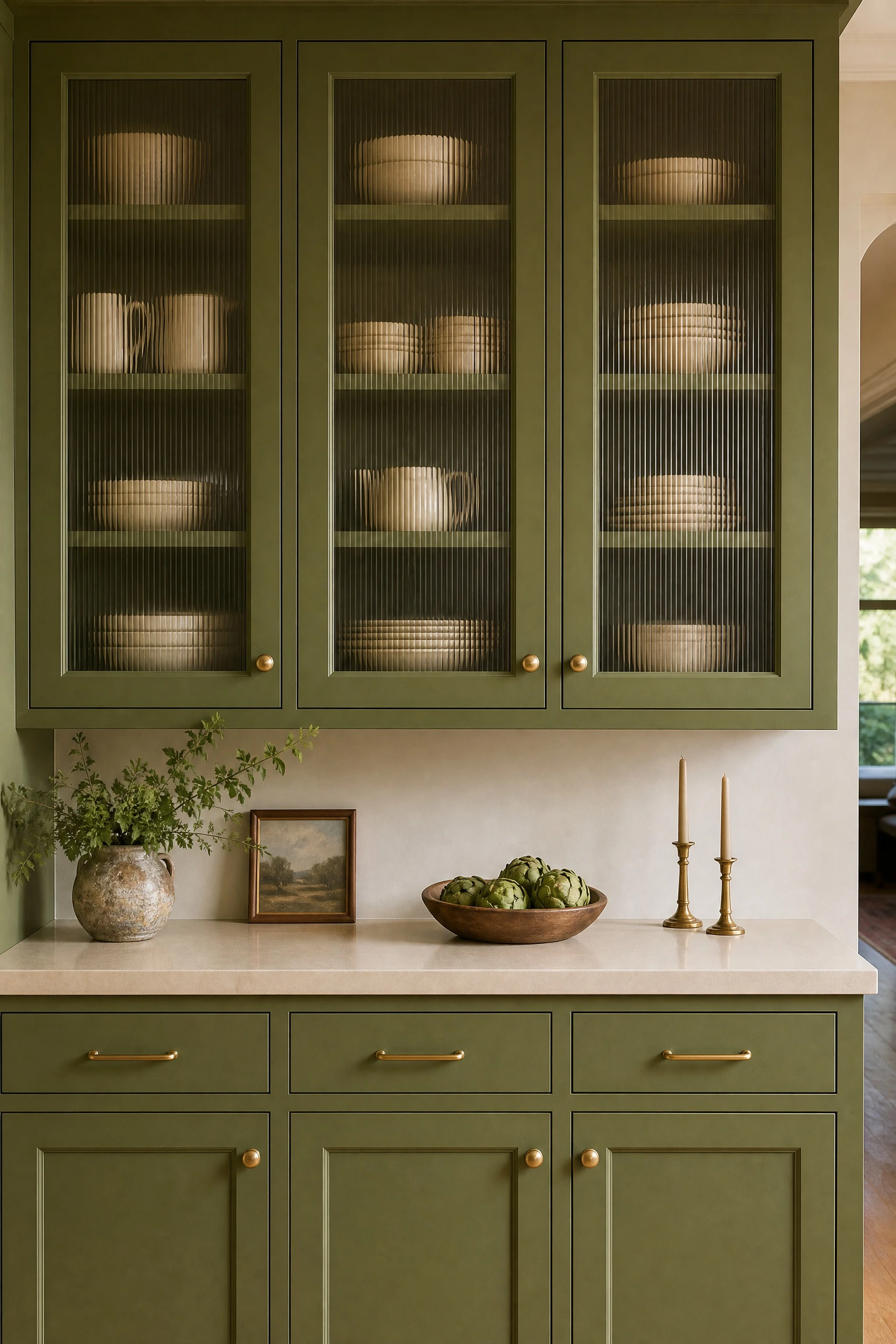
Glass-fronted cabinets in avocado green are a particularly interesting approach because the glass introduces a visual lightness that full-panel cabinet doors do not have, and the view into the cabinet creates an opportunity to style the interior as part of the overall kitchen design. In practice, glass-fronted avocado green cabinets look best when the interior is organized and styled rather than used as general storage: stacked cream ceramics, a row of glass jars with dry goods, and a few pieces of vintage kitchenware make the cabinet interior a design feature in its own right. Reeded or fluted glass is an increasingly popular choice over standard clear glass because it introduces texture and obscures the interior slightly, which means the contents need less rigorous styling to look good.
Designer Advice: Use reeded glass on the upper cabinets closest to the main kitchen view and reserve clear glass for any display-focused cabinets where you specifically want the contents to be fully visible. The mix of reeded and clear glass across a run of upper cabinets adds visual interest while keeping the practical reality of cabinet contents under control.
16. Choose a Farmhouse Sink to Complement the Colour
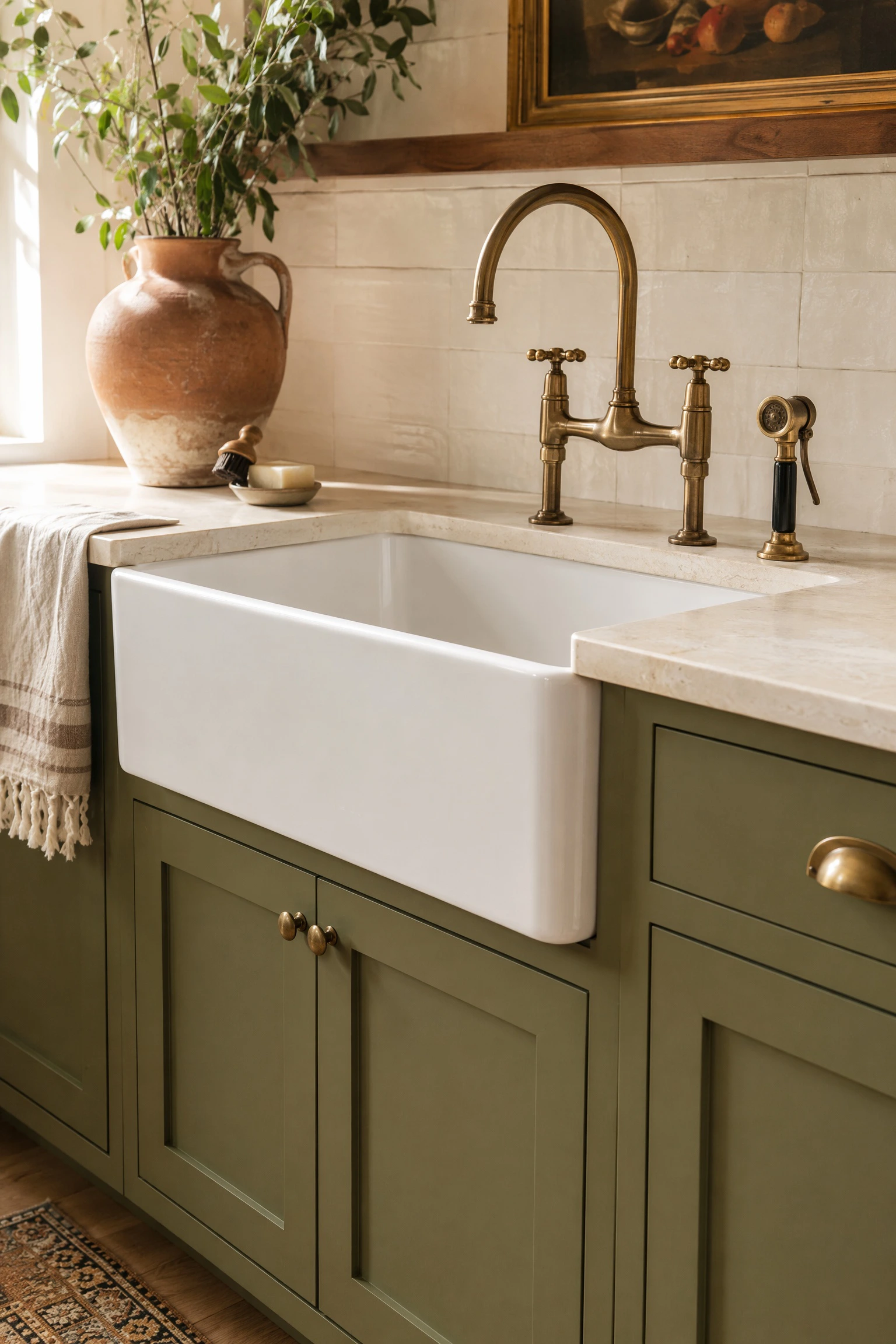
A farmhouse or apron-front sink in white ceramic or fireclay is one of the most natural companions for avocado green kitchen cabinets because the generous scale of the apron front suits the confident character of the colour, and the classic white ceramic reads as genuinely classic rather than trend-dependent. In a kitchen with avocado lower cabinets, the farmhouse sink sits in the run of base cabinetry and the white front panel provides a clean, bright interruption that prevents the cabinetry from reading as a single unbroken mass of colour. Paired with a brass or aged brass tap fitting, the combination is one of the most satisfying in current kitchen design. Stainless steel sinks are a practical alternative and work well in more contemporary avocado kitchens, though they read more neutrally and lose some of the warmth that makes this kitchen colour so appealing.
Quick Tip: A farmhouse sink is a larger project than most people expect because it requires modification of the base cabinet below it to accommodate the apron front. Factor this into the budget and timeline before committing, particularly in a kitchen renovation where cabinets are being refitted rather than replaced.
Avocado green cabinets against cream or warm neutral walls create a kitchen that feels cohesive, warm, and unpretentious in the best way. The wall colour in an avocado kitchen is often underestimated as a design decision, but it makes a significant difference to whether the cabinets read as rich and grounded or as a colour that is fighting everything around it. A warm cream or soft putty on the walls pulls the earthy undertones from the avocado and creates a continuous palette that flows from the cabinets through to the walls without a jarring contrast. Avoid bright white walls alongside avocado cabinets: the contrast between the warm green and cool bright white creates a slightly harsh juxtaposition that makes both colours look less considered than they are.
Reality Check: Test your wall colour alongside a sample of your chosen avocado green in your actual kitchen. The undertone relationship between the two colours changes completely depending on the natural and artificial light in the specific room, and what looks harmonious in a showroom or on a screen may not translate to your space.
18. Mix Avocado Green With Natural Rattan and Woven Textures
Rattan bar stools, woven pendant light shades, and a jute or sisal rug in the adjoining dining or living space are all materials that support avocado green kitchens beautifully by reinforcing the organic, nature-connected quality of the colour. The visual language of natural fibres alongside earthy green reads as considered and current rather than retro, because the combination is rooted in a broader design movement toward natural materials rather than a specific era reference. Rattan counter stools in particular work well at an avocado green kitchen island because they introduce texture and visual warmth at a sitting height where a solid-coloured stool would create a visual block. The practical consideration with rattan is durability: rattan and woven furniture does not tolerate sustained exposure to moisture well, so positioning it away from the sink and near any sources of steam makes sense.
Pro Move: Choose rattan bar stools with a cushioned seat in a warm cream or terracotta linen for a kitchen island arrangement that is comfortable for extended sitting and visually cohesive with the avocado green and timber palette.
The range hood or extractor is one of the most visually prominent fixed elements in a kitchen and in an avocado green kitchen it represents an opportunity to either reinforce the colour story or provide a deliberate contrast. A custom plaster range hood painted the same avocado green as the cabinetry creates a sculptural focal point that makes the hood feel like an integral architectural feature rather than an appliance addition. A raw brass or copper hammered metal range hood over avocado green cabinets introduces a material contrast that is warm and richly textural. A white or cream range hood keeps things lighter and more flexible. What tends to work less well is a standard brushed steel range hood in a kitchen that is otherwise full of warm, earthy colour, because the industrial neutrality of the steel fights the warmth of the palette.
Designer Advice: A custom plaster hood is not as expensive as it looks. Most plasterers can form a simple geometric hood shape over a basic steel extractor unit and the result, once painted, is indistinguishable from a fully custom-built installation at a fraction of the cost.
Painting the kitchen ceiling avocado green is one of the most unexpected and effective approaches on this list, and it works best when the cabinets and walls are kept in lighter neutrals so the ceiling becomes the defining colour statement in the room. In a kitchen with white or cream cabinetry, light timber floors, and warm brass fittings, an avocado green ceiling creates an enveloping canopy of colour that makes the kitchen feel like a complete, considered interior rather than a functional room that has been decorated incidentally. The ceiling approach is particularly effective in kitchens with lower ceilings, where a strong ceiling colour draws the eye upward and makes the proportions feel intentional. It is also one of the easiest approaches to change if the colour does not suit: repainting a ceiling requires no cabinetry work and can be done in a day.
Heads Up: Ceiling paint and cabinet or wall paint from the same colour card will look different on the ceiling because of the angle at which light hits the surface. Always test your chosen avocado green on a portion of the actual ceiling before buying full tins, not just on a card or on a wall surface.
21. Style With Cream and Green Vintage-Inspired Ceramics
The way you style an avocado green kitchen has almost as much impact on the overall impression as the colour itself, and the accessories and ceramics that sit on open shelves and countertops play a central role in whether the kitchen reads as nostalgic in a charming way or dated in an unwanted one. Cream, off-white, and speckled stoneware ceramics on open timber shelves above avocado green cabinets pull the palette together beautifully and reinforce the earthy, hand-crafted character of the colour. A few pieces in a slightly darker or more olive green tone alongside the cream ceramics adds depth and a sense of the collection having been intentional over time. Avoid very brightly coloured accessories in primary colours, which create a visual disconnect with the warm, muted quality of avocado green.
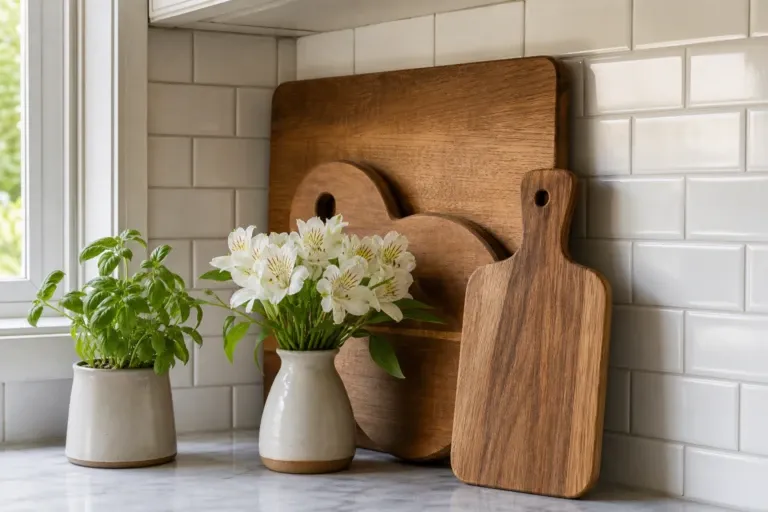
Quick Tip: A single large ceramic or stoneware vase with a few stems of dried botanicals, eucalyptus, or seasonal foliage on the counter or a shelf does more for an avocado green kitchen than almost any other single accessory. The green of fresh or dried plant material connects visually with the cabinet colour and reinforces the organic quality of the whole palette.
22. Add Warmth With Pendant Lights in Warm Brass or Aged Metal
Pendant lighting over a kitchen island or dining table adjacent to an avocado green kitchen is one of the most powerful finishing details in the space, and the fitting choice significantly affects whether the kitchen reads as warm and considered or slightly unresolved. Warm brass pendants, whether simple dome shades, elongated industrial forms, or more sculptural pieces, reinforce the brass hardware pairing and make the whole kitchen feel tonally cohesive. Woven rattan or paper pendant shades bring a more relaxed, organic quality that suits kitchens going for a boho or earthy natural aesthetic. Ceramic pendants in cream or speckled stoneware-effect finishes are an increasingly popular choice that works particularly well above an island with a butcher block top and avocado lower cabinets. The one pendant style to avoid in an avocado kitchen is cool-toned brushed nickel or chrome, which fights the warmth of the palette.
Designer Advice: Hang island pendants at a height where the bottom of the shade sits between 70 and 80 centimetres above the island surface. This keeps them in the sightline when seated at the island without blocking the view across the kitchen when standing.
23. Use Avocado Green in an Open-Plan Kitchen to Define the Space
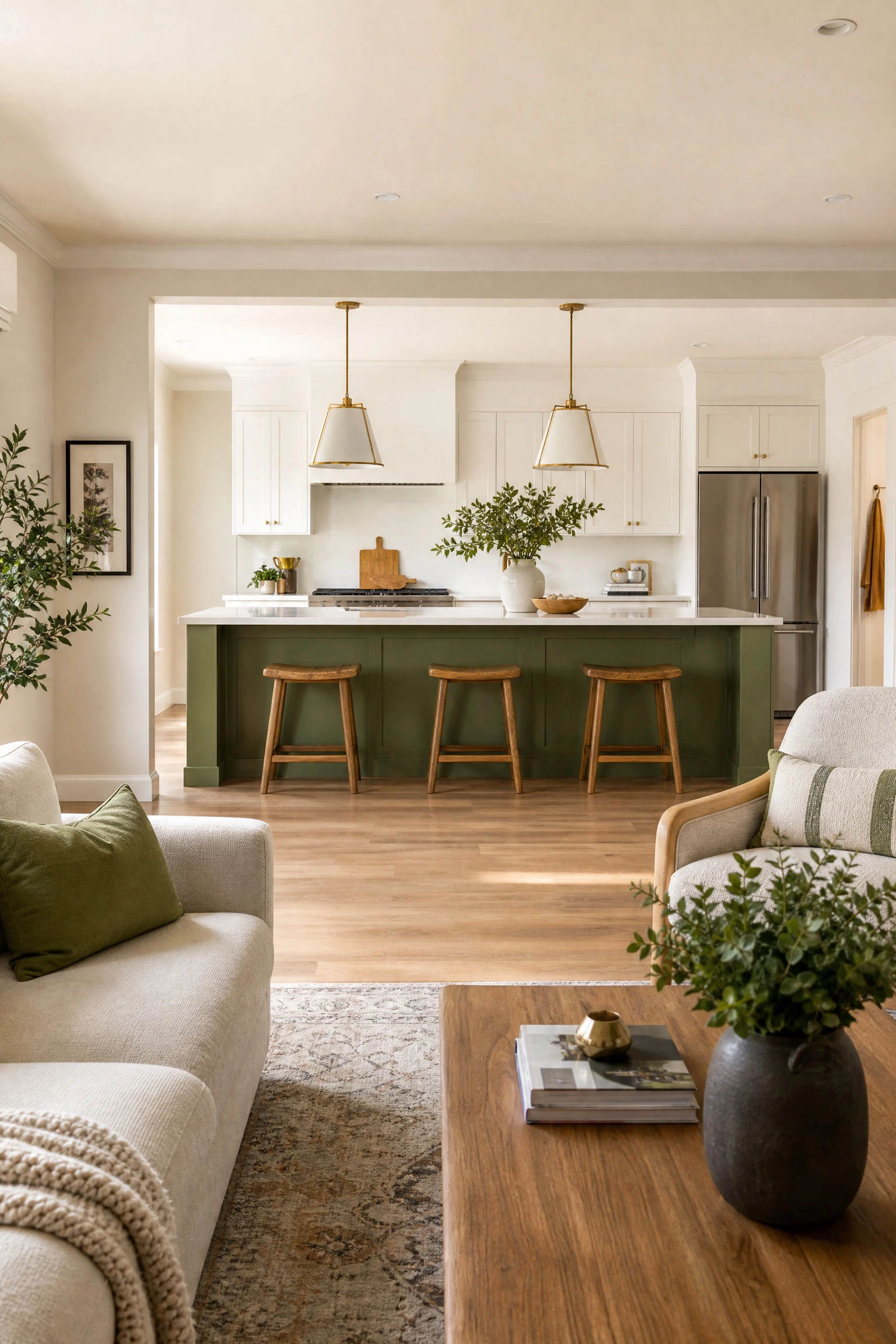
In an open-plan kitchen, dining, and living space, avocado green cabinetry is one of the most effective ways to visually define the kitchen zone without using a physical partition. The colour creates a clear boundary between the functional cooking area and the living or dining space beyond it, particularly when the surrounding areas are decorated in lighter, more neutral tones. This works especially well in contemporary open-plan homes where the kitchen island faces the living area: avocado green lower cabinetry on the island becomes the first thing you see when walking into the space from the living area, and functions as both a colour statement and a spatial marker. The connection between the kitchen colour and the rest of the open-plan space can be reinforced by bringing in one or two pieces in the same green family, a cushion, a plant, a piece of art, through the living area so the kitchen colour feels like part of a considered palette rather than an isolated decision.
Reality Check: In an open-plan space, your kitchen colour will be visible from every part of the connected room. Make sure the avocado green you choose works with the existing flooring, furniture, and natural light throughout the whole space, not just within the kitchen zone itself.
24. Pair Avocado Green With Limewashed or Venetian-Plaster Walls
Avocado green cabinets against limewashed or troweled plaster walls is one of the more sophisticated combinations in current kitchen design because both finishes share an organic, handmade quality that lifts the pairing beyond the standard painted or tiled kitchen. Limewash in a warm putty, aged bone, or pale terracotta tone on the kitchen walls alongside avocado cabinetry creates a continuous earthy palette with genuine textural depth. The variation in tone and surface of the limewash means the kitchen walls are never flat or static, which makes the whole room feel more alive and considered. This combination suits Mediterranean, Moroccan-influenced, or broadly earthy design directions and works best when the remaining elements, flooring, countertops, and fittings, stay within the same warm, muted palette.
Pro Move: Limewash is not typically suitable for the areas immediately around a sink or hob where it will be exposed to water and grease splatter. Use a hard-wearing washable paint or a tiled backsplash in those zones and reserve the limewash for the walls beyond the cooking and washing areas.
25. Go Two-Tone With Avocado Lower and Navy Upper Cabinets
Avocado green lower cabinets combined with deep navy upper cabinets is a boldly coloured two-tone pairing that suits kitchens with a confident, design-led aesthetic and enough natural light to support two rich colours in the same space. The combination works because green and blue are tonally related and both sit within the cool side of a warm palette, so they create contrast without clashing. In practice, navy uppers with avocado lowers tend to work best when the countertop is a light neutral that separates the two colours visually, and when the hardware is consistent across both cabinet colours, either all brass or all matte black. This is not a pairing for everyone, but in the right space with the right light it is one of the most distinctive kitchen colour combinations available.
Heads Up: Two rich cabinet colours in a kitchen require strong natural light to avoid the space feeling dark and enclosed. If your kitchen receives limited daylight, consider using the navy as an accent on a single element such as a pantry cabinet or kitchen island rather than committing to it across all the upper cabinetry.
26. Use Vintage Inspired Tile on the Floor for a Retro Connection
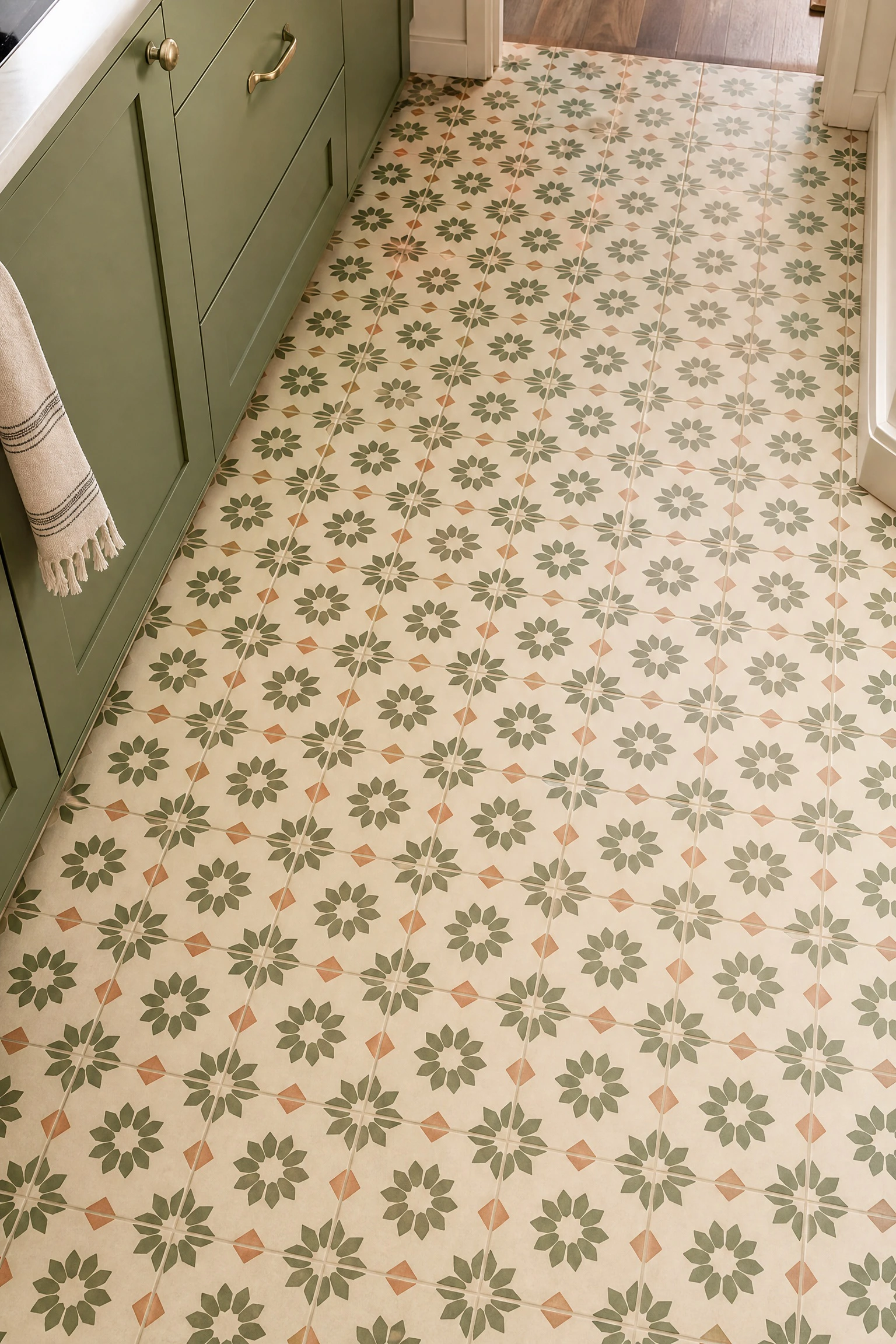
Encaustic or cement-look patterned floor tiles are a natural partner for avocado green kitchens because they share the same artisanal, slow-made quality that makes the colour feel current rather than dated. Patterns in cream and terracotta, green and white, or warm earth tones all work well with avocado cabinetry, and the visual complexity of the tile pattern means the kitchen floor does a lot of decorative work without needing additional elements. If full encaustic cement tiles are outside the budget, large-format porcelain tiles printed to replicate encaustic patterns are widely available at a significantly lower price point and are considerably more durable and easier to maintain than authentic cement tiles, which require regular sealing.
Quick Tip: Use the tile grout colour as a considered design decision rather than defaulting to standard grey. A warm cream or putty-toned grout with a cream and terracotta encaustic tile will look cleaner and more cohesive than grey grout, which introduces a cool tone that fights the warm palette of an avocado green kitchen.
27. Keep the Kitchen Feeling Light With White Painted Timber Floors
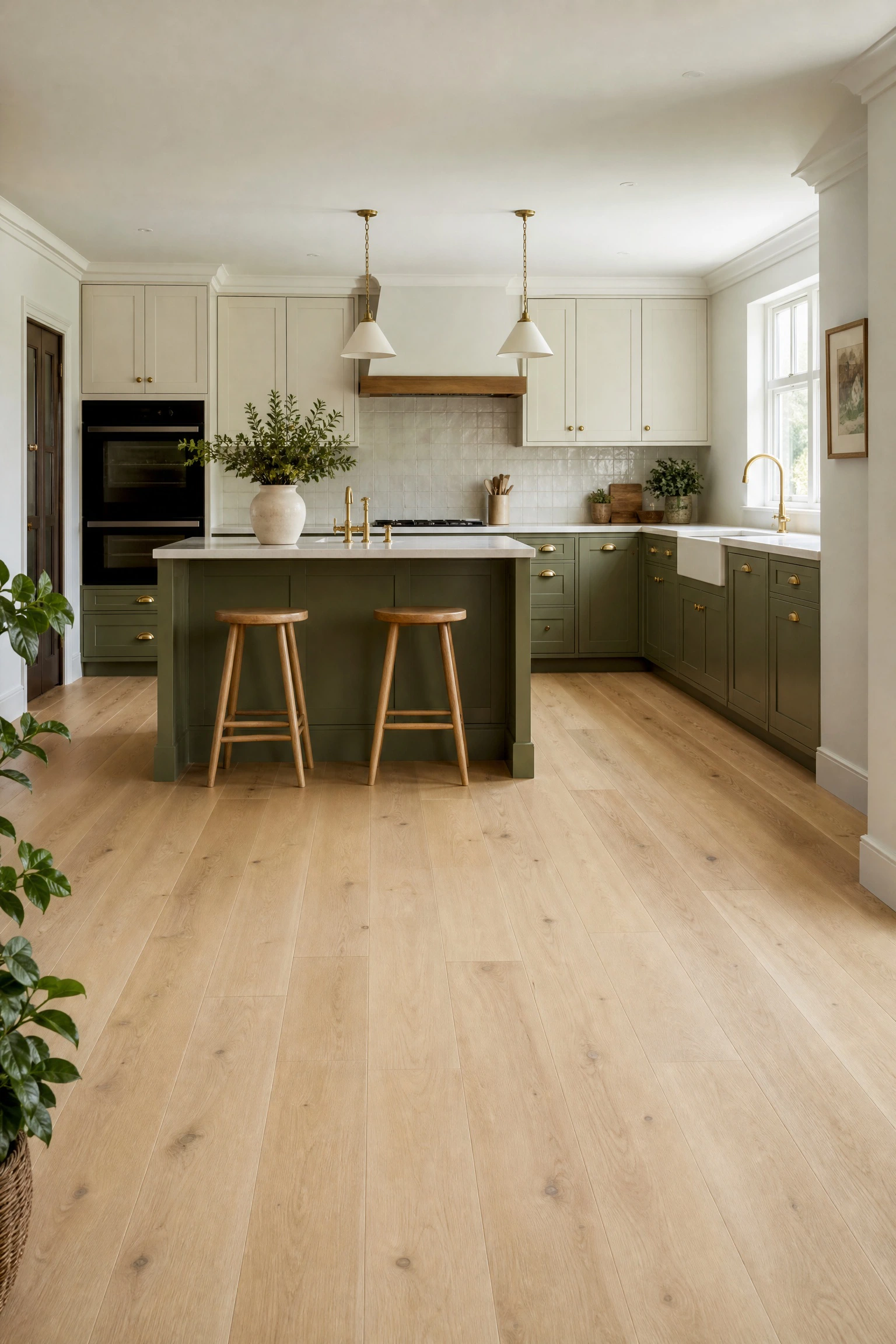
Light timber floors, either in a natural pale oak or a lightly whitewashed finish, are one of the most effective ways to keep an avocado green kitchen feeling open and airy rather than heavy. The warmth of timber against the earthy green reads as natural and organic, and the light tone of the floor reflects daylight back up into the kitchen, which is particularly valuable in kitchens that receive limited natural light or have lower ceilings. Engineered oak in a wide-plank format with a light natural or whitewashed finish is both practical and visually generous in a kitchen, as the wide planks make the floor feel more expansive than narrower boards. The practical caveat with light timber floors in a kitchen is that they show spills and dirt more readily than darker floors, so they suit households with a higher tolerance for cleaning frequency.
Reality Check: Light floors and avocado green cabinets create a bright, fresh kitchen but require more visible maintenance than darker floor options. Be honest about how your household actually uses the kitchen before choosing a floor finish that needs regular attention to look its best.
Indoor plants in an avocado green kitchen are not just a styling cliché: they are one of the most effective finishing touches available because they connect the colour of the cabinets to living, breathing plant material and reinforce the whole premise of a green kitchen as a space that feels rooted in the natural world. Trailing pothos, a large-leafed monstera on the windowsill, a small olive tree in a corner, or a row of herb pots on a timber shelf above the sink all work in slightly different ways. Trailing plants from a high shelf above the cabinets are particularly effective because the greenery bridges the visual gap between the cabinet colour and the ceiling and softens the top of the cabinet line. Herbs are the most practical choice for the areas immediately around cooking, and their seasonal variation and ongoing growth makes the kitchen feel genuinely alive rather than just styled.
Pro Move: Choose pots and planters in cream, terracotta, or matte white rather than plain plastic or bright colours. The container matters as much as the plant itself in a kitchen where every visual detail is contributing to a considered palette.
Avocado green is a colour that rewards commitment more than most. The kitchens that look truly extraordinary with this shade are not the ones that hedged their bets with a tiny dose of green on one cabinet door panel: they are the ones where a clear decision was made, the right pairings were chosen, and the colour was allowed to do what it does best, which is to create a kitchen that feels warm, earthy, distinctive, and genuinely personal. That said, the right amount of avocado green is entirely dependent on your kitchen, your light, your existing layout, and your appetite for a colour that is never going to be anonymous.
Start with the idea on this list that frightens you least. Test it with a sample or a small commitment before going further. Give the colour a few days in your actual space before deciding whether to push further or pull back. The best avocado green kitchen is not the boldest one or the most photographed one. It is the one that makes you want to spend time in the kitchen every single morning. Get that right and everything else follows.
“Which of these avocado green ideas would actually work in your kitchen right now? Drop your pick in the comments below.”
Frequently Asked Questions
Is avocado green a good colour for a kitchen?
Yes, when paired correctly. The 1970s version of avocado green felt dated largely because it was used on every surface simultaneously, cabinets, appliances, floors, and walls, all in the same shade, with materials that have since become associated with low-budget construction. The modern approach uses avocado green deliberately on specific elements, paired with high-quality materials like brass hardware, warm stone countertops, and artisanal tiles, and the result is warm, earthy, and genuinely distinctive without looking like an unrenovated period kitchen.
What colours go well with avocado green in a kitchen?
The strongest companions for avocado green are warm neutrals: cream, putty, aged white, and warm greige on walls and upper cabinets. Terracotta works beautifully as an accent colour in tiles, ceramics, and accessories. Warm timber in oak or walnut introduces natural material contrast. Brass is the best hardware and fitting finish for the colour. Navy can be used as a two-tone pairing on upper cabinets in a well-lit kitchen. Avoid cool grey, bright white, and chrome, all of which fight the warm earthy quality that makes avocado green work.
Does avocado green work in a small kitchen?
Yes, but with some adjustments. In a small kitchen, limit the avocado green to the lower cabinets and keep the upper cabinets and ceiling lighter to prevent the colour mass from making the space feel smaller. Use reflective hardware like brass to bounce light around. Choose a light-toned countertop and backsplash. Avoid dark countertops and dark backsplash tiles, which combined with a bold cabinet colour in a compact space will absorb too much of the available light.
What countertop works best with avocado green cabinets?
Warm white or cream quartz is the most versatile and widely available pairing. Butcher block adds warmth and a natural material connection. Honed cream quartzite or a marble with green and gold veining is the most luxurious option. Concrete works well in a more contemporary kitchen. Avoid cool grey countertops, which fight the warm undertone of avocado green and make the colour look dull rather than rich.
Is avocado green going out of style?
Avocado green is currently having a genuine revival rather than a forced trend moment, driven by the broader move away from all-white kitchens and the return of natural, earthy colour palettes. The shade will always be more niche than sage or forest green because of its specific cultural associations, but that specificity is also what makes it feel personal and distinctive rather than generic. Kitchens that use avocado green well with quality materials and considered pairings have a design life that extends well beyond any single trend cycle.
What hardware finish should I choose for avocado green cabinets?
Brass or brushed gold is the strongest and most flattering finish for avocado green cabinets because the warm yellow undertone of brass sits in complementary relationship to the earthy green. Unlacquered brass develops a natural patina over time that deepens the warmth of the pairing. Matte black is the alternative for a crisper, more contemporary look that works particularly well with white countertops and minimal styling. Avoid brushed nickel and polished chrome, which introduce a cool metallic tone that fights the warmth of the palette.