There’s a moment when you’re scrolling through home office inspiration and you see it: a room draped in black, moody and sharp, every element looking like it belongs in an editorial spread. And then you close the tab and go back to your beige walls because you’re convinced that kind of office would make you feel like you’re working inside a coffin. That hesitation is completely understandable, and it’s also exactly what this article is here to fix. A black home office, done well, is one of the most focused, grounded, and genuinely good-looking workspaces you can create.
The secret isn’t picking black and hoping for the best. It’s pairing the right black aesthetic with the one design decision that keeps it from tipping into oppressive. Every idea in this article follows that exact formula: the look, and the fix that makes it livable. Even a small corner can pull off the black office look if you focus the dark color on one wall and keep the rest light. [INTERNAL LINK: home office ideas for small spaces]
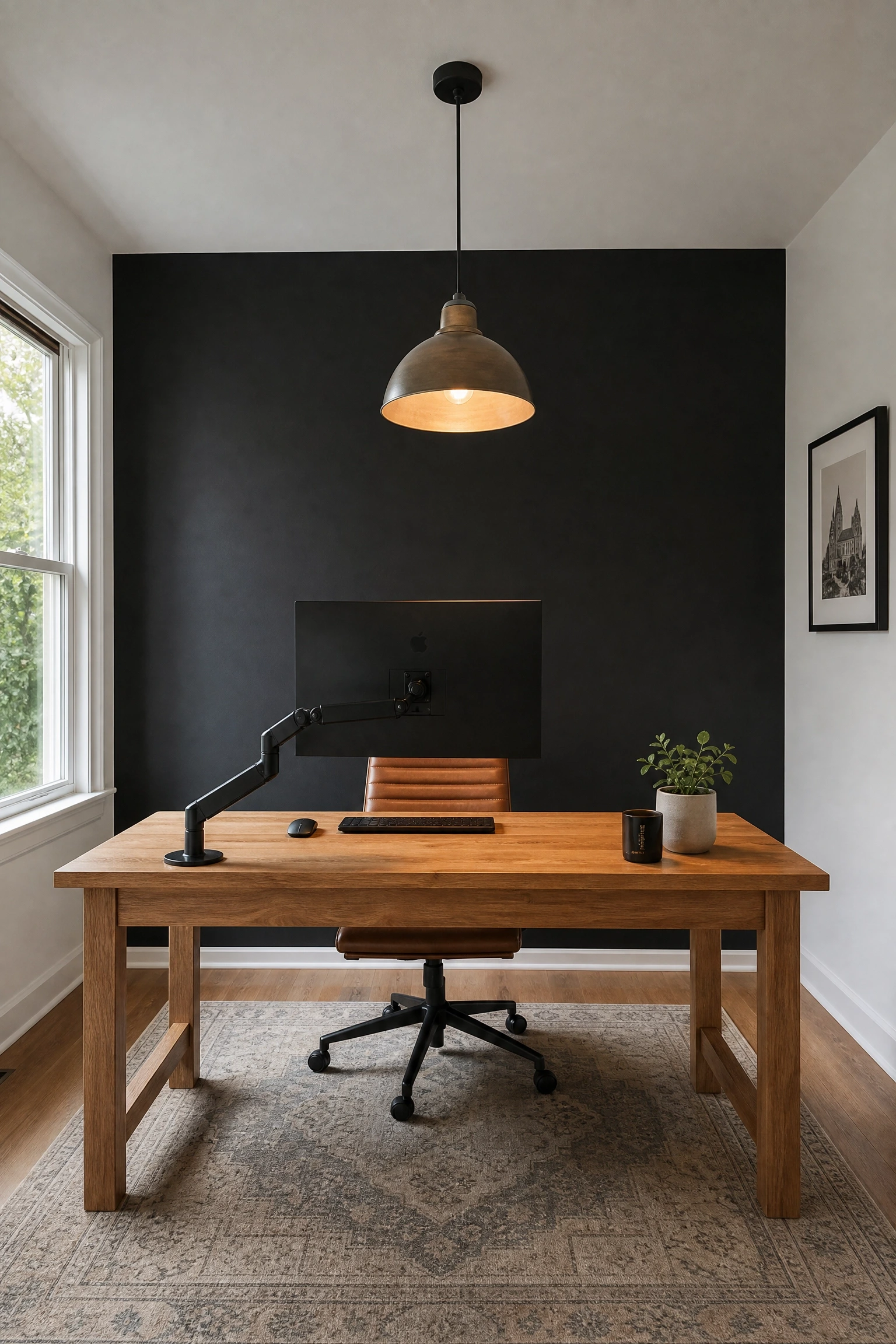
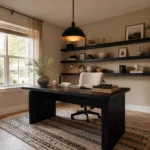
If you’re not ready to commit to black on every wall but you want the drama, a single black accent wall behind your desk is the most efficient way to get there. In practice, this look comes together best when the rest of the room stays light, think white or off-white on the remaining walls, because the contrast does the visual heavy lifting without swallowing the room. The desk is the key piece here: a natural wood surface, something in oak, walnut, or even pine with a light stain, sits against that black wall and immediately reads as warm rather than cold. The wood grain breaks up what would otherwise be a flat, graphic backdrop. Keep your monitor arms, cable management, and accessories in black or dark metal to maintain the through-line, and add a single pendant or wall sconce in a warm bulb tone directly above or beside the desk so the wall isn’t just a dark void when the lights go down.
Pro Move: Use matte black paint rather than eggshell on the accent wall; it absorbs light instead of bouncing it, which keeps the look grounded and intentional rather than shiny.
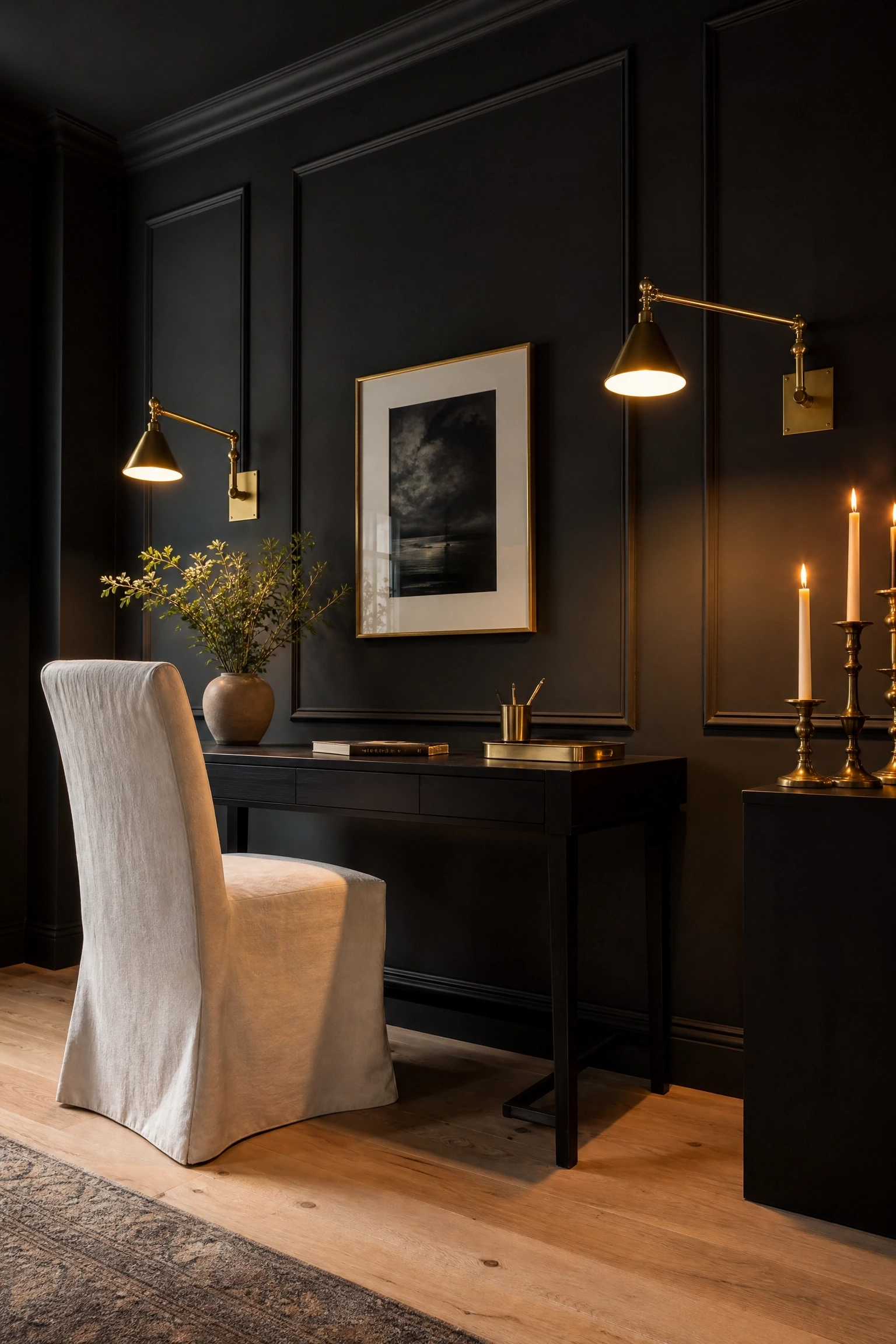
This is the combination that converts the most skeptics, and for good reason. Matte black walls on their own read as serious and slightly cold. Introduce warm brass, whether that’s a sculptural floor lamp, a pair of articulating brass desk sconces, or even just a brass pen cup and letter tray, and the whole room shifts. The warm metal tone pulls amber from the light and scatters it across the dark surface in a way that feels rich rather than bleak. Studio McGee has used this pairing to excellent effect in several projects, and the principle is consistent: brass is to black walls what lemon is to a rich sauce, it cuts through and brightens without changing the fundamental character of the thing. One thing that works really well here is layering the lighting, so you have an overhead source, a task light, and at least one ambient source like a table lamp on a side credenza, so the room is never relying on a single bulb to hold everything together.
Designer Advice: Antique brass outperforms polished brass in a black office; the slightly muted tone feels considered rather than glitzy.
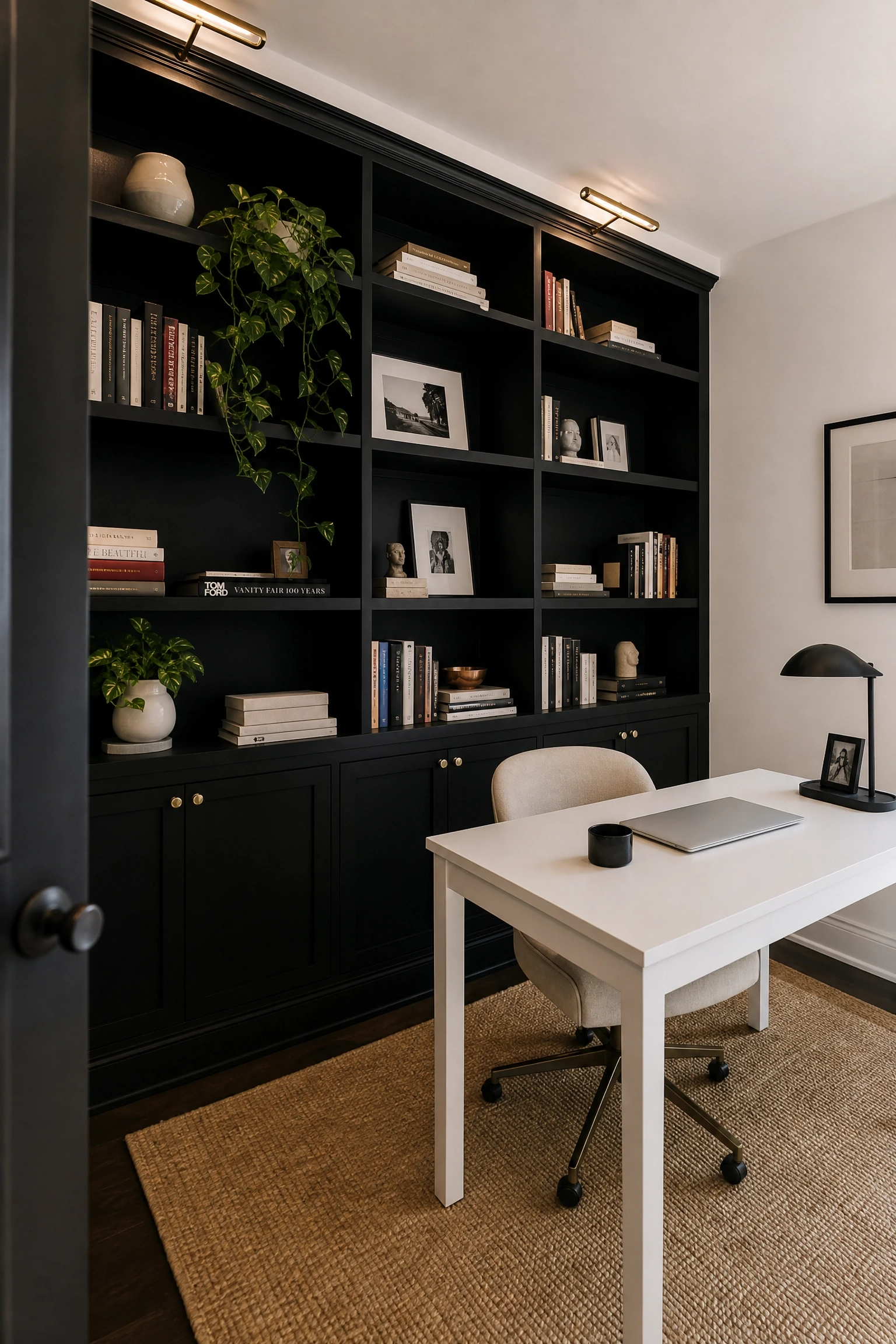
This approach is clever because it gives you the visual weight of black without painting a single wall. Floor-to-ceiling built-in shelving in matte black against white walls creates a graphic, almost architectural backdrop that photographs beautifully and works just as well in person. The white walls act as breathing room, so the black reads as a structural design choice rather than a mood. What you put on the shelves matters enormously here: a mix of books (spines out), small plants, a few ceramic objects, and one or two framed pieces keeps it from looking like a storage unit. Avoid filling every shelf to capacity because negative space on dark shelving is what gives the eye somewhere to rest. This is a particularly good option if you’re in a rental and can’t paint, since you can achieve a nearly identical effect with freestanding modular shelving units in matte black from brands like IKEA (the Kallax or Billy range in black-brown) or Floyd.
Heads Up: Black shelves show dust more visibly than lighter options, so keep a microfiber cloth nearby and do a quick wipe-down weekly if your shelves are in the background of video calls.
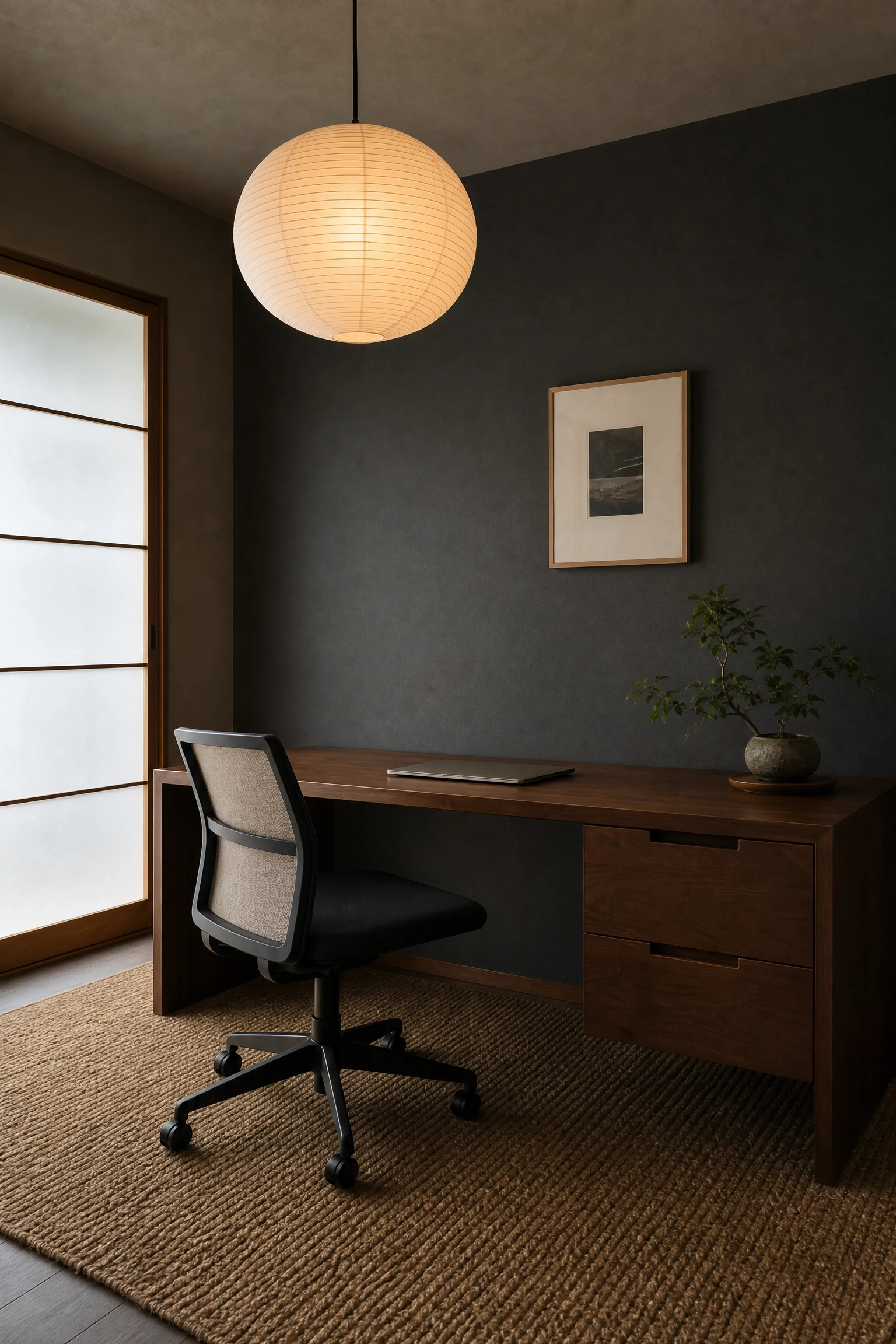
Japandi, the design marriage of Japanese minimalism and Scandinavian functionality, is one of the most naturally compatible aesthetics for a black home office. The style prizes restraint, natural materials, and a sense of quiet purpose, all of which pair with black far better than maximalist approaches do. The formula is straightforward: a low-profile walnut desk with clean lines, a matte black task chair in a simple silhouette (the HAY About A Chair or Muuto Fiber Chair both work well here), a single rice paper pendant light overhead for warmth, and nothing on the desk that doesn’t earn its place. The walls can be black or charcoal, but the key is keeping the surface count low. One ceramic object, one small plant in a terracotta or white pot, a single piece of minimalist wall art or a framed line drawing. The restraint is the point. In practice, the wabi-sabi principle applies: this isn’t a sterile space, it’s a calm one.
Designer Advice: A woven jute or natural fiber rug under the desk chair adds the tactile warmth that keeps Japandi from feeling cold, especially on hard floors.
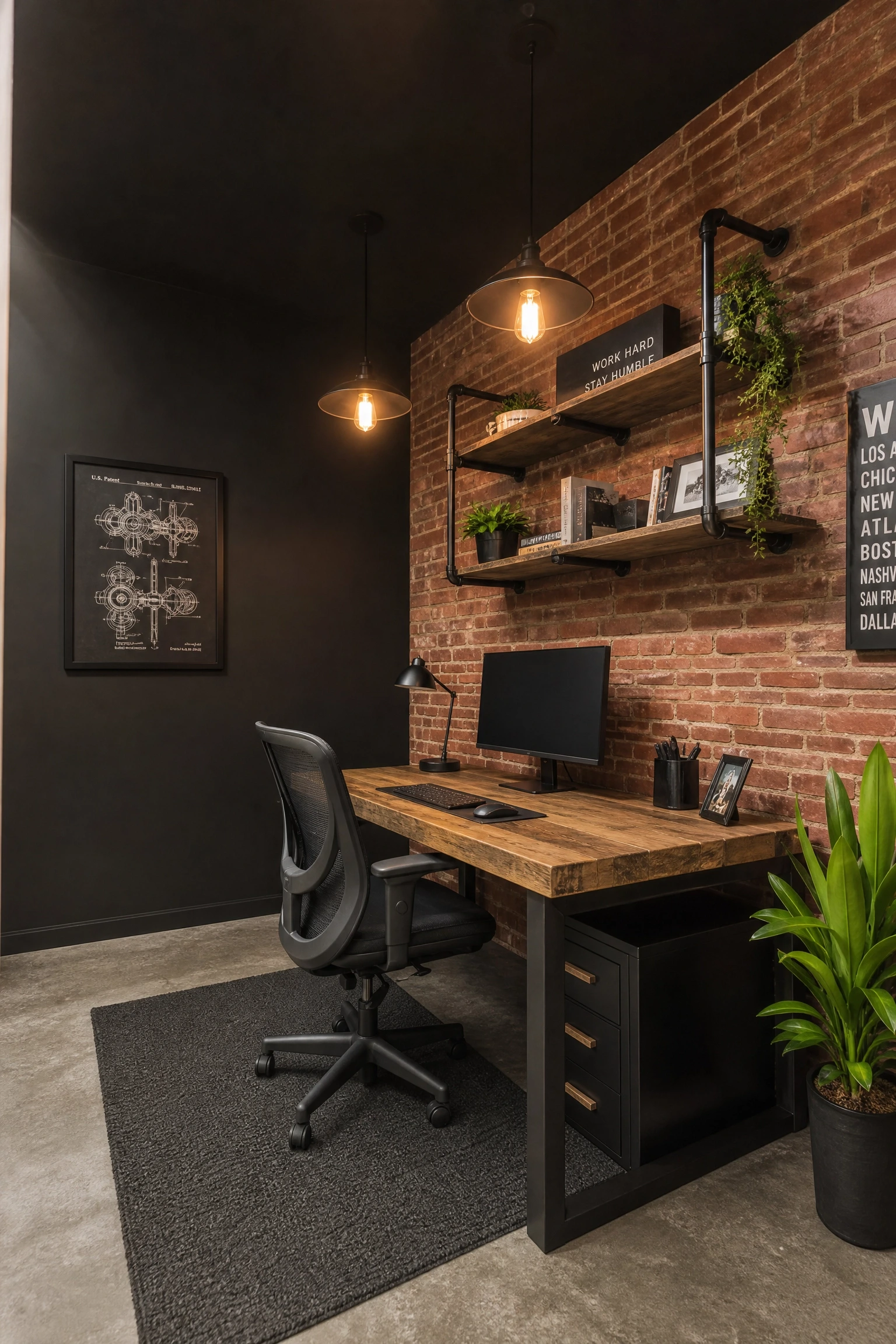
If your space has exposed brick or concrete, you are sitting on a gift for a black home office. The industrial aesthetic leans into raw materials rather than polished ones, so black here works through texture rather than precision. Think matte black powder-coated steel desk legs paired with a reclaimed wood desktop, black pipe shelving on the brick wall, and Edison bulb pendant lights or vintage-style cage sconces for task lighting. The rough texture of brick absorbs some of the darkness and gives the room a warmth that smooth black walls can’t replicate. If you don’t have brick, you can get close with a black limewash or textured plaster paint finish, both of which have a tactile quality that photographs and lives in a very different way from flat matte paint. The one thing to be careful about with this look is clutter, because industrial spaces can quickly tip from intentionally raw to just messy; keep cable management tight and surfaces edited.
Reality Check: Industrial lighting tends to run warm and low-output; if you do serious screen work, add a dedicated LED task lamp to supplement the mood lighting.
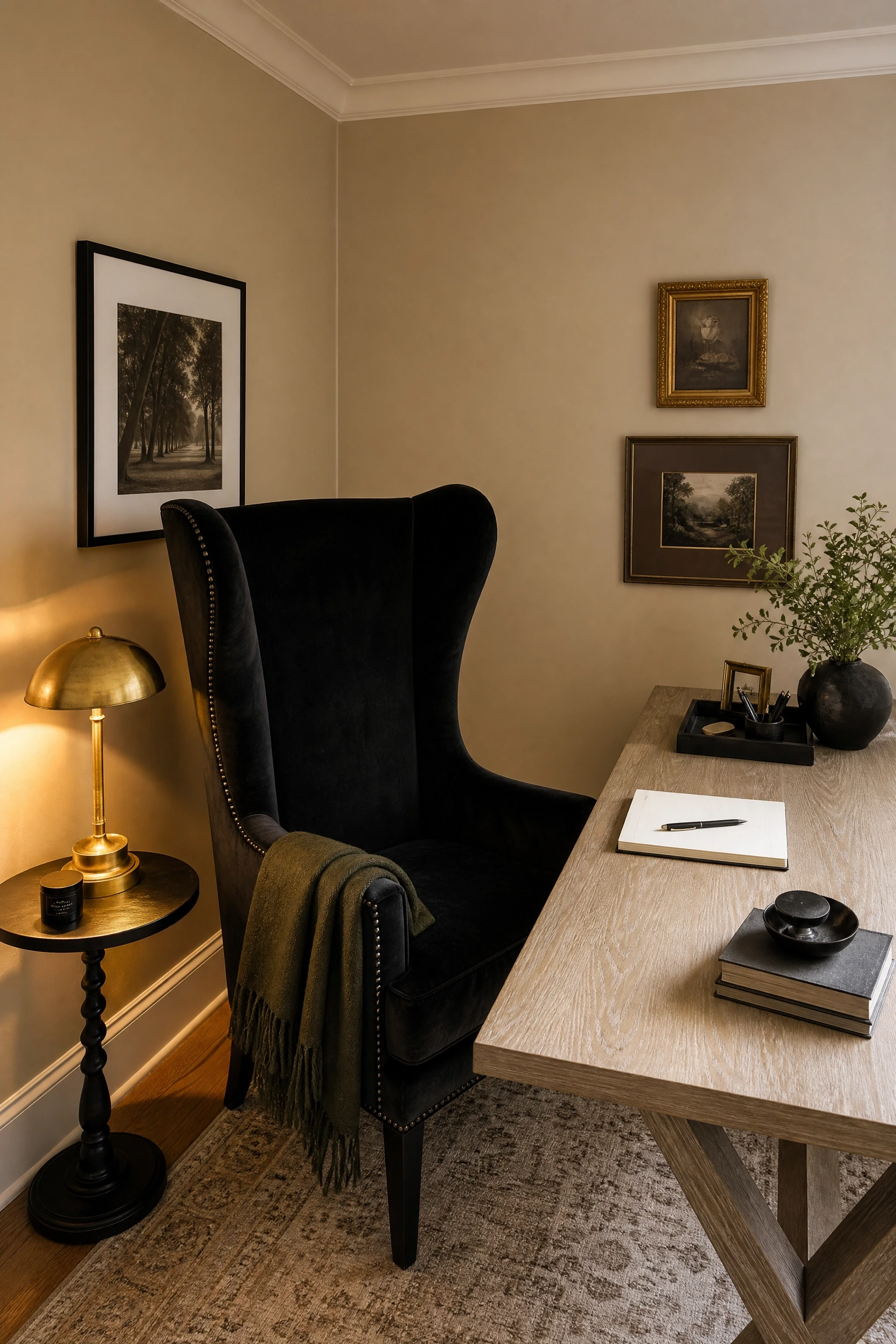
Not every black home office needs to start with the walls. If you’re decorating cautiously or working within a space that already has a set color scheme, a single black velvet chair can carry the whole black concept on its own. The key is choosing a chair with enough visual presence to anchor the room, something with a high back, substantial arms, or an interesting silhouette, rather than a generic task chair. A black velvet accent chair paired with a writing desk in a lighter wood or even a glass-top desk reads as intentional and pulled-together without the commitment of painting. Velvet is particularly good here because its texture catches light in multiple directions, so it never reads as flat or heavy despite the dark color. Style it with a small side table in matte black, a brass or warm-toned table lamp, and a simple throw in a complementary tone like deep olive, caramel, or charcoal.
Quick Tip: Velvet chairs repel most surface dust and lint with a light brush; avoid pressing hard or rubbing against the nap or you’ll create permanent marks.
Design Insight
“Color temperature in lighting has more impact on how a dark room feels than the shade of black paint you choose. Warm white bulbs (2700K-3000K) make a black office feel rich and cozy; cool white bulbs (4000K+) make it feel cold and clinical.”
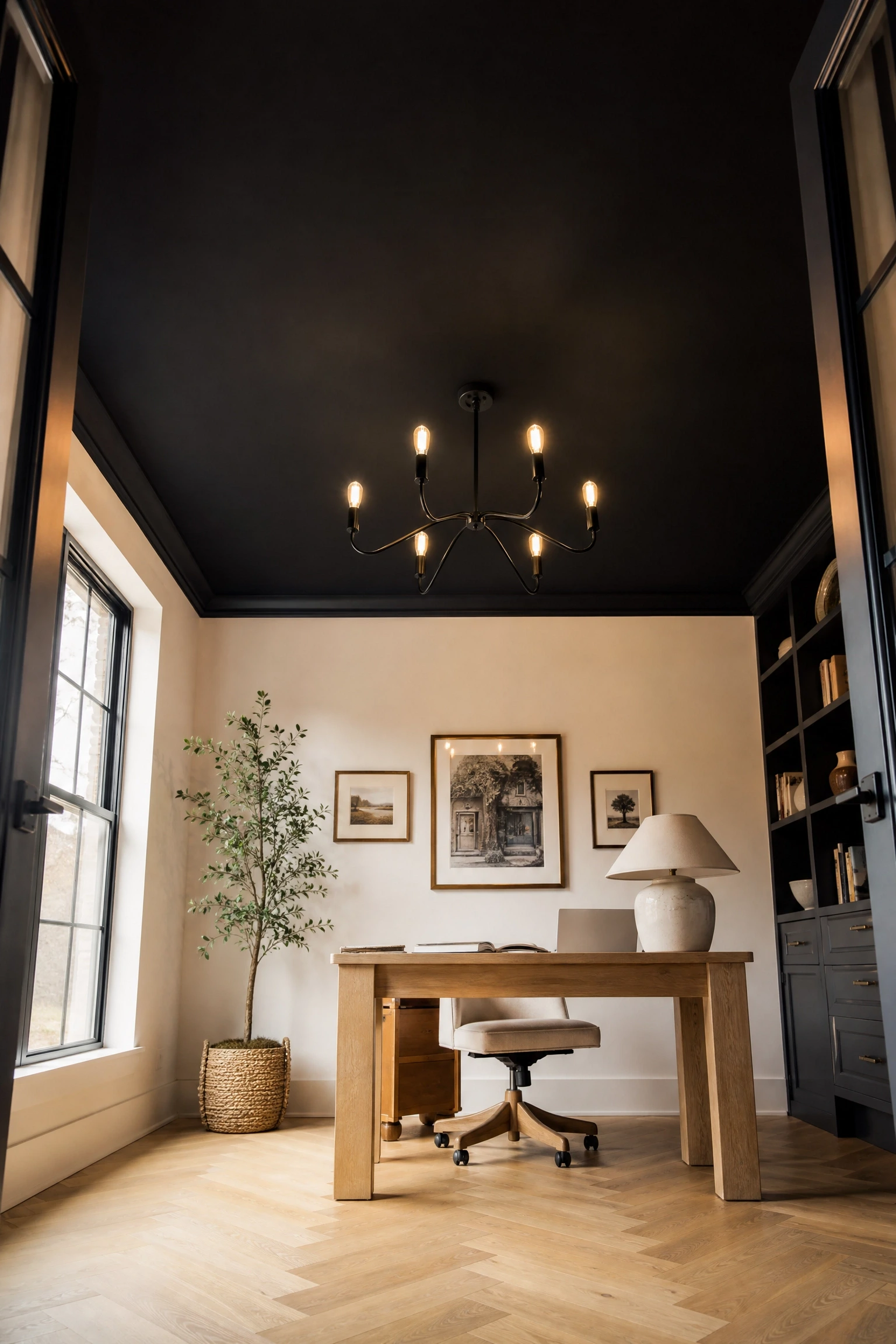
Painting the ceiling black while keeping the walls light is a genuinely underrated move that most people don’t consider because they’ve been told forever that dark ceilings make a room feel smaller. In a home office, though, a black ceiling does something unexpected: it creates a sense of enclosure that actually helps concentration, like working under a canopy rather than in an open-plan space. The walls and floor stay light, so the room doesn’t feel compressed, but the ceiling draws the eye up and creates drama without any of the cave-like qualities that scare people away from black walls. This works best in rooms with a ceiling height of at least 8.5 feet, though it can be done in lower rooms if you keep the walls very pale and the lighting bright. Pair it with a statement ceiling fixture in brass or black, since the dark ceiling will frame it beautifully, and watch how the whole room feels more deliberate.
Pro Move: Carry the black paint from the ceiling down 6 to 8 inches onto the top of each wall to create a subtle “cap” that makes the architectural detail look intentional rather than abrupt.
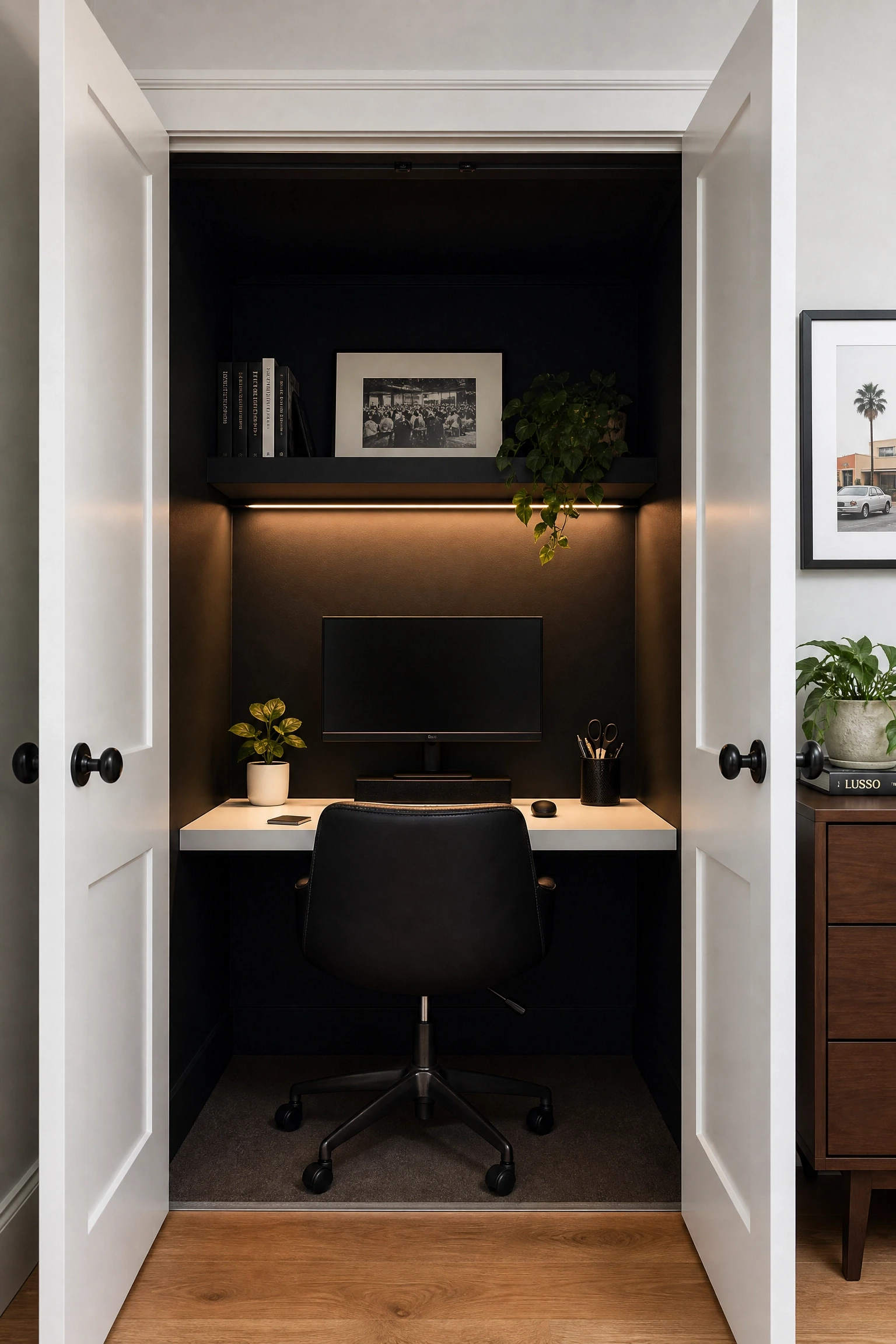
The closet-to-office conversion has become one of the most searched home office ideas in recent years, and a black nook takes it from functional to genuinely stylish. The logic is simple: when you’re working within a small, contained footprint, going dark actually works in your favor because the walls recede visually and the space feels more like a room-within-a-room than a cramped box. Paint the interior of the closet, including the ceiling and back wall, in a deep matte black, install a floating desk at the right working height, add under-cabinet LED strip lighting in warm white to illuminate the work surface, and you have a focused, self-contained workspace that you can close off from the rest of your home when the workday ends. The light surroundings of the room outside the nook contrast with the dark interior, which makes the setup look more dramatic and purposeful than it would if you’d used a lighter color.
Heads Up: Good cable management is even more important in a nook because there’s nowhere to hide a mess; invest in a cable box or in-desk cable tray before you set up your tech.
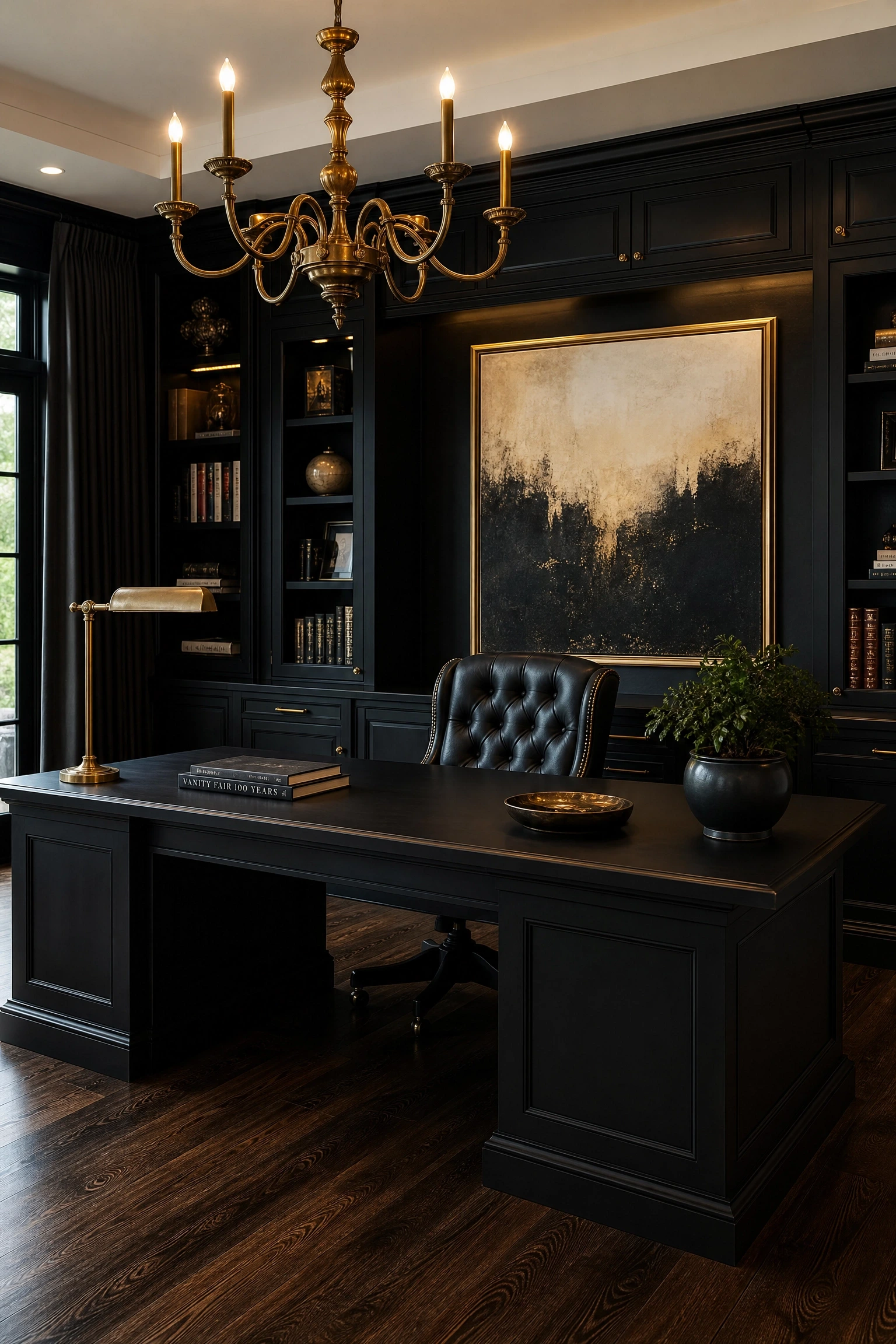
This is the boldest direction on this list and also the most high-commitment, but when it’s done right it is genuinely impressive. The reference point is the Hollywood Regency aesthetic, which pairs lacquered or matte black surfaces with warm gold, deep upholstery, and a sense of deliberate luxury. In a home office context, that translates to a large, substantial black desk (either lacquered or in a dark stone like black marble or granite-look laminate), a tufted black leather executive chair, gold or brass hardware on cabinetry, a statement chandelier or pendant in an antique brass finish, and layered lighting that makes the room feel like a private members’ club rather than a corporate floor. This is an investment-level look; the desk and chair alone will likely run $1,500 to $3,000+ if you’re sourcing quality pieces, but it can be approximated at a lower price point with the right furniture combinations from CB2 or West Elm’s darker collections.
Reality Check: High-gloss black surfaces show fingerprints and smudges constantly; in a working desk environment, matte or honed finishes are far more practical.
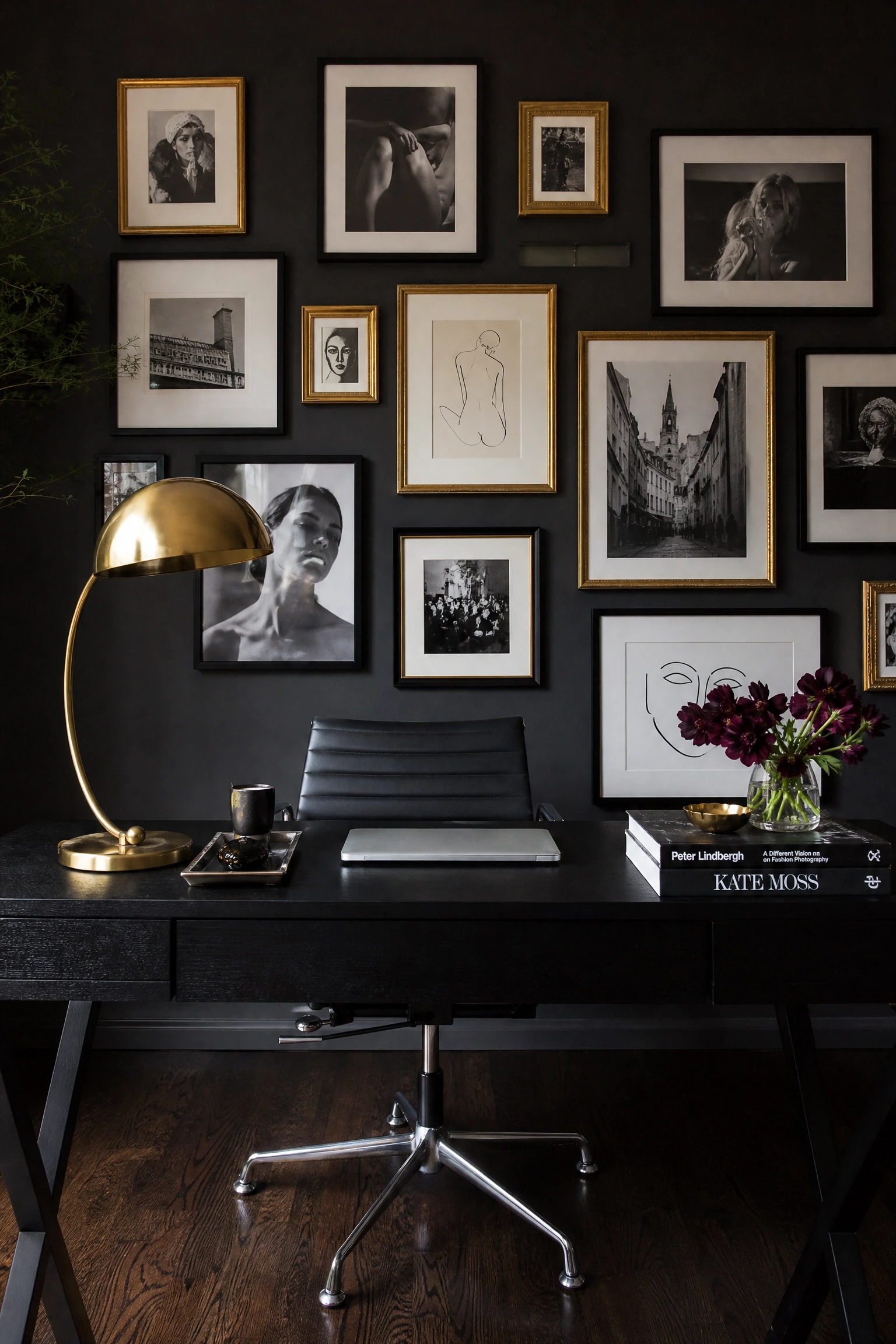
A gallery wall is one of the best tools for making a black home office feel personal rather than austere. On a black or deep charcoal wall, framed artwork, photographs, and prints create a layered, collected look that tells a story about the person working there. The key to pulling this off well is frame consistency: stick to one or two frame finishes, either all black frames for a graphic, editorial feel, or all warm metal (gold, brass, bronze) for something richer, and vary the size and content within that framework. Black-and-white photography works especially well against dark walls because the contrast reads clearly and the tones feel harmonious. Avoid frames with matting in colors that fight the wall. In practice, this is best planned on the floor before any nails go in: lay out your arrangement, photograph it, then transfer it to the wall. A gallery wall on a dark background has almost no margin for visible correction attempts.
Designer Advice: Leave at least 2 to 3 inches between frames; too tight and the wall reads as crowded, too far apart and it looks like you ran out of ideas.
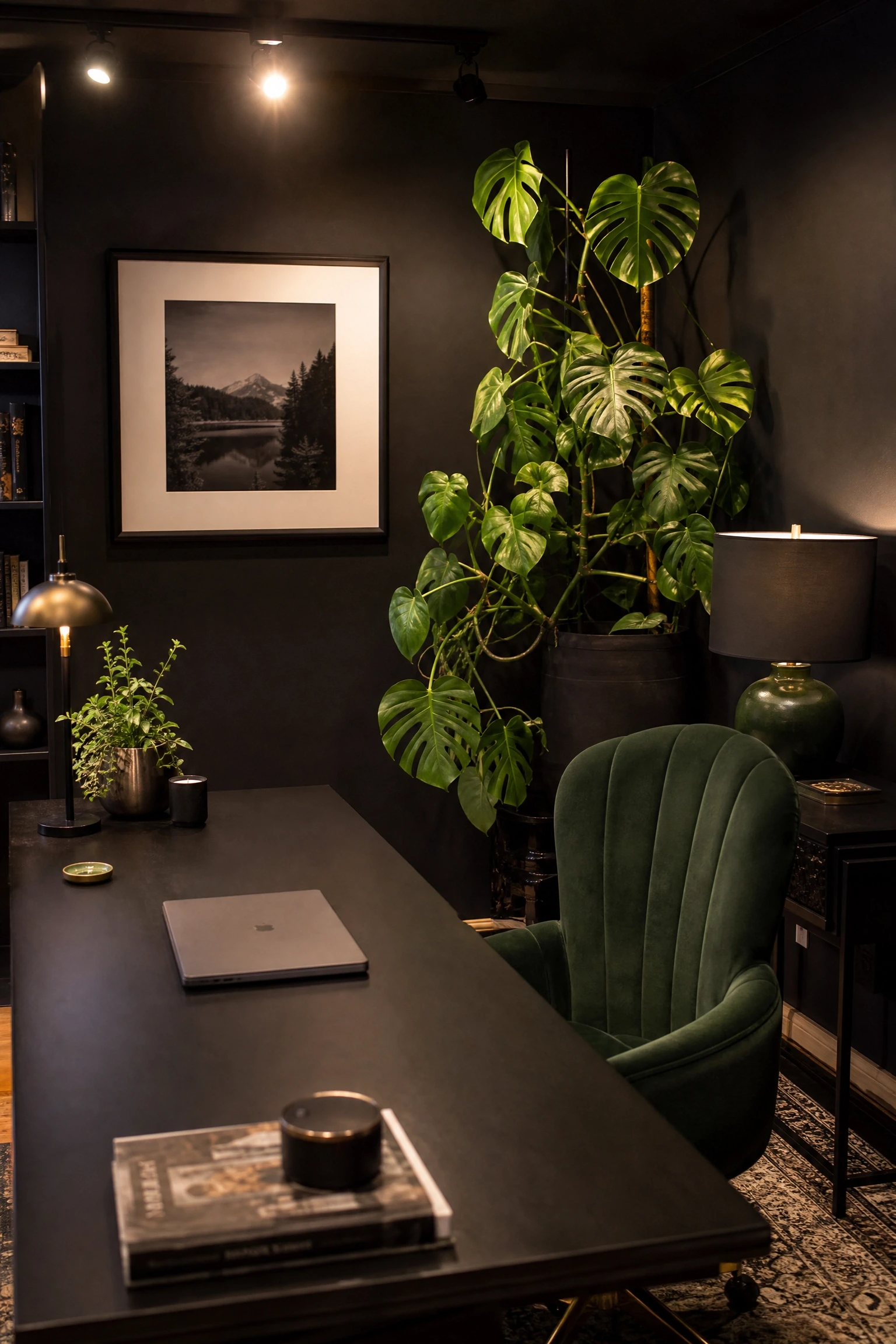
Black and deep green is one of the best color pairings in interior design right now, and it’s particularly well-suited to a home office because both colors are associated with focus and calm. The green to reach for here is not a bright or sage-adjacent tone; you want deep forest green, hunter green, or bottle green, the kind that almost reads as black in low light but reveals itself as a rich, organic color in good light. In a black office, you bring it in through upholstery (a deep green desk chair or small sofa), through plants (the oversized fiddle leaf fig or a trailing pothos in a matte black pot), through a single painted drawer unit or filing cabinet, or through a throw pillow or two on a reading chair. The result is a room that feels grounded and slightly botanical rather than cold or corporate, which is a hard combination to find in dark office design.
Quick Tip: Matte finish on both the black and green surfaces is key; mixing matte and gloss finishes in these two colors can look accidental rather than intentional.
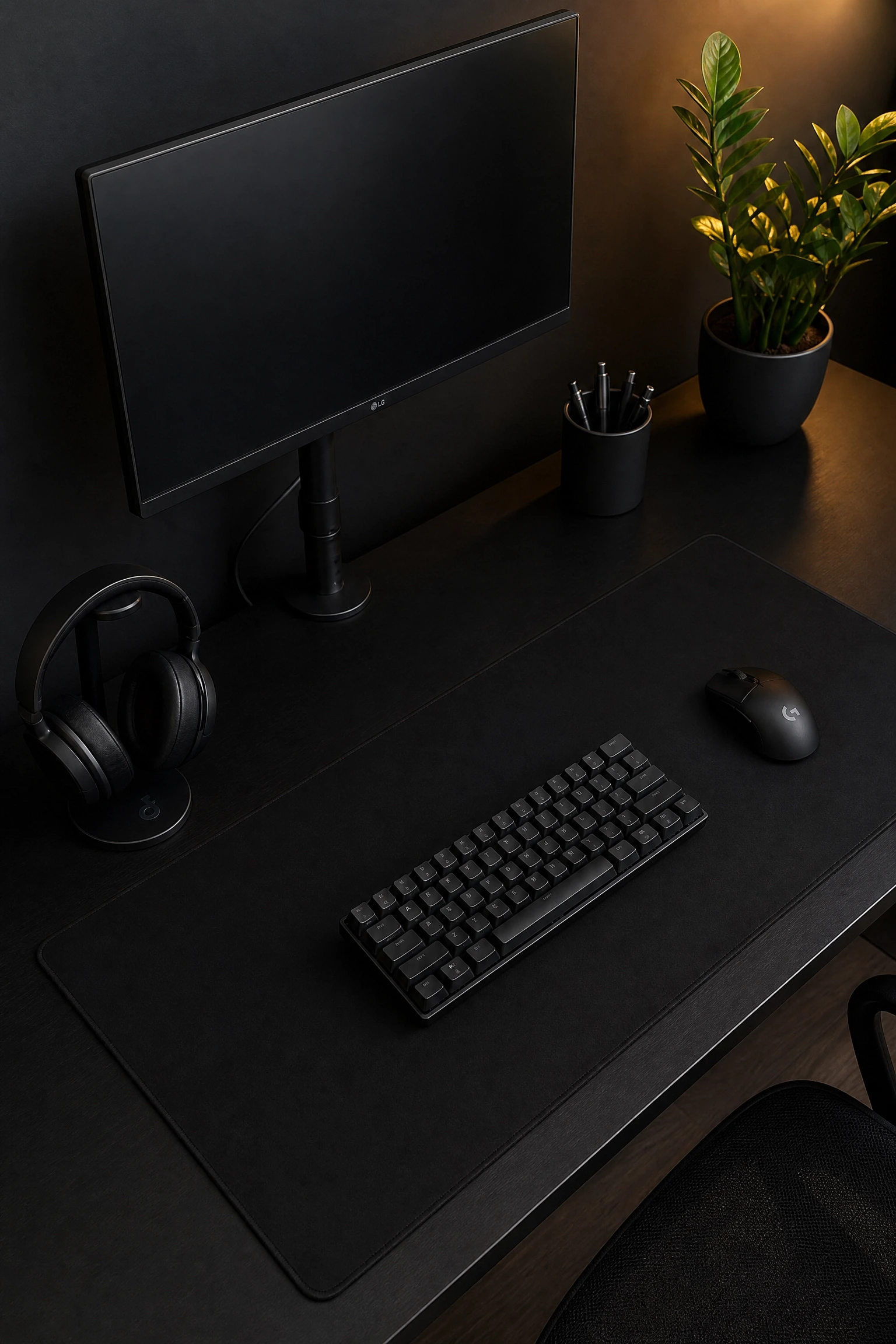
This idea is less about the room and more about the desk itself, which is actually a valid approach if you’re working in a shared space or can’t alter the walls. A flat-lay black desk setup, which is the style that dominates tech YouTube and productivity content, is built around a single black desk surface with every accessory chosen in black, matte black, or dark charcoal. This includes the monitor (or monitor arm), keyboard, mouse, desk mat, cable management clips, headphone stand, small speaker, and even the plant pot. The result is a desk that functions as a self-contained aesthetic object within any room. The discipline required is real: one off-color accessory in white or silver can break the whole thing, so when you’re building this setup, commit completely or not at all. This works particularly well in open-plan apartments where the office is visible from the living area and needs to look intentional from a distance.
Pro Move: A large matte black desk mat (at least 31 by 15 inches) is the single item that pulls a flat-lay black setup together most effectively; it unifies all the elements on a single plane.
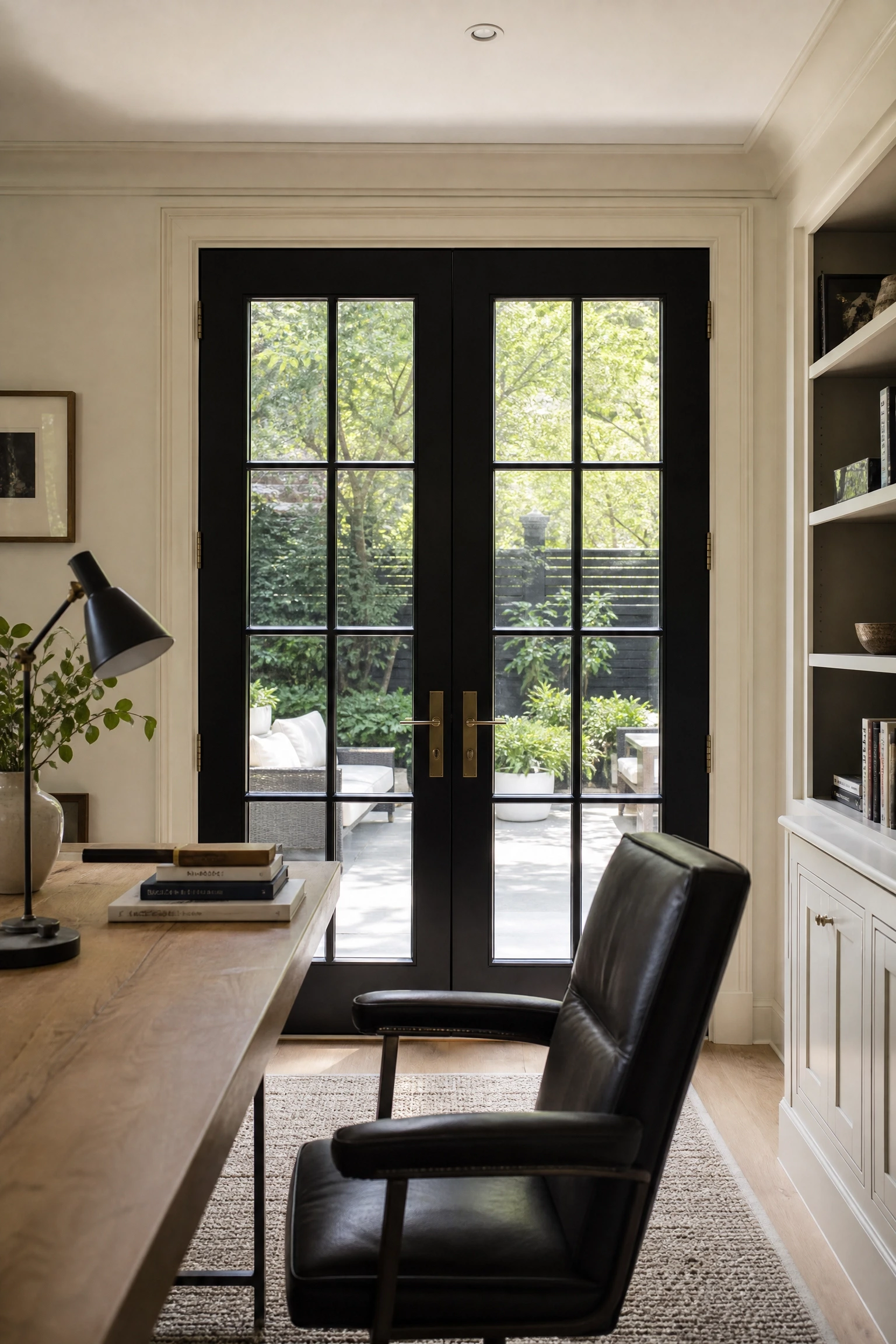
If your home office has or can accommodate French doors, painting them black is one of the most architectural moves you can make in the space. Black French doors, whether internal or leading to a garden, patio, or hallway, function as a graphic frame that gives the room immediate visual structure. The doors become the focal point, which means the rest of the room can be fairly neutral: white or cream walls, a simple desk, natural materials, and the doors hold the design together from across the space. This is a look that professional designers love because it’s relatively low-cost (a can of black exterior or semi-gloss paint) and has a disproportionate impact on the overall feel of the room. If replacing or adding French doors isn’t in the budget, the same principle applies to a standard single door painted in a deep matte black with black hardware; it’s not quite the same drama, but it works as a gesture in the right direction.
Heads Up: Use a semi-gloss or satin finish on doors rather than matte; doors take a lot of contact and matte paint scuffs and marks more easily in high-traffic areas.
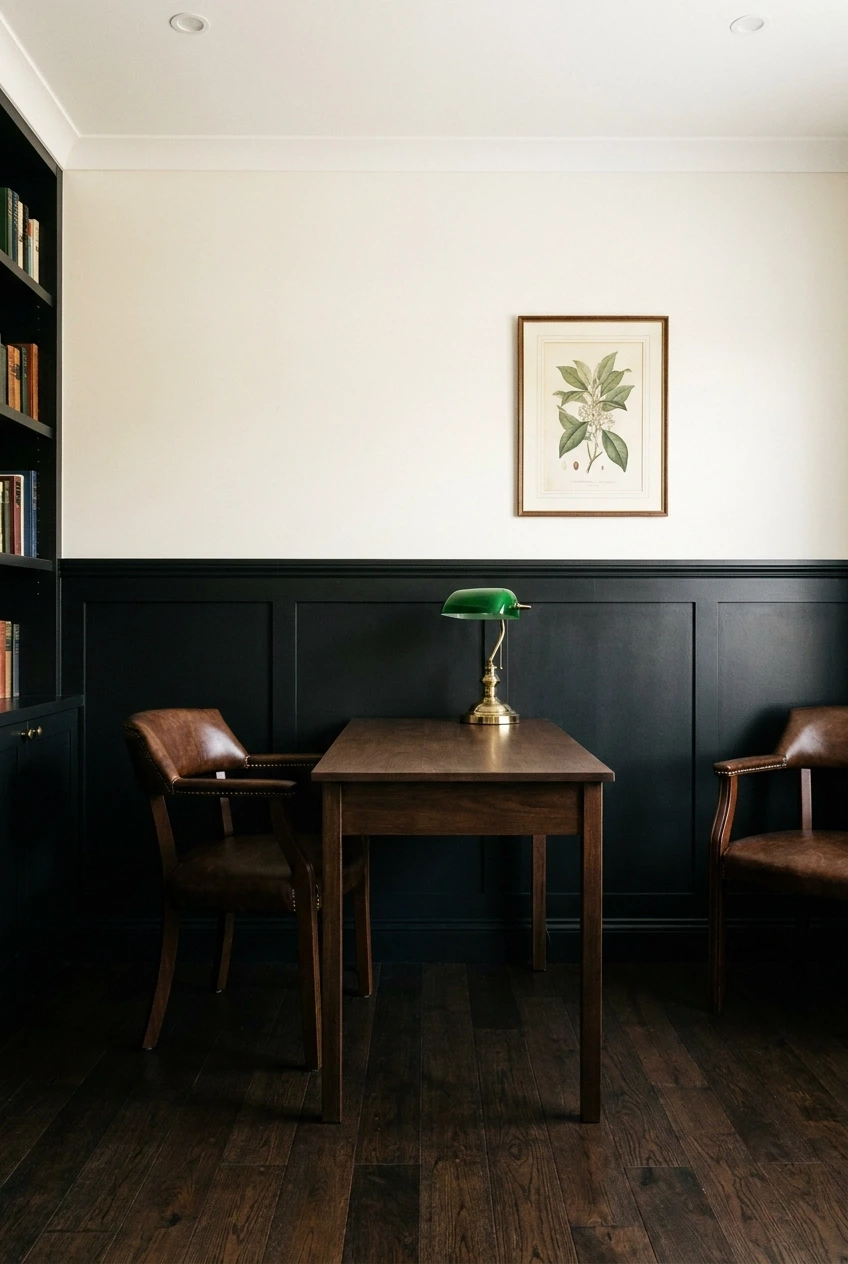
Wainscoting is having a genuine moment right now, and black wainscoting in a home office is a particularly good application because it grounds the lower half of the room without committing the entire wall to dark color. The standard approach is paneling from the floor up to roughly 36 inches (chair rail height), painted in a deep matte black, with the upper wall in white, cream, or a soft warm gray. The visual effect is a room that feels anchored and structured, with a clear horizontal line that makes the ceiling appear higher. This works especially well in offices that are also used as reading rooms or sitting rooms, since the wainscoting gives the space a slightly traditional, library-like quality that black paint alone doesn’t achieve. For the paneling itself, simple shaker-style or flat-panel wainscoting reads as contemporary; more ornate raised paneling suits a traditional or maximalist direction.
Designer Advice: Paint the baseboard and door trim in the same black as the wainscoting to make the lower architectural elements read as a unified system rather than separate choices.
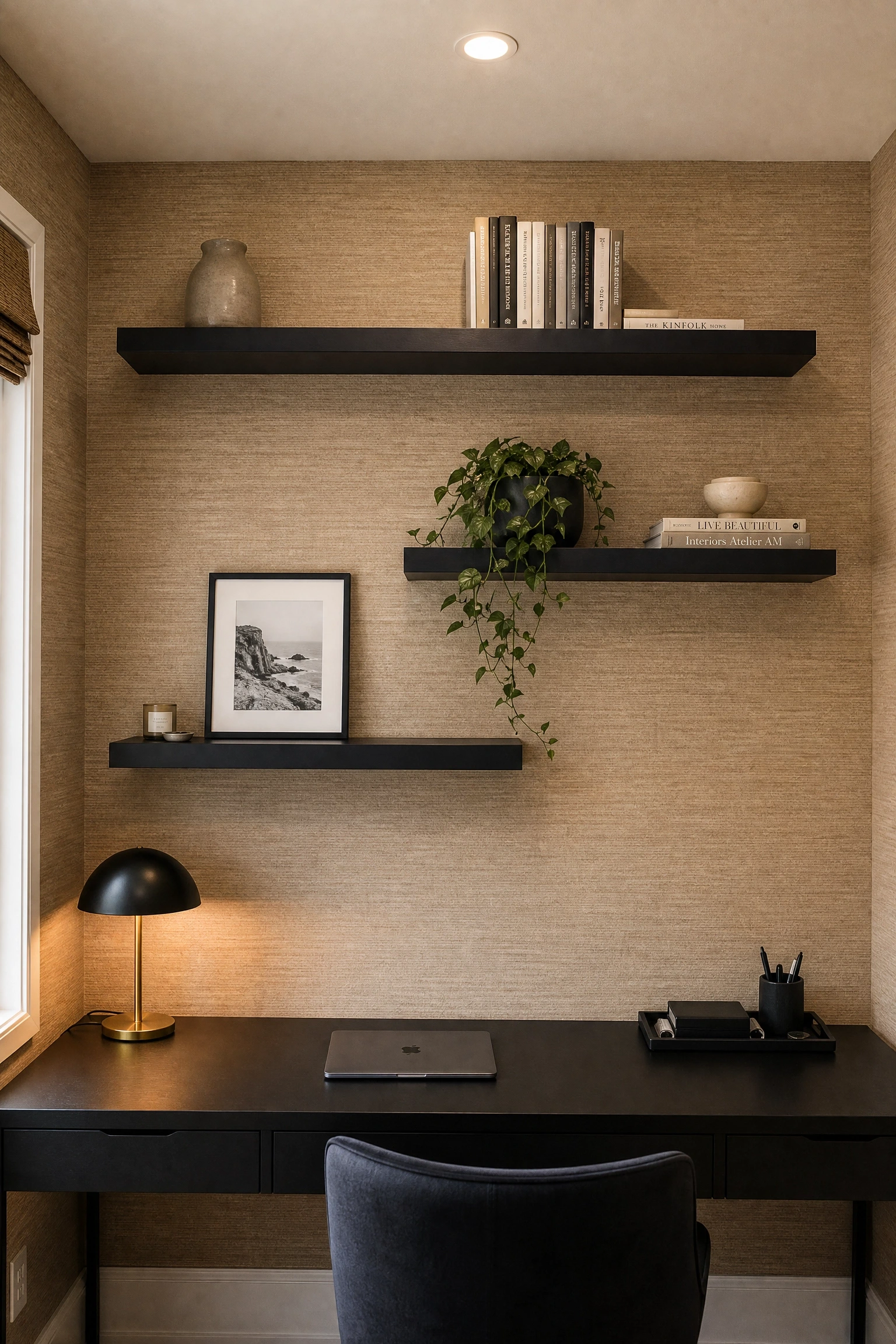
Floating shelves in matte black are a low-commitment, high-impact way to introduce the color into a home office, especially when placed against a wall with texture, whether that’s grasscloth wallpaper, limewash plaster, shiplap, or even a natural linen panel. The texture of the wall surface behind the black shelves creates depth and visual interest that a flat painted wall doesn’t provide, and the shelves themselves anchor the arrangement without demanding that you commit to dark paint. The styling of the shelves should mix functional items (books, binders, a small printer or scanner) with decorative ones (a framed print, a small sculptural object, a plant in a ceramic pot) so the overall look is organized rather than decorative-only. In a small office, two or three staggered shelves in different lengths look more considered than a uniform row of identical shelves at the same height.
Quick Tip: Check the wall stud locations before buying shelves; heavy books on floating shelves require proper anchoring, and the length of your shelves should be determined by where the studs fall.
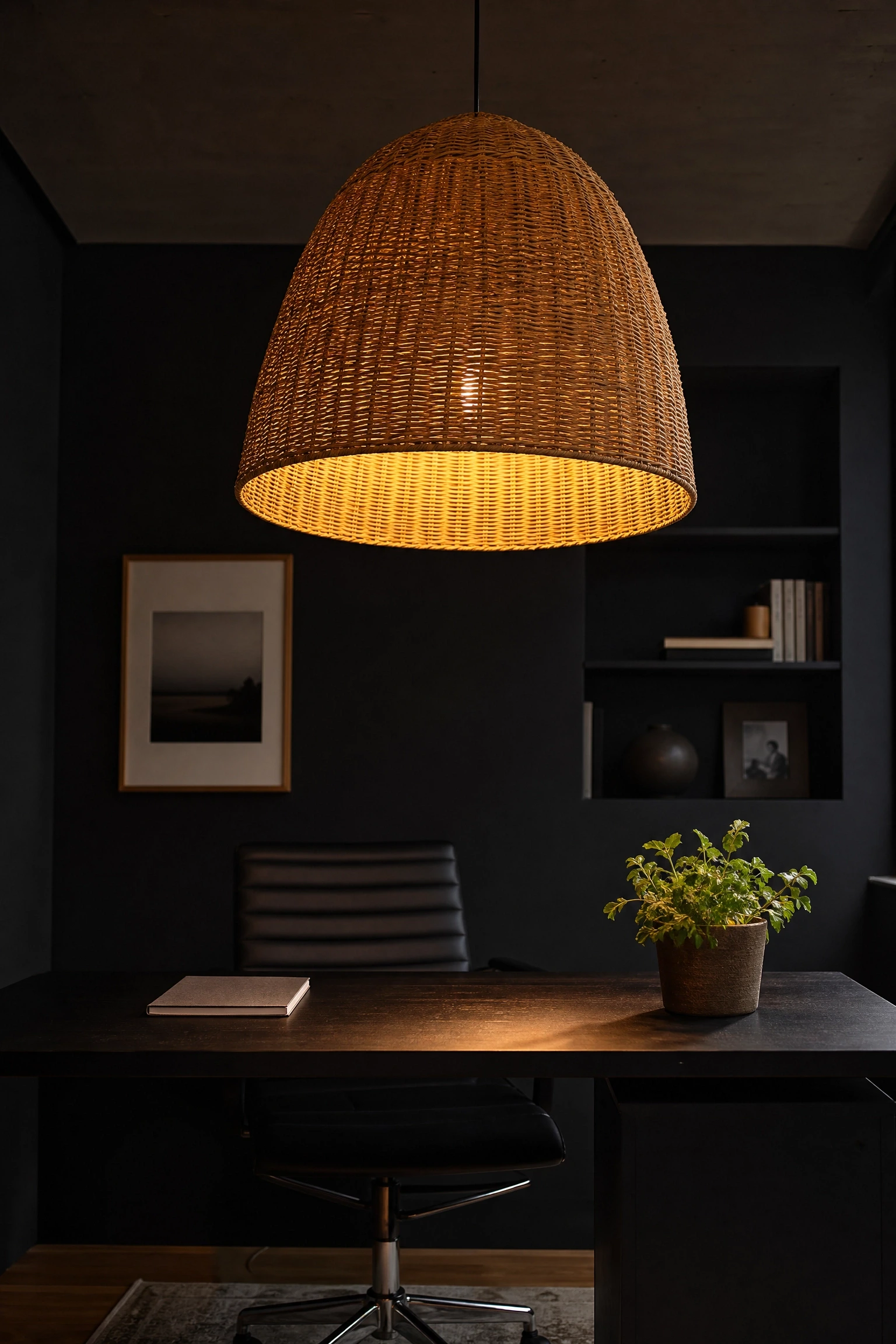
In a black home office, lighting is doing more structural work than in any other kind of room because it’s fighting against the light-absorbing nature of dark surfaces. A statement pendant light, centered over the desk or over the room, serves two purposes: it provides meaningful ambient light and it acts as a piece of visual art that breaks up the darkness and gives the eye a place to land. The best pendant choices for a black office are ones with a sculptural quality, something in woven rattan for warmth and texture, a Japanese paper lantern for softness, a large black cage pendant for a graphic industrial look, or an oversized linen shade for a more relaxed editorial feel. The bulb matters more than most people think: a filament LED bulb in warm white (2700K) creates a glow that feels candlelit and cozy, while a standard cool white bulb will make the room feel clinical regardless of how beautiful the pendant itself is.
Reality Check: A pendant over a desk looks best at 60 to 72 inches from the floor to the bottom of the shade; too high and it loses presence, too low and it becomes a hazard for anyone standing up quickly.
17. Black and Warm White Office with Linen Accents
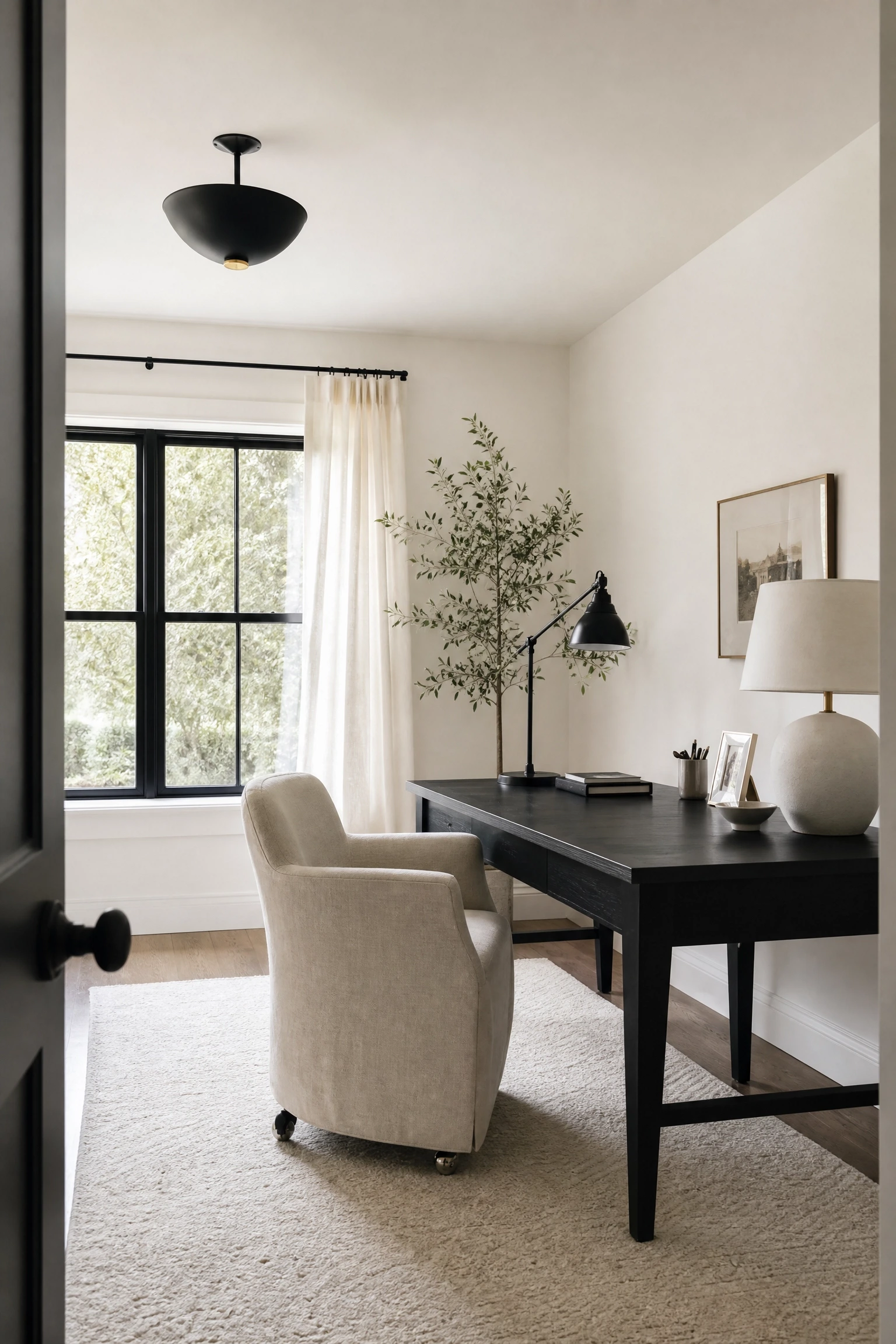
This is the softest interpretation of a black home office and probably the most accessible one for people who are nervous about dark colors. The principle is using black as the structure, whether that’s a black desk, black window frames, black light fixtures, and black hardware, while keeping everything else in warm white and natural linen textures. A linen desk chair, a washed-linen curtain panel, a cream wool rug, a white ceramic table lamp: these are the elements that do the softening work. The contrast between the crisp black structure and the soft organic textiles is what makes this look so livable. It works in bedrooms-turned-offices and sunrooms particularly well because the linen and white tones keep the natural light feeling open while the black grounds the space and keeps it from feeling too airy and unfocused. Budget-wise, this is also one of the more affordable black office directions since the black elements can be hardware and accessories rather than major furniture purchases.
Designer Advice: Washed linen is more forgiving than unwashed; it hangs and drapes in a way that looks lived-in and intentional rather than stiff.
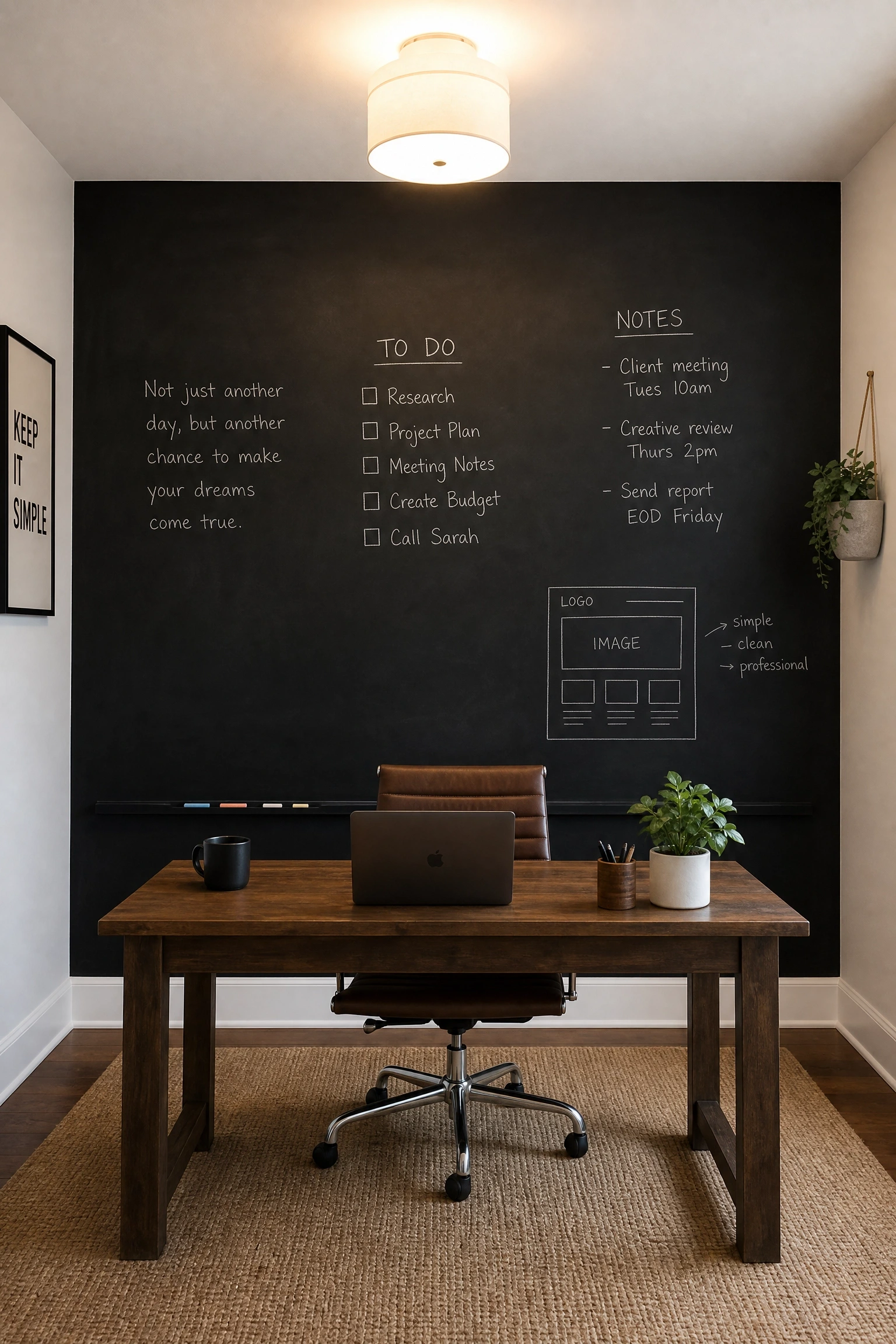
Chalkboard paint is one of those ideas that sounds gimmicky until you actually use it, and in a home office it earns its place as one of the smartest functional-meets-decorative decisions you can make. A full wall or a large section behind or beside the desk painted in chalkboard paint gives you an always-available surface for notes, diagrams, to-do lists, mind maps, and sketches that don’t require opening another app or finding a piece of paper. It also reads, from a design perspective, exactly like a matte black accent wall because chalkboard paint has a flat, deep finish that doesn’t photograph as different from regular matte black unless you’re looking for it. The added benefit is that a wall with chalk on it automatically looks lived-in and purposeful, which helps the office feel like an active, working space rather than a decorative installation. Keep a box of white chalk and a small felt eraser on the desk or on a small ledge installed at the base of the wall.
Heads Up: Season a new chalkboard wall by rubbing the side of a chalk stick over the entire surface and then erasing it before first use; this prevents ghosting of your first drawings.
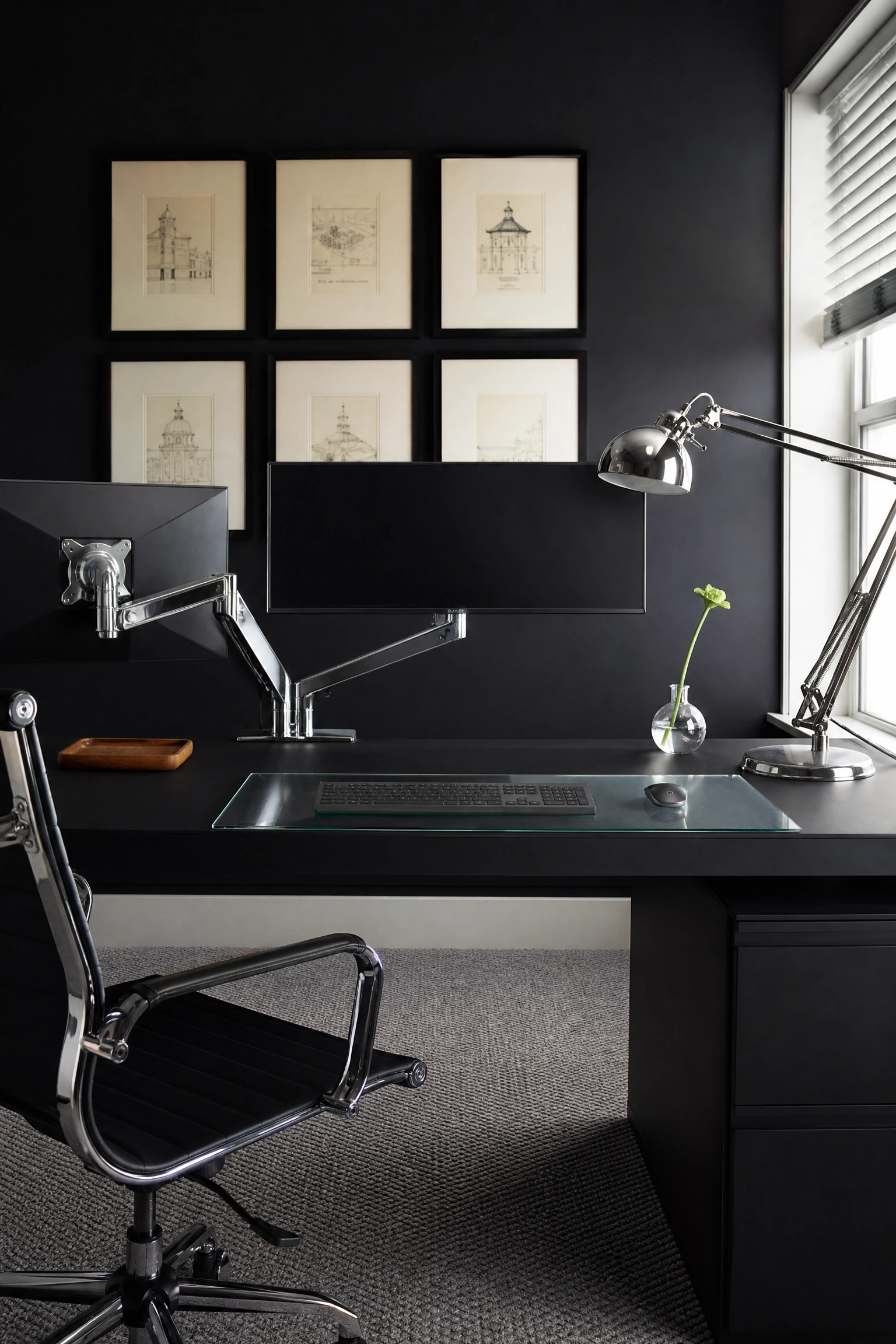
Where brass gives a black office warmth and traditionalism, chrome and glass push it in a sharper, more contemporary direction. A matte black desk paired with chrome monitor arms, a glass desk mat, a chrome desk lamp, and a glass vase or two creates a workspace that feels sleek and precisely edited, closer to a tech studio or a modern architecture firm than a cozy reading room. This look works best in rooms with good natural light because chrome and glass are reflective and will amplify whatever light is coming in, which counterbalances the darkness of the desk and any dark walls. The risk here is that the combination can feel cold if you don’t add one natural material to the equation: a small wooden tray, a single ceramic object, or even a plant in a simple pot is enough to keep the room from feeling sterile. This direction suits people who want an office that looks as considered and functional as their workflow.
Pro Move: Fingerprint-resistant coatings on chrome accessories are worth paying extra for in a working desk environment; standard chrome shows every touch.
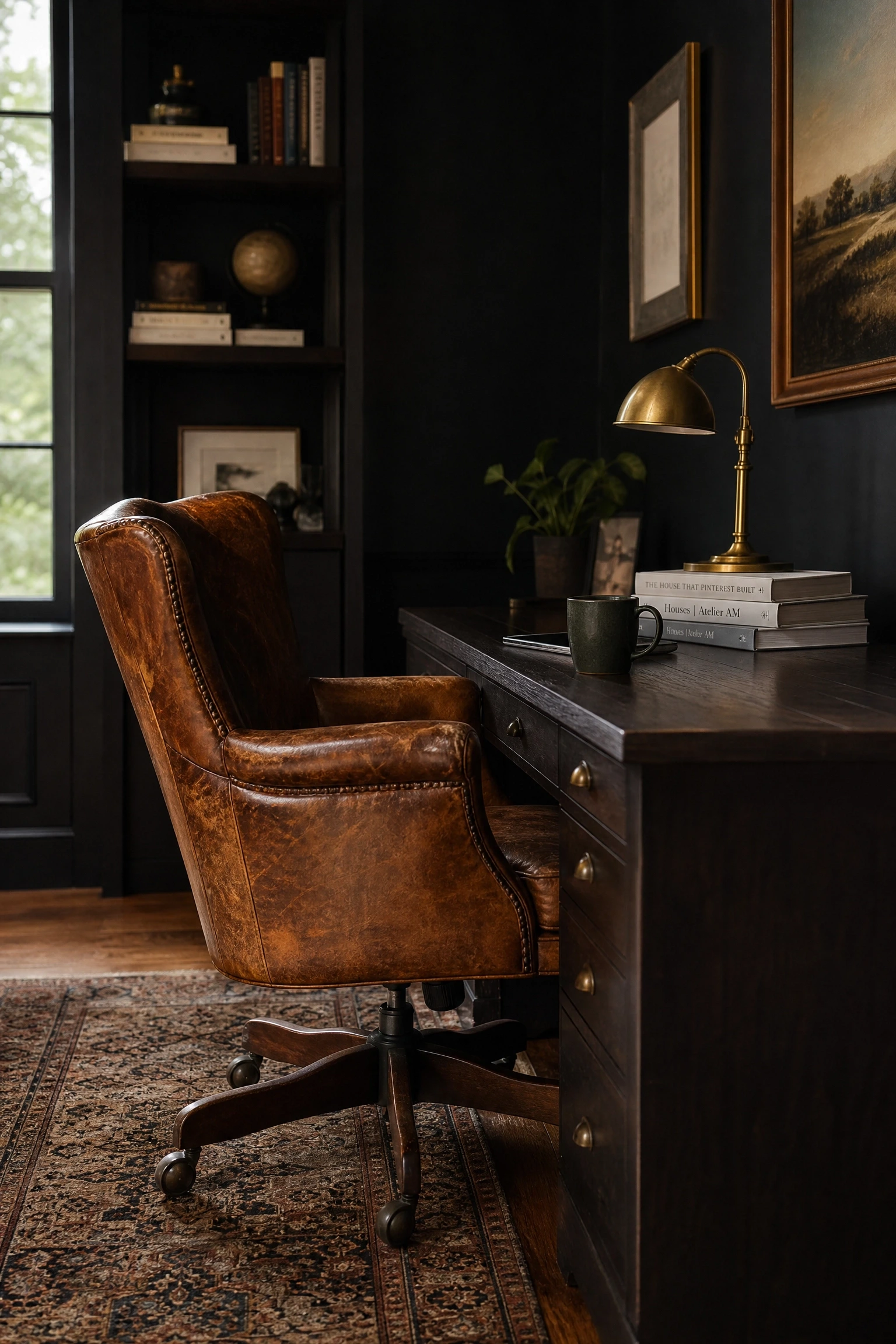
A worn vintage leather chair, the kind with slightly distressed arms and a deep chestnut or cognac color, does something interesting in a black home office: it introduces age and character into what might otherwise be a very precise, controlled aesthetic. The patina of old leather reads as warmth and history against a dark backdrop, and the contrast between the black architecture of the room and the soft, worn quality of the chair creates a tension that feels genuinely interesting to inhabit. This is particularly effective in offices with dark wood elements, exposed beams, or traditional architectural details, where the leather chair feels historically continuous rather than out of place. You don’t need an original Eames or a Chesterfield to get this effect; a good second-hand leather chair from a thrift store or estate sale, cleaned up and conditioned, will often have more character than a new reproduction. [INTERNAL LINK: vintage home office decor ideas]
Reality Check: Vintage leather requires conditioning every 6 to 12 months to prevent cracking, especially in rooms with low humidity or direct sunlight.
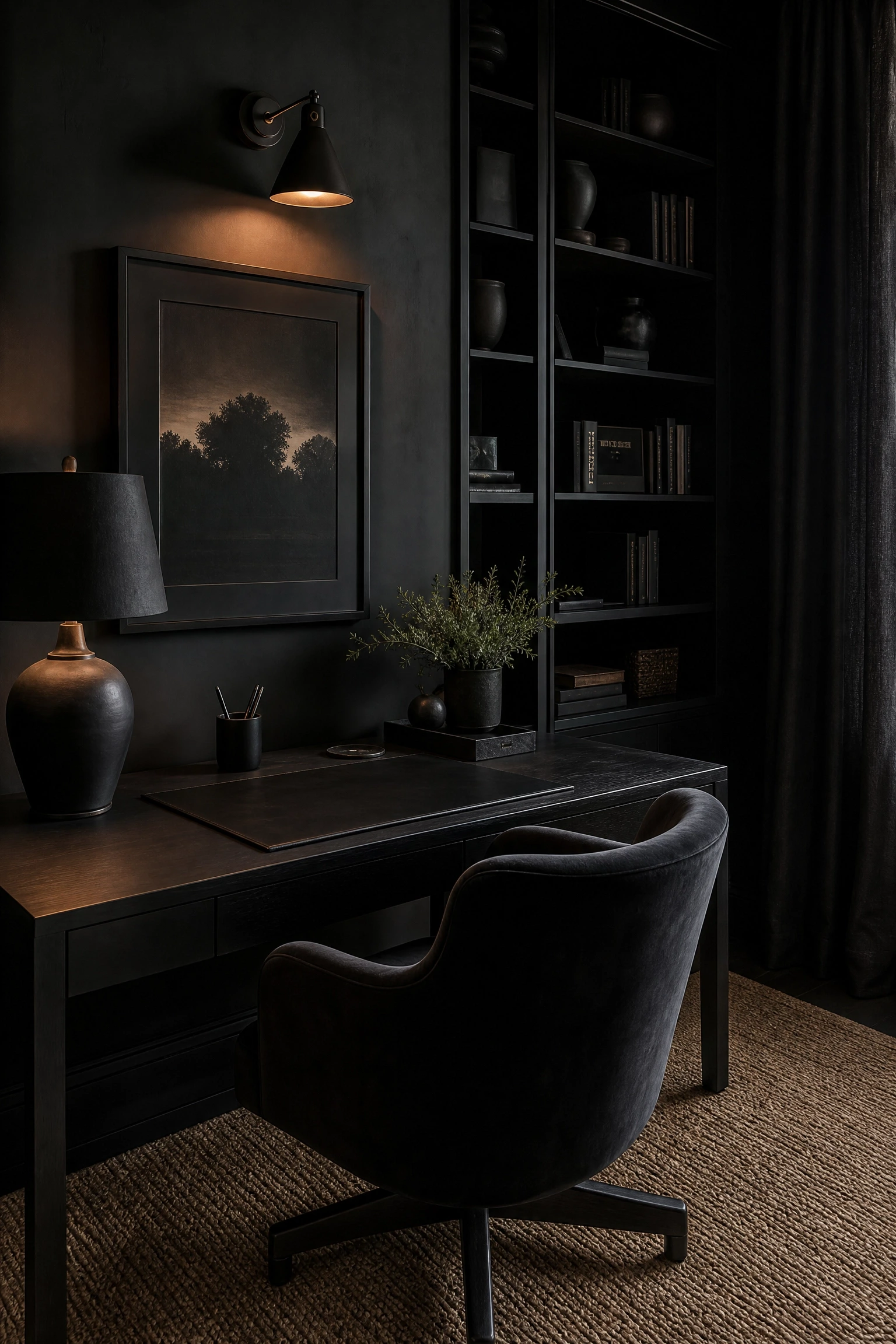
A monochrome black office, where walls, furniture, and accessories all sit within the same dark tonal range, sounds like a recipe for a room that feels dead. The thing that makes it come alive is texture, and specifically the variety of surfaces within that dark palette. Matte paint on the walls, a velvet desk chair, a woven jute rug, a leather desk pad, a ceramic lamp base, a linen curtain, a lacquered pencil cup: each one reads as black or near-black but behaves completely differently under light. The interplay between those surfaces is what gives the room depth and dimension. In practice, this is a harder look to pull off than it seems because it requires discipline and careful material sourcing, but when it works, it’s one of the most visually sophisticated home office environments you can create. Interior designers often describe texture variety in dark rooms using the concept of visual weight: some surfaces absorb light, some bounce it, and balancing those properties is what makes a monochrome room feel rich rather than flat.
Designer Advice: Aim for at least four distinct textures in a monochrome black office; anything fewer and the room will look under-furnished rather than minimal.
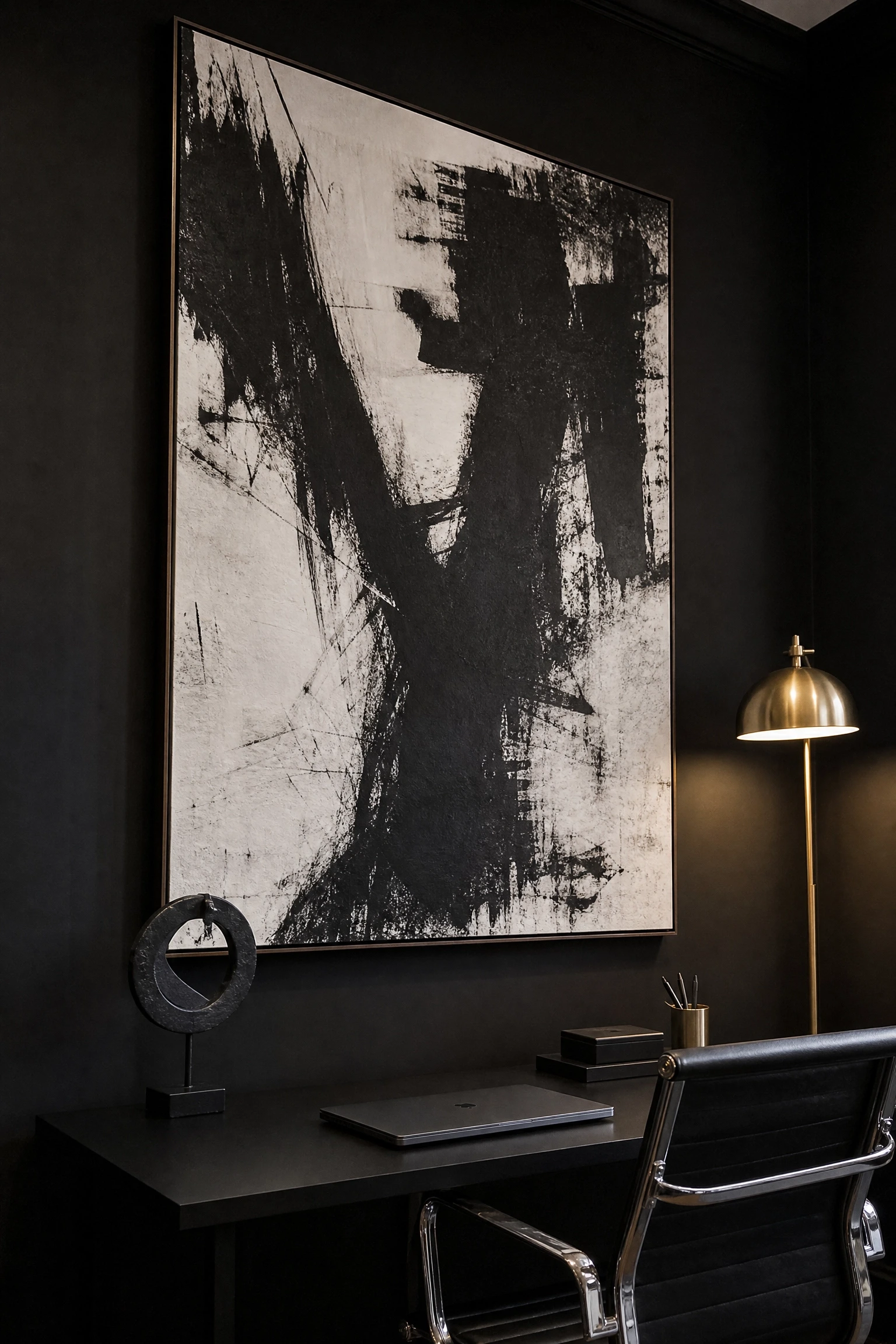
One large piece of art does more for a black home office than a dozen small accessories, and scale is the thing most people underestimate when decorating dark spaces. In a black or dark office, an oversized canvas or framed print, something at least 36 by 48 inches, commands the room and gives the space a focal point that isn’t the technology on your desk. The best choices are works with a light or high-contrast palette because they pop against the dark wall: a black-and-white abstract, a stark landscape photograph, a line drawing in white on black, or even a single large typographic print. The frame matters: in a black office, a sleek black frame disappears into the wall (which can work for a floating effect) while a gold or brass frame creates a strong outline that makes the piece feel formally hung. Either approach works; what doesn’t work is a thin, insubstantial frame that makes the art look like it’s trying to disappear.
Quick Tip: The center of a piece of wall art should hang at eye level for a seated person in a workspace, roughly 57 to 60 inches from the floor to the center of the image.
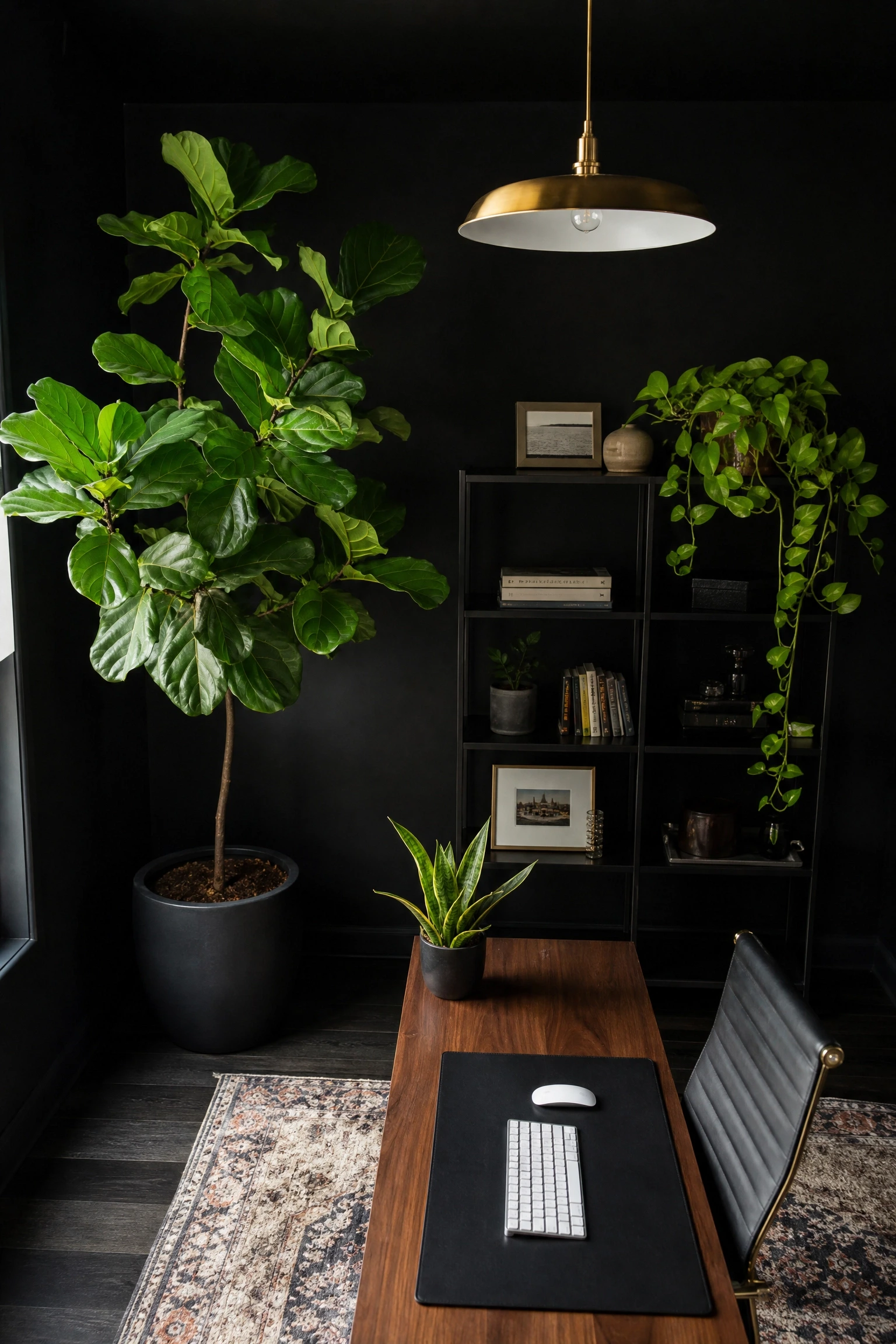
Plants are possibly the most underused tool in dark office design, and they solve the one problem people most often cite with black rooms: that they feel lifeless. A deep green fiddle leaf fig in a matte black pot against a black or charcoal wall is a combination that reads as lush and intentional rather than dark and heavy. The key is scale: one or two large plants make a stronger statement than six small ones, and in a dark office, you want statement. Plants with large, glossy leaves, pothos, monstera, rubber plants, fiddle leaf figs, work particularly well because the sheen of the leaves catches light and creates a gentle brightness within the dark room. Care-wise, be mindful that dark rooms mean less natural light reaching the plants, so choose shade-tolerant varieties or supplement with a small grow light hidden in the pot or behind the plant. ZZ plants and snake plants are both excellent choices for lower-light offices and require minimal maintenance.
Pro Move: A single oversized plant in one corner of a black office adds more visual impact than a collection of small plants scattered across the room; go big and go singular.
Wrapping Up
A black home office is one of those design choices that feels intimidating in theory and deeply satisfying in practice. The key insight running through all twenty-three ideas in this article is the same: black works when it’s paired with the right counterbalance, whether that’s warm metal, natural wood, layered texture, greenery, or carefully considered lighting. The mistake most people make isn’t choosing black, it’s choosing black without thinking about what will keep it from tipping into something heavy or oppressive. The fix is almost always simpler than you’d expect: one warm-toned lamp, one natural material, one piece of art with a light palette, one plant in a corner.
You don’t need to commit to all four walls or a full furniture overhaul to start exploring this direction. A black accent wall behind your desk, a black velvet chair, a set of black floating shelves: any one of these is a low-risk entry point that gives you a genuine sense of what working in a darker space actually feels like before you go further. Most people who try it don’t go back. There is something about the focus and enclosure of a well-designed black office that a white-walled room simply can’t replicate, and once you’ve experienced it, the beige alternative stops looking neutral and starts looking unfinished.
Which of these looks would you actually try in your own space? Drop it in the comments below.
FAQ
Will a black home office make the room feel too small?
Not necessarily. A black office in a small room can actually feel more intentional and cozy than a light-colored one, especially if you use a dark nook or closet conversion approach. The key is keeping at least some surfaces light, such as the floor or ceiling, and using good layered lighting so the room doesn’t feel dim.
What color should I paint the ceiling in a black home office?
You have two solid options. If you want a more traditional feel, keep the ceiling white or cream, which will bounce light down into the dark room. If you want maximum drama and a sense of enclosure that helps with focus, paint the ceiling black too, but make sure you have excellent lighting sources at desk level.
How do I stop a black office from feeling cold or depressing?
Warm lighting is the single most important fix. Use bulbs in the 2700K to 3000K range, which emit a warm amber-white light rather than a cool blue-white. Layer your light sources with a mix of overhead, task, and ambient, and add at least one natural material like wood, leather, linen, or a plant to introduce organic warmth.
Can I create a black home office on a budget?
Yes. You can achieve the core aesthetic by painting one wall in matte black paint (a quart runs around $30 to $50), adding a black desk lamp or pendant, and choosing one black accessory like a desk mat or chair. You don’t need all-black furniture to make the look read; the contrast between dark accents and lighter elements is often more interesting anyway.
What kind of lighting works best in a black home office?
Layered lighting is essential. You need task lighting directly on your work surface (an adjustable desk lamp or monitor light bar), ambient lighting to fill the room (a pendant, floor lamp, or wall sconce), and ideally accent lighting such as LED strip lights behind shelves or under cabinets to create depth and prevent the room from feeling flat.
What colors go well with black in a home office?
Warm brass and gold accents are the most popular pairing right now and for good reason. Natural wood tones in walnut, oak, or pine add warmth and organic contrast. Deep green, whether in upholstery or plants, creates a rich and grounded combination. White and cream balance the darkness. Chrome and glass push the aesthetic toward a sharper, more modern direction.