Most apartment bathrooms arrive in the same condition: builder-grade fixtures, a vanity that has seen better decades, overhead lighting that flatters nobody, and walls the colour of mild regret. The instinct is to accept it, live around it, and wait until you own your own place before doing anything about it. But you are paying for that bathroom every single month, and the time between now and homeownership is real time that deserves a real space.
The ideas in this article are organized by what they require of you in terms of commitment, tools, and landlord relationship. Some need nothing more than a trip to a home goods store. Others take an afternoon and a screwdriver. A handful involve a two-minute conversation with your landlord that is more often than not a yes. All of them are reversible or permission-covered, because losing a security deposit over a shower curtain rail is not a trade-off anyone should be making.
Zone 1: Do It Today, No Tools Required
These ideas require nothing except an internet order or a trip to the shops. No drilling, no hardware, no landlord email. They are also the ideas that do the most for the least effort, because apartment bathrooms respond dramatically to the right textiles, lighting, and surface accessories.
1. Replace the Shower Curtain and Change Everything
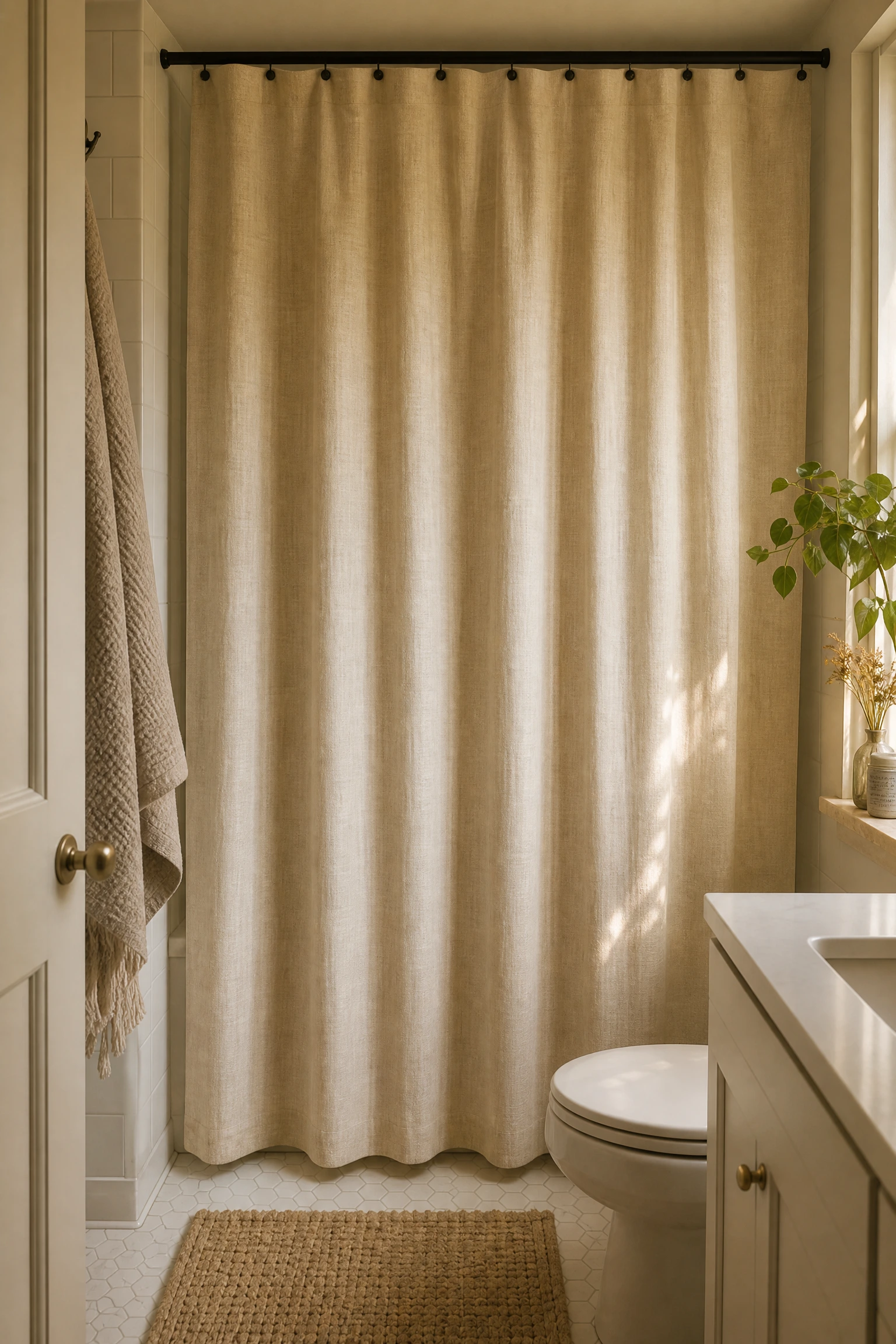
The shower curtain is the largest single piece of textile in an apartment bathroom, and it sets the visual tone of the entire room in a way that nothing else at the same price point can match. A standard white or clear plastic liner is fine as a functional layer, but the decorative curtain hung outside it is the design decision. A linen-look shower curtain in cream or warm white makes a bathroom feel spa-like and considered. A bold pattern, whether a graphic botanical print, a wide stripe, or an abstract watercolour wash, gives the bathroom a personality it almost certainly does not currently have. A waffle-weave or textured cotton curtain adds tactile depth that changes the shower area from a utilitarian necessity into something that looks intentional. The original curtain or liner can be stored and replaced on move-out day in under ten minutes, making this one of the highest-return, lowest-risk changes available to any renter.
Quick Tip: Always hang a shower curtain higher than the curtain rod allows by default. Use curtain rod extenders or a tension rod positioned as close to the ceiling as possible. A curtain that hangs from ceiling height to floor makes the bathroom feel dramatically taller and the shower area feel more like a proper room.
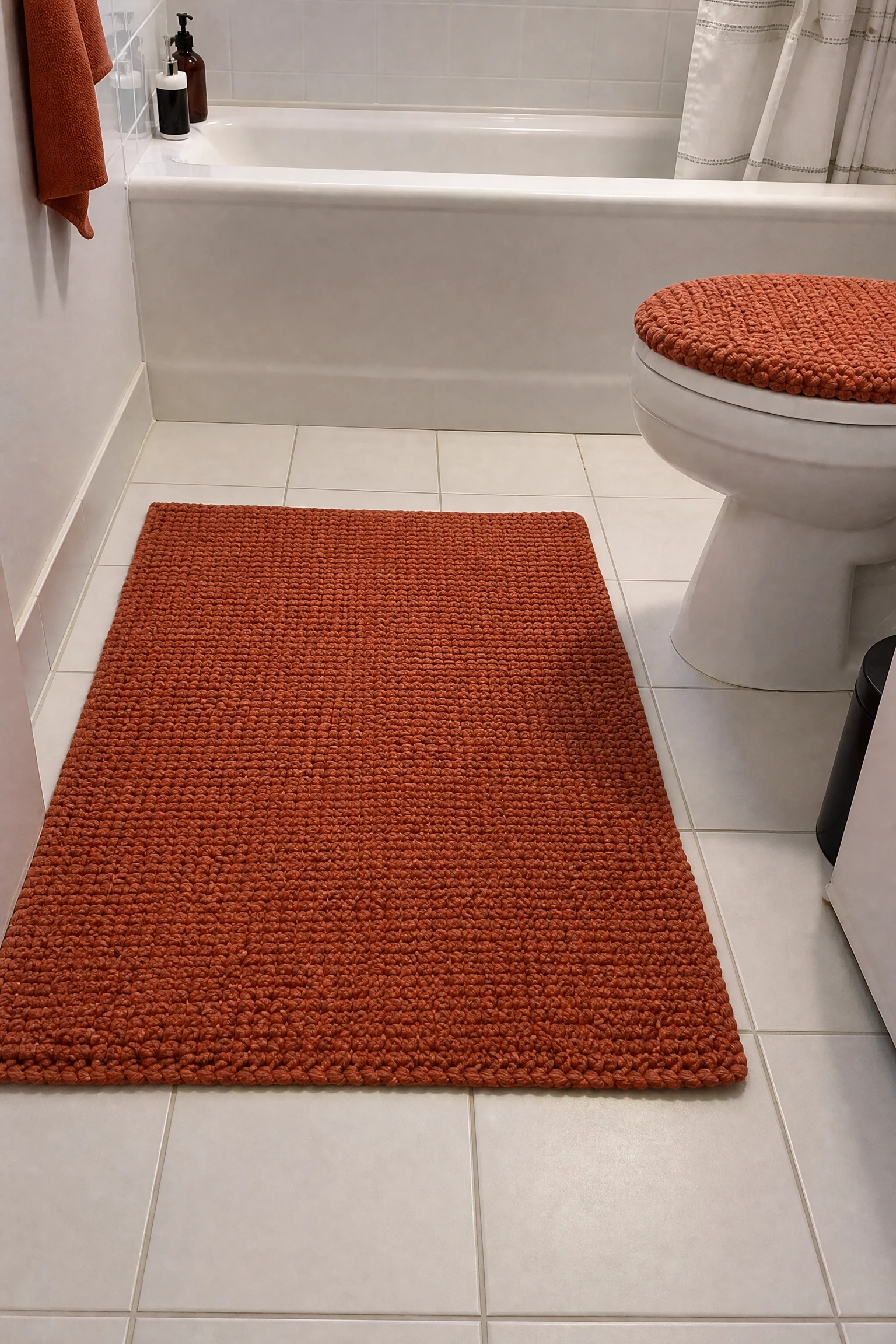
The floor of an apartment bathroom is usually the element renters have the least control over, and a bath mat is the simplest way to address it. But most people treat bath mats as purely functional and choose whatever is cheapest, which is why so many apartment bathrooms look finished everywhere except the floor. A bath mat in a considered material, such as a chunky woven cotton in a warm neutral, a tufted loop pile in sage or terracotta, or a patterned cotton flatweave, does the same work for the bathroom floor that a rug does for a living room: it introduces warmth, colour, and texture at a point in the room where the eye naturally falls. A matching or coordinating toilet lid cover, where the existing toilet has a removable plastic seat lid, extends the textile palette to the far corner of the room and makes the whole space feel deliberately styled rather than assembled from whatever came with the apartment.
Designer Advice: Choose a bath mat that is slightly oversized for the space in front of the shower or tub. A mat that is too small looks like it belongs to a different, smaller bathroom. Generous proportions make the room feel more considered and more comfortable underfoot.
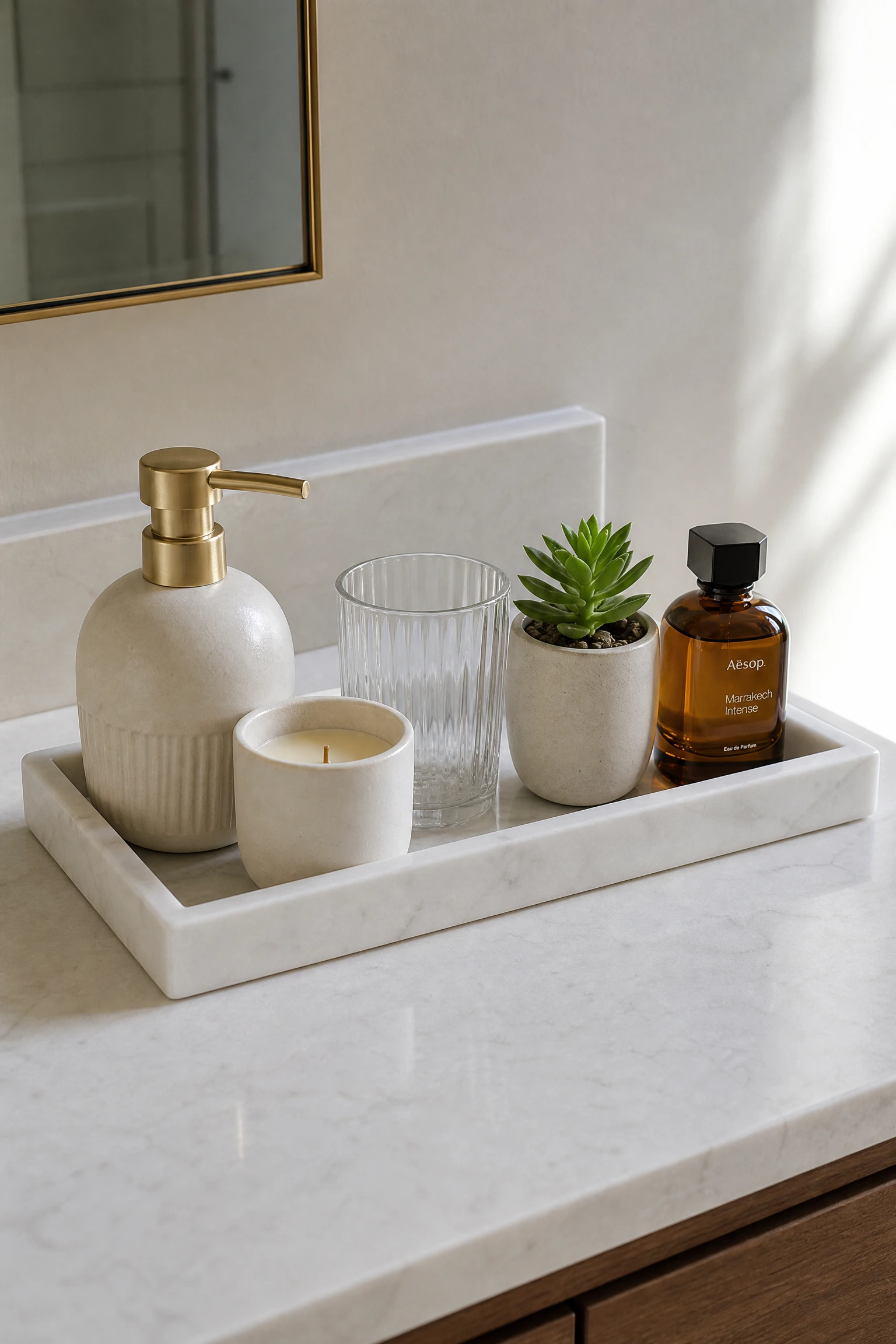
Apartment bathroom counters tend to accumulate in a way that makes even a clean bathroom look cluttered: a collection of individual products, each with its own packaging and footprint, spread across the vanity top with no organizing logic. A simple tray, whether a marble slab, a rattan oval, a lacquered wooden rectangle, or a raw brass bar tray, gives the counter surface an organizing principle that makes a group of mismatched products read as a collected collection. The same products that looked like bathroom clutter become a styled vignette when they sit within a defined boundary. Keep the tray to five items or fewer: a hand soap dispenser decanted into something attractive, a small candle, a ceramic or glass rinse cup, a plant cutting in a small vessel, and one skincare item you actually use daily. Everything else goes in the cabinet. The tray is not storage. It is the part of the counter that is allowed to be visible.
Pro Move: Decant your hand soap into a ceramic or glass dispenser that matches the mood of the tray. The original plastic pump bottles from most hand soaps are the single element most likely to break the visual coherence of an otherwise styled counter arrangement.
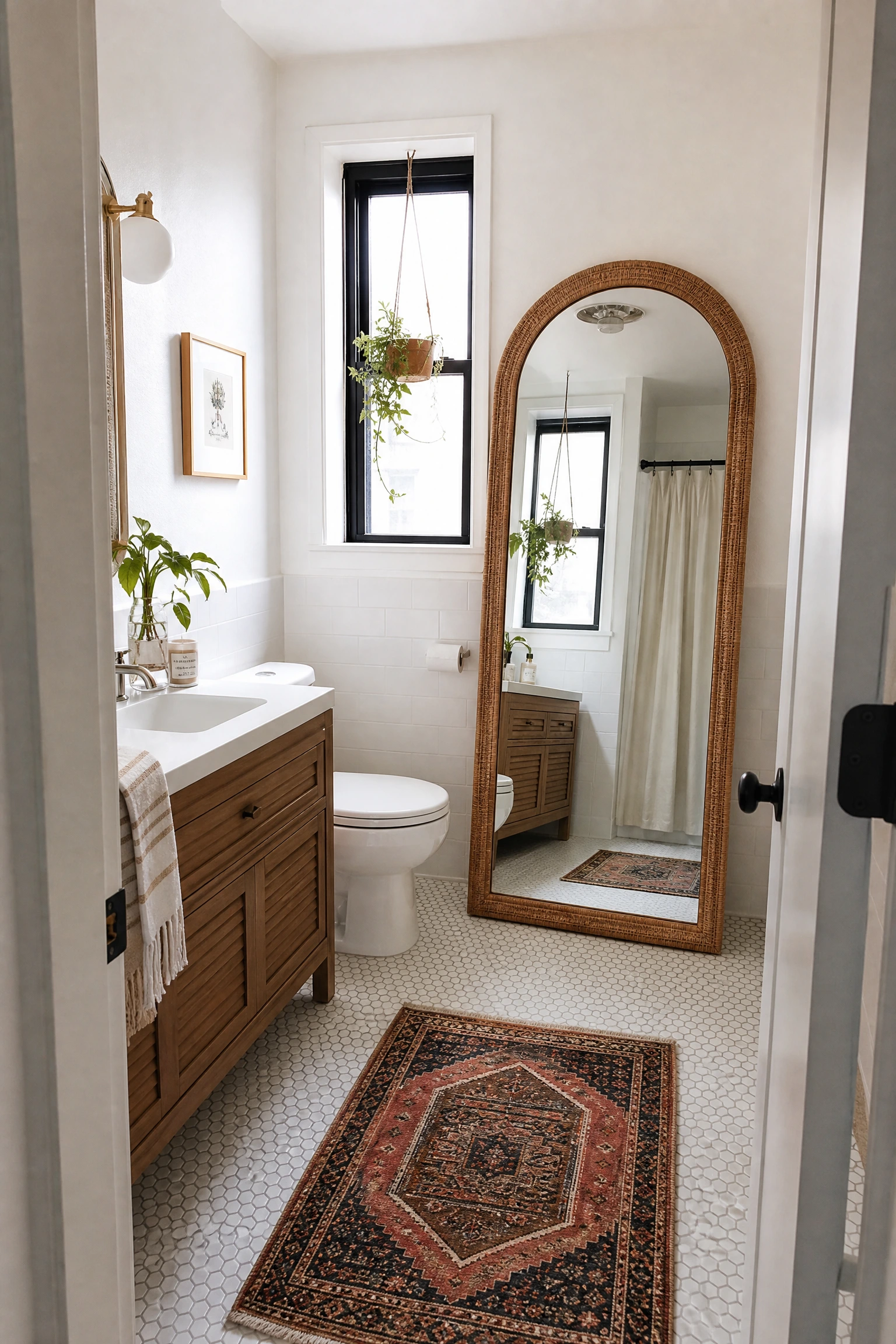
Most apartment bathrooms have a single mirror above the vanity that is fixed in place and not always particularly well-sized or positioned. A freestanding or leaning full-length mirror added to the back of the bathroom door, against a wall beside the vanity, or in any available vertical space does two things simultaneously: it provides a genuinely useful full-body view that the vanity mirror does not offer, and it reflects light back into the bathroom in a way that makes the room feel measurably larger and brighter. A full-length mirror with a warm timber, rattan, or black metal frame adds a decorative element to the bathroom that costs nothing to install and can be taken to the next apartment without any marks left behind. In a very small bathroom, positioning the mirror to reflect the window or the light source from above dramatically increases how much light the room appears to have.
Heads Up: A leaning mirror needs to be secured against tipping, particularly in a bathroom where the floor may be damp. A simple adhesive wall anchor or a small furniture strap attached to the back of the mirror and looped around the door handle or a towel rail is enough to prevent accidents without requiring any permanent wall fixings.
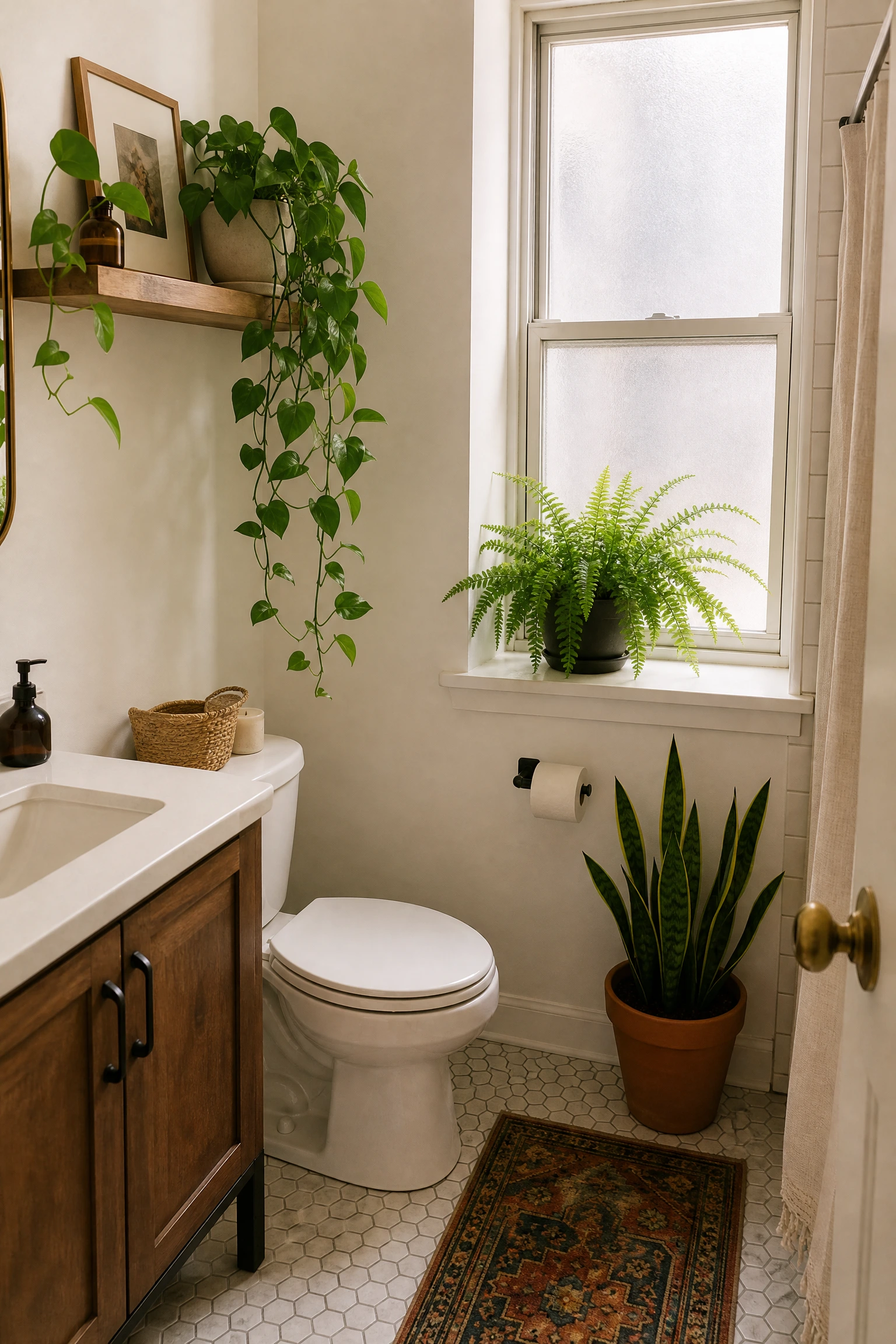
An apartment bathroom is one of the better environments in any home for certain plant varieties because the warmth and humidity created by daily showering replicates the conditions of a tropical environment more closely than any other room. Pothos, heartleaf philodendron, spider plants, boston ferns, and certain varieties of peace lily all thrive in low-to-medium indirect light and high humidity. A trailing pothos on a shelf above the toilet, a small fern on the windowsill, and a snake plant on the floor beside the vanity introduce living green material into the bathroom in a way that lifts the space from functional to genuinely atmospheric. The practical note is that the specific plant matters more in a bathroom than elsewhere in the home because of the low-light conditions typical of interior apartment bathrooms: any plant that requires direct sunlight will deteriorate quickly in a bathroom with a frosted or north-facing window.
Reality Check: A dying or neglected plant does the opposite of what a thriving plant does in a bathroom. Choose varieties that match the actual light conditions honestly and maintain them, or stick to high-quality artificial plants in ceramic pots, which in a well-styled bathroom are virtually indistinguishable from real ones at a glance.
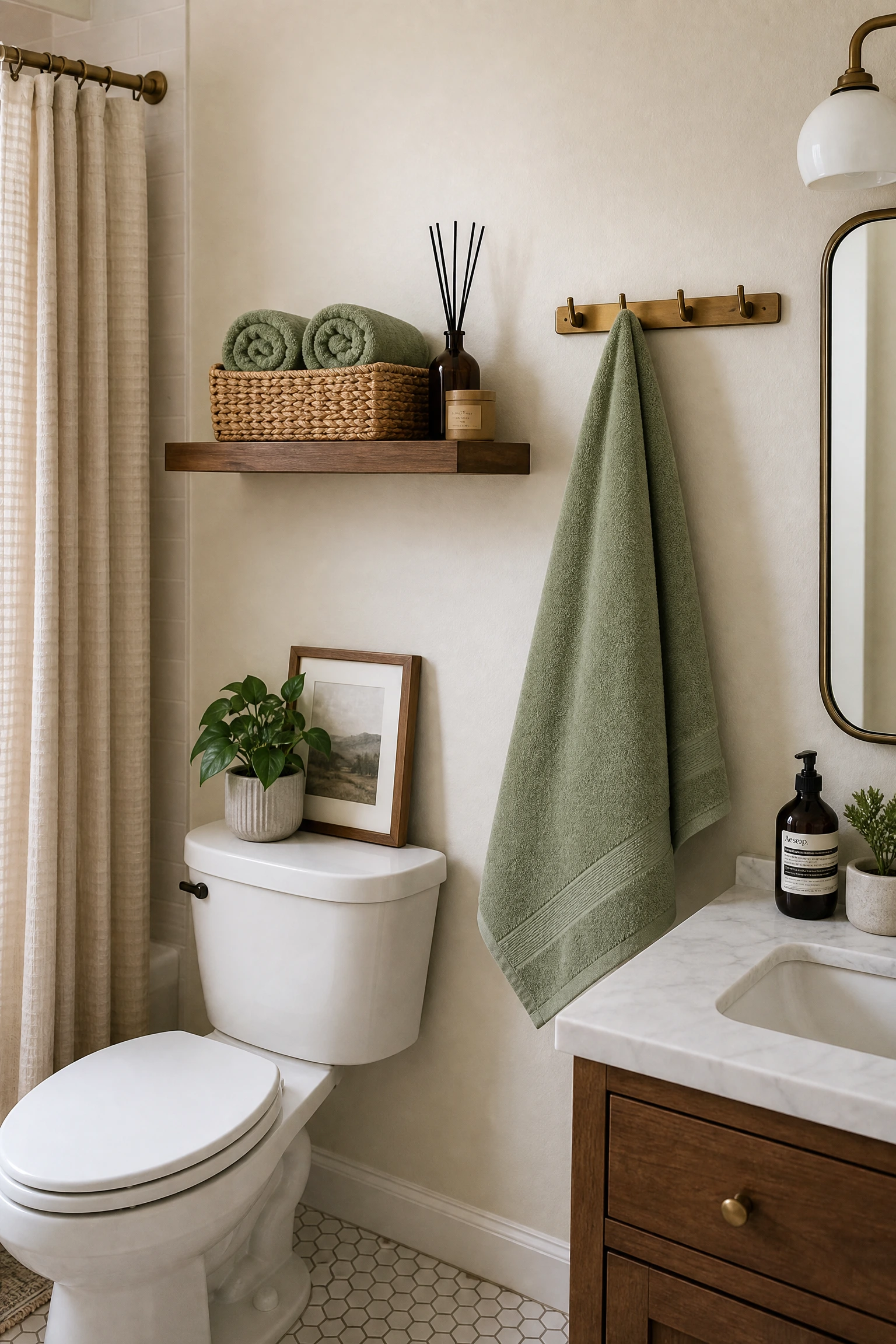
Towels are in the bathroom every day and most people treat them as a purely practical item stored wherever they fit. But the way towels are displayed contributes significantly to whether a bathroom looks finished or incomplete. A set of matching towels in a consistent colour, whether white, warm cream, dusty sage, or terracotta, hung or folded in a consistent way, changes the towel storage from a functional necessity into a visual element of the bathroom design. Rolled towels displayed in a basket or in a ladder shelf carry a spa-like warmth. Folded towels stacked on a small tray on the counter are both accessible and styled. Towels hung on a hook rail with each towel folded to show a clean edge look considered and tidy. The key is consistency: mismatched colours and sizes create visual noise even when the towels themselves are clean, while a set of matching towels creates calm even in a small, imperfect bathroom.
Quick Tip: Invest in two or three sets of towels you genuinely like rather than accumulating a collection of towels from different purchases over time. The visual coherence of matching towels in a bathroom does more for the overall impression of the space than almost any other single textile change.
Zone 2: One Afternoon, One Screwdriver
These ideas require a small amount of installation work but nothing that will concern a landlord or affect the apartment structure. Most use removable adhesive fixings, tension mechanisms, or swap existing hardware that gets stored for move-out.
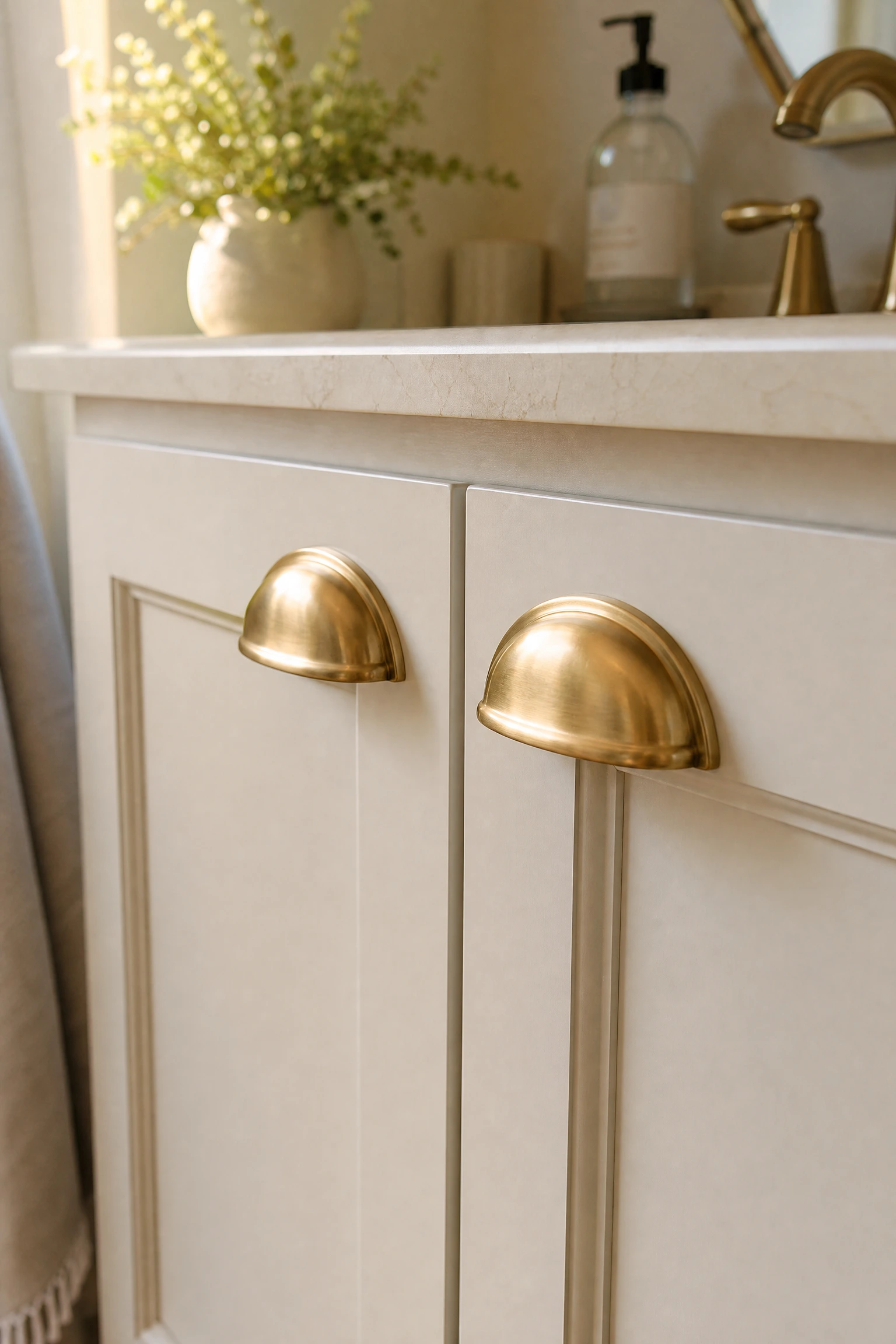
The handles and knobs on an apartment vanity are almost always the builder-grade option chosen for cost rather than design, and swapping them out is one of the fastest ways to make a bathroom feel more intentional. Brushed brass cup pulls on a white or beige vanity look warm and expensive. Matte black bar pulls on a tired beige vanity look contemporary and deliberate. Ceramic knobs in a hand-painted or speckled finish add a craft-market warmth that softens a dated bathroom. The process requires only a screwdriver, takes about fifteen minutes, and is completely reversible: store the original hardware in a labelled bag in the back of a cabinet and reinstall it on move-out day. The only practical consideration is matching the screw hole spacing of the new hardware to the existing holes in the cabinet doors, which are typically either 64mm, 96mm, or 128mm centre-to-centre for bar pulls.
Pro Move: Measure the existing screw hole spacing before buying new hardware. A pull with the wrong spacing will require filling the old holes and drilling new ones, which crosses from a reversible change into one that needs landlord approval.
8. Install a Tension Rod Shelf System in the Shower
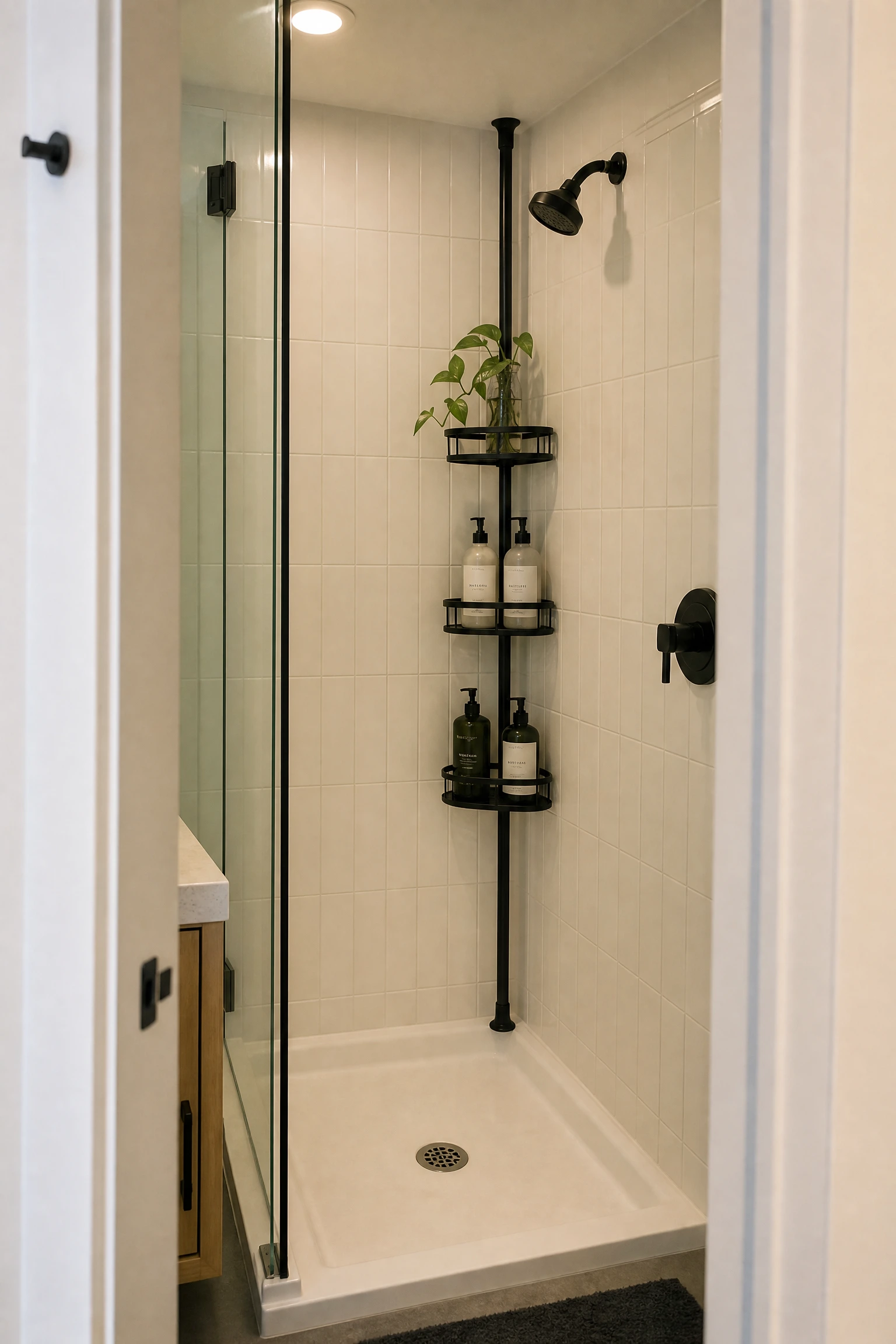
Most apartment showers have minimal built-in storage for shampoo, conditioner, body wash, and other shower products, which tend to accumulate on the floor of the shower or tray in a way that looks disorganized and makes cleaning difficult. A tension rod caddy that wedges between the floor and ceiling of the shower cubicle provides multiple shelving levels for products without drilling any holes. An alternative is a tension shower rod at a higher level inside the shower used to hang an S-hook basket or hanging organizer. Either approach adds meaningful vertical storage in a space that typically has none, keeps products off the shower floor, and is completely removed without any marks when you leave. The practical choice between options depends on the shower type: corner caddies on tension poles work best in standalone shower enclosures, while hanging organizers on a secondary tension rod suit shower-over-bath arrangements.
Heads Up: Tension pole caddies need to be re-tightened periodically as they can gradually loosen with the weight of products and the vibration of daily use. A pole caddy that has started to wobble is at risk of falling and damaging the shower tray or tiles. Check the tension monthly.
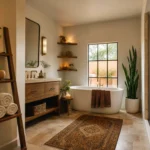
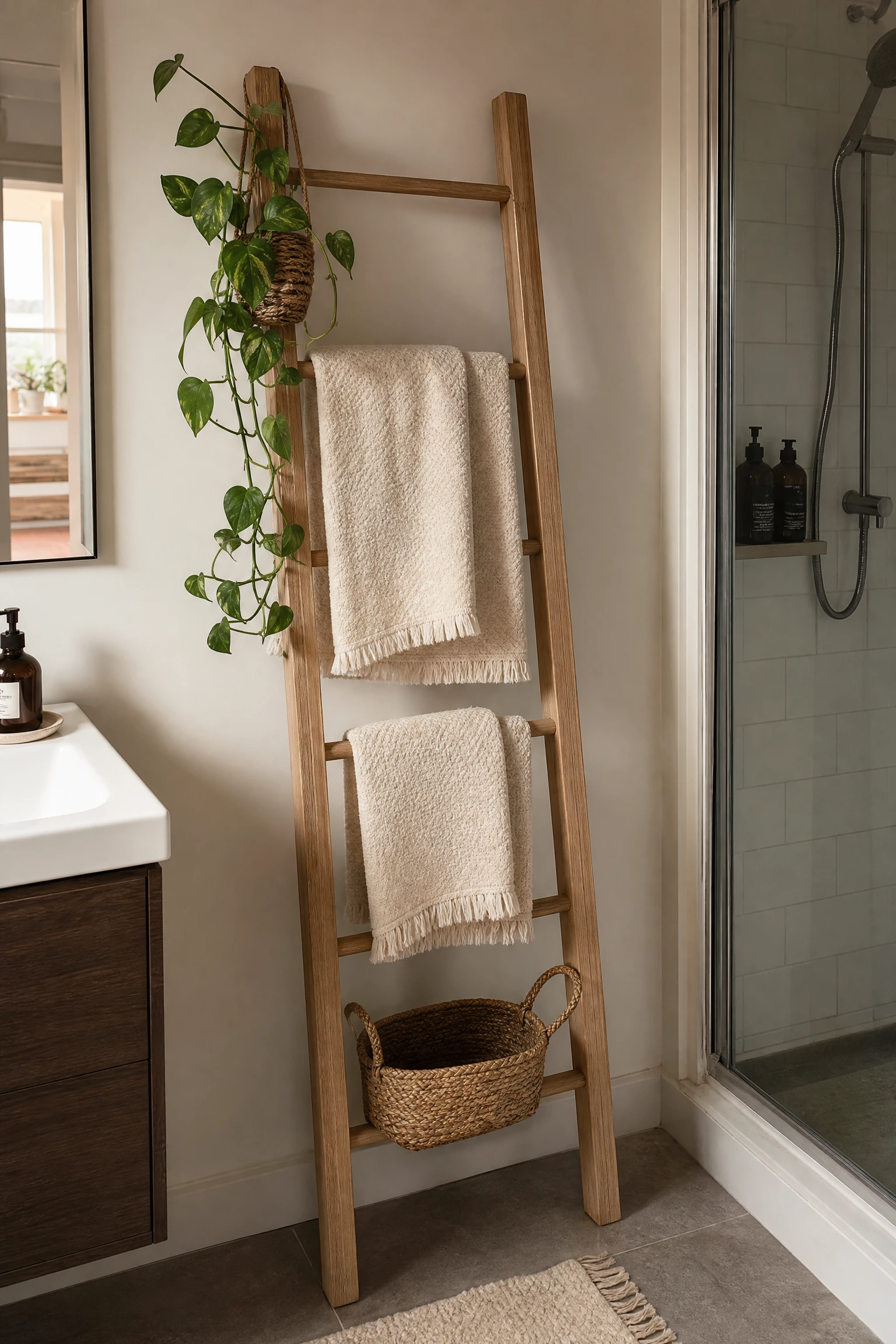
A towel ladder or freestanding towel rail that stands independently on the bathroom floor is one of the most useful additions to an apartment bathroom because it solves the problem of insufficient towel storage without requiring any wall fixings. A slim timber ladder in natural oak or blackened ash leaning against the wall beside the shower adds warmth, texture, and practical function simultaneously. A freestanding brass or matte black towel rail with a weighted base is the more contemporary option and takes up a slightly smaller floor footprint. Either approach creates an additional towel hanging surface beyond whatever the apartment provides, keeps towels off the floor, and contributes to the visual mood of the bathroom in a way that the original builder-installed chrome rail usually does not. The ladder or rail also serves as an additional styling surface: a small basket of rolled washcloths on the bottom rung or a trailing plant in a hanging pot from the top adds another layer of interest.
Designer Advice: Position a towel ladder to the side and slightly in front of the shower or bath entrance rather than pushed flat against the wall at the back. The slight angle and accessible position make it more likely to actually be used rather than just admired, and the slight projection into the room adds depth to the bathroom layout.
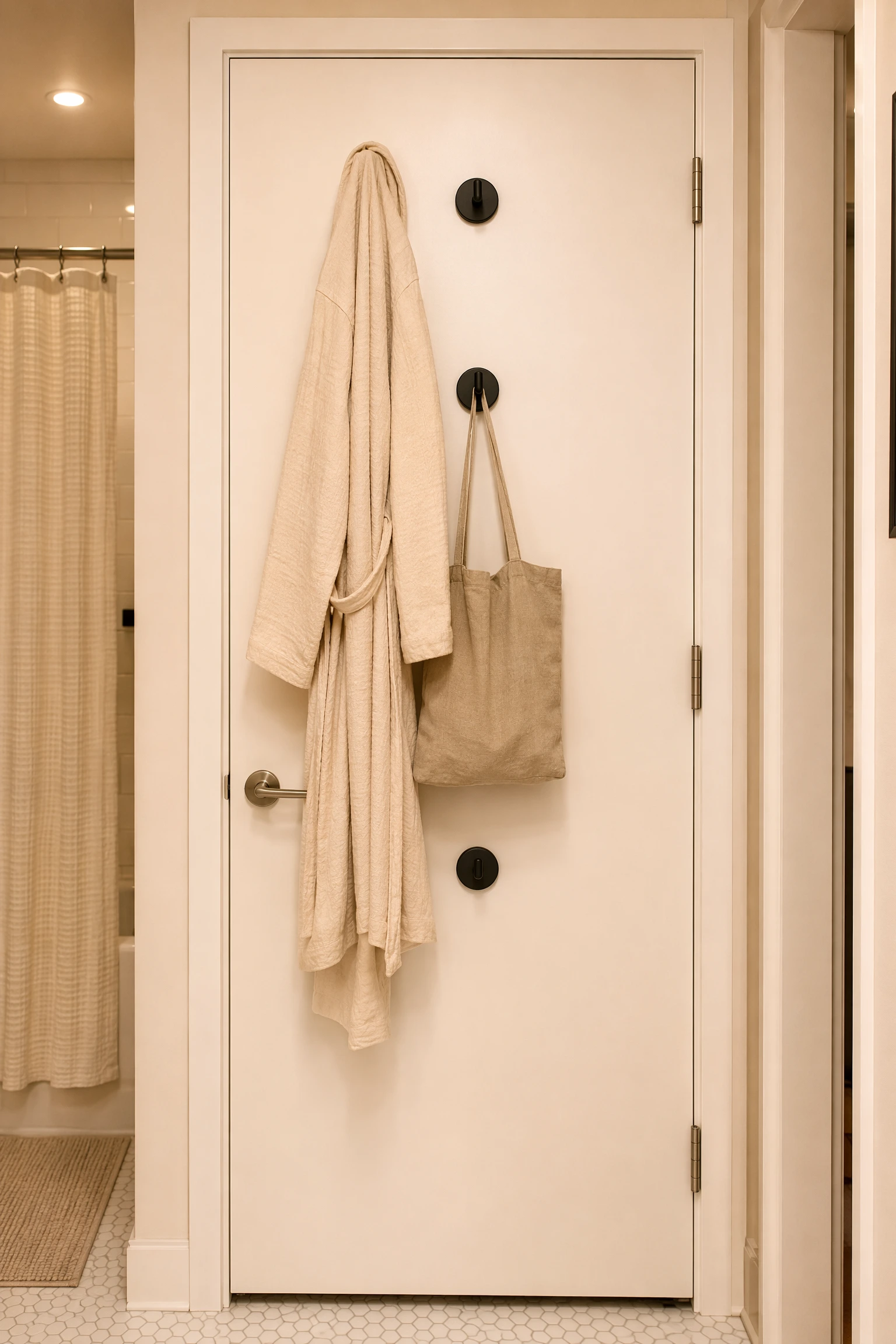
Command and similar adhesive hooks have become significantly stronger and more design-forward in recent years, and they are the apartment renter’s most underused tool. A row of three adhesive matte black hooks on the wall beside the shower serves as a robe hook, a towel hook, and a spare hook simultaneously. A single adhesive hook on the back of the bathroom door holds a robe or a bag without any drilling. A set of adhesive hooks inside the cabinet door holds a hairdryer, straightening iron, or the long-handled brush that otherwise ends up balanced against the wall. The practical requirement for adhesive hooks to hold properly is surface preparation: the wall needs to be clean, completely dry, and free of any moisture or residue from cleaning products before the hook is applied. An adhesive hook that has been applied to a damp or greasy bathroom wall will fail.
Reality Check: Always follow the weight limit on adhesive hooks precisely. The typical failure mode is applying them to a damp or dirty surface and then hanging something heavier than the stated limit. Both errors together almost guarantee failure. Follow the preparation steps from the packaging and respect the weight ratings.
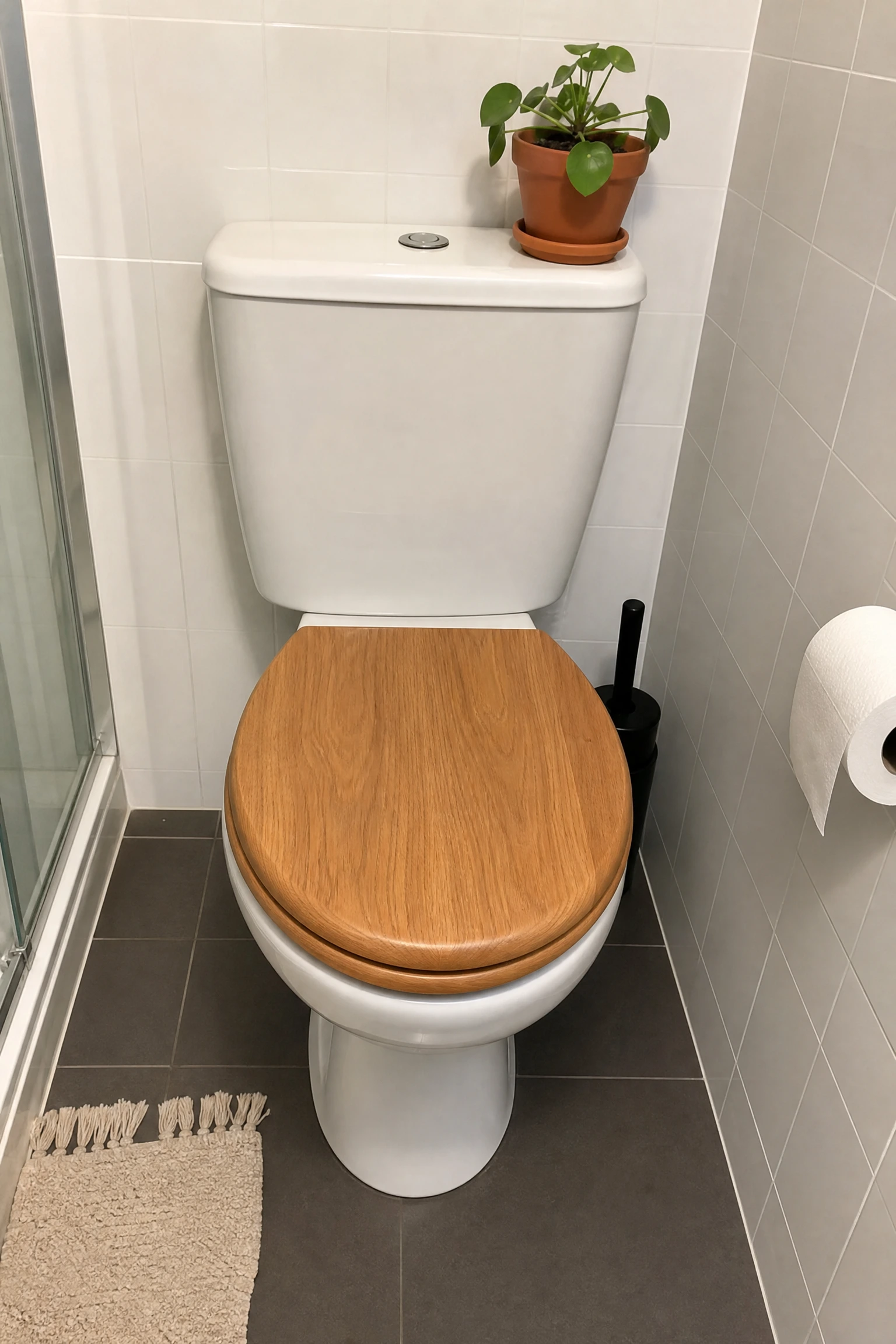
The toilet seat is one of the most overlooked opportunities for improvement in an apartment bathroom, but it is also one of the most hygienically compelling. Most apartment toilet seats are standard white plastic that has yellowed with age and is attached to the toilet with visible plastic fittings that accumulate limescale and discolouration. Replacing the seat with a new one in soft-close white with concealed fixings, a wooden seat in a warm beige or natural timber finish, or a black seat for a more contemporary look takes about ten minutes, requires no tools beyond what is usually already under the kitchen sink, and is completely reversible. The original seat gets stored under the vanity and reinstalled on move-out day. The improvement in both the appearance and the daily experience of the bathroom is immediate and significant, and it is one of the few changes that benefits both aesthetics and basic hygiene simultaneously.
Quick Tip: Measure the shape of your existing toilet before ordering a new seat. Toilet seats come in two standard shapes, round and elongated, and the wrong shape for the toilet will not sit flush. Most online suppliers include a measuring guide and the information is usually on a sticker under the existing seat lid.
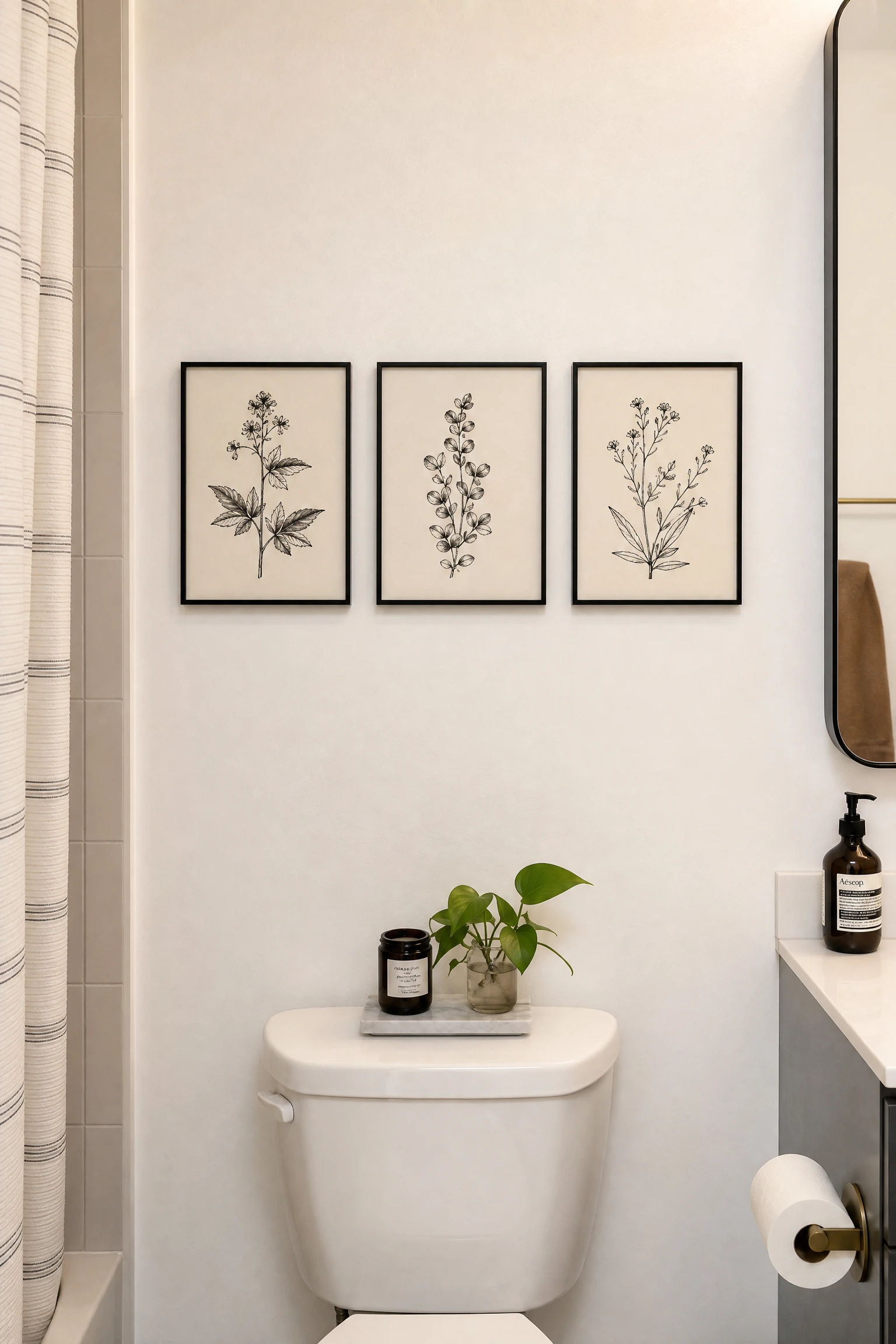
Bathroom walls in apartments are almost always empty, and empty walls in small rooms make the room feel institutional rather than personal. A single well-chosen framed print or piece of art on the bathroom wall, hung with a damage-free adhesive strip rated to hold the frame weight, introduces personality and intention into a space that typically has neither. The choice of subject matter matters more in a bathroom than in other rooms because the bathroom is often experienced alone and at close quarters: botanical prints, abstract ink drawings, a simple typography piece, a vintage map, or a photographic print of somewhere meaningful all work well. Multiple small frames arranged in a grid above the toilet or beside the mirror create a gallery effect that fills a larger area of wall while keeping each individual print at a scale appropriate to the small room. Moisture-resistant canvas or prints behind glass are the practical choices for bathroom walls where condensation is a factor.
Heads Up: Use proper picture-hanging adhesive strips rated for the weight of the frame rather than general-purpose adhesive. In bathrooms where the wall temperature fluctuates between cool and warm with steamy showers, cheaper adhesives can fail within weeks. Brands like Command specifically rate their strips for temperature variation environments.
“The apartment bathroom that feels personal is not the one with the most things in it. It is the one where every thing has been chosen rather than simply arrived.”
Zone 3: Quick Landlord Conversation, Almost Always a Yes
These ideas typically require a brief email or message to your landlord because they involve a change to a fixed fixture or a surface that technically belongs to the apartment. The good news is that most landlords say yes to changes that improve the apartment, and these ideas all do exactly that.
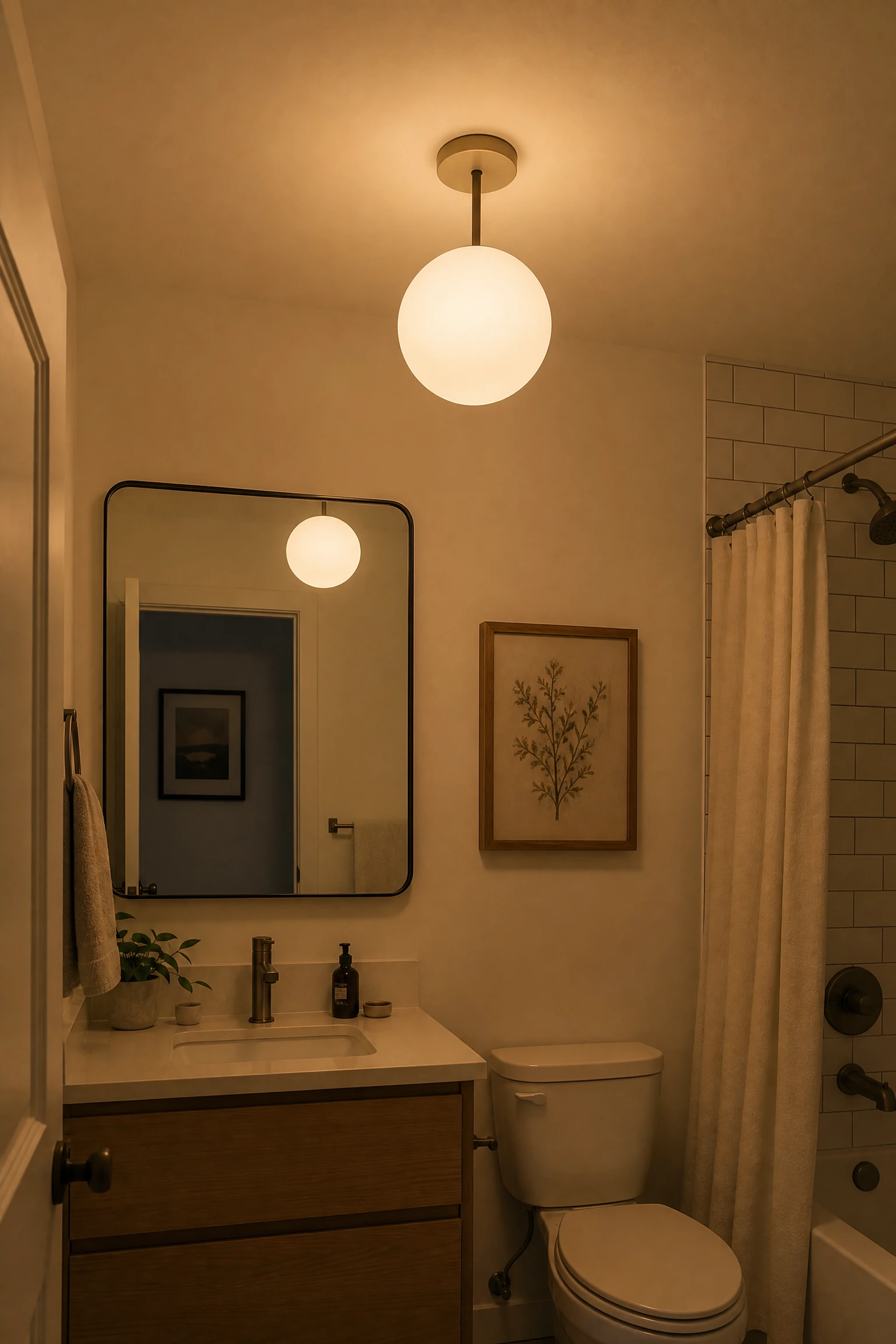
The bathroom light fixture is almost certainly the builder-grade option: a surface-mounted ceiling globe, a strip fluorescent, or a vanity bar with clear globes that casts a cold, unflattering light over the whole room. Replacing it with something that provides warmer, more considered illumination changes the atmosphere of the bathroom as completely as almost any other single change. A simple globe pendant in matte white or smoked glass, a pair of wall sconces either side of the mirror, or a surface-mounted ceiling fitting with a diffused shade all provide dramatically better light quality than the typical apartment fixture. The landlord conversation is worth having because a better light fixture is an improvement that stays in the apartment, and most landlords would rather have a nicer fixture than the one they installed. Store the original fixture carefully and have it reinstalled on move-out day, or negotiate to leave the new one as part of the apartment.
Pro Move: Warm white LED bulbs rated at 2700K to 3000K in whatever fixture you choose will do more for the bathroom atmosphere than any other lighting decision. Bathroom lighting at these colour temperatures is genuinely flattering and creates an ambience that daylight-spectrum bulbs never achieve regardless of the fixture style.
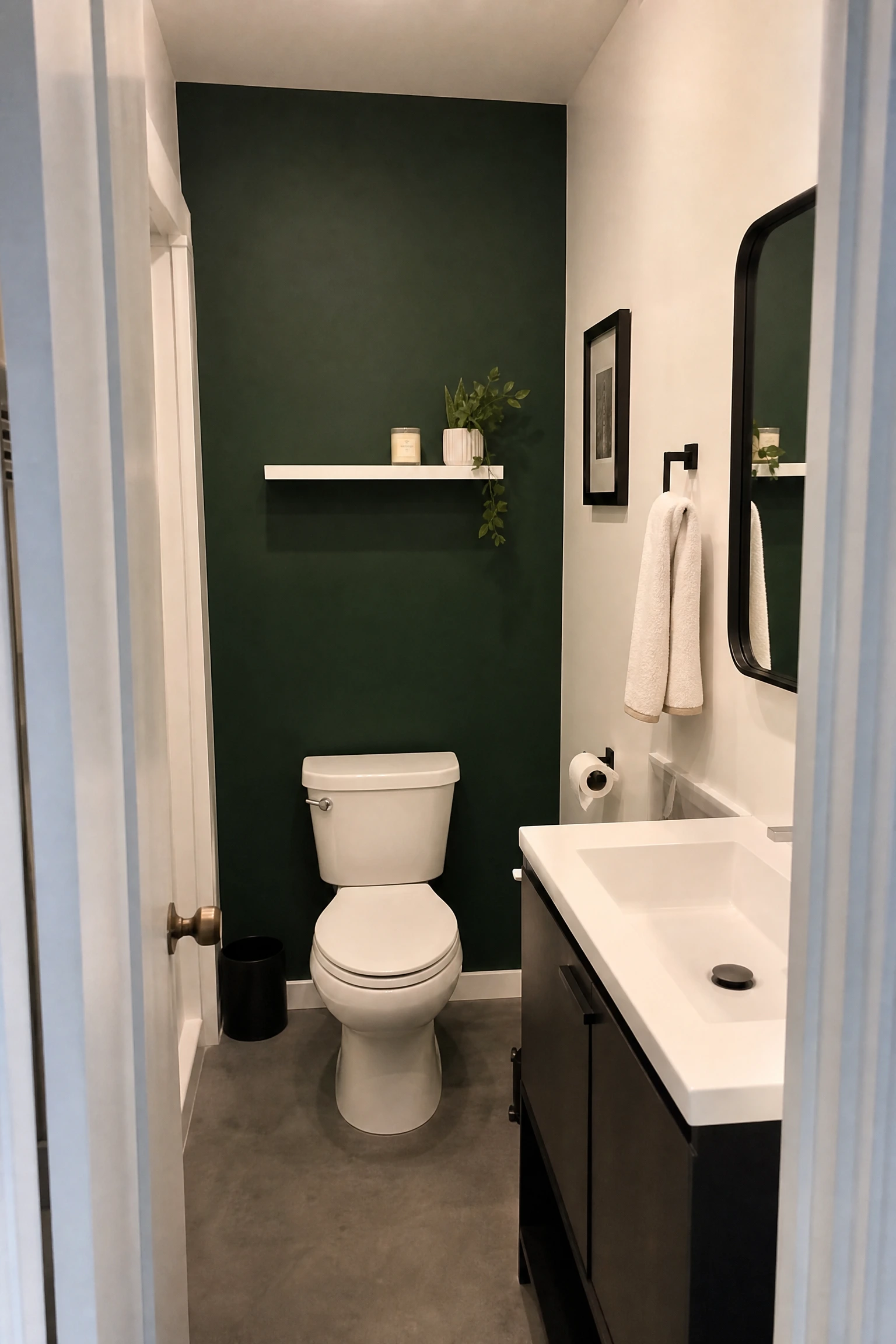
Painting is the most impactful single change available in an apartment bathroom and the one most likely to be permitted with a simple landlord conversation, particularly if you offer to repaint in the original colour when you leave or to paint in a colour the landlord approves. A small bathroom painted in a warm earthy neutral, a deep forest green, a dusty terracotta, or even a confident navy changes the entire emotional register of the room from a functional white box to an immersive, considered space. Even painting just one wall, typically the wall behind the toilet or the wall facing the door, creates a focal point that gives the bathroom a sense of design intention it almost certainly lacked before. A litre or two of paint is one of the cheapest materials in interior design and the return on the investment in a bathroom is exceptional.
Designer Advice: In a bathroom, consider painting the ceiling the same colour as the walls rather than keeping it white. The enveloping effect of a single colour wrapping the walls and ceiling makes a small bathroom feel like a jewel box rather than a box with a lid, and the colour reads more deeply and more intentionally as a result.
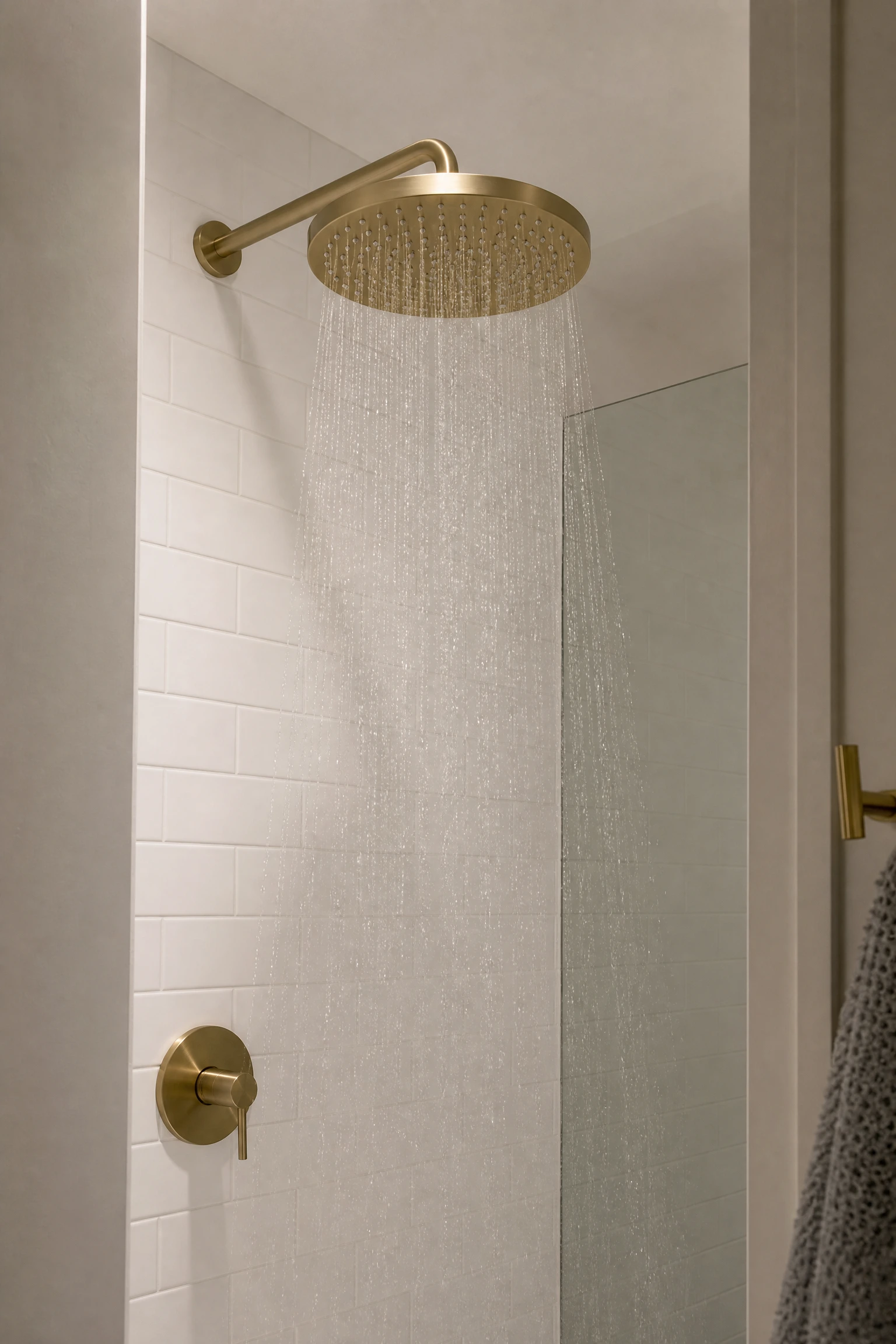
The standard apartment showerhead is almost always a low-pressure, low-design fixture that was chosen entirely on cost. Replacing it with a rainfall head, a high-pressure handheld head, or a fixed head with multiple spray settings costs between thirty and a hundred dollars and requires no tools beyond an adjustable spanner and some plumber’s tape. The original showerhead gets stored under the vanity and reinstalled on move-out. The landlord conversation is brief and almost always approved because a better showerhead improves water efficiency and the tenant experience simultaneously. In a bathroom where the shower experience is one of the few daily rituals that genuinely affects wellbeing, a showerhead that delivers satisfying water pressure and coverage at the right height is a quality-of-life improvement that costs a fraction of what most people spend on bathroom accessories that make no functional difference.
Quick Tip: Check the existing shower arm thread before buying a new head. Most showerheads in North America and the UK use standard half-inch BSP or NPT threads that are interchangeable, but if the existing arm has a non-standard thread or an integrated head, a simple adapter is usually available from the same supplier.
16. Add a Medicine Cabinet or Recessed Mirror Cabinet
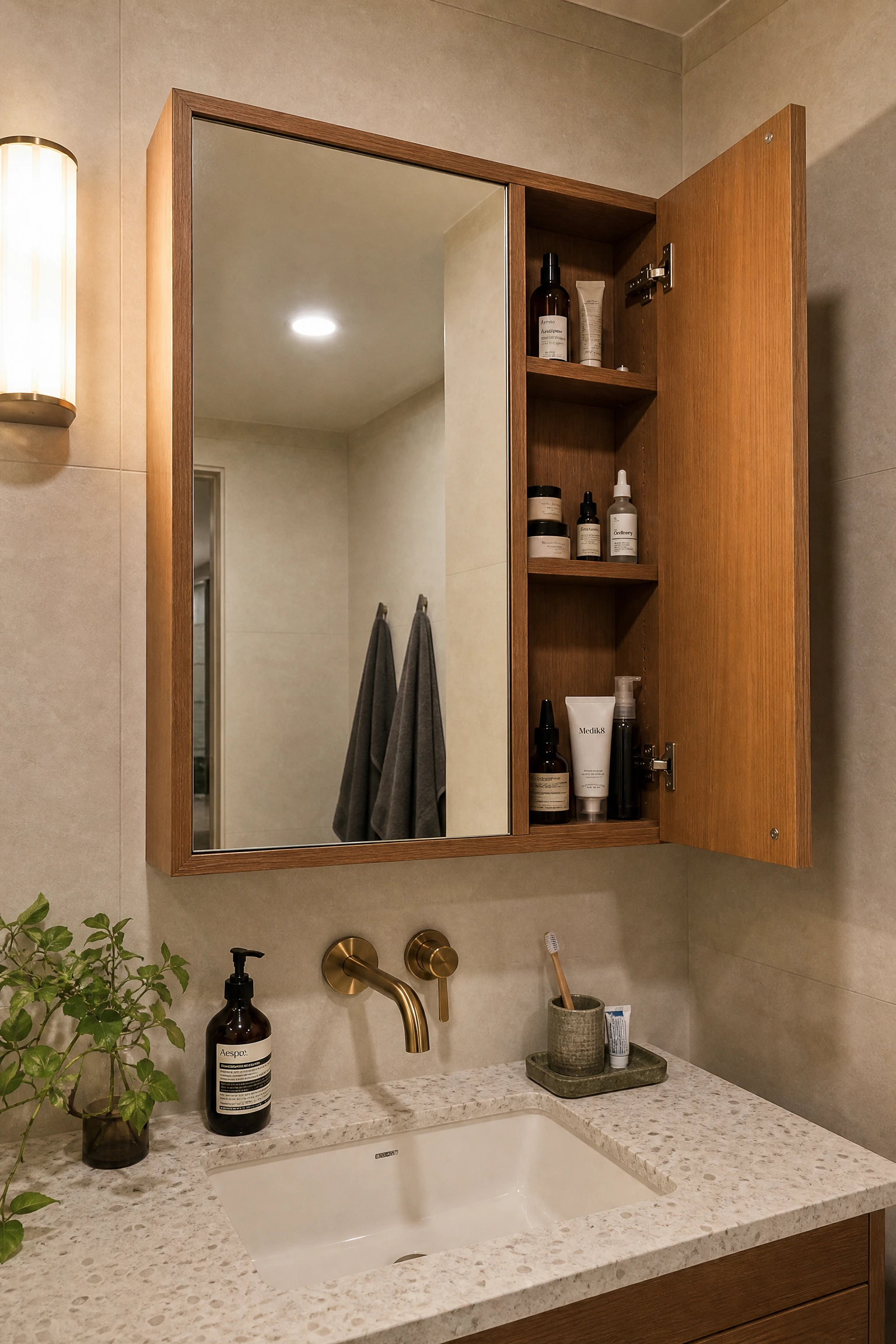
Most apartment bathrooms either have a basic flat mirror above the vanity with no storage behind it, or a shallow medicine cabinet with a mirror that was installed thirty years ago and has a broken hinge. Replacing or adding a surface-mounted mirror cabinet with proper internal shelving gives the bathroom meaningful additional storage in the most useful position: directly above the sink where daily-use items like toothbrushes, skincare, and medications need to be accessible. A mirror cabinet with a warm timber surround, a black metal frame, or a simple white finish with internal LED lighting is both a practical and aesthetic improvement over the standard apartment option. The landlord email is worth sending because a good mirror cabinet is a genuine improvement to the apartment that typically stays when you leave and increases the rental value for the next tenant.
Reality Check: If the bathroom wall is a wet wall (the wall directly behind the shower or bath where plumbing runs), avoid mounting a recessed cabinet here. Surface-mounted mirror cabinets are the practical choice for renters because they require only the same wall anchors as a standard heavy mirror rather than any structural work.
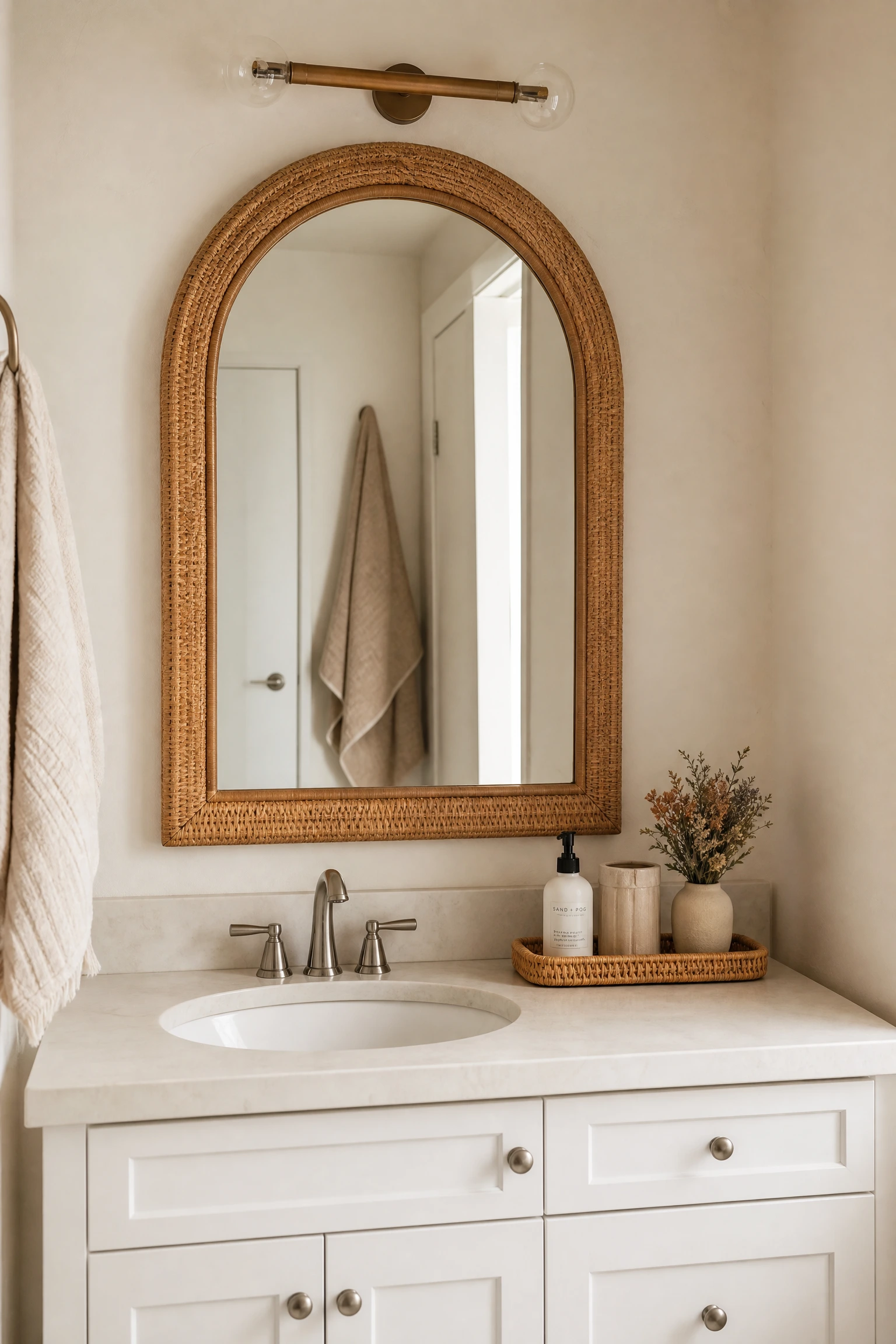
The builder-grade mirror typically installed in apartment bathrooms is a plain rectangular mirror glued directly to the wall or mounted with minimal fixings, with no frame and no design intention. Replacing it, after a brief landlord check, with a mirror that has a rattan frame, a warm timber surround, a vintage-inspired arched shape, or a backlit LED edge changes the entire vanity area from a functional surface into a designed zone. The mirror is the first thing you look at in the bathroom every morning and the last thing you see at night, and its size, shape, and frame make a significant difference to how the bathroom feels during those daily interactions. A slightly oversized mirror that extends a few centimetres wider than the vanity below also reflects more light around the room and makes the bathroom feel wider than it actually is.
Designer Advice: If the original glued mirror cannot be removed without damage, mount a new framed mirror directly over it rather than trying to remove the original. A framed mirror mounted at the right height over the existing flat mirror sits flush, covers it completely, and can be removed without affecting either the existing mirror or the wall.
Zone 4: Worth It If You Are Staying a While
These ideas are slightly more involved or represent a slightly larger investment. They are worth doing in an apartment you plan to stay in for a year or more, and they deliver a return on that investment in daily experience that the smaller changes cannot quite match.
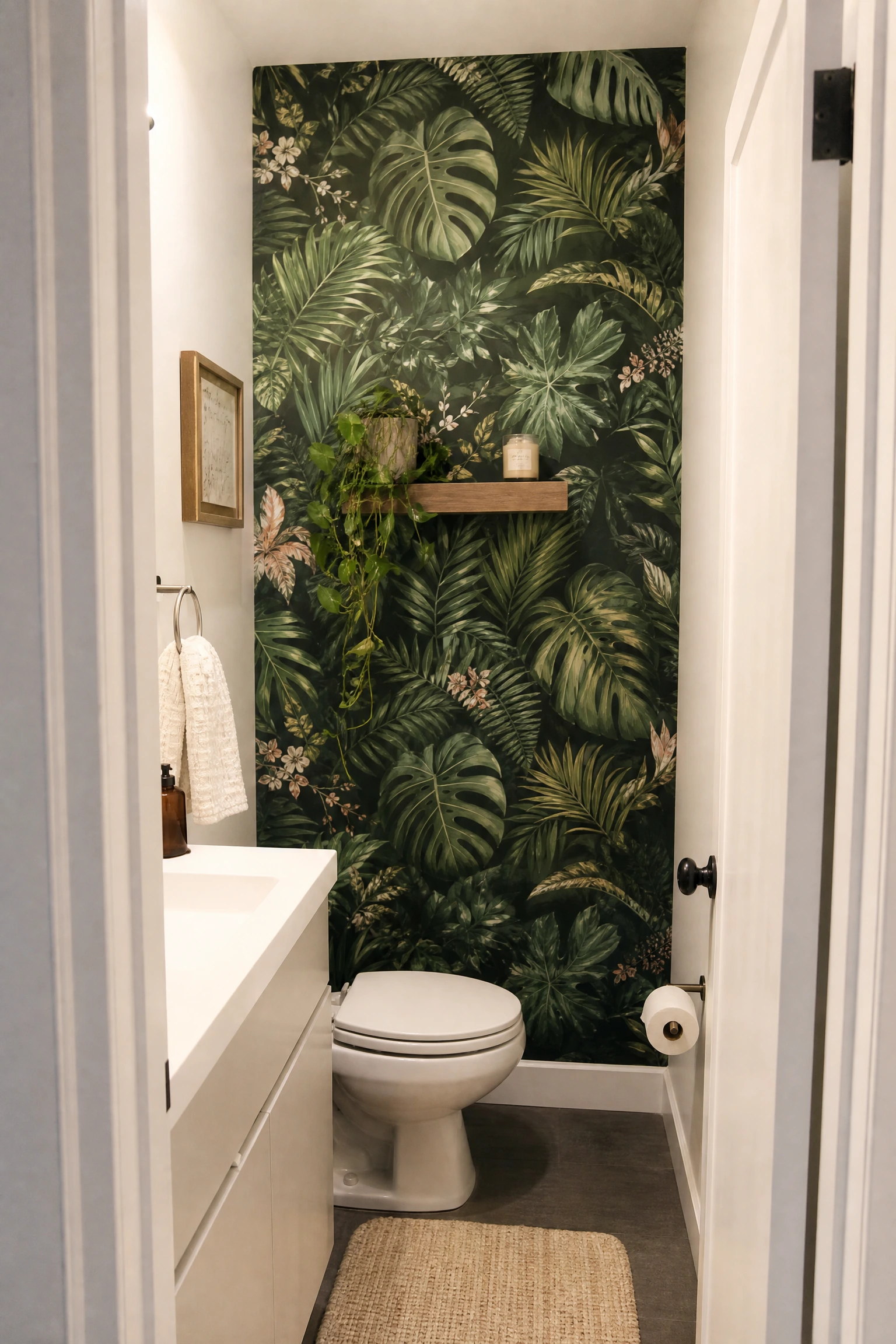
Peel-and-stick wallpaper has improved dramatically in quality over the past five years, and the best current products, from brands including Chasing Paper, Tempaper, and Rebel Walls, have a weight, texture, and visual depth that is virtually indistinguishable from traditional paste wallpaper at a glance. In an apartment bathroom, a single wall of peel-and-stick wallpaper, most often the wall behind the toilet, the wall facing the door, or the wall opposite the mirror, introduces a pattern, colour, or texture that no amount of accessories and textiles can replicate. A botanical print, a geometric tile pattern, a subtle textured grasscloth effect, or a maximalist floral can each give the bathroom an entirely distinct personality. The application takes a careful afternoon and the removal, when done correctly, leaves no residue. The practical caveat is that peel-and-stick wallpaper requires a smooth, clean, fully cured wall surface to adhere properly. New paint or damp walls both cause adhesion problems.
Heads Up: Do a test patch in an inconspicuous corner before applying peel-and-stick wallpaper to the full wall. Different wall surface types and paint finishes behave differently with adhesive wallpapers, and a test patch will tell you whether the product will adhere cleanly and remove cleanly before you have committed to the full installation.
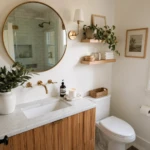
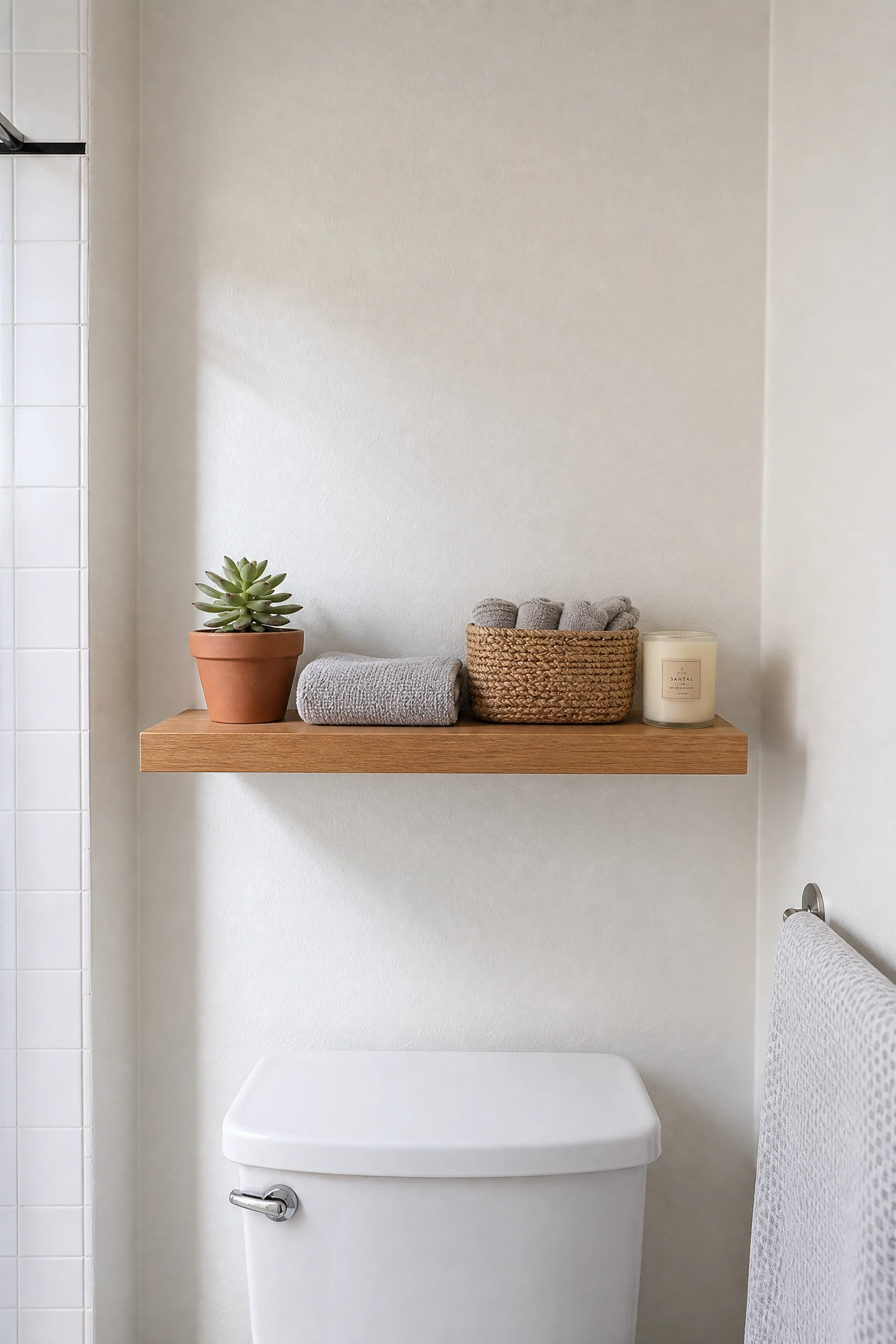
The wall space above the toilet is the most consistently underused surface in any apartment bathroom, and a floating shelf or small set of shelves in this position provides meaningful additional storage and a styling surface in a room that almost never has enough of either. A single shelf in warm oak, painted MDF, or a black metal and timber combination, installed with two wall anchors (which leave two small holes that can be filled with white toothpaste or a dab of filler on move-out day), holds a small plant, a few rolled towels, a candle, and a basket for spare bathroom supplies. Two shelves at different heights in the same position double the storage and create an opportunity for a more developed arrangement. The practical installation requires two wall anchors and about twenty minutes, and the result is one of the most proportionally impactful changes available in a bathroom where floor space is already fully occupied.
Pro Move: Keep the shelf styling to no more than four or five items: one plant, one basket or small container, one candle or diffuser, and one practical item like a rolled towel or a small jar of cotton rounds. More than five items on a bathroom shelf starts to read as clutter even when each individual item is attractive on its own.
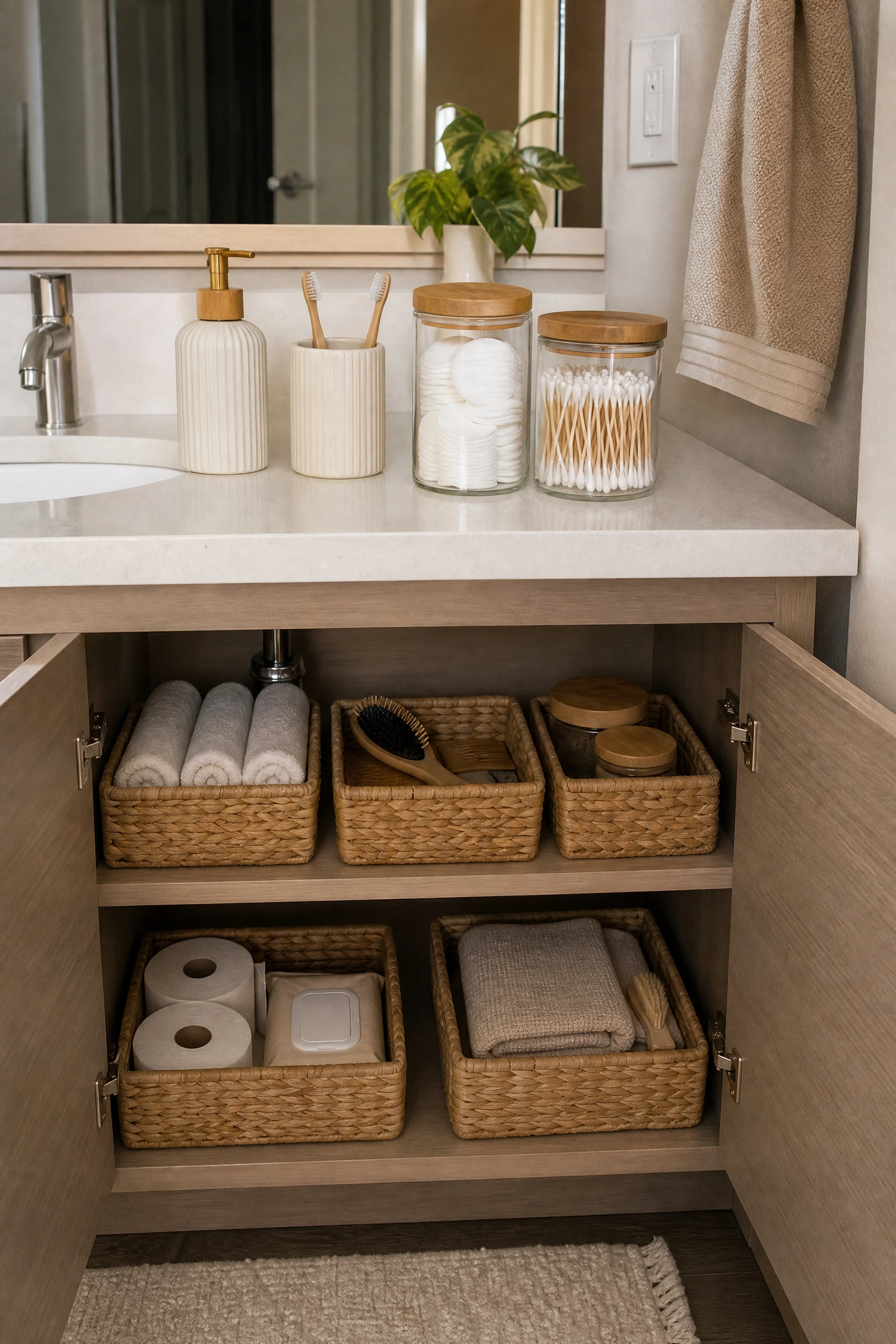
The bathroom counter and cabinet interior in most apartments are occupied by a combination of original product packaging, mismatched containers from different purchases, and improvised storage solutions that made sense at the time but have never been replaced. Coordinating the containers across the bathroom, whether through a set of glass jars with bamboo lids on the counter, a set of matching baskets in the cabinet, a soap dispenser and toothbrush holder in the same material, or clear acrylic drawer organizers for the vanity drawer, creates a visual consistency that makes the whole bathroom feel designed rather than assembled. This is the category where the investment is modest (a complete bathroom container set costs between thirty and a hundred dollars depending on materials) and the visual return is immediate and disproportionate to the cost. The containers move with you to every subsequent apartment.
Designer Advice: Choose containers in one material family throughout the bathroom: all glass and bamboo, all matte ceramic, all rattan and linen, or all clear acrylic. Mixing materials and colours between different containers in the same space creates exactly the kind of visual noise that the investment in coordinated storage is meant to eliminate.
21. Use Peel-and-Stick Tiles on the Backsplash or Floor
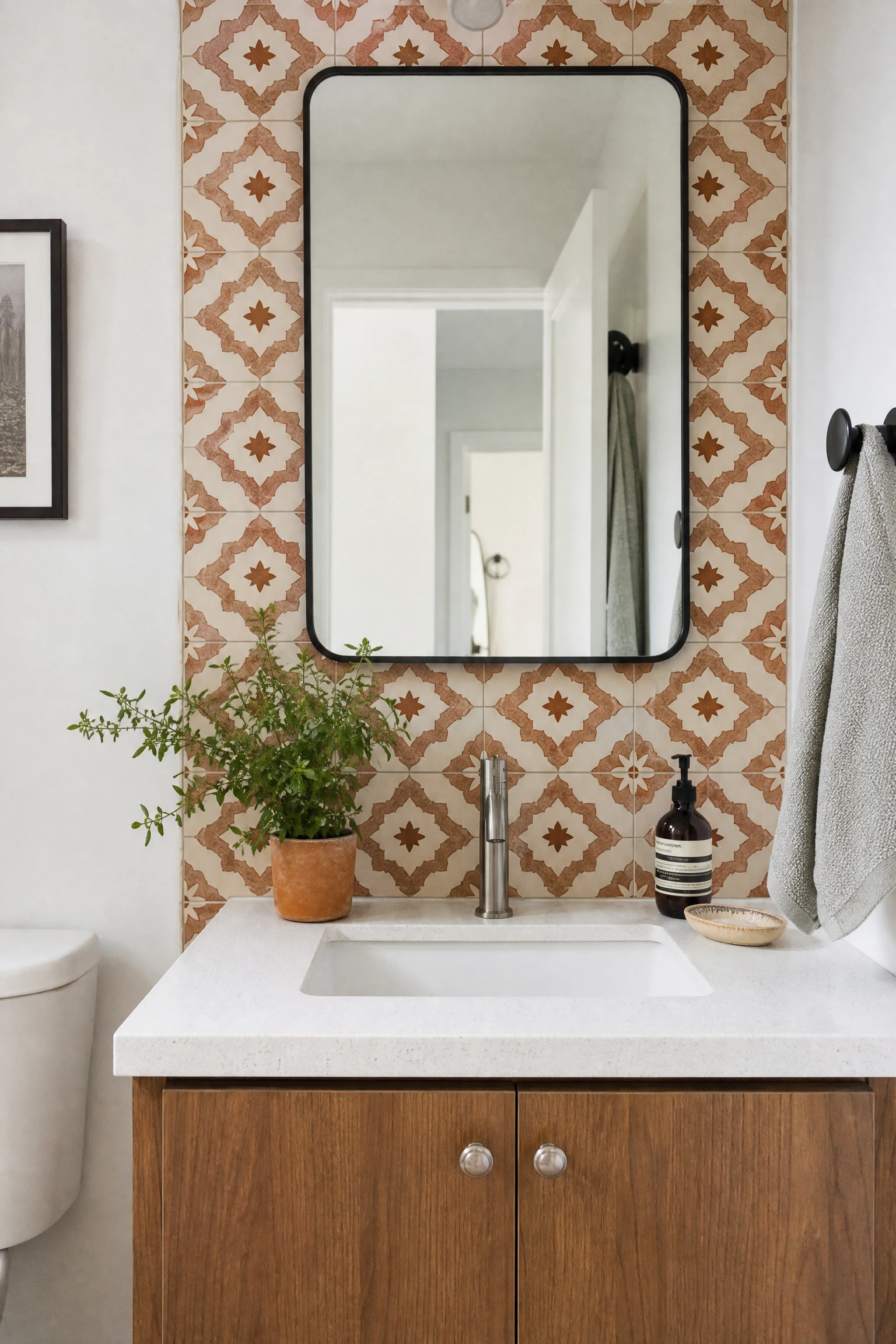
Peel-and-stick tile sheets have become a genuinely viable option for apartment bathroom upgrades because the best products from brands like Smart Tiles, Aspect Tile, and WallPops use a durable adhesive that adheres cleanly to smooth tile and grout surfaces and removes without damage. Behind the vanity sink, a peel-and-stick tile sheet in a Moroccan geometric, a classic subway pattern, or a terrazzo-effect can entirely change the character of the backsplash area. On a small section of floor in front of the bathtub or around the vanity pedestal, a peel-and-stick floor tile can cover an existing tile pattern that is particularly dated or unattractive. The practical requirements are the same as for peel-and-stick wallpaper: clean, smooth, dry surface and careful alignment from the start, because adjustment becomes increasingly difficult as more tiles are laid.
Reality Check: Peel-and-stick tiles work best as a temporary upgrade in apartments where the existing tile is in good condition and just visually dated. They do not adhere well to damaged, cracked, or textured tile surfaces, and attempting to use them as a repair solution for genuinely damaged tiles will create more problems than it solves.
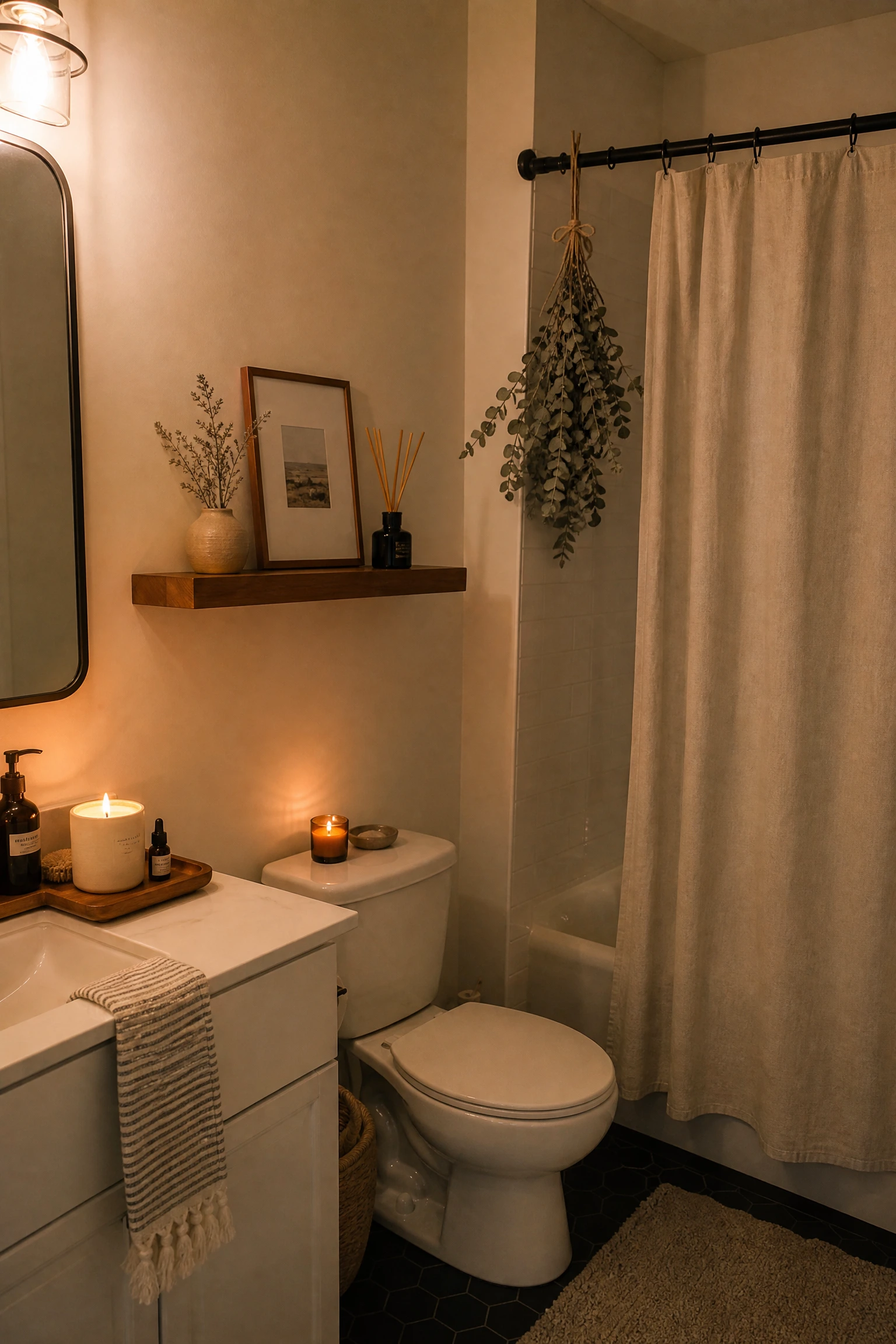
Scent is the most underestimated element in apartment bathroom decor because it operates below conscious visual attention and yet profoundly affects how the space feels to be in. A bathroom that smells good feels cleaner, more considered, and more personal than an identical bathroom that does not, regardless of how it looks. A soy wax candle in a ceramic vessel on the vanity tray, a reed diffuser on the floating shelf, a bundle of dried eucalyptus hung from the showerhead (the steam activates the oils), or a small essential oil diffuser in a corner all introduce scent in ways that also contribute visually to the bathroom styling. The practical choice between these options depends on ventilation: in a bathroom without a window, a diffuser or dried botanicals are safer than candles, which should not be left burning in unventilated spaces.
Quick Tip: Hang a bundle of fresh or dried eucalyptus from the showerhead or the shower curtain rod with a simple piece of twine. The steam from the shower releases the natural oils in the eucalyptus leaves and fills the bathroom with a clean, fresh scent that takes approximately thirty seconds to set up and costs under five dollars.
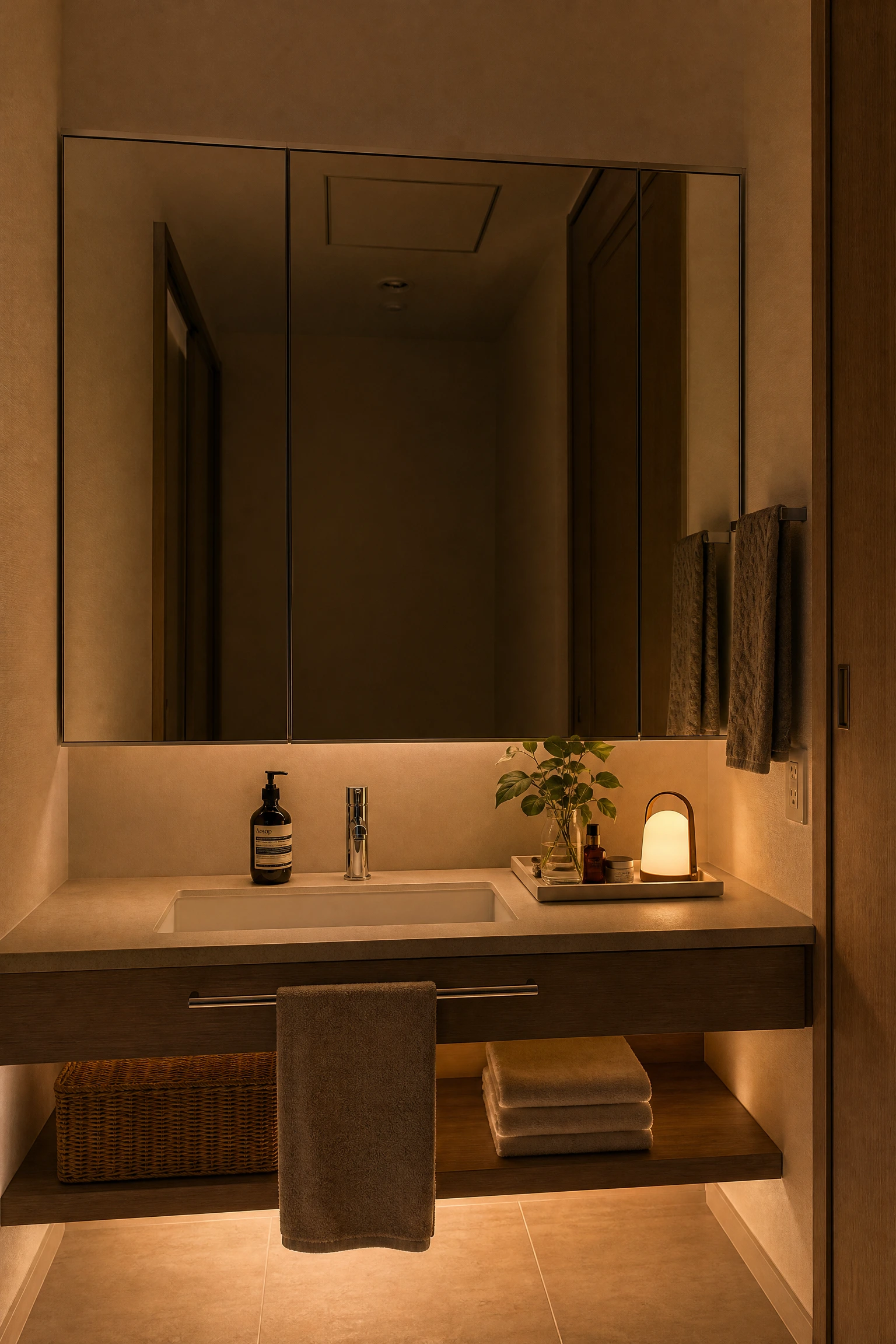
The fixed overhead light in an apartment bathroom is rarely flattering and almost never the only light source the room deserves. Adding portable lighting sources that do not require any electrical work, specifically a battery-operated LED strip light under the vanity shelf, a rechargeable LED candle or lamp on the counter, a wireless LED mirror light clipped to the existing mirror, or a plug-in wall sconce beside the vanity mirror, creates a layered lighting scheme that makes the bathroom feel atmospheric and considered in a way that a single overhead fixture never can. The warm glow of a candle-temperature LED source at counter height alongside the task lighting from above changes the bathroom from a clinical white-lit box into a room that feels genuinely inviting to spend time in. In a bathroom where the only plug socket is the shaver socket above the vanity, a rechargeable lamp or a battery-powered LED source is the practical solution that requires no additional electrical access.
Designer Advice: Avoid cool-white or daylight-spectrum portable lights in a bathroom. The colour temperature of a portable light source matters as much as its position: a warm-white LED at 2700K on the vanity shelf creates a genuinely flattering and atmospheric light. The same position with a cool 5000K source creates a clinical effect that is no better than the overhead light it was meant to complement.
24. Define the Style Completely With One Cohesive Refresh
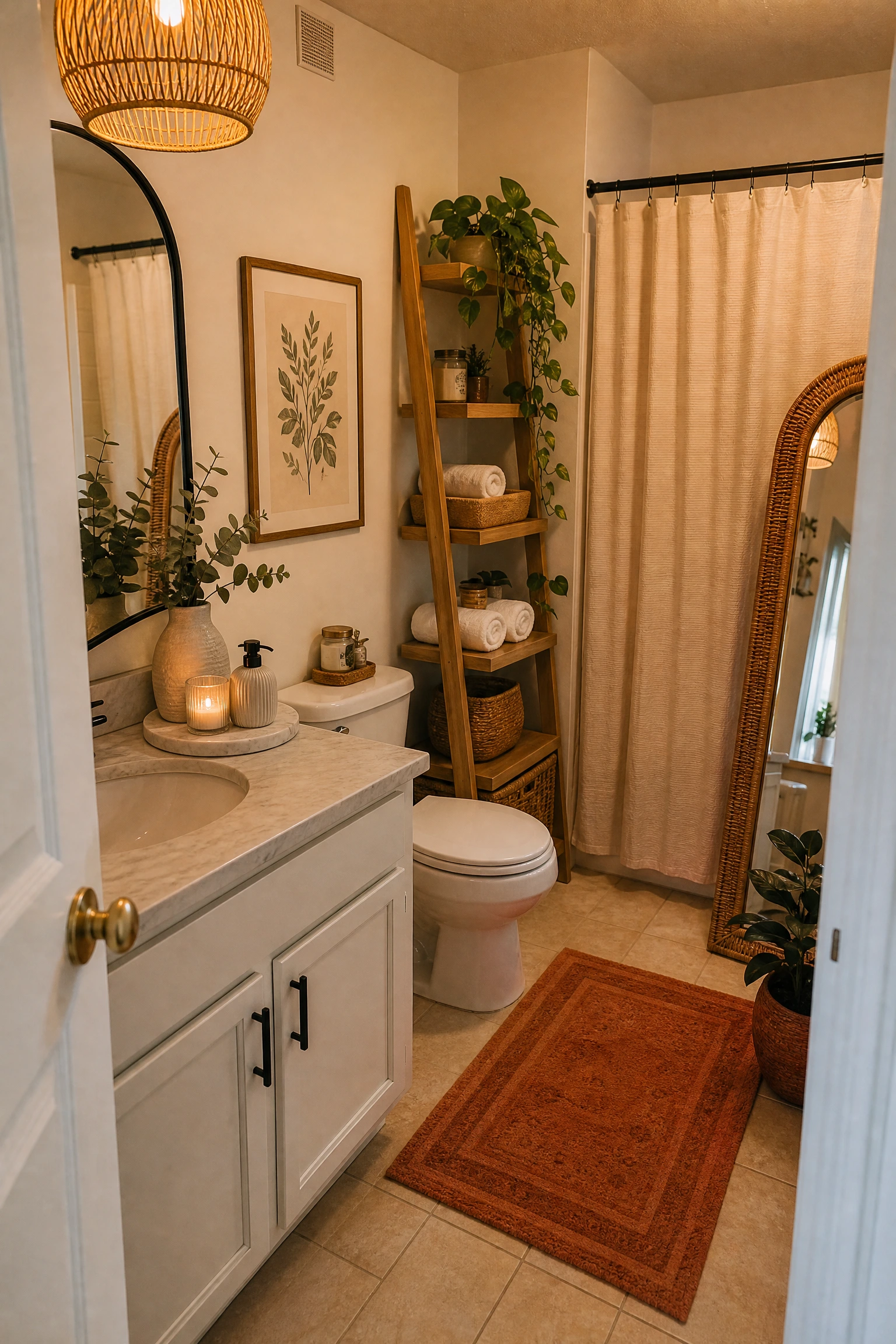
Every idea in this article works individually, but the apartment bathroom that feels truly finished is the one where multiple ideas from the same aesthetic direction have been applied together so that the whole room reads as a single decision rather than a collection of separate upgrades. A bathroom that goes all-in on a warm earthy minimal aesthetic, with cream linen shower curtain, terracotta bath mat, warm oak ladder shelf, brass-tipped candle, a single large snake plant, and cream coordinated counter accessories, looks designed in a way that no single element from that list achieves alone. The investment across those elements is typically well under two hundred dollars, but the result in a room that takes up perhaps six square metres is the difference between a bathroom you are embarrassed by and one you are genuinely proud of. Spend twenty minutes deciding on the direction before buying anything, and every subsequent purchase decision becomes easy because you already know what it needs to be.
Pro Move: Save three or four specific inspiration images that all point toward the same aesthetic before buying a single item for a bathroom refresh. Every purchase decision then becomes a simple filter: does this fit the images I saved? If yes, buy. If you are not sure, it is a no. Decision fatigue in home decor is real, and a pre-decided aesthetic direction eliminates it completely.
An apartment bathroom does not have to wait for homeownership to feel good. The limitations of renting, no permanent changes, no drilling, no landlord drama, are real but they are also narrower than most renters assume. The vast majority of the changes in this list are either fully reversible, land in a category most landlords enthusiastically permit, or represent improvements to the apartment that leave it better than you found it. None of them are about disguising the fact that the bathroom is small or that the tiles are dated or that the light fixture belonged to a different era. They are about making the space your own within the boundaries you have, and doing it in a way that makes your daily routine feel more considered and more pleasant.
Start with Zone 1. Choose the change that bothers you most and fix it this week. Give it a few days and notice whether the bathroom feels different. It will. Then move to the next idea. An apartment bathroom gets better incrementally, and the cumulative effect of several well-chosen changes in the same aesthetic direction is genuinely remarkable in a room where even small improvements are felt immediately because the space is used every single day.
“Which of these ideas would make the biggest difference to your bathroom right now? Drop it in the comments below.”
Frequently Asked Questions
How can I decorate my apartment bathroom without losing my security deposit?
Stick to Zone 1 and Zone 2 ideas which require no permanent changes. Use removable adhesive hooks rated for the wall surface, tension rod systems for shower storage, peel-and-stick products tested on a small area first, and swaps of removable elements like hardware, toilet seats, and showerheads where original items are stored and reinstalled on move-out. Always photograph the bathroom before making any changes so you have a clear record of the original condition.
What are the best plants for an apartment bathroom with no window?
ZZ plants and pothos are the most resilient options for very low-light bathrooms. Both tolerate indirect artificial light and high humidity. Cast iron plants are another strong choice. If the bathroom has no natural light at all, a high-quality artificial plant in a real ceramic pot is a more honest choice than a real plant that will slowly deteriorate. Rotate artificial plants with fresh stems of eucalyptus from the shower curtain rod to maintain the organic connection to plant material without requiring any light at all.
How do I make a very small apartment bathroom feel bigger?
Hang the shower curtain as high as possible, ideally from a tension rod positioned close to the ceiling. Add a large or full-length mirror to reflect light and the illusion of depth. Keep the counter clear except for a collected tray with five items or fewer. Use a bath mat that is slightly oversized rather than too small. Choose light-coloured towels. Use warm-toned lighting at counter level to prevent the room from feeling like a cold, bright box. Keep the floor clear of anything that does not need to be there.
Can I paint my apartment bathroom?
Most landlords permit painting with permission, and the conversation is worth having. Offer to repaint in the original colour when you leave, or to use a colour from a small approved palette. Many landlords are pleased to have a tenant improve the space at no cost to them. If permission is not granted, peel-and-stick wallpaper on a single accent wall is the next best option and requires no landlord approval because it is fully removable.
What is the best thing to put on a bathroom counter to make it look styled?
A tray is the single most effective counter accessory because it organizes everything else within a defined boundary. Within the tray, keep five items or fewer: a decanted hand soap, a small candle or diffuser, a ceramic or glass rinse cup, a small plant cutting in water, and one skincare item you use daily. Everything else goes in the cabinet. The discipline of the five-item rule is what separates a styled counter from a cluttered one.
Is peel-and-stick wallpaper suitable for bathrooms?
Yes, provided the wall surface is smooth, fully cured, clean, and dry. Most peel-and-stick wallpaper products now use an adhesive formulated for bathroom conditions, and the better brands specify moisture-suitability on the product. Do not apply peel-and-stick wallpaper to freshly painted walls (allow at least 30 days for paint to cure), to textured or heavily stippled walls, or to walls with existing peeling or damaged paint. A test patch in an inconspicuous corner before the full installation is always the right approach.