A bathroom corner is not one problem. It is five or six different problems depending on which corner you are looking at. The corner inside the shower needs something completely different from the corner beside the bathtub, which needs something completely different from the open floor corner beside the door. Treating all of them the same way is why most bathroom corner advice is so frustrating to actually use: a tip about a floor corner plant stand is useless if the corner you are trying to solve is in the shower. This article is organized by where the corner actually is, so you can skip straight to the section that matches your specific situation and find ideas that will genuinely work in that space.
Each idea names the exact corner position it is solving, explains what makes that position distinctive from the others in the room, and gives you the honest practical notes on installation, humidity tolerance, and scale that most corner decor articles leave out entirely. Look at each corner in your bathroom separately. What bugs you about each one is probably different, and the fix for each is different too.
Shower Corner Ideas
The shower corner is the most functionally demanding position in any bathroom because everything placed here must tolerate constant water exposure, steam, and temperature fluctuation. Storage and practical solutions dominate this zone, but the way you execute them determines whether the corner looks designed or improvised.
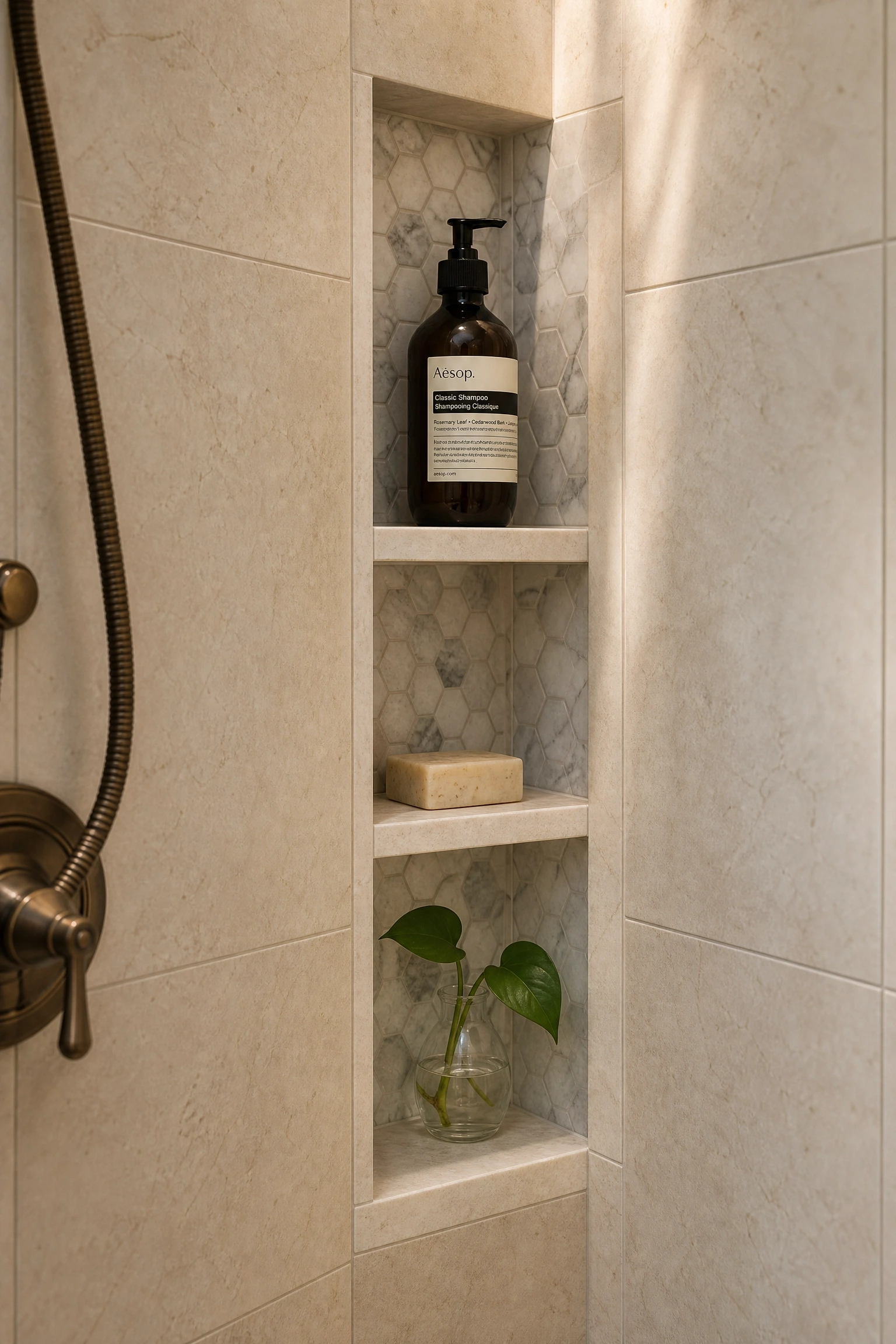
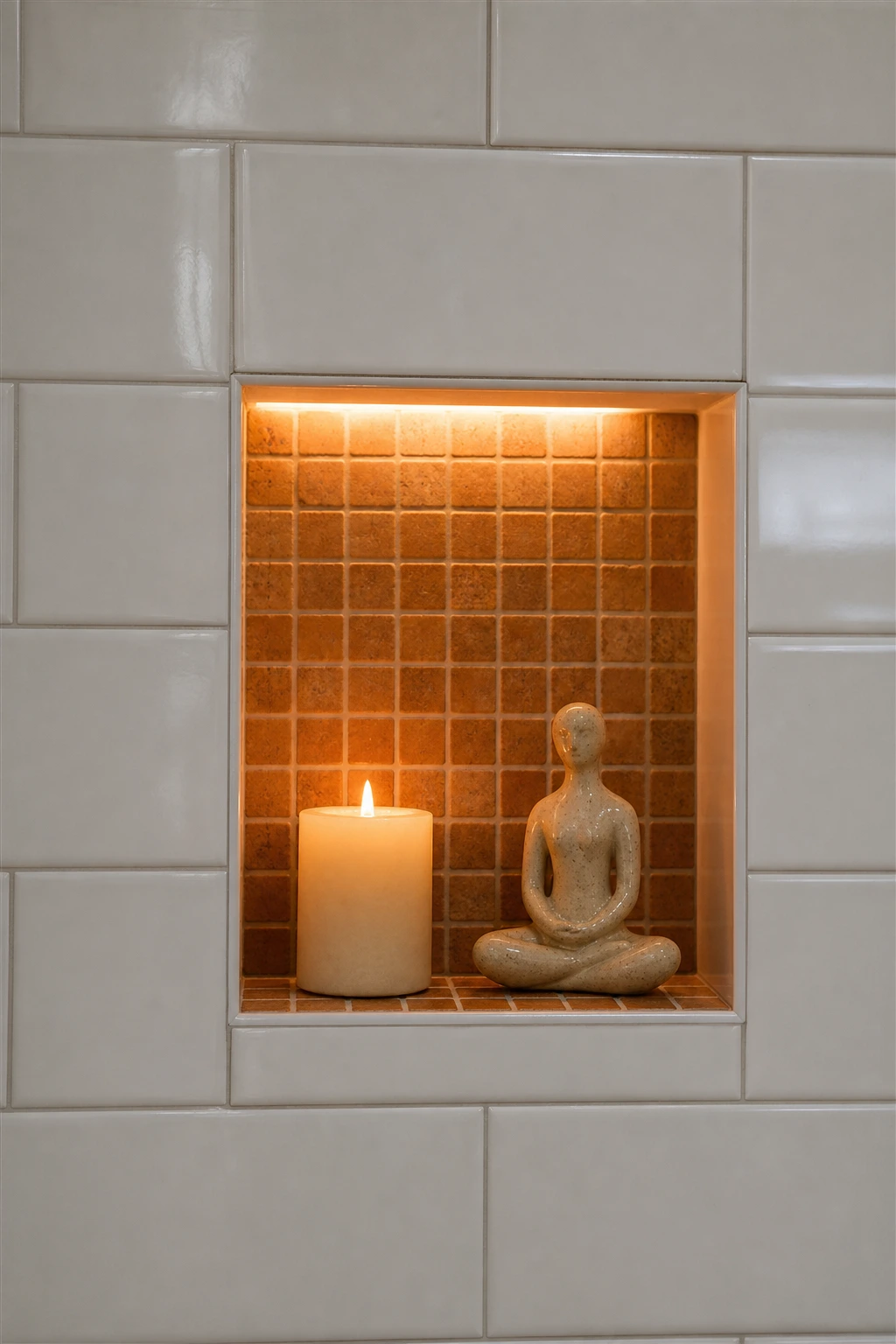
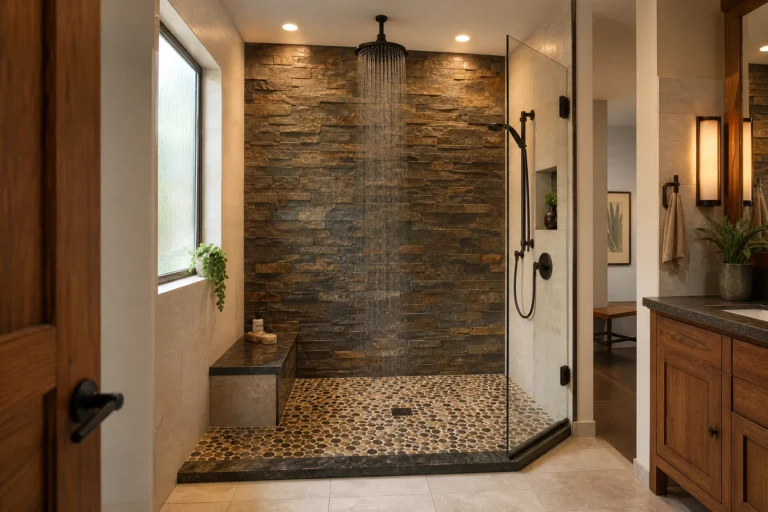
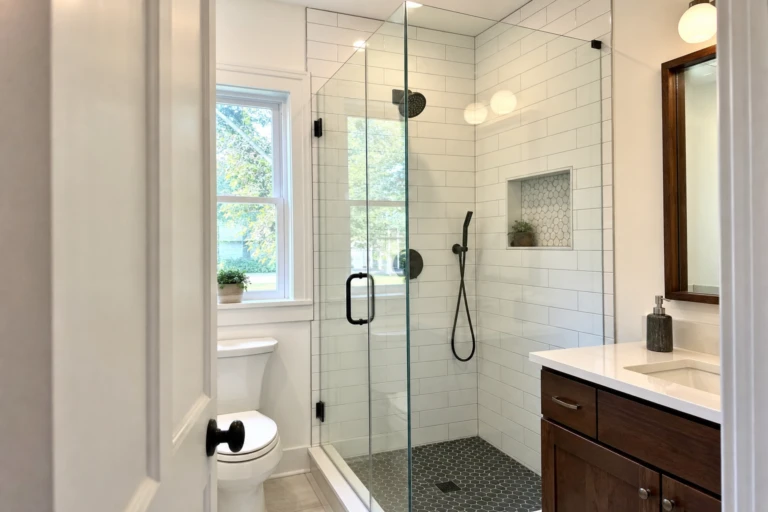
A recessed tile niche built into the corner of the shower wall is the most permanent and most polished storage solution for a shower corner, and it is the approach that professional designers consistently recommend over any surface-mounted alternative. A corner niche is recessed into the wall cavity, which means it takes up no floor space and no projection into the shower enclosure, and the tile finish makes it an integral part of the shower design rather than a separate element. The interior of the niche can be tiled in the same material as the surrounding shower wall for a smooth effect, or finished in a contrasting tile, a slab of marble, or a mosaic insert for a decorative focal point. A single large niche between two studs typically provides enough shelf space for four to six products with room for a small plant cutting in a waterproof vessel or a candle-style accessory. This is a renovation-level decision rather than a decor change, but for any bathroom where the shower is being retiled, it is the single best corner improvement available.
Pro Move: Size the niche opening to fall between two studs rather than cutting into them, which is typically around 30 to 35 centimetres wide. Tile the interior with a mosaic or contrast tile that picks up a colour from the main shower tile palette, and use a matching trim tile as the lip on each shelf level.
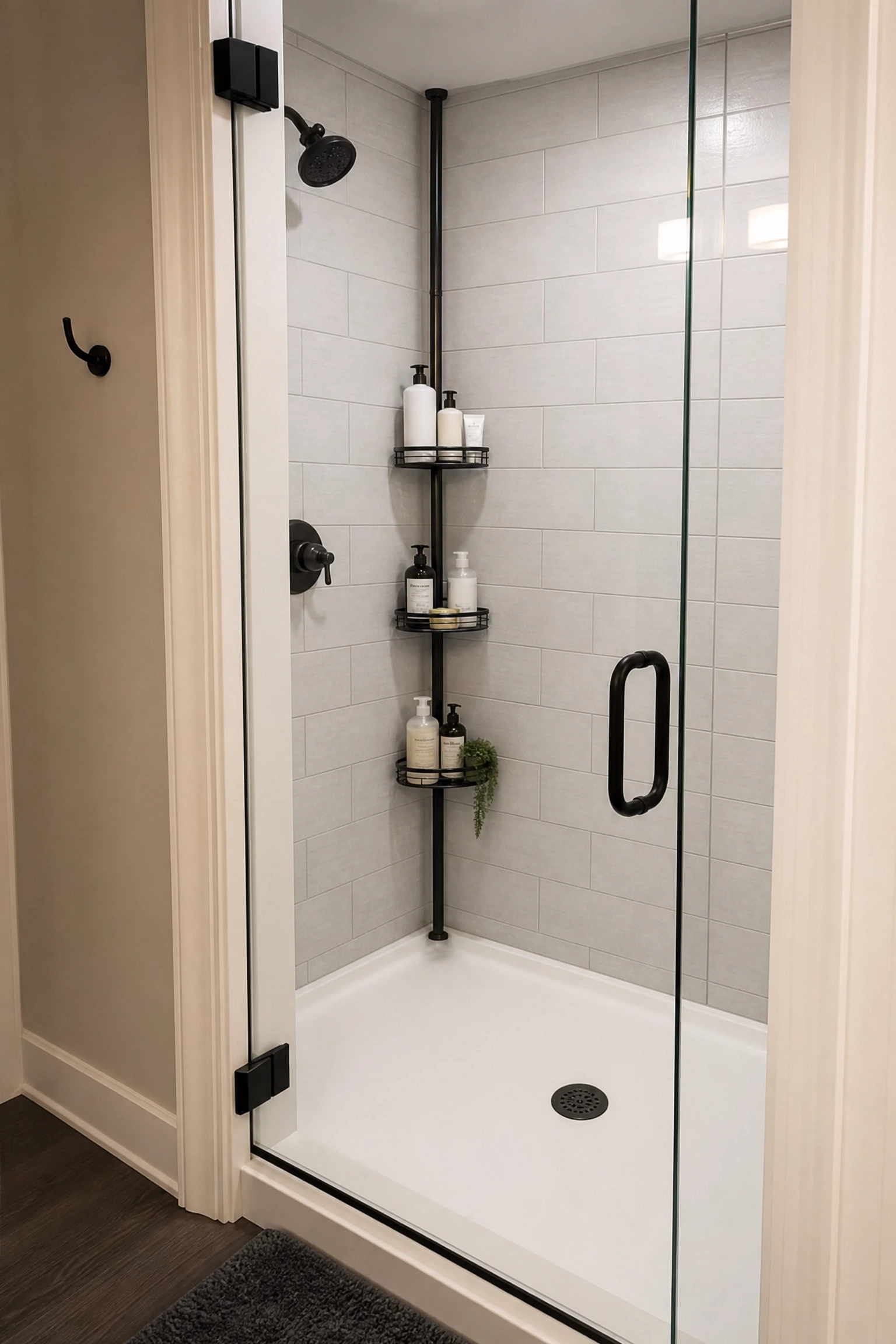
A tension pole shower caddy that wedges between the floor and ceiling of the shower enclosure is the most practical non-permanent solution for a shower corner in a home where the shower tile cannot be modified. The pole sits in the corner and provides two to four shelving levels for shampoo, conditioner, body wash, razors, and other shower essentials, keeping everything off the floor and the shower tray without requiring any drilling or adhesive. The best tension pole caddies have rust-proof aluminium or stainless steel construction, adjustable shelf heights, and a solid locking mechanism at the top that prevents the pole from shifting with the weight of products. The practical limitation is that most tension poles require a flat, level ceiling surface to grip properly, and they do not work in showers with angled or curved ceiling profiles. In practice, a tension pole caddy that is regularly overtightened will leave marks on both the floor and ceiling over time, particularly on softer tile or acrylic tray surfaces.
Heads Up: Do not hang towels or heavy items from a tension pole caddy. The pole is designed to hold lightweight shower products and the weight of a wet towel is more than the locking mechanism of most standard caddies is designed to sustain. A separate hook or rail outside the shower is always the better towel solution.
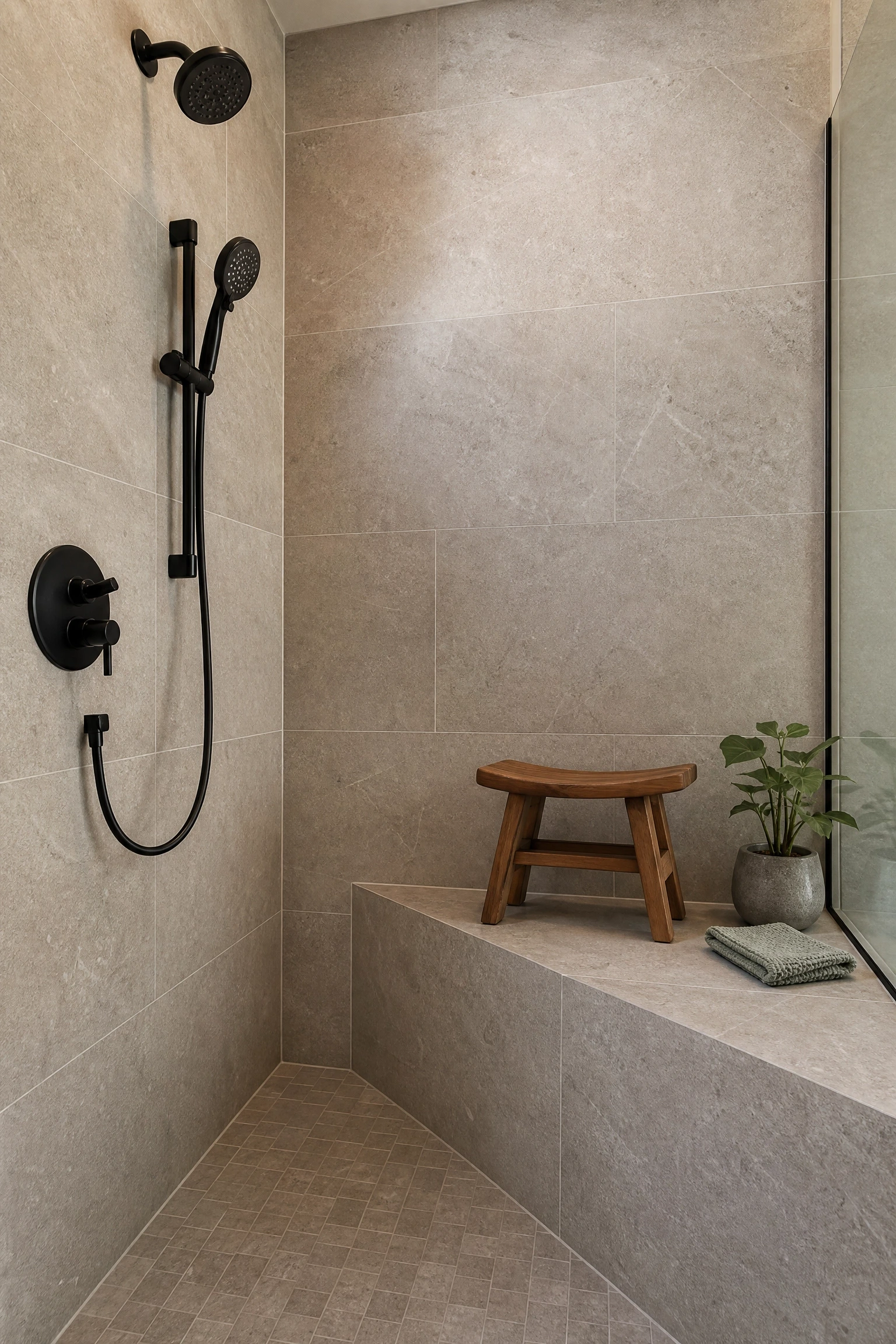
A built-in corner bench at one end of the shower enclosure is one of the most practical additions to a larger shower corner because it provides a seated surface for shaving, a rest point during longer showers, a prop for washing feet without contorting, and a styling surface for a plant, a candle, and a stack of washcloths when the shower is not in use. Corner benches are typically tiled in the same material as the shower floor and walls, making them structural features of the shower rather than furniture additions. In a smaller shower where a built-in bench is not feasible, a teak or treated timber shower stool positioned in the corner achieves most of the same practical functions without any construction work, and can be moved outside the shower for cleaning or storage when not needed. Teak is the most suitable timber for wet shower environments because of its naturally high oil content, which prevents the absorption of water and the warping or mould growth that affects most other untreated timber species.
Designer Advice: Style a shower bench or stool with a single small plant cutting in a sealed glass vessel and one candle in a waterproof holder for a spa-like effect that reads as genuinely designed even when the shower is not in use. The bench becomes a visible design element from outside the shower enclosure rather than just a functional seat.
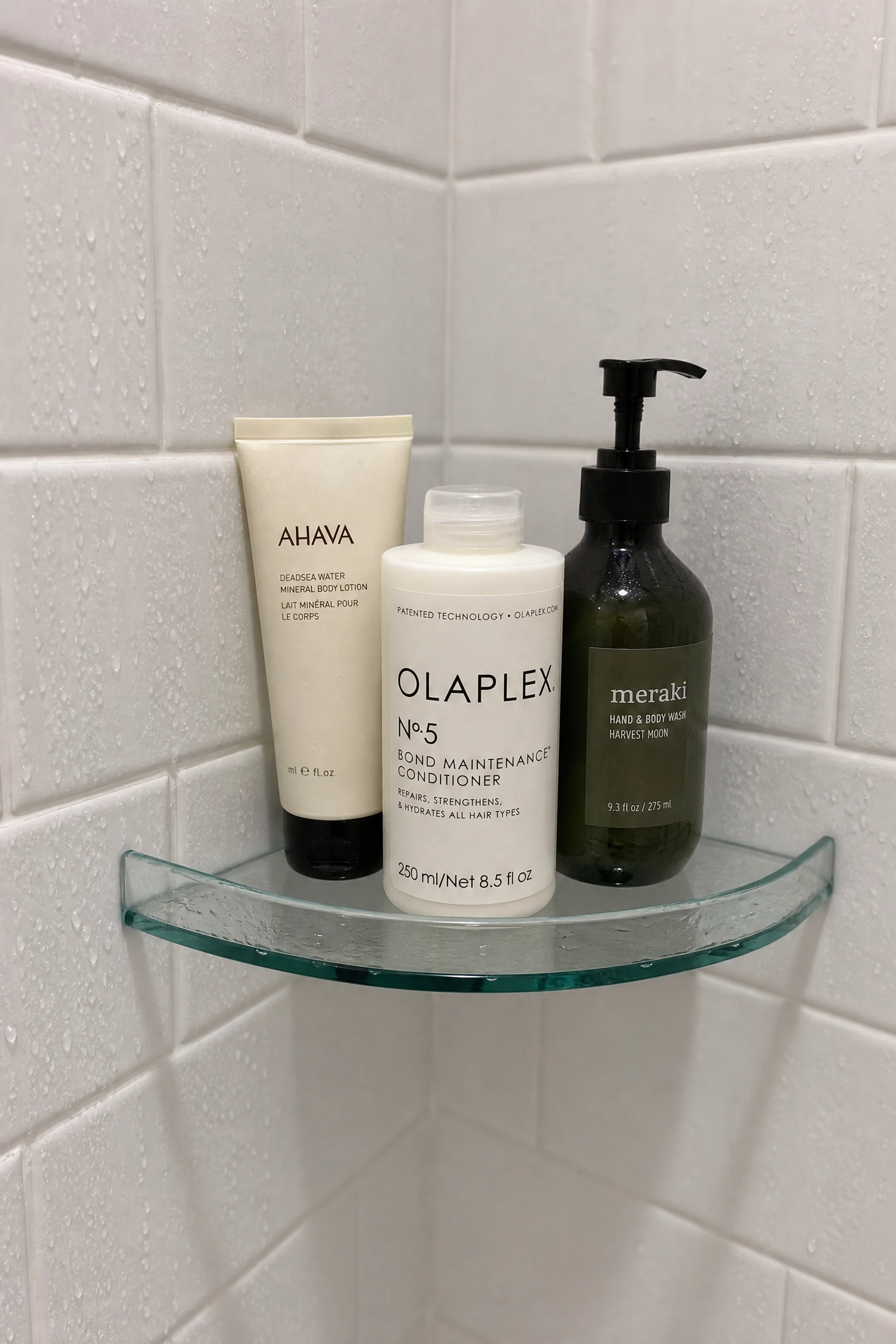
A glass corner shelf mounted on two wall-drilled fixings inside the shower is the slimmest and most visually light storage solution for a shower corner, and it works particularly well in small shower enclosures where a tension pole caddy would make the space feel cluttered. Tempered glass corner shelves are specifically manufactured for wet environments and the glass material means they introduce no visual weight into the shower: from outside the enclosure, the shelf is almost invisible and what is on it appears to float. The installation requires drilling into the tile, which is a permanent change and requires appropriate tile drill bits to avoid cracking the tile surface. The practical capacity of a glass corner shelf is limited: it suits two to four products per shelf level and should not be overloaded, as the weight of a full collection of shower products on a single glass shelf creates a lever effect on the wall fixings over time.
Quick Tip: Choose a glass corner shelf with a slightly upturned front lip of at least one centimetre. Products placed on a flat glass shelf in a wet shower environment will gradually slide toward the front with repeated water impact from the showerhead. A raised front lip prevents products from ending up on the shower floor.
5. Stacked Timber Corner Shelf Tower in the Shower
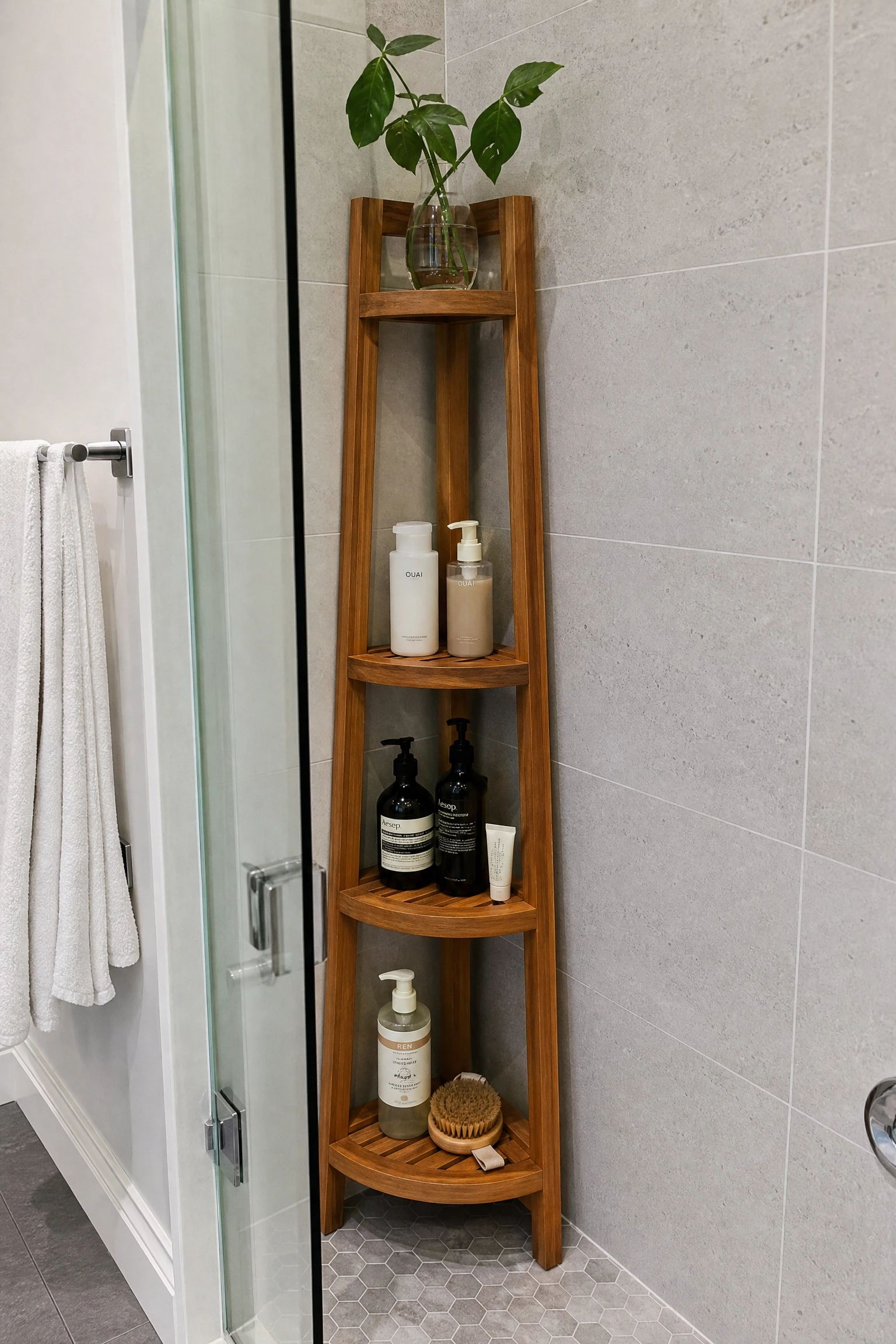
A freestanding teak or treated timber shelf tower designed for shower corners provides multiple storage levels without drilling and without the visual weight of a tension pole system. These units are purpose-built for shower environments, with a triangular footprint that fits exactly into the 90-degree angle of the shower corner, three to four open shelf levels, and either no bottom panel or a raised base to prevent water pooling. The natural material of timber in a shower corner creates a warmth and materiality that chrome or plastic alternatives lack, and teak shower towers in particular age well because the timber darkens slightly with repeated water exposure in a way that reads as character rather than deterioration. The practical maintenance requirement is that a timber shower unit needs to be moved out of the shower weekly during cleaning to prevent mould forming in the corner underneath, and needs to dry fully between uses to maintain the timber condition over time.
Reality Check: Any timber used in a wet shower corner needs to be naturally water-resistant or treated specifically for wet environments. Standard pine, MDF, or untreated softwood will deteriorate rapidly in shower conditions regardless of how it is finished on the surface. Teak, bamboo, and marine-grade treated timber are the only practical choices.
Bathtub Corner Ideas
The corner beside or at the end of a bathtub is one of the most opportunity-rich positions in any bathroom. It is at a natural pausing point, it is usually visible from the door, and it has the benefit of being adjacent to a relaxation space where a little considered styling has a disproportionate effect on the overall atmosphere of the room.
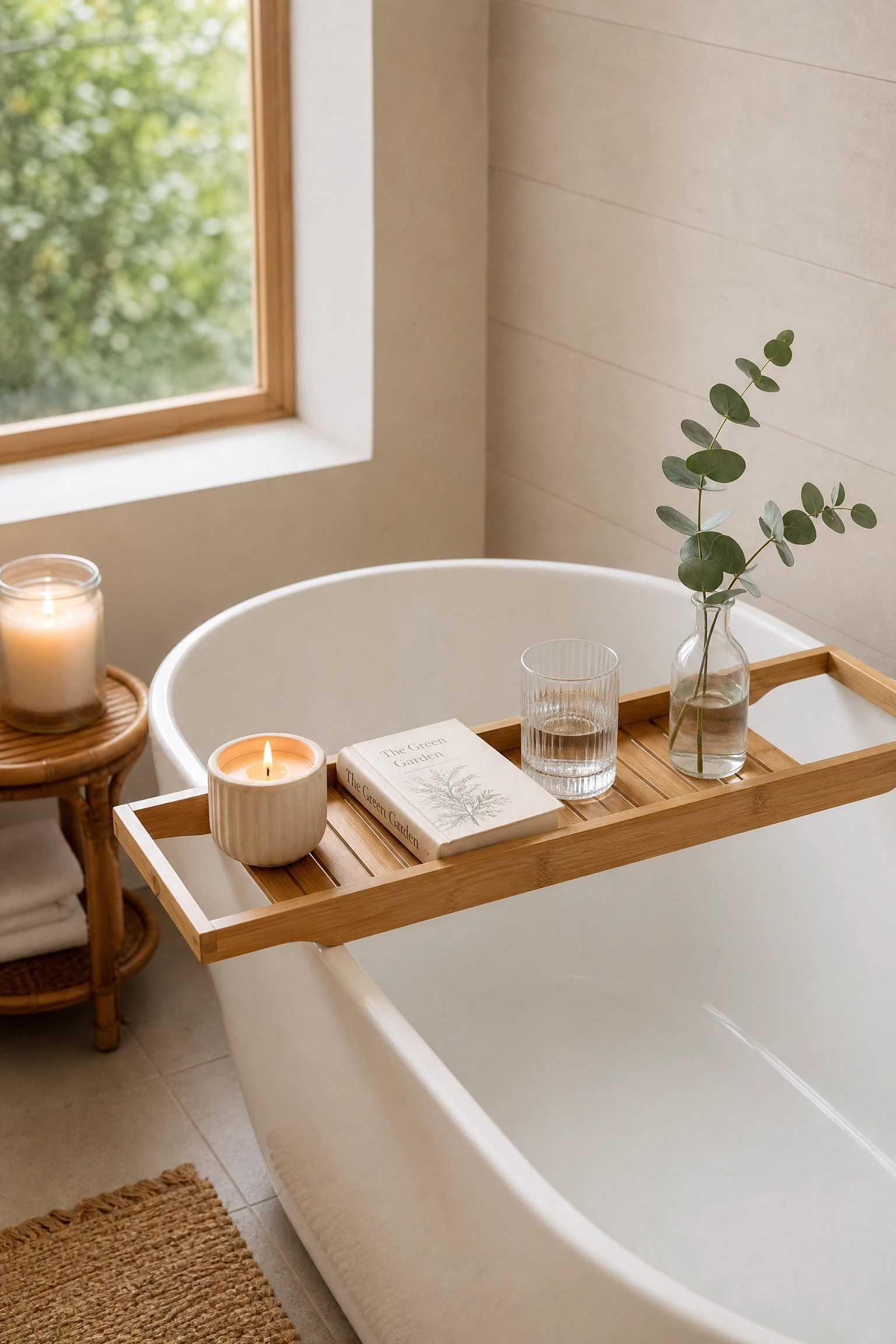
A bath caddy or tray that spans the width of the bathtub is technically a tub accessory rather than a corner solution, but it works directly with the corner beside the tub by connecting the two surfaces and creating a vignette that reads as a complete spa-like arrangement. A timber bath caddy in bamboo, teak, or light oak with slots for a book or phone, a candle holder position, and a small vessel for product places everything you need for a bath directly at arm reach, and when styled well, the tray and the items arranged on the corner ledge or floor beside the tub read as a single composed scene. Keep the tray to three to five items: a candle in a ceramic holder, a small book or magazine, a glass of water or a small ceramic cup, and optionally a single stem or sprig of eucalyptus in a bud vase. Anything beyond five items on a bath tray tips from styled to cluttered.
Pro Move: Match the material of the bath tray to the floor corner elements beside the tub. A bamboo tray above a bamboo side table below creates a material continuity that makes the whole bathtub area read as one considered design zone rather than two separate ideas placed next to each other.
7. A Small Stool or Side Table in the Bathtub Corner
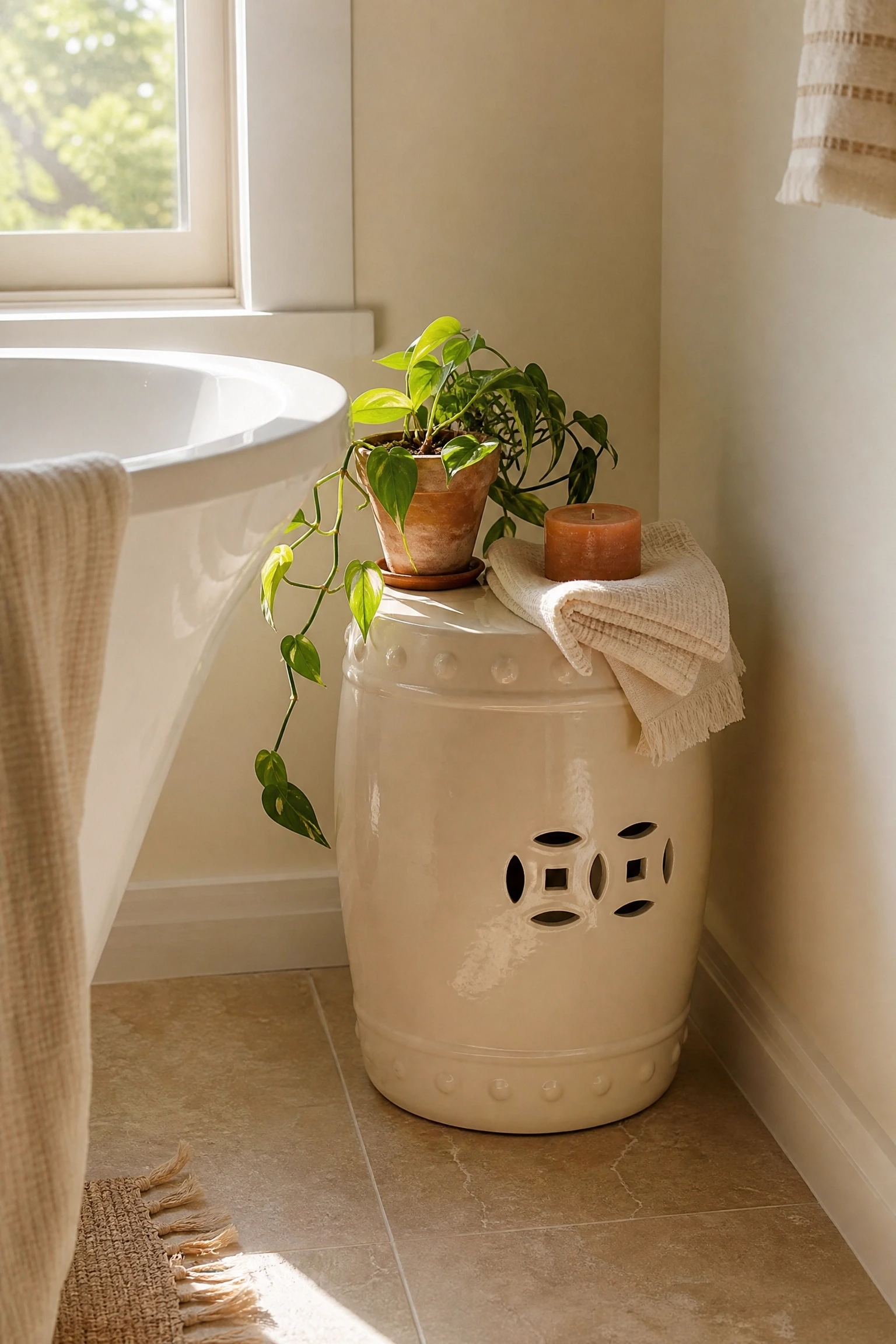
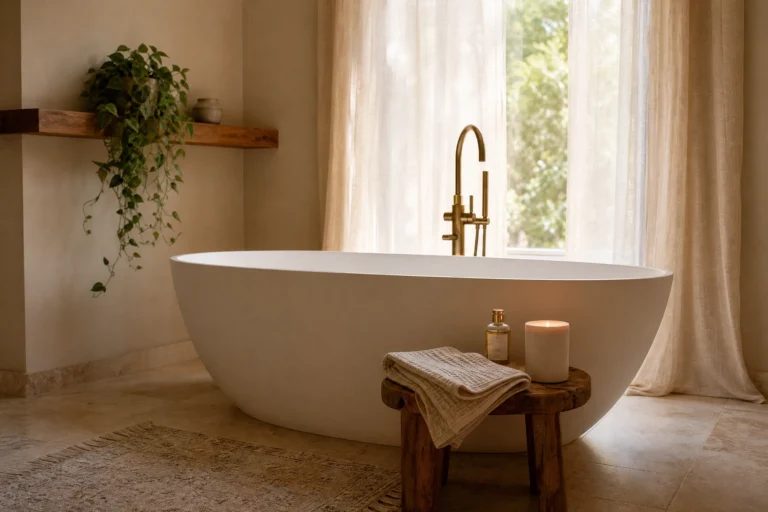
The floor corner at the foot or head end of a freestanding or alcove bathtub is one of the most natural positions for a small stool or accent table in any bathroom. A wooden stool, a rattan side table, a stone garden stool, or a concrete pedestal in this position provides a surface for candles, a plant, a small dish of bath salts, and a folded towel within arm reach of the bath. The style of the stool or table matters as much as its function: a ceramic garden stool in a warm terracotta tone beside a freestanding white bathtub reads as quietly luxurious. A low oak saddle stool beside a built-in bath creates a warm, natural material contrast. A woven rattan side table in a larger bathroom corner gives the bath zone a relaxed, organic quality. The practical requirement is that any furniture placed in the corner adjacent to a bathtub needs to tolerate splashing and occasional damp surfaces: solid ceramic, sealed stone, sealed timber, and rattan are the best material choices, while painted MDF, metal furniture without a protective coating, and untreated softwood will deteriorate quickly in a wet bathroom environment.
Heads Up: A stool or side table in the bathtub corner should be low enough that it does not block the view into the bath from the door or from the mirror, and tall enough that the surface is comfortably reachable from inside the bath without stretching. The ideal height for a bath-side surface is between 40 and 55 centimetres from the floor.
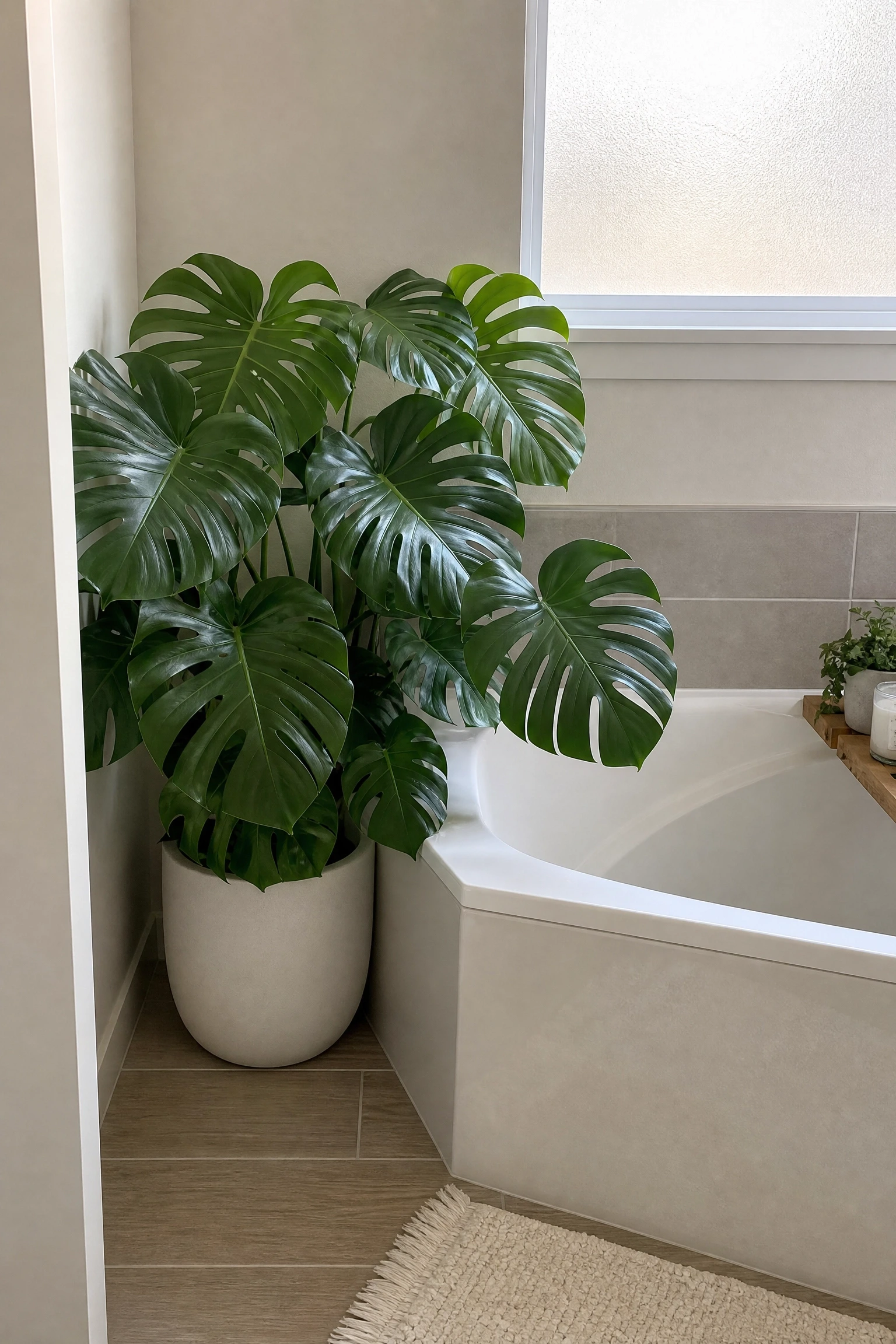
The floor corner at one end of a bathtub, particularly if there is a window nearby, is one of the best positions in any home for a tall indoor plant because the combination of warmth, humidity, and available natural light creates near-ideal growing conditions for a wide range of plant varieties. A large monstera deliciosa, a mature fiddle-leaf fig, a columnar snake plant, or a tall bamboo palm in this corner creates a strong vertical element that draws the eye upward and makes the bathroom feel both larger and more lush. The plant in this position is not incidental decor: at a scale that fills the corner, it becomes the defining design feature of the bathtub zone and sets the atmosphere for the whole room. The practical consideration is the pot: a large plant in a light plastic nursery pot sitting inside a decorative ceramic, rattan, or concrete pot cover is both more manageable for watering and more aesthetically satisfying than a plant in a plain plastic pot with no cover.
Designer Advice: Choose a plant pot that is at least 30 centimetres in diameter for a corner floor plant beside a bathtub. A pot that is too small relative to the plant looks ungrounded, as if the plant might tip over, and the scale mismatch reduces the visual impact of what would otherwise be a strong design moment.
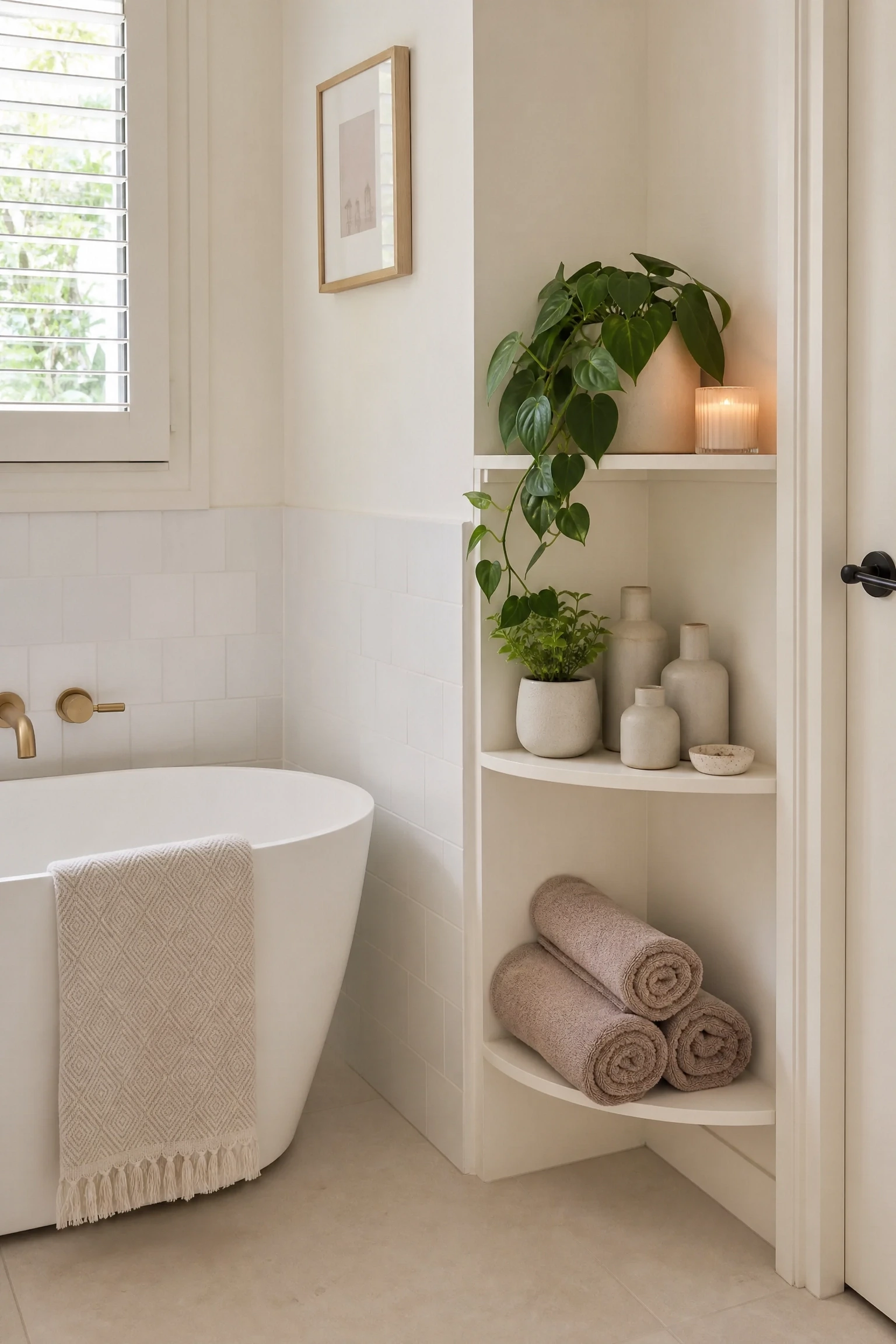
In bathrooms where the bathtub is positioned against two walls with a clear corner at one end, a built-in shelf unit in that corner creates the most architecturally integrated solution for bathtub-side storage. Built-in shelving running from the floor to the ceiling in the corner, finished in the same material as the bathroom walls or in painted timber, provides storage for towels, products, plants, and decorative objects in a form that looks like it was designed with the room rather than added to it. The shelving can be open for a light, airy effect or closed with a cabinet door for concealed storage below and open display above. Even in a bathroom where full floor-to-ceiling shelving is not feasible, a single corner shelf unit at the height of the bath surround or window sill creates a natural display surface for a candle arrangement, a small plant, and a folded guest towel.
Reality Check: Built-in shelving beside a bathtub needs to be finished in a material that tolerates regular exposure to steam and occasional splashing. Painted timber with a satin or gloss finish is the minimum requirement. High-humidity environments will cause peeling and bubbling on flat matte paint within months regardless of the number of coats applied.
10. A Freestanding Towel Rail in the Bathtub Corner
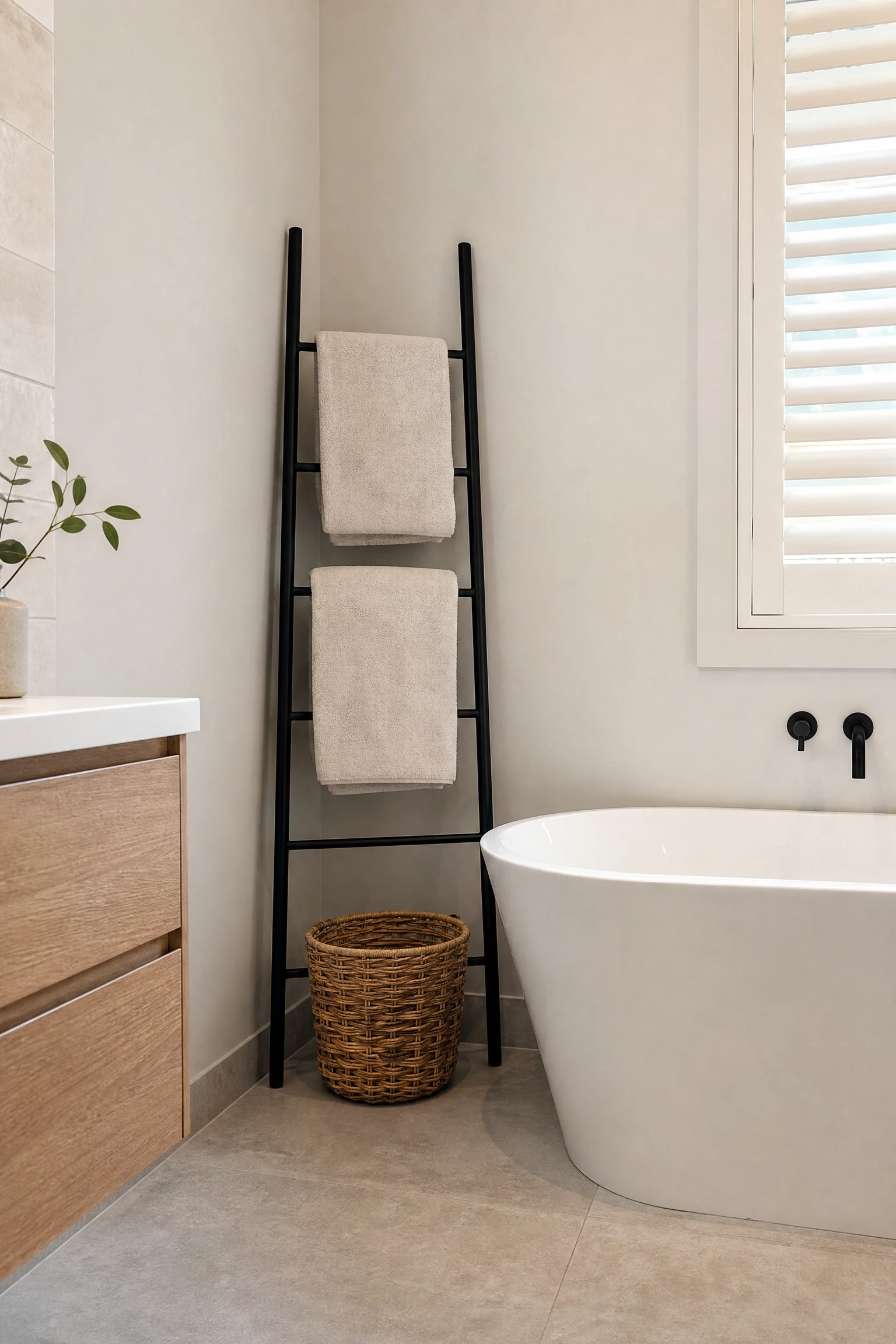
A freestanding heated or unheated towel rail positioned in the corner at the foot of the bathtub solves both a practical and an aesthetic problem simultaneously: it provides the warm, dry towel that is the most luxurious single element of any bath experience, and it fills the corner with a vertical element that gives the bathroom a sense of completion in a position that is often left empty. Freestanding towel rails come in a range of heights and finishes, from slim stainless steel to warm brushed brass to matte black, and their visual footprint is narrow enough that they work even in compact bathrooms where any additional furniture would feel crowded. A heated freestanding rail requires an electrical connection nearby, but a standard unheated ladder rail in the corner has no power requirement and can be positioned anywhere the floor space allows.
Quick Tip: Fold bath towels on a freestanding corner rail with the folded edge facing outward rather than hanging them over the rungs in a single flat panel. Folded towels on a rail look more considered, dry more evenly, and create a cleaner visual line from across the room than flat-hung towels that drape unevenly.
Floor Corner Ideas
The open floor corner in a bathroom, most often the corner beside the door, opposite the vanity, or beside the toilet, is the corner people struggle with most because it is too small for furniture in the traditional sense but too visible to leave entirely empty. These ideas treat it as a design opportunity rather than a dead zone.
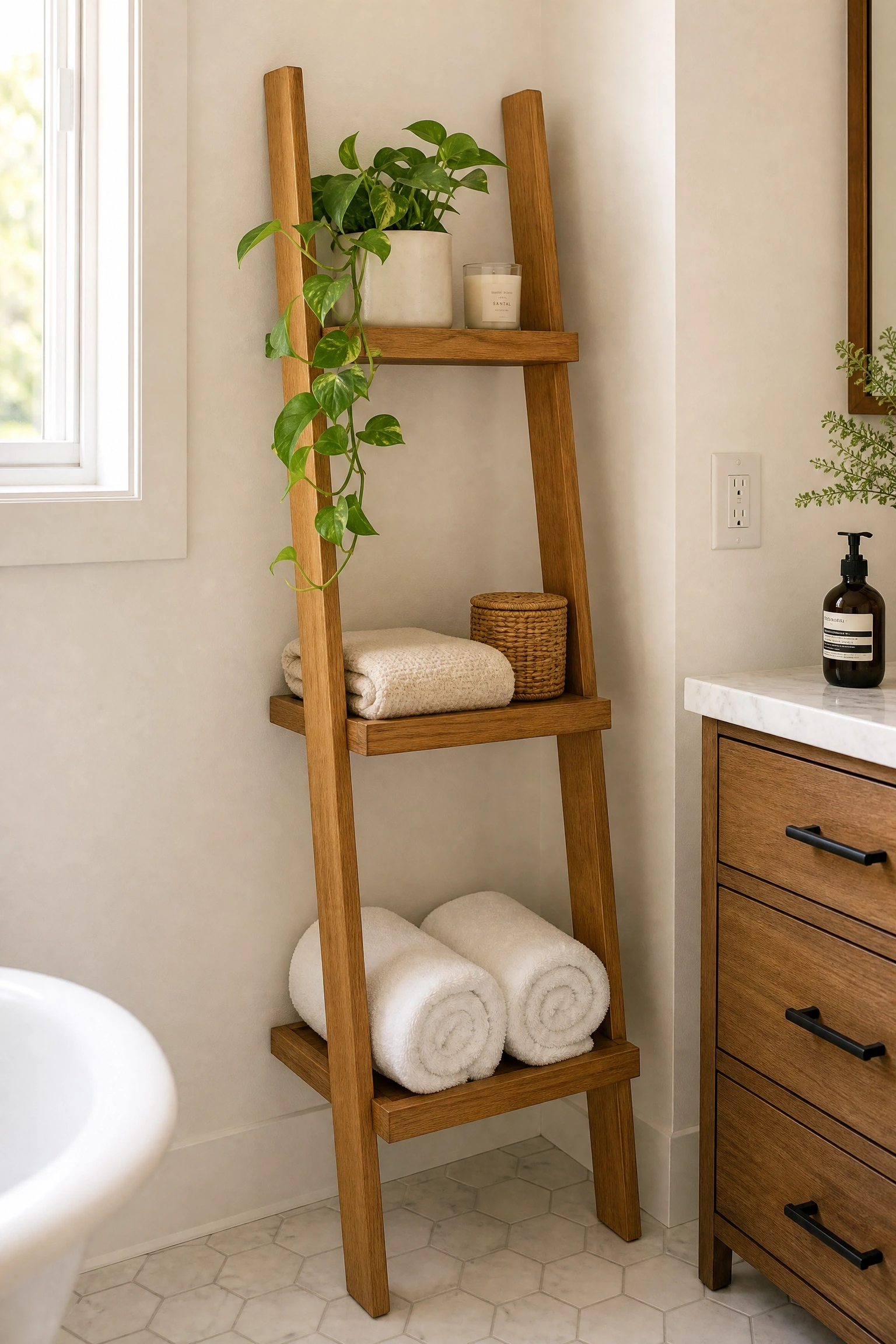
A timber or metal ladder shelf leaning against the wall in a floor corner is the most versatile floor corner solution available for a bathroom because it provides vertical storage across multiple levels without taking up significant floor space and without requiring any wall fixings. The triangular footprint of a leaning ladder shelf means it occupies only the corner itself and the shelf extends outward at each rung level, creating display and storage space that is visible from across the room without blocking any movement through the bathroom. A warm oak or blackened timber ladder in a corner with cream walls creates a strong material contrast. A white-painted ladder in a white bathroom disappears into the wall while still providing practical shelf space. A matte black metal ladder in a dark or moody bathroom adds an industrial note without competing with the overall palette. Each shelf level can hold a folded towel, a basket, a plant, or a candle arrangement, and the combination across three or four levels creates a genuine display that makes the corner feel designed.
Pro Move: Style a bathroom ladder shelf in thirds: the top third holds the lightest and most decorative items such as a small plant and a candle, the middle third holds folded textiles or an attractive basket, and the bottom third holds the most practical and heaviest items such as rolled towels or a woven storage basket with spare products. This proportion mirrors how professional stylists approach vertical display.
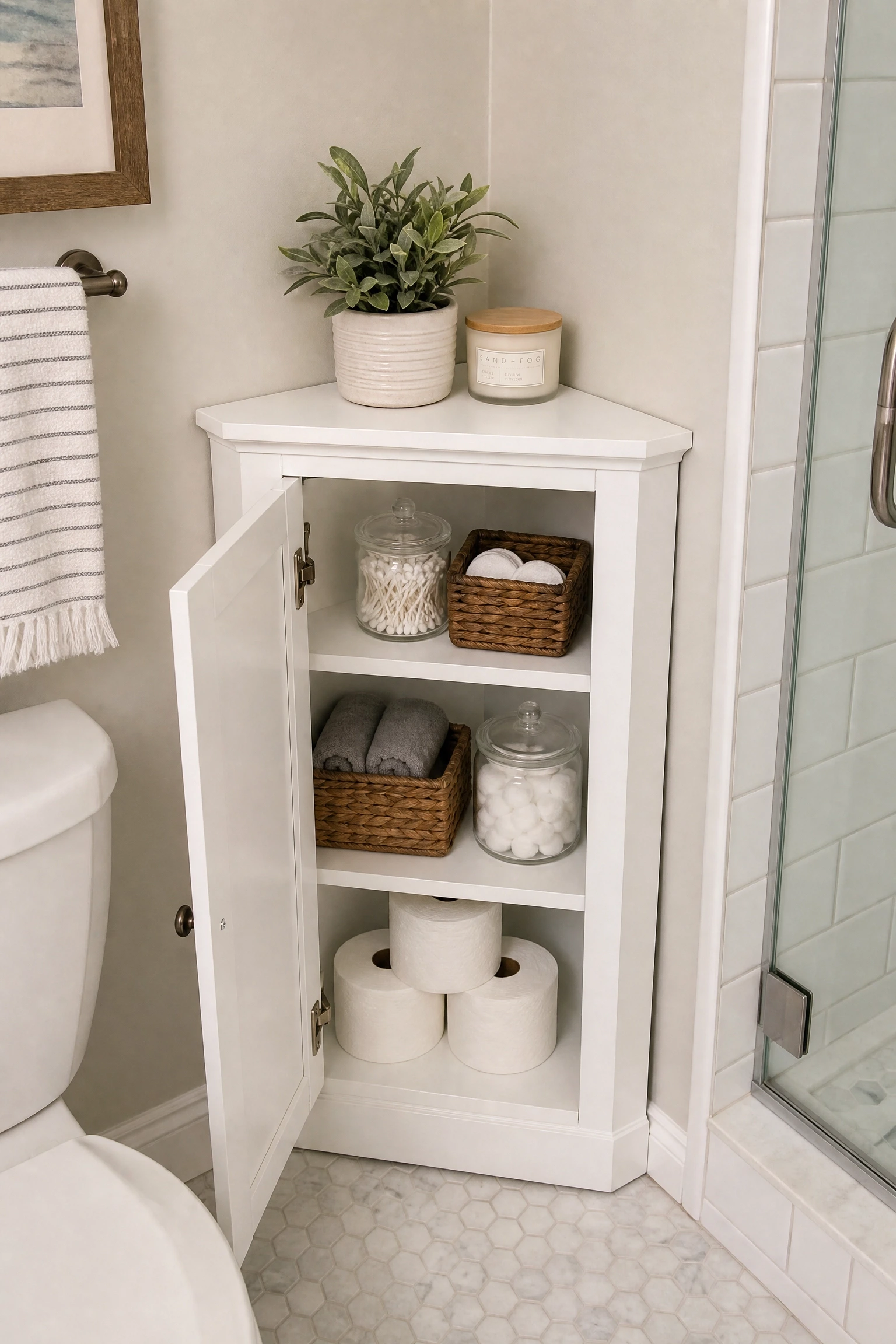
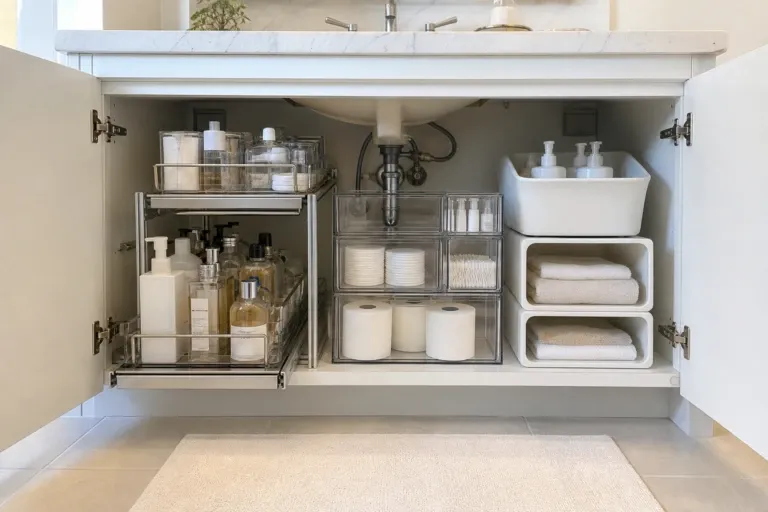
A floor-standing corner cabinet with a triangular or angled footprint designed specifically for 90-degree corner positions provides concealed storage in a bathroom floor corner without the visual weight of a standard rectangular cabinet. Corner-specific floor cabinets are available in timber, painted MDF, and mirror-fronted designs, and the triangular interior can hold a surprising amount of bathroom storage: toilet paper rolls, cleaning products, spare towels, or off-season bathroom accessories. The mirror-fronted corner cabinet is the most functionally efficient option because it reflects light from the bathroom into the corner position where it will otherwise be the darkest spot in the room, simultaneously increasing the apparent size of the bathroom and providing useful additional mirror surface. The practical consideration is floor drainage: in a bathroom where the floor is sloped for drainage, a corner cabinet with adjustable feet will sit level on the uneven surface without rocking.
Designer Advice: Choose a corner cabinet whose door opens outward toward the centre of the bathroom rather than toward the wall. A cabinet door that swings into the wall or into the corner when open is both impractical and creates a visual awkwardness that makes the corner feel more crowded rather than more organized.
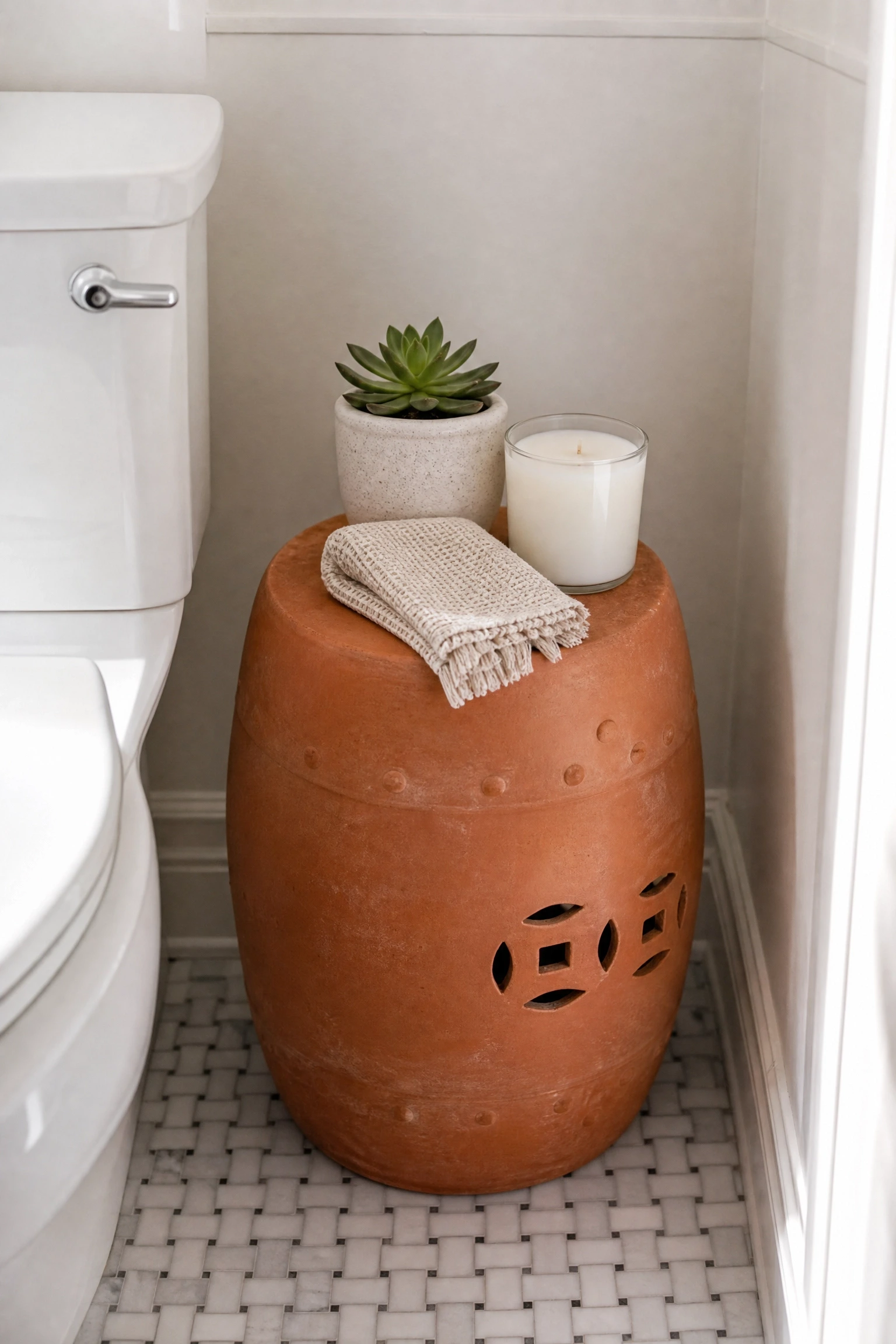
A ceramic garden stool in a bathroom floor corner is one of those ideas that looks like it was placed there effortlessly but actually solves several design problems at once: it fills a corner with a sculptural form at a human scale, it provides a surface for a candle, a plant, or a folded towel, and the weight and presence of ceramic makes it feel like a considered addition rather than a stop-gap. Ceramic garden stools come in a wide range of colours from warm terracotta and cream to cobalt blue and deep forest green, and they suit almost any bathroom aesthetic from rustic farmhouse to contemporary minimal depending on the colour and finish chosen. They are completely waterproof, easy to clean, and require no installation of any kind. The only practical note is that a solid ceramic garden stool in a corner is a fixed object once it is in place: it is heavy enough that it will not be moved casually, so choose the corner position thoughtfully before setting it down.
Reality Check: A ceramic garden stool in the corner looks best when it is not overloaded with items. One plant in a small pot, one candle, and one small folded hand towel are the limit. Piling multiple objects on a stool top creates a precarious arrangement that looks cluttered and could result in items falling onto the bathroom floor.
“The corner you have been ignoring is usually the corner with the most potential. It has walls on two sides, which means it is already framed. You just have to decide what goes inside the frame.”
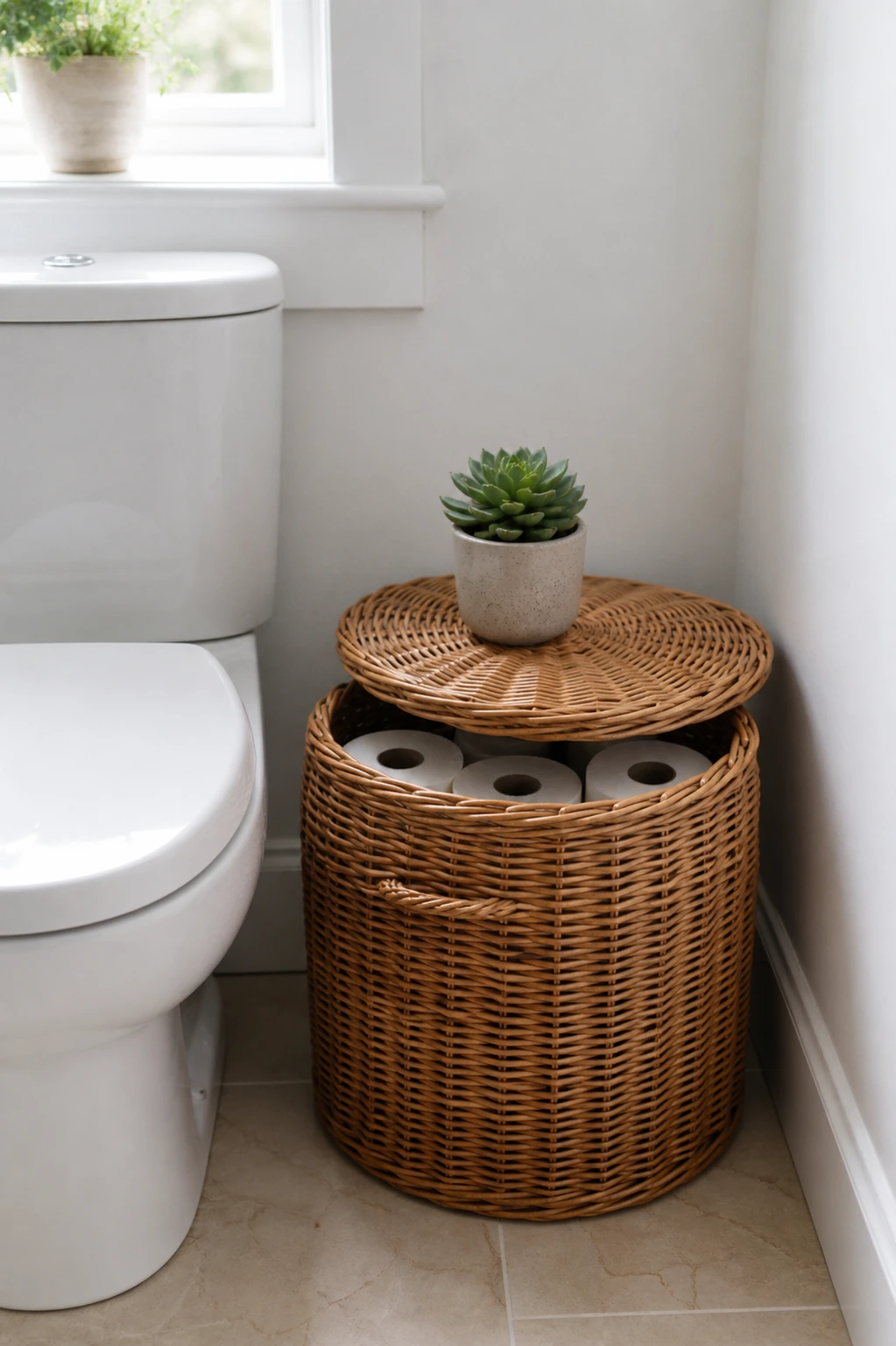
A large wicker or rattan storage basket in a bathroom floor corner is the most understated and most practical corner solution on this list, and it is also one that improves with time because natural wicker and rattan age in a way that looks intentional rather than worn. A round or oval basket with a lid in the corner beside the toilet holds spare toilet rolls, hand towels, or bathroom cleaning supplies with no visual clutter. An open-top basket in the corner beside the vanity holds rolled towels, a plant in a pot, or a collection of bathroom accessories in a way that reads as styled without requiring any careful arrangement. The natural texture of wicker and rattan introduces warmth and organic material into the bathroom regardless of the overall design style, which makes a basket the single most versatile floor corner option across the widest range of bathroom aesthetics.
Quick Tip: Choose a basket that is at least 40 centimetres in diameter for a bathroom floor corner. A small basket in a corner looks like it was placed there to be out of the way. A generous basket at the right scale looks like it belongs to the room and was chosen for that specific corner.
15. A Tall Snake Plant or Architectural Plant in the Corner
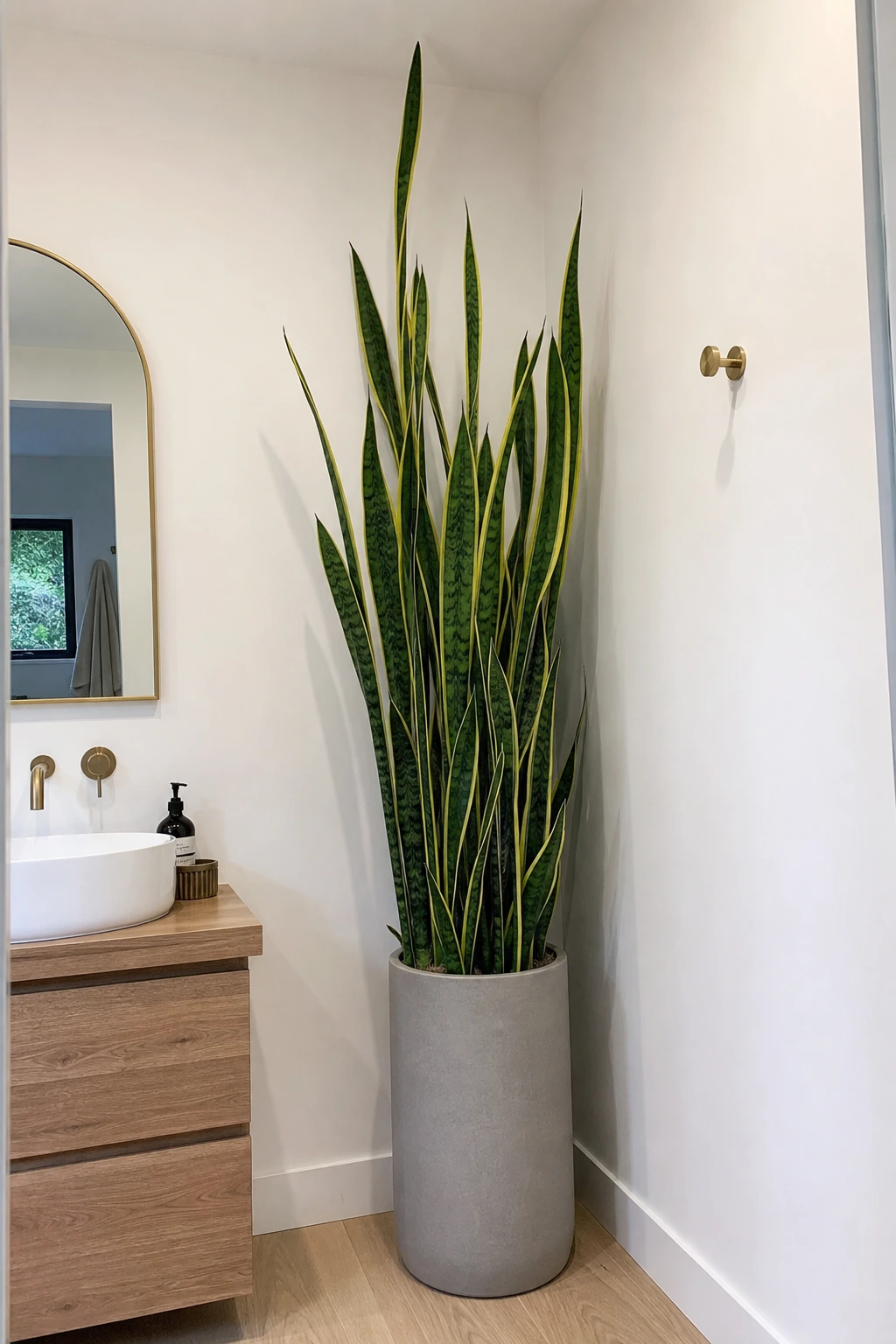
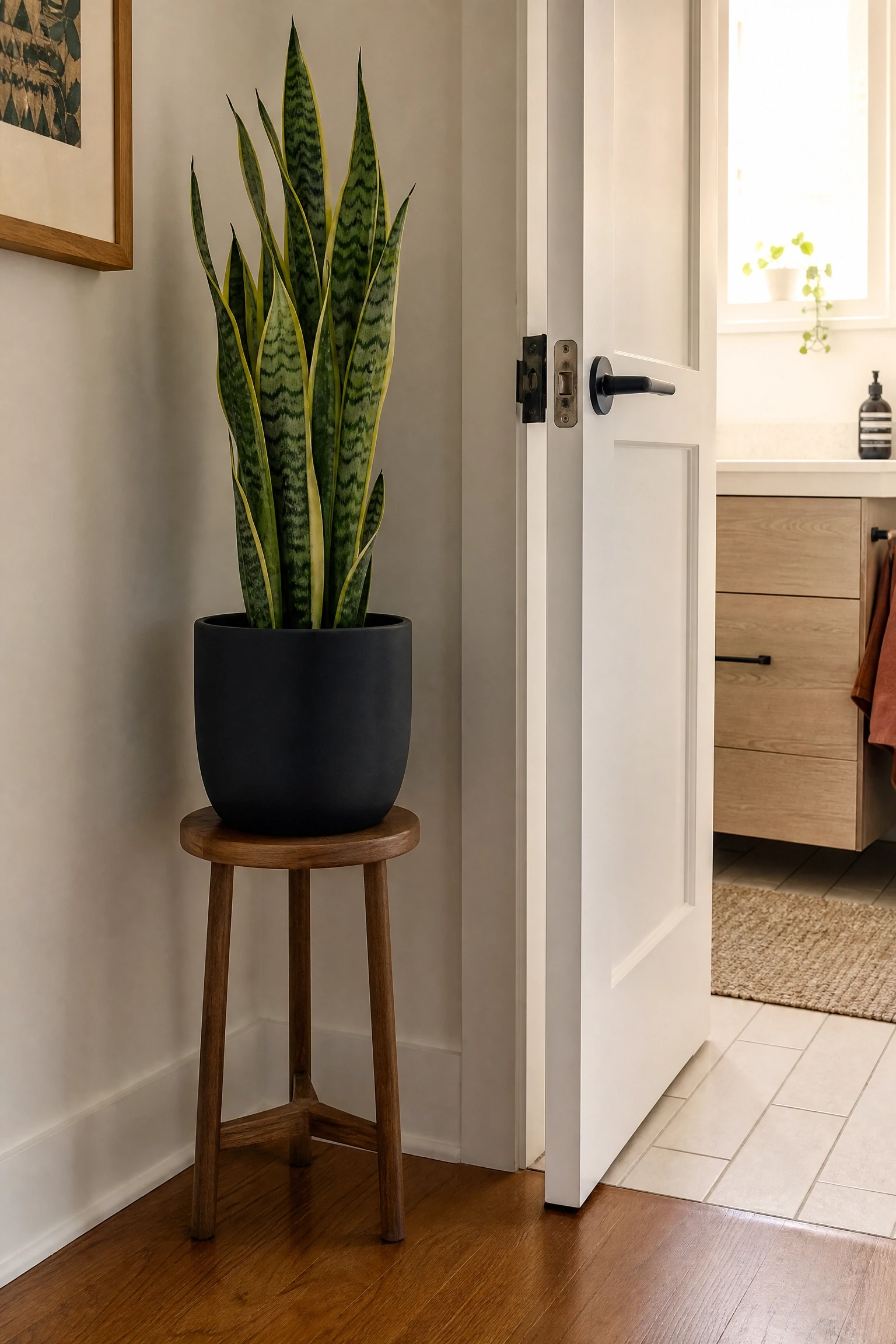
A tall snake plant (Sansevieria) in a floor corner is the single most reliable plant choice for bathroom corners because the snake plant tolerates low light, infrequent watering, high humidity, and temperature fluctuation better than almost any other indoor plant species. In a floor corner, a tall architectural snake plant with upright sword-shaped leaves fills the vertical space of the corner effectively, introduces a strong organic form that contrasts with the hard surfaces of a bathroom, and requires almost no maintenance. Snake plants can reach 90 centimetres to 1.5 metres in height, which gives them enough scale to anchor a corner without a pot stand or pedestal. The choice of pot matters: a snake plant in a plain black nursery pot looks neglected. The same plant in a matte white ceramic pot, a textured concrete planter, or a woven rattan pot cover reads as a deliberate design element.
Designer Advice: Position a tall corner plant at a slight angle so its tallest leaf tips point toward the centre of the bathroom rather than directly into the corner or directly outward toward the door. The diagonal orientation gives the plant a natural, growth-following quality rather than the rigid, symmetrical look of a plant placed perfectly parallel to the walls.
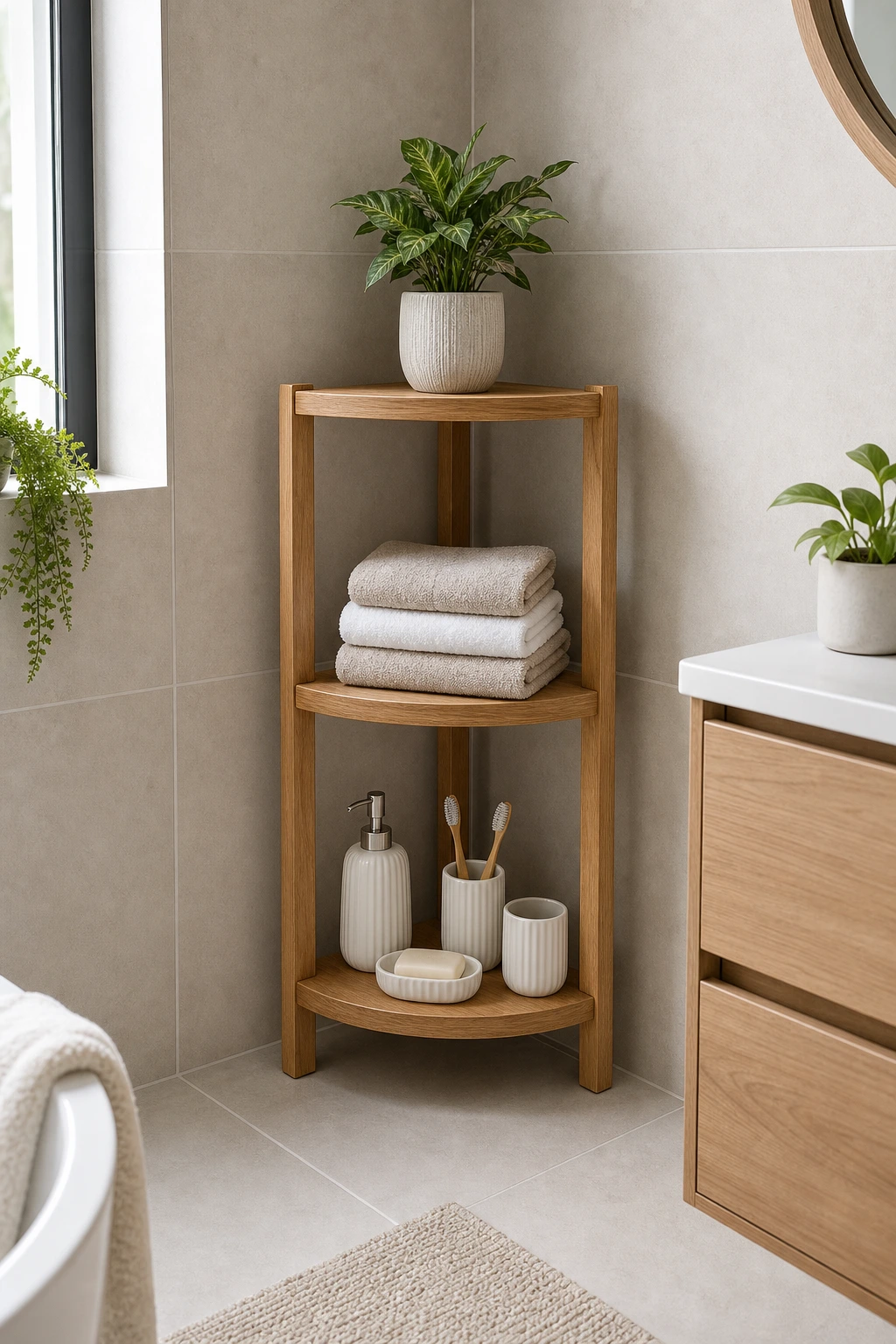
A freestanding corner shelf unit with a triangular footprint specifically designed to sit in a 90-degree corner provides open shelving across three or four levels in a floor corner without wall fixings and without the leaning mechanism of a ladder shelf. The advantage over a ladder shelf is stability: a corner shelf unit with a triangular base and internal supports does not rely on gravity and wall contact to stay upright, which makes it a safer option in households with children or in bathrooms where the walls are not perfectly flat. The advantage over a corner cabinet is visibility: an open shelf unit lets the styling of each shelf contribute to the overall look of the bathroom corner rather than concealing everything behind a door. In a small bathroom, choose a narrow corner shelf unit that fills the corner without projecting more than 30 centimetres into the room at its widest point.
Heads Up: Freestanding corner shelf units with flat-pack construction can be less stable than they appear in product photographs. Check the assembly instructions for any anti-tip wall fixing requirements before placing the unit in the corner, particularly if you plan to store heavier items on the lower shelves.
Wall Corner Ideas
The wall corner, the vertical junction between two bathroom walls above floor level, is the position most people overlook entirely. It is where the eye naturally travels in any small room, and a well-used wall corner can make a bathroom feel significantly more considered and more complete than the same room with identical floor decor but empty upper walls.
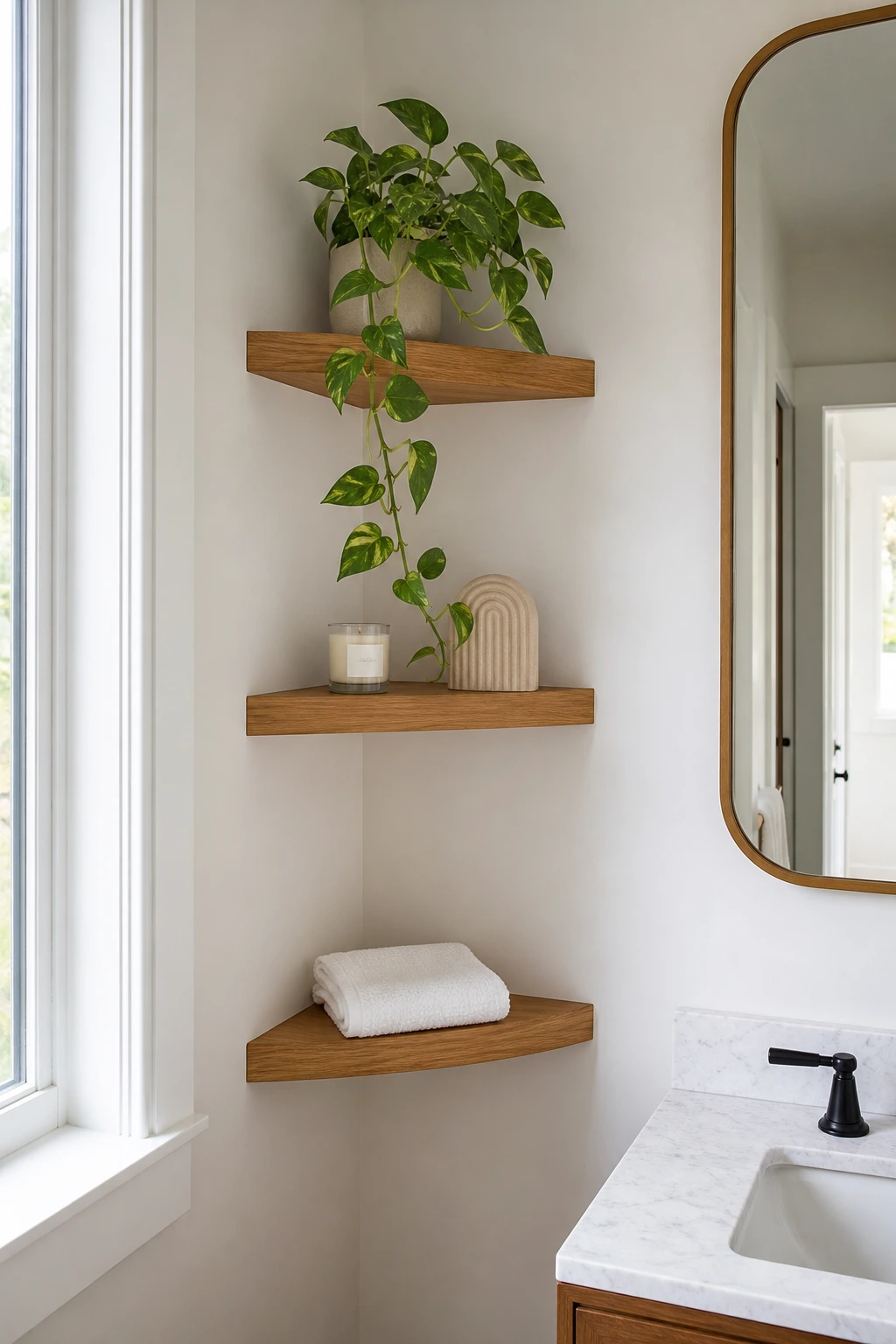
Two or three floating shelves installed at staggered heights in a wall corner, each one stepping slightly inward as they rise, create a display arrangement that fills the corner from mid-wall to ceiling height without the bulk of a full-height cabinet. The shelves need to be corner-specific, fitted at a 45-degree angle or cut to meet the two walls at right angles, rather than standard rectangular shelves that project only from one wall. A set of stacked corner shelves in natural timber, painted white, or in a dark stained finish creates the visual effect of a considered display zone in a bathroom corner that might otherwise be an unused space between two towel rails. Style each shelf level differently: the highest shelf holds a small trailing plant or an air plant in a ceramic vessel, the middle shelf holds a candle and a small ceramic or glass object, and the lowest shelf holds something practical, a rolled washcloth or a small basket.
Pro Move: Install corner floating shelves at heights that relate to existing horizontal elements in the bathroom. A shelf at the same height as the top of the mirror, another at the top of the door frame, and a third halfway between the two creates a visual rhythm that ties the shelving to the architecture of the room rather than floating arbitrarily on the wall.
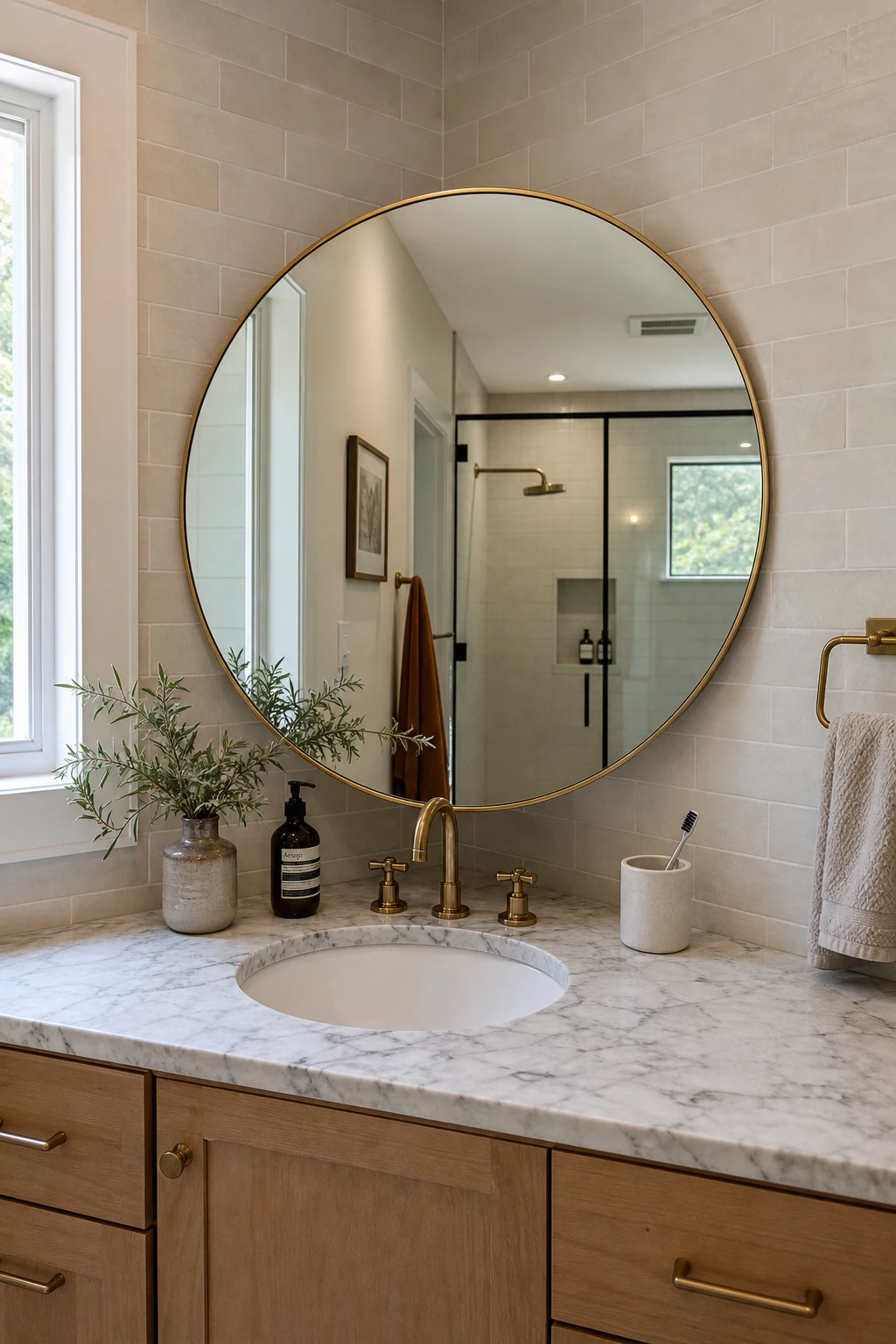
In a bathroom where the vanity sits in a corner position rather than against a flat wall, a corner-mounted or angled mirror that bisects the wall corner at 45 degrees reflects the full vanity surface and the bathroom beyond it simultaneously, effectively doubling the apparent size of the room from the vanity position. A corner mirror installation requires either a custom-cut mirror fitted to the corner or a standard round or arched mirror mounted on the wall that is angled to catch the reflection of the adjacent wall. This approach works especially well in compact bathrooms where the standard position of a mirror directly above the vanity is not available because the vanity sits in a corner with walls on both sides. The reflection of a corner mirror from across the bathroom creates a depth that makes the room feel wider and more open from every position.
Designer Advice: A round mirror is the most forgiving shape for a corner wall position because it does not require precise alignment with the corner angle in the way that a rectangular mirror does. A circle mounted in the visual centre of the corner wall reads as balanced and intentional regardless of the exact angle.
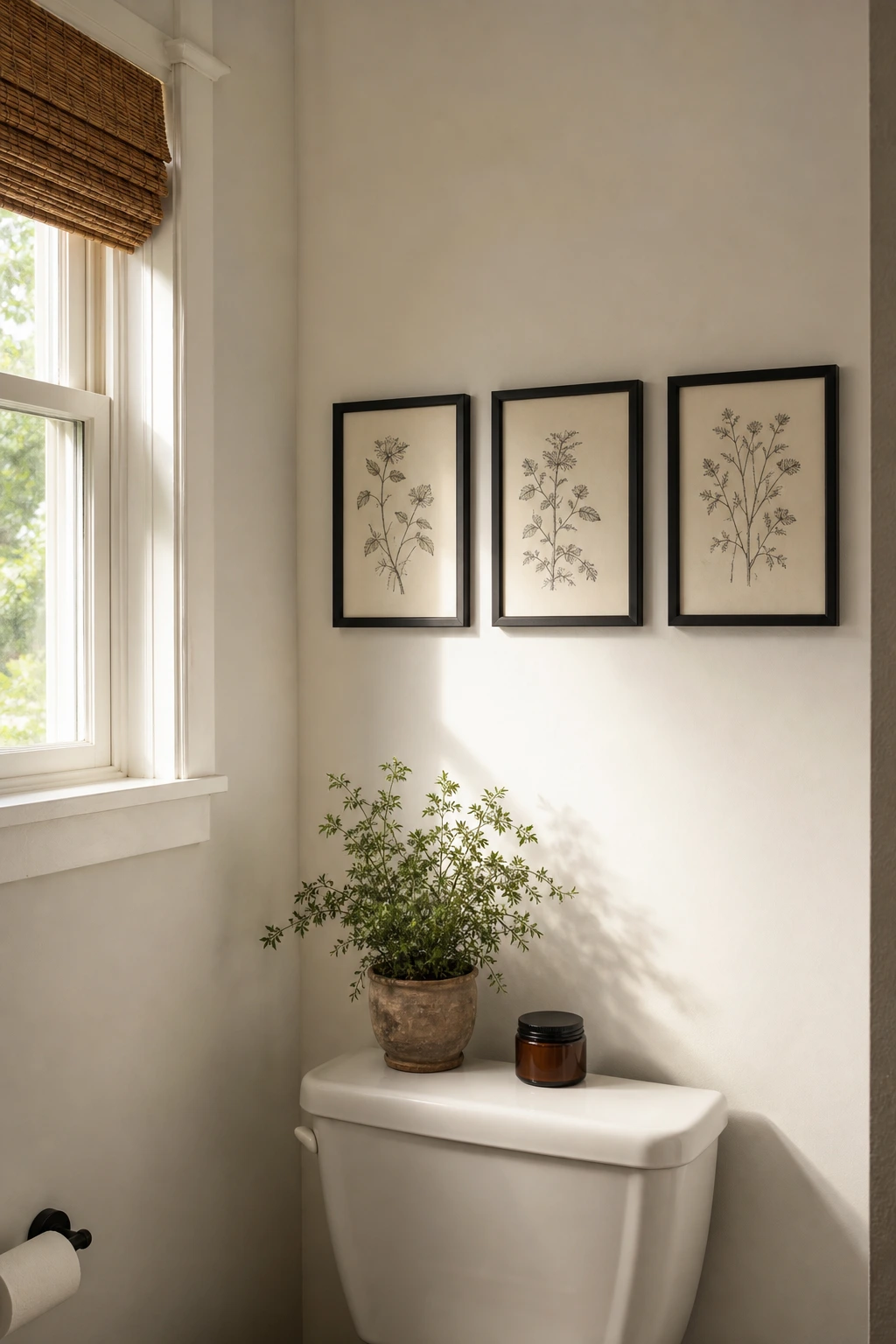
A single piece of framed artwork, a ceramic wall tile, a hanging textile, or a collection of small prints arranged in a grid in the wall corner between the two adjacent walls makes the corner a focal point that draws the eye from elsewhere in the bathroom. In a small bathroom, artwork in the corner opposite the door is the first thing you see when you enter, and a well-chosen piece changes the entire atmosphere of the space from functional to designed. The choice of subject matter is as important in a bathroom as anywhere else: botanical prints, abstract ink drawings, photography in neutral tones, or simple typographic pieces all work well in bathroom wall corners without competing with the room function. The most important practical detail is the hanging method: bathroom humidity makes paper-based prints vulnerable to warping, so frames with a sealed back and glass-fronted prints are the practical requirement for any corner artwork near steam or condensation sources.
Quick Tip: Hang a single piece of art in a bathroom wall corner at eye level as measured from the position you most often occupy in that part of the bathroom, not at standard gallery height from the floor. In a corner opposite the toilet, the right eye level is the one you experience when seated, not when standing.
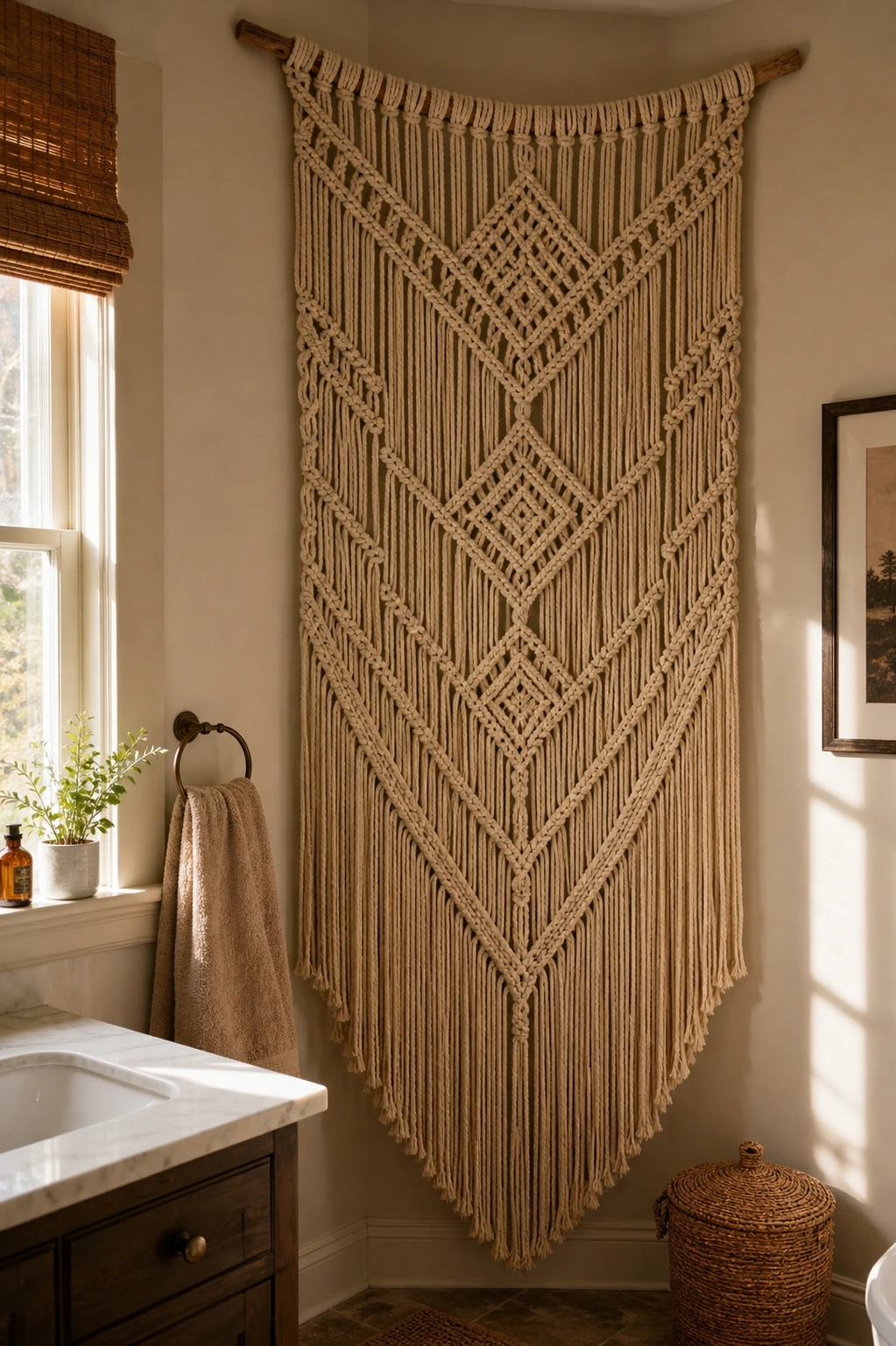
A macrame wall hanging, woven textile, or large-format fibre art piece in a bathroom wall corner introduces texture, warmth, and handmade quality that no tile, paint, or mirror can replicate. The organic irregularity of a hand-knotted macrame piece in a corner between two hard-surfaced walls creates a softness that has an immediate effect on how the bathroom feels to be in: warmer, more personal, and more genuinely comfortable. Natural cotton rope macrame in cream or undyed natural tones suits the widest range of bathroom aesthetics. A woven textile in warm earthen tones, sage, terracotta, or warm grey, suits bathrooms with a more earthy or boho design direction. The practical consideration for textile art in a bathroom is position relative to the shower or bath: a macrame hanging in a corner that is directly in the path of steam from the shower or splashing from the bath will deteriorate quickly and develop mould in the fibres. Corner positions away from direct moisture exposure are the safe choice.
Reality Check: Natural fibre textiles including cotton, jute, and hemp are all susceptible to mould in sustained high-humidity environments. Position any textile hanging in a wall corner that is at least two metres from the shower or bath, and ensure the bathroom has adequate ventilation to prevent the fibre absorbing residual steam after showers.
A recessed niche built into a bathroom wall corner, either triangular to use the corner geometry or rectangular and set into one of the two corner walls, creates a display alcove that sits within the wall plane without projecting into the room at all. A small corner niche at eye height, tiled or painted and lit from above with a small LED strip, holds a candle, a small plant, or a collected arrangement of bathroom accessories in a way that feels architectural and intentional rather than decorative and added-on. Wall niches are a renovation-level addition that requires checking for pipe and wiring runs before cutting into the wall, but in any bathroom where renovation work is being planned, a corner niche at display height is one of the most visually rewarding additions available for the wall corner position at a relatively modest additional cost.
Heads Up: Before cutting into any bathroom wall for a niche, have the pipe and wiring layout checked by a plumber or electrician. Bathroom walls almost always contain plumbing runs and sometimes electrical supplies for shaver sockets and heated rails, and cutting into an active pipe or cable is a significantly more expensive problem than the cost of a niche installation.
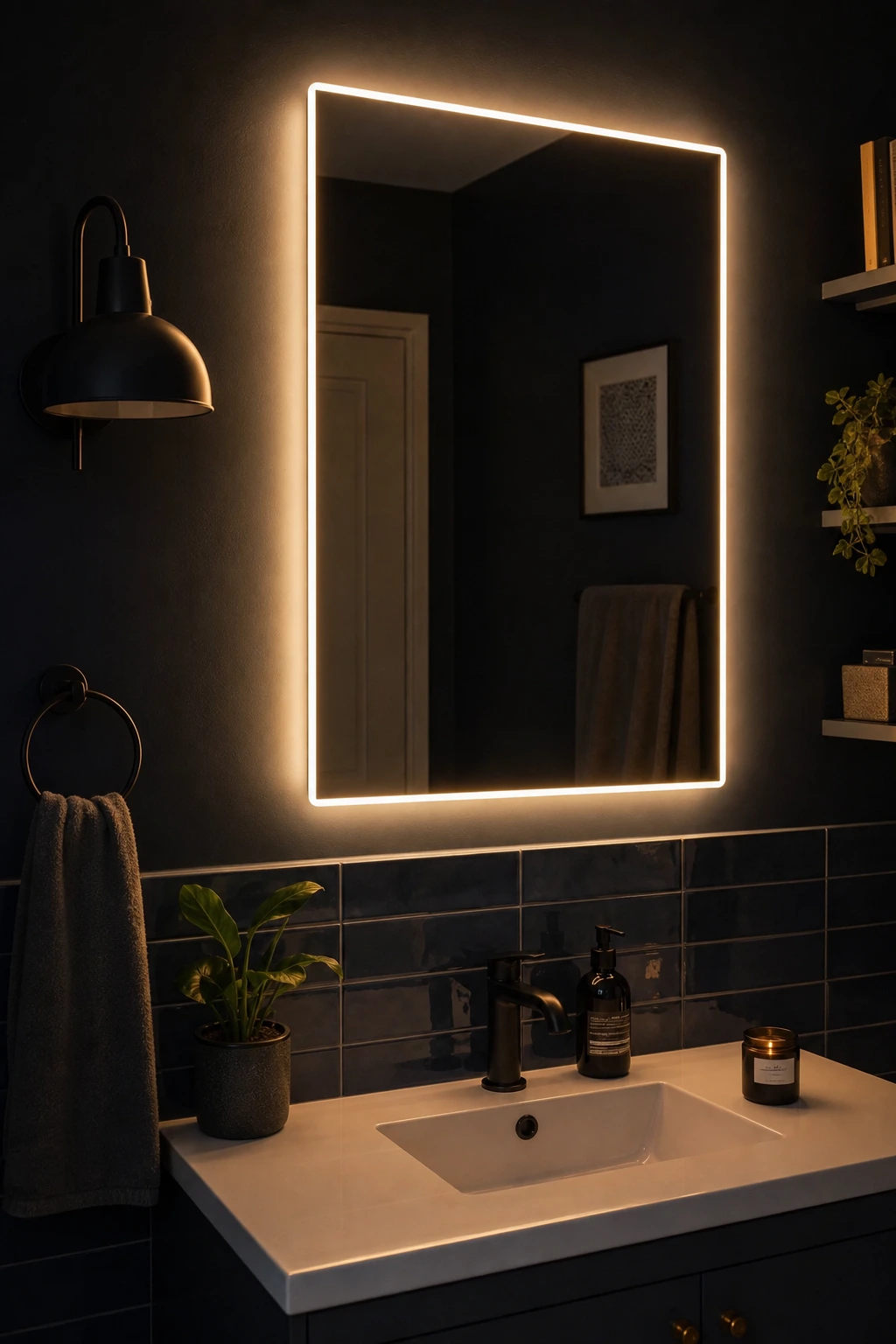
A backlit or LED-integrated mirror mounted in a bathroom wall corner provides both a functional mirror surface and a light source from a position that most bathrooms never use for lighting. A corner LED mirror creates a warm glow that fills the corner with light rather than shadow, which changes the corner from the darkest point in the room to one of its warmest. The light from a corner LED mirror is also particularly flattering because it comes from a position that illuminates the face at an angle that the typical above-mirror or overhead lighting does not. Frameless backlit mirror panels in a rectangular format, or circular LED mirrors in a round form, are both available in corner-appropriate sizes and can be mounted on the wall of the corner with the same fixings as a standard mirror. The warm light from an LED mirror at 2700K to 3000K changes the atmosphere of the bathroom during evening use far more significantly than the mirror itself.
Pro Move: If the bathroom has a corner position near the vanity, a secondary LED mirror in that corner provides task lighting for make-up application and grooming from a lateral angle that reveals shadow and dimension in a way that straight-on overhead lighting cannot. The aesthetic benefit is matched by a genuine functional improvement.
Door Corner Ideas
The corner behind the bathroom door, or the narrow corner between the door frame and the adjacent wall, is the most challenging and most consistently ignored position in any bathroom. It is a constrained space that must work around the swing of the door, which limits what can be placed there permanently, but with the right approach it can hold more than most people realize.
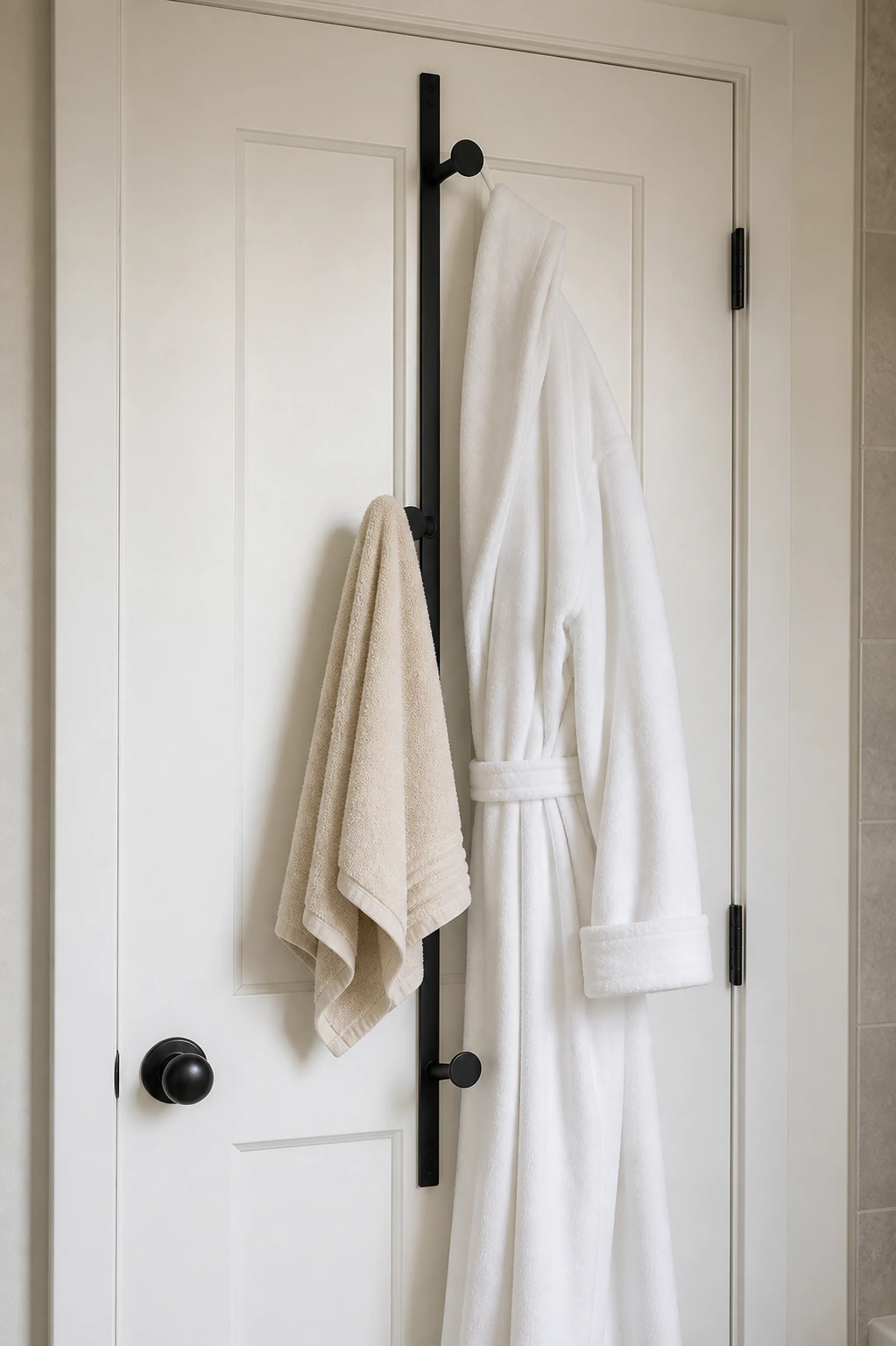
The back of the bathroom door is the most consistently underused surface in the room and the back corner of the door, where it meets the door frame, is the most valuable position on that surface. A row of hooks on the back of the door, starting at the top and working downward to suit the items being hung, creates immediate storage for robes, towels, bags, and the outfit staged for after the shower without taking up any floor space at all. Over-door hook bars that hang from the top of the door frame without any drilling are the most renter-friendly approach. Drilled hook rails in matte black, brushed brass, or timber pegs give a more permanent and more considered result. The specific corner behind the door is also a good position for a narrow hook rail that holds tomorrow morning outfit on a single hanger, which is a daily habit that sounds minor but makes the bathroom routine dramatically more organized.
Quick Tip: Limit the back of the bathroom door to one category of hung items rather than using it as a general dumping point for everything that needs to be off the floor. A door that is used exclusively for robes and towels always looks tidy. A door that holds robes, bags, spare clothes, and miscellaneous items always looks cluttered regardless of how many hooks are used.
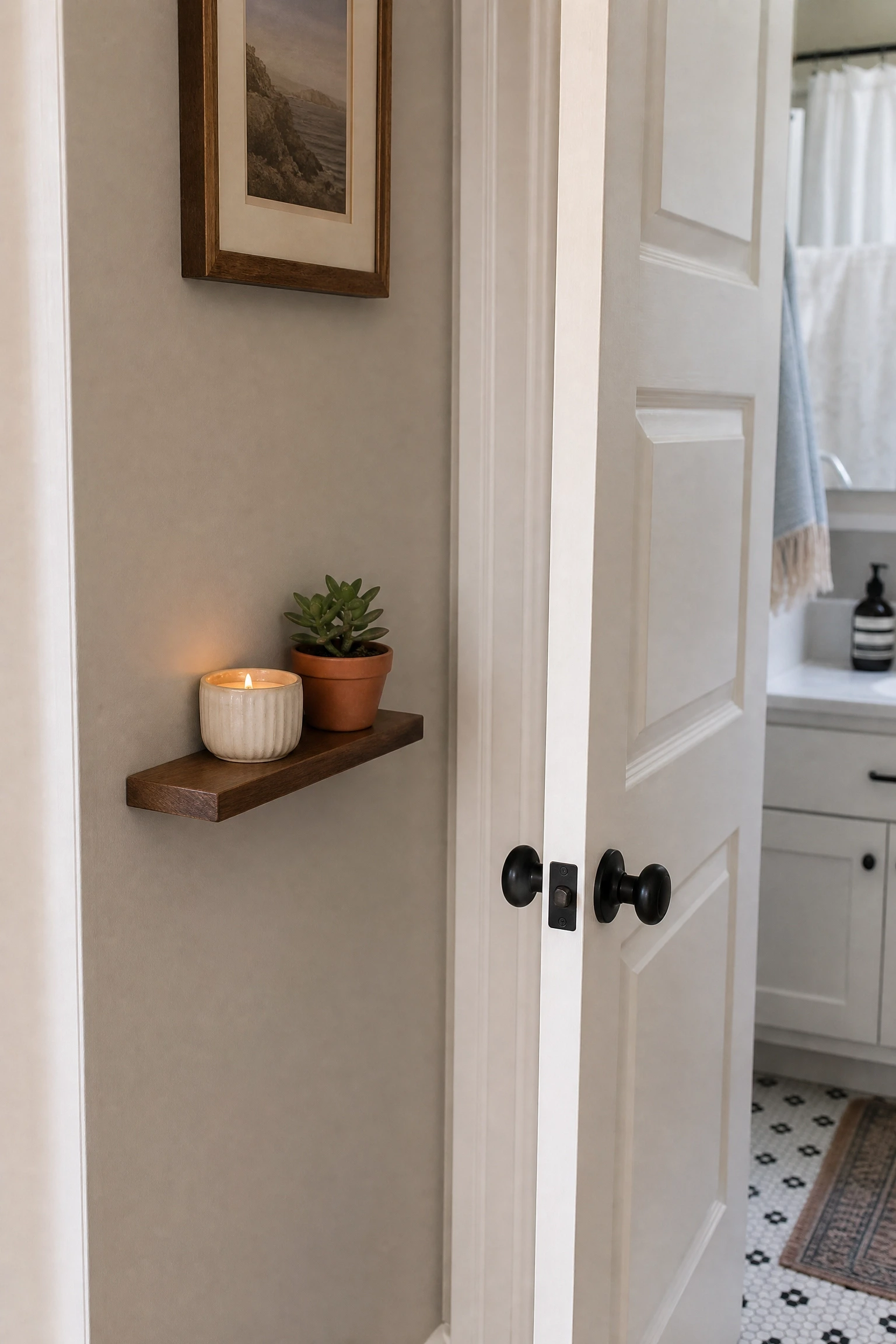
The wall between the bathroom door frame and the adjacent wall corner is often too narrow for a cabinet or a standard shelf but wide enough for a slim floating shelf at the right height. A shelf of 15 to 25 centimetres in depth mounted on the narrow wall section beside the door frame at approximately eye level, or at the height of the door frame top, creates a small but genuinely useful surface for a candle, a hand lotion, a small plant, or a ceramic dish for jewellery removed before showering. The shelf needs to be positioned so that the door can open fully without hitting it, which usually means placing it higher than the door handle height or recessing it slightly into the wall position on the latch side rather than the hinge side of the door. A shelf in this position that is permanently in the way of the door opening is worse than no shelf at all.
Heads Up: Measure the full arc of the bathroom door swing before mounting any shelf on the adjacent wall. The door handle protrudes further than the door itself and needs its own clearance. A shelf on a narrow door-frame wall needs at least 10 centimetres of clearance from the door handle at its closest point of the door swing.
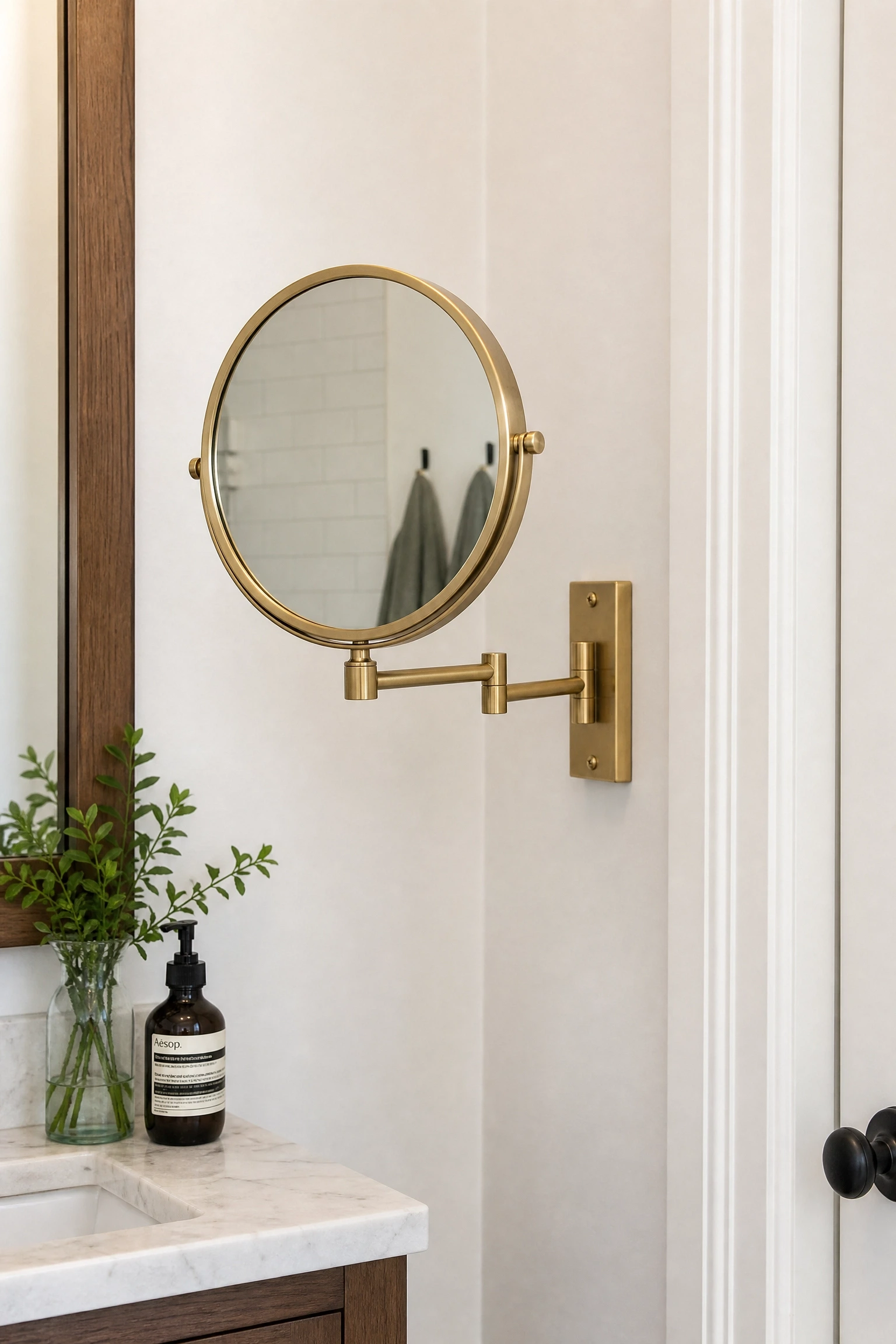
The wall corner beside the bathroom door, particularly on the latch side where a slim wall section is available, is a good position for a wall-mounted folding or extending magnifying mirror. This type of mirror folds flat against the wall when not in use, taking up no projection from the wall surface at all, and extends outward on a jointed arm when needed for close-up tasks like make-up application, shaving, or skincare. Positioning it in the corner beside the door rather than at the main vanity creates a secondary grooming position in the bathroom that does not compete with the main mirror and is particularly useful in a shared bathroom where two people need simultaneous access to mirror space. Wall-mounted magnifying mirrors in brushed brass, matte black, or polished chrome are all widely available and the wall fixings for a mirror arm are lightweight enough that adhesive mounts are a viable option for renters who cannot drill.
Designer Advice: Choose a magnifying mirror arm that extends at least 40 centimetres from the wall. An arm that is too short pulls the user uncomfortably close to the wall to use the mirror, which defeats the practical purpose of having a secondary mirror in the door corner. The extension length is as important a specification as the magnification factor.
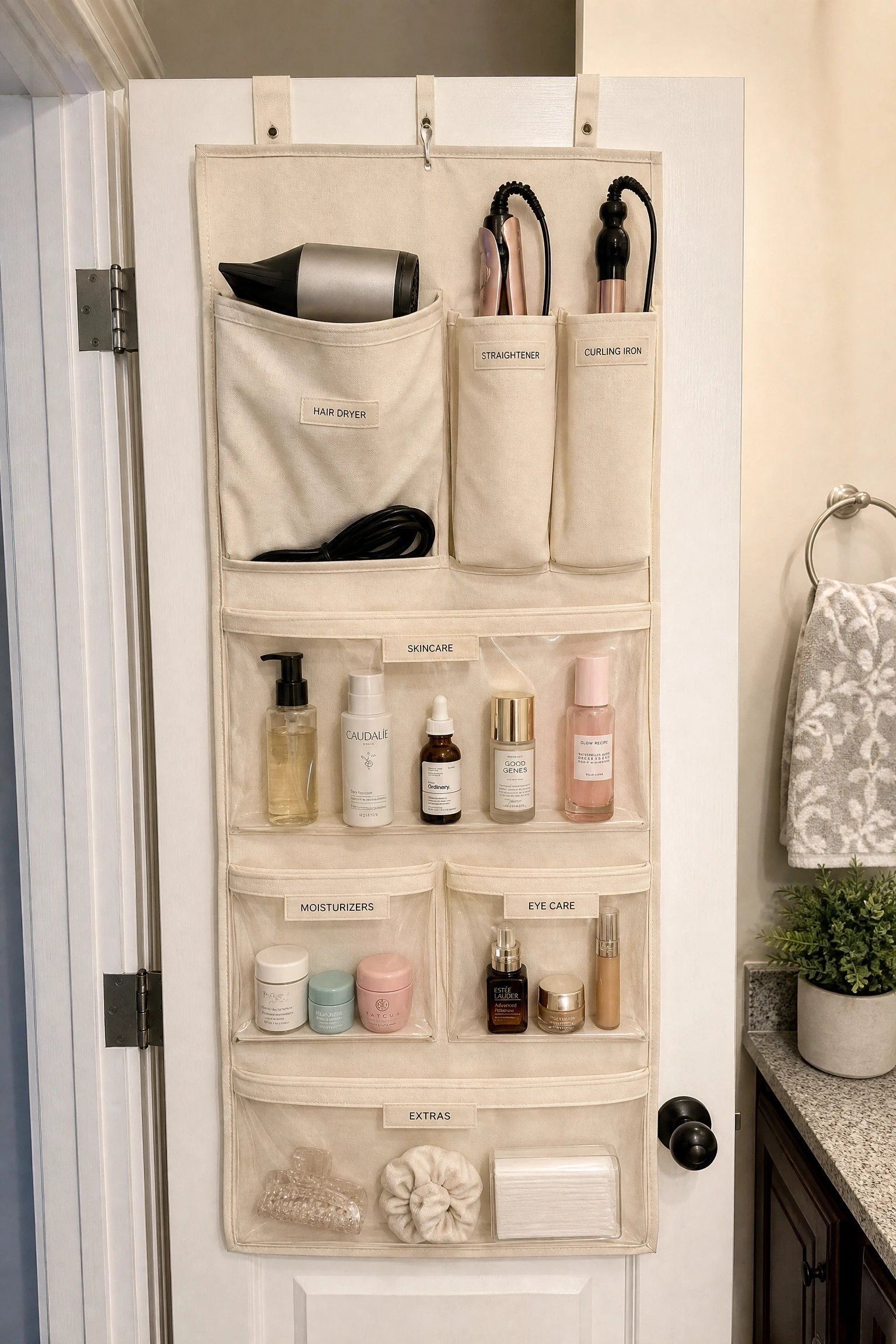
An over-door organizer with clear or fabric pockets hung from the top of the bathroom door uses the back of the door as storage in a more organized and capacity-efficient way than hooks alone. A clear pocket organizer in a bathroom holds hair tools, straightening iron, hair dryer, styling products, and daily skincare in individual visible pockets that make everything accessible without requiring any drawer or cabinet space. This approach is particularly useful in bathrooms where counter space and cabinet space are both limited, because it creates storage capacity from a surface that was previously contributing nothing. The aesthetic challenge of an over-door pocket organizer is that the plastic or fabric pockets themselves are rarely attractive objects, so choosing a version in a neutral tone, white, cream, or black, and keeping the contents organised by category rather than randomly filled is the difference between a functional storage solution that reads as intentional and one that looks improvised.
Reality Check: An over-door pocket organizer in a bathroom works best for items that are accessed daily. Items that go in and rarely come out are better stored elsewhere. A pocket organizer that is fully used and regularly rotated stays organized. One that is only partially used with random items in scattered pockets looks more chaotic than no organizer at all.
The floor corner directly beside the bathroom door on the latch side, a position that is typically too narrow and too close to the door swing to hold furniture, can often accommodate a slim plant stand or a tiered corner plant shelf if the door swing geometry allows. A plant stand of 20 to 30 centimetres in diameter with a single shelf for one large plant, positioned so that the door can open fully without touching it, creates a living moment at the entry point of the bathroom that is the first thing you see when you open the door from outside. The specific positioning of the plant relative to the door swing needs to be checked physically before any purchase: stand in the corner and open the bathroom door to its full extent to find exactly where the door handle sweeps, and choose a plant stand that sits outside that sweep with at least 10 centimetres of clearance. A snake plant, a ZZ plant, or a sculptural cactus in a well-chosen pot is the right scale and the right light-tolerance for a corner that is unlikely to receive consistent natural light.
Quick Tip: If the door corner is too tight for any floor piece, consider a wall-mounted plant bracket at head height on the narrow wall beside the door. A single small trailing plant in a bracket pot at head height creates a living element at the bathroom entry point without occupying any floor space at all.
Every bathroom has at least five or six distinct corners, and each one has its own constraints, its own opportunities, and its own right solution. The shower corner problem is different from the bathtub corner problem. The floor corner beside the door has different answers than the wall corner above the toilet. The reason most bathroom corner advice is hard to act on is that it treats all of these positions as the same problem, which they are not. Go back to the specific corner in your bathroom that is bothering you most, find the group in this article that matches that position, and start with the simplest idea in that group rather than the most ambitious one.
Small bathroom corners respond dramatically to even modest changes because the scale of the room means that every element is noticed. A plant in the right corner of a bathroom does more for the atmosphere of the room than the same plant in the corner of a living room, because the bathroom is smaller, the surfaces harder, and the contrast between living material and hard tile more pronounced. Give each corner a role, keep each solution scaled appropriately to the position, and the bathroom as a whole will feel more considered and more complete as a result.
“Which corner in your bathroom have you been ignoring the longest? Drop it in the comments and tell us what you are planning to do with it.”
Frequently Asked Questions
What can I put in a bathroom corner to make it look styled?
The answer depends entirely on which corner you mean. A shower corner needs water-resistant storage like a glass shelf or teak caddy. A floor corner beside the toilet works well with a wicker basket, a ladder shelf, or a tall plant. A wall corner above floor level benefits from stacked floating shelves, artwork, or a backlit mirror. A door corner is best used with hooks, a narrow shelf, or a plant stand on the latch side. Match the solution to the specific position rather than applying a general idea to any corner.
What plants work best in a bathroom corner?
The right plant depends on the light available in the specific corner. Snake plants and ZZ plants tolerate very low light and high humidity, making them the most reliable choice for dark interior corners. Pothos and philodendron tolerate low to medium light and thrive in the humidity of a bathroom environment. Monstera deliciosa needs medium indirect light and is best for a corner near a window. For shower corners specifically, a small air plant in a sealed glass vessel or a sprig of eucalyptus hung from the showerhead are the most practical living additions because they tolerate direct water exposure.
How do I decorate a bathroom corner without drilling?
Tension pole caddies in the shower corner require no drilling. Freestanding floor corner solutions including ladder shelves, corner shelf units, wicker baskets, ceramic garden stools, and plant stands all require no wall fixings. Adhesive hooks for the back of the door and the door-frame wall are available in load-rated versions that work without drilling. Over-door organizers require no fixings at all. Peel-and-stick corner shelf brackets are available for lightweight display items. The main limitation of non-drilled solutions is stability: any shelf or surface intended to hold heavier items should be properly wall-fixed for safety.
How do I make a small bathroom corner feel larger?
Avoid adding multiple elements to a small bathroom corner. One well-chosen item at the right scale reads as designed; two or three competing items in the same corner reads as cluttered regardless of how attractive each individual piece is. Use a mirror in the corner to reflect light and create depth. Choose light-coloured or transparent materials (glass, white ceramic, light timber) rather than dark or heavy ones. Position any floor element so it is lower than the ceiling by at least 30 centimetres to avoid making the corner feel compressed. Keep the floor around the corner element clear.
What is the best corner storage solution for a bathroom?
For the shower corner, a built-in tile niche is the best permanent solution and a glass corner shelf is the best non-permanent alternative. For the floor corner, a freestanding corner shelf unit or a ladder shelf provides the most versatile storage across multiple levels. For the wall corner above floor level, stacked floating corner shelves give the most display and storage capacity for the wall area they occupy. For the door corner, over-door hooks and a slim floating shelf on the adjacent wall are the most practical combination. Budget and rental restrictions typically determine which of these is most appropriate for any given bathroom.
How do I decorate a bathroom corner beside the toilet?
The corner beside or behind the toilet is the most constrained floor corner in the bathroom because the toilet itself occupies most of the accessible floor space. A slim corner floor cabinet designed for this position is the most storage-efficient option. A small wicker basket for spare toilet rolls is the most affordable and most renter-friendly option. A slim ladder shelf in the corner behind the toilet provides vertical display space without occupying the floor beside it. A single tall narrow plant such as a snake plant or a columnar cactus in this corner creates a strong visual element with a very small floor footprint.