A black accent wall fails for one reason more than any other: the wrong wall got picked. Paint the wall behind the mirror and the room gains depth; paint the wall the light dies on and the room gains a cave.
These 26 bathrooms are grouped by which wall went black, behind the vanity, all the walls at once, inside the shower, and the small powder walls, because the right choice depends on what stands in front of the wall and how much light it receives.
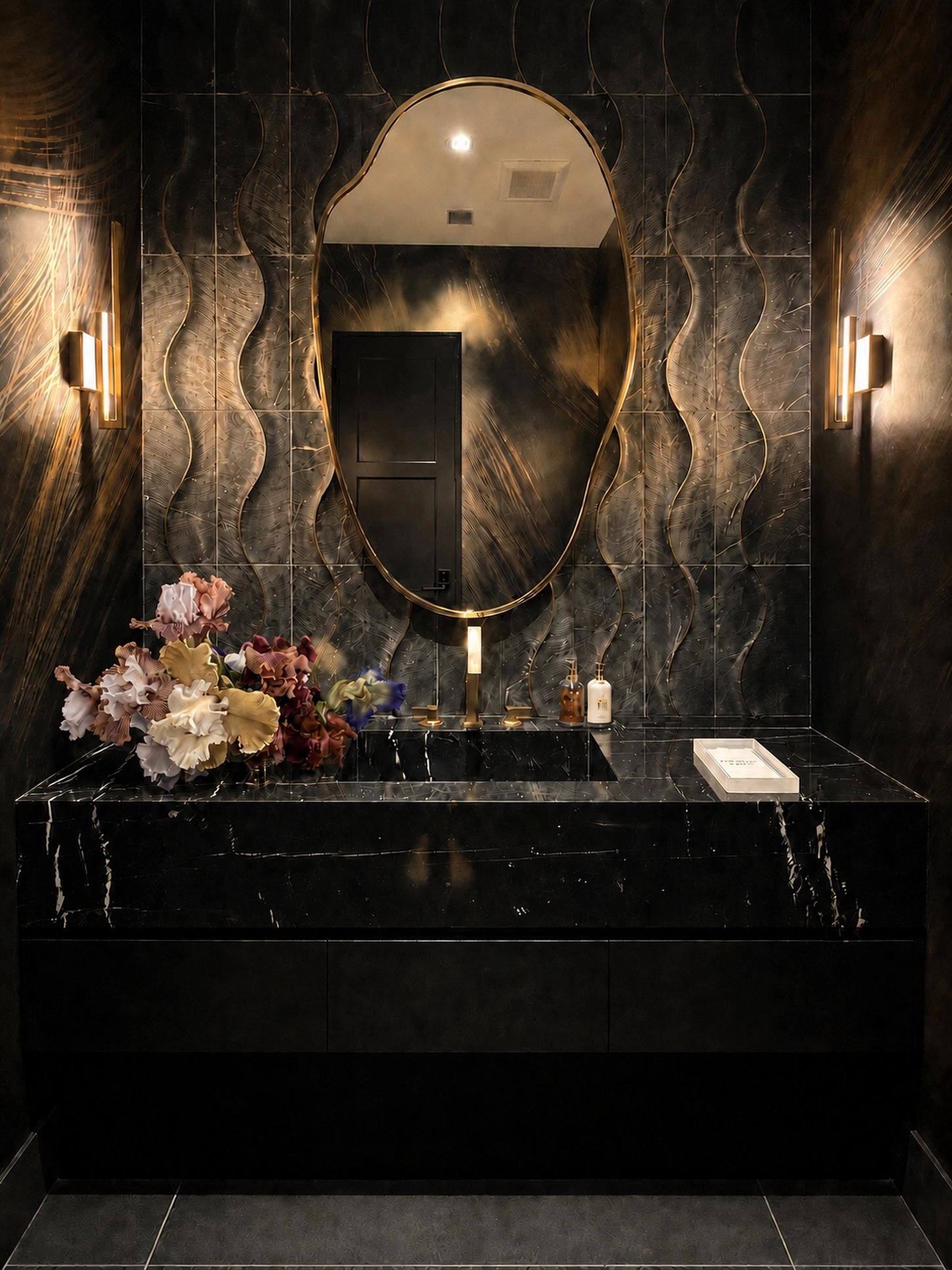
This powder room wraps its vanity wall in undulating black tile with brass veining, a black marble basin and counter below, and an oval mirror floating in the middle. Sculptural tile is the luxury end of the accent wall idea because it changes with the light all day, throwing small shadows that flat paint cannot. It also hides splashes better than any smooth surface, since the eye reads the waves first. If the budget stretches to one tiled wall in a powder room, spend it here where guests stand closest to it.
Proximity rule:The closer people stand to a wall, the more texture it deserves. Vanity walls are read at forty centimeters; shower walls at two meters.
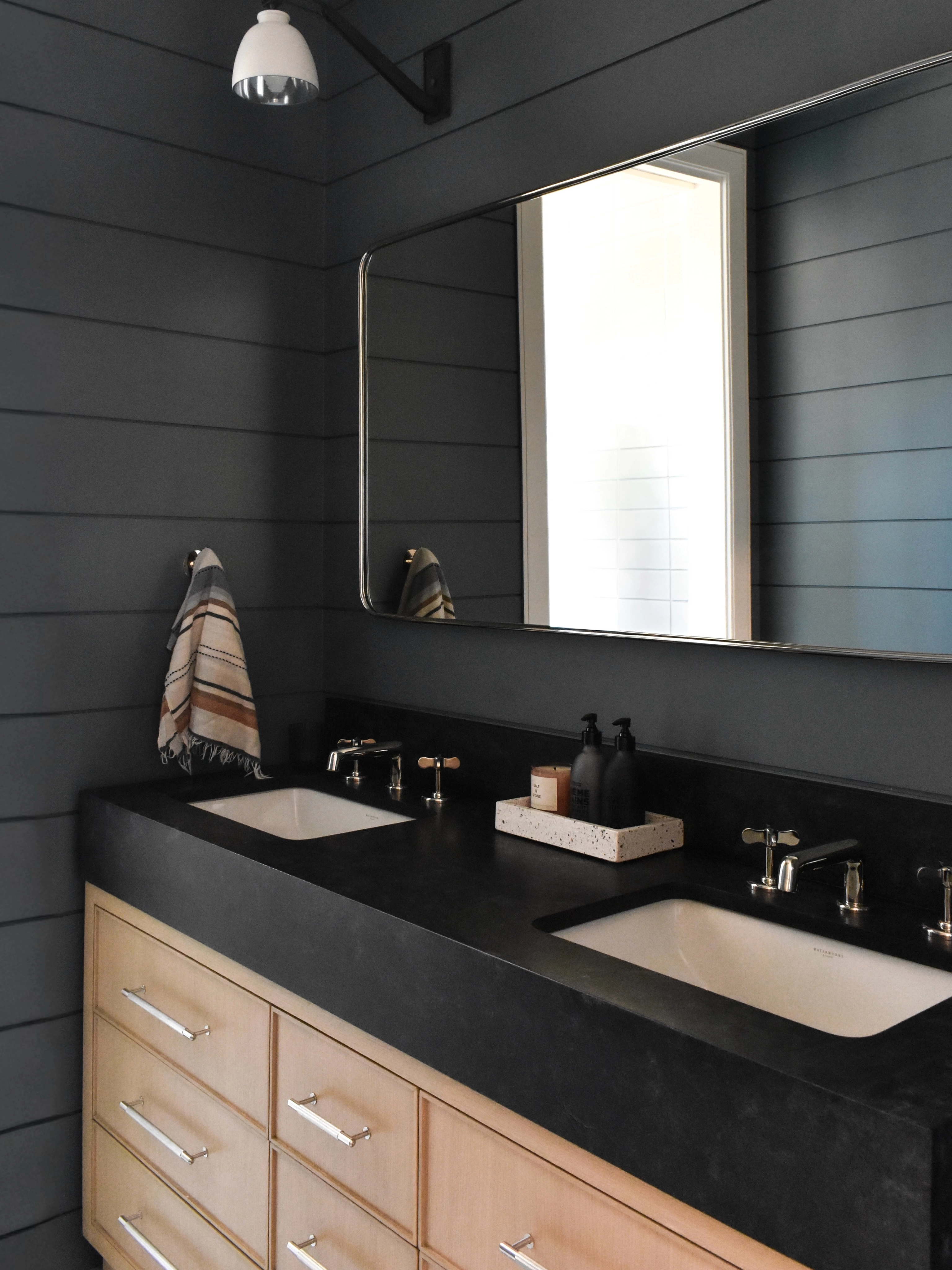
Horizontal black shiplap wraps this bathroom’s vanity and toilet wall, pale wood drawers and a black counter anchoring the bottom. Shiplap is the friendliest black wall for family bathrooms because the grooves give the darkness a rhythm, and rhythm keeps black from reading as a void. It is also repairable in a way tile is not: one damaged board swaps out in an afternoon. Use moisture rated boards or seal standard ones well, especially on the splash line behind the taps where water lands daily.
Splash line:Behind taps, any wood wall needs its sealer renewed yearly. Put a reminder with the smoke alarm batteries and it will actually happen.
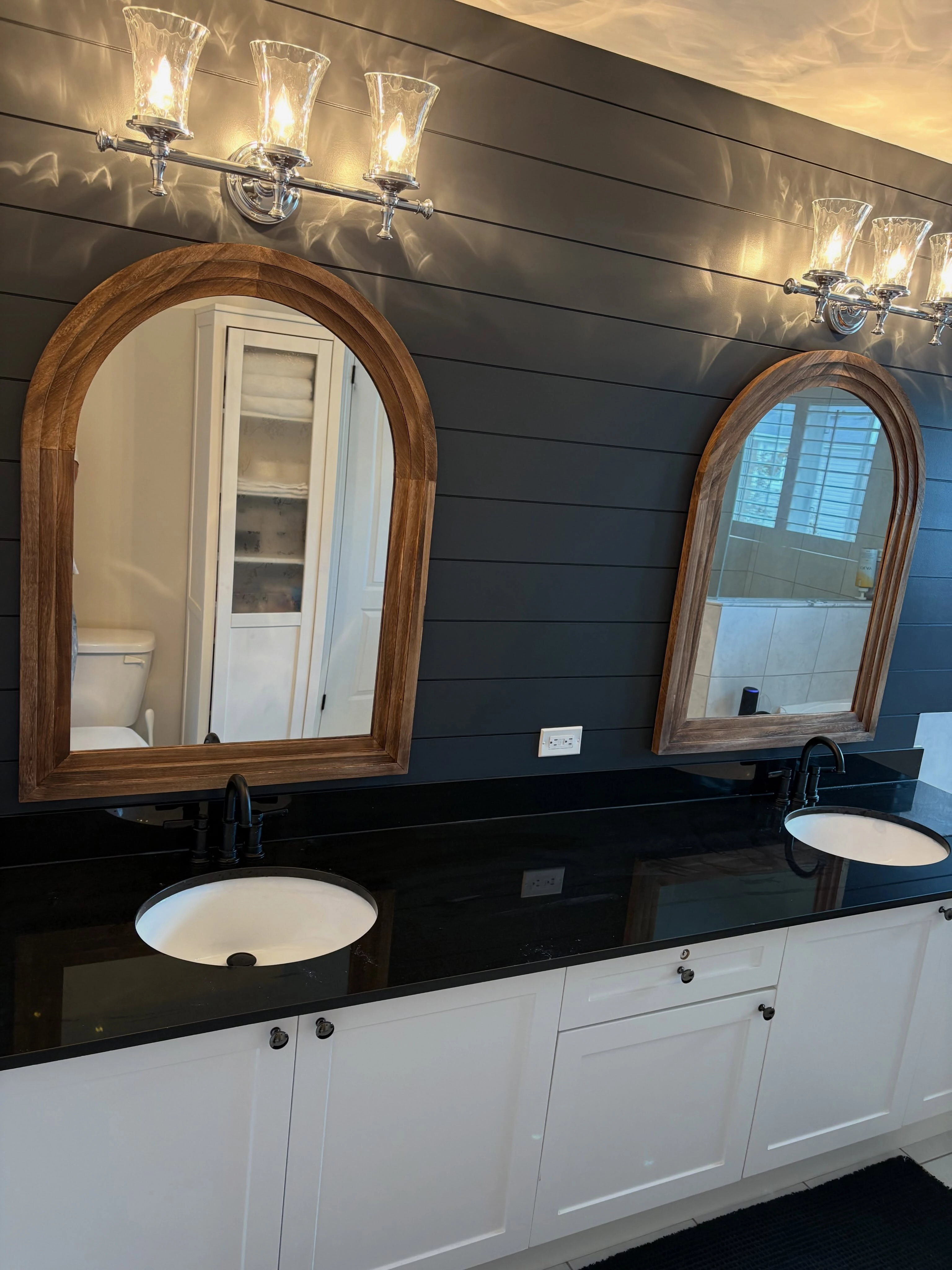
A contractor’s finished bathroom pairs a black shiplap wall with white shaker cabinets, a black countertop and arched wood mirrors. The white cabinets are doing quiet structural work: they bounce light back up into faces, which is the weakness of every black vanity wall. If your vanity itself is dark too, add the light somewhere else, pale counters, a big mirror, brighter sconces. The arched mirrors repeat the softness of the wood frames and keep the straight shiplap lines from turning the room into a barcode.
Face light test:Stand at the mirror at night with only the bathroom lights on. If your face falls into shadow, the wall is fine and the lighting is not; fix the cheaper one.
The simplest treatment in this section: one wall painted black behind a wood vanity, white subway tile in the shower beside it. Paint is the accent wall for the undecided, because a weekend and a single tin reverse it completely. The contrast with the white shower is what makes it read as design rather than gloom; black needs a bright neighbor to perform. Choose a paint with a slight sheen, satin rather than dead matte, in working bathrooms, since matte black shows every toothpaste fleck at sink height.
Sheen choice:Satin or eggshell black wipes clean; dead matte black chalks and marks. Save the true matte for powder rooms nobody brushes their teeth in.
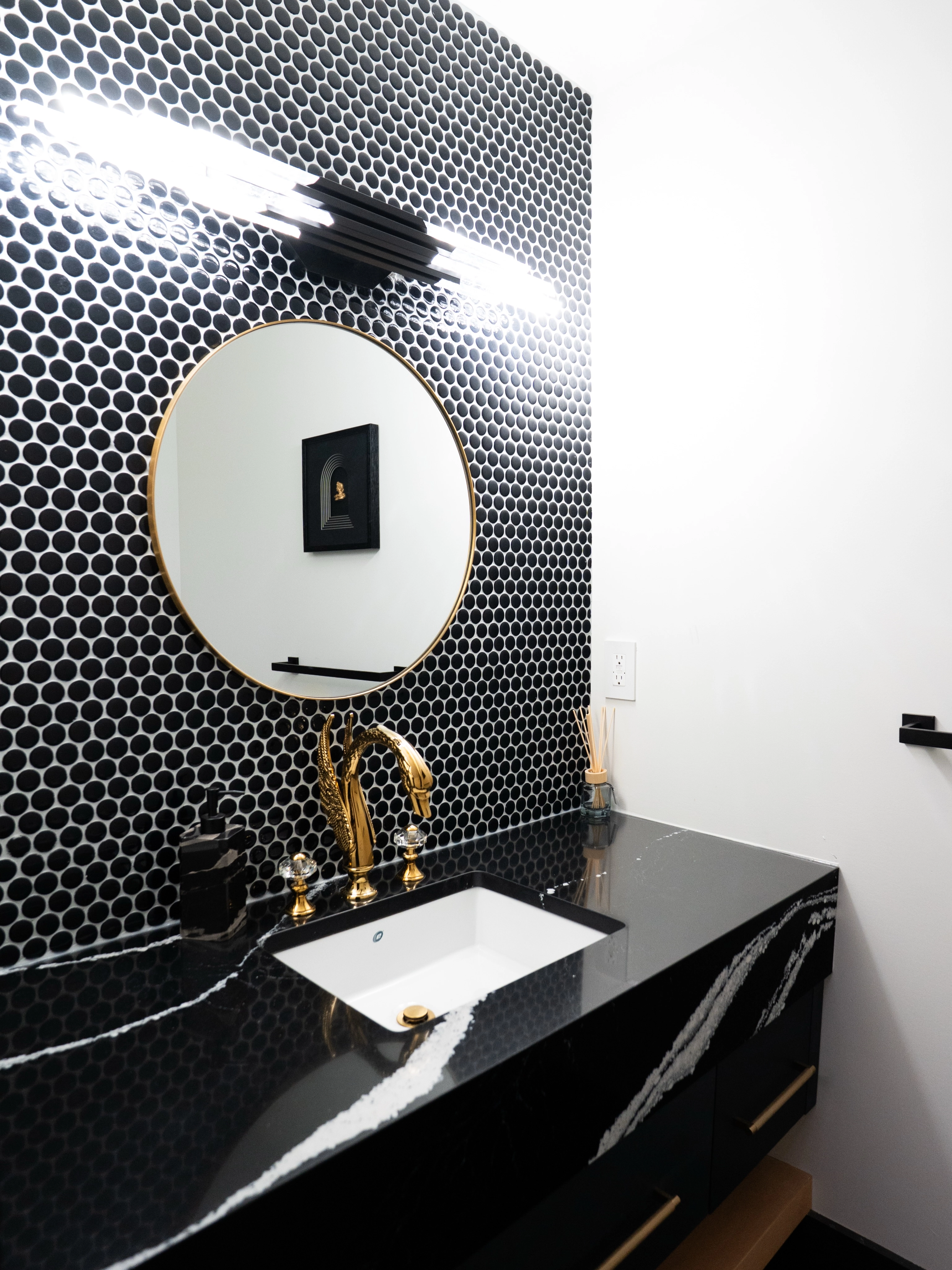
Black penny rounds tile the wall behind this powder room’s mirror and vanity, the other walls kept white. Penny tile earns its keep on accent walls because thousands of tiny grout lines turn a flat color into a texture, and the round shape softens black more than squares do. Grout color decides the volume: dark grout makes a quiet wall, pale grout makes a patterned one that reads almost like fabric. In a powder room, where the wall is small and the labor is the cost, penny tile is the affordable luxury.
Grout volume:Same tile, two walls. Dark grout whispers, light grout talks. Choose before the tiler arrives, not during.
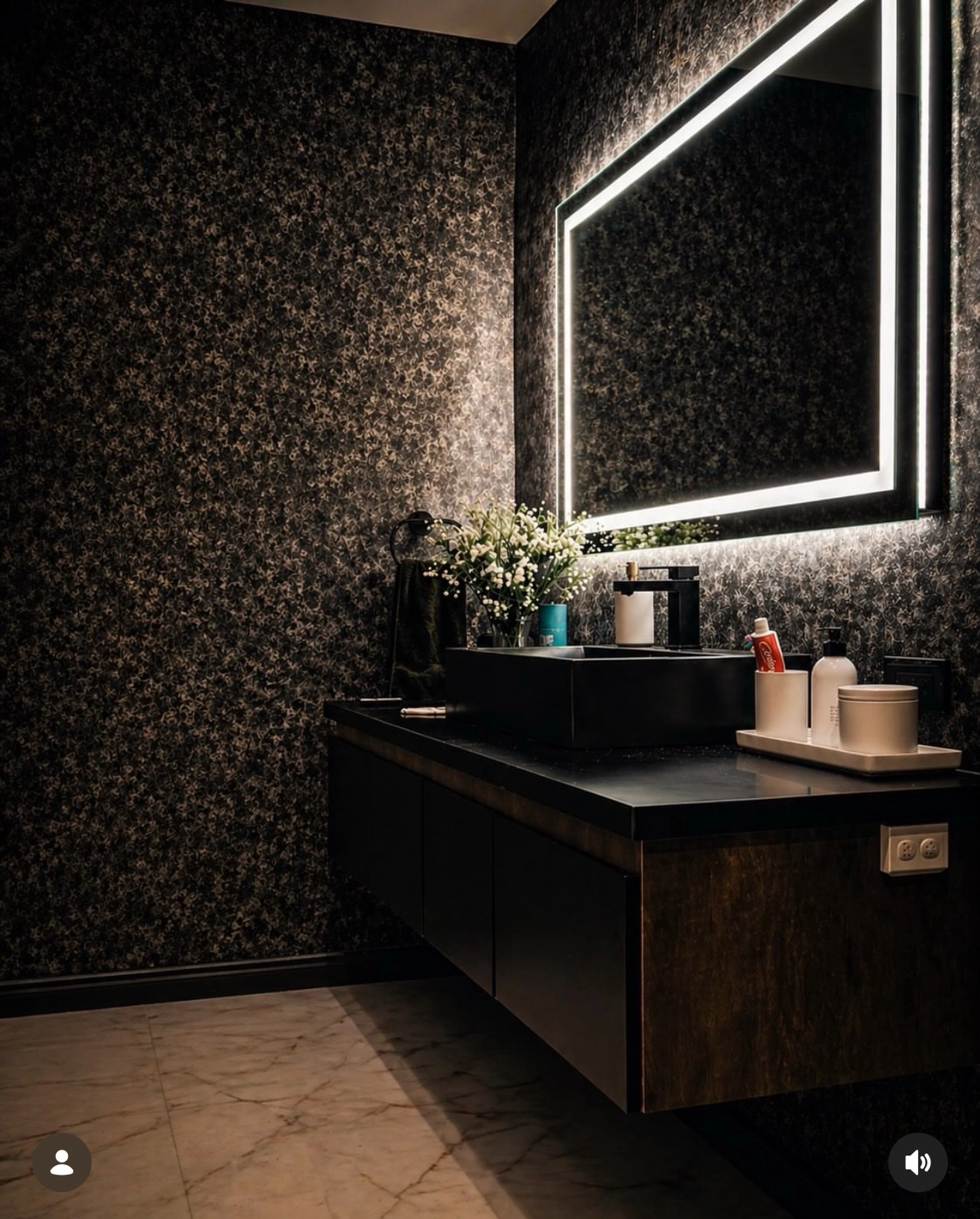
A dark mottled wallcovering wraps the vanity and side walls of this bathroom, a floating dark vanity beneath. Mottled and cloudy patterns are wallpaper’s gift to imperfect walls: the pattern’s movement hides the bumps and seams that flat black paint would spotlight. Wallpaper in a bathroom needs the right paste and a vented room, and modern vinyl and non woven papers handle steam far better than their reputation suggests. In powder rooms without showers, paper is nearly always safe.
Wall honesty:Paint shows a wall’s truth; patterned paper forgives it. Plaster like a lunar surface gets paper, not black paint.
7. Patterned Dark Wallpaper Behind a Pedestal Sink
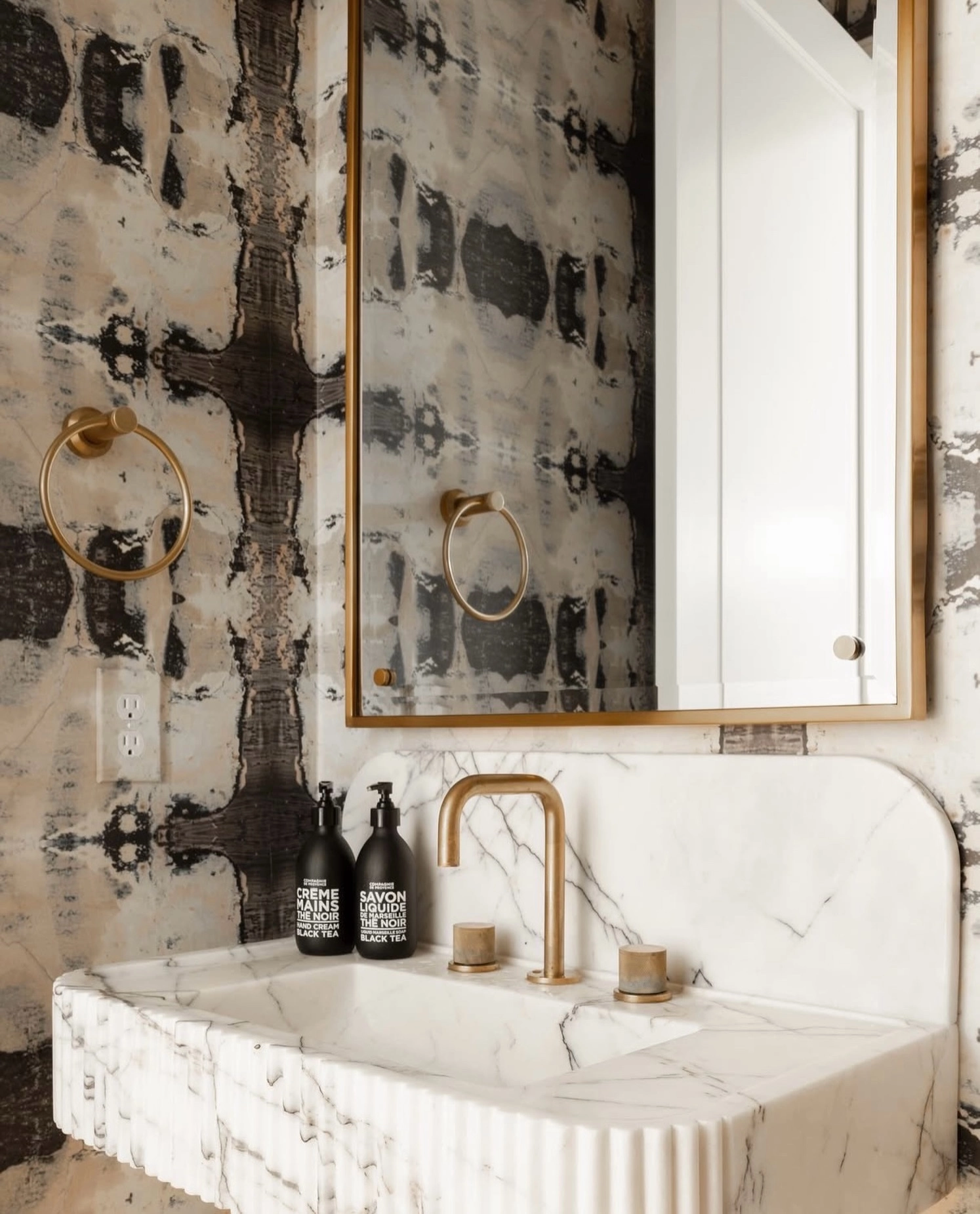
A white marble pedestal sink stands against black and beige patterned wallpaper in this powder room. The pedestal is the point: with no vanity cabinet, the wall becomes the furniture, and pattern gives it enough presence to carry the room. Patterned dark papers also solve the mirror problem, since a busy wall needs no art and barely any accessories. Keep the floor and ceiling plain when the wall pattern is loud, and let one wall do all the performing.
One performer rule:A loud wall means quiet everything else. If the paper has a pattern, the floor, towels and art should all be plain.
Myth vs fact, the three everyone repeats:
Myth: black walls always shrink a room. Fact: a black wall behind the vanity blurs the room’s edges and can read deeper, not smaller; shrinking happens when dark walls meet a dark floor and low light together.
Myth: black shows every speck of dust and toothpaste. Fact: gloss black does; matte and textured black hide marks better than gloss white, which is why most rooms here are matte, woven or tiled.
Myth: black walls are only for big bathrooms. Fact: powder rooms and tiny WCs are the safest place for them, since nobody expects a small room to feel big.
This suite commits completely: black marble on the floor and shower walls, charcoal plaster at the vanity, a long wood vanity and a black tub under tall windows. Total darkness only works with total light, and the wall of windows here is the real design decision; without it, this room would need far more artificial light to stay welcoming. The wood vanity is the warmth anchor, the one material keeping the marble from turning the room into a vault. If you take every wall dark, budget one warm material in a large dose.
Darkness budget:Every dark wall must be paid for with light or warmth: a window, a lit niche, a wood vanity. Count the payments before you commit the room.
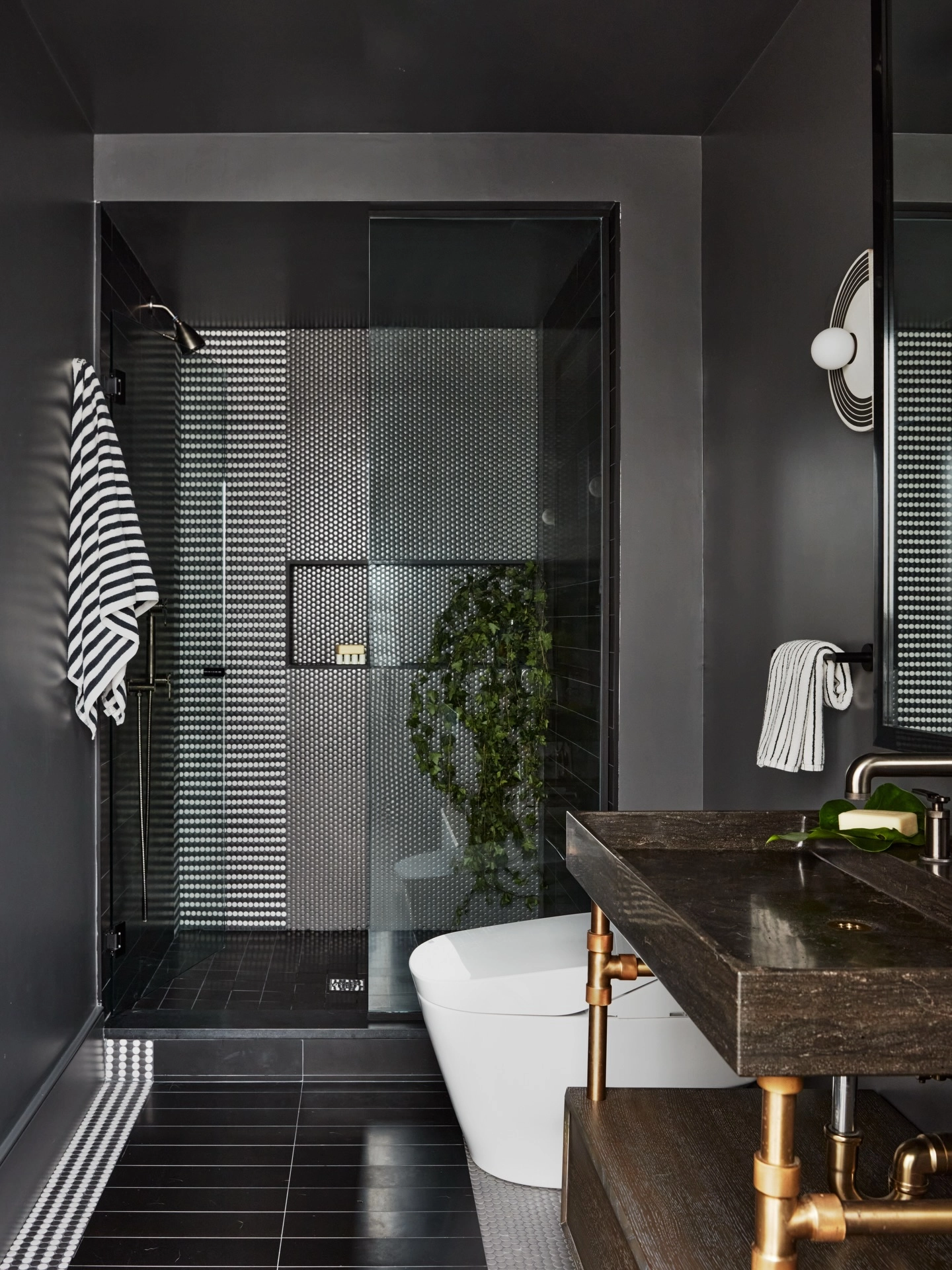
Black painted walls and ceiling surround this bathroom while the shower’s back wall runs black and white penny rounds in stripes. The striped shower wall is clever staging: inside a dark room, the one patterned surface becomes the destination the eye walks toward. Penny stripes also break the shower’s black into a rhythm, which hides water spots better than flat black tile. Painting a ceiling black lowers it visually, a trick that flatters tall rooms and punishes low ones, so measure yours before copying.
Ceiling math:Black ceilings flatter rooms over 2.7 meters and crowd rooms under 2.4. Between the two, paint the walls only and keep the ceiling white.
Large dark grey marble effect tiles wrap this Greek bathroom on every wall, close enough to black to borrow its mood and just light enough to keep the veining visible. This is the halfway commitment for people who love the look and fear the cave: charcoal stone reads dark in the evening and grey at noon, adjusting itself to the light. Large format tile keeps grout lines few, which matters in dark rooms where pale grout would draw a grid over everything. Match the grout to the tile’s darker veins.
Grout matching:On dark stone tile, grout should match the darkest vein, not the tile’s average tone. The grid disappears and the stone reads as slabs.
Charcoal plaster walls wrap this small bathroom, and an arched niche behind the basin is lined in glossy black brick tile. Two blacks are at work here, matte and gloss, and the difference between them is the room’s whole decoration. Gloss inside a niche bounces the candlelight or sconce light around and turns a storage hole into a jewel box. If your bathroom has any alcove, arch or recess, that is the surface to make glossy black while the rest stays matte.
Two blacks trick:Matte black walls plus one gloss black detail reads designed; matte everywhere reads unfinished. The niche, a shelf or a framed mirror can carry the gloss.
A black marble wall with white veining runs beside warm wood panelling in this ensuite, the vanity counter in matching black marble. Pairing the darkest stone with wood panelling is the same translator trick the black and wood rooms use, applied at wall scale: the wood stops the marble reading cold, and the marble stops the wood reading rustic. Veining direction matters at this scale; run the boldest veins where they will be seen whole, usually the wall faced from the door, not chopped behind fittings.
Vein placement:Book the showpiece slab for the wall seen from the doorway. Veins hidden behind a vanity are money spent on an audience of pipes.
This bright bathroom paints its window wall and ceiling surround in deep charcoal while stone and a honey wood vanity fill the middle. It is the daylight answer to the all dark room: the charcoal frames the windows, so the view and the light become the artwork, and the room never loses its brightness. Painting the wall the light comes through, rather than the wall it lands on, is the counterintuitive move that makes dark paint safe in sunny rooms. The charcoal also hides the window frames, simplifying the whole elevation.
Frame the light:In a sunny bathroom, darken the window wall itself. The frames disappear, the view sharpens, and the room keeps its light.
Every wall of this shower is matte black large format tile, with a speckled terrazzo floor and niche breaking the darkness. Black inside a shower is kinder than its reputation: water spots show on gloss black, far less on matte, and the terrazzo floor’s speckle is camouflage for everything a shower floor collects. The niche in matching stone keeps toiletries from becoming colored clutter against the black. If you tile a shower black, light it from the ceiling with a warm bulb, since black tile swallows light greedily.
Matte in wet zones:Gloss black tile shows every dried droplet; matte and honed finishes hide them. In showers, finish matters more than color.
Glossy black subway tile wraps this shower while a black and white patterned floor does the decorating below. The gloss is deliberate here: in a shower with a window or strong light, glossy black tile reflects enough to keep the cubicle from feeling like a well, and the small format keeps the reflections broken and lively. Subway layout matters at this scale; a vertical stack modernizes it, the classic brick bond traditionalizes it. Choose the layout by the age of your house and the argument ends.
Layout language:Brick bond reads period, vertical stack reads modern, herringbone reads crafted. The tile is the same; the sentence changes.
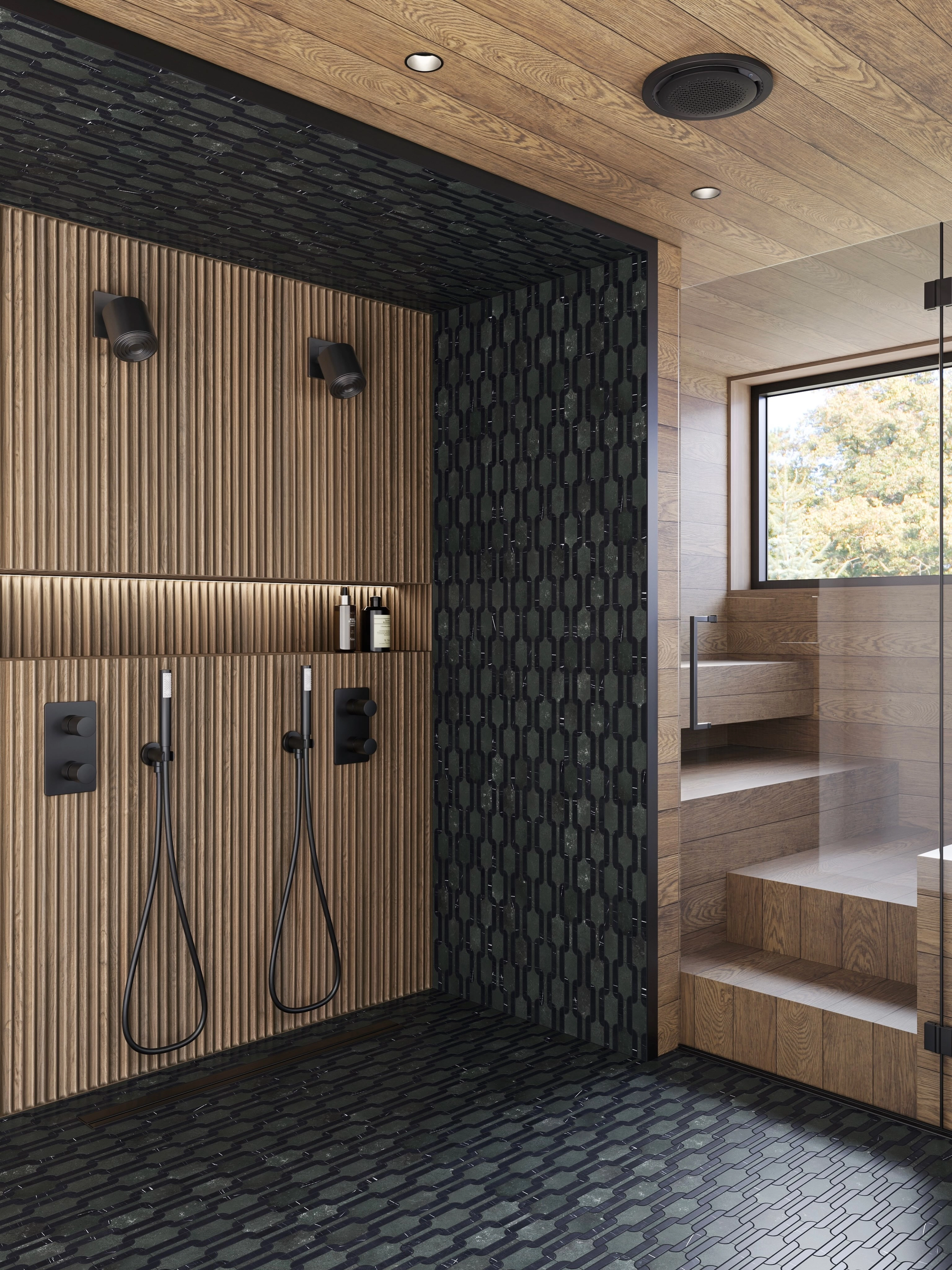
A showroom shower pairs a black geometric patterned tile wall with wood slat walls and a matching dark floor. Patterned black tile is the middle path between flat black and a mural: the geometry gives the eye work to do, so the wall reads as design rather than darkness. Wood slats opposite warm the cubicle and echo the spa references that make black showers feel intentional. In real homes, put the patterned tile on the back wall of the shower, the one faced on entry, and keep the side walls plain.
Back wall rule:Pattern belongs on the shower’s back wall, plain tile on the sides. Pattern on all three walls closes the space in.
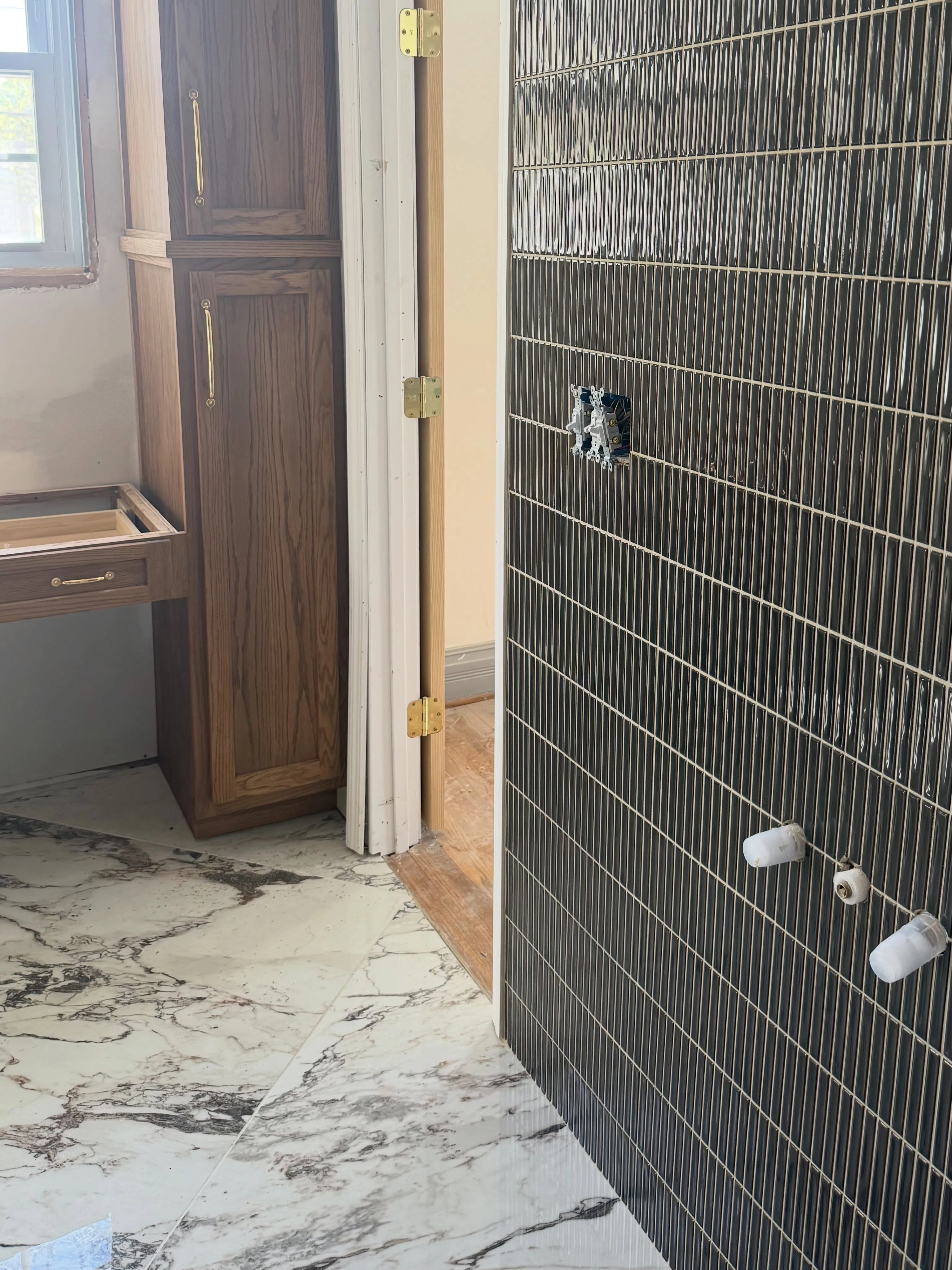
Slim vertical kit kat tiles in black cover this shower wall, photographed during the renovation before the fittings went on. The narrow vertical format is worth studying even unfinished: hundreds of thin lines stretch the wall upward and turn black into a texture closer to fabric than stone. Kit kat and finger tiles cost more in labor than large tiles, since every piece is small, but on a single shower wall the area is modest. Their grout lines also grip better underfoot, which is why the same tiles often continue onto shower floors.
Labor honesty:Small format tile on one wall is a treat; on a whole shower it is a budget line of its own. Price the tiling per wall before falling in love.
18. The Black Hex Niche, Smallest Accent Wall There Is
Inside this white subway tiled shower, the niche is lined in small black hex tiles, with the shower floor in matching dark hex. It is the smallest possible accent wall, about a third of a square meter, and it proves the principle at pocket scale: a dark recess reads deeper, the bottles inside it look arranged rather than stored, and the white tile around it looks brighter. Anyone unsure about black walls can start here for the price of a few sheets of mosaic and reverse it in an afternoon.
Starter dose:A black niche is the reversible trial run for this whole article. Live with it for a month before committing a full wall.
Powder Rooms and Toilet Walls: Small Rooms, Big Nerve
19. Dark Paint Behind the Toilet, Beige Shower Beside
This remodel paints the toilet side wall and ceiling in dark brown black while the shower stays beige herringbone. Splitting a bathroom by zone, dark where the toilet is, light where the water is, is a practical compromise for shared bathrooms where one person wants drama and another wants to see to shave. The dark ceiling over the toilet end lowers that corner into a nook. Zone painting also costs less than any tile treatment in this article, since it is paint and a free Saturday.
Zone logic:Dark at the toilet end, light at the mirror and shower end. Drama where you sit, light where you groom.
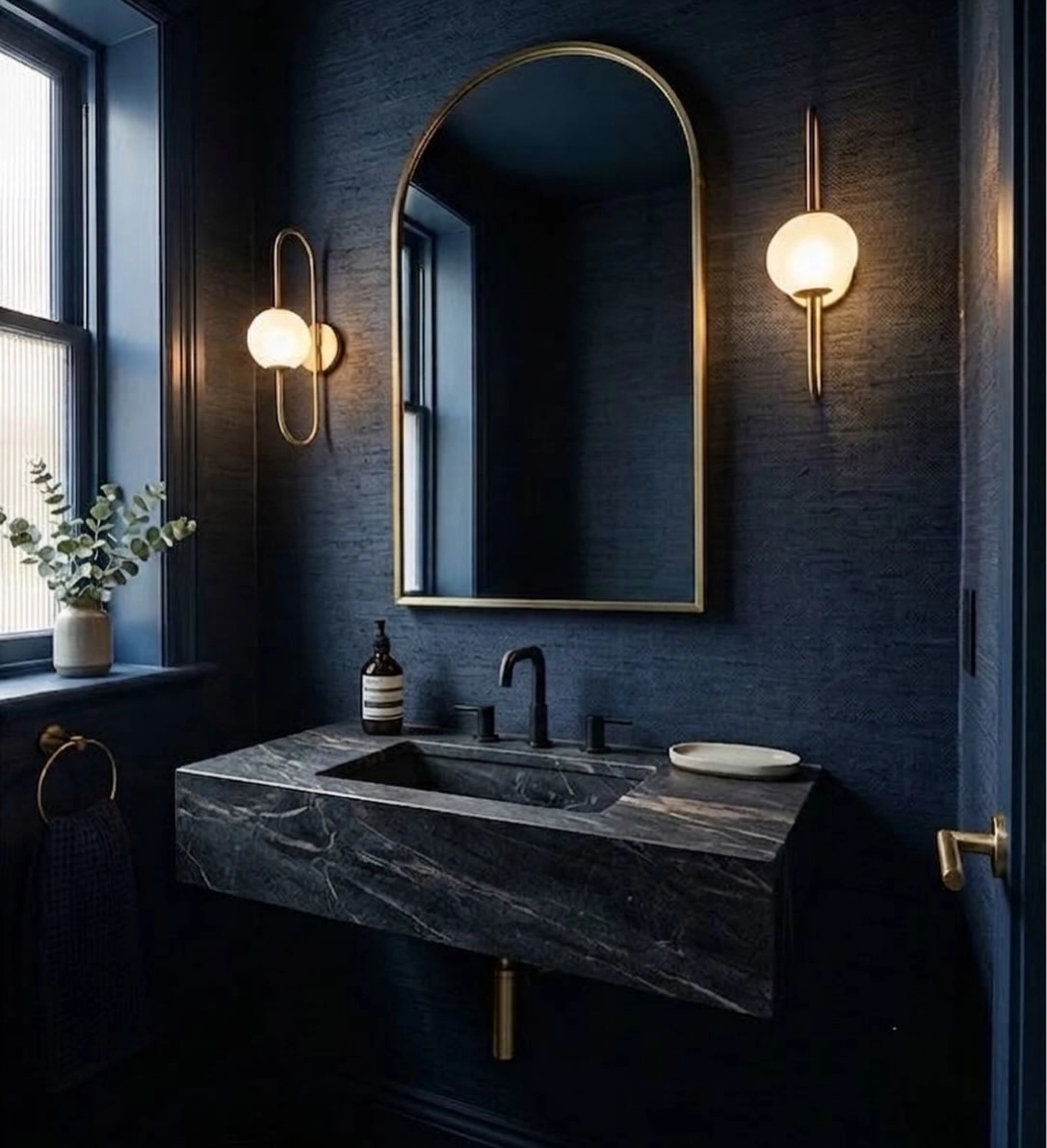
Textured navy black grasscloth wraps this powder room, a floating stone sink and an arched mirror against it. Grasscloth and its vinyl imitations bring a woven texture that drinks light softly, which is why they flatter powder rooms lit by sconces. True grasscloth dislikes splashes, so in a powder room with careful users it survives for years; in a family bathroom choose the vinyl lookalike. The stone sink’s weight against the soft wall is the contrast that makes the room feel considered.
Material match:Real grasscloth for powder rooms, vinyl grasscloth for family bathrooms. Same look, different tolerance for toothpaste.
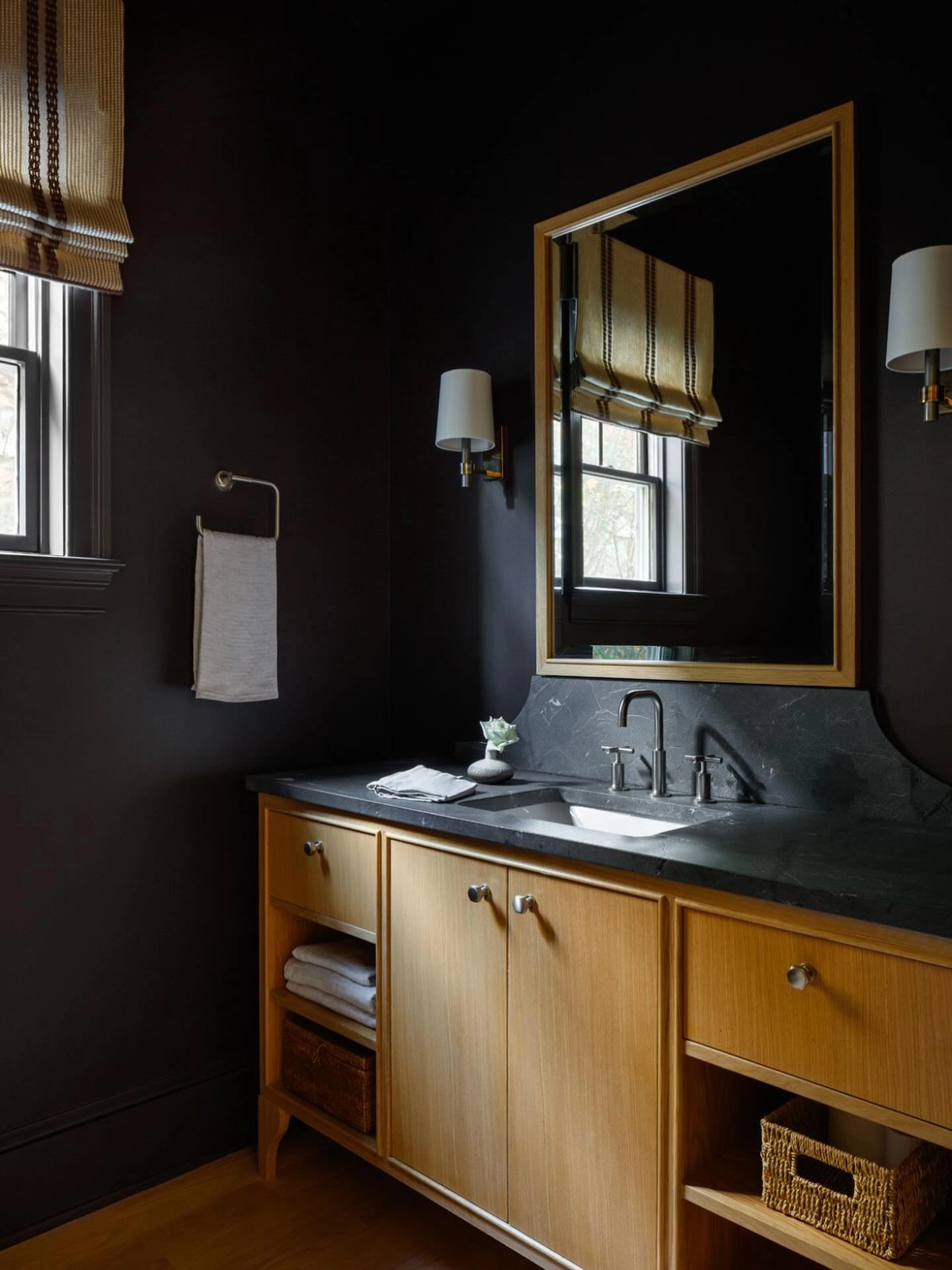
A designer powder room in smooth black paint with a wooden vanity and little else. This is the control experiment of the article: no tile, no paper, no pattern, just black walls and warm wood. It works because powder rooms are visited briefly, lit warmly, and judged like a restaurant’s hallway, where drama is the point. The wood vanity is not optional decoration in such a room; it is the warmth that keeps the black hospitable. Reproduce this with one tin of paint and whatever wood vanity you already own.
Control room:Black paint plus existing wood vanity is the cheapest full transformation in this list. If it fails in your room, it fails for one tin’s worth of money.
22. Floral Wallpaper Over Black Wainscoting, Take One
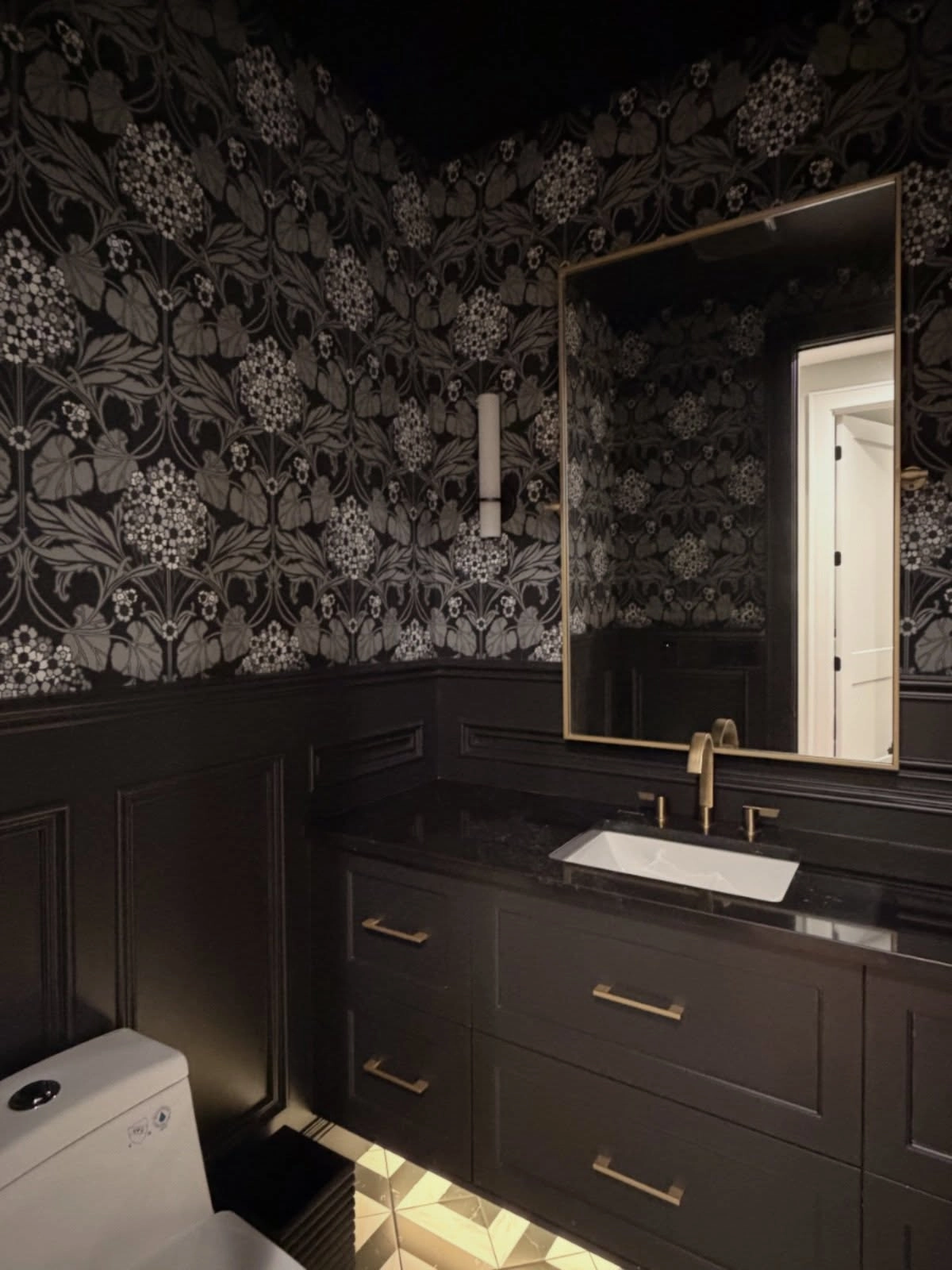
Black floral wallpaper runs above black panelled wainscoting in this powder room, a traditional pairing given dark colors. Wainscoting earns its place in powder rooms by taking the knocks: chair backs, bin edges, mops and buckets all hit the lower wall, and painted wood takes it better than paper. The split also proportions the room, the solid black base grounding the pattern above. Cap the wainscot at a third of the wall height in low rooms and a half in tall ones.
Proportion split:Wainscot at one third height in low rooms, one half in tall rooms. The pattern needs the bigger share when ceilings are low.
A dark floral wallpaper covers the vanity and toilet wall of this bathroom completely, flowers glowing against the near black ground. Full height dark florals are the romantic end of the accent wall family, and powder rooms are their natural home since the dose is small and the visits are short. Scale is the decision: blooms larger than your hand read modern and bold, tiny sprigs read vintage. Order a sample large enough to hold a whole repeat; small swatches lie about scale.
Sample size:Judge wallpaper from a piece showing one full pattern repeat, taped up for a day. A palm sized swatch cannot tell you the scale story.
Dark textured plaster wraps this powder room, lit low and warm around a marble basin. Textured plaster, tadelakt and its cousins, is the artisanal end of black walls: the surface moves like water under raking light, and no two walls are ever identical. It is also the least reversible choice here, closer to a building material than a decoration, so it belongs in houses you plan to keep. In return it shrugs off steam and splashes that would end wallpaper, which is why it suits full bathrooms as well as powder rooms.
Commitment order:Paint reverses in a day, paper in a weekend, tile in a demo, plaster almost never. Choose your wall by how long you plan to stay.
25. Black Wallpaper Over Black Panelling, Take Two
A second take on the wainscot formula from a different builder: dramatic black wallpaper above, black panelling below, in a new build powder room. Two builders landing on the same split tells you it solves real problems: pattern where eyes rest, armor where life happens. The black on black layering works because the finishes differ, matte panels against the paper’s slight sheen. When layering one color, vary the finish at every layer or the room flattens into a single dark shape.
Finish ladder:Same color, three finishes: matte, satin, gloss. The eye reads the differences as depth even when the color never changes.
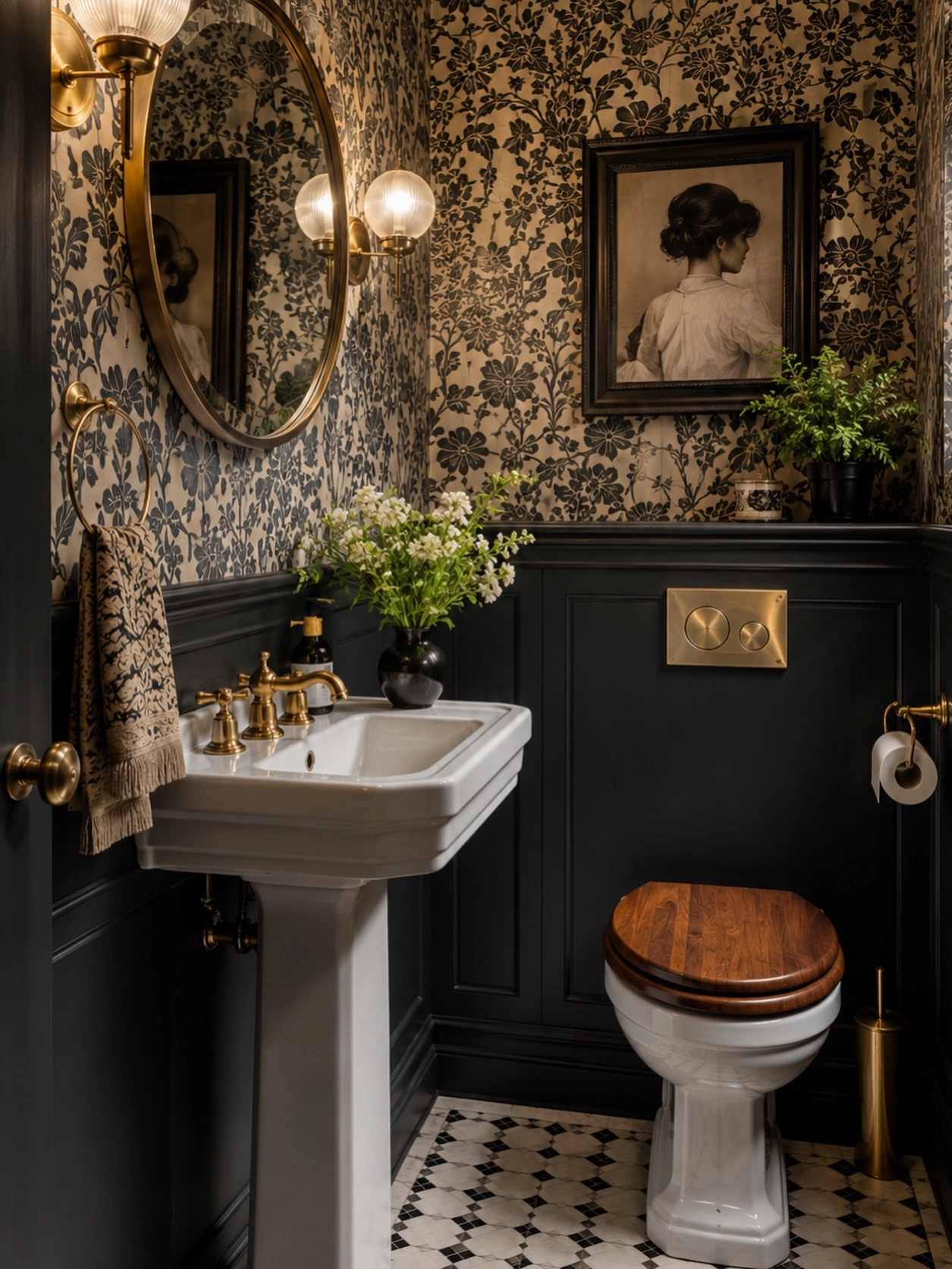
The smallest room in the article closes it: a tiny WC with black painted panelling below and black and beige patterned wallpaper above, white toilet standing out like a guest of honor. Small rooms are where black walls are safest, because nobody expects a cupboard sized WC to feel spacious anyway, so the darkness reads as intention rather than error. The white fixtures become the decoration, which is why tiny dark rooms should keep their porcelain white and their metals warm. If you have been hesitating over a bigger room, rehearse here.
Rehearsal room:The downstairs WC is the lowest risk room in any house for a black wall. Paint it first, live with it, then decide about the big bathroom.
Where the money goes: paint is the cheapest wall in this article, one tin and a weekend, roughly the cost of a nice towel set. Wallpaper lands in the middle, the paper plus paste plus a day of hanging, with patterned papers at the top of the band. Tile costs more, material plus a tiler’s day rate per wall, and small formats push the labor up further. Plaster and stone sit at the top: specialist labor, days not hours, and a finish you choose like you mean to keep it.
Final Thoughts
The wall matters more than the black. Put it behind the vanity for depth, inside the shower for drama that water cannot spoil, or around a powder room where the visit is short and the nerve can be bigger. Pay for every dark wall with light or warmth, start with the niche or the WC if you are unsure, and remember that paint, the boldest looking choice here, is also the easiest to undo.