Blue and yellow sit opposite each other on the colour wheel, which is why they either sing or shout. Blue cools a room down, yellow heats it up, and every good blue and yellow living room is really a temperature negotiation: how much sunshine can this room take before it turns loud, and how much blue before it turns cold.
These 25 rooms are grouped by the form the yellow takes, yellow sofas first, then yellow in chairs and cushions, then blue sofas carrying the yellow, and finally yellow on walls and in big gestures. Find your dose, then hold the other colour steady while you pour it in.
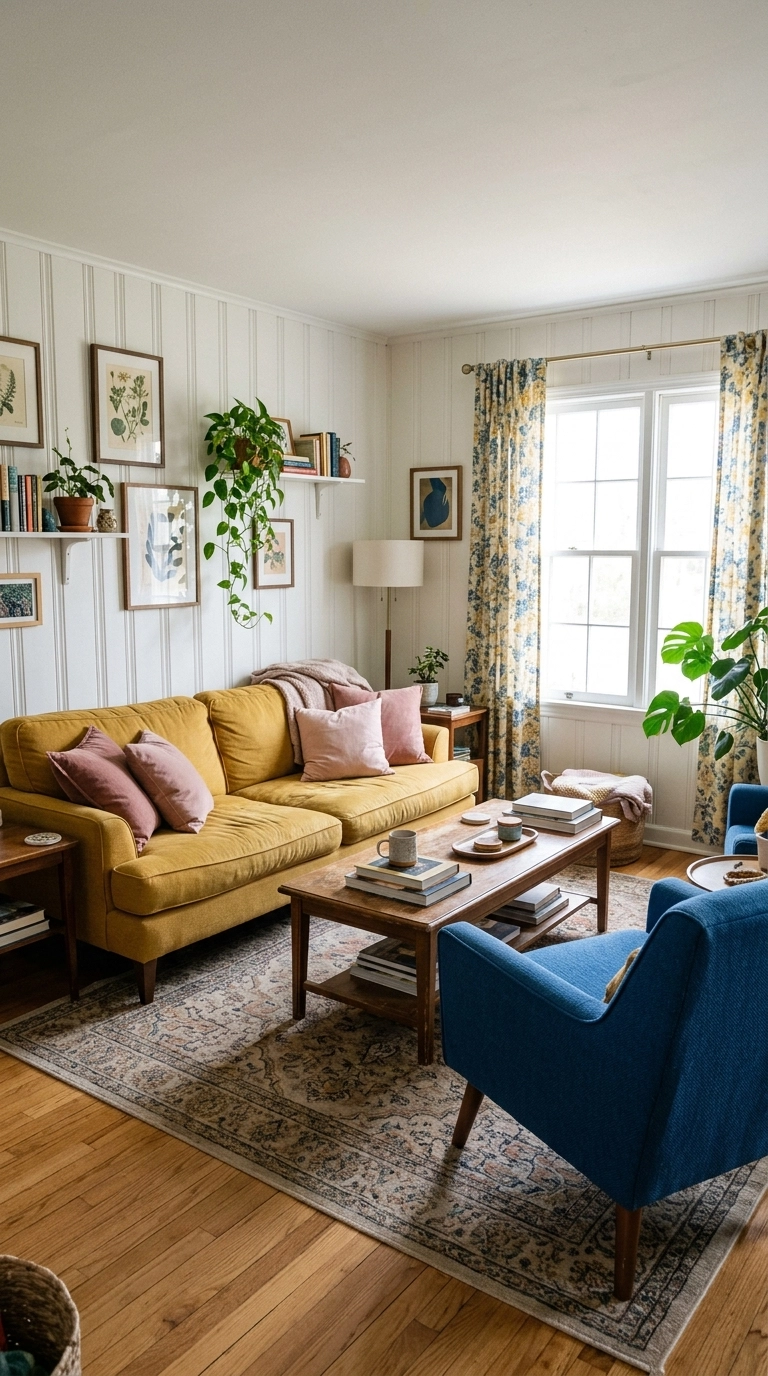
A mustard sofa on one side of a panelled white room, a bright blue armchair answering it from the other, floral curtains with both colours in the pattern. This is the pairing at its friendliest: two saturated pieces facing each other across a pale room, with the curtains acting as the peace treaty that contains both. If you take one lesson from this list, take the curtain trick. A fabric that mixes your two colours makes them look chosen rather than clashed.
Treaty fabric: One patterned piece carrying both colours, curtains, a rug, a throw, tells the eye the pairing was planned.
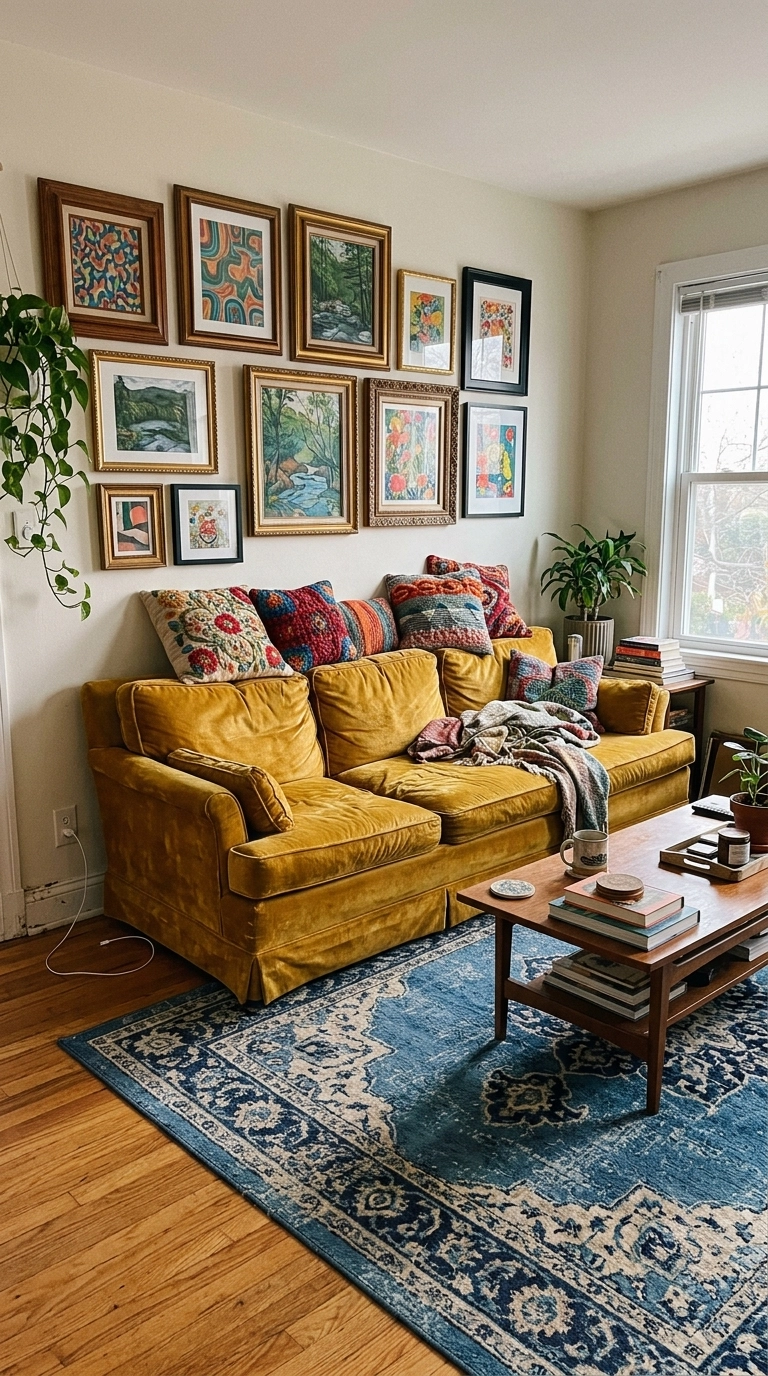
A mustard velvet sofa piled with multicoloured cushions under a wall crammed with the owner’s own art, photographed from the sofa itself with the photographer’s feet up. Artist rooms run hotter than other people’s, and the blue here hides in the artwork, the rug and a denim lap, small cool notes inside a warm room. It works because the art wall gives the eye so much to do that the colours stop competing. A gallery wall is the maximalist’s pressure valve.
Art valve: The busier the art wall, the brighter the sofa can be. Pattern absorbs colour clashes the way a crowd absorbs noise.
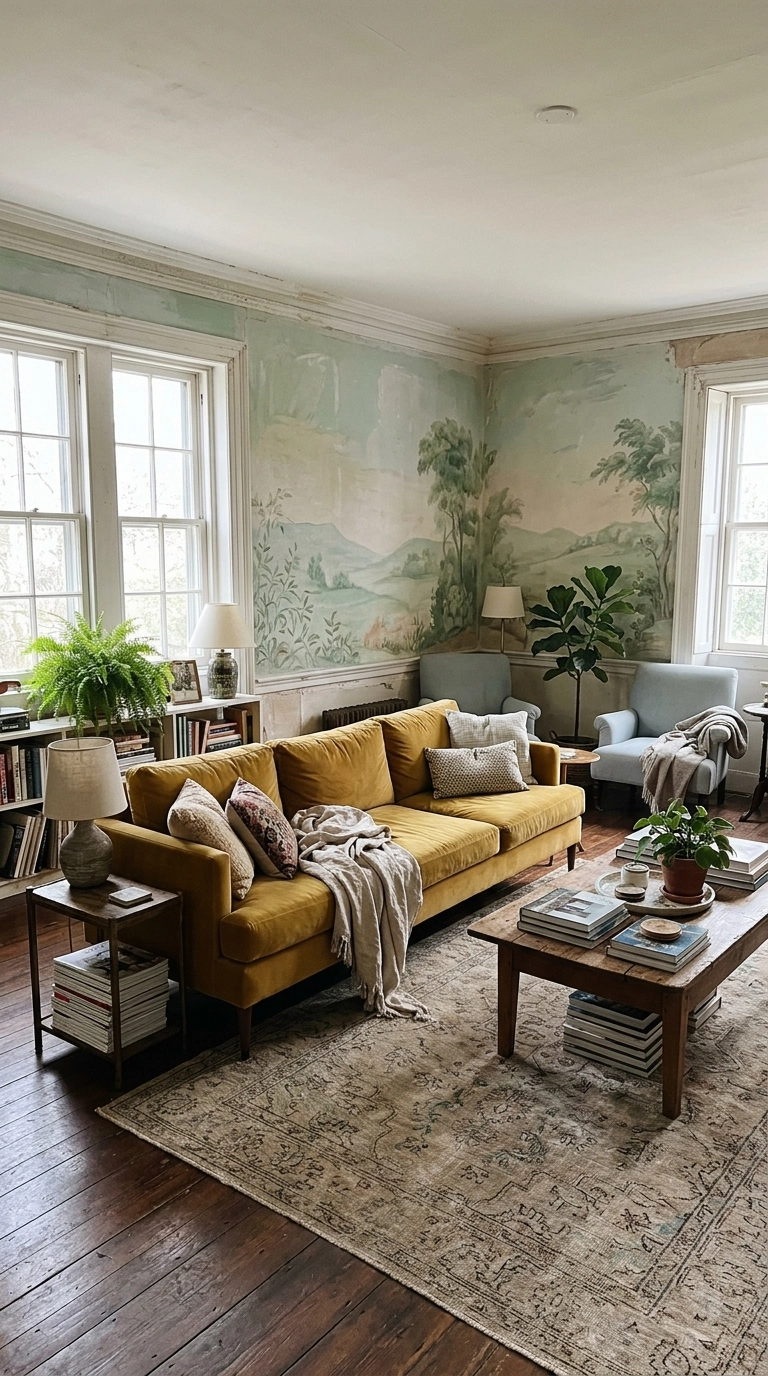
A mustard velvet sectional in a room with hand painted landscape murals in soft greens and blues, a mushroom stool and pale blue grey armchairs at the edges. Murals give blue a landscape to live in, sky and distance, so it feels natural rather than decorative. The sectional is one long ribbon of yellow, and it can afford to be because everything around it is soft focus. Long yellow sofas need their surroundings blurred: pale, painterly, low contrast.
Ribbon rule: A sectional is one colour said very loudly. Keep every other colour in the room at half volume.
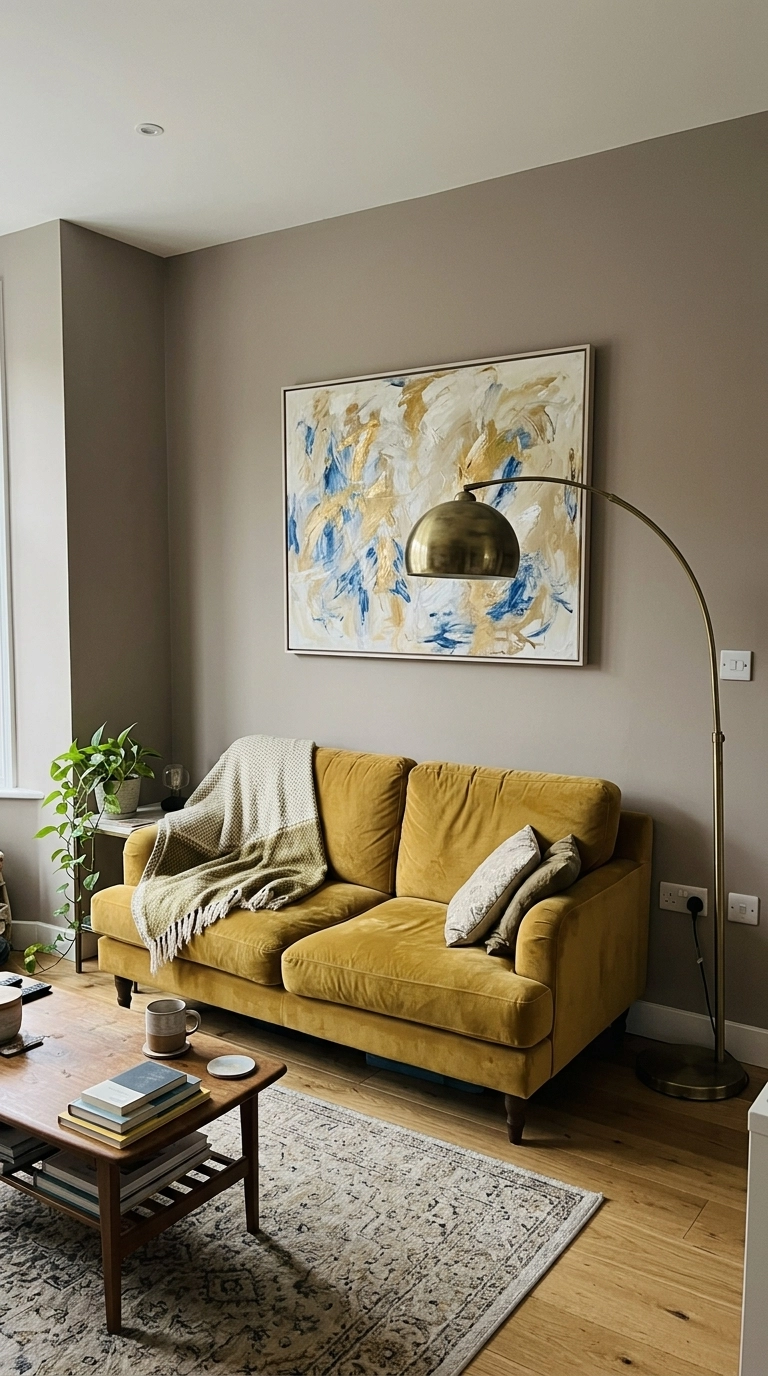
A mustard velvet two seater in a calm taupe room, one large abstract in cream, gold and blue above it, a brass arc lamp alongside. This is the showroom simple version: when the room is plain, the sofa and the painting do everything, and the painting’s job is to smuggle the blue in. Blue in art counts. It cools the yellow without upholstering anything, and you can change it in an afternoon when you tire of the pairing.
Blue by canvas: The cheapest blue in any room is a painting. Start there before committing to a blue sofa or wall.
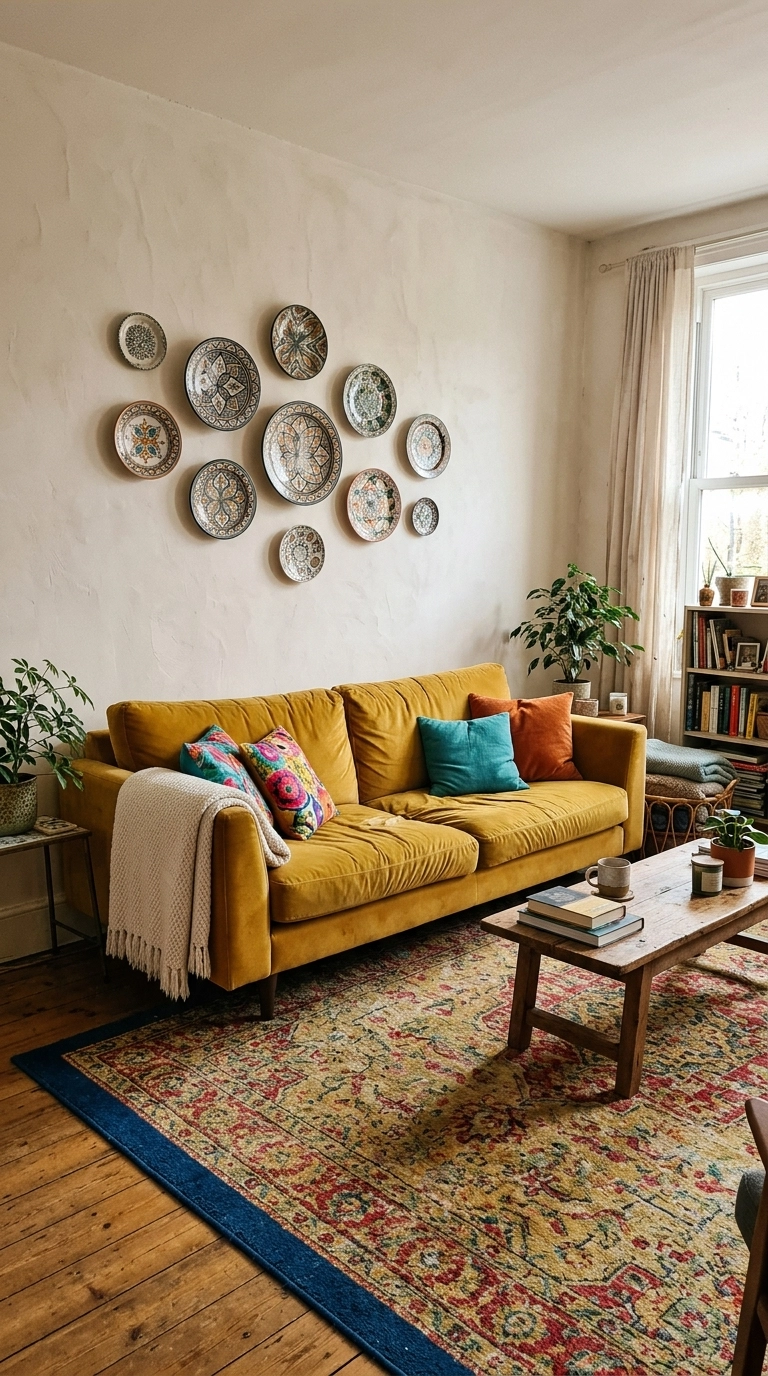
A mustard velvet sofa with a white throw and bright cushions, wall plates and metal flowers above it, and a huge multicoloured rug with a deep blue border covering the floor. The rug’s blue fringe edge is the quiet genius here: it frames the whole seating area in blue, so the warm colours inside it read as contained rather than spilling. Eclectic rooms need one framing device, a bordered rug, a dark floor, a painted ceiling line, or the colour collection looks accidental.
Border control: A rug with a dark blue border is a frame for the whole room. Eclectic colour needs a frame or it reads as clutter.
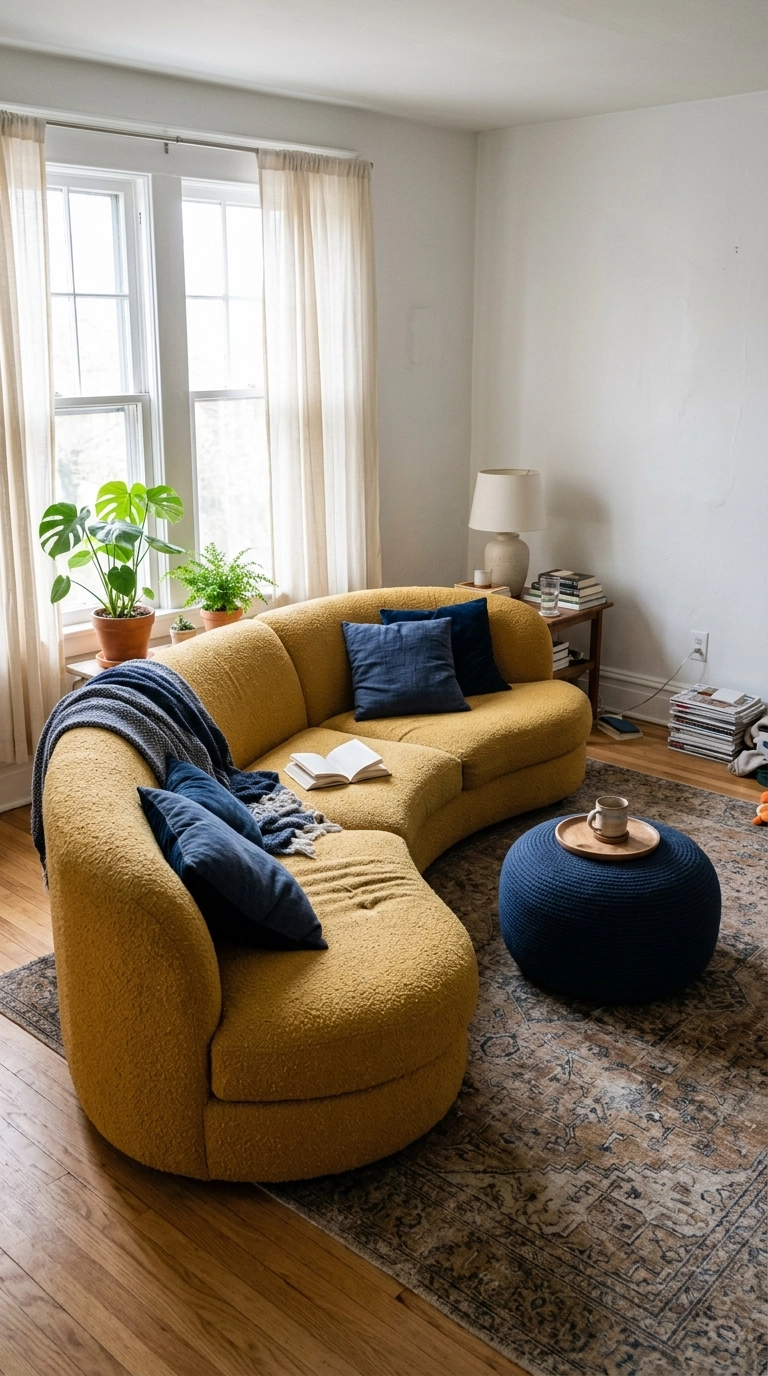
A curved mustard boucle sectional with navy cushions and a round navy pouf in front of it, in a plain white room. Boucle softens yellow more than any other fabric; its nubby texture breaks the colour into a thousand tiny shadows, so even a huge curved sofa reads gentle. The navy pouf is the only blue and it is exactly enough, one dark round note under all that soft yellow. Curved sofas in bright colours are the friendliest statement pieces there are.
Texture discount: Boucle and corduroy both let you use more yellow than velvet or linen would. Texture is a volume knob for colour.
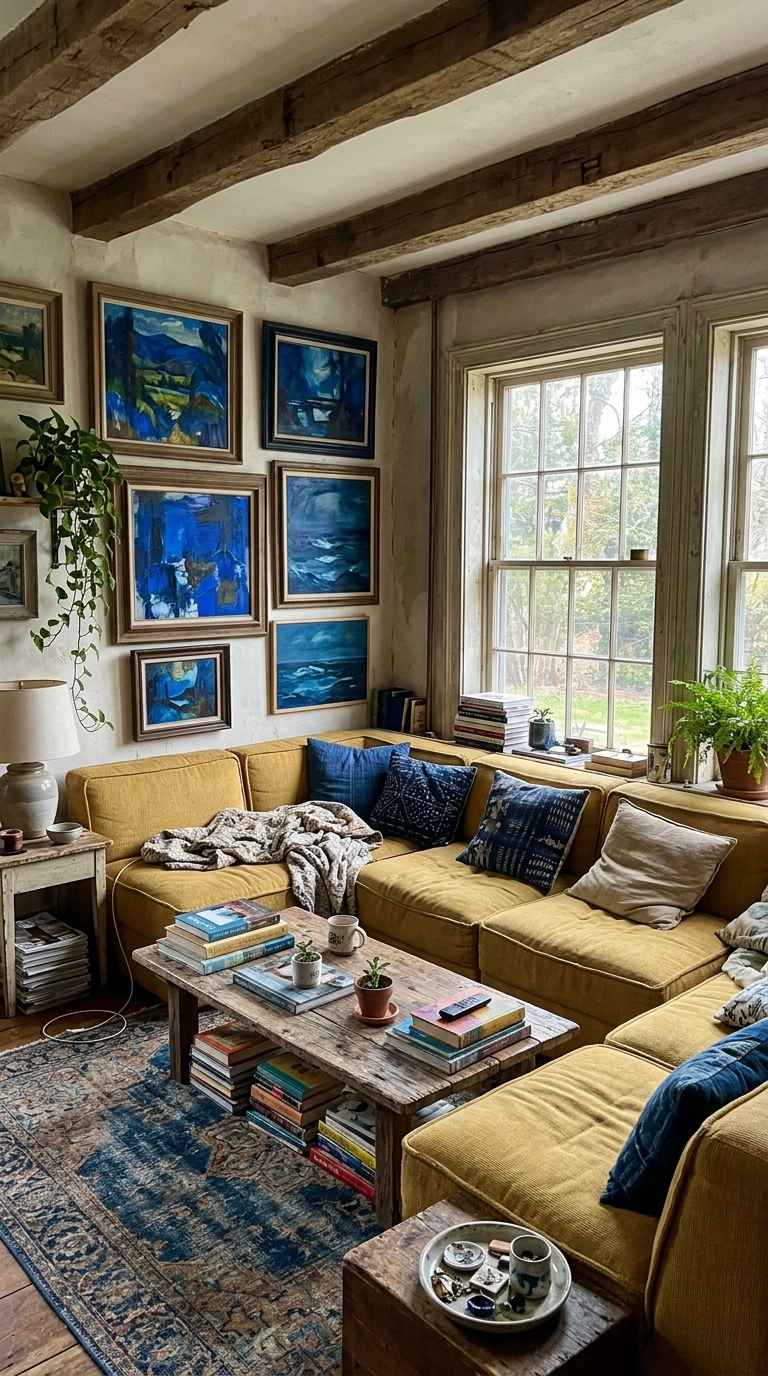
A mustard modular sectional sprawling across a beamed, wood floored room, books stacked on the coffee table and a gallery of paintings with strong blue passages on the walls. Old beams and yellow velvet love each other; the wood’s honey tones are yellow’s family, so the sofa looks inherited rather than installed. The blue lives in the paintings and book spines, scattered small, which suits a room that is fundamentally warm. Rustic rooms should take their blue in objects, not upholstery.
Rustic rule: In beamed and wooden rooms, keep blue to art and objects. Blue upholstery fights wood; blue pictures befriend it.
Myth vs fact:
Myth: blue and yellow only works in children’s rooms or team colours. Fact: the pairing ran drawing rooms for two centuries; it turns childish only when both colours are equally bright and equally everywhere.
Myth: the two colours must match in intensity. Fact: the best rooms pair a deep with a soft, navy with pale lemon, or powder blue with hot mustard.
Myth: you need a lot of yellow. Fact: one centred cushion, one bouquet or one vase carries the pairing if the blue is already in the room.
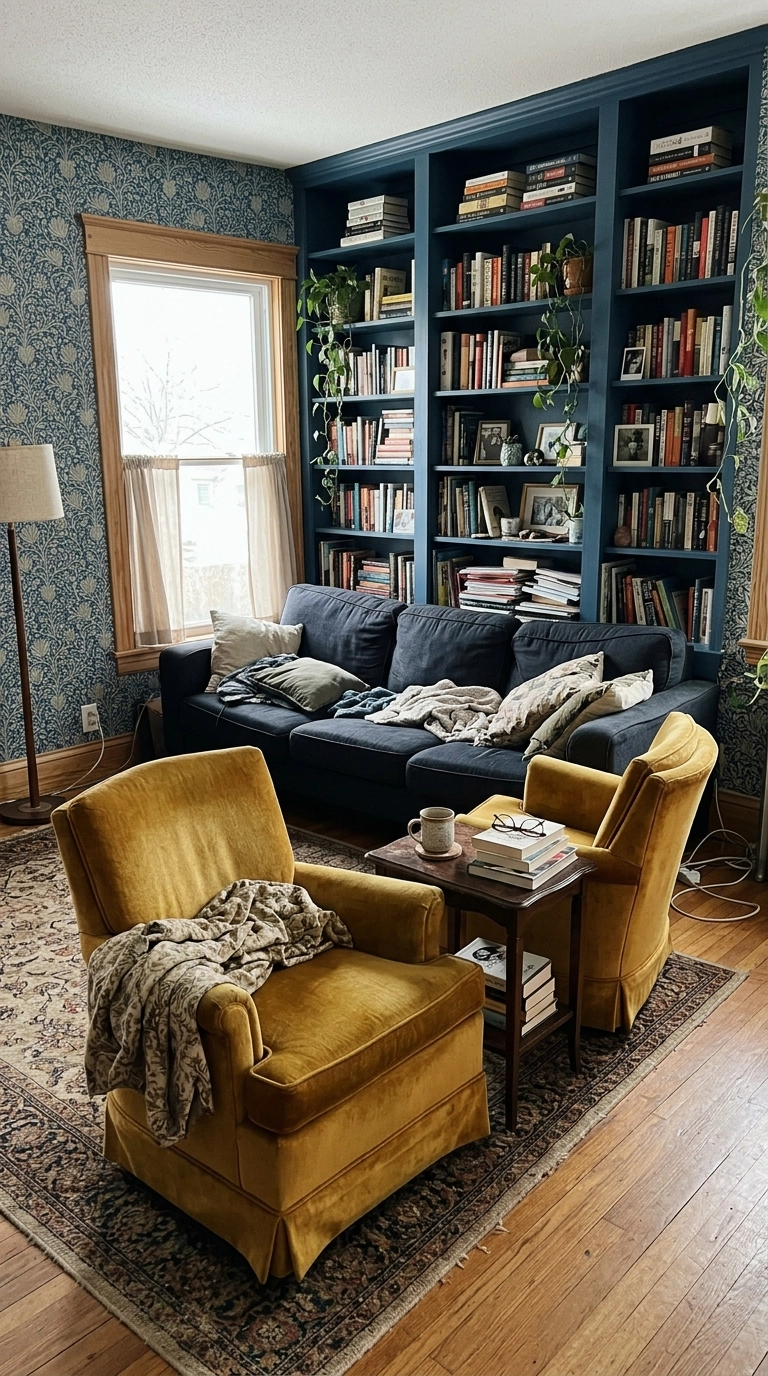
Blue patterned wallpaper and blue built in shelves wrapping a room, a dark sofa at the back, and two mustard velvet armchairs glowing in the foreground. Blue walls with yellow chairs is the pairing’s most architectural version: the cool colour is fixed, the warm colour is furniture you can move. Two matching yellow chairs read as a pair of exclamation marks. If your room is already blue and you want the pairing, this is your move, and it costs two chairs.
Pair of marks: Yellow chairs work best as a matched pair. One yellow chair looks lost; two look like punctuation.
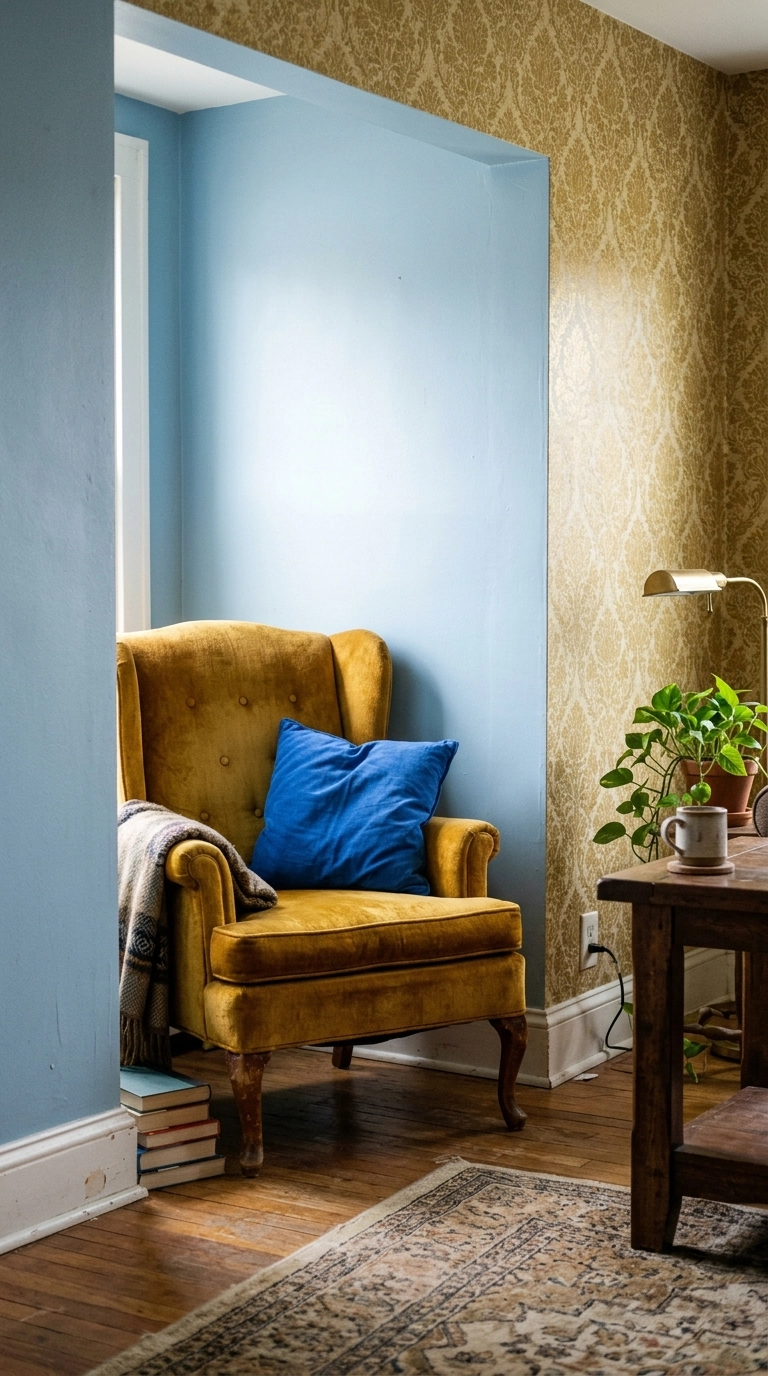
A mustard velvet wingback chair with a bright blue cushion, a small dog in residence, a pale blue painted alcove behind and gold patterned wallpaper beside it. One chair can carry a whole colour scheme when it is placed against its opposite: the blue alcove makes the yellow chair look deliberate, and the blue cushion ties the two together. Wingbacks suit yellow because their tall backs show the colour like a banner. This is the smallest room in the list and maybe the most copyable.
Banner chair: Put a single yellow chair against a blue wall or alcove. Contrast is what makes one chair a scheme instead of a leftover.
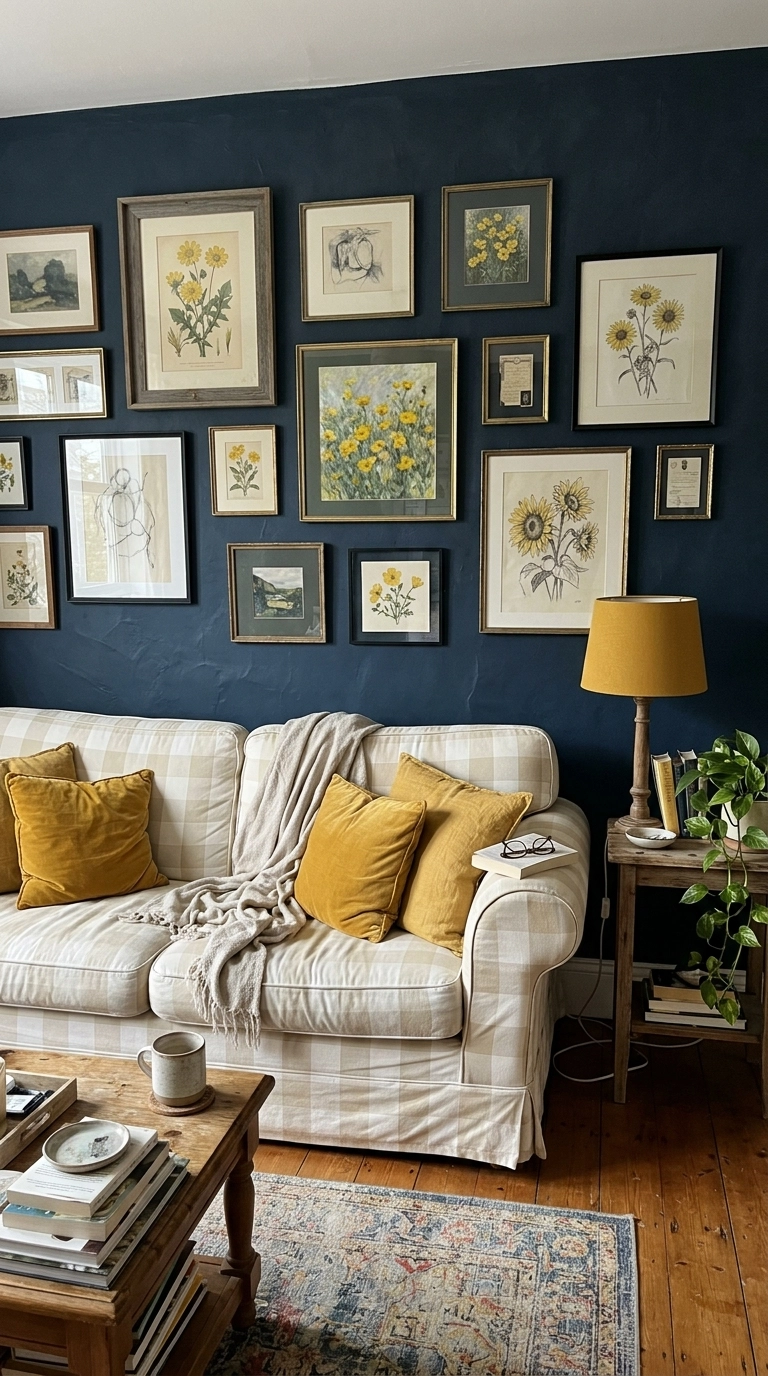
A cream checked sofa with mustard cushions against a dark blue textured gallery wall, a yellow flower picture and a yellow shaded lamp completing the set. This is yellow at cushion dose, the renter’s version, and the dark blue wall is what makes it land: pale walls would wash the mustard out. Notice the yellow appears three times, cushions, art, lampshade, in a triangle around the sofa. Three sightings is the minimum for an accent colour to look intentional.
Triangle rule: Place your accent yellow in three spots that form a triangle around the seating. The eye reads triangles as design.
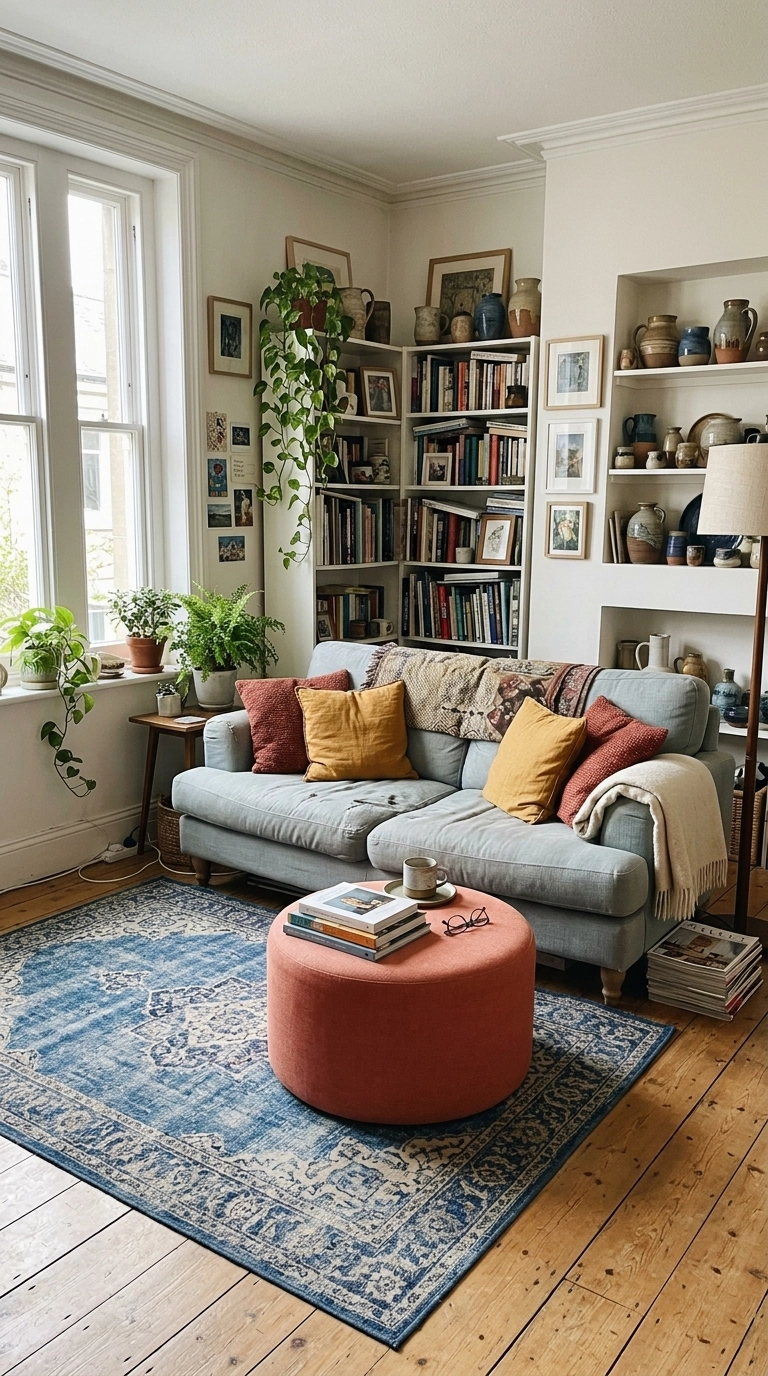
A pale blue grey sofa with yellow and red cushions, a blue patterned rug under it and a coral ottoman in front, in a bright sitting room full of ceramics. Pale blue is the diplomat of this pairing: it lets yellow and even red sit on it without the room turning primary school. The rug repeats the blue at floor level so the sofa does not float. Rooms that host lots of colourful objects should keep the sofa this pale; it is the quietest blue that still counts as blue.
Diplomat blue: Powder and pale grey blues can host almost any cushion colour. Navy is pickier; pale blue is not.
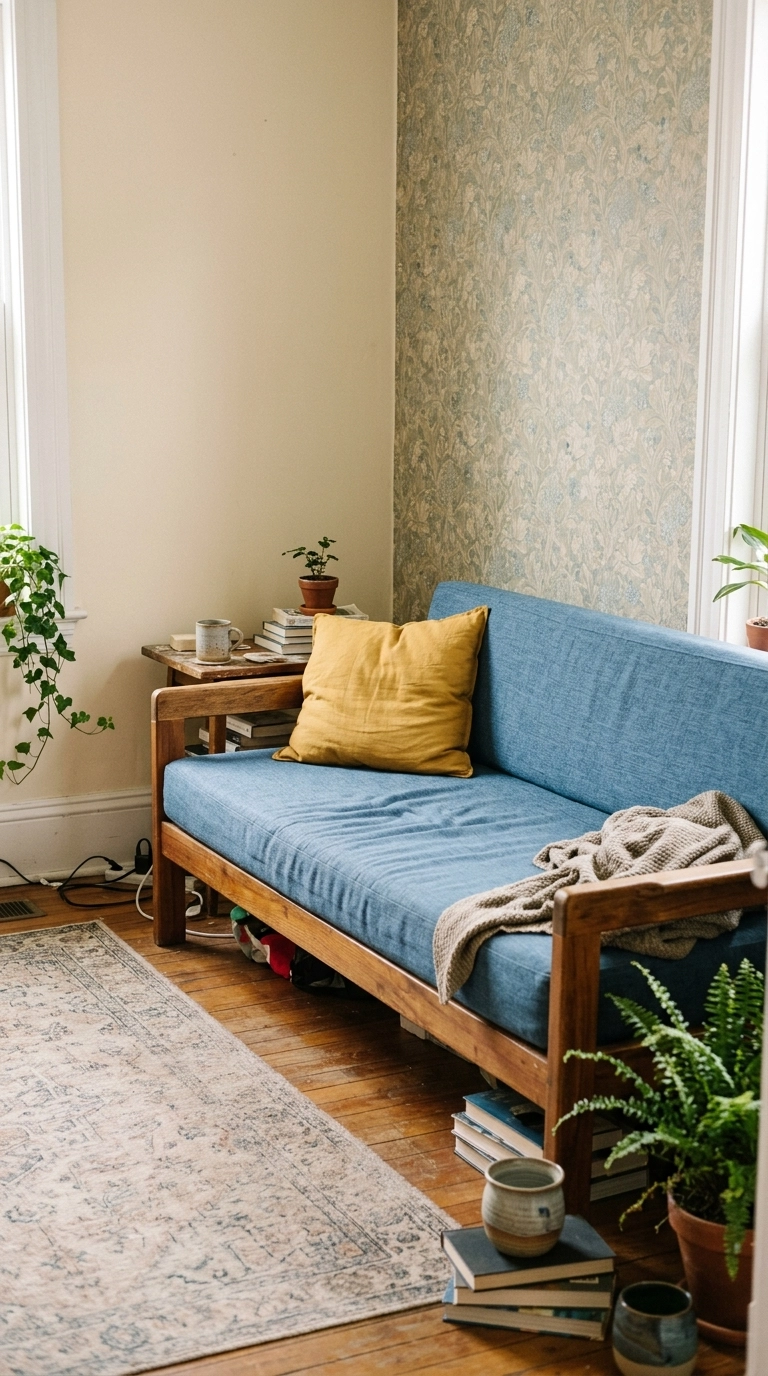
A blue daybed sofa with wooden frame against cream and patterned walls, and a single mustard cushion placed dead centre. The smallest dose in this entire list, and it works for a precise reason: the cushion sits at the exact middle of the blue, where the eye lands first. One accent, centrally placed, reads as a full stop, deliberate and calm. Scattered small accents read as indecision; one centred accent reads as taste. Guest rooms and spare rooms, take note.
Full stop rule: A single accent cushion belongs in the centre, never at the end. Centred is a statement; at the end it looks forgotten.
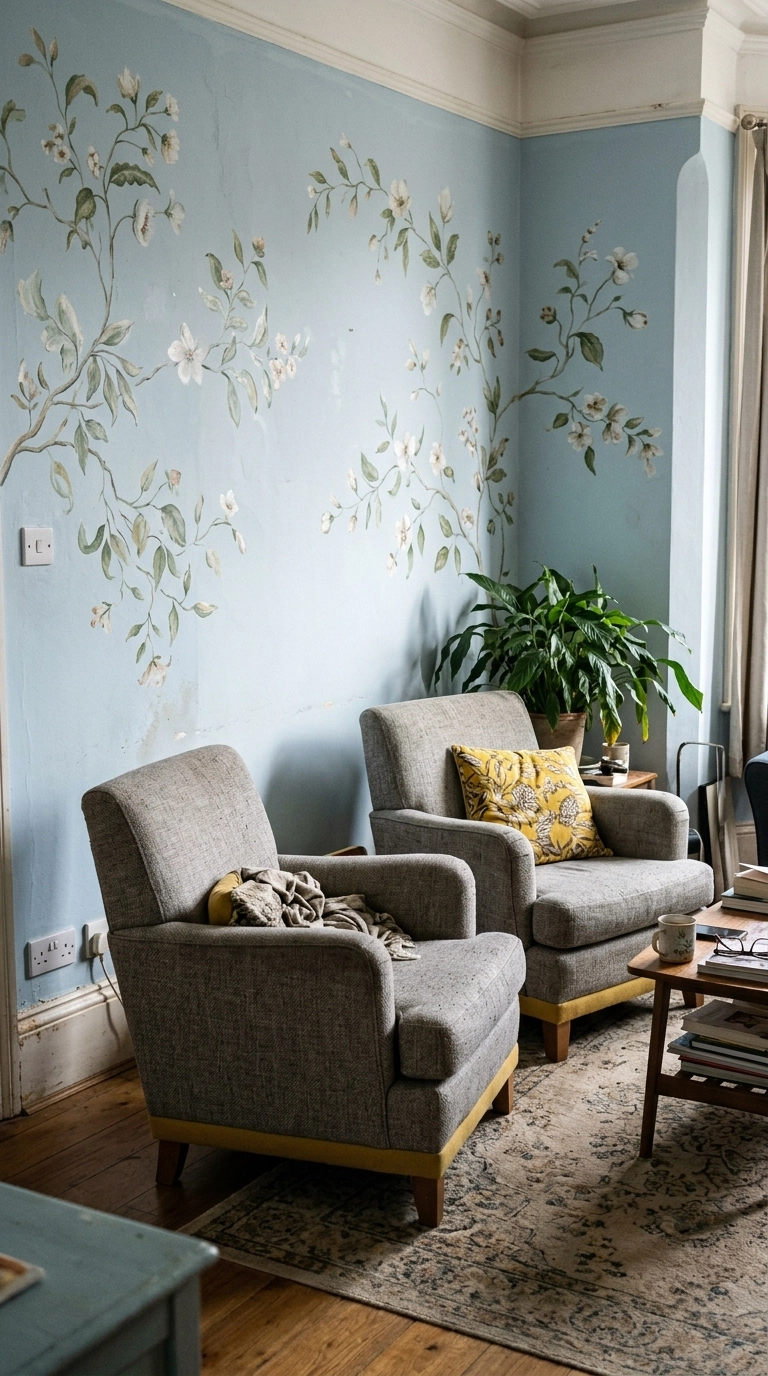
Grey textured armchairs with yellow trim along their bases, a yellow patterned cushion, and a pale blue wall hand painted with floral branches behind them. Yellow as trim is the tailored dose: a line of it along a chair base, like piping on a jacket. The painted blue wall does the cooling with a brush rather than upholstery, and the floral branches keep it soft. Bespoke touches aside, the transferable idea is piping: yellow piping on blue or grey chairs gives the pairing in miniature.
Piping dose: Contrasting piping is the pairing at its cheapest and smartest. Yellow piping on a blue chair, or the reverse, reads custom made.
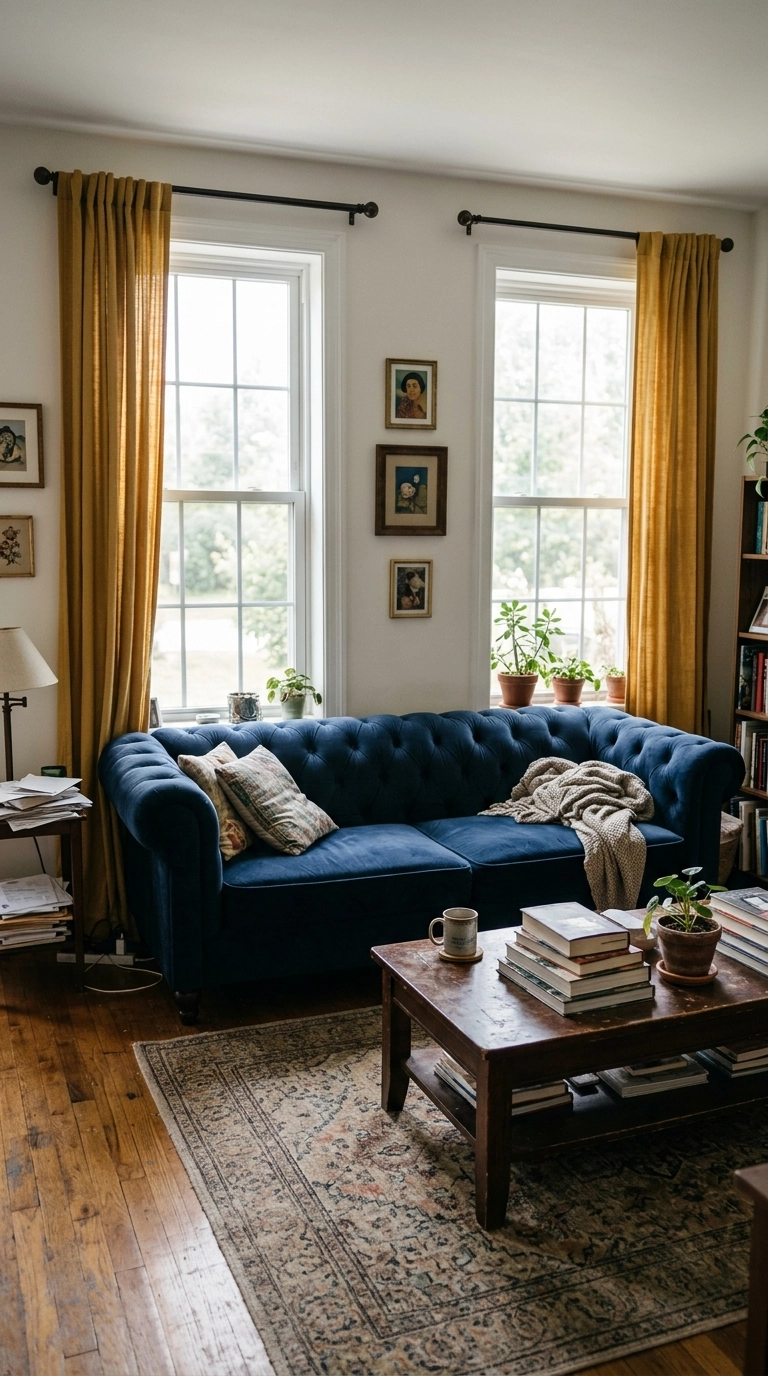
A deep navy tufted Chesterfield between two windows dressed in full length yellow curtains, a dark wood coffee table in front. Curtains are yellow’s biggest soft surface, and framing a navy sofa with two of them is like hanging the sofa between two lamps. The Chesterfield’s formality keeps the yellow cheerful rather than childish; buttoned velvet is grown up in any company. Tall windows with strong curtains on either side of a dark sofa is a composition worth stealing whole.
Curtain frame: Yellow curtains either side of a navy sofa act as built in lighting. The sofa looks lit even at noon on a grey day.
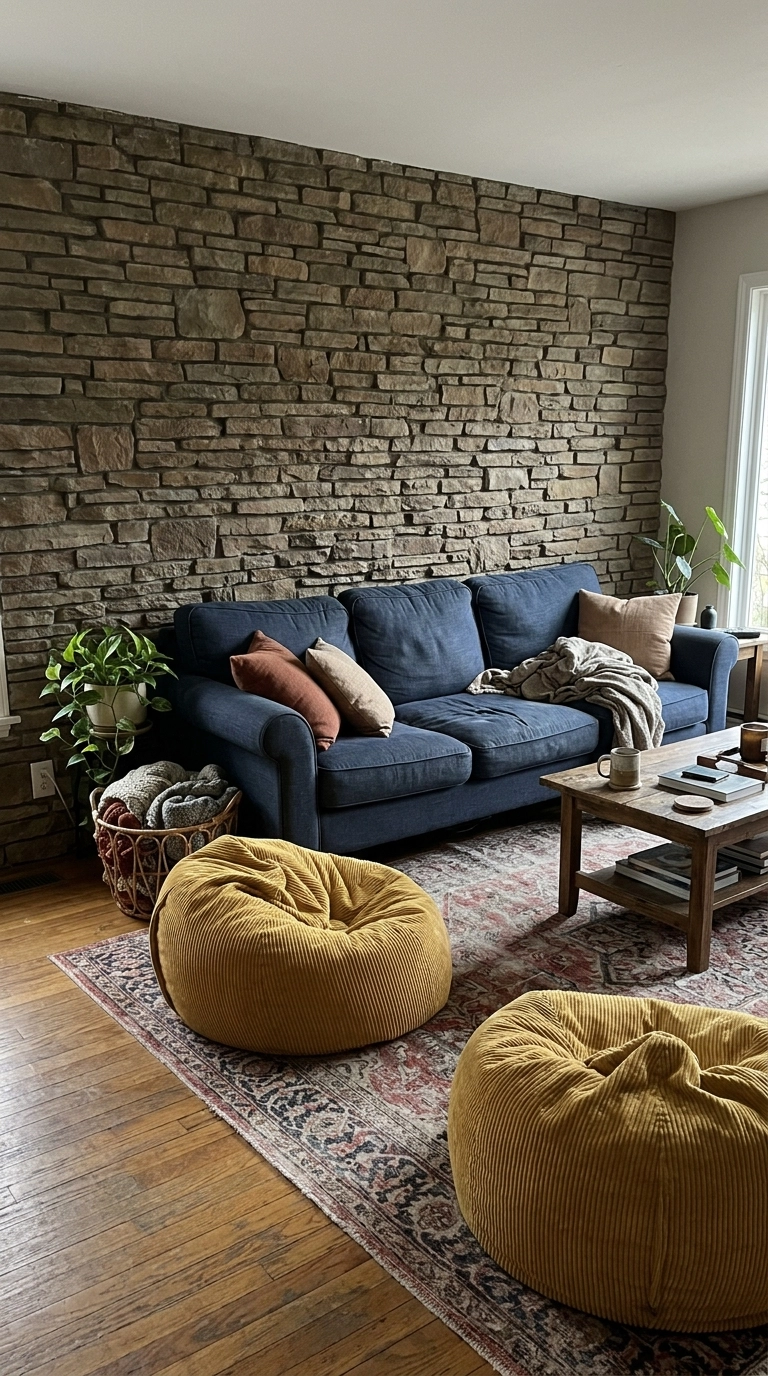
A navy sofa against a stacked stone wall, with two mustard corduroy beanbag chairs slumped in front of it. Beanbags are yellow without commitment, floor level, movable, and their slouch is the perfect foil for a tailored navy sofa. The stone wall’s grey browns mediate between the two strong colours. Family rooms should copy this shamelessly: the expensive piece stays blue and calm, the cheap pieces carry the sunshine and take the wear.
Cheap seats, loud colour: Put the yellow on the pieces that get replaced, beanbags, poufs, cushions, and keep the investment sofa blue.
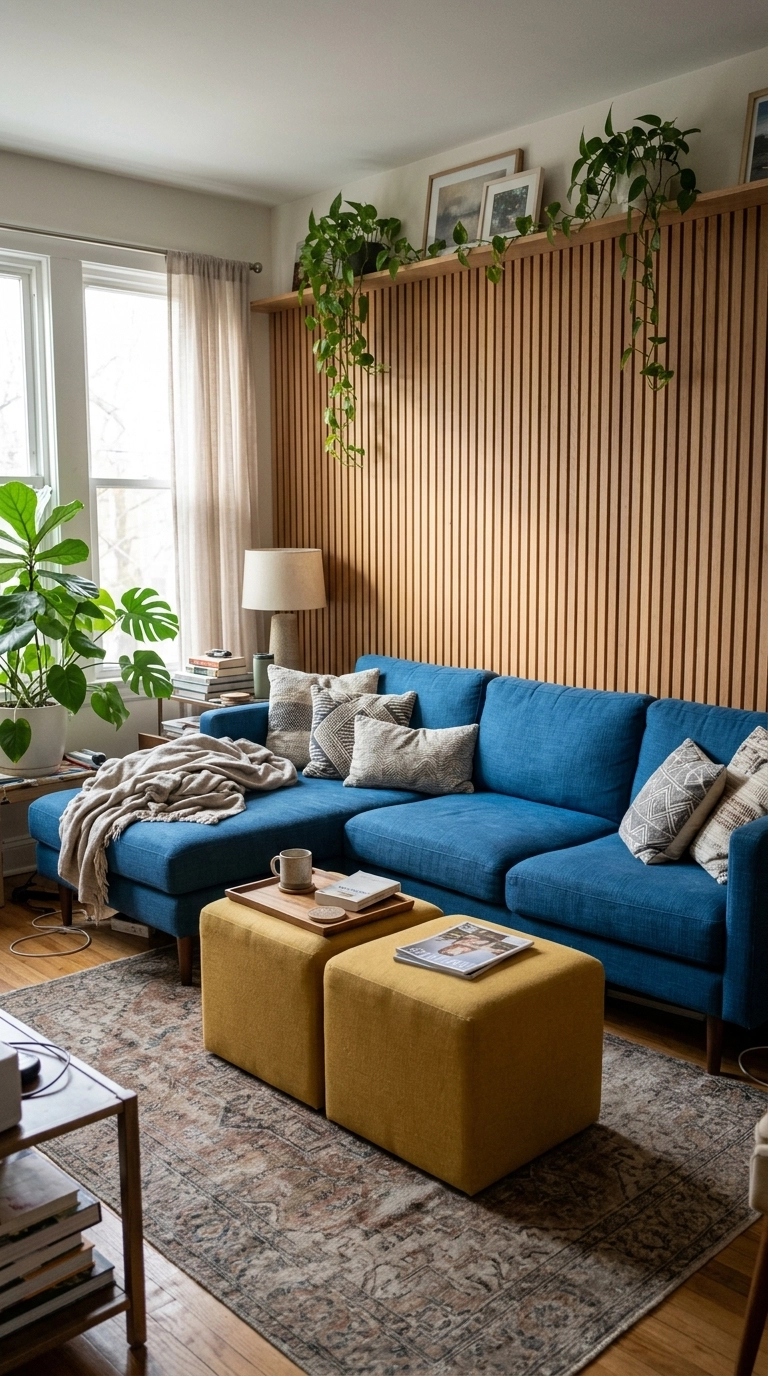
A bold blue L shaped sofa with geometric cushions, two mustard ottomans in the middle of the room and a slatted wood wall behind. Ottomans are the hardest working yellow there is: seats, footrests, coffee table stand ins, and colour blocks all at once. Two matching ottomans in the centre of a seating group read as a designed island. The geometric cushions mix blue and yellow in pattern, which knits the two blocks of colour together.
Island ottomans: Two ottomans beat one. A pair can split for feet, join for a table, and their double dose of yellow balances a whole blue sofa.
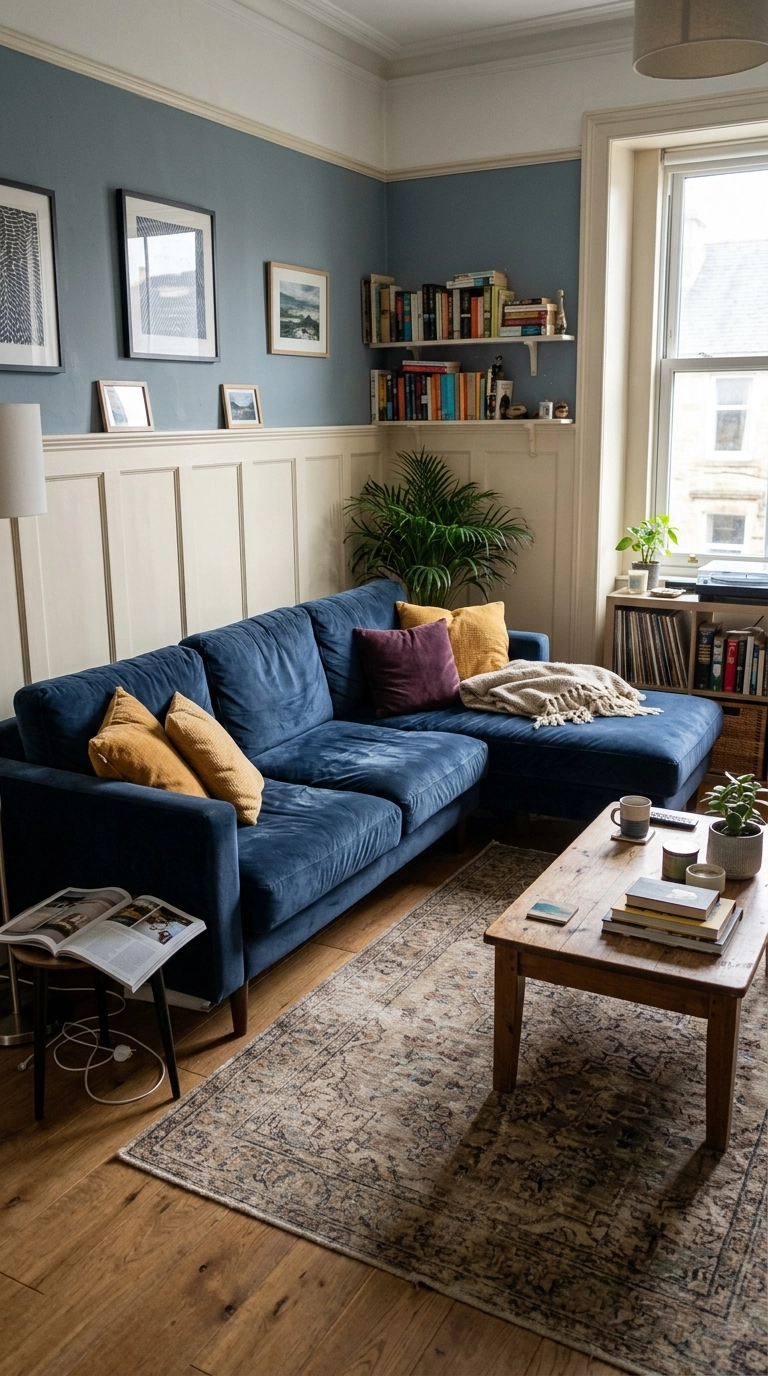
A navy velvet sectional in a real family room, muted blue upper walls with cream panelling below, and mustard cushions with one plum cushion hiding among them. This is the pairing as most homes actually do it, and the plum cushion is the detail to steal: a third colour, used once, stops blue and yellow looking like a football kit. The muted blue wall shows restraint too; the wall whispers so the sofa can talk. Real rooms beat showrooms at this pairing because cushions get swapped and schemes stay alive.
Kit breaker: Add one cushion in a third colour, plum, rust, olive, to stop blue and yellow reading as a team strip.
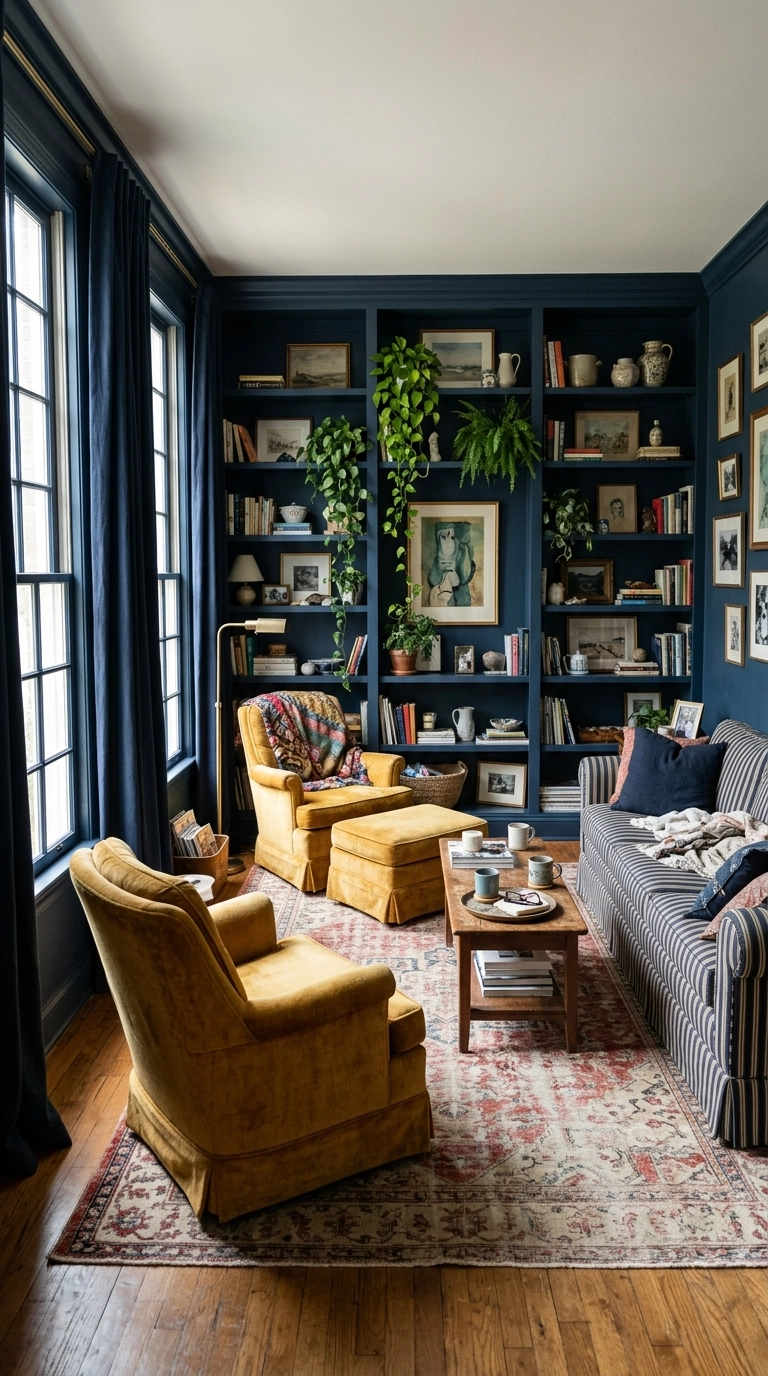
A deep navy keeping room with shelving, tall windows in navy curtains, a pinstripe sofa, and ochre armchairs and ottomans glowing in the middle. Ochre is yellow after dark, deeper and easier than mustard in a navy room, where bright yellow can look neon under lamplight. The floral ceiling is the room’s private joke and proof that navy rooms can take pattern overhead. In north facing or evening rooms, always choose ochre over lemon; it is the yellow that behaves at night.
Evening yellow: For rooms used mostly after dark, ochre and antique gold shades of yellow beat bright ones every time.
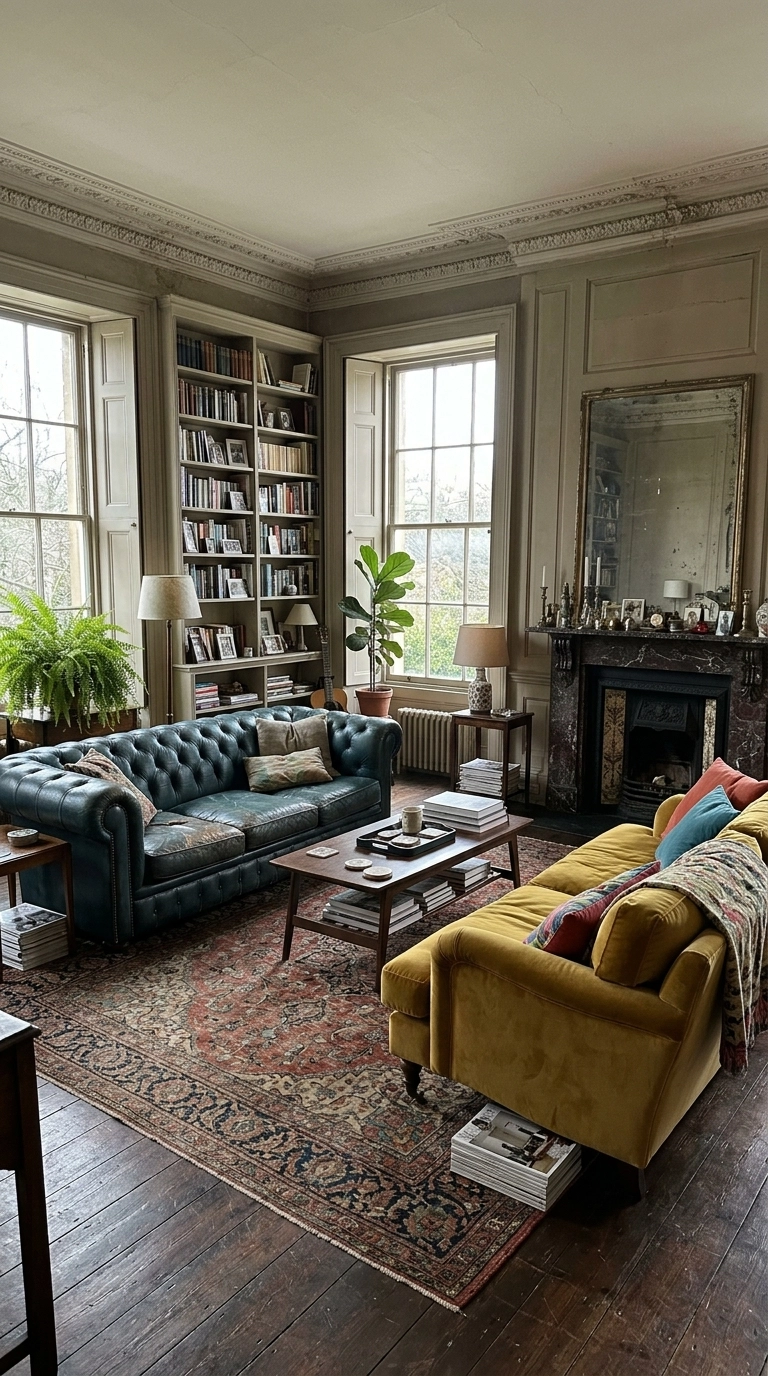
A dark teal tufted leather Chesterfield and a mustard velvet sofa facing each other in a period room, the two colours at full strength, piece against piece. This is the pairing as a fair fight, and it works because both sofas are equally formal, equally saturated and equally confident. Mismatched energy is what usually kills two sofa rooms; matched confidence saves them. Leather against velvet also gives the colours different textures to live in, one shining, one soft.
Fair fight rule: Two statement sofas must match in formality and depth of colour. One shy sofa and one loud one always looks like a mistake.
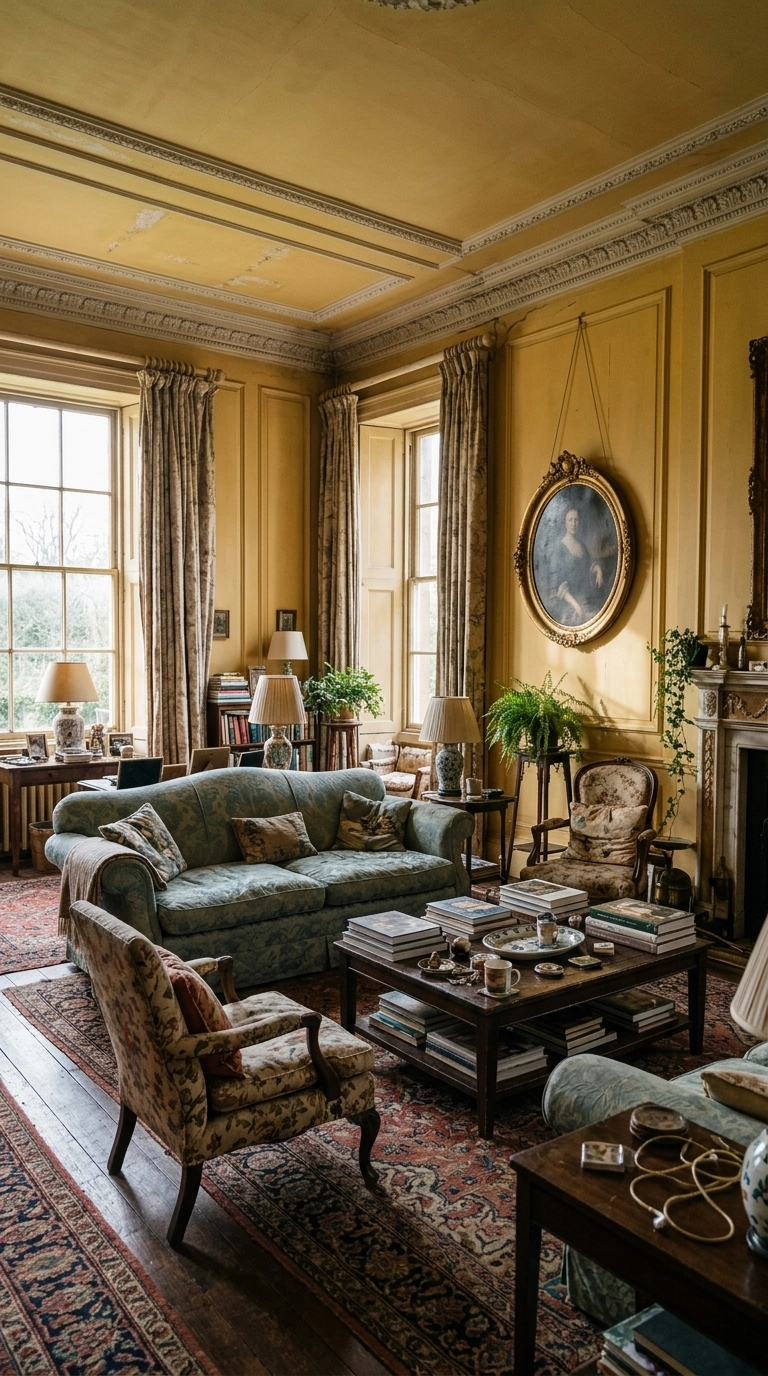
A grand room with yellow walls and ceiling, a blue green damask sofa, floral armchairs and a portrait in a heavy oval frame. Yellow walls are the boldest move in this list, and they need old fashioned company: damask, gilt, portraits, pattern on pattern. The blue sofa cools the walls the way a lake cools a field, one deep calm surface in all that sunshine. Yellow walls also flatter everything in the room, faces included, which is why drawing rooms wore this colour for centuries.
Wall courage: Yellow walls demand traditional furniture. In a minimal room they look like an accident in a rental.
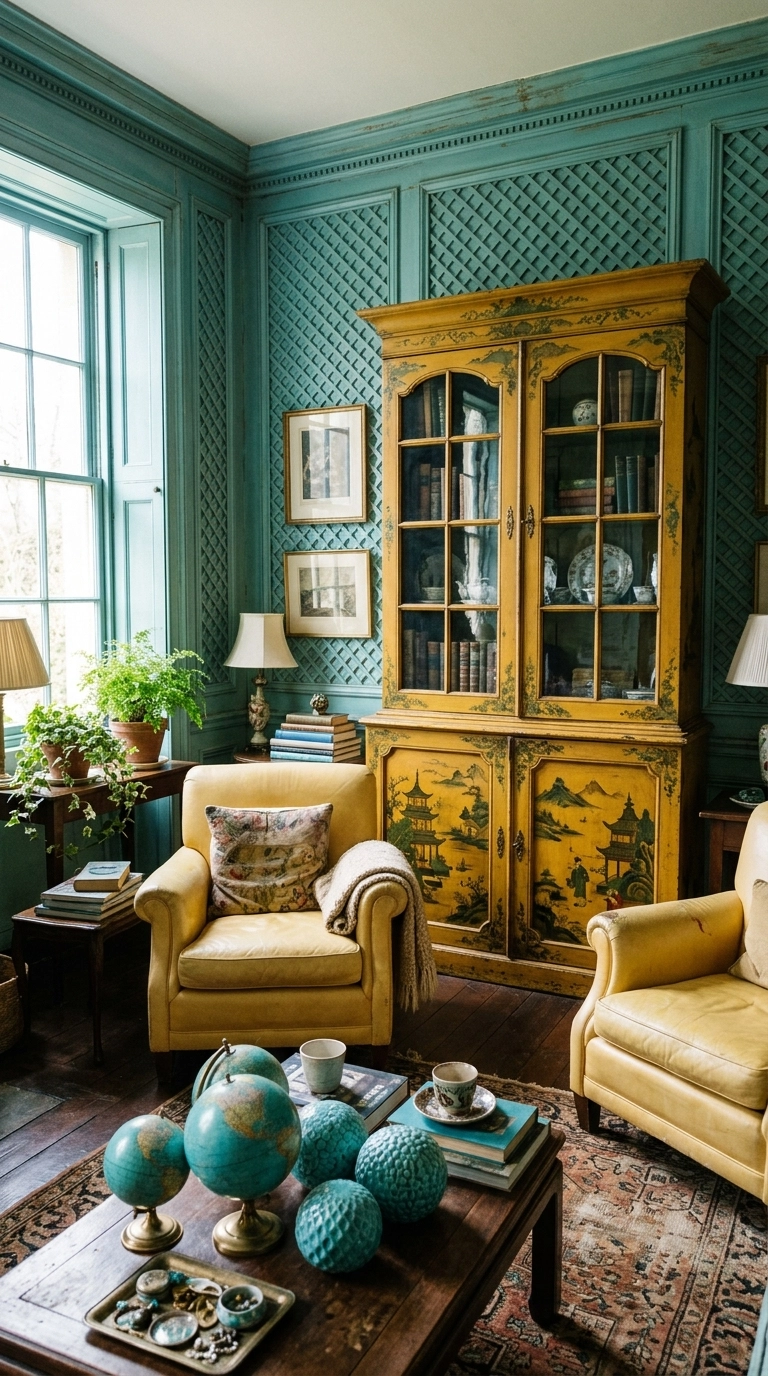
Turquoise lattice walls, butter yellow seating, and a huge yellow chinoiserie cabinet painted with landscapes standing as the room’s centrepiece, turquoise globes on the table echoing the walls. A painted cabinet is furniture as artwork, and in yellow against turquoise it becomes the sun in the room’s sky. The lesson is scale: one enormous yellow piece can do what twenty yellow cushions cannot, anchoring the pairing in a single gesture. If you find a big old cabinet, painting it yellow may be the best decision in the room.
One sun rule: A single huge yellow piece, cabinet, bookcase, piano, anchors the pairing better than a dozen small accents.
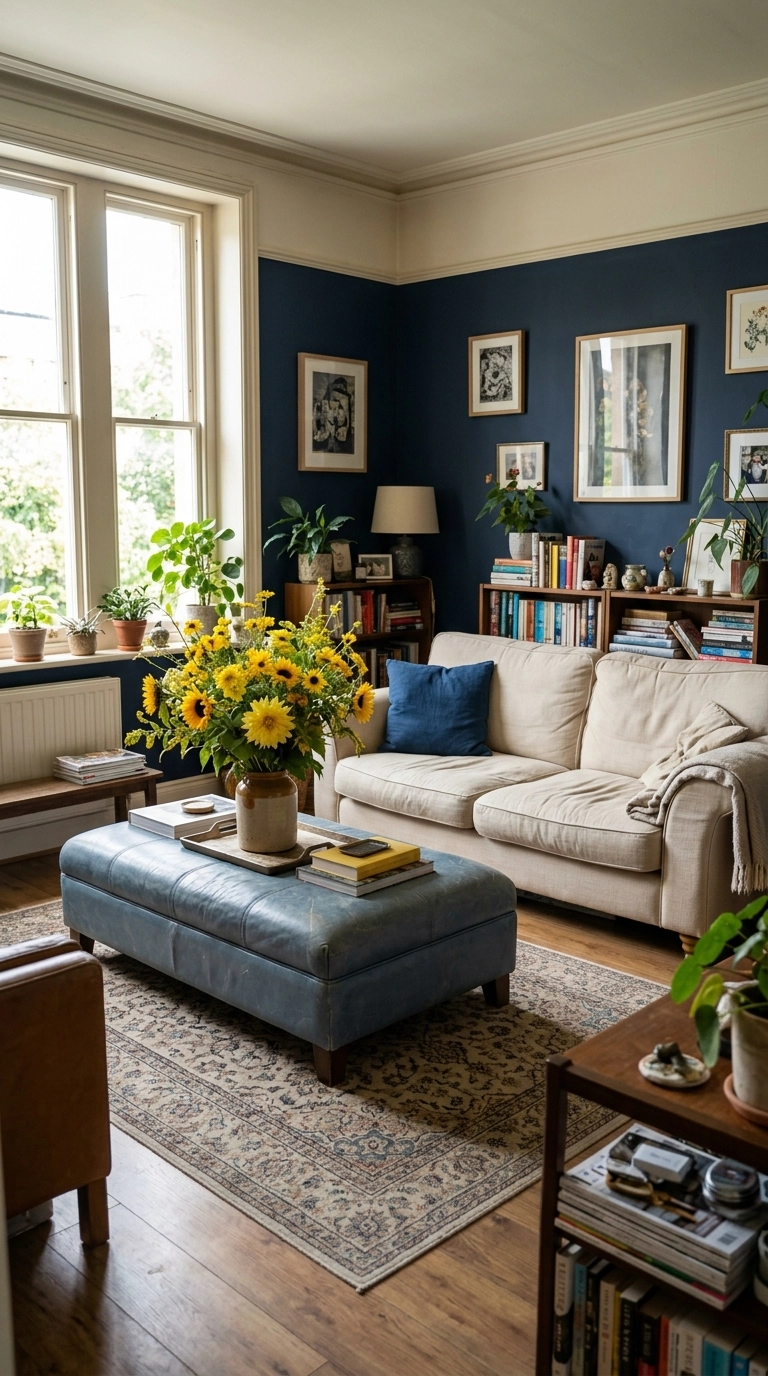
Deep navy walls, a cream sofa with a blue cushion, a dusty blue leather ottoman, and in the centre a large bouquet of yellow flowers doing all the yellow work in the room. Flowers are yellow with an expiry date, which makes them the perfect trial: a week of yellow before you buy anything. The bouquet’s size matters; a small bunch would vanish into the navy, this one is scaled like furniture. In dark rooms, flowers and fruit are not decoration, they are lighting in colour form.
Trial week: Test yellow with a huge bouquet before buying a single object. Scale it like furniture, live with it, then decide.
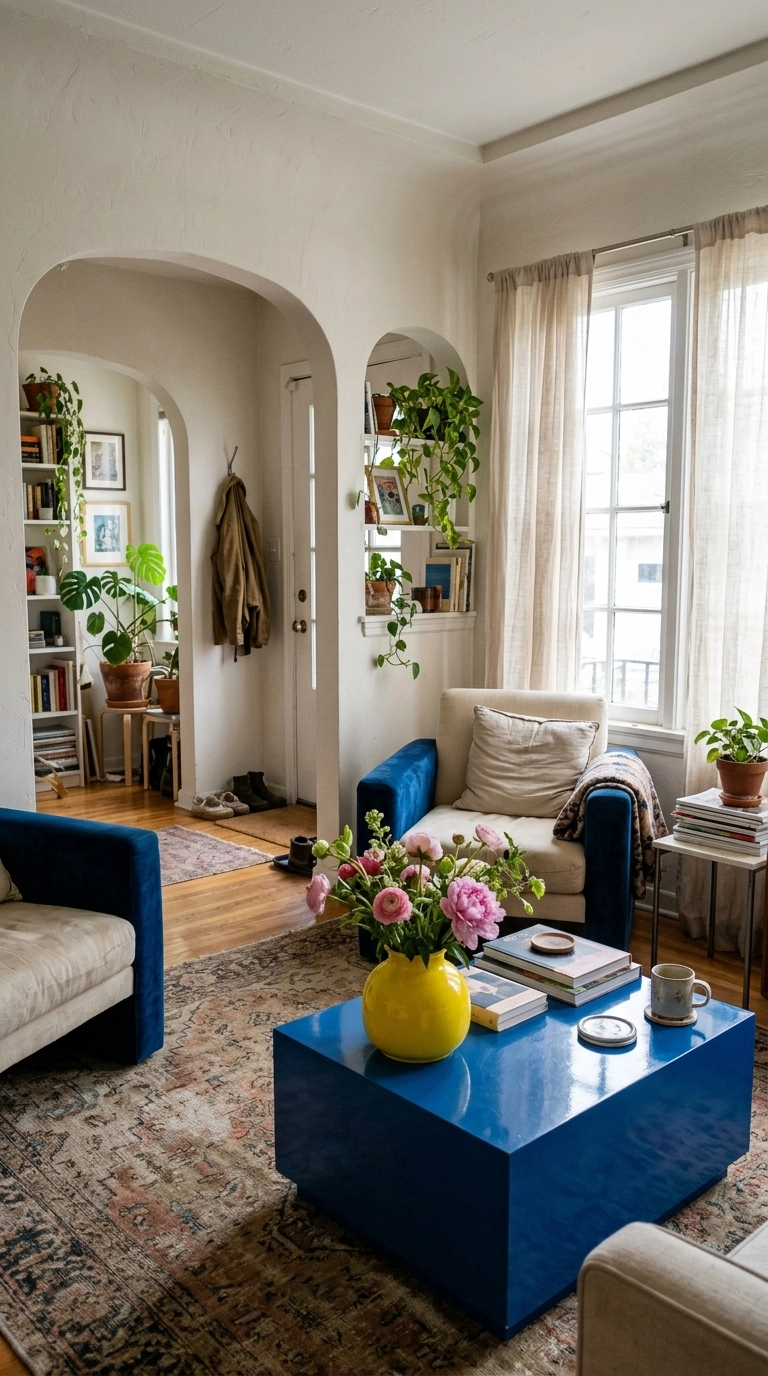
A bright arched room with a cream and blue velvet armed chair, glossy blue and green block tables, and a bright yellow vase of pink flowers on the table. Lacquered colour block tables are the modern way into this pairing, furniture painted in gloss so the colours look like enamel. The yellow vase is small but glossy, which doubles its presence; shine is a colour amplifier. In white modern rooms, gloss is how you get away with strong colour, everything reads as an object in a gallery.
Gloss amplifier: A small glossy yellow piece reads twice as big as a matte one. In pale rooms, buy your accents lacquered.
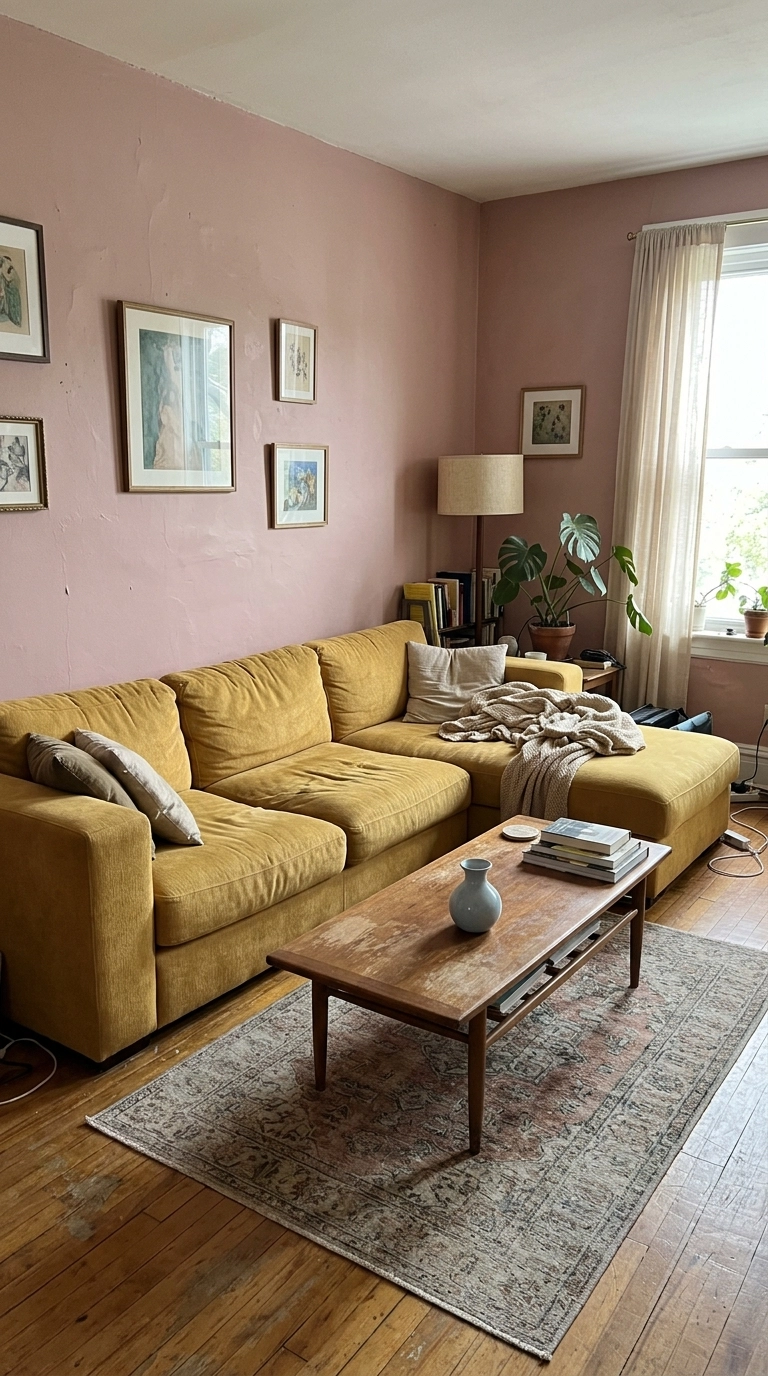
A large mustard modular sectional in a dusty pink walled room, and for blue, essentially one pale blue grey vase on the coffee table. This is the minimalist dose, a room that is honestly a yellow room with a blue signature. It earns its place here because many people want exactly this: commitment to one colour, a nod to the other. The vase works because it sits at the room’s centre on the table, the same full stop trick as the single cushion, in ceramic form.
Signature dose: One blue object at the centre of a yellow room is a signature, not a scheme, and sometimes a signature is all a room wants.
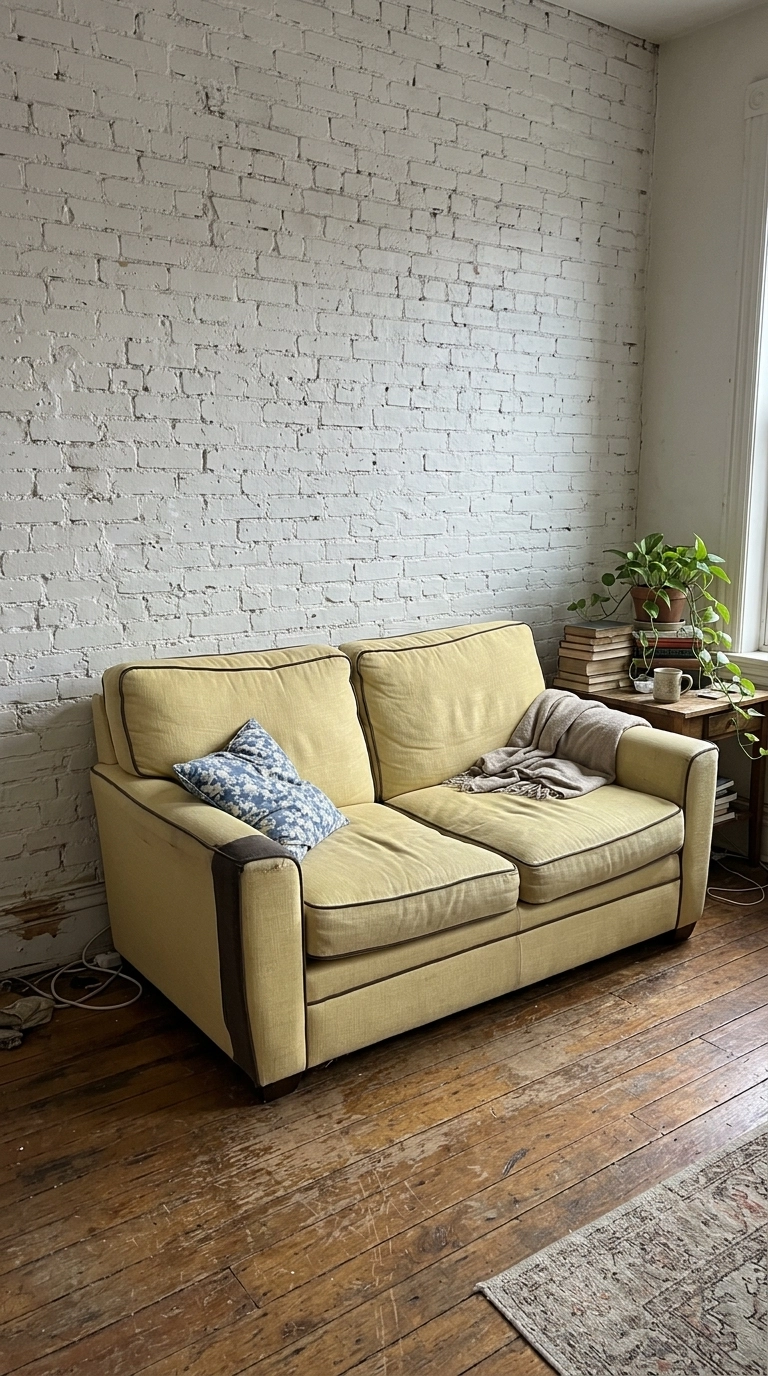
A pale yellow sofa with dark trim against a white painted brick wall in a worn floored studio style room, a blue and white floral tote hanging on its end. Lemon pale yellow is the shyest version in the list, nearly a neutral, and on white brick it reads as sunlight rather than colour. The tiny blue note in the tote is almost a joke about how little blue a room can carry and still join this list. Loft and studio rooms suit pale yellow because it warms industrial surfaces without fighting them.
Sunlight shade: Pale lemon yellow on brick or concrete adds warmth without a colour commitment. It is the beginner’s yellow.
Six mistakes that sink blue and yellow:
Matching the brightness exactly, so the room vibrates like a sports kit. Drop one colour a shade deeper or paler.
Scattering yellow in ones. A single cushion here and a lone vase there reads as accidents; group in threes.
Forgetting the mediator. Wood, cream, grey or pattern between the two colours gives the eye a rest.
Choosing lemon yellow for an evening room. Under lamplight it goes sour; ochre and mustard behave.
Putting the yellow only at eye level. The pairing needs one low note, a rug border, an ottoman, or it floats.
Adding a third strong colour at full strength. A third colour gets one appearance, like the plum cushion, never a second piece.
Blue cools, yellow warms, and the whole art is the dose. A yellow sofa under blue art, mustard cushions on a navy sectional, one yellow chair against a blue wall, or a whole room of yellow walls cooled by a single damask sofa: every version in this list is the same negotiation at a different volume. Pick the dose your room’s light can handle, hold the other colour steady, and repeat your accent three times so it looks like a decision. Then stop. The pairing rewards restraint more than enthusiasm.