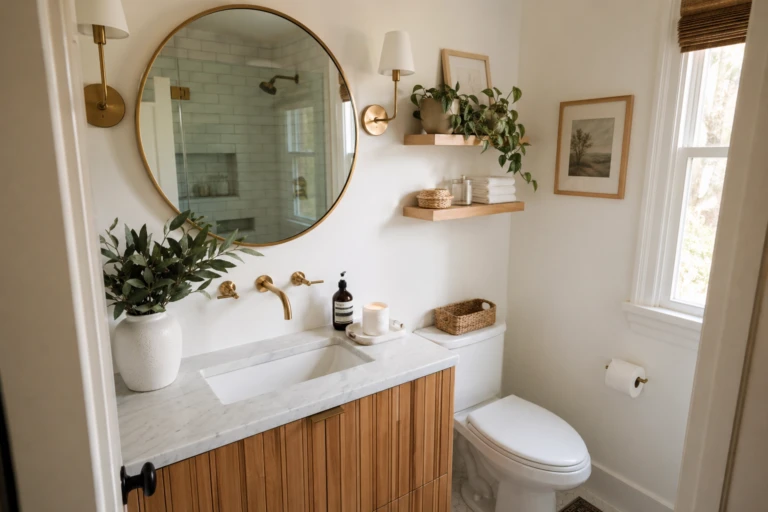
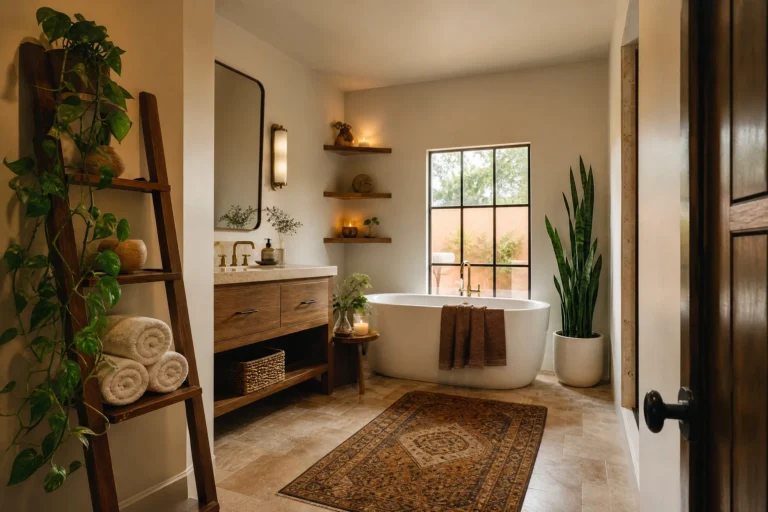
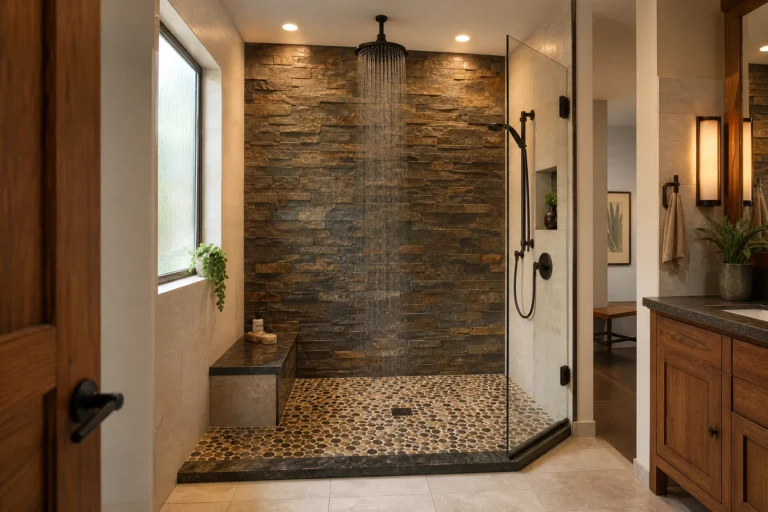
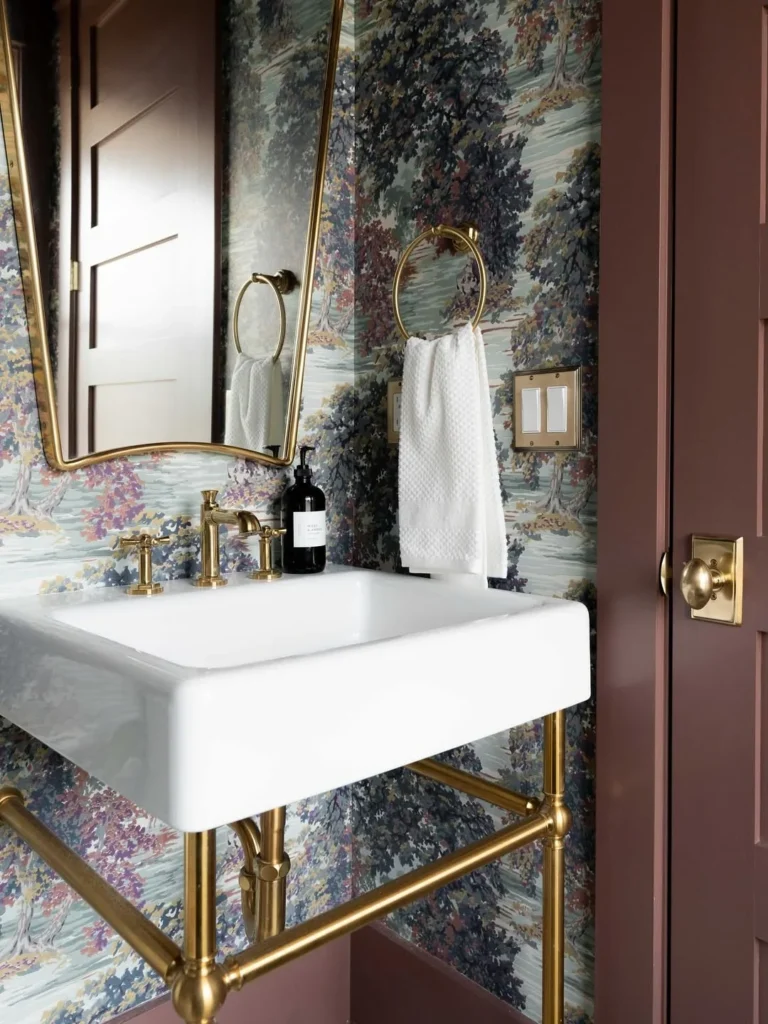
Most vanity mirror regrets have nothing to do with style. The mirror is lovely, it just hangs two inches off center from the faucet, stops at chin height, or fights the sconces for the same patch of wall. Mirrors take their orders from the room around them, from the sink below, the light beside them, the frame that suits the house, and the people who stand there half asleep at 6 a.m.
These 27 bathrooms show the orders being followed well, with the sizing and placement rules tucked inside each idea so you can steal the look and the measurements at the same time.
Orders From the Sink: Width and Centering
1. Two Mirrors, One Per Sink, Centered on the Taps
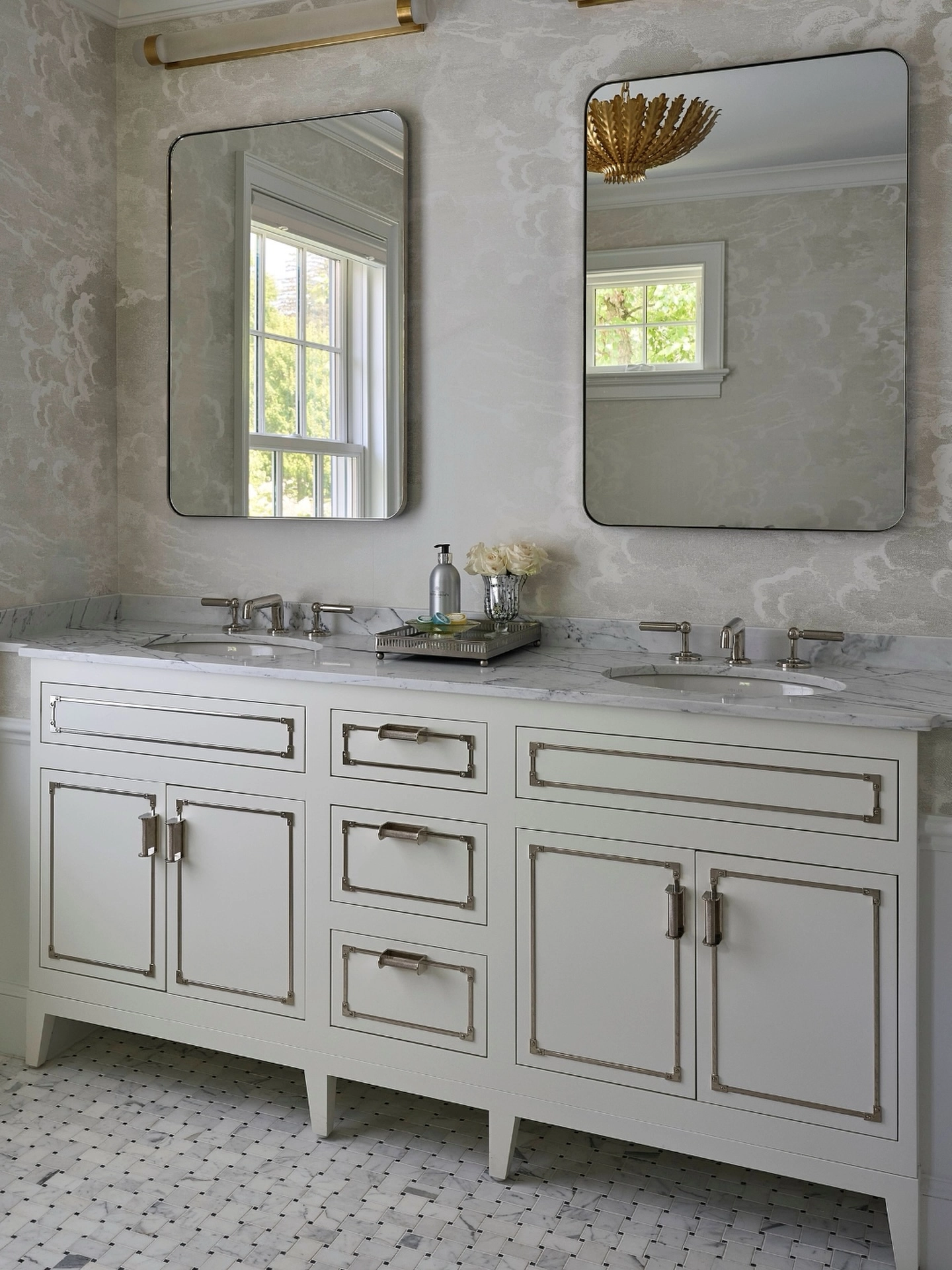
The double vanity rule that prevents more arguments than any other is simple: each mirror centers on its own sink, not on the cabinet as a whole. These two rounded corner rectangles sit exactly over their faucets, with slim brass light bars above each, so both people get a straight on view at the same time. When sinks are offset inside a long cabinet, centering on the cabinet instead leaves one person leaning sideways every morning. Measure from the drain, not from the drawers, and the whole wall falls into line.
Center rule:Find the drain centerline, drop a plumb line or tape strip up the wall, and hang the mirror on that line even if it looks off center against the cabinet below.
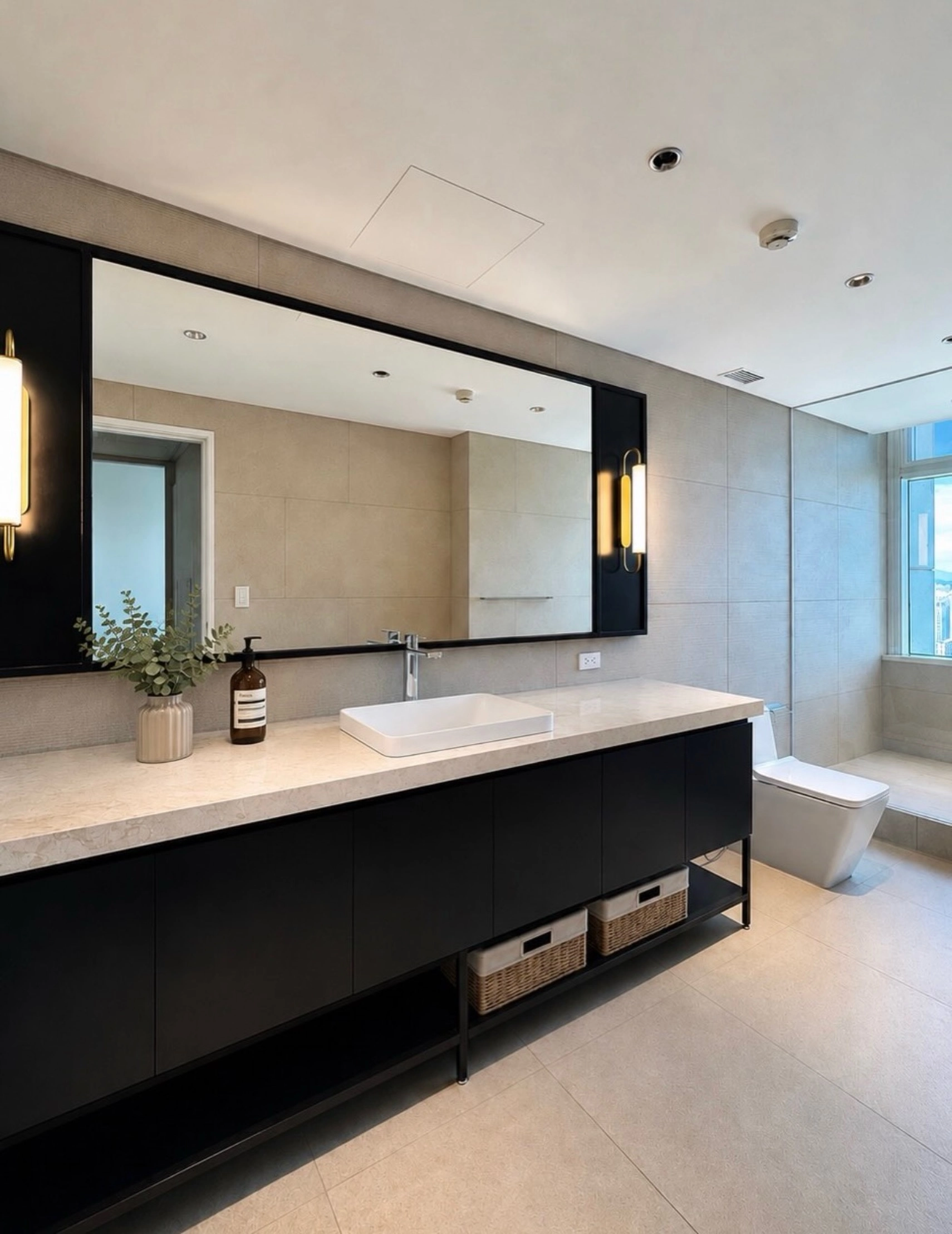
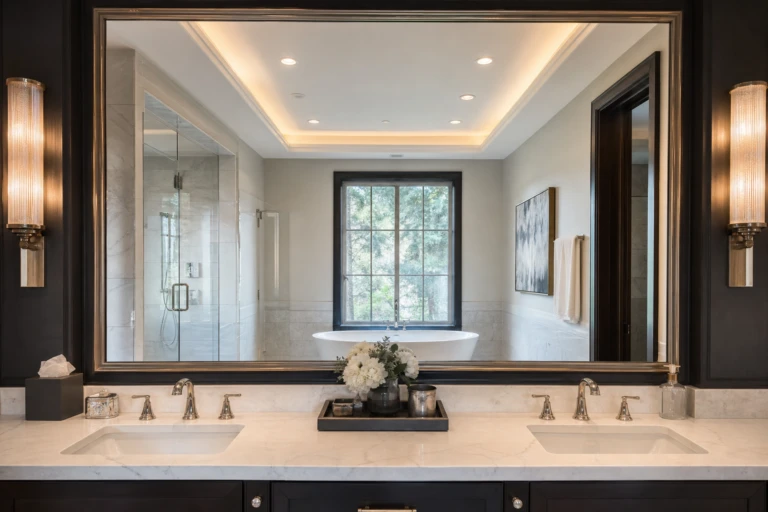
A single wide mirror is the other honest answer for two sinks, and this long black framed sheet shows why it survives every trend cycle. It bounces more light around than two smaller mirrors, gives both users an unbroken reflection, and keeps one long sightline that makes the vanity feel wider. Slim vertical sconces sit at both ends of the glass, which puts light at face height instead of only overhead. The trade is practical: one wide mirror is a two person hang, and a chip anywhere means replacing the whole sheet.
Width guide:A shared mirror should stop a couple of inches short of the vanity at both ends. Edge to edge glass leaves no landing spot for a water glass and shows every splash against the wall.
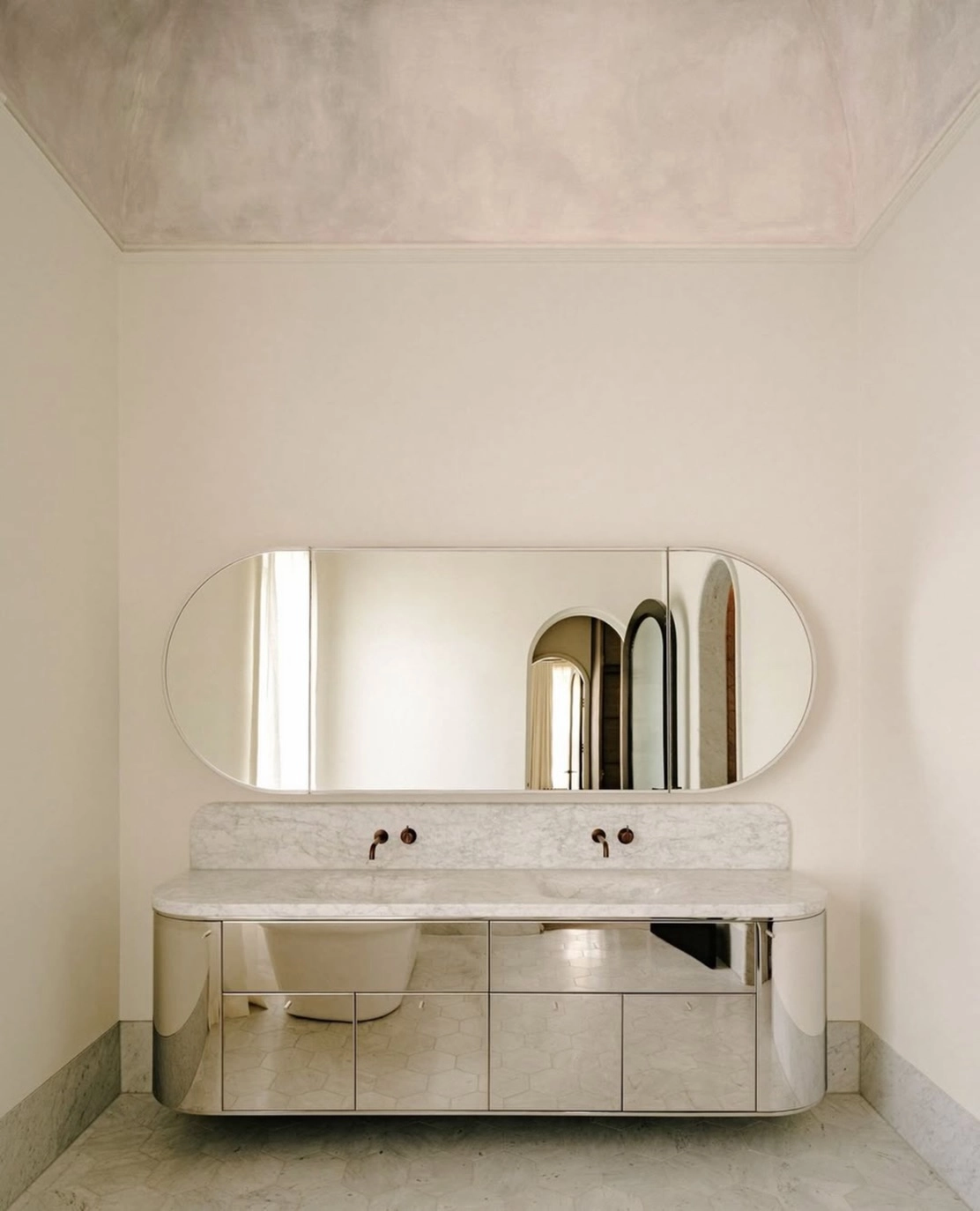
Turning the popular pill shape sideways solves the double vanity problem in one move. This wide horizontal pill floats over a mirrored vanity and two sinks, softening every hard angle in the room while still reading as one calm shape. The frameless edge keeps it light, which matters when a mirror runs this wide, since a heavy frame at that size can feel like a billboard. Wall mounted taps below keep the counter clear, so nothing competes with the reflection. It is a strong pick for modern bathrooms that feel a bit too full of straight lines.
Height check:A wide mirror still needs its center near eye level, roughly 55 to 60 inches off the floor for most adults, or taller households will be ducking to shave.
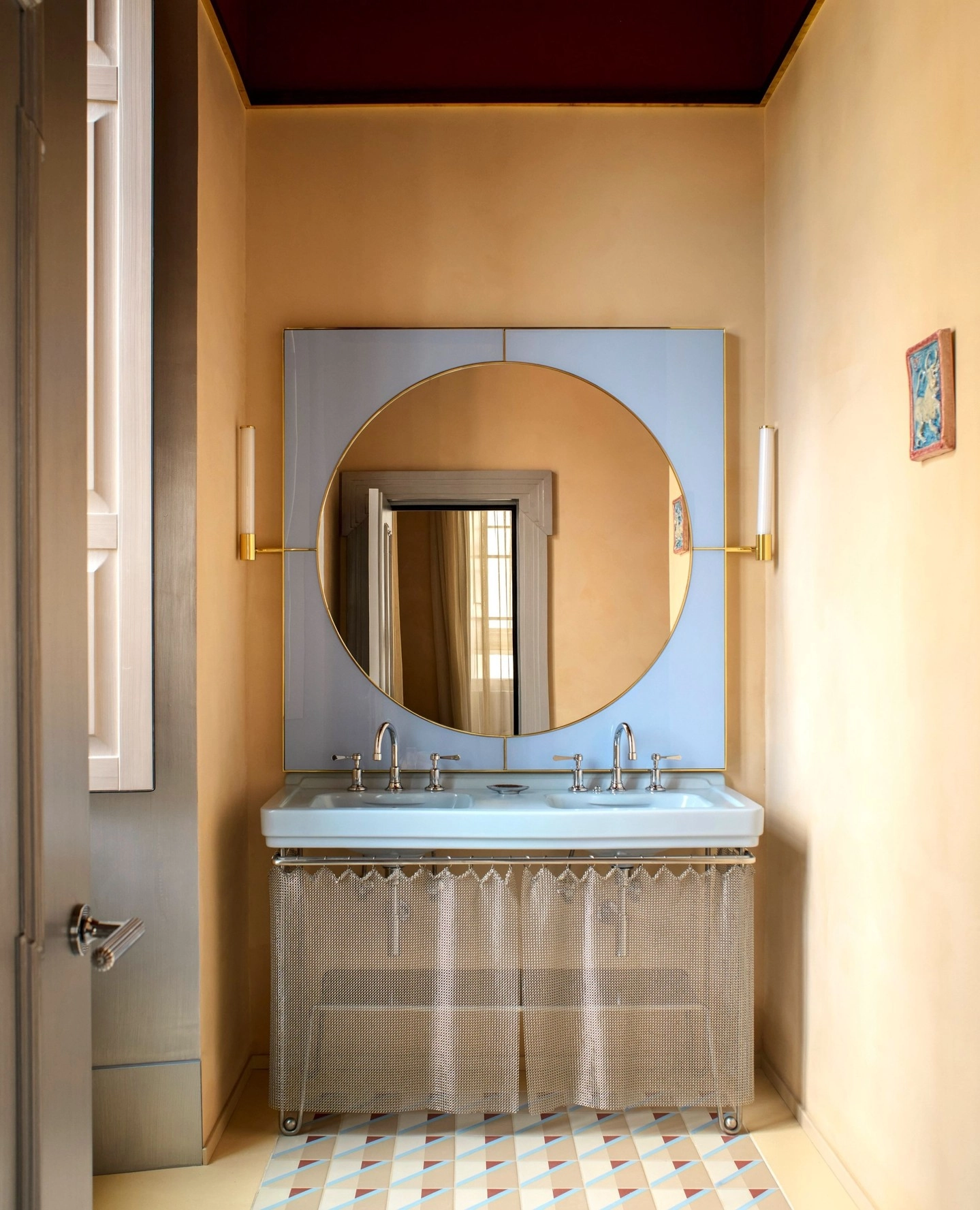
Conventional advice says a double sink needs two mirrors or one wide one, but a single oversized round can hold a double console together beautifully. This one sits on a pale blue square panel that acts like a mat in a picture frame, giving the circle a defined field on a warm plaster wall. The skirted double basin below is old fashioned in the best way, and the round mirror keeps it from feeling formal. Round mirrors also forgive slightly uneven walls and off level hanging in a way rectangles never do.
Round sizing:Pick a diameter close to the width of one sink zone plus a little breathing room, and the circle will look deliberate rather than lost over a long vanity.
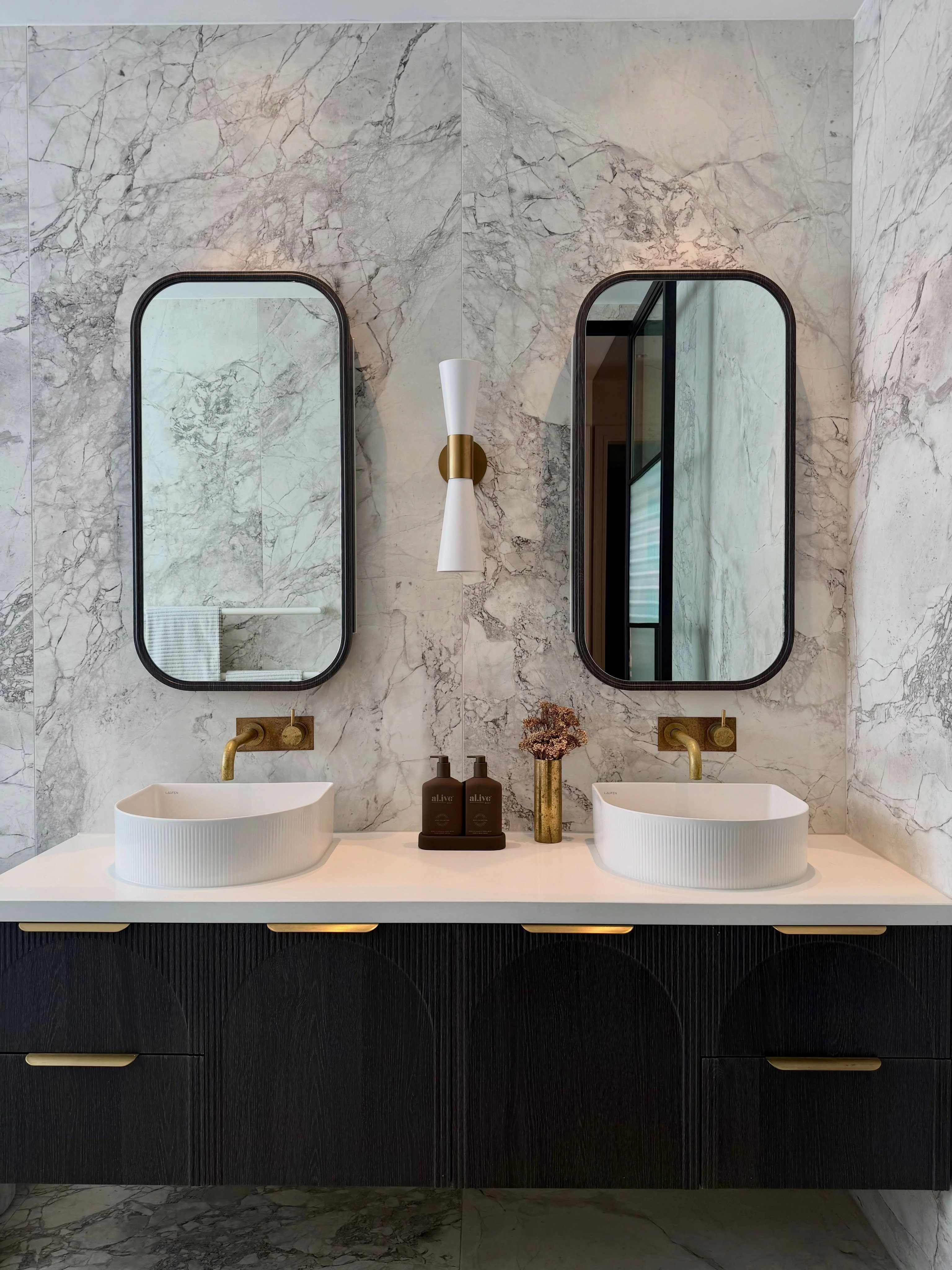
Rounded corners are the quiet compromise between sharp modern rectangles and soft ovals, and this pair shows the shape at its best. Thin black frames trace two tall mirrors over white vessel sinks, with a single sculptural sconce between them doing the lighting for both. The marble wall behind carries enough pattern that plain glass with a slim frame is exactly right. Notice the mirrors are taller than they are wide, which pulls a standard ceiling height up and gives a full head and shoulders view over the raised vessels.
Vessel adjustment:Vessel sinks raise the splash zone, so start the mirror a little higher than usual and choose a frame or sealed edge that shrugs off water spots.
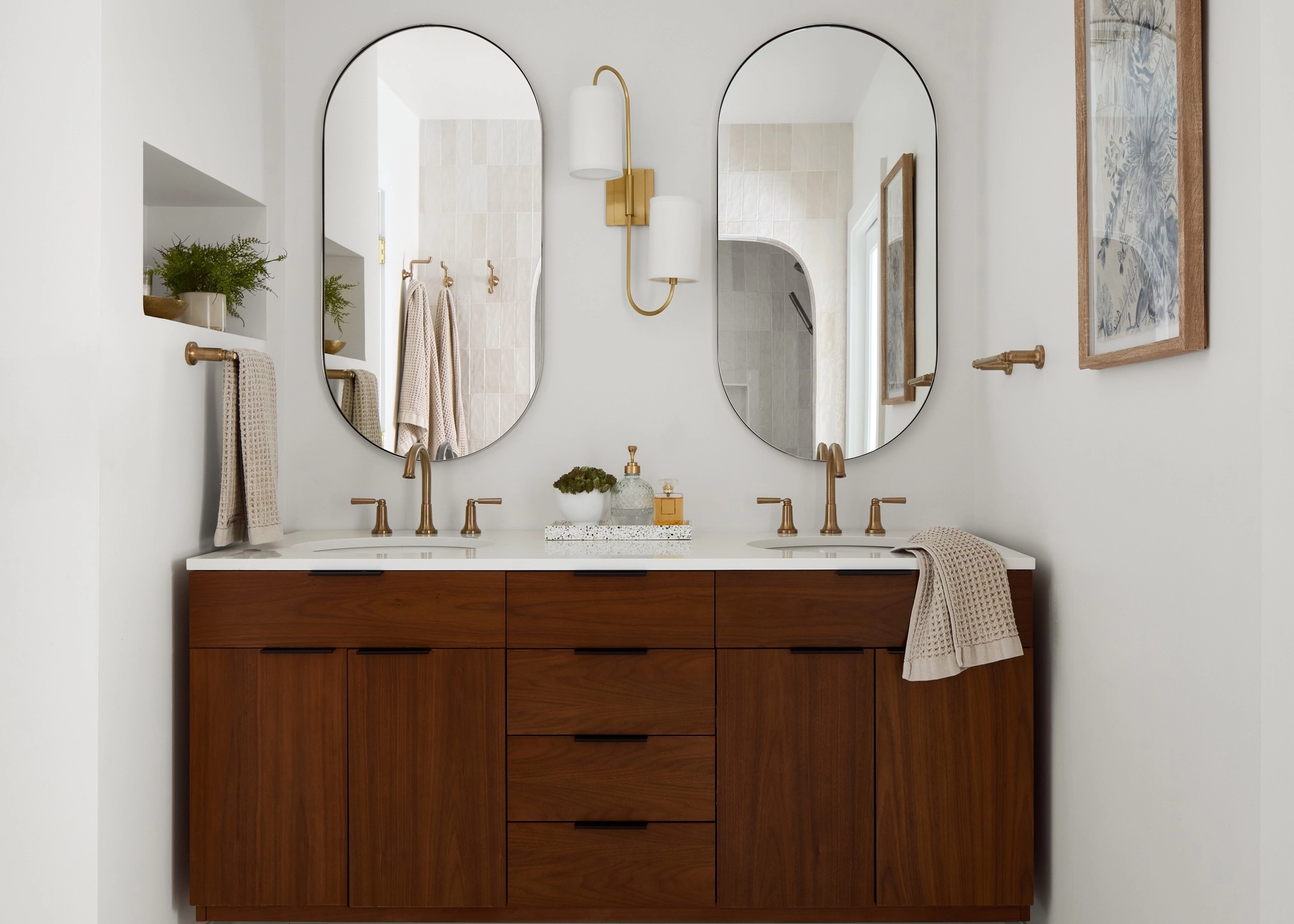
This real remodel pairs two slim oval mirrors with a walnut vanity and one brass double sconce shared between them. The ovals leave generous wall space on both sides, which keeps a modest bathroom from feeling wallpapered in glass, and their height makes up for the narrow width when you are actually using them. A single sconce between two mirrors is a budget friendly pattern worth copying, since one fixture lights two faces when it sits at the right height. Warm metals repeat in the taps, so the whole wall reads as one decision.
Shared sconce height:Mount a between mirrors light so its center lands around eye level, near 60 inches, and both faces get lit without one side falling into shadow.
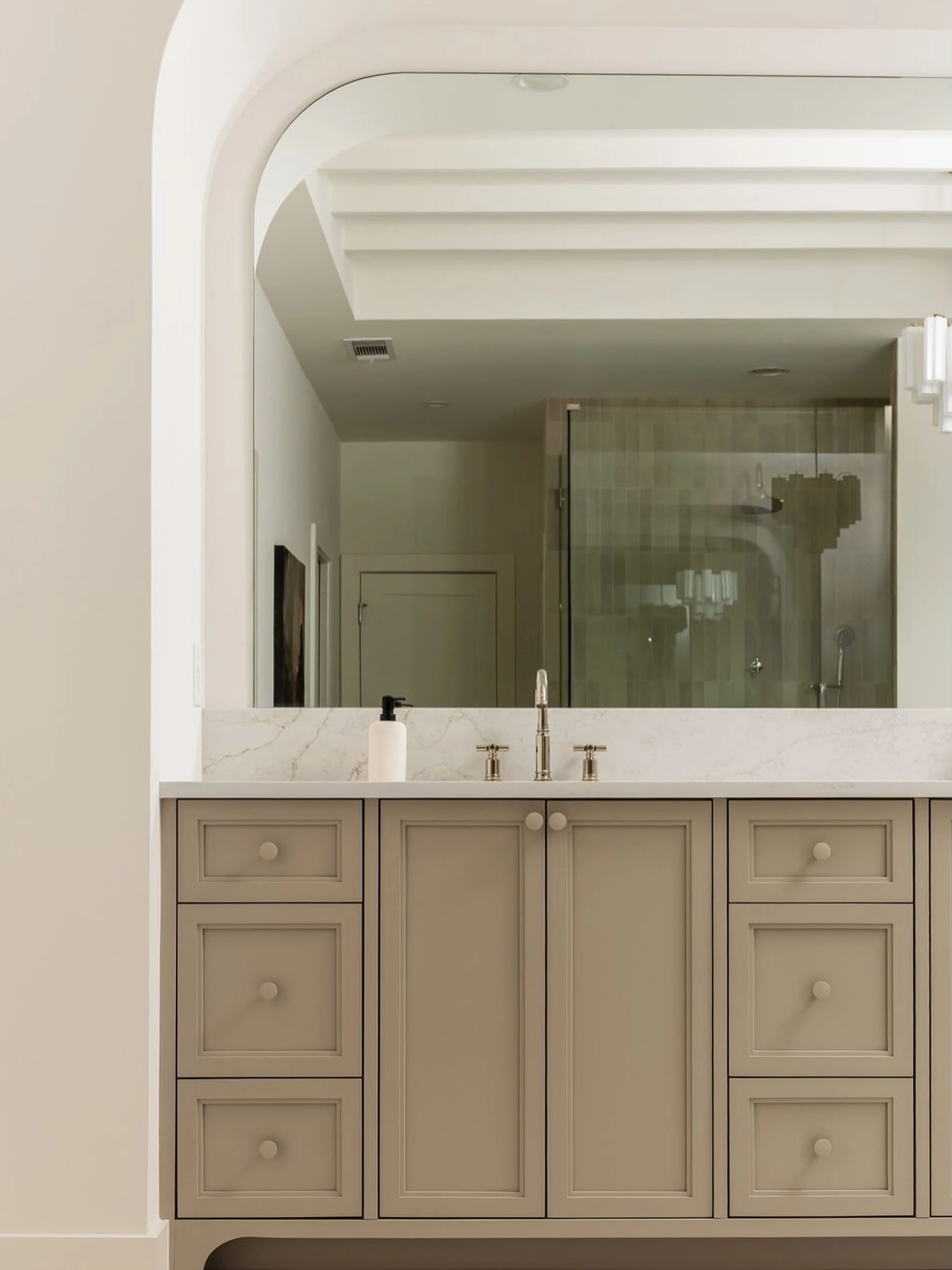
When the wall itself has an arch, the bravest move is to mirror the entire recess and let the architecture be the frame. This taupe double vanity sits under one huge arched sheet that runs the full width of the alcove, reflecting the shower glass and making a windowless feeling corner feel twice its size. A mirror cut to a shape like this is custom work, templated on site, and it costs more than anything off a shelf. What it buys is a bathroom with zero visual seams on its main wall, calm in a way framed mirrors cannot match.
Template tip:For any mirror cut to an arch or angle, have the fabricator template from the finished wall, not the plans. Plaster and tile shift openings by enough to ruin a pre cut sheet.
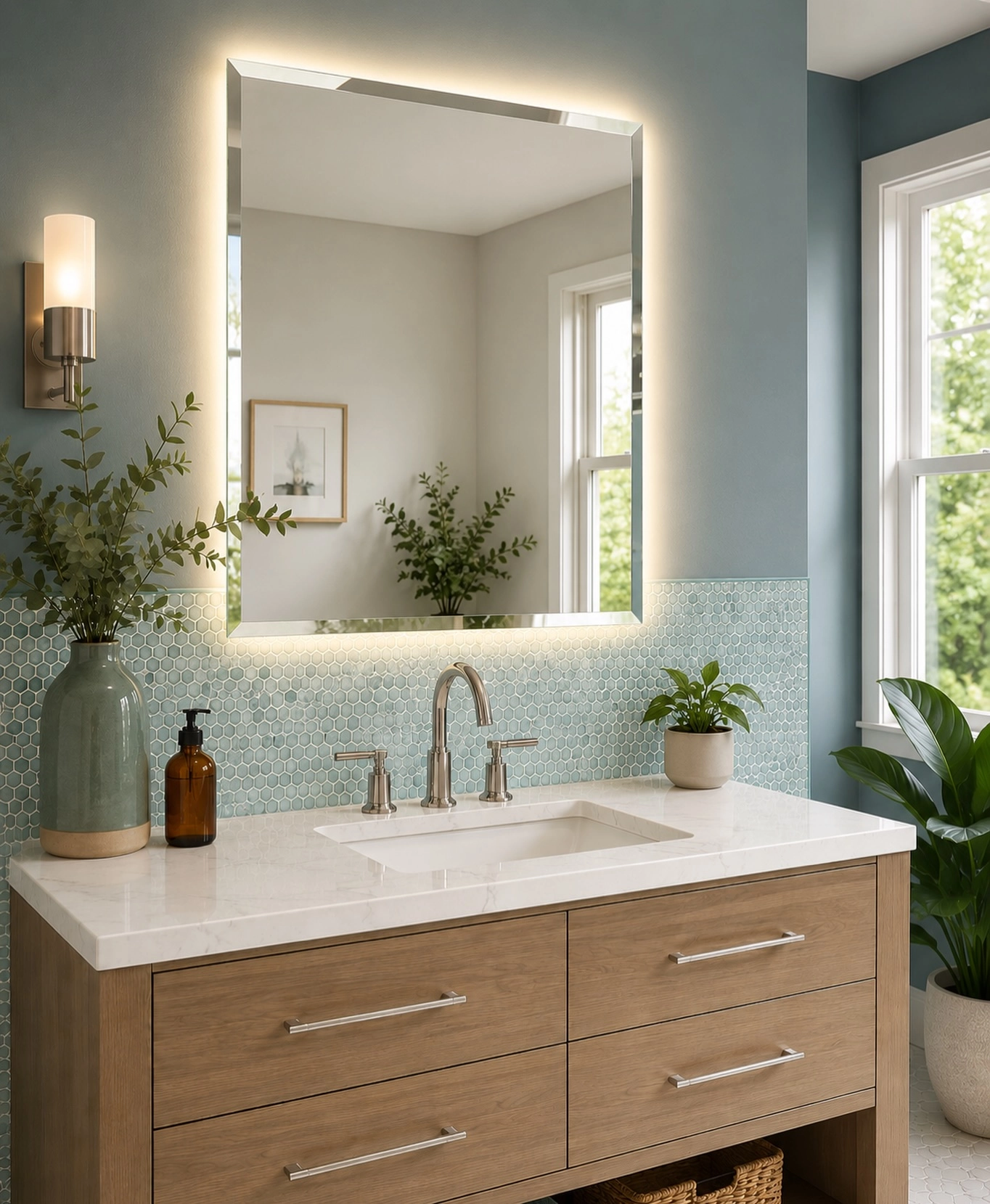
A backlit mirror throws its light from behind the glass, washing the wall with a halo and lighting your face with no fixture in sight. This frameless rectangle floats over a light wood vanity and a small hex tile splashback, and the glow makes the whole corner feel like morning even at midnight. Backlit mirrors earn their keep in bathrooms with no room for sconces, since the light source takes up zero extra wall. Many include a demister pad that keeps a clear patch in the steam, which owners consistently call the feature they would not give back.
Wire it early:Backlit mirrors need power behind the glass, so the electrician has to know before tiling. Retrofitting one onto a finished wall usually means a visible cord or a battery model.
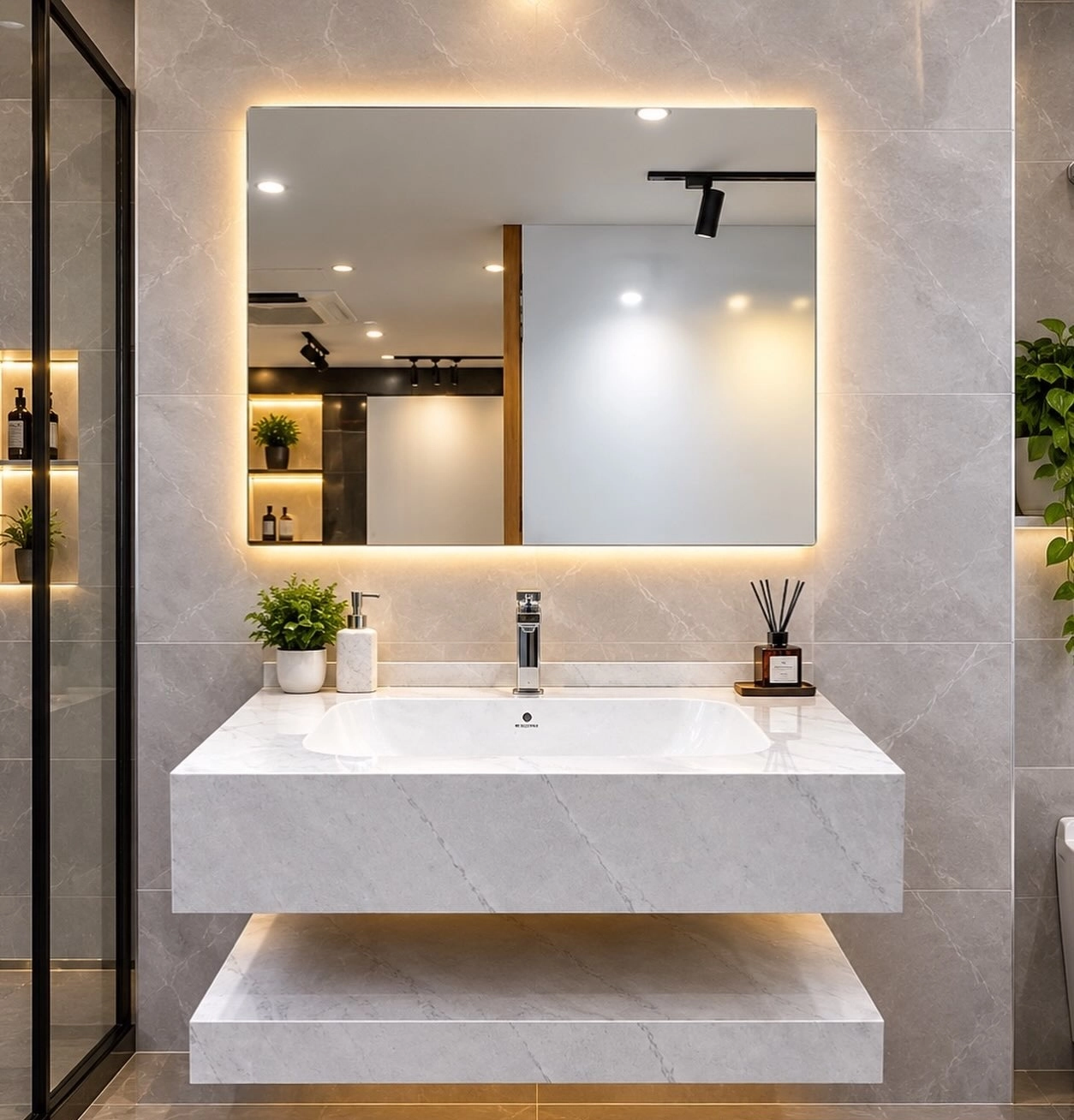
Floating vanities and backlit mirrors are natural partners, because both hover. This marble topped floater carries one wide lit rectangle, and the light spilling from behind the glass picks out the stone veining in the splashback below. The effect doubles after dark, when the mirror becomes the room’s main light source and everything feels calmer than an overhead fitting would allow. Keep the mirror a touch narrower than the vanity, as done here, so the halo has wall to land on instead of spilling past the edges.
Color temperature:Choose a warm to neutral light, around 3000K to 4000K, for a bathroom mirror. Very cool light makes skin look grey and makeup go on heavier than it should.
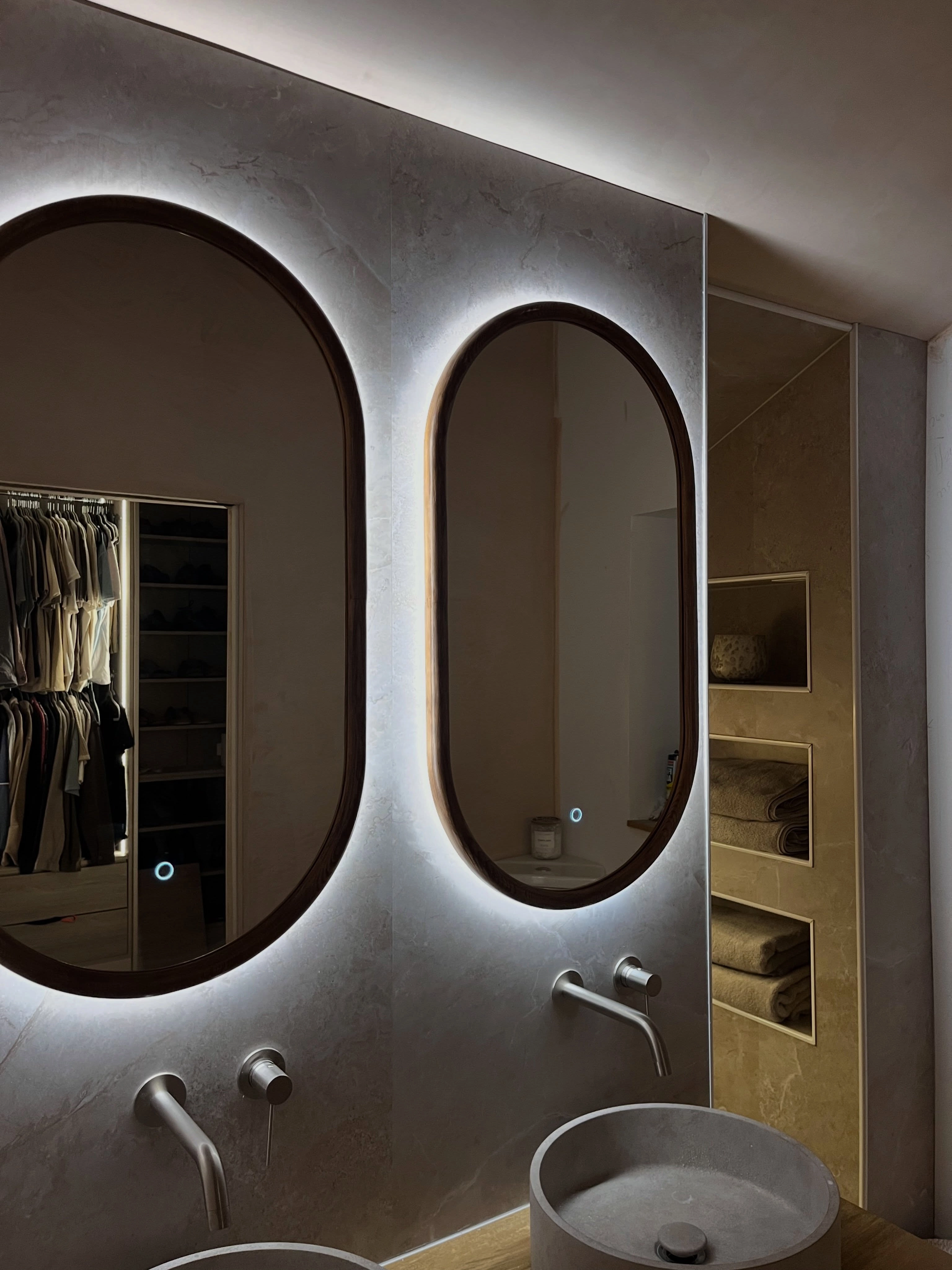
Two tall pill mirrors, each with its own halo, give a double vanity the backlit benefits without one giant sheet of glass. The dark frames keep a crisp outline around each glow, and the grey stone vanity below stays quiet so the light does the talking. In a moody, windowless bathroom like this, halo mirrors also act as night lighting, enough to find the sink at 3 a.m. without waking yourself up fully. Wall mounted taps keep the narrow stone top completely clear, which suits the floating look.
Dimmer sense:Put backlit mirrors on a dimmer or pick a model with built in dimming. Full brightness is for makeup and shaving, not for a midnight glass of water.
The fog problem: Steam fog is not just annoying. Daily wiping of a fogged mirror slowly wears the silvered edges, which is exactly where black spots start. A demister pad behind the glass, or a decent extractor fan that actually gets used, protects the mirror you just paid for. If your mirror fogs edge to edge after every shower, the room needs air movement as much as the mirror needs a cloth.
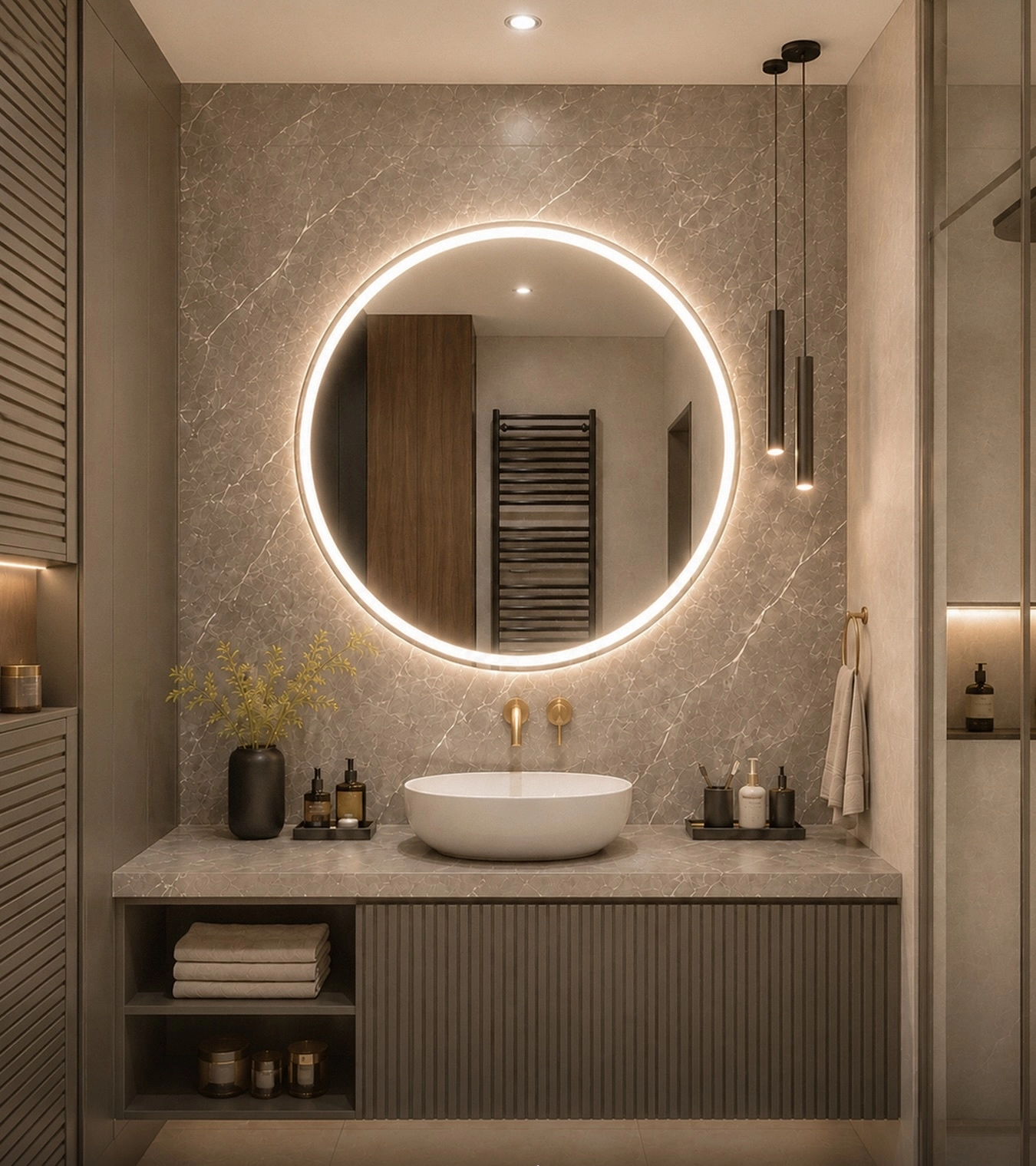
Layering light is what separates a good mirror wall from a flat one. This big round backlit mirror handles the face light, while two slim black pendants drop beside it for shape and sparkle, all over a fluted vanity with a stone vessel sink. The round mirror’s glow outlines the circle against the marble, turning a plain shape into the room’s focal point. Pendants near mirrors need care with placement, since a hanging light too close to the glass doubles its glare in the reflection.
Pendant spacing:Hang pendants at least a few inches out from the mirror face and check the reflection from where you actually stand, not from the doorway.
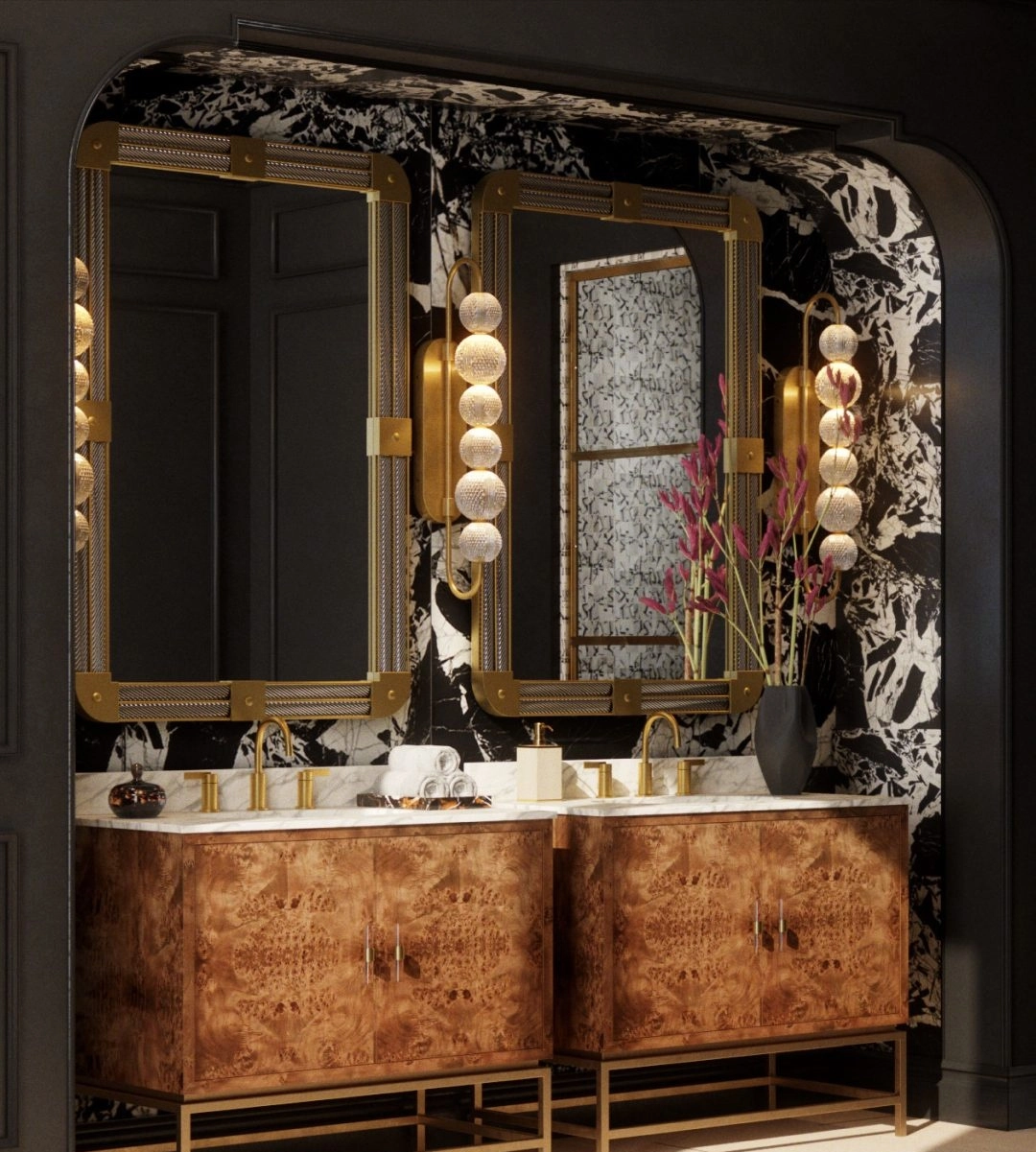
Old theatre dressing rooms had the right idea: a row of bulbs at face height lights skin evenly and honestly. These vertical globe strips stand between and beside two brass stepped frame mirrors over burl wood vanities, against a black and white marble wall that does not do subtle. The light lands from the front, not above, so eye sockets and chins do not fall into shadow the way a single ceiling light makes them. It is a glamorous setup, but the principle scales down happily to one strip beside a single mirror.
Bulb choice:Frosted globes soften the theatre effect and cut glare. Clear bulbs look sharper in photos and harsher on tired morning eyes.
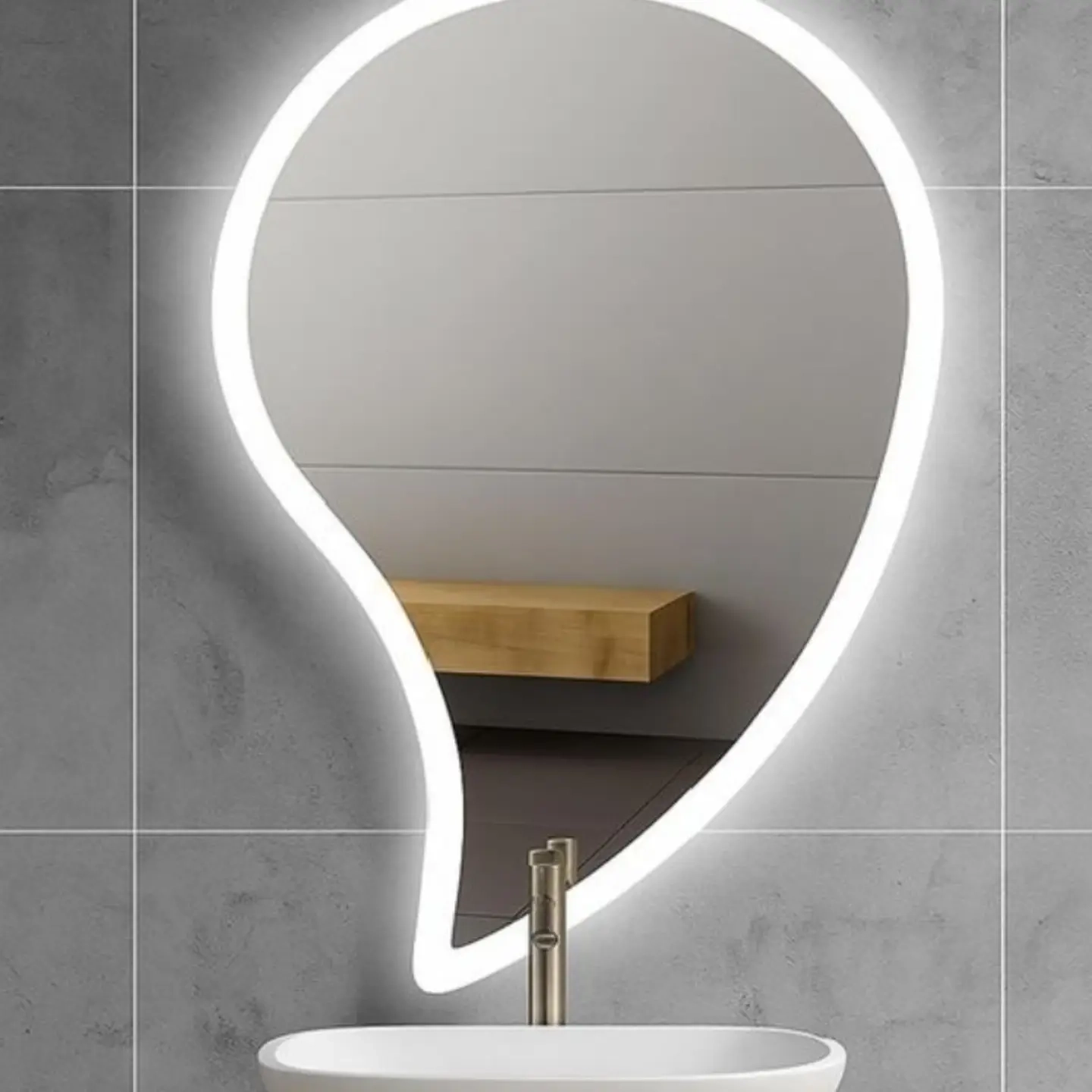
Not every lit mirror is a rectangle with ambitions. This teardrop shape carries its light in a glowing edge that traces the whole outline, part mirror, part wall sculpture, over a simple white vessel sink and grey tiles. Shapes like this suit powder rooms and single sink bathrooms where the mirror can be the room’s one artistic gesture. The honest limit is reflection area: the narrow point gives back little usable mirror, so this is a hand washing and lipstick mirror, not a full grooming station.
Shape honesty:Fall for an artistic shape in the room where guests wash hands. Keep the main bathroom’s mirror wide and plain enough for two handed tasks like contacts and eyeliner.
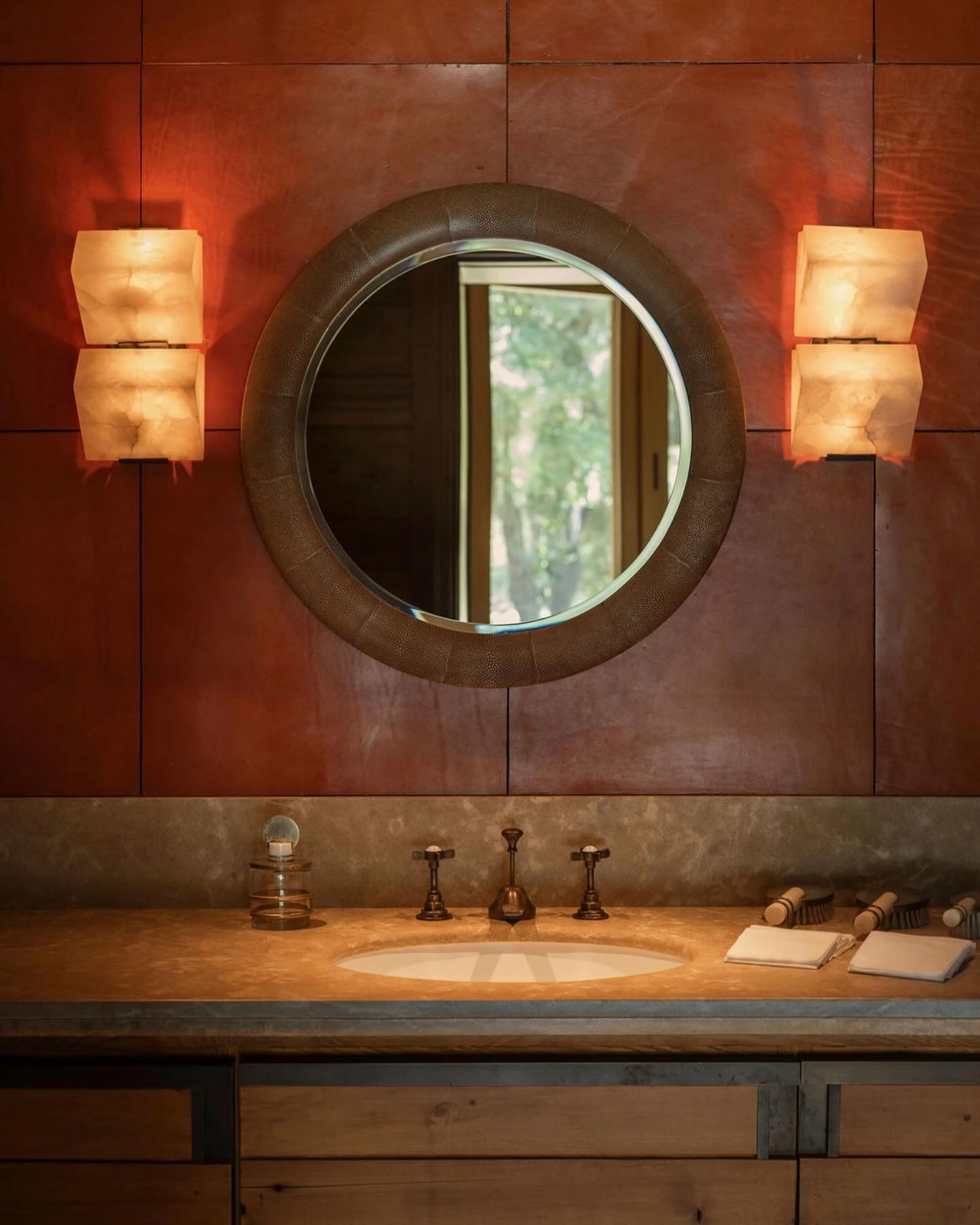
Powder rooms are where thick frames earn their money, because the mirror is basically the art. This round mirror wears a deep, textured dark frame against leather look wall panels, lit by two alabaster sconces that glow like candles. The frame’s weight balances the dark vanity and the moody walls, where a frameless sheet would disappear. In a small room with no window, a mirror this considered makes guests feel the space was designed, not leftover. Choose the frame finish before the taps here, since the frame is the louder voice.
Frame depth:A deep frame casts a small shadow line that reads as craft. In steamy full bathrooms, check the frame material is sealed or metal, since raw wood swells near showers.
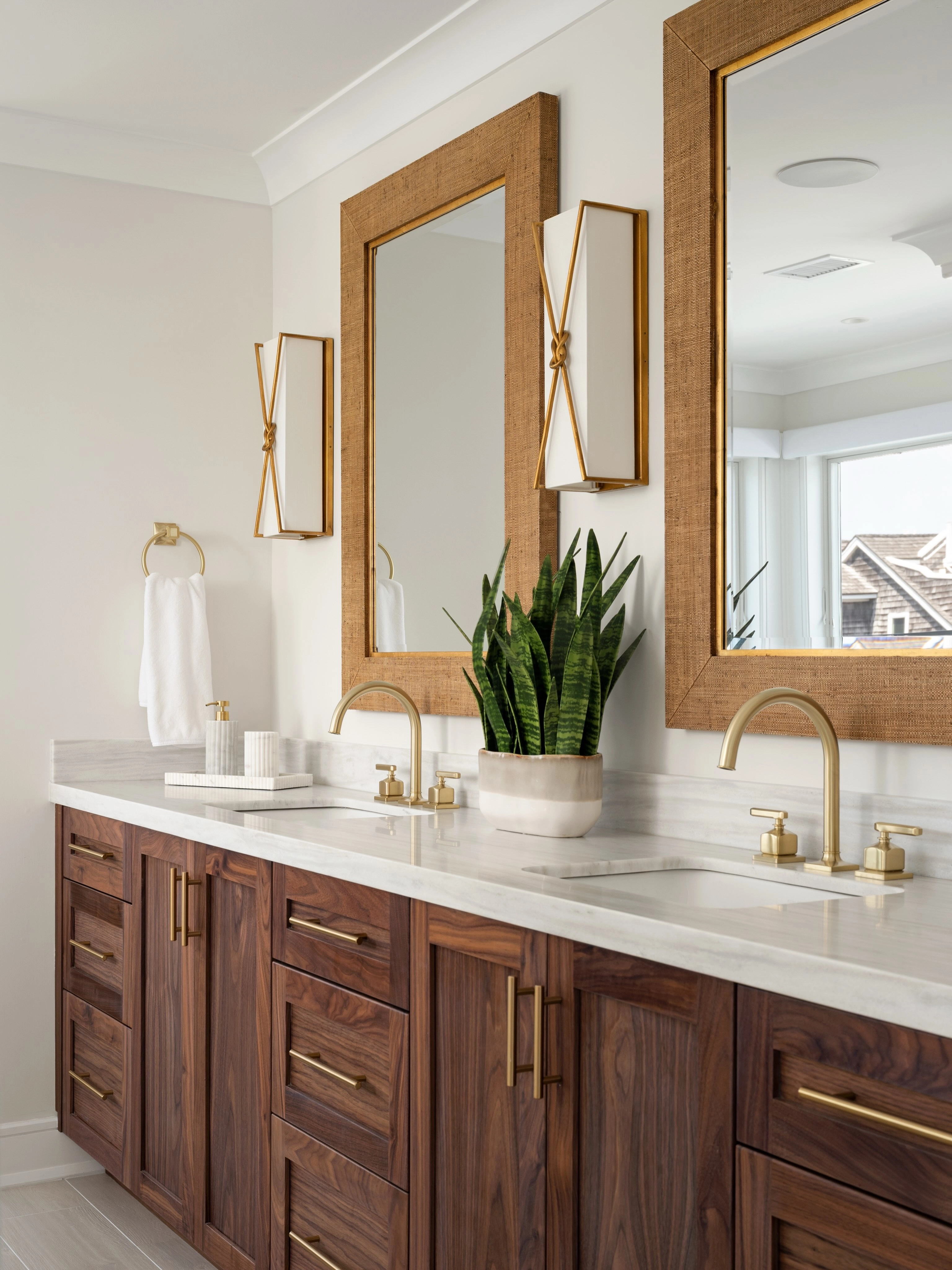
Texture is the difference between a gold frame that looks expensive and one that looks sprayed. These two tall mirrors wear woven, almost rattan like gold frames that catch light unevenly and warm up the dark walnut vanity below. Geometric brass sconces repeat the metal in a different pattern, so the wall has rhythm instead of repetition. Woven and wrapped frames also hide the small dings that bathroom life delivers better than mirror smooth finishes do. If your bathroom leans plain, a textured frame is the safest single upgrade in this whole list.
Metal mixing:Two metals are fine when one clearly leads. Here brass leads in frames, sconces and taps, while the darker sink fittings stay quiet in the background.
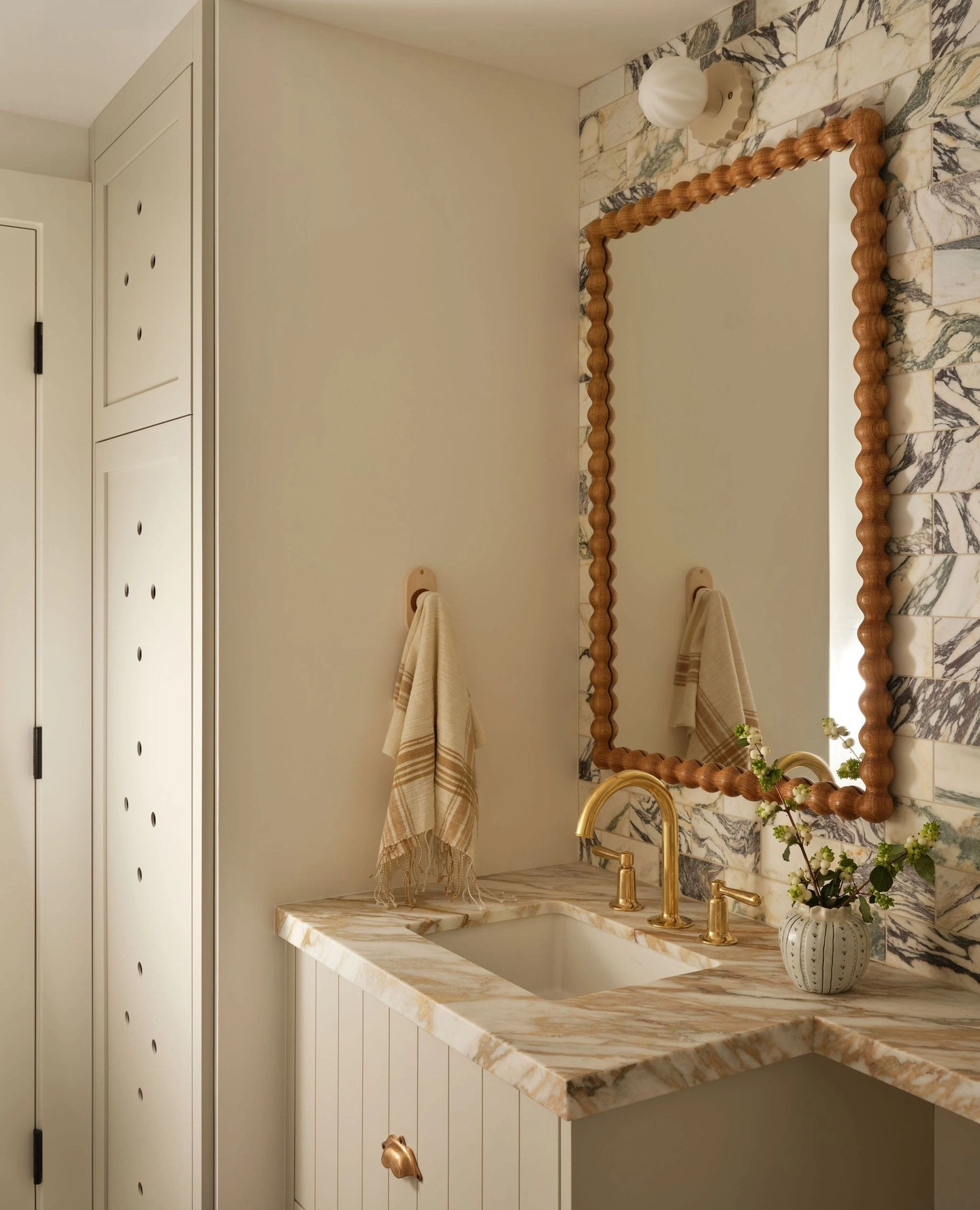
Bobbin trim, a row of turned wooden beads, turns a plain rectangle into something that looks inherited. This warm brown bobbin frame hangs over a corner vanity with a marble top, under one round ceramic sconce, in a room that mixes floral paper with plain plaster. Frames with this much carving suit traditional and country houses where a slim black frame would feel like it wandered in from a hotel. The corner placement matters too: a framed mirror with real depth needs its swing and sight lines checked against the side wall.
Corner check:On a corner vanity, open any nearby door and cabinet fully before fixing the mirror position. Chunky frames lose fights with door swings more often than you would think.
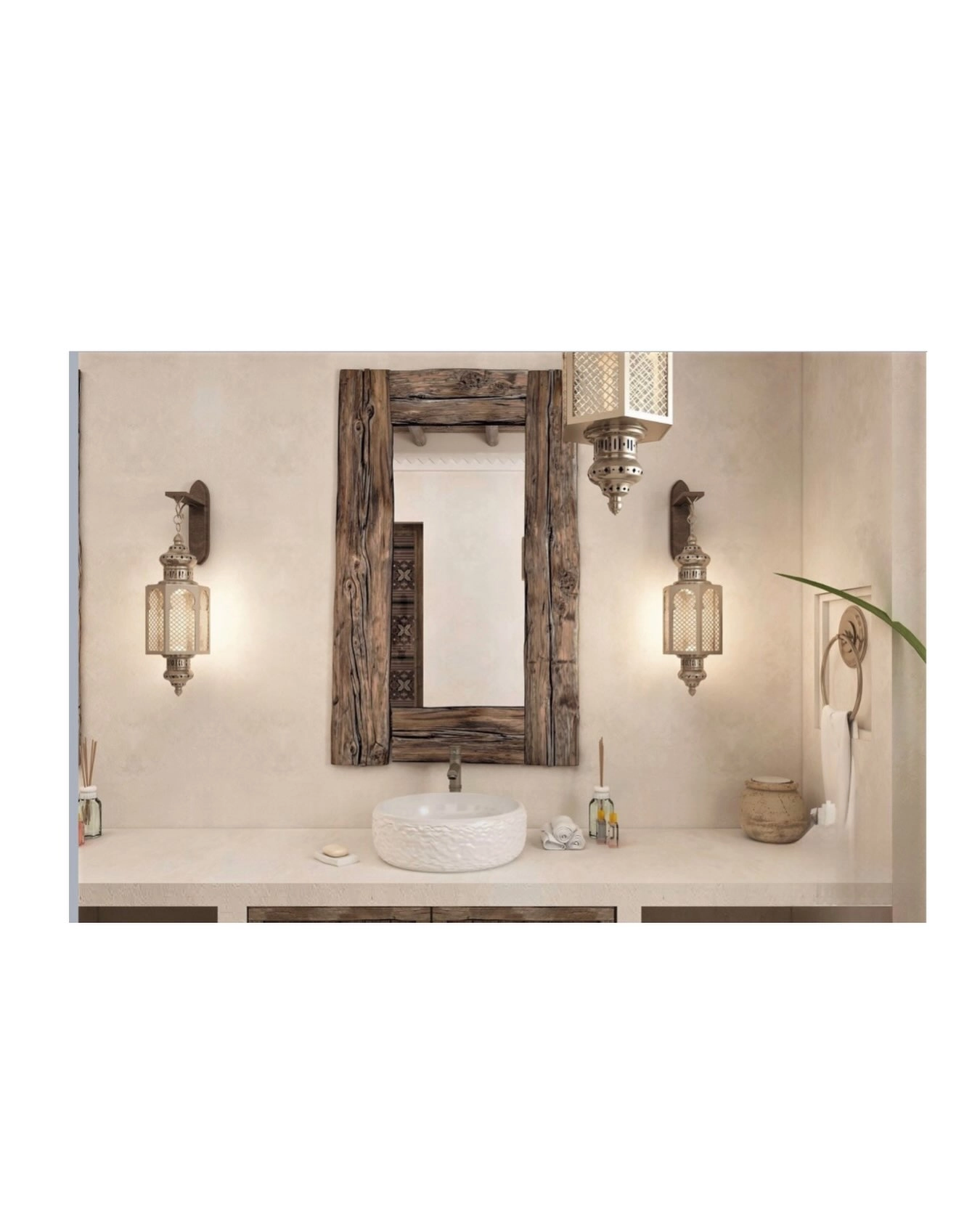
Some frames are built from wood that had a first life, and the knots and cracks are the point. This wide rustic frame, more beam than trim, holds a plain mirror over a cream stone vanity, flanked by three lantern style sconces that suit a house with age in its bones. A frame this heavy visually needs a calm mirror and a simple sink, or the wall starts to shout. It also needs proper fixing into studs or solid blocking, since reclaimed timber frames weigh far more than they look like they should.
Weight warning:Weigh any solid wood framed mirror before choosing fixings. Two screws into drywall anchors is not a plan for a frame built from old beams.
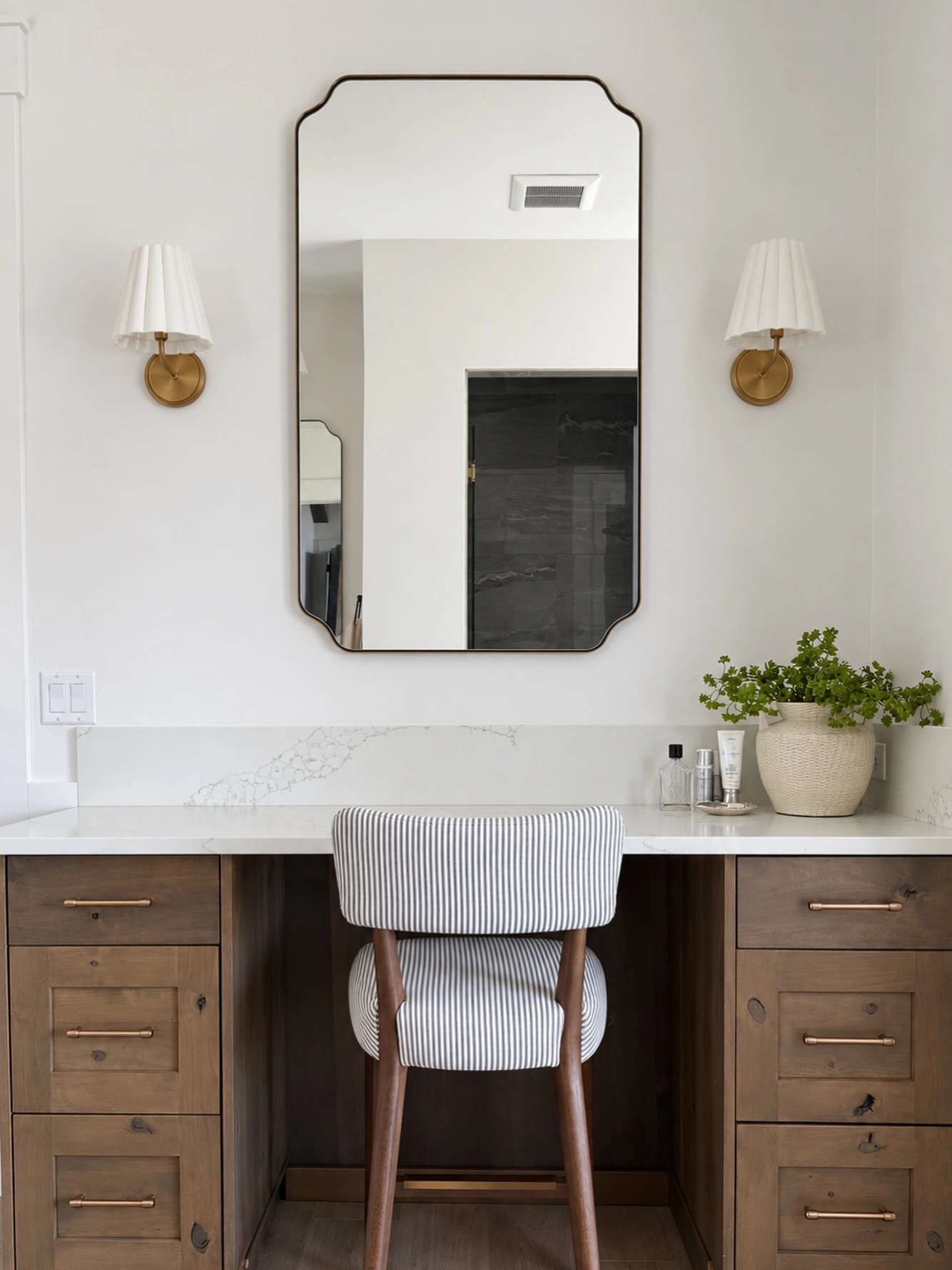
Clipping the corners off a rectangle is a small geometry change with an outsized effect, softening the mirror without going full arch. This tall clipped corner mirror hangs over a dressing desk in a wood vanity run, between two pleated shade sconces, and the shape quietly echoes older furniture silhouettes. It is a kind shape for narrow walls, since the missing corners make the mirror feel lighter at eye level. Dressing areas forgive more experimentation than sink walls, because splashes never reach the glass.
Splash distance:The closer a mirror sits to a working sink, the plainer its bottom edge should be. Save carved and clipped frames for spots at least a basin away from daily splashing.
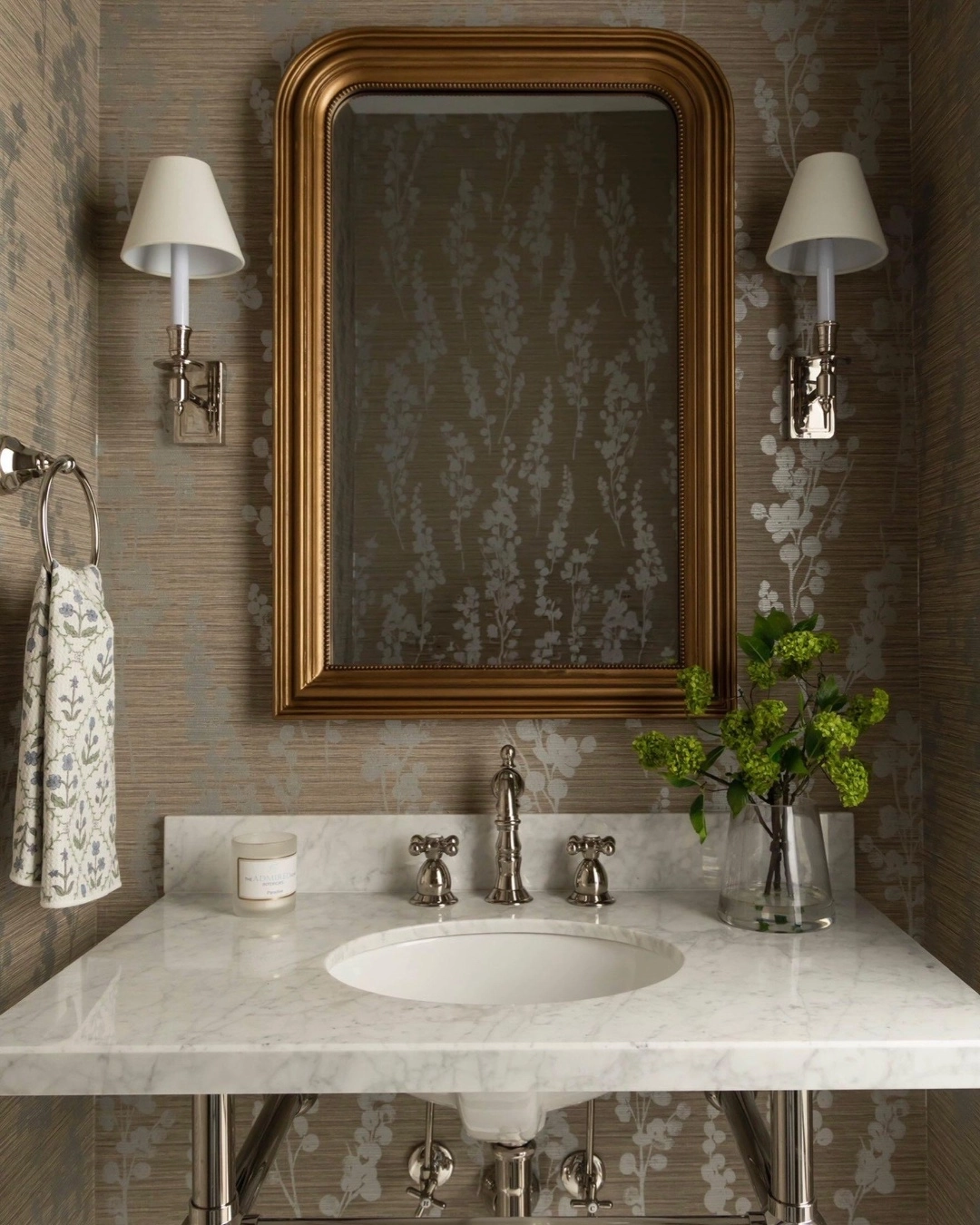
A wide brass frame reads as furniture, not fixture, and this rounded corner rectangle over a marble console sink shows the register it sets: traditional, calm, a little formal. Nickel sconces beside it prove the frame does not have to match every metal in the room when the shapes agree. Wide frames eat into reflection area, so size up one step from your first instinct to keep a usable mirror inside the border. On a console or washstand vanity with legs, a framed mirror also keeps the wall from looking top heavy over all that open space below.
Size up rule:For frames wider than two inches, buy the mirror as if the frame were not there. Your face needs the glass area, not the overall measurement on the box.
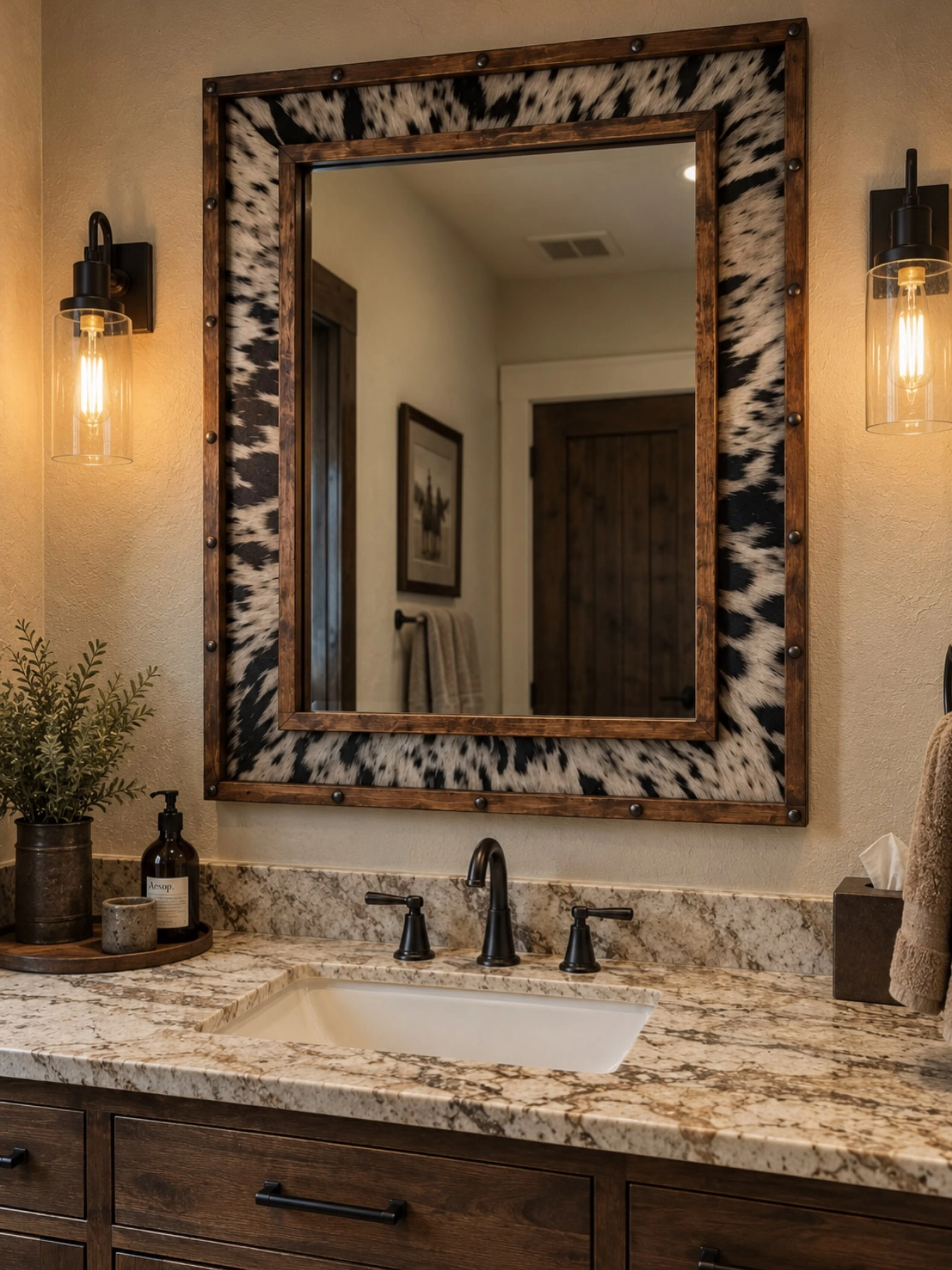
Every list needs one mirror that starts conversations, and a cowhide wrapped frame is a strong candidate. This one pairs its speckled hide border with a wood inner frame, black cage sconces and a granite topped dark vanity, landing somewhere between ranch house and boutique hotel. A frame this bold wants plain everything else: simple taps, quiet walls, no competing pattern in sight. It also wants a room with a sense of humor about itself, which a guest bathroom should always have.
One statement rule:If the frame is the story, let it be the only story on that wall. Move the patterned towels and busy art to another surface.
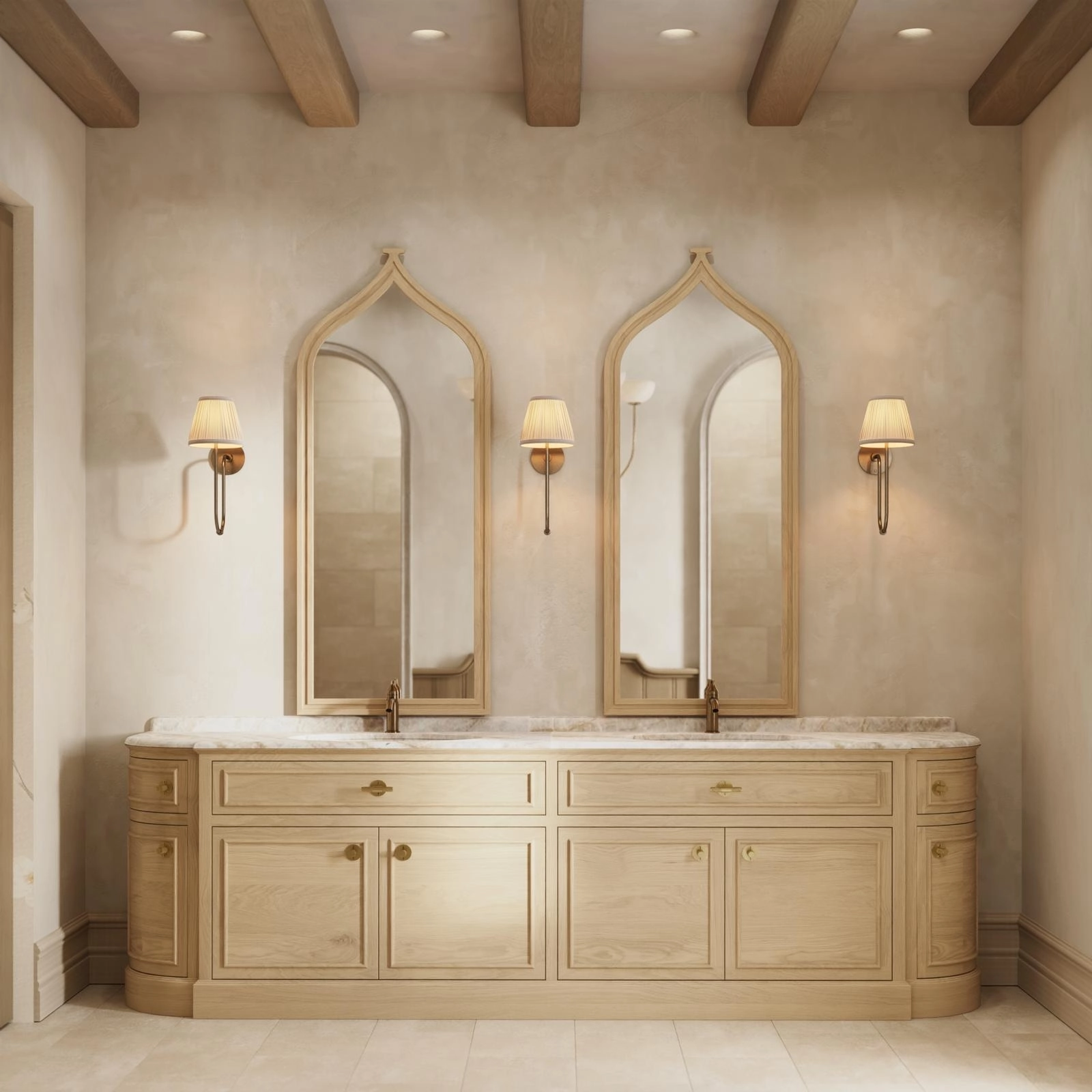
These tall pointed arch mirrors take their shape from the room itself, with exposed beams and a plastered, almost chapel like calm. Light oak frames keep the pair gentle against the cream wall, and three small sconces thread between and beside them. When a house has any architectural curve, an arch, a vault, a rounded doorway, echoing it in the mirror makes the bathroom feel designed as one thought. Buying two identical arches also means one can be replaced years later without rethinking the whole wall, a dull but real advantage.
Echo check:Look for one curve already in the room or the house, a doorway, window or stair rail, and let the mirror repeat it. An arch with nothing to echo looks random.
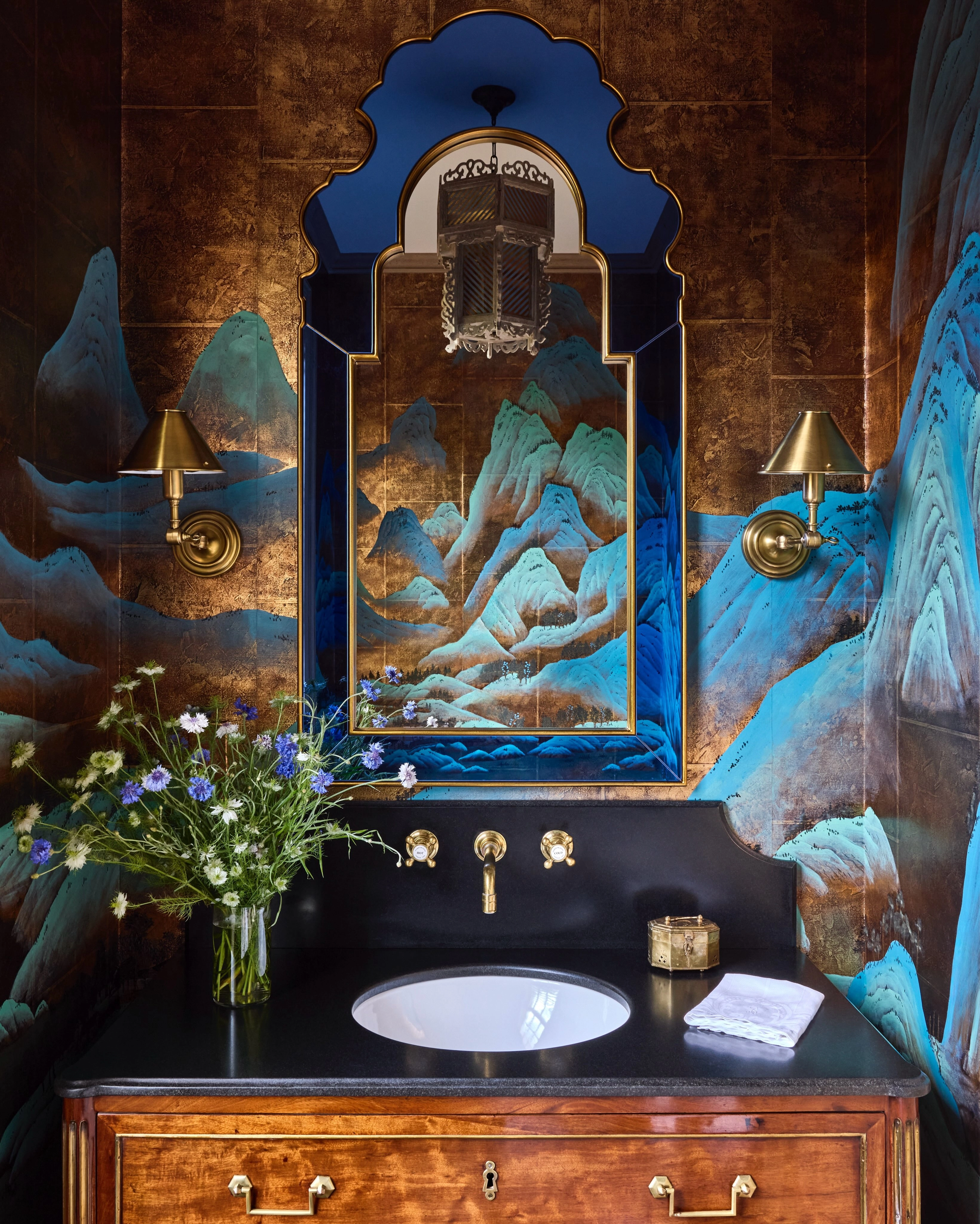
At the far end of mirror drama sits this Moorish arched mirror, gold trimmed, reflecting a carved hanging lantern and hand painted mountain wallpaper. It is less a bathroom fitting than a piece of set design over a burl wood vanity, and in a powder room that is exactly the job. Mirrors like this are found, not bought off a shelf: vintage dealers, salvage yards and custom frame shops are the hunting grounds. The lesson worth stealing is proportion, since the mirror rises well above the sconces and owns the whole wall height.
Powder room license:Guests use this room for thirty seconds and remember it for years. Spend the drama budget here, where no one has to shave in front of the artwork.
An arched mirror with a scrolled gold frame against blue marbled wallpaper sounds like three statements at once, yet this one works because the colors stay in one family of blues and warm gold. The mirror’s reflection doubles the wallpaper, which is either the best or worst feature of mirrored walls near pattern: the room feels bigger and the pattern never ends. The wood vanity below grounds everything with plain grain. If your wallpaper is bold, let the mirror be large and the frame simple in outline, even if the finish is rich.
Pattern math:Mirror plus wallpaper equals twice the pattern. Choose the paper as if you were buying double, because visually, you are.
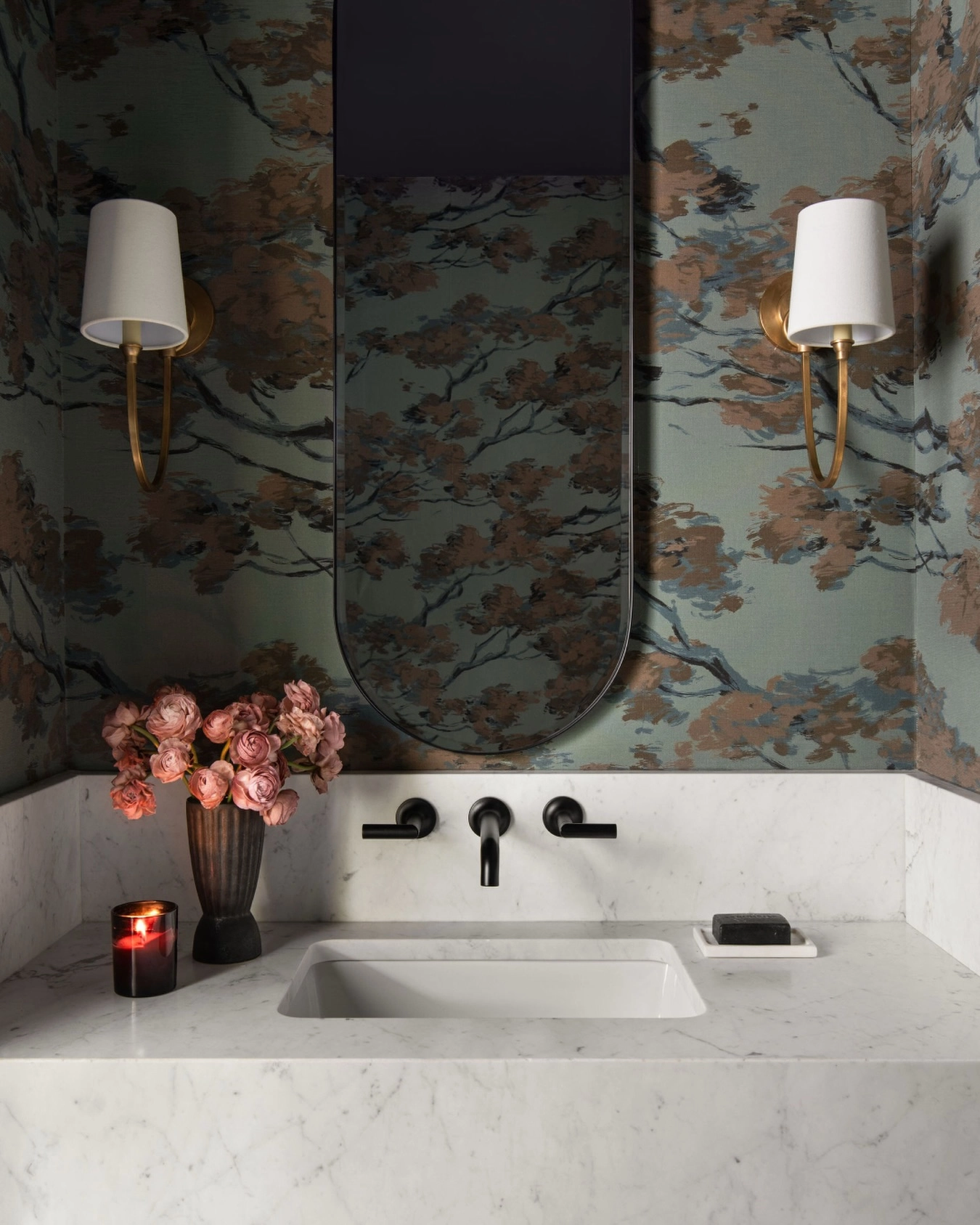
This moody bathroom runs a tall dark pill mirror down a botanical wallpaper wall, over a marble counter with wall mounted black taps. The mirror glass reads almost like another panel of the wallpaper, reflecting branches back at the real ones, and two white shade sconces keep the scene from going full cave. Tall pills flatter tall, narrow walls between a door and a shower, where a rectangle would leave awkward slivers of wall. Just confirm the reflection you are buying: dark tinted looking glass is atmospheric and slightly less honest at makeup time.
Reflection test:Hold your phone flashlight to any showroom mirror and look at your hand in it. If colors read dull or grey, that mirror will do the same to your face every morning.
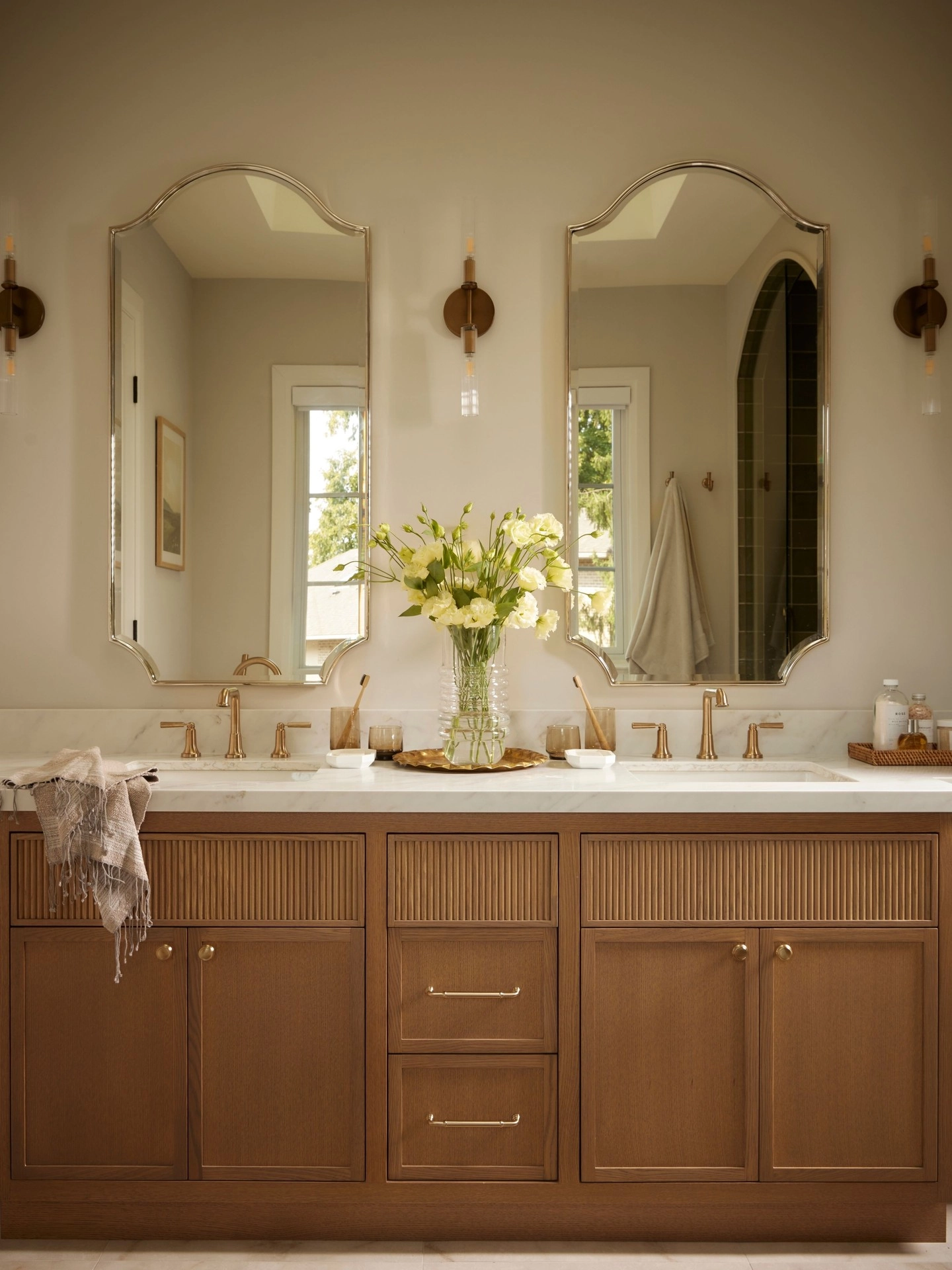
After the theatre, the classic: two slim brass arched mirrors over a fluted wood double vanity, fresh flowers between them, nothing trying too hard. Arches soften a long run of cabinetry, and pairing them keeps the his and hers symmetry that double vanities promise. This is the version most likely to still look right in fifteen years, because every element has a hundred year history behind it. When in doubt between a fashionable shape and this one, remember which mirror you will be looking at during early mornings and bad flu days.
Gap guide:Leave at least a hand’s width between two mirrors, around four to six inches, so the pair reads as two pieces and cleaning a cloth can pass between them.
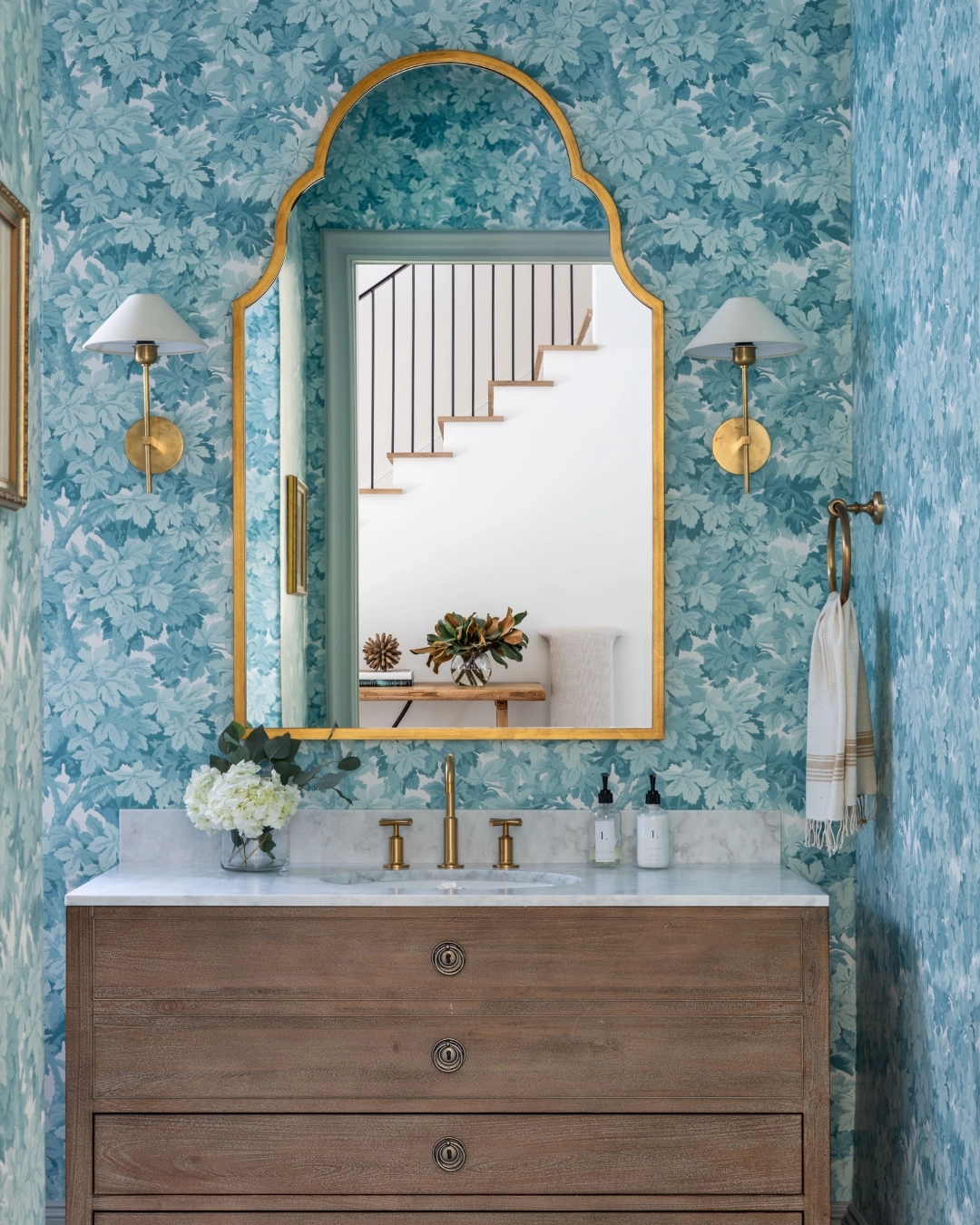
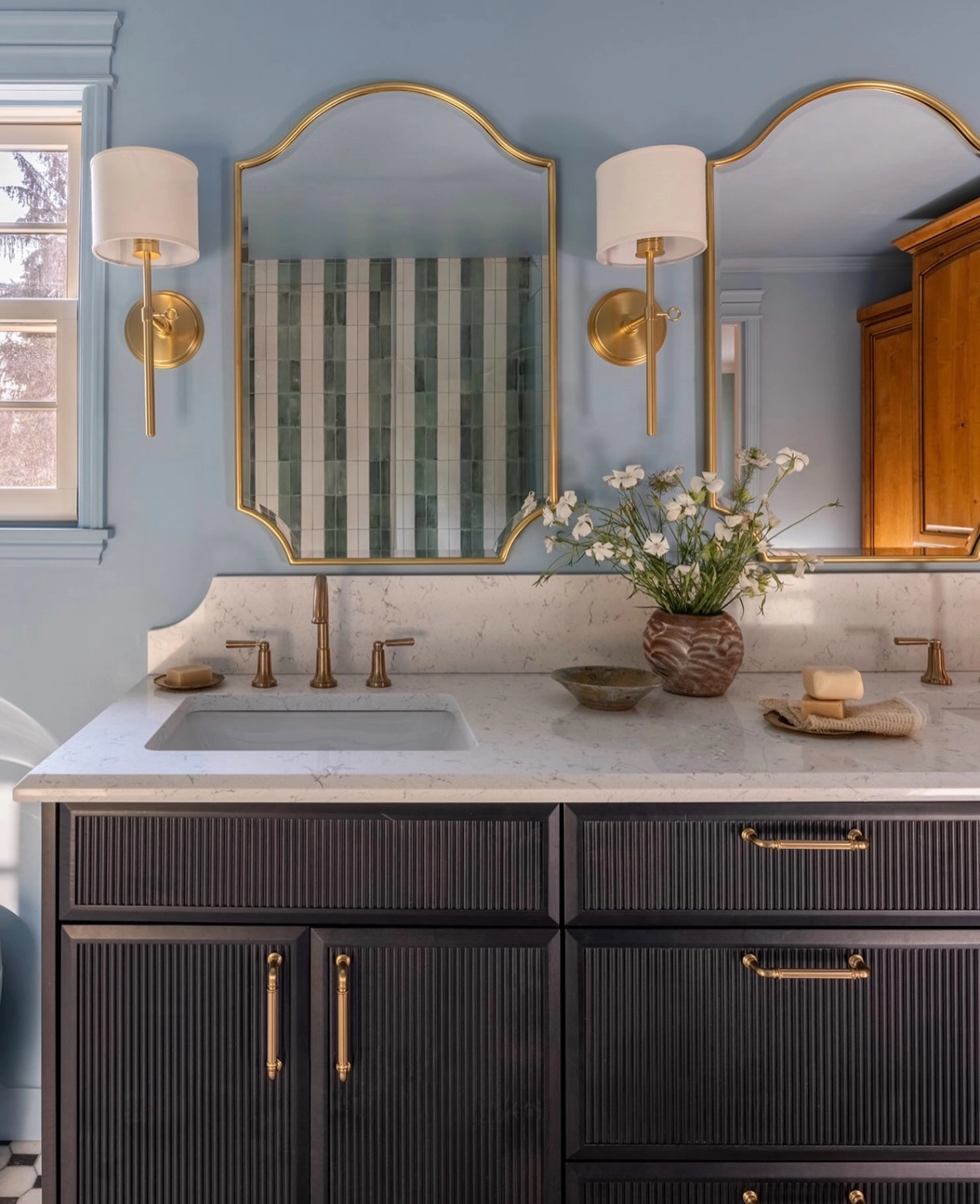
Pale blue walls and gold arched mirrors are a gentle pairing this dark ribbed vanity anchors from below. The mirrors here have a stepped, almost picture frame top that adds formality, and brass sconces with white shades sit between them like a third small mirror of light. Color on the wall changes what a frame should be: gold warms cool paint, black would sharpen it, and chrome would vanish into it. Try frame samples against your actual wall color in daylight before ordering, since return shipping on mirrors is nobody’s idea of fun.
Sample first:A two dollar gold picture frame from a thrift store, held on the wall for a day, predicts a brass mirror’s effect better than any screen image.
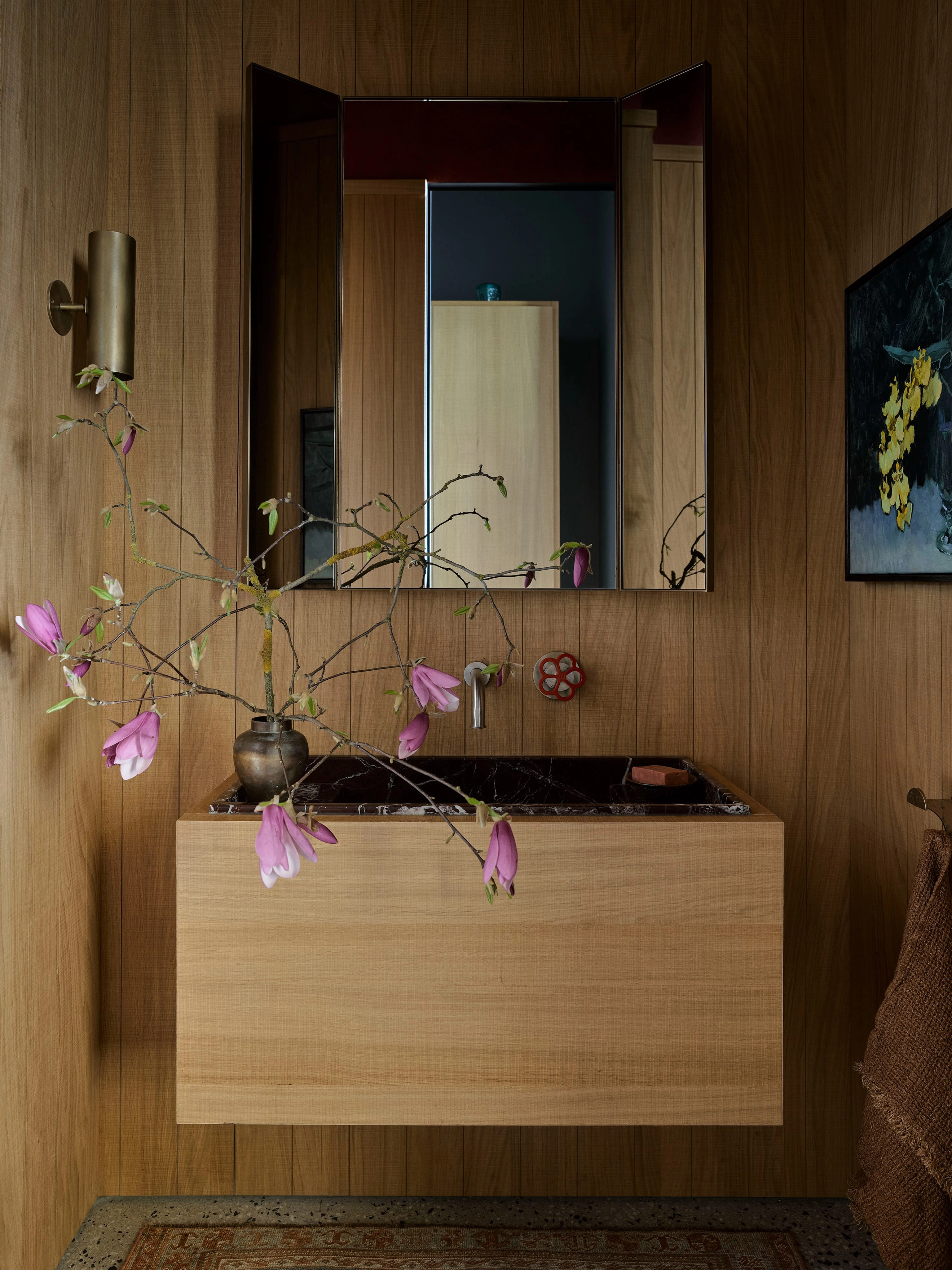
The hardest working mirror is the one that opens. This angled mirrored cabinet on a wood panelled wall hides the daily clutter behind a plain sheet of glass, over a floating oak vanity with a black stone top. Modern mirrored cabinets are a long way from the rattly boxes of old rentals: soft close hinges, adjustable glass shelves, and sometimes lighting and demisters built in. In a small bathroom with no linen closet, this single swap can clear the entire counter. Measure your tallest bottles before choosing, since shelf spacing decides what actually fits.
Depth check:A recessed cabinet needs a wall cavity free of pipes and wires. Open a small inspection hole or check the other side of the wall before the big cut happens.
[SCROLL-STOPPER: size table after idea 7; fact box after idea 10; checklist before conclusion]
Before you drill: five minutes with a tape and a level now beats filling holes later. Run this list once, out loud, before the first fixing goes in.
Center the mirror on the drain line of the sink, not on the cabinet.
Keep the mirror a couple of inches narrower than the vanity top.
Set the bottom edge 4 to 6 inches above the top of the backsplash.
Put the center of the glass near eye level for the people who will use it.
Open every door and cabinet nearby to check the swing clears the frame.
Find the studs, or use fixings rated for the mirror’s real weight.
Final Thoughts
A vanity mirror is never just a mirror. It is a measurement, a light source, a frame material and a storage decision all pretending to be a simple purchase. Let the sink set the center and the width, let the light land at face height whether it comes from sconces or the glass itself, and let the frame suit the house rather than the trend cycle. Do that, and the shape, round, arch, pill or plain rectangle, becomes the easy part. The bathrooms above prove the same point 27 times: when the mirror takes its orders from the room, it always looks like it belongs there.