Black Curtains, Decided by the Window
Black curtains are the boldest thing a bedroom can wear, and the choice that goes wrong most often, because people pick them for the colour when they should pick them for the job. A bedroom window has work to do: block the dawn, soften the light, warm the glass, frame the view. Black fabric does some of those jobs brilliantly and others badly, and the difference is the window, not the curtain.
These 23 bedrooms are grouped by the window’s job, full height drama first, then black layered over sheers, then true blackout setups, then the small windows, bays and awkward shapes that defeat standard advice. Decide which job your window holds, then choose inside that group.
Full Height Drama
1. Ceiling to Floor Velvet in a Tall Room
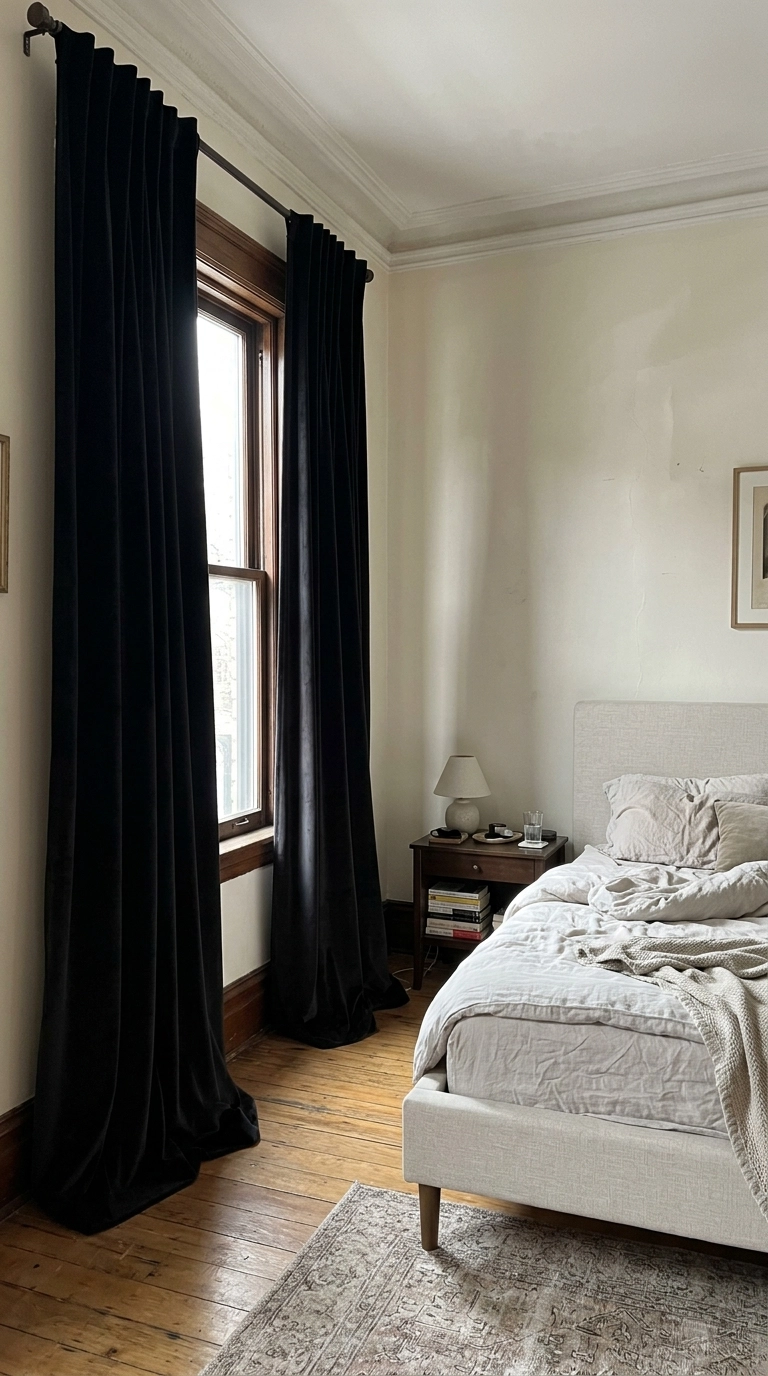
Black velvet curtains hung from the ceiling line to a soft puddle on the floor, in a tall bedroom with a pale upholstered bed. Height is the whole trick: a rod at the ceiling makes the window read double height and the black falls in one unbroken column. Velvet is the fabric that deserves this treatment because its pile drinks the light and the folds show as shadow stripes. Keep the walls pale; the curtains are the room’s dark wall, worn vertically.
Rod height: Mount the rod within ten centimetres of the ceiling. Every centimetre lower is drama handed back.
2. Black Linen on a Black Rod
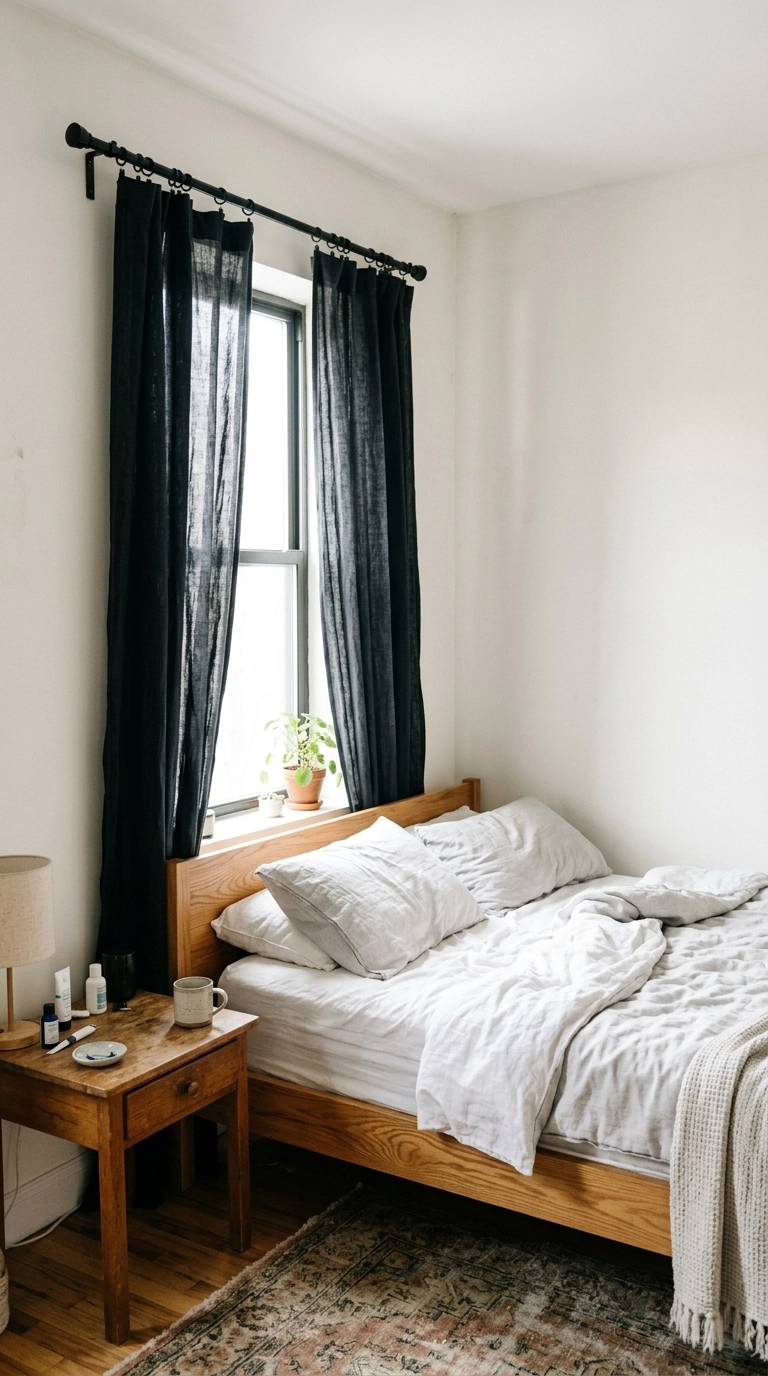
Washed black linen curtains on a matte black rod, in a bright bedroom with white walls and a natural wood bed. Linen is velvet’s opposite: it lets a breath of light through its weave, so the black reads charcoal at the edges by day. The black rod matters more than it sounds; a chrome or brass rod draws a bright line across the top and breaks the column. Tone on tone hardware keeps black curtains looking designed rather than installed.
Hardware rule: Match the rod to the curtain, black on black. Contrast hardware belongs on pale curtains.
3. The Double Width Sweep
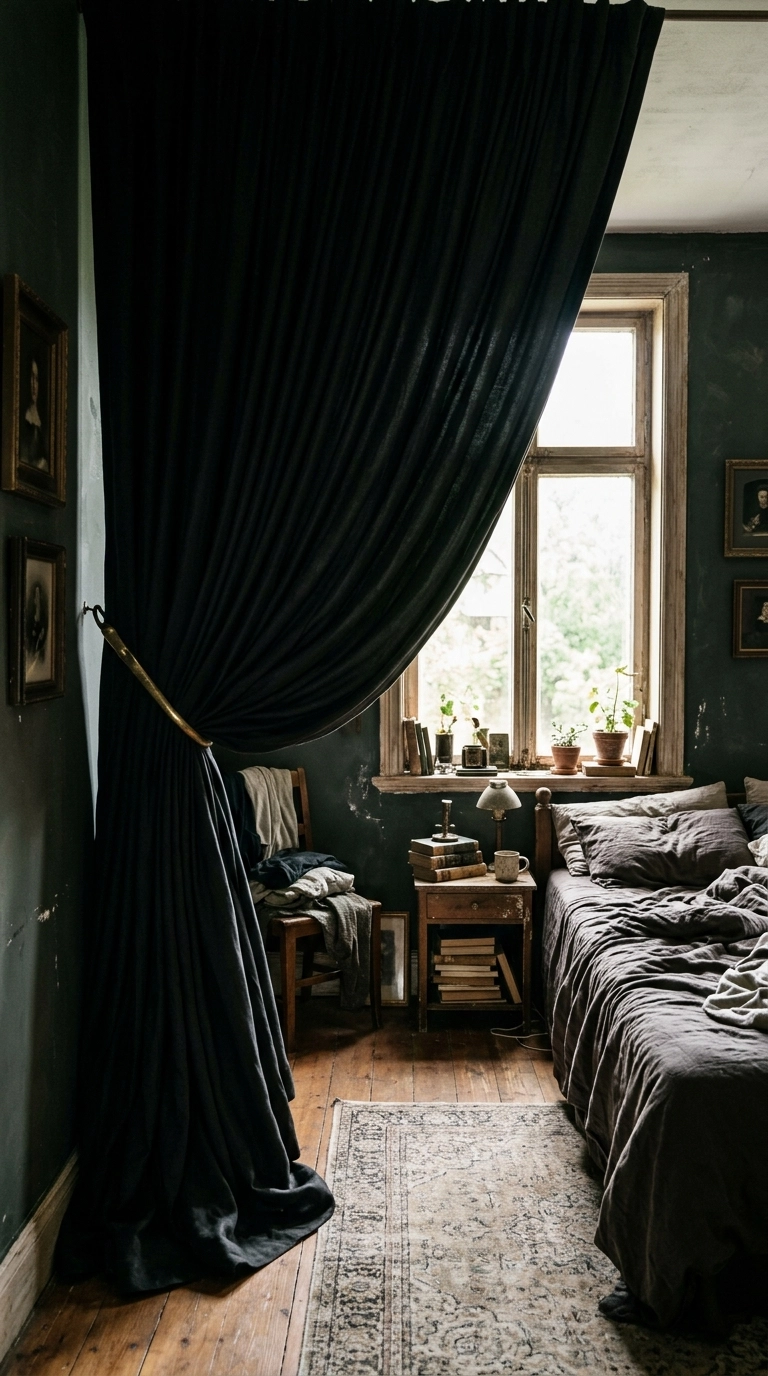
Extra wide black curtains, twice the window’s width in fabric, drawn to one side in a single theatrical sweep in a moody bedroom. Fullness is what separates curtains from blankets on a rod: at double width the folds stay deep even when closed, and the sweep holds its curve when open. Buy width before you buy length or label; a long thin curtain looks mean, a full short one looks tailored. Tiebacks in brass give the sweep its waist.
Fullness maths: Fabric width should be twice the rod width for curtains, two and a half times for sheers. Less looks like a shortage.
4. Black Curtains Behind the Bed
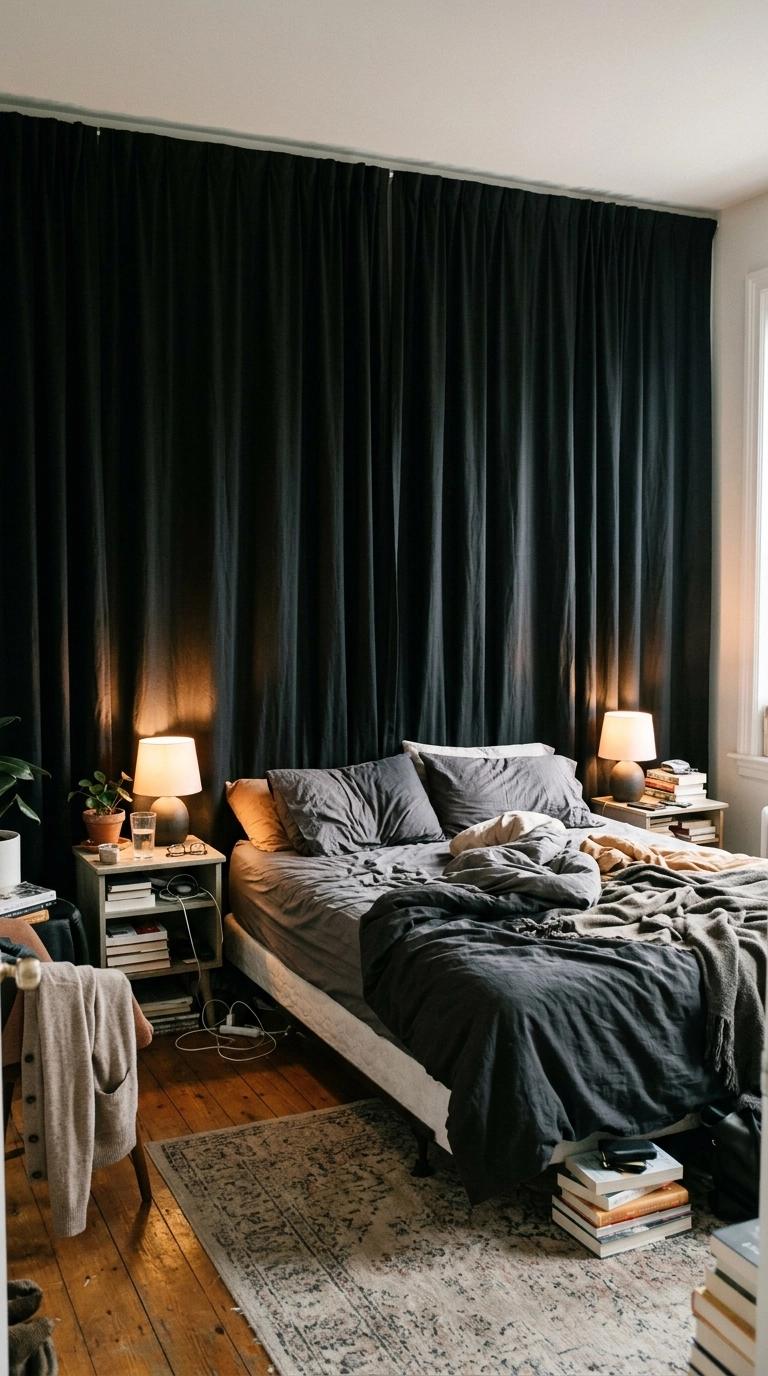
A wall of black curtains behind a bed in a room where the window sits off centre, the bed placed against the curtained wall like a stage set. When a window lands in the wrong place, curtaining the whole wall hides the problem and hands the bed a backdrop in one move. The folds read as panelling at night and the room gains a softness no paint can give. Choose blackout lining here; you are sleeping against glass, whatever the view says.
Backdrop lining: Curtains used as a wall need blackout lining even on a north window. Unlined fabric glows at dawn and betrays the trick.
5. Pinch Pleat Formals
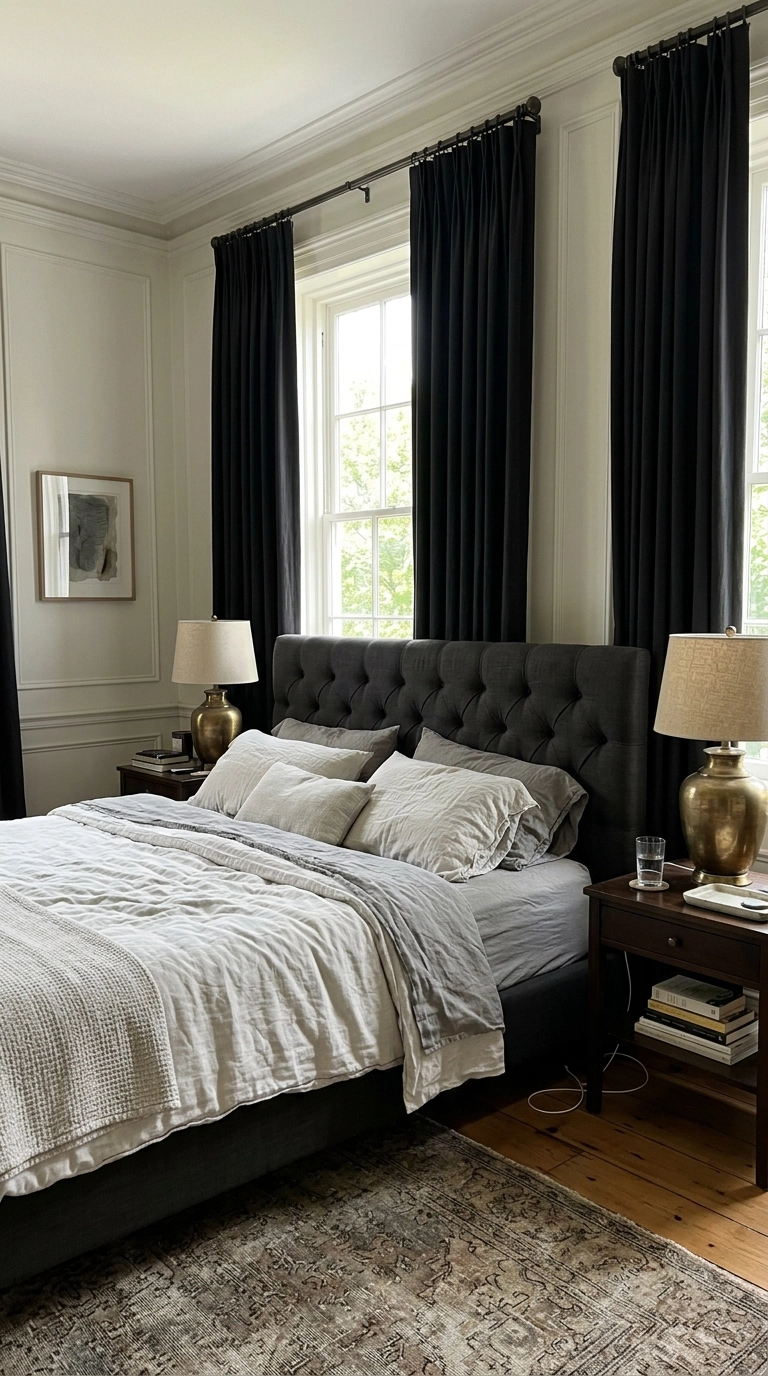
Black pinch pleat curtains with a tailored, even fold, in a formal bedroom with a buttoned headboard and brass lamps. Pinch pleats are the pressed suit of curtains: the fold is sewn in, so the curtain hangs in perfect columns open or closed. Formal bedrooms need that discipline because everything else in them is symmetrical. Pair with a pelmet or a covered track if the room is traditional; exposed rings belong to relaxed rooms.
Pleat match: Pinch pleats suit symmetrical rooms, wave folds suit modern ones. Mixing a formal pleat into a casual room looks like a hotel error.
More Looks You'll Want to Steal:





6. Black and Cream, Half and Half
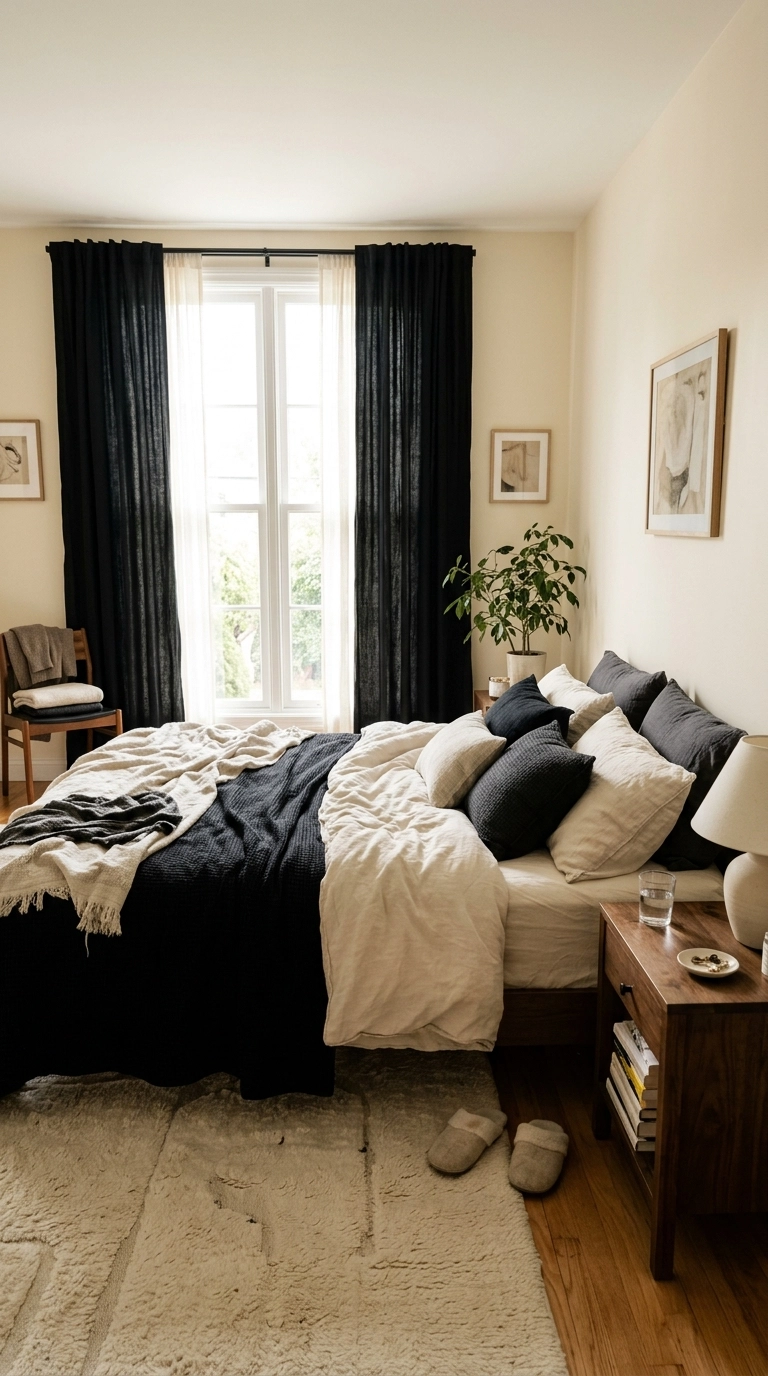
Black curtains on the window wall of a cream bedroom, the wall painted cream, the bedding cream and black in layers. This is the safest full height version: black owns one wall as fabric, cream owns everything else. The ratio keeps the room light while the curtains give it a spine. It works in rental bedrooms because the drama is all textile; take the curtains down and the room is innocent again.
Rental drama: Curtains are the only black wall you can take with you when you move. Paint is a commitment; fabric is a loan.
Black Layered Over Sheers
7. Black Over White Sheers, Day and Night
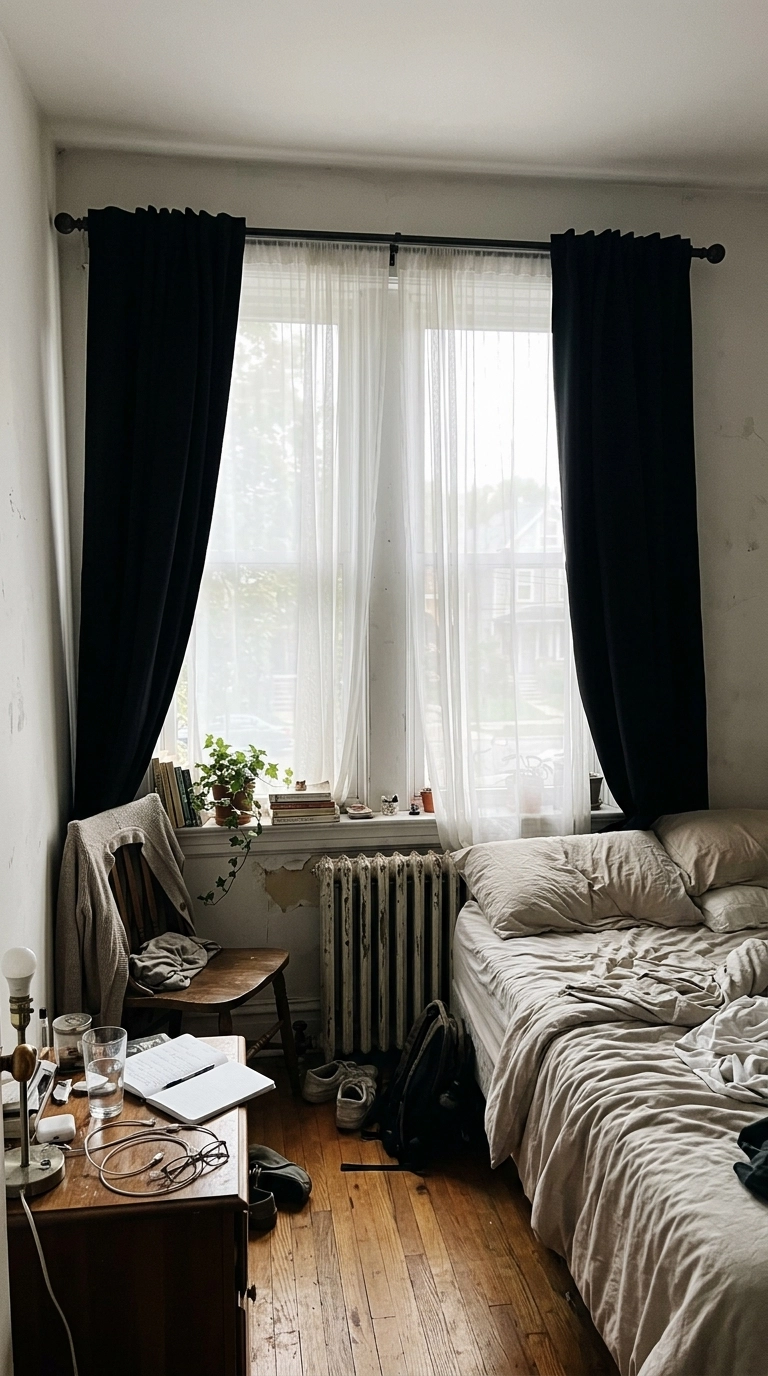
Black curtains drawn open over white sheers that stay closed, in a bedroom facing a busy street. The double layer is the working answer to most bedroom windows: sheers earn their keep all day, privacy and soft light, and the black panels close at night for darkness and theatre. Mount two rods or one double track, sheers on the inner, black on the outer. The contrast between the layers is the look; keep the sheer plain white so the black frames it.
Layer order: Sheer to the glass, black to the room. Reversed layers look wrong in a way guests feel but cannot name.
| Window job | Hang them | Fabric width | Length |
|---|---|---|---|
| Drama | Rod or track at the ceiling line | Twice the window width | Floor, plus a small puddle for velvet |
| Layered privacy | Double rod, sheer to the glass | Twice for black, two and a half for sheers | Floor or sill, matched on both layers |
| Blackout | Ceiling track with returned ends, or a pelmet | Twice, plus a hand’s width overlap each side | Floor, sealing the bottom edge |
| Small or awkward | Fitted inside or just outside the frame | One and a half times is enough | Two centimetres below the sill for short pairs |
8. Sheers in Front, Theatre Style
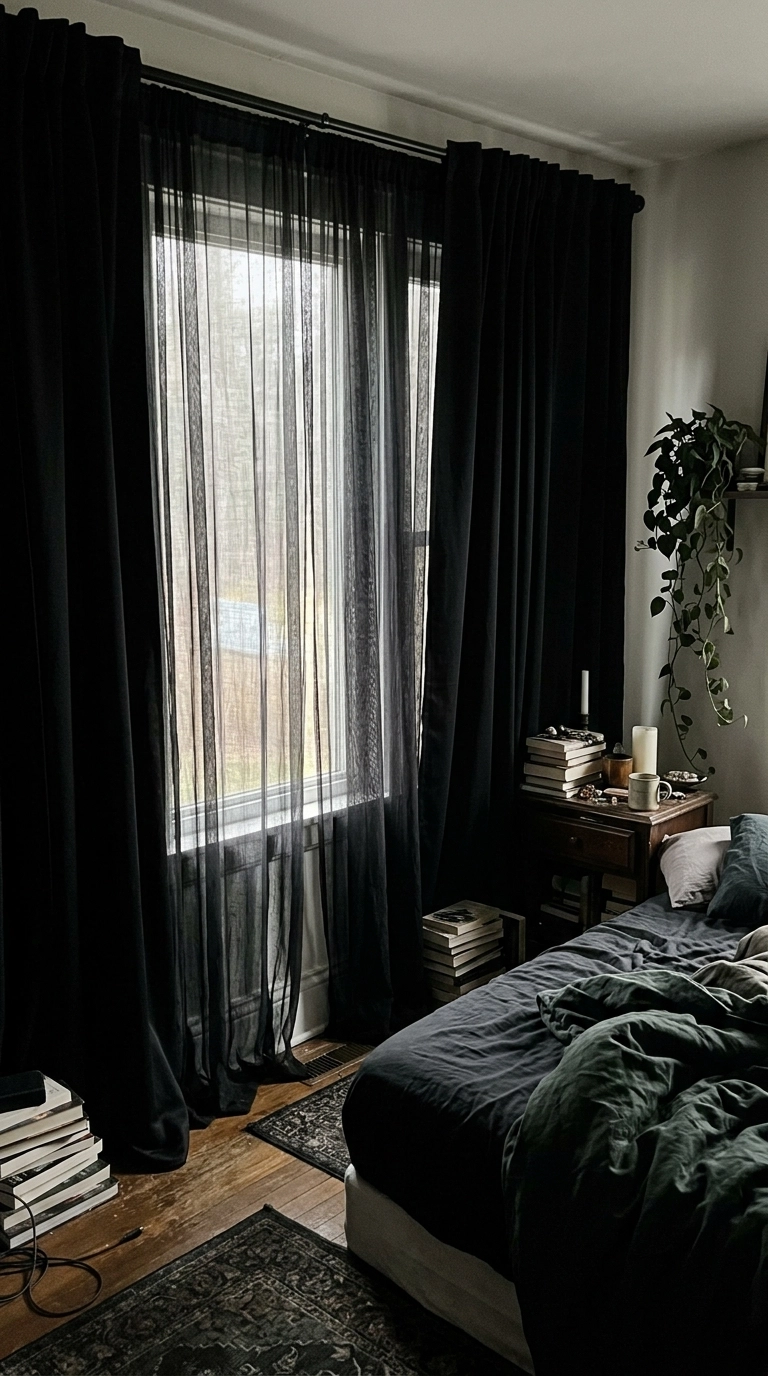
Black blackout curtains against the glass with a sheer black voile hanging in front of them, in a dark romantic bedroom. Putting the sheer in front is the stylist’s reversal: the room sees a soft haze of black all day, and the heavy curtains hide behind it. The voile takes the curtain’s hard edge away, which suits bedrooms with dark walls where black on black needs texture to separate. Light the layers from the side and the folds glow in grades.
Haze effect: A black voile in front of black curtains reads as one deep curtain with weather in it. It is the cheapest luxury in this list.
9. Black Panels, Sheer Centre
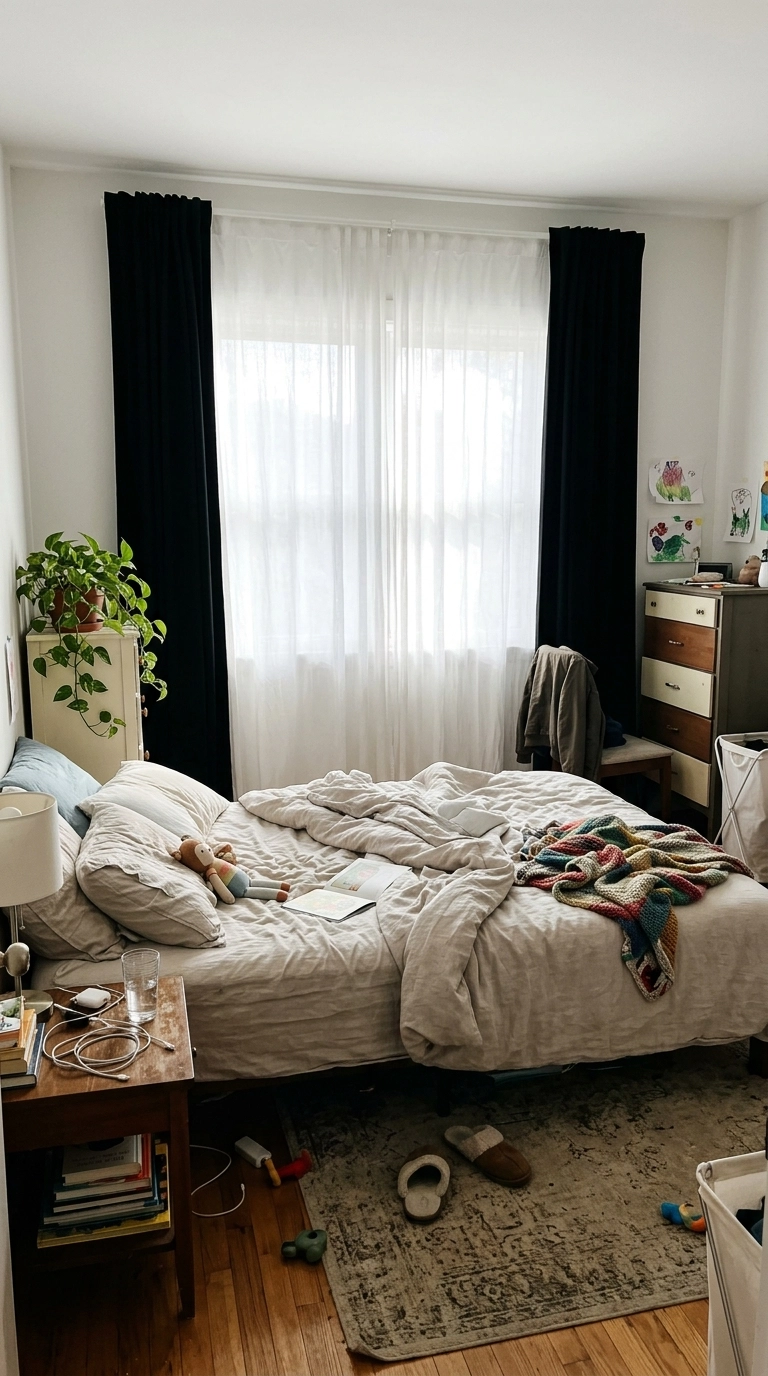
Two black curtain panels fixed at the sides of a wide window with a full width white sheer between them, in a bright family bedroom. The panels never move; they are architecture, framing the window and adding the black, while the sheer does all the daily opening and closing. Fixed panels need half the fabric of working curtains, so the budget can go on better cloth. This is the arrangement hotels use, and bedrooms can steal it without shame.
Fixed savings: Stationary panels use one width of fabric each side. Spend the saving on lining; unlined fixed panels fade unevenly in the sun stripe.
10. Lace and Black for Vintage Rooms
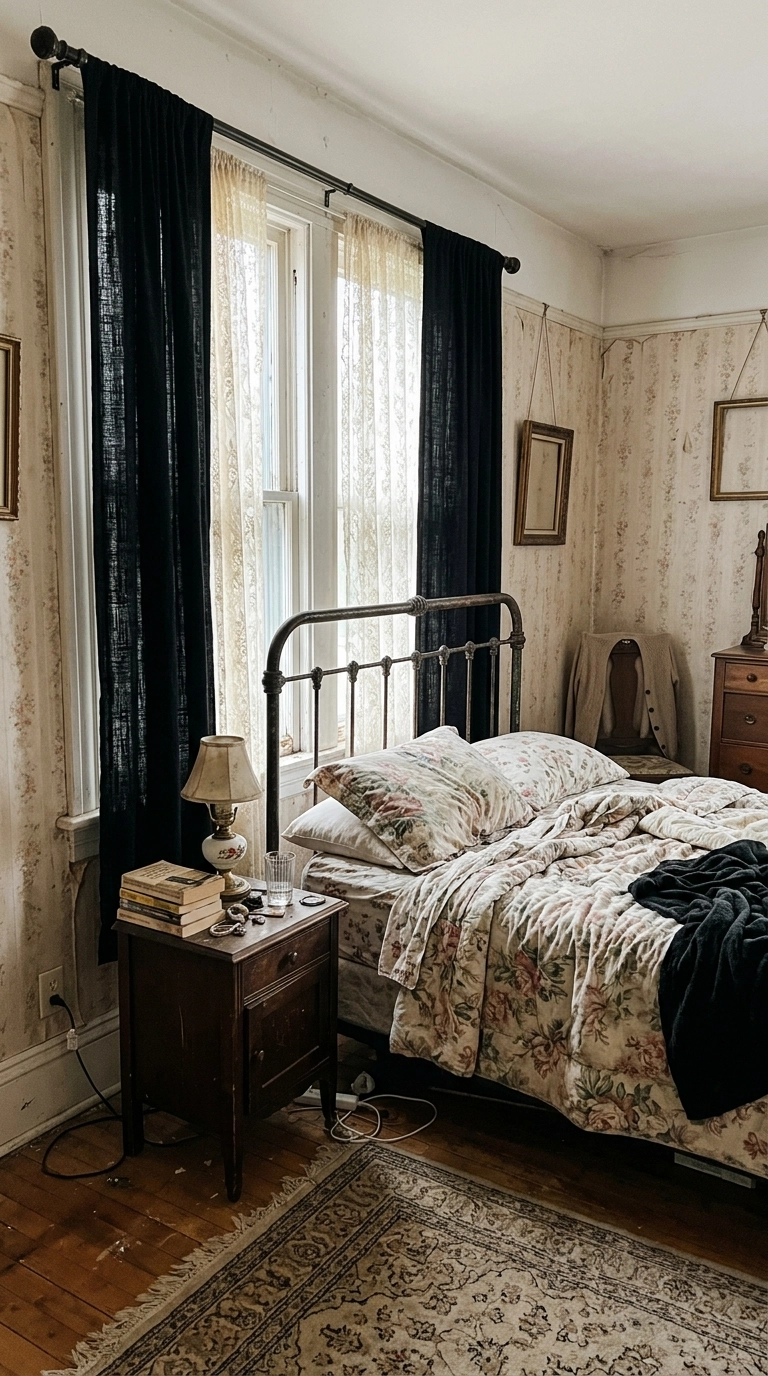
Black curtains layered over cream lace panels in a vintage styled bedroom with an iron bed and floral bedding. Lace under black sounds like a contradiction until you see the light come through: the pattern prints itself on the floor at noon and the black frames it like a picture. Vintage rooms already mix black iron and cream cotton, so the curtains simply join the family. Keep the lace pattern small; big lace motifs fight the curtain folds.
Pattern scale: Lace motifs should be smaller than a coin at window distance. Larger patterns read as doilies, and the room tips into costume.
11. Two Blacks, Matte and Shine
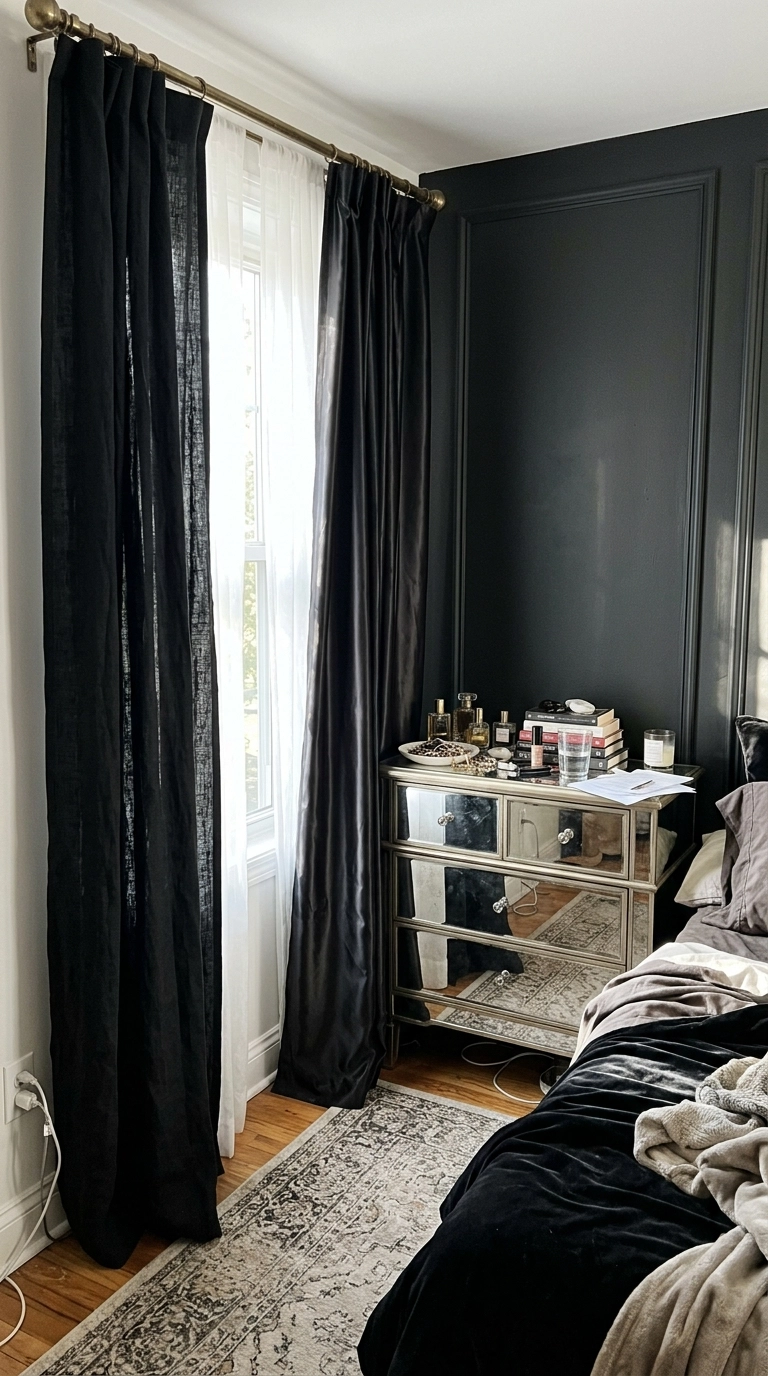
A matte black linen curtain paired with a black satin blackout curtain on the same window, in a glam bedroom with a mirrored dresser. Two blacks layered teach the eye that black is a family, not a colour: the linen sits dull, the satin catches the lamp, and the window gains depth a single fabric cannot give. Glam rooms run on exactly this, contrast of finish rather than contrast of colour. Keep every other textile matte so the satin keeps its job.
Finish contrast: When colour cannot vary, finish must. One shine surface per window is the rule; two makes a shop display.
12. Black Sheers Alone in a Bright Room
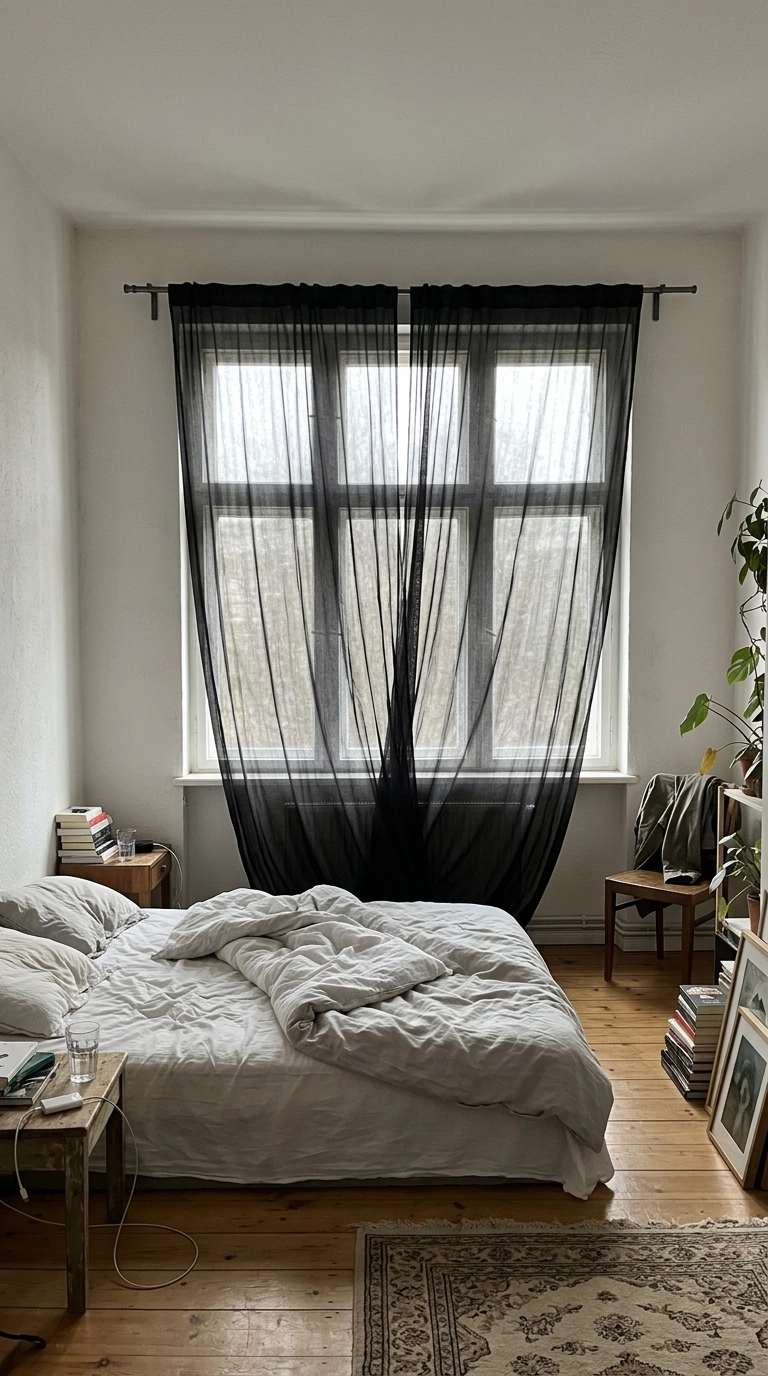
Black sheer curtains alone on a wide window in a white bedroom, the light coming through them grey and soft. Black sheers are the lightest way to wear black at a window: they take the glare off a south window, keep a degree of privacy, and read as a shadow across the glass rather than a wall of fabric. They will not darken a room for sleep, so pair them with a blind if dawn wakes you. On their own they suit siesta rooms and studios.
Glare maths: Black sheers cut glare like sunglasses but block far less light than they appear to. Judge them at noon, not at dusk.
True Blackout Setups
13. The Shift Worker’s Fortress
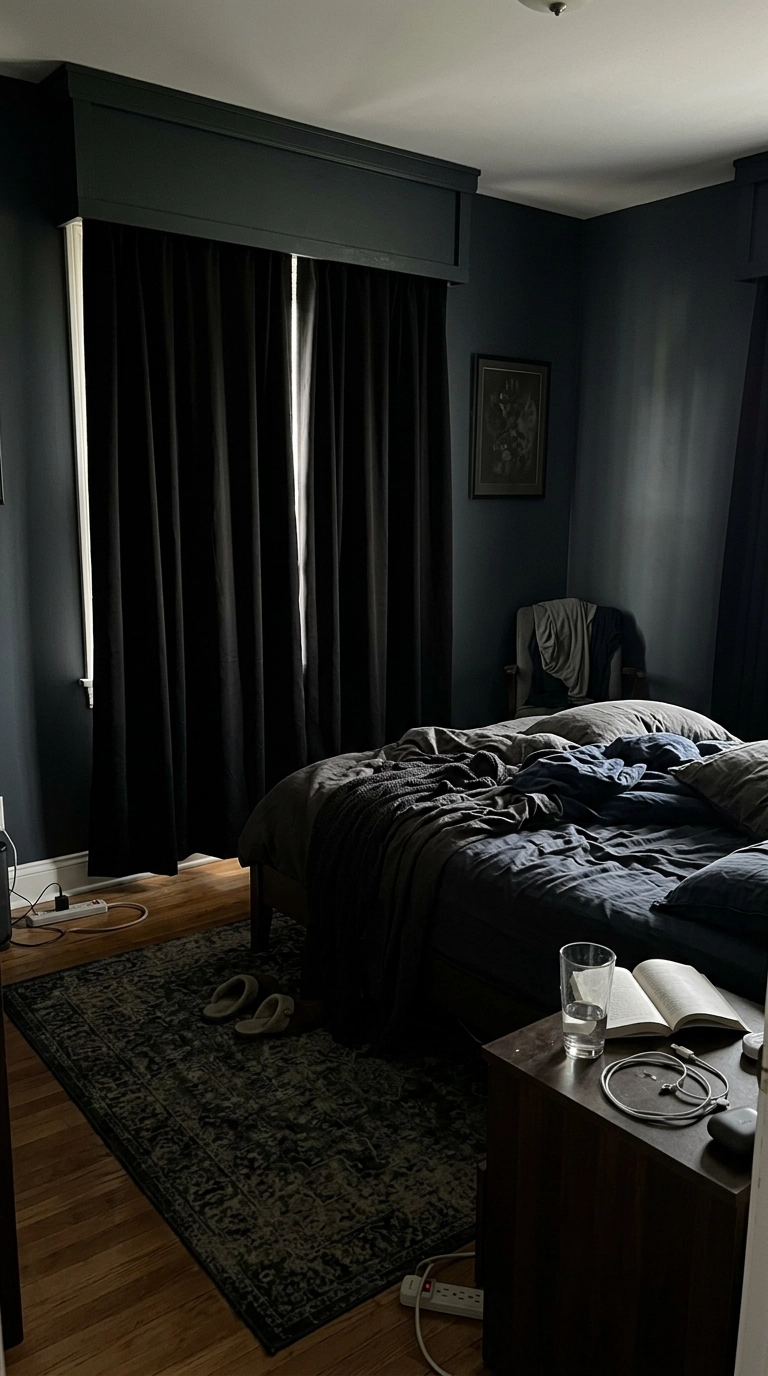
Black blackout curtains fitted inside a pelmet box with side channels, in a plain bedroom arranged entirely for daytime sleep. Real blackout is a system, not a fabric: the pelmet stops light over the top, channels or tight returns stop it at the sides, and the curtain overlaps the wall by a hand’s width all round. Black fabric helps because any pinhole of wear shows less and the face colour matches the lining’s job. This is the setup night shift nurses swear by, built like a darkroom.
Gap audit: Stand in the room at noon with the curtains closed and let your eyes adjust for five minutes. Every glowing edge is a job: pelmet, return, or overlap.
14. Blackout Curtains With a Ceiling Track
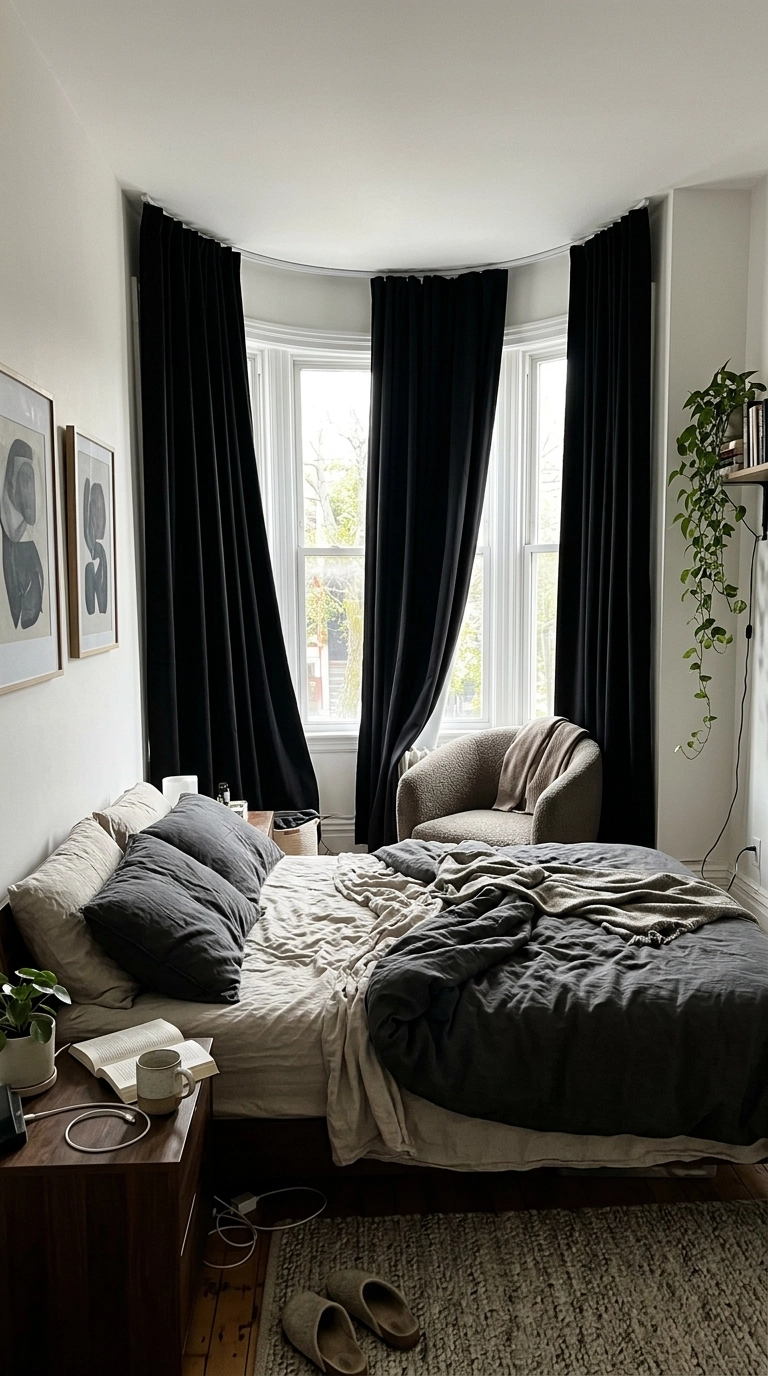
Black blackout curtains on a ceiling mounted track that curves around the window bay of a modern bedroom. Ceiling tracks beat rods for blackout because there is no gap above the rod and the curtain can return to the wall at both ends, sealing the sides. The wave fold a track gives also suits black fabric, even columns with no hardware showing. Modern rooms should default to tracks; rods are furniture, tracks are architecture.
Track returns: Order the track with returned ends that bend back to the wall. That small curve is worth more darkness than a thicker lining.
Six mistakes that ruin black curtains
- Buying the fabric width the same as the window width. Flat black curtains look like bin bags; fullness is the whole luxury.
- Hanging the rod at the frame instead of the ceiling, then wondering why the drama never arrived.
- Forgetting the lining. Unlined black fades to rust at the folds within two summers of sun.
- Chrome or brass rods across black curtains in a modern room, drawing a bright line through the one place the eye should rest.
- Expecting blackout fabric alone to black out. Light leaks at edges, not through cloth; seals make the darkness.
- Pooling cheap thin fabric on the floor. Puddles only work in velvet and heavy linen; thin cloth just looks unmeasured.
15. Triple Weave Black in a Nursery Corner
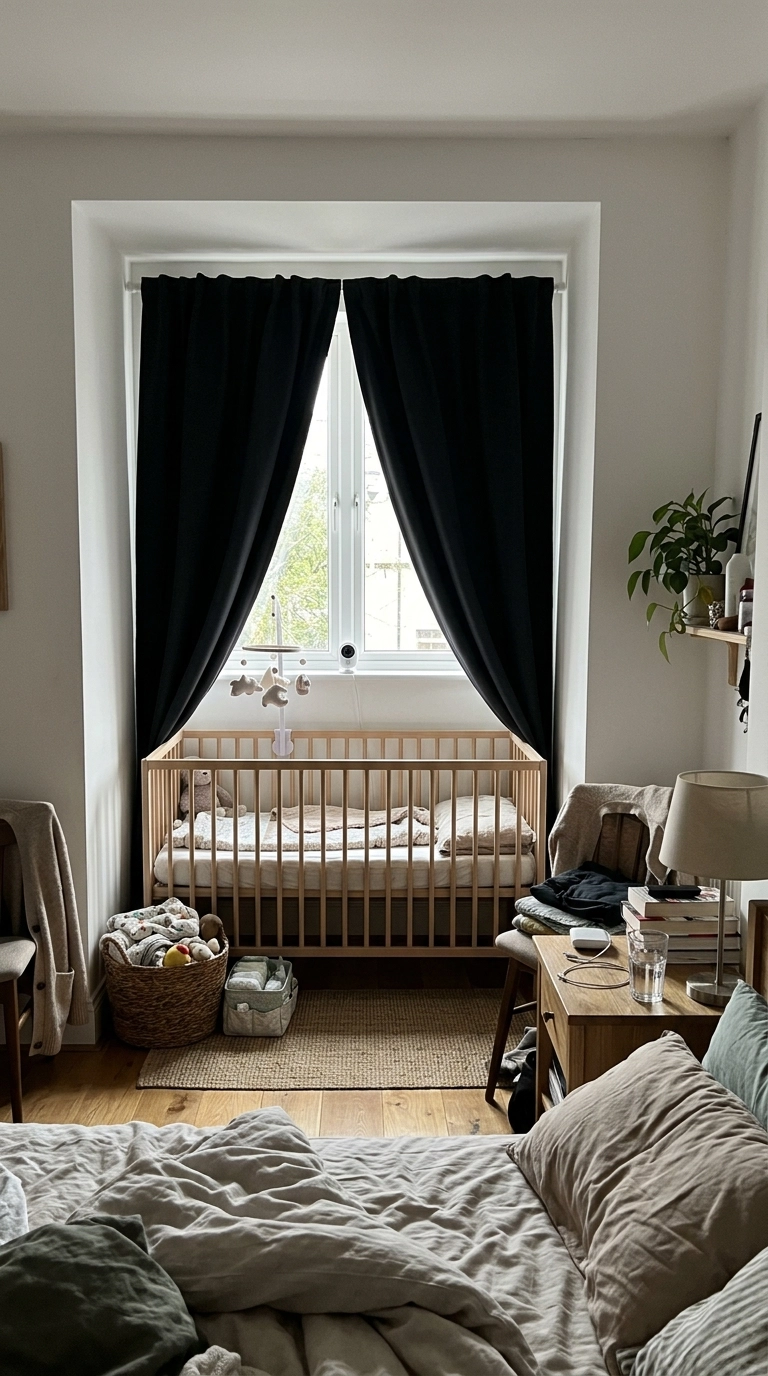
Black triple weave curtains on the window of a nursery corner inside the parents’ bedroom, the cot placed in the curtained alcove. Triple weave fabric blocks light without a coated lining, so it drapes softly and washes without cracking, which is why it suits rooms with babies. Black in a nursery sounds stern and works kindly: the alcove becomes a cave, naps lengthen, and the parents’ side of the room stays pale and adult. Keep the curtain off the floor by a centimetre for the vacuum’s sake.
Washable dark: Triple weave is the blackout fabric that survives the washing machine. Coated linings craze and let light through in cracks after a few washes.
16. Black Velvet Blackout for Light Sleepers
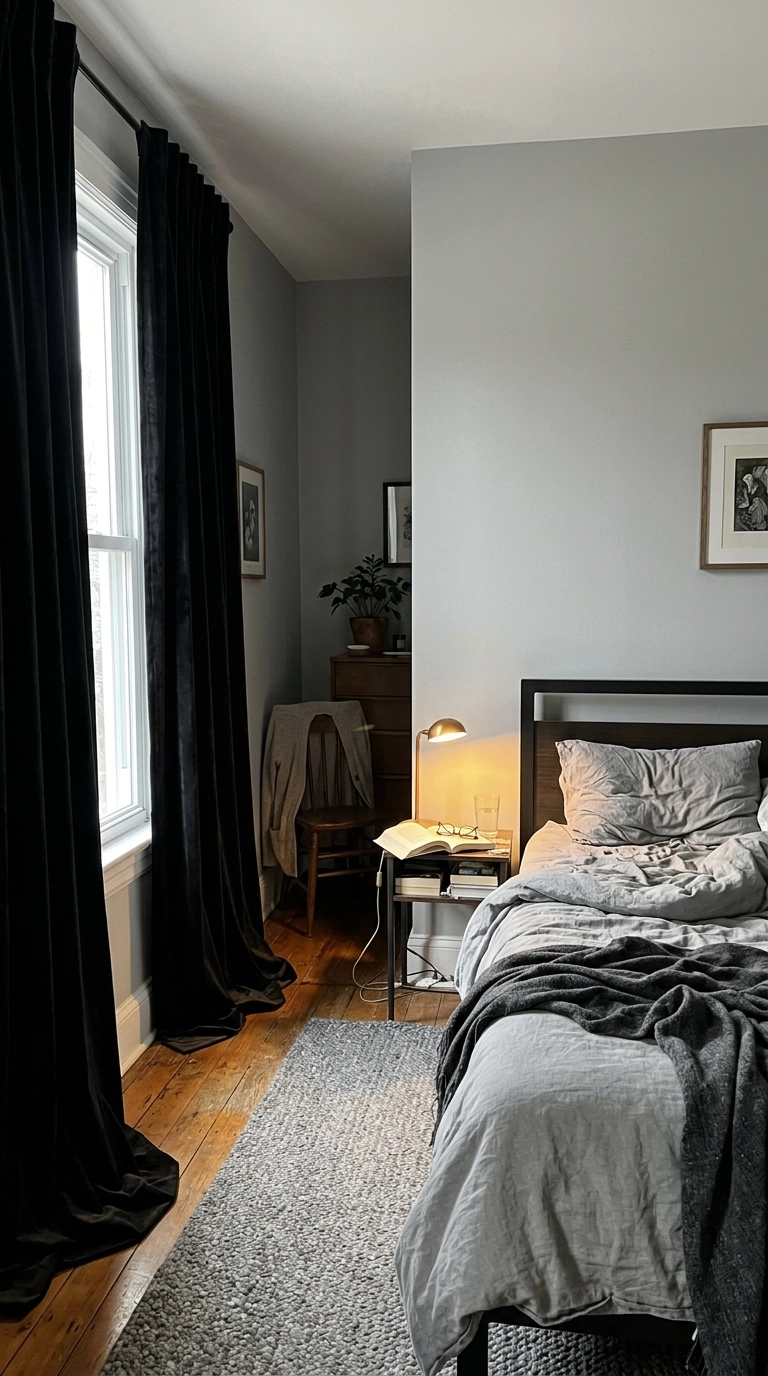
Black velvet curtains with a blackout lining in a serene bedroom with grey bedding and a single reading lamp. Velvet plus blackout lining is the heavyweight combination: the pile absorbs sound as well as light, and rooms dressed this way feel quieter in a way visitors notice without naming. The weight needs a strong rod or track, fixed into studs or with proper anchors; heavy curtains on weak fixings bow within a season. Budget for the hardware as seriously as the cloth.
Weight check: Velvet blackout curtains can weigh over a kilo per metre of width. If you can lift the rod with two fingers, it is too weak.
17. Hotel Style Black With a Blind Behind
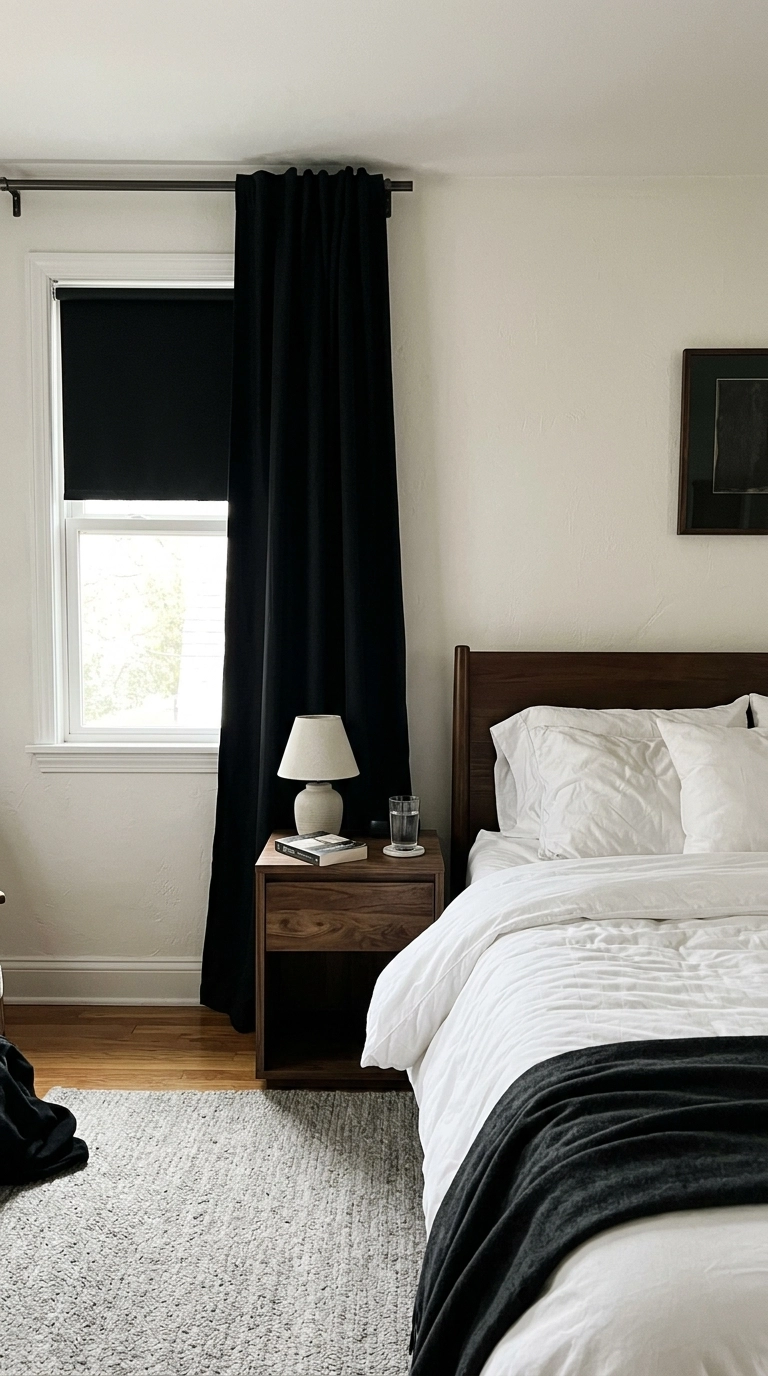
Black curtains over a black roller blind in a smart bedroom with crisp white bedding and dark wood furniture. Hotels layer a blind behind curtains because each does half the job perfectly: the blind seals the glass, the curtain seals the edges and brings the style. A black blind behind black curtains disappears when open, rolled into a shadow line. This pairing is the most forgiving blackout for rented rooms, since the blind fits inside the frame with minimal fixing.
Seal order: Blind first for the glass, curtains second for the edges. Either alone leaks; together they are a system.
18. Black Curtains in a Loft Bedroom
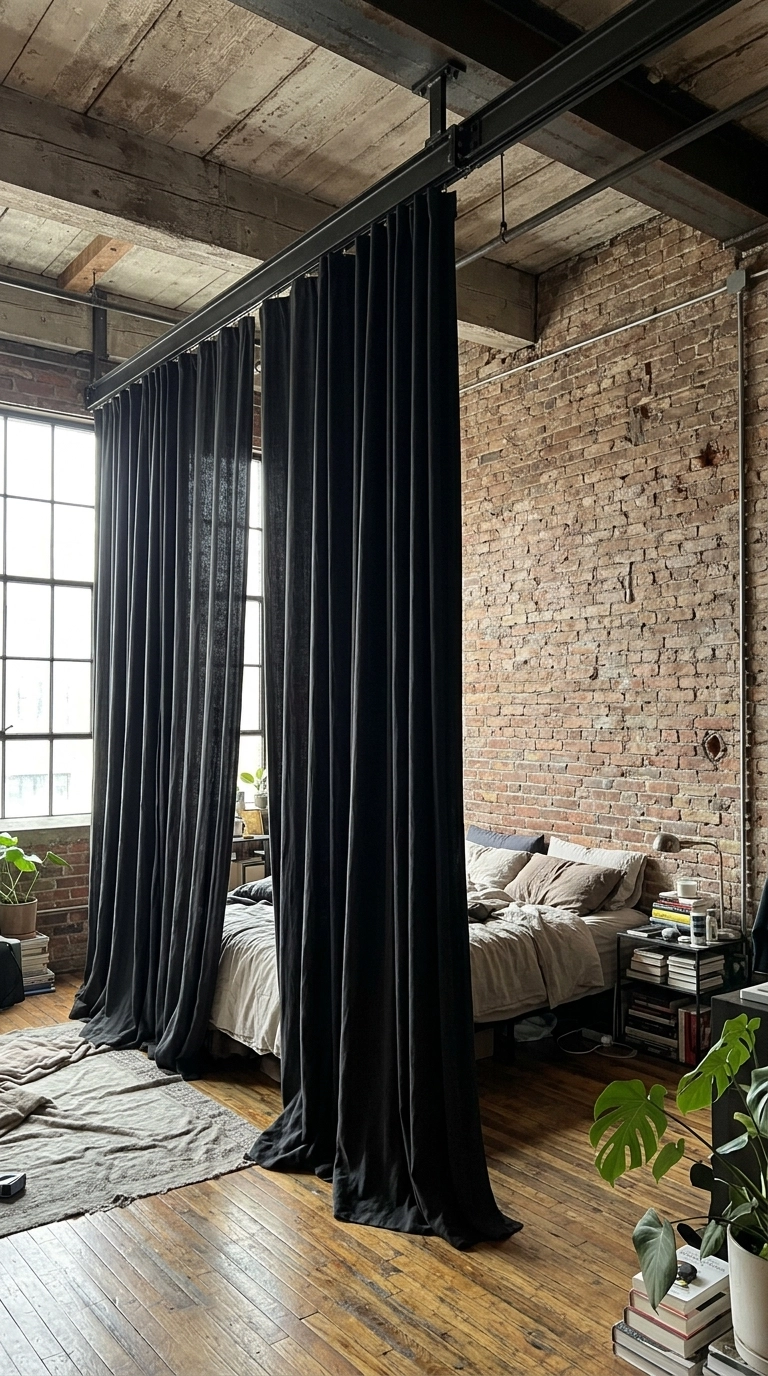
Floor to ceiling black blackout curtains dividing the sleeping zone of a loft bedroom, hung on an industrial black track. Lofts have windows too big and walls too few, so a curtain wall becomes the bedroom door, the blackout and the backdrop in one. Black suits industrial bones, echoing the steel and shadow lines already in the room. Run the track past the window’s width so the open curtain stacks on wall, not on glass, and the daylight survives the division.
Stack space: A curtain needs stack room of roughly a third of its width when open. Give it wall, or it will eat your window.
Small Windows, Bays and Awkward Shapes
19. Short Black Curtains on a Small Window
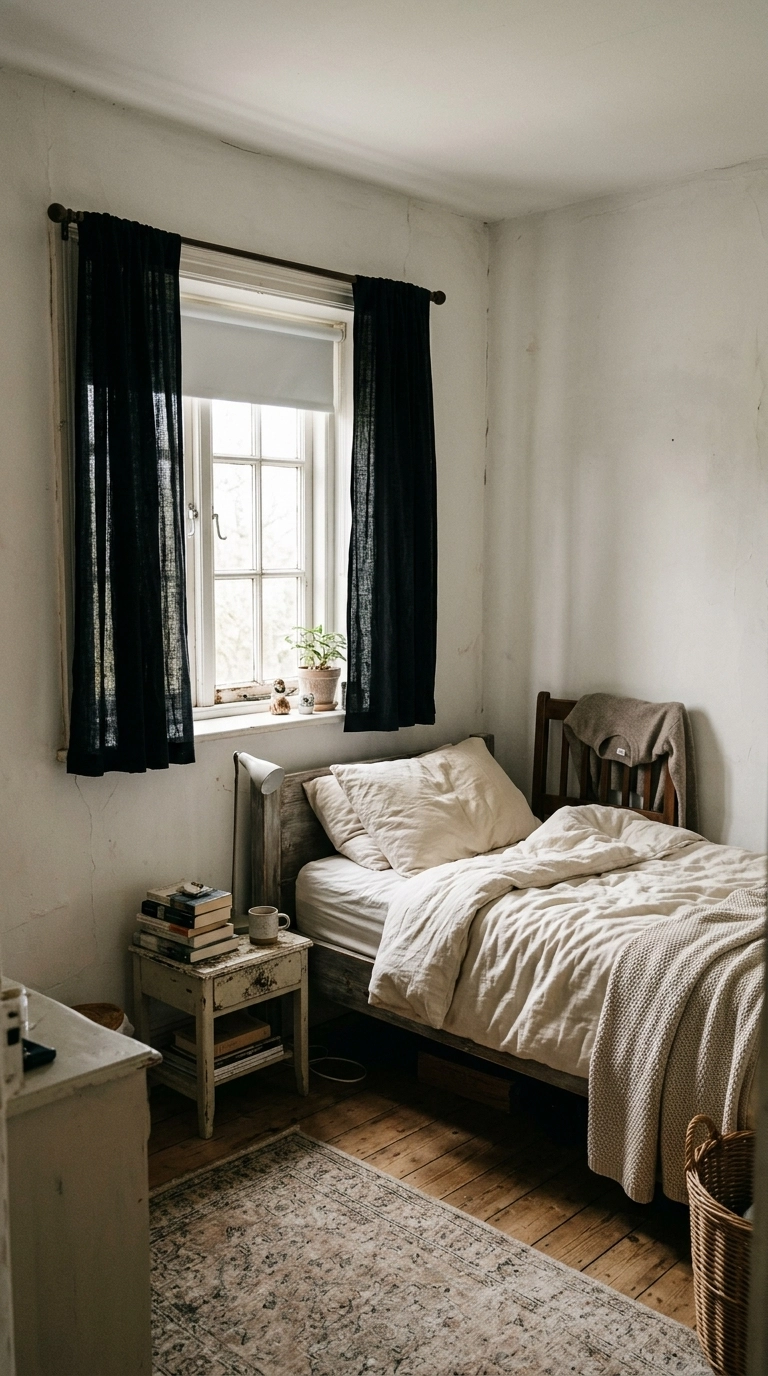
Short black curtains ending just below the sill of a small bedroom window, with a white blind behind them. Small windows punish full length curtains, which pool and swallow the wall; a sill length pair keeps the proportions honest. Short curtains in black read as a deliberate frame, especially with the blind handling privacy. The look suits cottages and spare rooms where the window is a porthole, not a picture.
Sill rule: Short curtains should clear the sill by two centimetres or cover it fully. Hovering at sill level looks like a measuring error.
20. The Bay Window, Panel by Panel
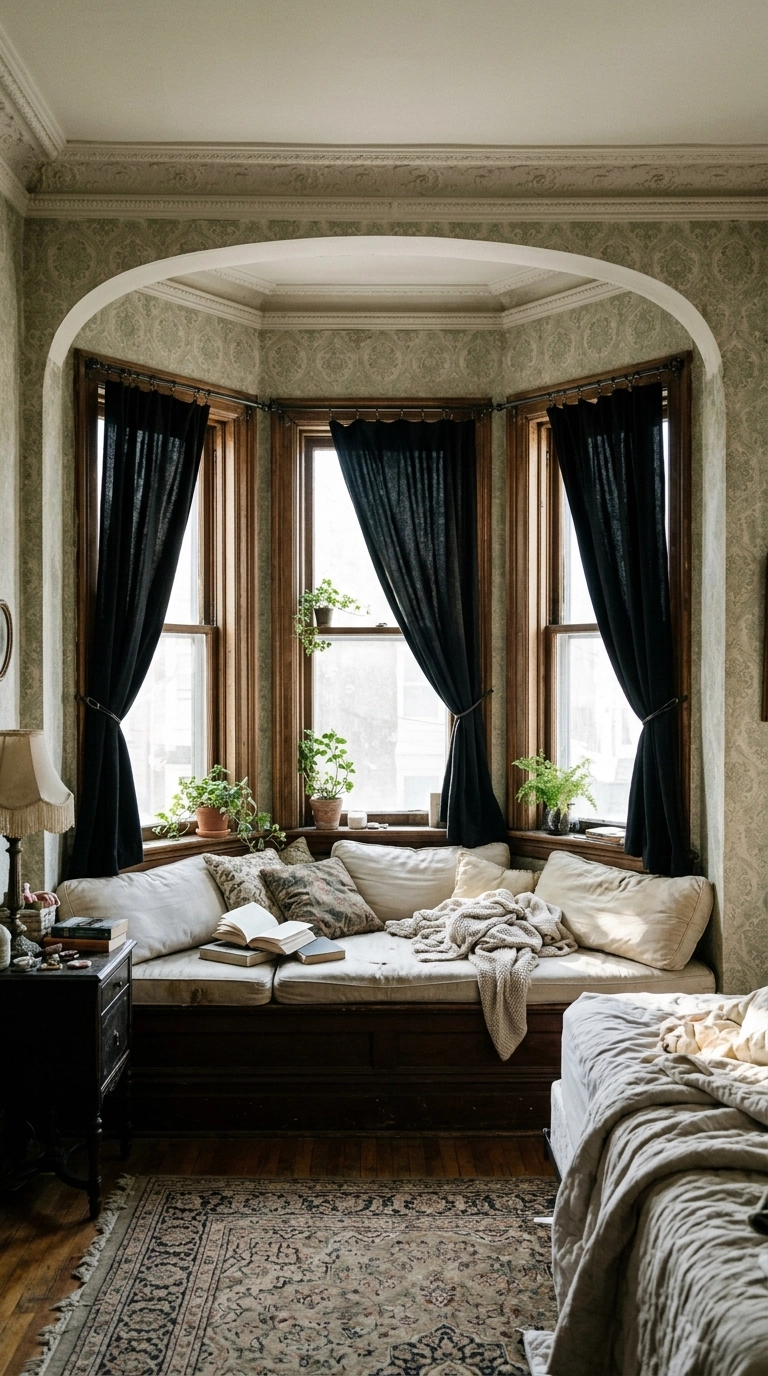
Black curtains hung as separate panels on each section of a bay window in a Victorian bedroom, drawn together at the corners. Bays defeat single rods; the honest answer is a bent track or one pair per facet, accepting the corners as part of the design. Black on a bay makes the window seat below it the cosiest seat in the house, a dark alcove by day. Dress the seat in pale cushions so the alcove glows against the black.
Bay maths: A bent track costs more and works once. Three cheap rods cost less three times. Bays reward buying the track first.
21. Black Cafe Curtains for a Low Window
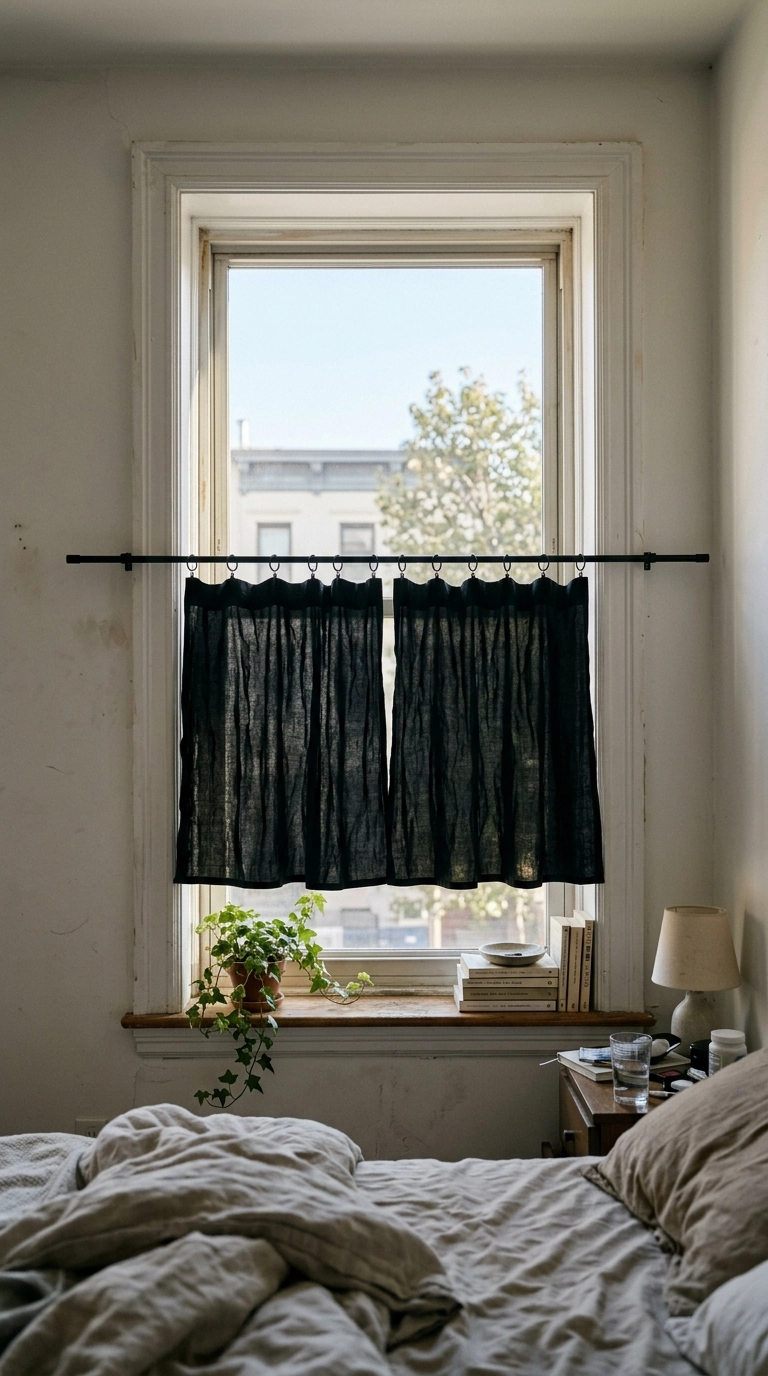
Black cafe curtains covering the lower half of a street level bedroom window, the top half open to the sky. Cafe curtains solve the overlooked bedroom without sealing it: privacy where bodies are, light where the sky is. In black they read smart rather than net curtain nostalgic, especially in linen with a plain hem. Pair with a simple black rod halfway up the frame and keep the top glass bare; the contrast is the charm.
Half measure: Cafe curtains belong at the height of a passer-by’s eye line, usually the lower half to two thirds. Higher turns them into a valance.
22. One Panel for an Off Centre Window
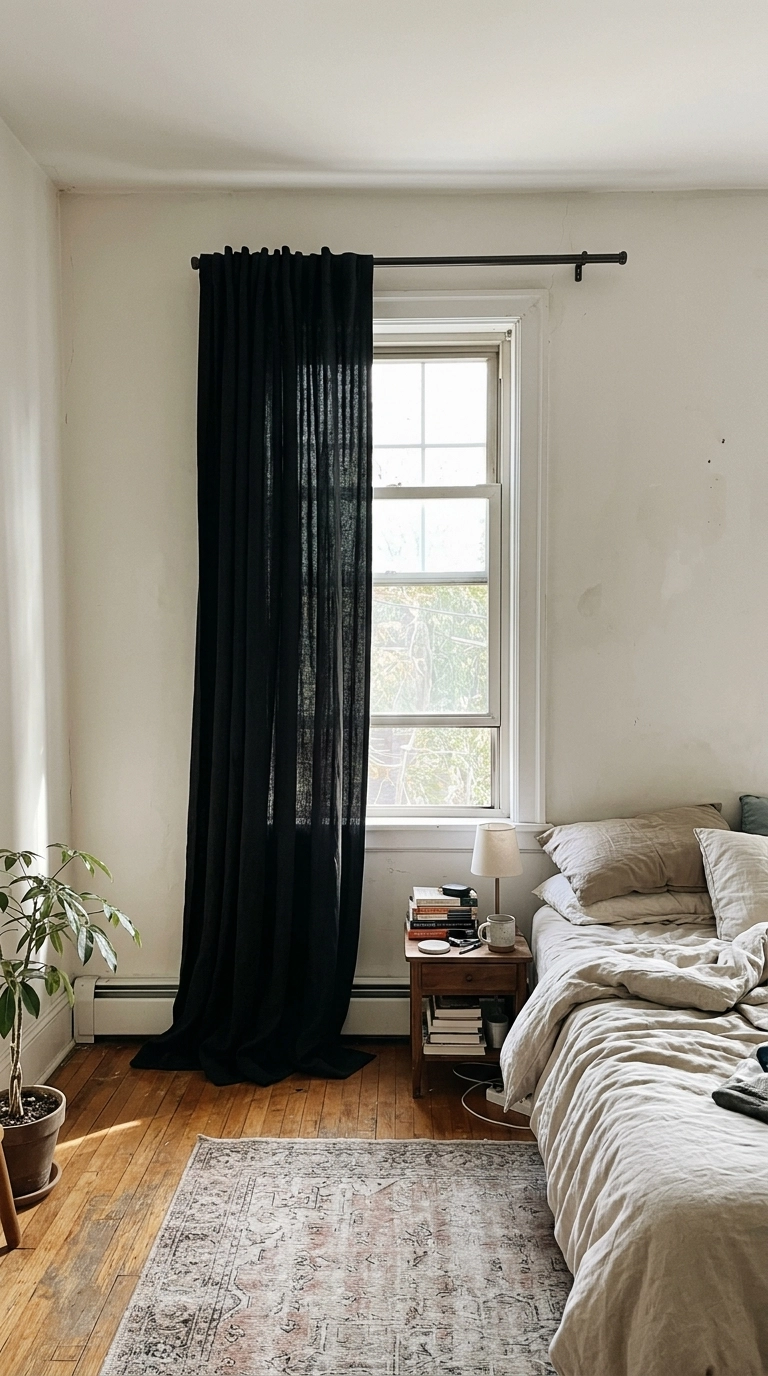
A single wide black curtain panel sweeping across an off centre bedroom window, stacked entirely to the wider side. Asymmetrical windows make pairs look apologetic; one confident panel treats the oddness as a decision. The single sweep also gives a small room one strong gesture instead of two weak ones. Choose a fabric with body, linen or velvet, because a lone panel in flimsy cloth reads as a towel on a rod.
Confidence rule: One panel must be wider and heavier than half a pair would be. Undersized singles look like a curtain is missing.
23. Black Curtains With a Pale Lining Surprise
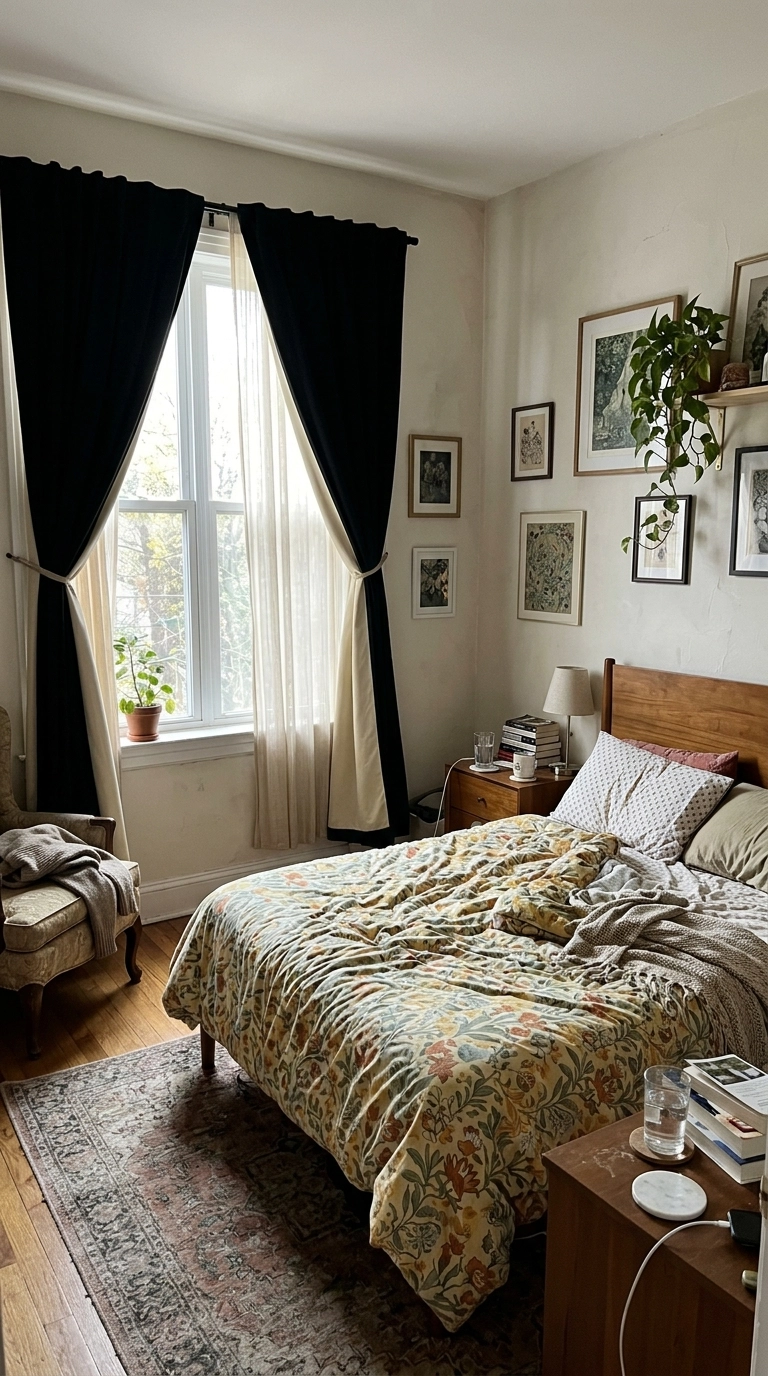
Black curtains lined in cream, the cream edge showing as the panels turn back in a cheerful bedroom with patterned bedding. A pale lining is the stylist’s pressure valve: the room gets its black, the window keeps a light edge, and from the street the house wears a polite cream face. Tiebacks show the lining off best, holding the panel in a curve that flashes the contrast all day. It is also the practical choice where rules or neighbours prefer light curtains facing out.
Street face: Many streets and landlords quietly expect pale curtains outward. A cream lining satisfies the street and keeps your black.
Which black curtain is yours?
- You sleep in the day: the fortress setup, pelmet, returns, triple weave or velvet, and a gap audit at noon.
- Your room is rented: full height black on a tension friendly rod with a cream lining, drama you can take with you.
- Your window is huge and plain: ceiling to floor velvet or a double width sweep; scale is your problem, not colour.
- Your window is small or odd: fitted short pairs, cafe curtains or one confident panel, sized to the window you actually have.
- You want the look without the dark: black sheers or black panels over white sheers, shadow rather than blackout.
Decide by the window, not by the photograph. Tall windows earn drama, layered windows earn their keep in privacy and darkness, blackout is a system of seals rather than a fabric name, and awkward windows want honest, fitted answers. Black will do any of these jobs beautifully if the fullness, the hardware and the lining are chosen with it. Get those three right and the boldest curtain in the house becomes the easiest one to live with.