Most backyards look completely different at night, and not always in a good way. A space that feels warm and lived-in during the day can turn flat and unwelcoming the moment the sun goes down. The right lighting does not just add brightness, it creates mood, defines zones, and gives your garden a character it simply cannot have with overhead solar alone. Here is what actually works.
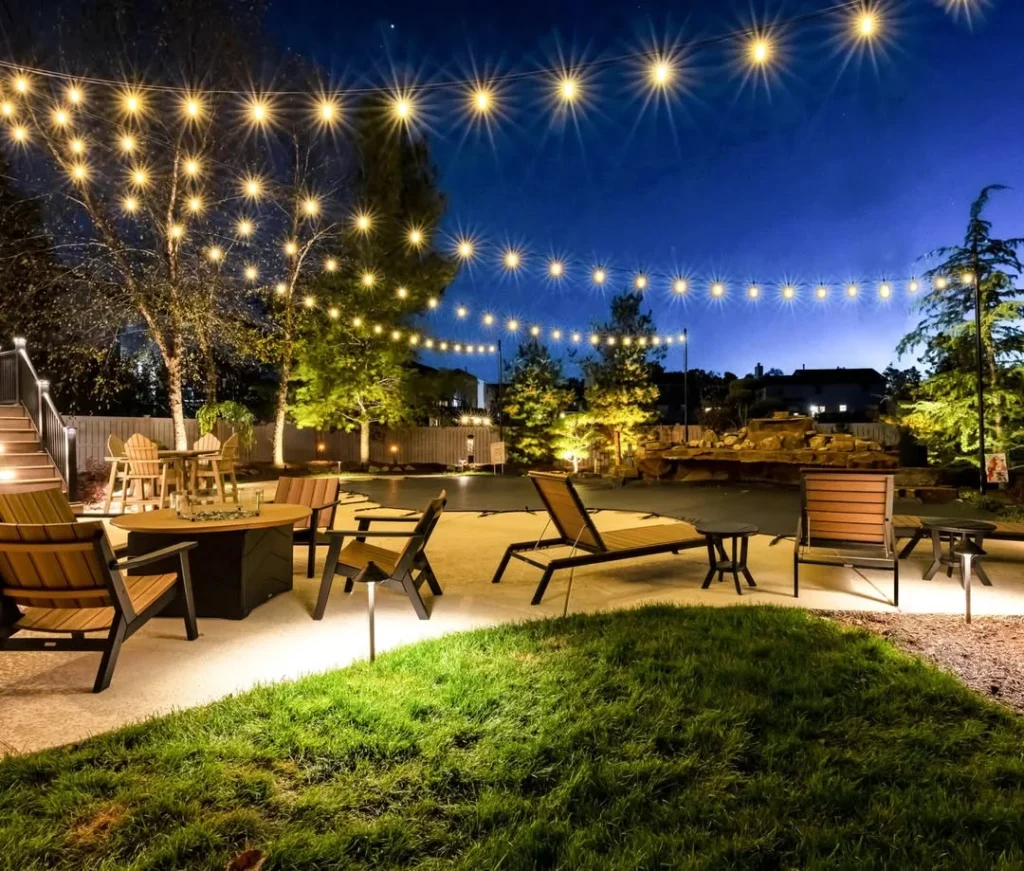
Suspending multiple runs of globe string lights from tall timber poles across a large patio or entertaining area produces an effect that is genuinely hard to replicate with any other fixture type: a warm, low ceiling of light that makes the whole space feel enclosed and intimate without any physical structure overhead. The trick that separates a great installation from a mediocre one is the pole placement: at least 10 to 12 feet high, spread to create tension in the cable, and with bulbs spaced around 18 inches apart so the points of light read as individual stars rather than a bright strip. This works as well in a substantial suburban yard as it does in a professional event space.
Pro Move: Use S14 Edison bulbs rated at 2700K rather than clear globe bulbs; the filament is visible at a distance and creates a warmer, more dramatic effect at night.
2. Cross-Span String Lights Over the Whole Backyard
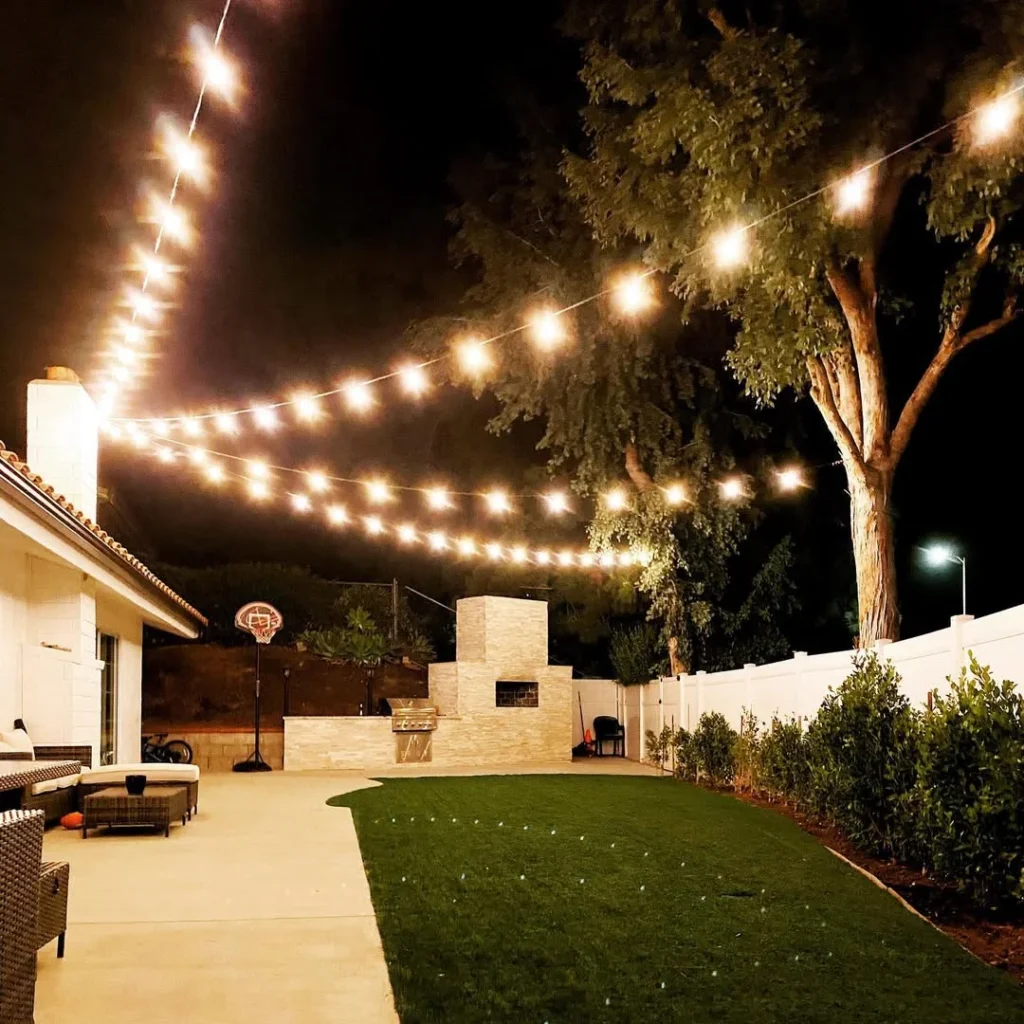
A slightly different approach to string light coverage is running multiple parallel runs in a fan or wave pattern from the house wall to a fence line or tree, crossing the entire open space at different angles, which produces a denser overhead canopy than a simple parallel grid. One thing that works really well here is using the natural anchor points already in the garden, a chimney, a mature tree, a fence post, rather than adding freestanding poles, which keeps the installation feeling organic. This approach suits rectangular backyards especially well and costs about the same as a standard bistro light setup, around $60 to $150 for a basic system, with solar-powered options now reliable enough for everyday use.
Quick Tip: A smart plug or simple outdoor timer costs around $15 and means your lights come on at dusk automatically without you having to think about it every evening.
3. Globe Lights Over a Long Dining Table Under a Pergola
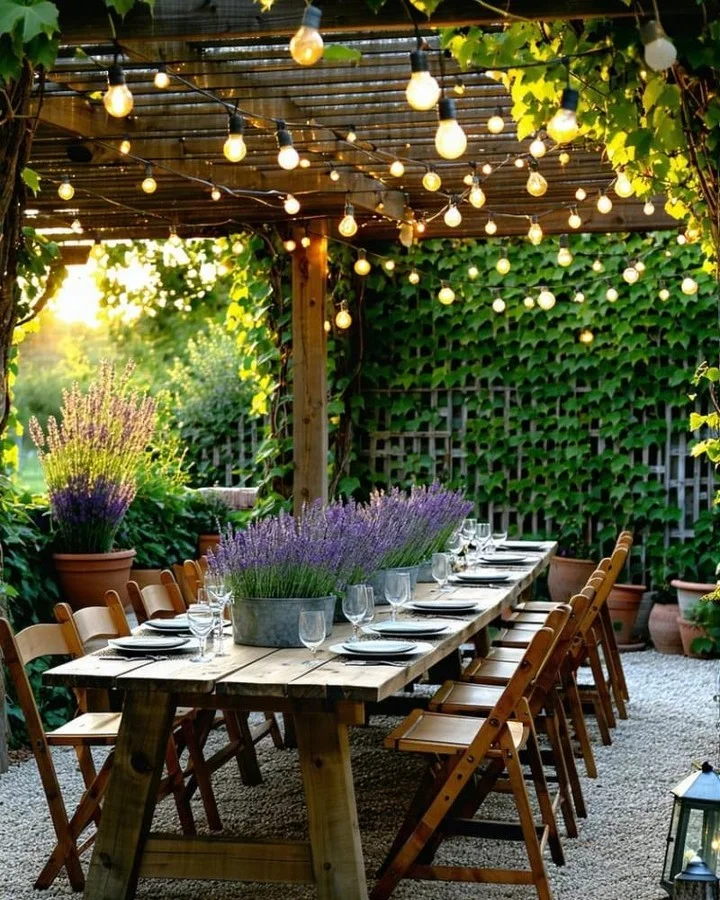
A rustic farm-style dining table under a vine-covered pergola with two parallel runs of globe lights crisscrossed overhead is one of the most consistently beautiful outdoor dinner setups possible, and the main reason it works is layered light: the warm glowing canopy above, candles or lanterns on the table surface, and possibly a soft wash on the surrounding planting creates three distinct levels that prevent any single source from overpowering. Lavender in terracotta pots around the base of the pergola adds fragrance as well as structure, and in practice the whole setup is at its best in the golden hour just after sunset before the sky goes fully dark.
Designer Advice: Crisscross two runs of lights at slightly different heights rather than running them parallel; the overlapping diagonal pattern reads as more intentional and generous overhead.
4. Layer Cafe Lights with Wisteria, Dining, and an Outdoor Fireplace
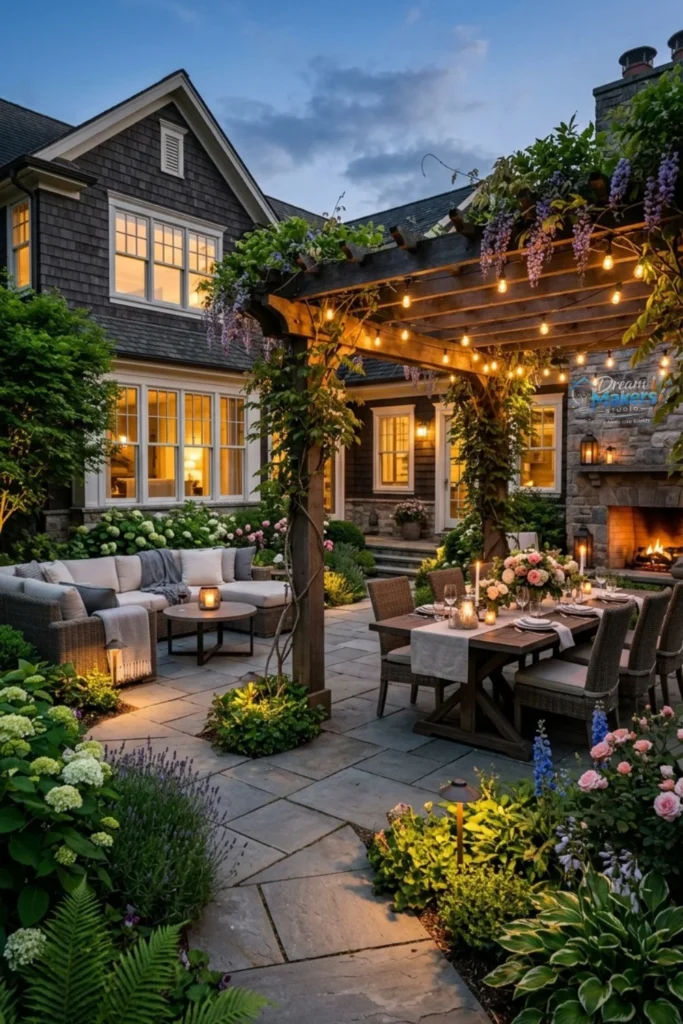
A genuinely complete evening backyard has at least three lighting elements working together: overhead string lights for ambient glow, a fireplace or fire pit for focal warmth, and candles or lanterns on the table surface for intimate task lighting. This combination, seen here with wisteria climbing the pergola posts and hydrangeas in the planting beds, is what interior designers call layered lighting applied to an outdoor room, and it is exactly what makes some gardens feel like restaurants and others feel like car parks. The fireplace does not need to be large or expensive; even a simple bio-ethanol box mounted to a rendered wall achieves the warmth and movement that a third light source provides.
Reality Check: String lights and a fireplace together are a fire risk if the lights hang within a few feet of open flame; keep at least 5 feet of clearance and use LED string lights which generate almost no heat.
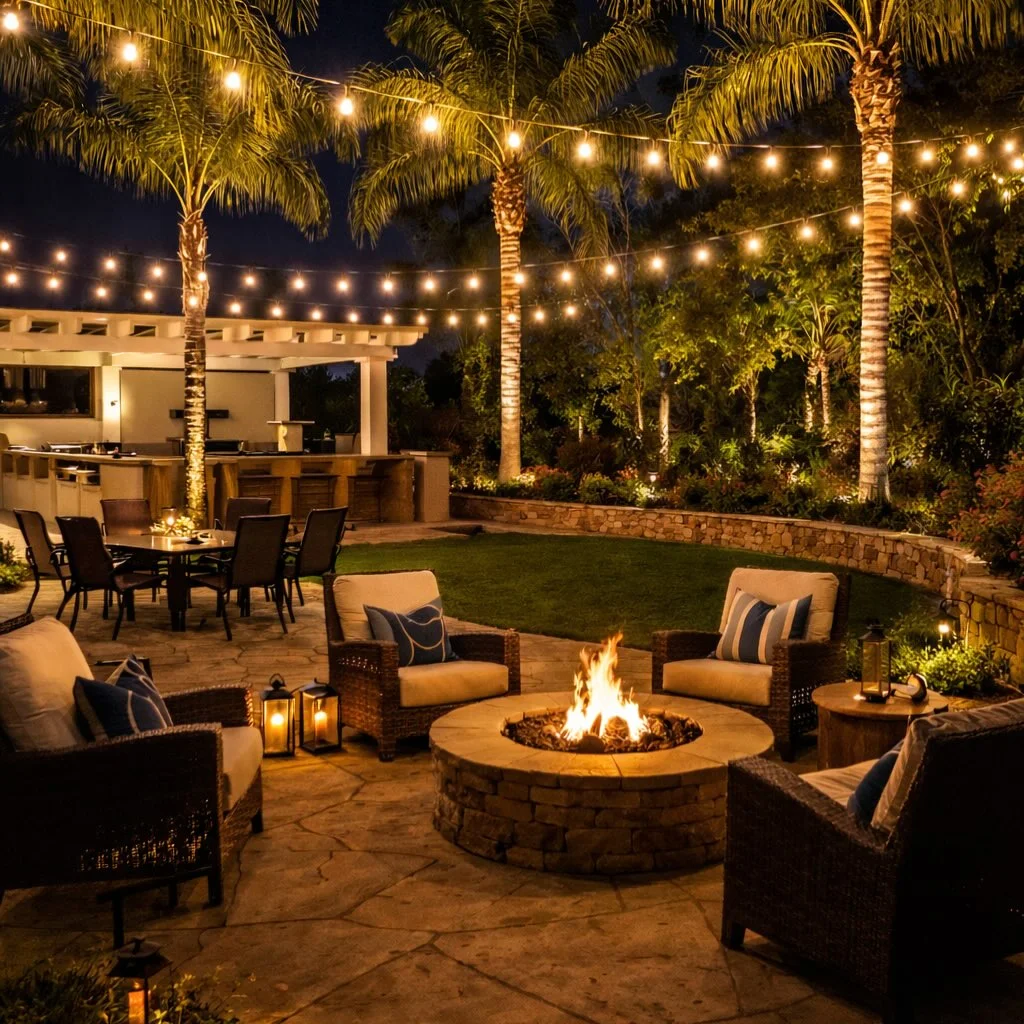
5. String Lights Through a Palm Canopy Over a Fire Pit
Using existing trees as structure for string lights rather than installing poles is both cheaper and more visually interesting because the organic shapes of branches and fronds create an irregular, layered canopy that no manufactured pole system can replicate. Running globe lights through a palm or mature tree canopy above a fire pit and seating area means the light source sits at the same level as the natural structure, which makes the whole garden feel like one cohesive environment at night rather than a space with a light fixture added to it. This suits warm-climate gardens especially well and pairs beautifully with lanterns placed on the ground between the chairs.
Heads Up: Attach string lights to tree branches with purpose-made soft cable ties, not staples or nails, to avoid damaging the bark and creating entry points for disease.
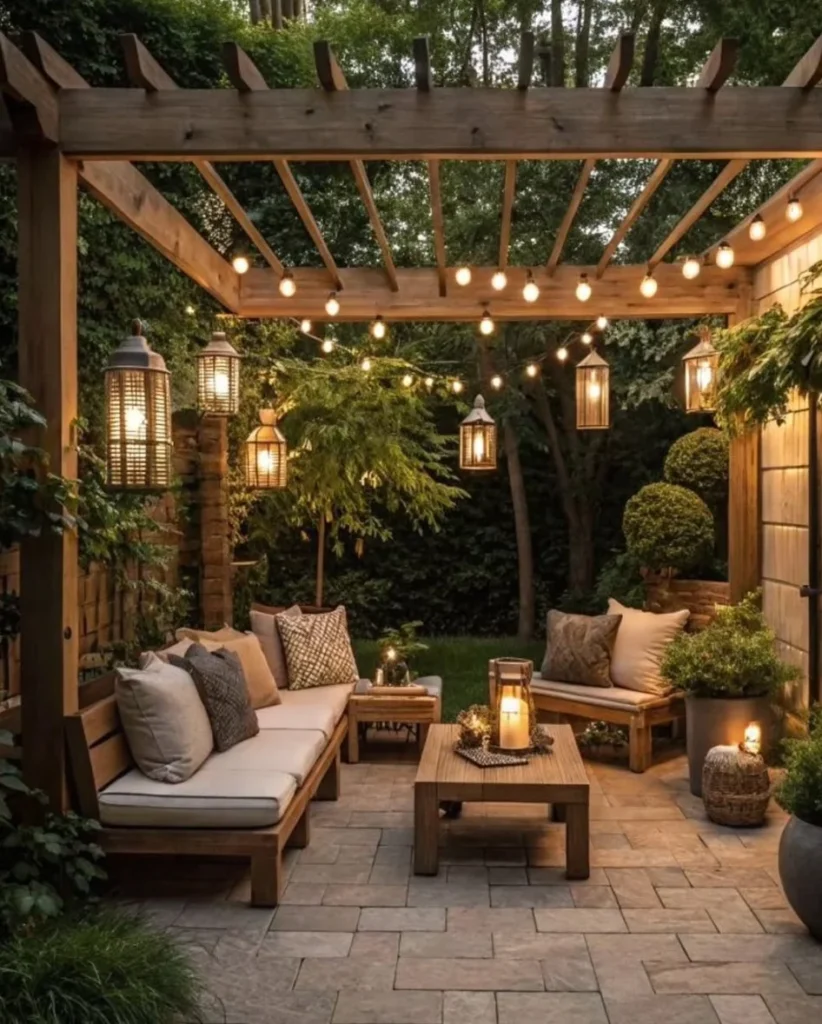
6. Hang Wicker Lanterns Between String Lights on a Timber Pergola
Mixing large wicker or rattan pendant lanterns with a run of Edison globe lights on a timber pergola creates a depth and richness that string lights alone cannot achieve: the lanterns read as individual glowing objects at eye level while the string lights provide the broad overhead wash, so the eye has multiple points of interest to settle on. This approach works particularly well on a natural timber pergola because the warm tone of the wood, the amber of the filament bulbs, and the honey colour of rattan all sit in the same colour family and reinforce each other. The lanterns should be weatherproof rated IP44 or above; genuine rattan is not, so look for synthetic rattan alternatives or accept that they will need replacing after a couple of seasons.
Quick Tip: Vary the drop height of three to four lanterns rather than hanging them all level; staggered heights create a relaxed, lived-in feel that an even row cannot match.
7. Classic Covered Pergola with Café Lights and a Curtain Drop
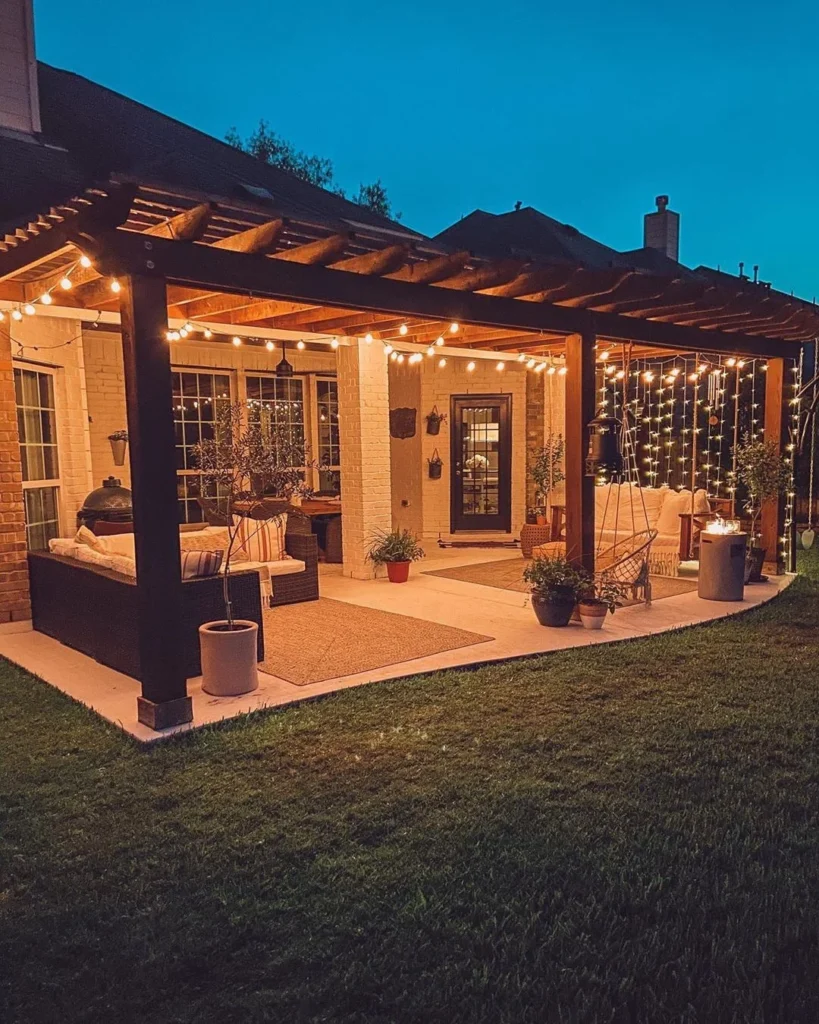
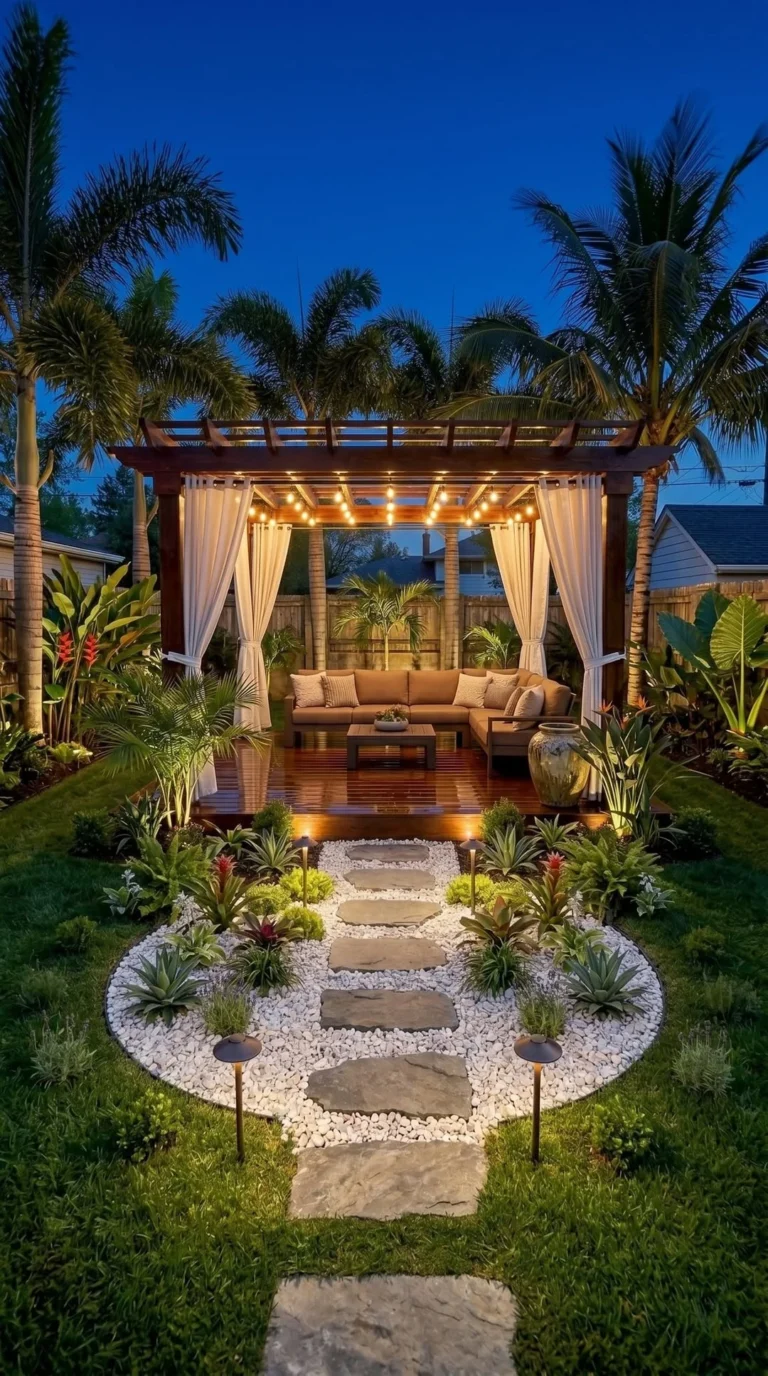
Running string lights along the underside of a covered pergola roof, combined with a secondary curtain of fairy lights or light chain falling vertically from the edge of the structure, creates a two-layered light effect that defines the edges of the outdoor room precisely. The curtain of lights acts like a soft wall that separates the lit pergola space from the darker lawn beyond, which is a simple way to create a sense of enclosure and intimacy without physical screens or planting. This is one of the more affordable ways to light a covered outdoor space, since string lights cost far less than recessed LED fittings, and a DIY installation of two 100-foot runs of café lights takes an afternoon.
Pro Move: Use a separate circuit for the vertical curtain drop and the horizontal run so you can dim or switch each layer independently for different moods through the evening.
8. Dense Grid of Café Lights Inside a Dark Pergola with an Outdoor Screen
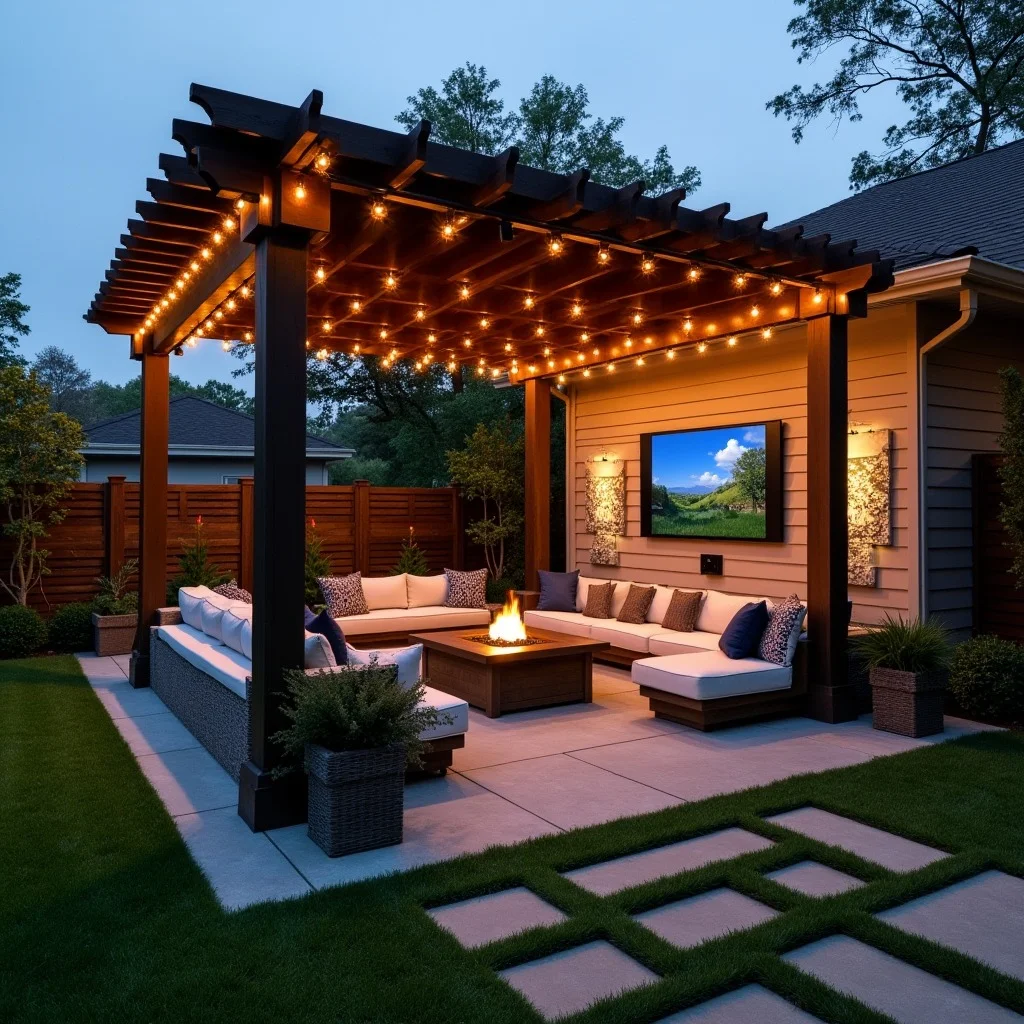
A solid-roofed or heavily structured dark pergola with a dense crisscross grid of café lights laced across the interior ceiling creates a low, warm, almost theatrical glow that is completely different in character from lights hung on a slatted open structure. The light bounces off the ceiling material and creates a diffused, even wash rather than individual point sources, which suits a space with a built-in TV screen especially well because it reduces contrast and eliminates the harsh shadows that a single overhead fixture creates. This is the kind of setup that makes a backyard feel like a genuine outdoor room rather than a patio with furniture on it.
Reality Check: Outdoor screens need to be at least 400 nits brightness to be readable in evening ambient light; consumer TV sets moved outside rarely meet this and struggle even after dark.
9. Two-Zone Lighting: Dining Area and a Lit Pergola Backdrop
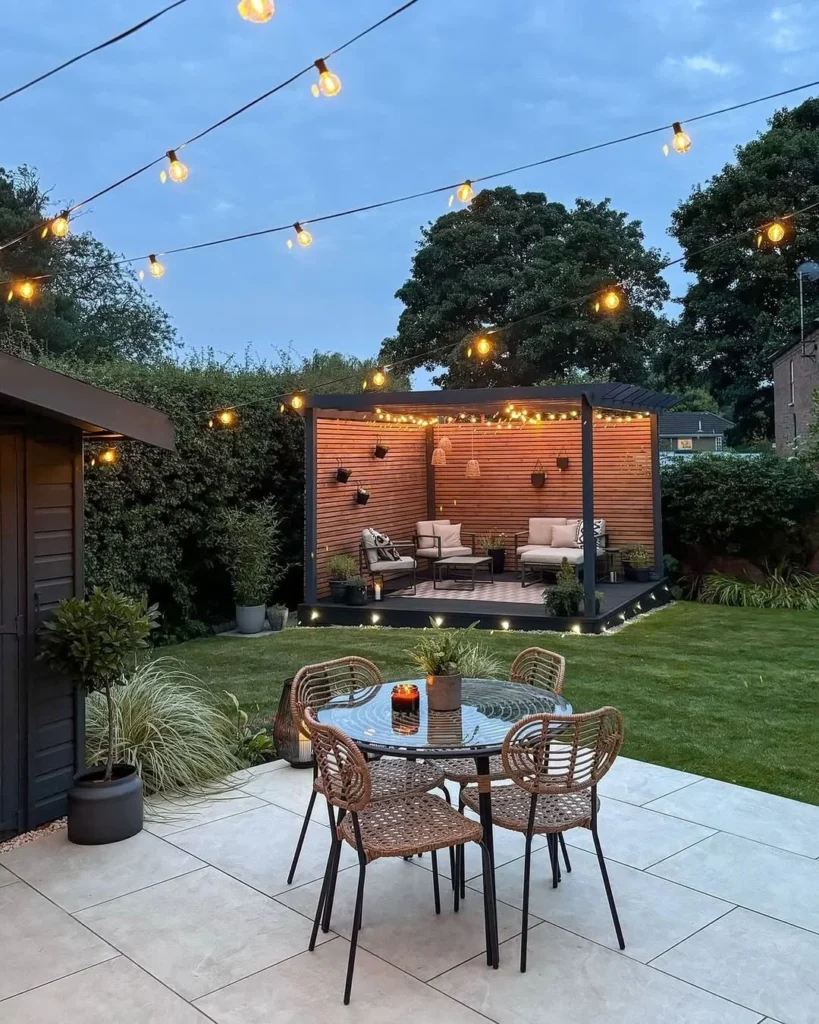
Creating two distinct lit zones in the same garden, one for dining and one as a lounge or pergola destination, is one of the most effective ways to make a medium-sized backyard feel larger and more purposeful because it gives people a reason to move through the space rather than all gravitating to one spot. Here, café lights run from the house across to a timber pergola structure that has its own internal string lights and wicker pendants, making the pergola itself a focal point visible from the dining area and worth walking toward. The two zones should use lights at slightly different colour temperatures if possible: warmer (2200K) for the pergola lounge and slightly cooler (2700K) for the dining area, which helps the brain read them as separate spaces.
Designer Advice: Place a low-level lantern or ground light at the transition between the two zones to guide the eye and the feet from one space to the other without a harsh change.
Quick reference: backyard lighting types, typical DIY cost, and best use case at a glance.
Lighting Type
Avg Cost (DIY)
Effect
Best For
String lights
$30 to $150
Warm ambient canopy
Entertaining, dining
Pendant lanterns
$40 to $200
Focal point + task glow
Pergolas, seating areas
In-ground uplights
$15 to $60/unit
Plant and path drama
Borders, trees, steps
LED step/deck risers
$20 to $50/unit
Safety + architectural edge
Decks, terraced gardens
Wall sconces/uplighters
$50 to $180/unit
Feature wall wash
Courtyards, modern patios
Solar ground stakes
$5 to $30/unit
Low border accent
Budget-friendly paths
10. Wicker Pendant Lanterns Hung from a Garden Tree
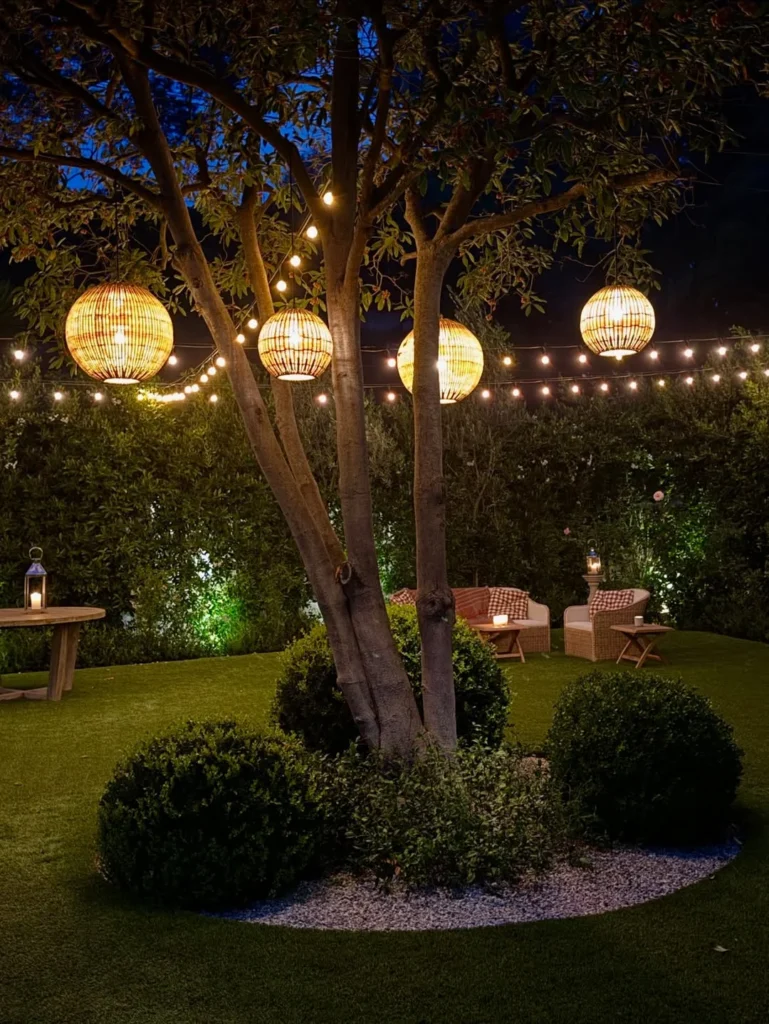
Hanging multiple oversized wicker pendant lanterns from the branches of a large garden tree, combined with a string light run through the canopy, produces an effect that is part Balinese resort, part English garden, and entirely its own thing at night. The key is using lanterns with a warm visible bulb inside (an E27 LED globe in amber or warm white works well) so the wicker weave becomes a decorative screen casting patterned light through it. This idea works best with mature trees that have wide, horizontal branching, and the lanterns should be sized generously: small lanterns on a large tree look apologetic, whereas lanterns 40 to 50 cm in diameter create the visual weight the tree deserves.
Heads Up: Check the tree branches are dead wood free and that the lantern weight is supported from multiple attachment points; a 3 to 4 kg pendant in high wind can cause real branch damage.
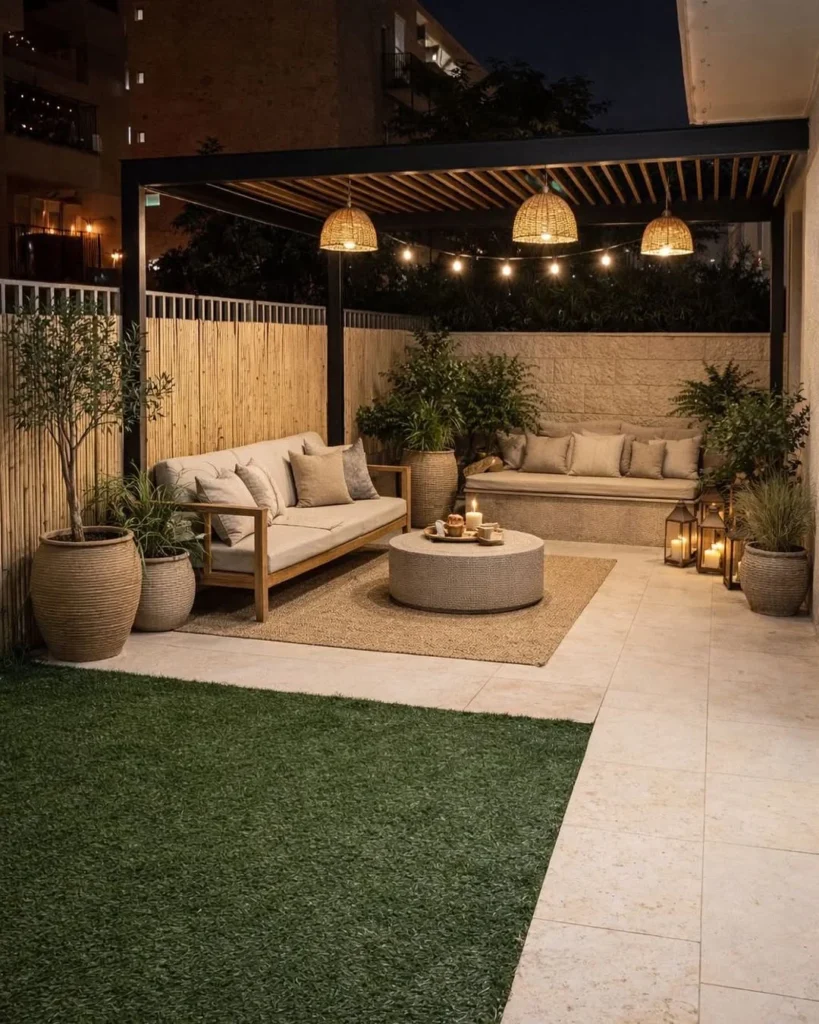
Fitting three woven dome pendants on drop rods inside a black steel-frame pergola with bamboo privacy screening creates a contemporary take on the wicker lantern idea that feels architectural and considered rather than rustic. The pendants do the decorating work so the furniture can stay clean and minimal, and the warm glow through the dome shade creates interesting shadow patterns on the bamboo backing and the jute rug below. This kind of setup suits compact courtyards and city-facing gardens especially well because the defined overhead structure of the pergola makes the lighting feel purposeful and permanently installed, not improvised.
Quick Tip: A jute or natural fibre rug directly under pendant lights creates a defined pool that grounds the seating group and makes the lighting feel even more cohesive.
12. Cinema Deck with Paper Lanterns, Hammock, and Edison Bulbs
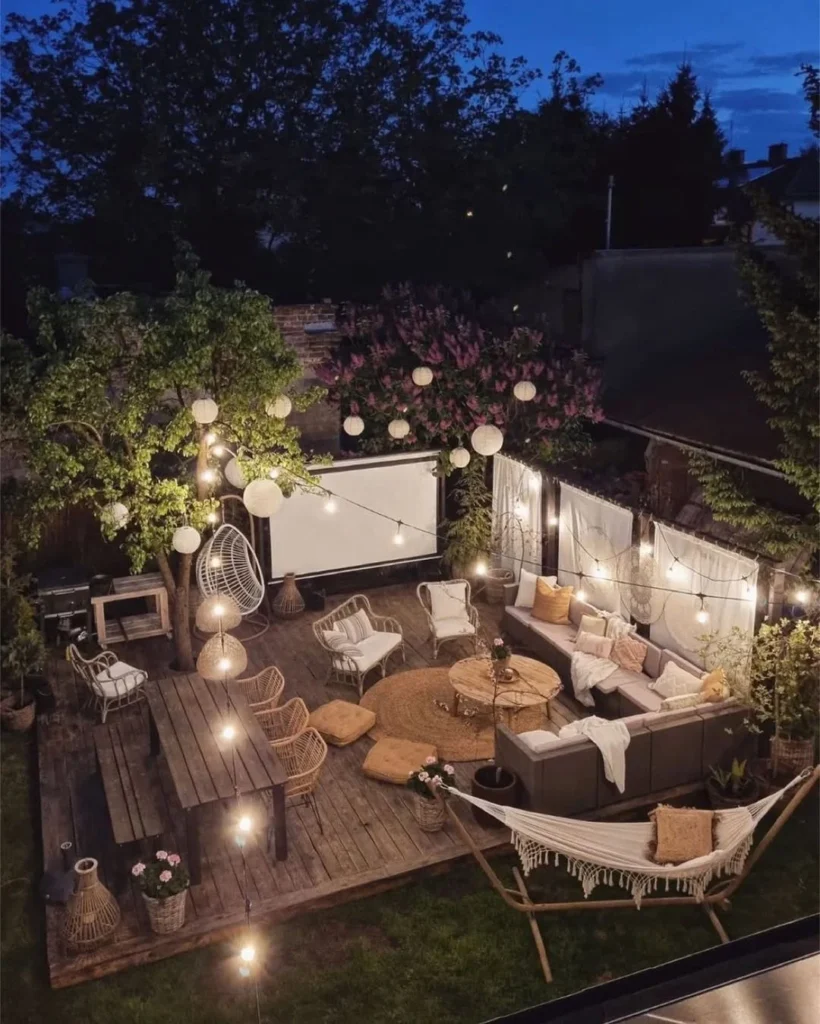
An outdoor cinema setup works best when the lighting around it is deliberately low: paper lanterns hung at varying heights, Edison café lights strung loosely through tree branches overhead, a hammock with a wicker pendant above it, and floor-level lanterns around the perimeter create a warm ambient wash that is bright enough to navigate safely but dim enough not to compete with the projected screen. The mix of paper globe lanterns and Edison bulb strings at different scales gives the overhead plane a festive, informal quality that suits a movie night much better than a formal single-source fitting. Paper lanterns should be in a weatherproof nylon version for outdoor use; the standard paper ones dissolve in rain after a season.
Pro Move: Run the projector audio through a Bluetooth speaker rather than the projector’s built-in speaker and place it away from the seating area so the sound field wraps around rather than coming from a single point.
13. Uplighting Inside Raised Planters Along a Modern Path
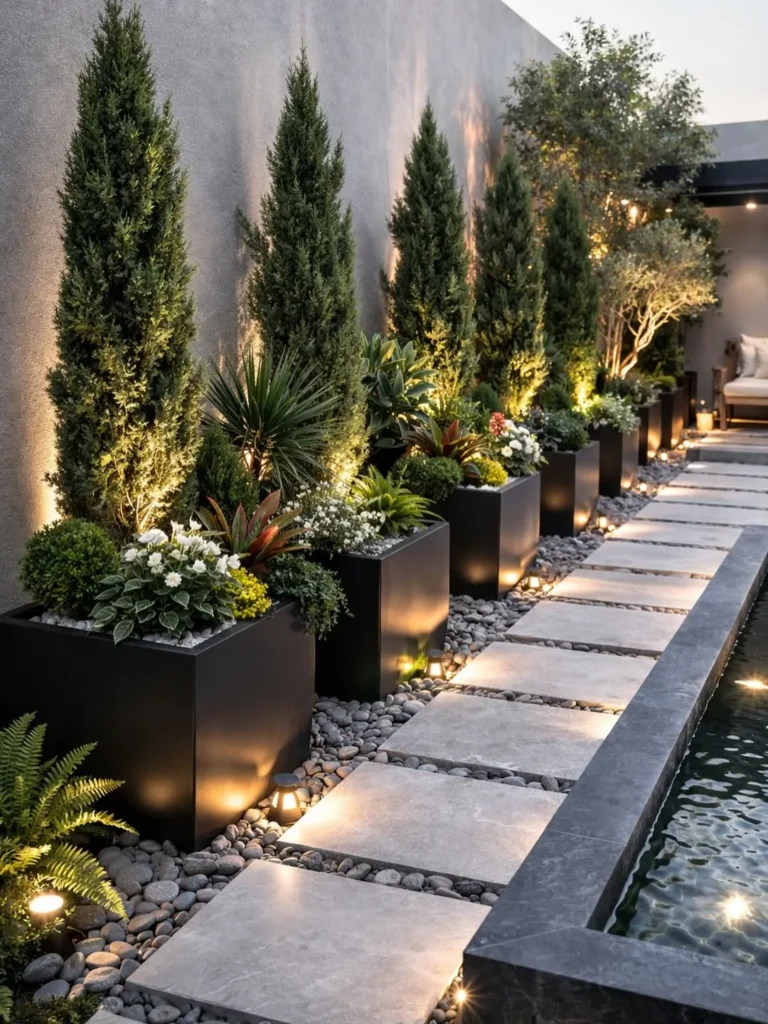
In-ground or planter-embedded uplights positioned at the base of columnar conifers and ornamental trees inside tall black metal planters along a stone pathway create a night-time version of the garden that reads completely differently from the daytime one: the plants become lit sculptures rather than background greenery, and the pathway between them glows from the light spilling onto the pale stone surface. This is a professional landscape lighting technique called uplighting or ground-staking, and it is highly effective at adding drama to what might otherwise be a simple straight path. Low-voltage LED spike lights rated for outdoor use can be purchased for $15 to $25 per unit and installed without an electrician in most jurisdictions.
Designer Advice: Keep all uplights in the same planting row at the same colour temperature, ideally 2700K or 3000K, to read as a coherent design rather than a mix of different product batches.
14. Step Riser and Path Lighting on a Terraced Garden
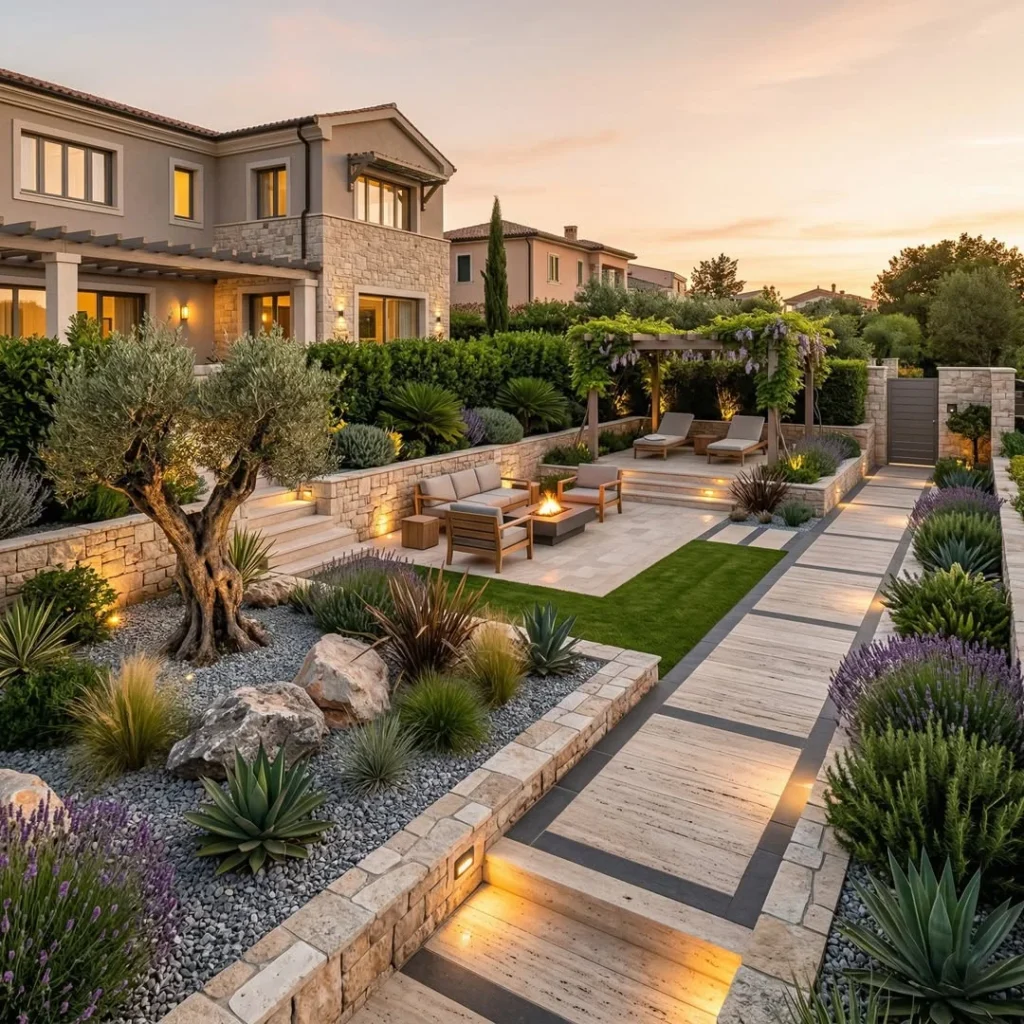
In a multi-level garden with stone or travertine steps and terraced planting beds, fitting recessed LED step risers in the vertical face of each step tread creates a practical safety feature that doubles as a design element: the warm lines of light running horizontally across the steps make the structure itself visible and sculptural after dark, and the glow bounces onto the paving below and the planting either side. This is worth combining with low bollard lights or in-ground spots at the base of specimen trees in the planting beds, as seen here with the olive tree and agave groupings, so the planting comes alive at the same level as the pathway rather than disappearing into darkness.
Reality Check: Step riser LEDs need to be hardwired by an electrician in most regions and require a waterproof IP65-rated fitting; the installation cost is worth it since these lights last 10 to 15 years with zero maintenance.
15. Bollard Lights and LED Wall Cove Along a Garden Border
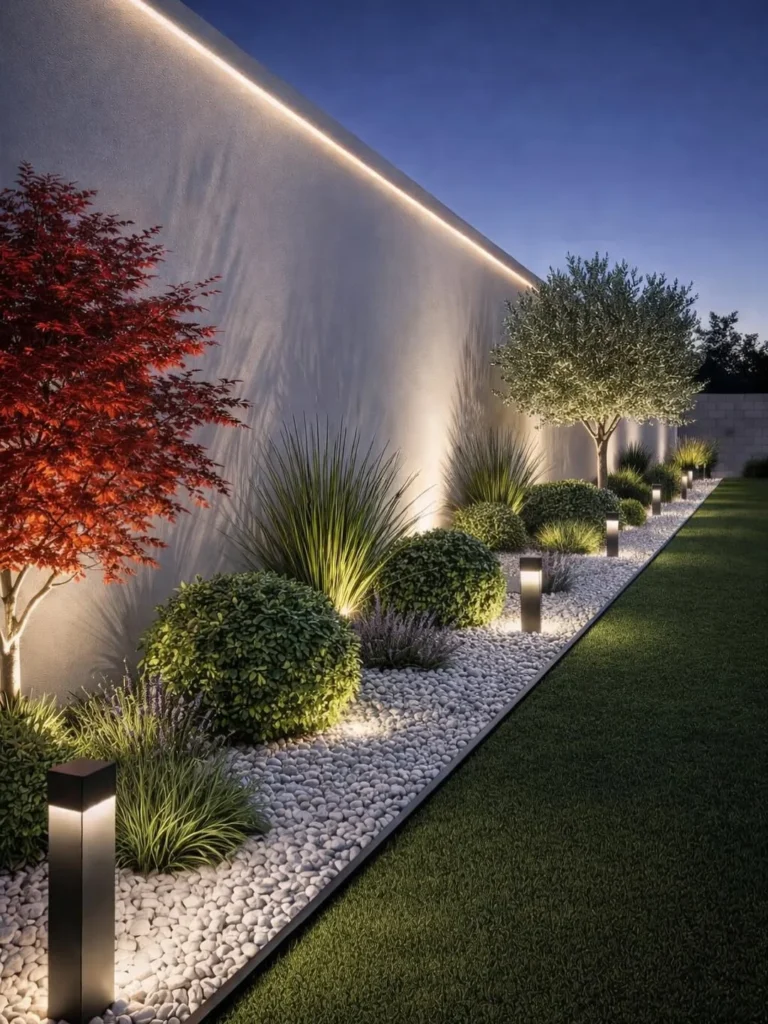
A row of stainless steel bollard lights spaced along a white gravel border between a manicured lawn and a planted bed, combined with a continuous LED strip light recessed into the top of the boundary wall above, creates an entirely different kind of garden lighting: the bollards provide pools of downward light that illuminate the planting at ground level, while the wall cove creates a diffused wash that makes the rendered surface glow and appears to lift the wall slightly off the ground. This two-source approach is borrowed from hospitality design, where lighting consultants always separate pathway illumination from feature wall illumination, and it produces a result that feels genuinely considered rather than functional.
Heads Up: LED strip in an outdoor cove needs to be IP67-rated and the aluminium channel it sits in should have a diffuser cover to produce an even, smooth line of light rather than visible individual LED dots.
16. Inset Deck Path Lights with LED Step Edges and an Egg Chair
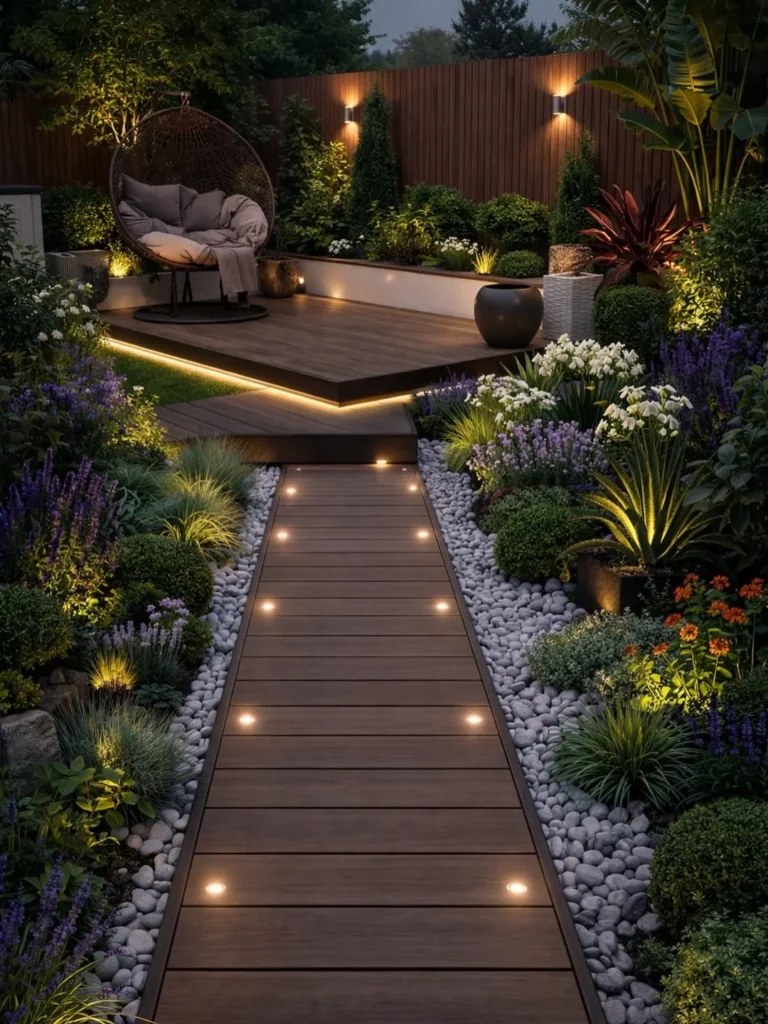
Flush-mounted inset LED discs in the surface of a timber composite decking path, combined with an LED strip running along the edge of the raised deck platform above, creates a strong visual line that draws the eye toward the focal point at the end, in this case a hanging egg chair, while simultaneously making both the path and the step transition safe to navigate in the dark. This kind of integrated deck lighting is installed during the deck build rather than added afterward, and it is worth specifying from the outset if you are replacing or building a deck, since routing cables retrospectively through composite boards is genuinely difficult. The wall-mounted uplighters on the timber fence behind add a third source that prevents the fence from being a dark void at night.
Quick Tip: Choose recessed deck lights with a frosted or diffused lens rather than a clear one to prevent a hot-spot glare effect that makes it uncomfortable to walk toward the light source.
17. Illuminated Waterfall Pool Feature with Recessed Downlights
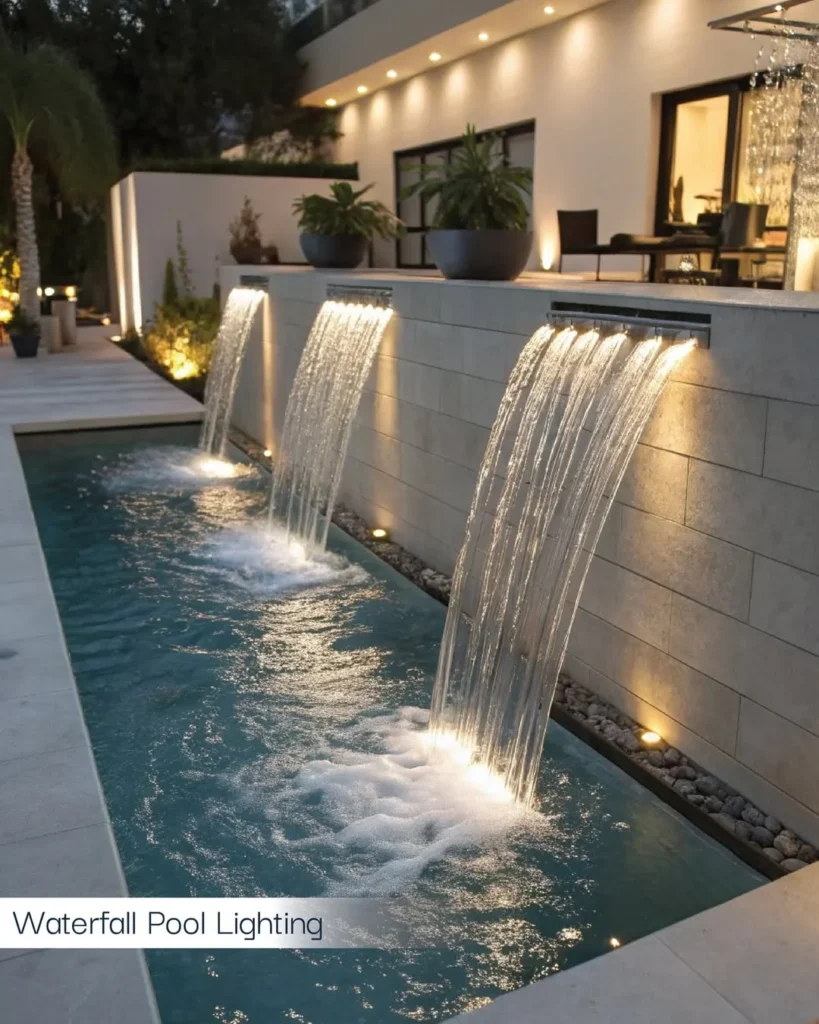
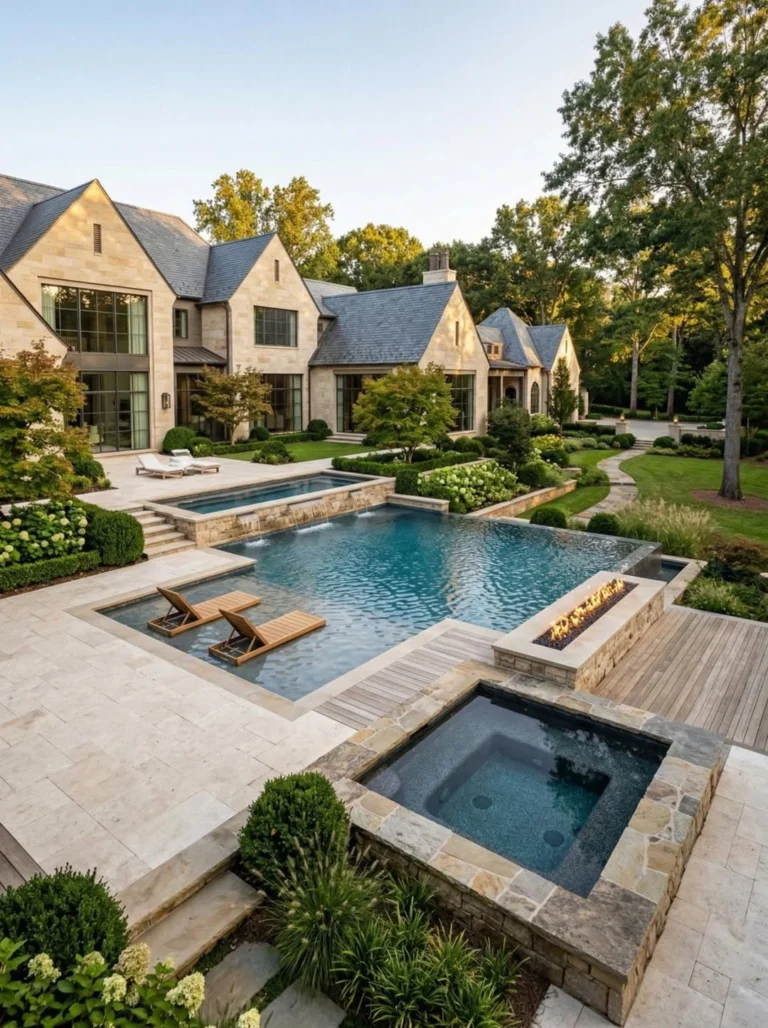
A pool water wall with three sheet waterfall blades lit from above by recessed LED downlights, falling into a lit pool below, is investment-level backyard lighting, typically $5,000 to $20,000 installed depending on pool size, but it produces an effect that is categorically different from any other option in this article: the moving water catches and scatters the light in a constantly changing pattern that makes the whole backyard feel alive at night. The recessed downlights along the top fascia should be colour-temperature matched to the pool underwater lights, both in a neutral white around 4000K, so the water reads as clear and clean rather than green or warm, which can make a pool look murky.
Pro Move: RGBW LED fittings in pool water walls let you shift the colour from warm to cool or even cycle through colours for events, though for everyday use a fixed neutral white reads as more refined.
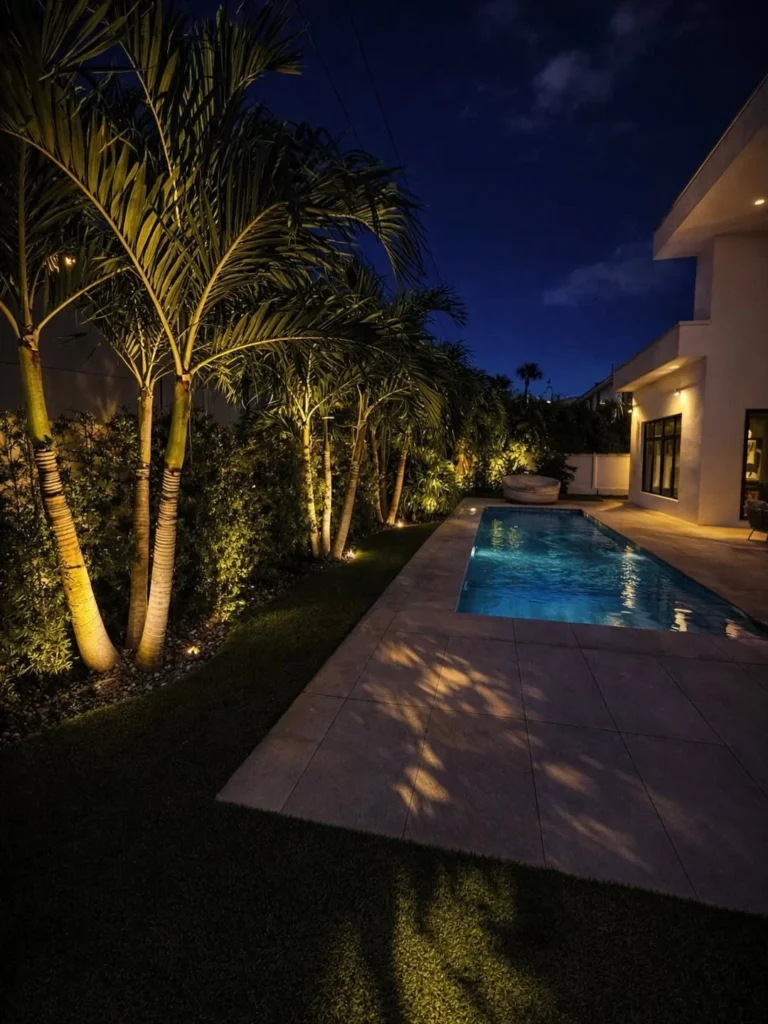
Positioning ground-spike uplights at the base of each palm trunk in a poolside tropical planting creates one of the most atmospheric night-time effects possible in a warm-climate garden: the lit trunks become vertical columns of light that rise into the dark canopy above, while the pool reflects the glow back across the deck surface. In practice, the spike lights should be aimed slightly off-vertical to skim up the rough texture of the palm trunk rather than washing straight up through the fronds, and a warm 2700K colour temperature reads much better with tropical foliage than a cooler white, which tends to make green leaves look grey or silver at night.
Designer Advice: Use a separate low-voltage circuit for the uplighting so you can turn the tree lights on without activating the pool lights, which lets you use each layer independently for different occasions.
19. Dark Frame Pergola with LED Strip Cove and Step Edge Lighting
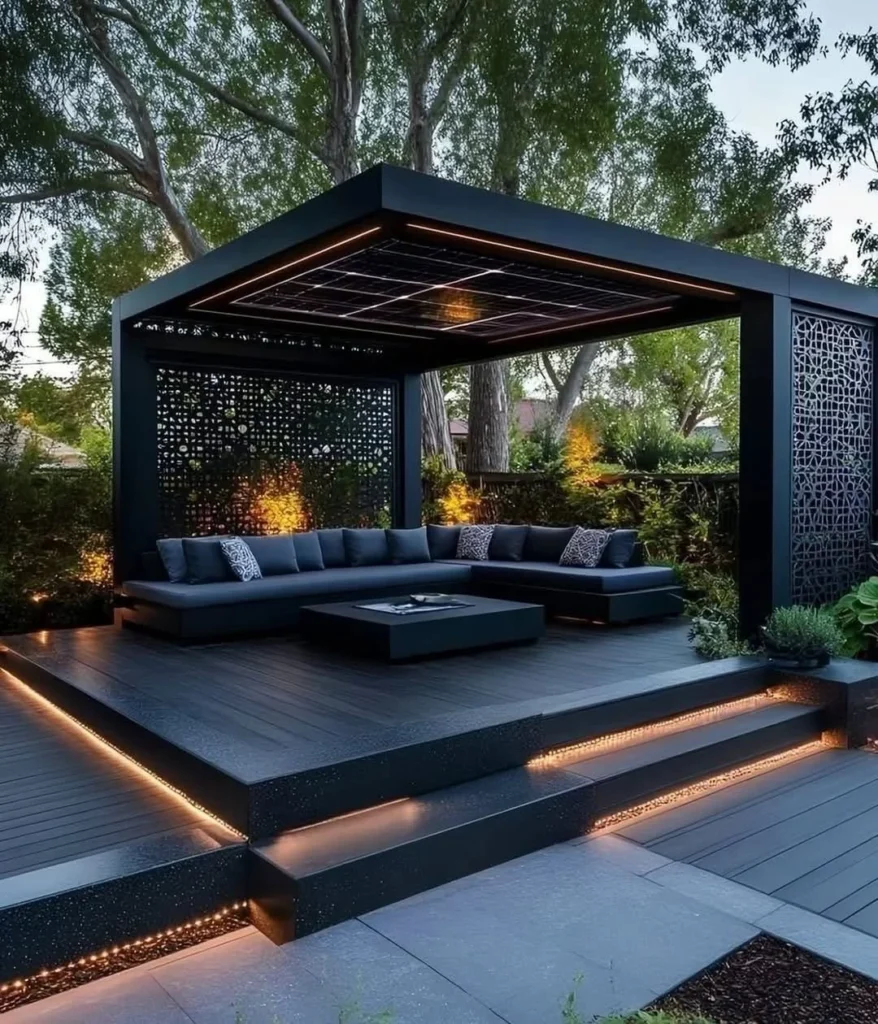
A fully dark, matte black aluminium pergola frame with a slatted or solid roof panel and laser-cut privacy screens is a specific design direction that maximises the contrast between the lit interior and the dark garden beyond, making the space feel like a room at night without needing walls. LED strips recessed into the inner frame create a continuous warm glow that outlines the structure, and step-edge LED strips on the raised platform below make the transition between the deck and the paving safe and visually defined. This look is popular in contemporary Australian and Californian garden design and typically costs more to execute well than a timber pergola since aluminium framing and quality laser-cut screens are premium products.
Reality Check: Dark-frame pergolas show dust and water marks more visibly than timber ones, so plan for an annual clean of the aluminium surface to keep the finish looking intentional rather than neglected.
20. Minimalist Pergola with a Single LED Cove Strip Under the Roof
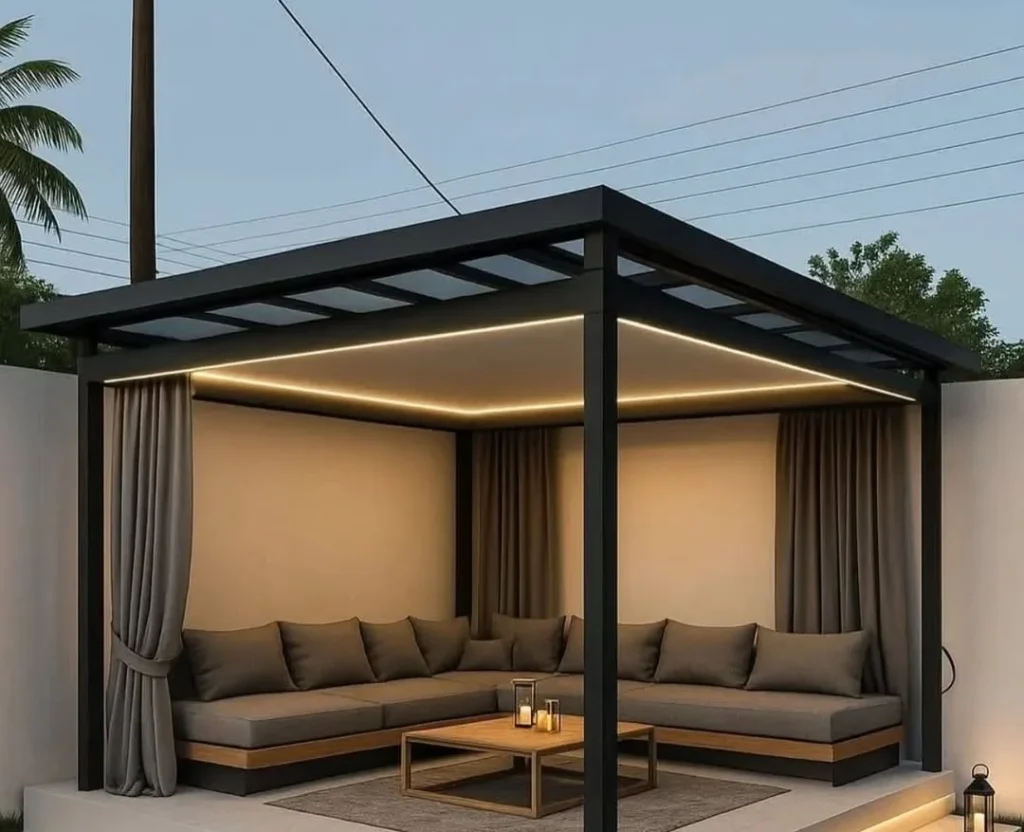
A clean black-frame pergola with drape curtains and a single continuous LED strip recessed into the inner edge of the roof panel produces an effect that is deliberately restrained: the warm line of light at ceiling height creates a glow that fills the space without any single visible fitting or fixture, which is exactly the kind of architectural lighting that makes a space feel expensive and resolved. The curtains here serve both as a privacy screen and as a light diffuser, softening the glow from the LED strip and creating a warm wash across the fabric. This is one of the simpler integrated lighting approaches to execute well since it requires only one LED channel and one driver, but it needs careful installation to ensure the strip is perfectly level and the light is consistent along its entire length.
Quick Tip: Install the LED strip inside an aluminium channel with a PC diffuser cover so the light emits as one seamless line rather than revealing individual diode dots, which is the difference between looking professional and looking DIY.
21. Wall-Mounted Uplighters and Under-Bench LED on a Patio
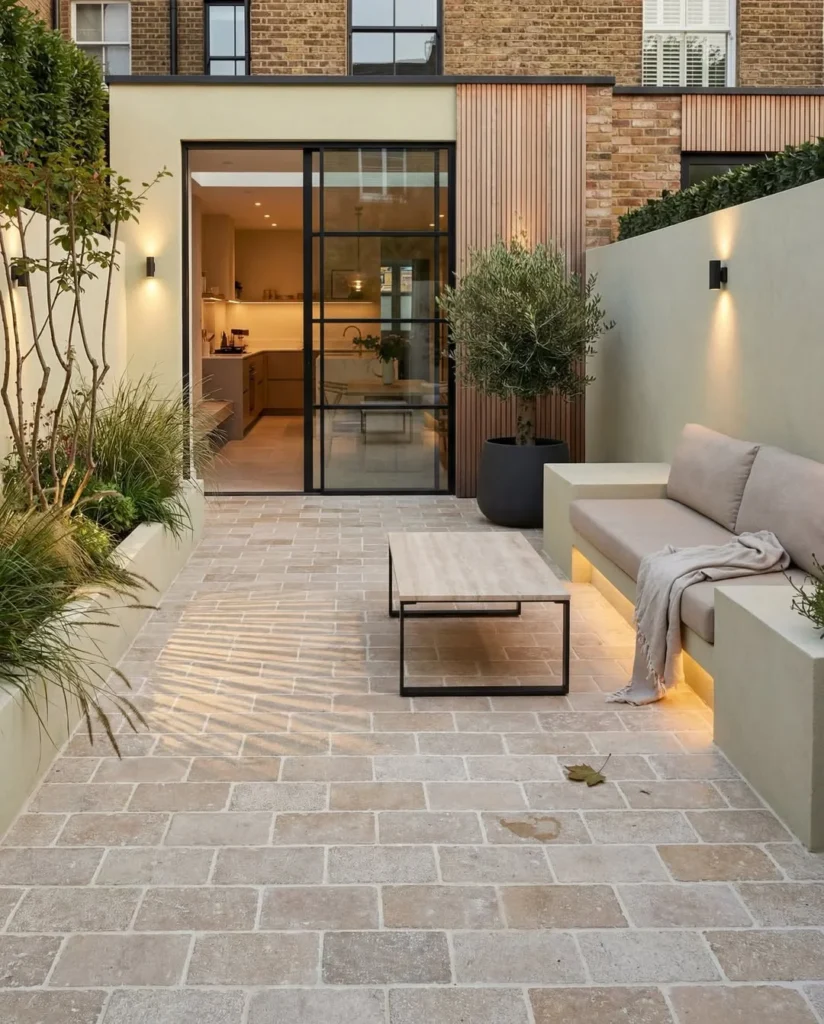
Two wall-mounted cylindrical uplighters in matte black pointing up against a rendered garden wall, combined with a warm LED strip running along the underside of a built-in concrete bench, creates a sophisticated courtyard lighting scheme from just two fixture types. The wall uplighters create a wash of light on the rendered surface that makes it visually light and airy rather than a dark boundary, and the under-bench strip provides a floating effect that makes the heavy concrete structure look lighter than it is. This combination works especially well in urban courtyard gardens where the boundary walls are close and a lack of any upward lighting would make the space feel like a box.
Pro Move: Choose wall uplighters with a frosted or eggshell-diffused reflector rather than a clear one; the diffused version creates a smooth even wash rather than a sharp halo that reveals the fitting’s mounting position.
22. Layered Garden Lighting Across Multiple Zones from Above
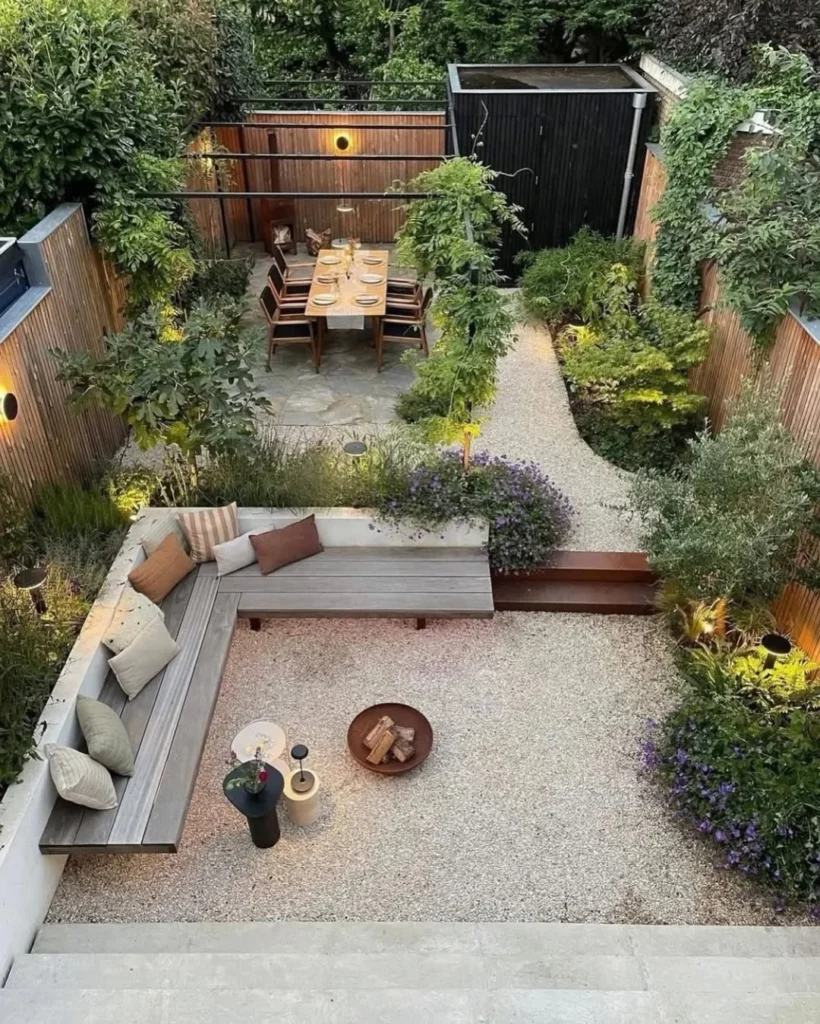
Looking at this Scandinavian-influenced walled garden from above reveals something that most individual photos of backyard lighting miss: the way multiple light sources at different heights create a map of the garden that is legible and beautiful from any angle. The wall-mounted sconces illuminate the cedar screening panels, the in-ground spots pick out the planting, the café lights over the upper dining area create a ceiling plane, and a bowl fire on the lower terrace provides the focal warmth. Getting this kind of layered result in a real garden takes planning rather than one product purchase, and the easiest way to think about it is to ask: does each zone have a light source at ground level, at eye level, and at ceiling level?
Reality Check: Plan your lighting scheme on paper before buying anything and note which fixtures need hardwiring, which can be solar, and which zones need dimmer control; this prevents a patchwork of incompatible products.
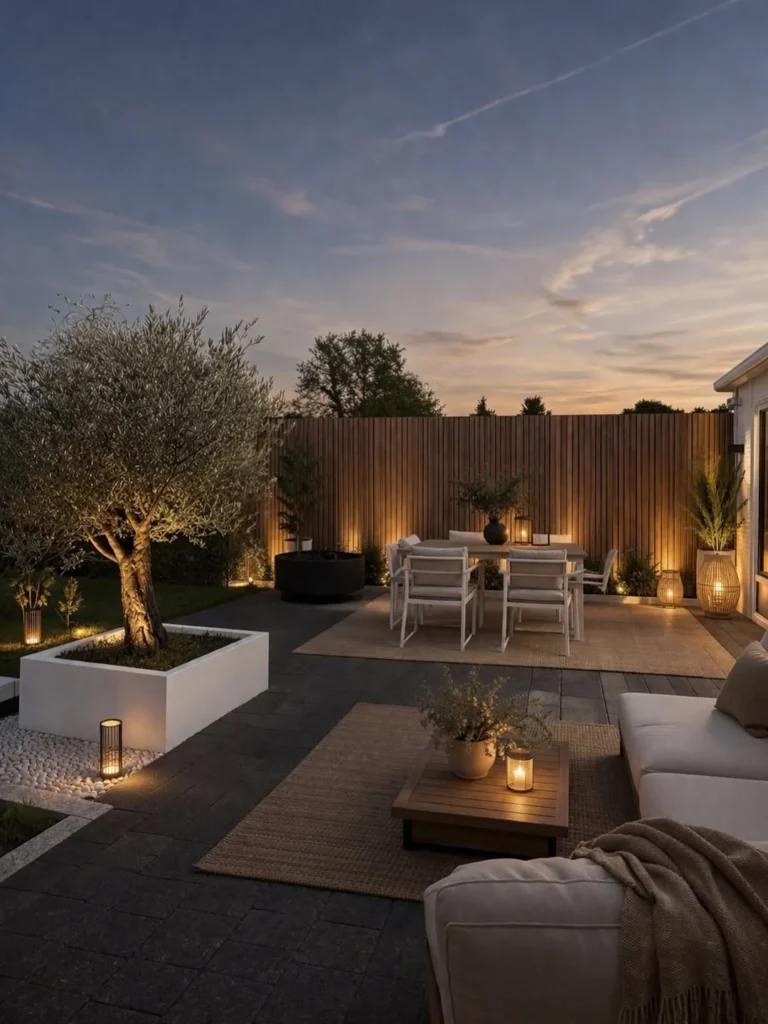
23. Scandinavian Patio at Dusk with Bollard Lanterns and Tree Uplighting
A calm, restrained approach to backyard lighting, popular in Scandinavian and northern European garden design, uses tall floor-standing lanterns, low bollard lights, and single-tree uplighting rather than string lights or canopy effects, creating a quieter, more adult mood that suits a garden used for evening conversation rather than entertaining. Here, a slender bollard lantern near the white rendered raised bed and a warm uplight washing the olive tree create enough ambient light to make the space usable without any overhead string fixture, and the dining area behind relies on a separate circuit of low-level table candles and possibly a wall sconce rather than overhead strings. This style tends to photograph more quietly than other approaches but feels genuinely restful in person.
Designer Advice: Floor lanterns in warm amber or amber-tinted glass read better in this style than clear lanterns, which look stark; the slight colour warmth shifts the mood from functional to atmospheric.
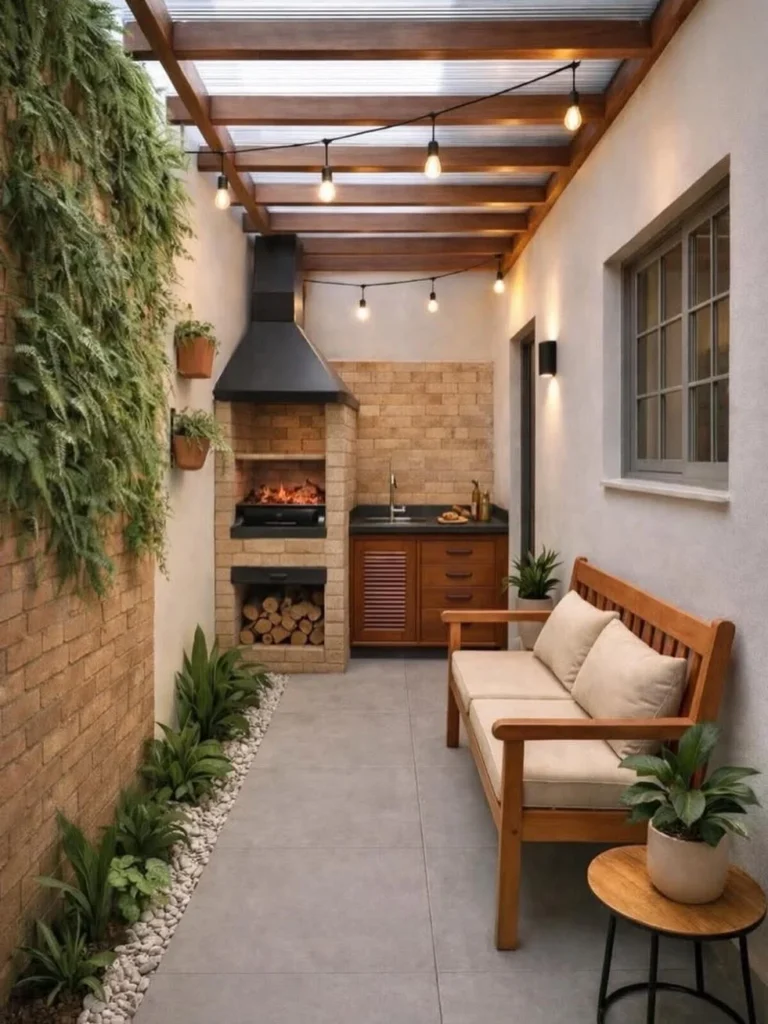
24. Edison Pendant Lights in an Outdoor Kitchen Nook
A compact outdoor kitchen alcove with a brick barbecue, a small sink unit, and a timber-beamed polycarbonate roof is exactly the kind of space that benefits from a dedicated pendant light rather than string lights: two or three bare Edison-style pendants hanging directly over the work surface provide task lighting for cooking while the warm filament appearance keeps the mood of the space relaxed rather than clinical. A wall sconce on the adjacent rendered wall adds a secondary ambient source that prevents the space from looking like a utilitarian shed once the sun goes down. Polycarbonate roof panels can be fitted with LED channel lights along the beam sides for a third, diffused layer if more light is needed.
Heads Up: Any pendant fitting over an outdoor cooking area must be rated to IP44 minimum and positioned well clear of the cooking zone; grease splatter on a warm fitting is both a cleaning problem and a fire hazard.
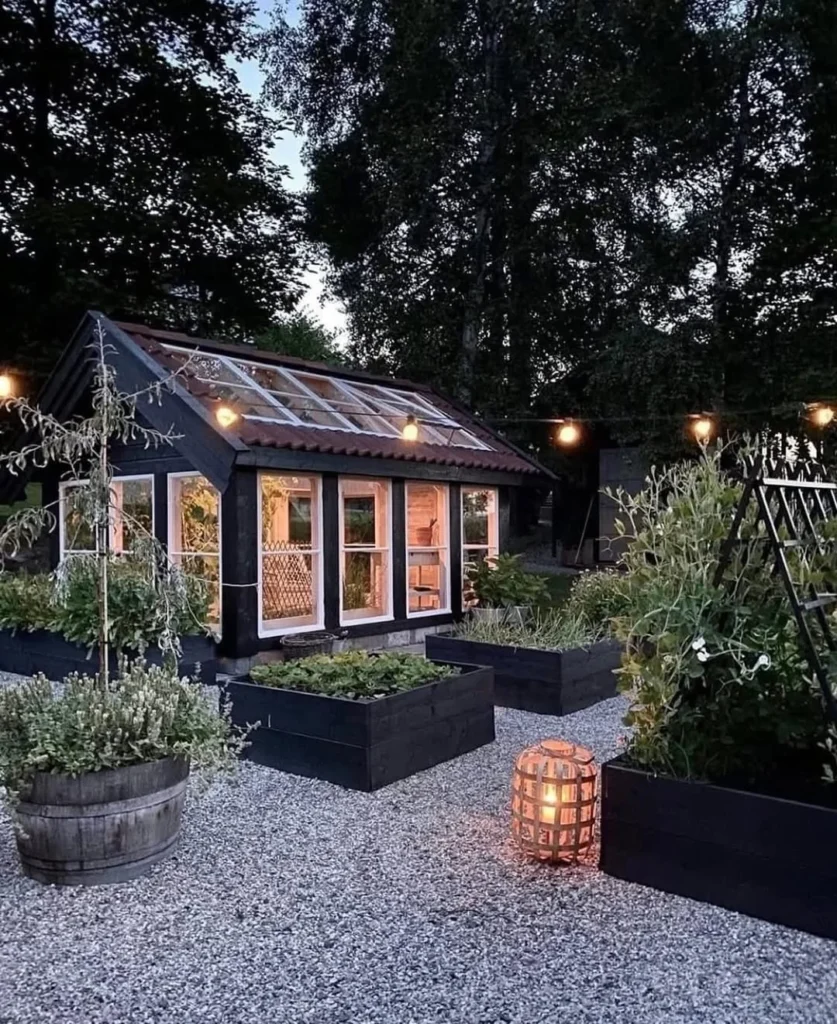
A black-painted timber greenhouse with glass panels glows from within at dusk in a way that nothing else in a garden quite manages: the warm orange light through the glass makes the interior visible and inviting, and the structure becomes a lantern itself rather than just a functional building. String lights hung along the roof ridge outside and a single ground lantern placed on the gravel between the raised beds create a complete lighting composition that is almost entirely incidental to the greenhouse’s actual purpose. This effect costs almost nothing beyond a simple plug-in LED bulb inside and a single strand of outdoor-rated string lights, making it one of the highest-return lighting ideas in the whole garden.
Quick Tip: Use a warm amber LED bulb rather than a daylight or cool white bulb inside the greenhouse; the orange glow through the glass looks intentionally atmospheric while cool white looks like a work lamp left on by accident.
One Last Thing About Backyard Lighting
Good backyard lighting is never really about brightness. The gardens that look best after dark, the ones where people genuinely linger and lose track of time, are lit in layers, with each source doing a different job: some guiding, some warming, some simply making something beautiful visible in the dark. You do not need all of these ideas at once. Pick the one that addresses the specific thing your backyard is missing right now, and go from there. Most people find that once one layer is in place, they start to see clearly what the next one should be.