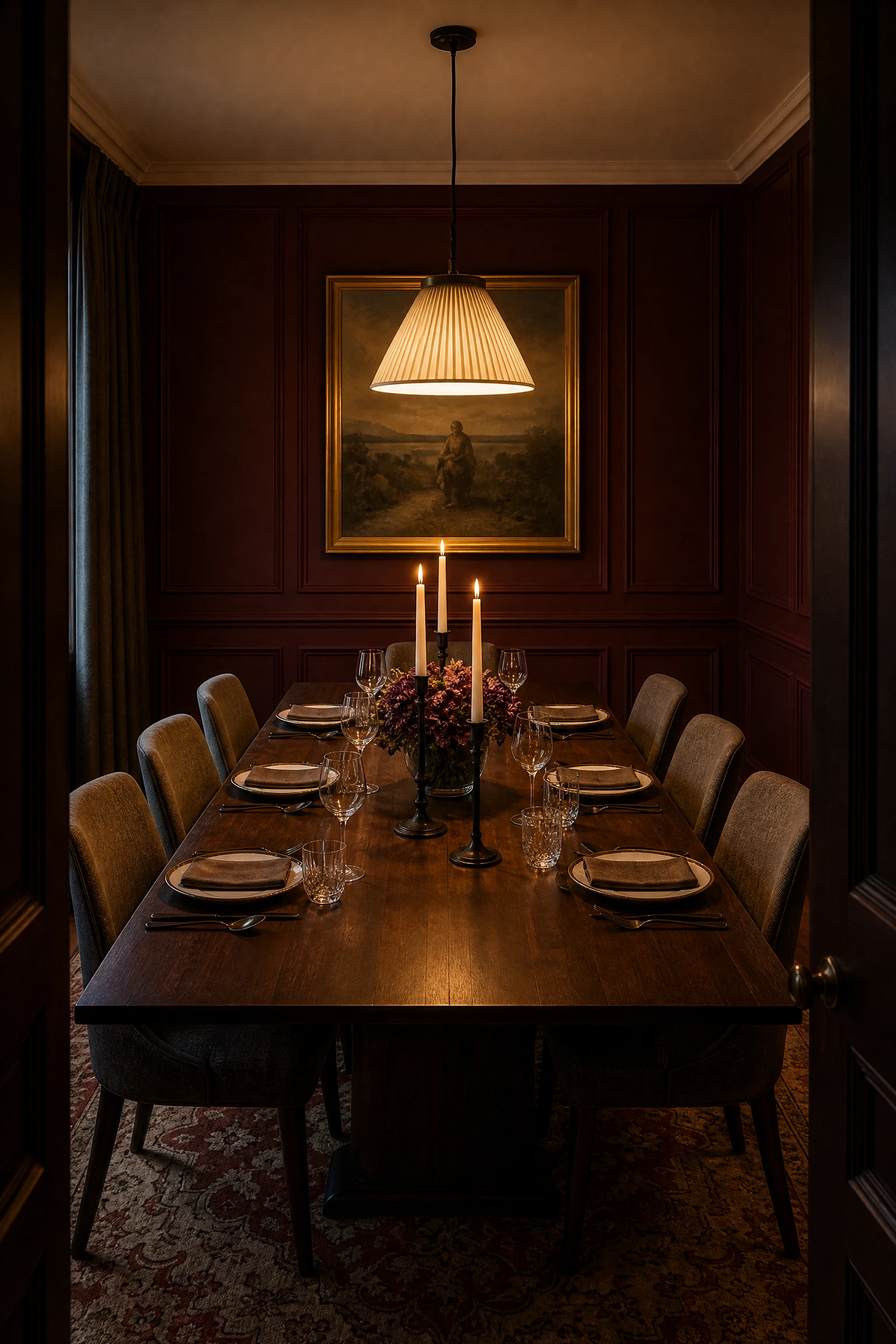
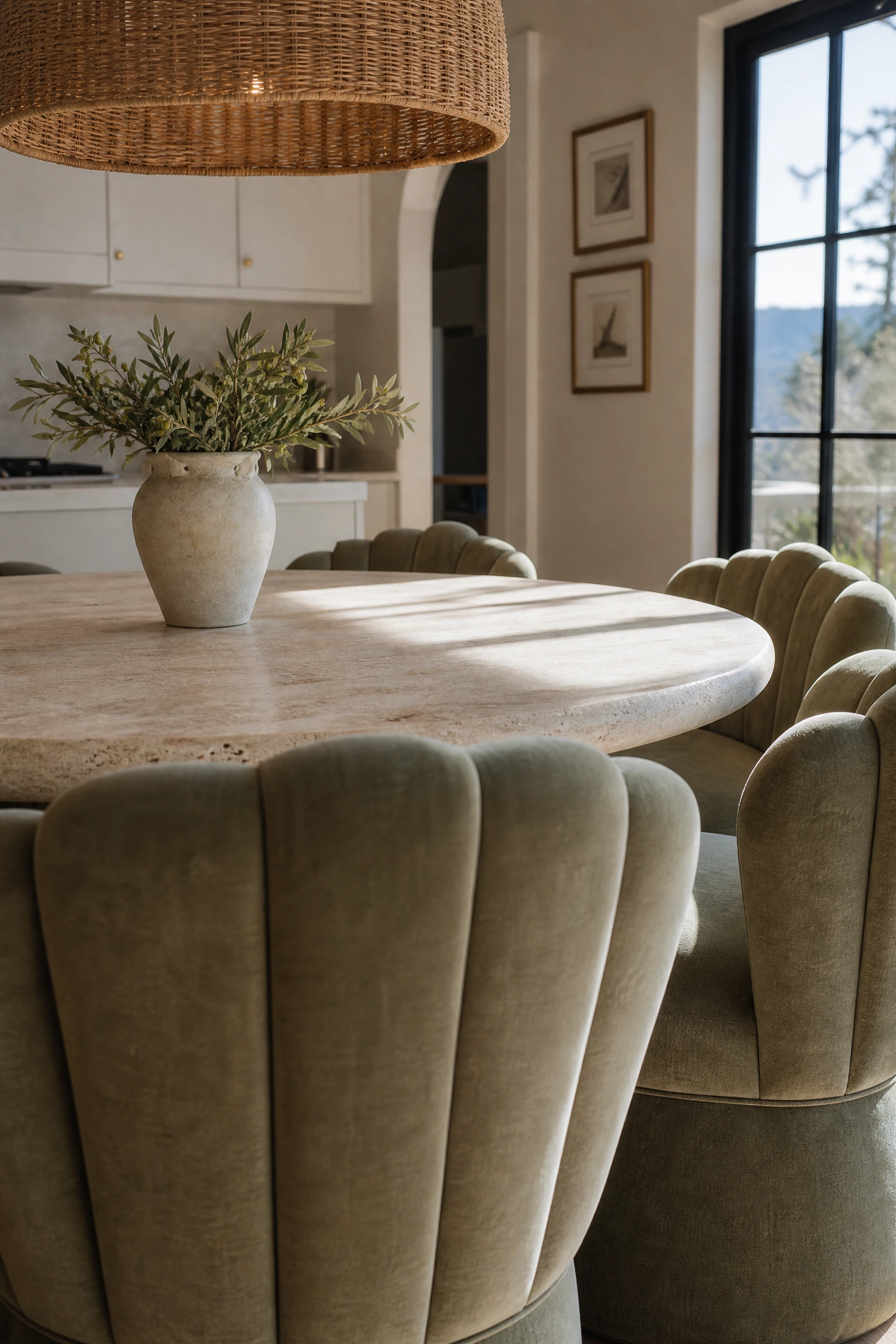
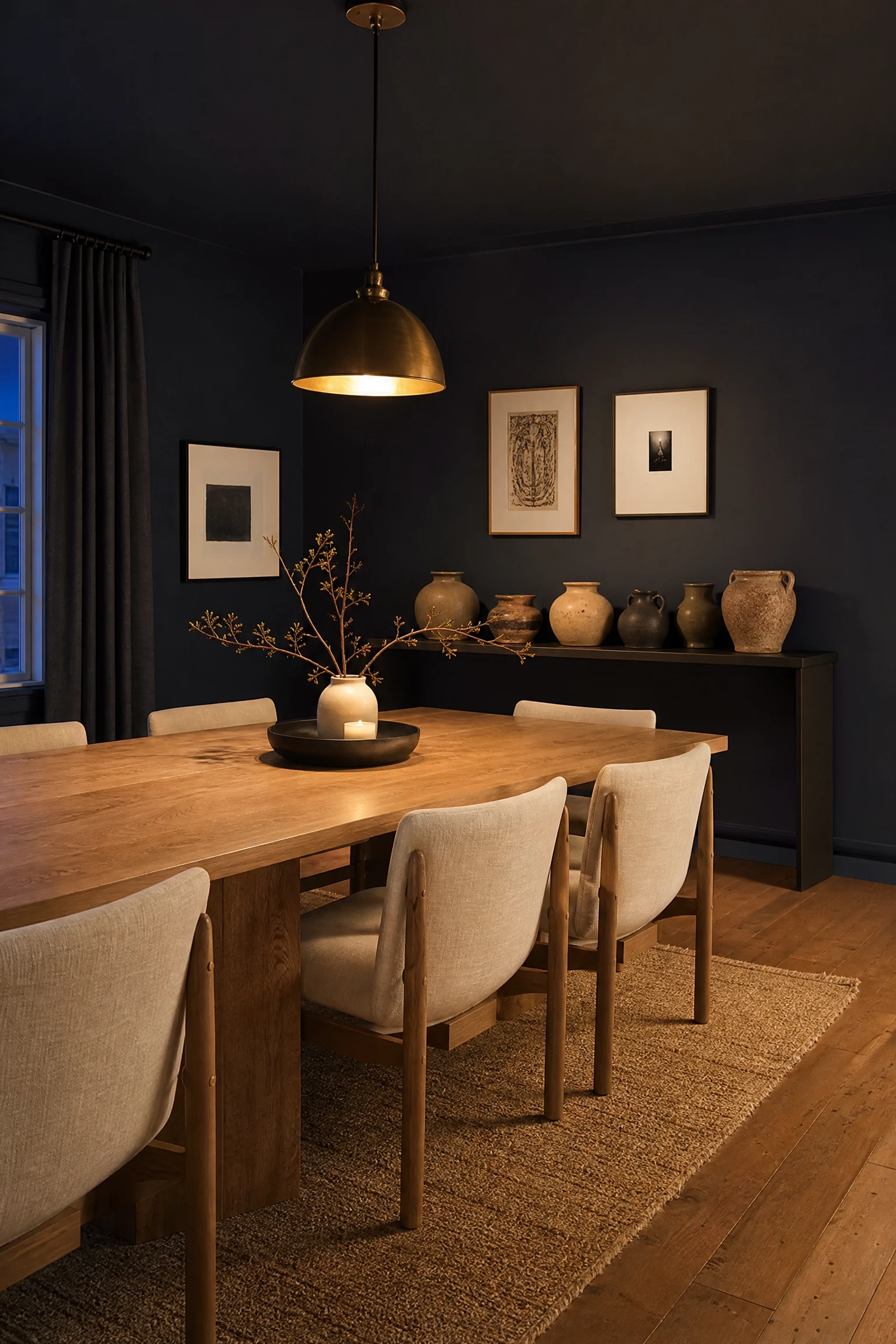
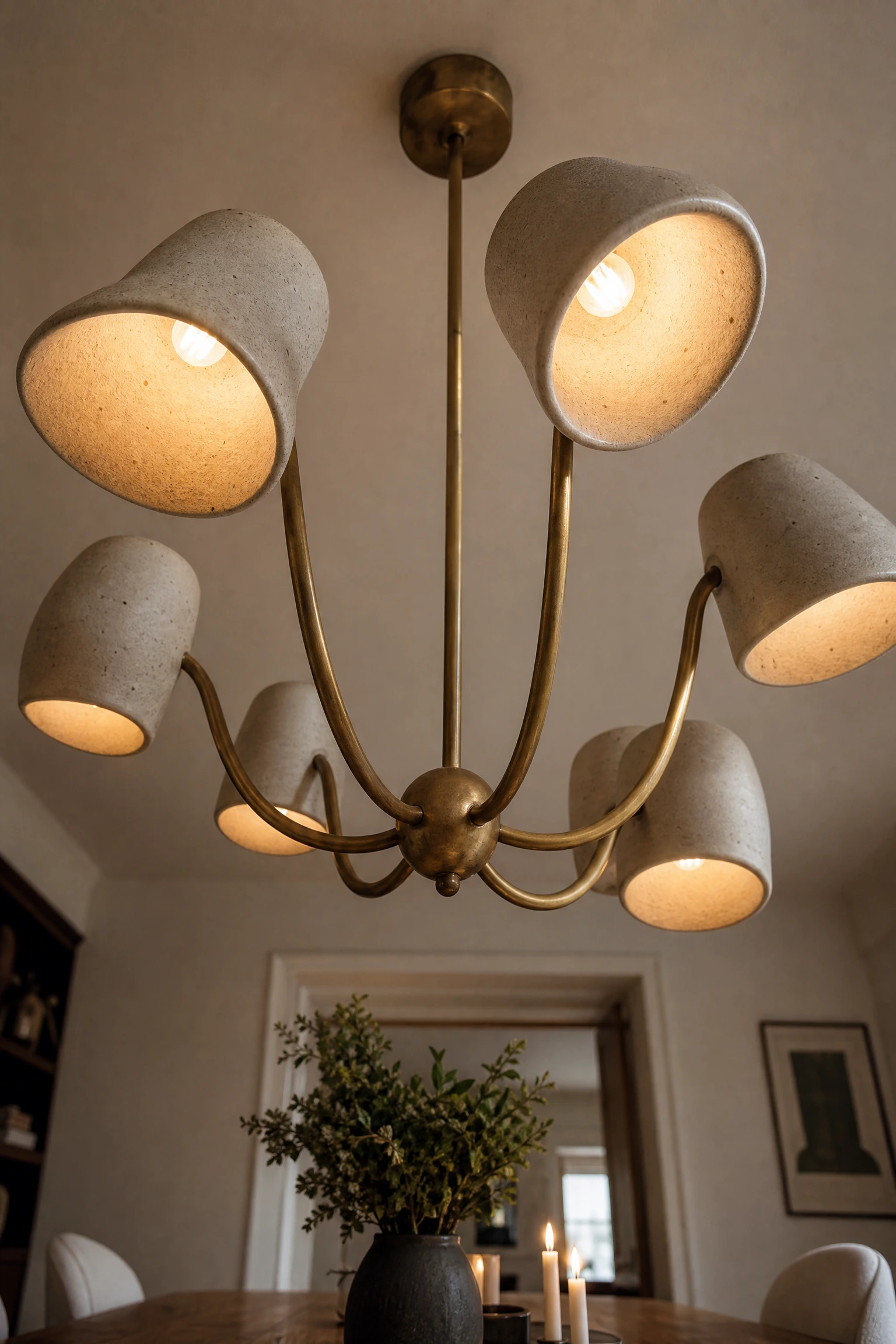
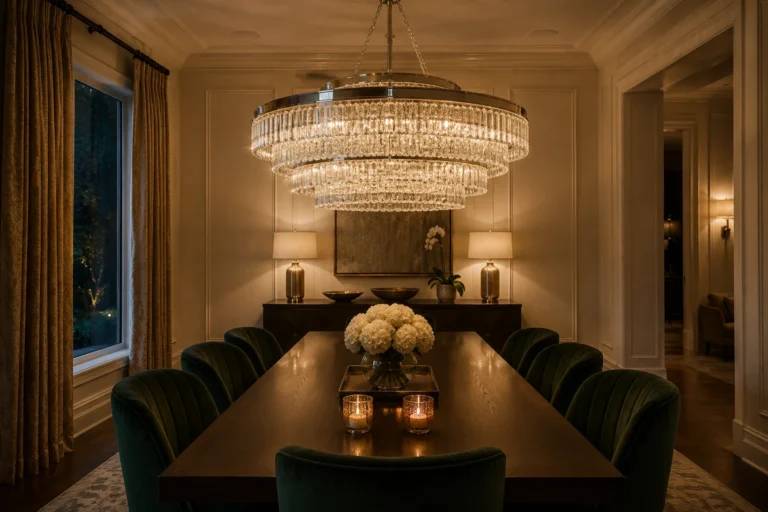
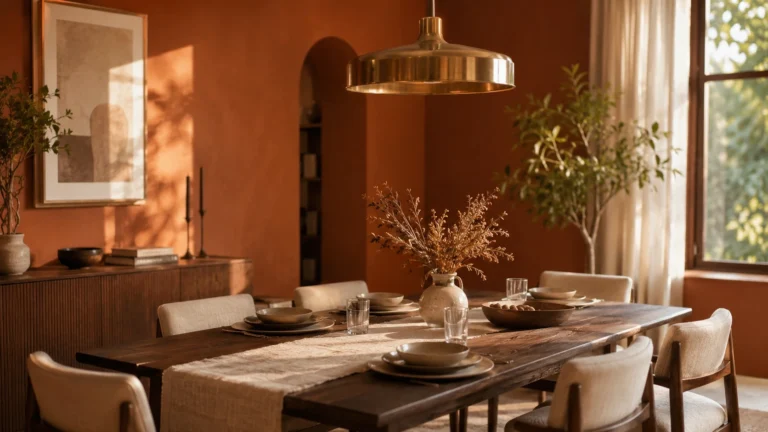
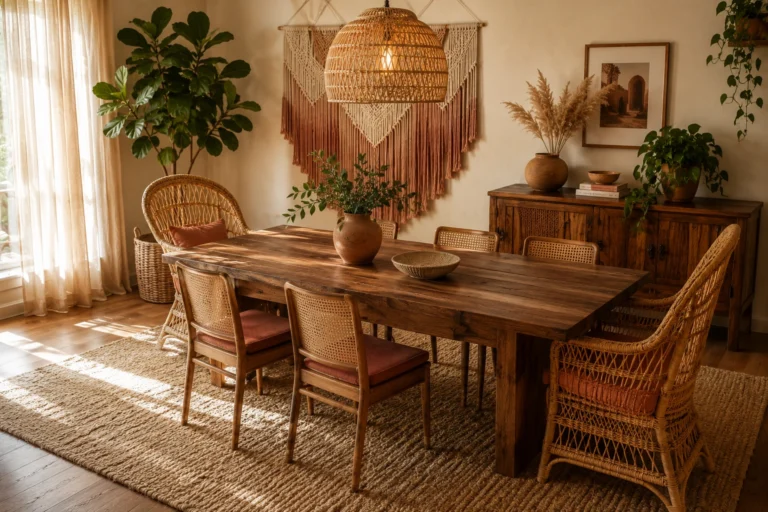
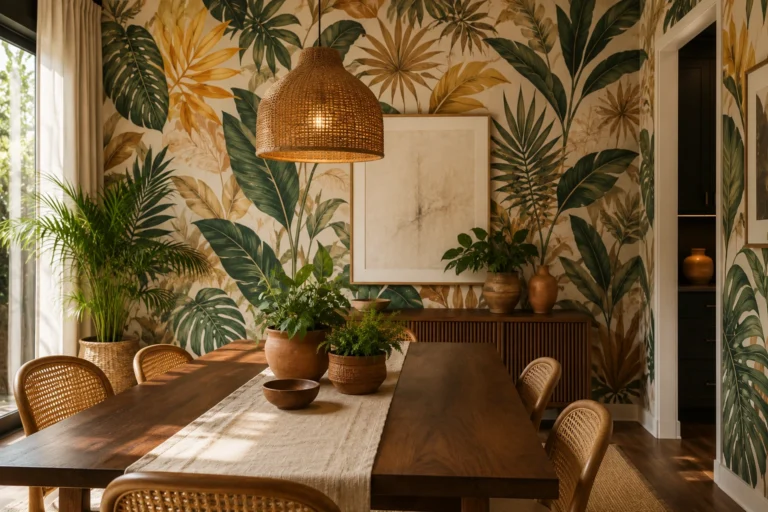
The dining room has quietly become the most interesting room in the house again. After years of being swallowed up by open-plan layouts and treated like little more than a place to park a table, it is having a real moment. Designers are leaning into it as a proper destination – somewhere that has its own mood, its own identity, and its own reason to exist. The trends emerging right now are not about chasing novelty. They are about making the room work harder, feel better, and give people an actual reason to sit down and stay.
What makes this particular wave of trends worth paying attention to is that it is driven by a real shift in how people want to live. Forum conversations, reader comments on design sites, and real homeowner questions all point to the same thing: people are tired of dining rooms that feel staged or forgettable, and they want to know what actually works in a real home, not just in a photoshoot. This article cuts through the noise and gives you the trends that are genuinely changing dining rooms in 2026 – what has shifted, why it matters, and exactly what to do about it.
For the better part of a decade, the dining room was losing ground to open-plan layouts where the table just floated in the middle of a combined kitchen and living space. That is reversing fast. Designers and homeowners alike are rediscovering the appeal of a room that has a defined purpose and a mood of its own. The shift is not about going back to the stiff, rarely-used formal dining rooms of the past – it is about creating a space that feels special enough to make people want to gather there on a regular Tuesday, not just at Christmas. In practice, this means giving the room visual weight through paint color, architectural details like picture rails or panel moulding, and lighting that sets a tone rather than simply illuminating a table. If your dining room currently doubles as a homework zone or a dumping ground for things that do not have a home, the first move is treating it as a room worth designing properly.
Pro Move: Hang a statement mirror or a piece of large-scale artwork on the wall directly opposite your entry point – it signals immediately that the room has been thought about, and that alone changes how people feel when they walk into it.
Round Tables Are Back, and They Are Doing Real Design Work
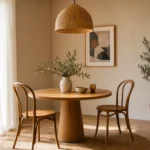
The rectangular dining table has dominated for years, partly because it feels like the default and partly because it photographs well. But round and oval tables are making a serious comeback in 2026, and the reason goes beyond aesthetics. A round table creates a genuinely different social dynamic – there is no head of the table, everyone faces each other, and conversation flows more naturally. Oval tables offer similar benefits with a slightly more generous surface area, making them a good middle ground for households that need to seat six or more. From a design standpoint, a round or oval table also softens a room that might otherwise feel boxy or formal, and it is easier to move around, which matters in smaller dining spaces. Solid wood with a natural oil finish, travertine stone tops, and limewashed surfaces are all strong material choices right now, giving these tables a grounded, tactile quality that rectangular glass-and-chrome versions simply cannot match.
Designer Advice: Before you commit to a round table, measure the room with tape on the floor and walk around it with chairs pulled out – you need at least 90 centimetres of clearance on every side for comfortable movement, and that catches a lot of people off guard.
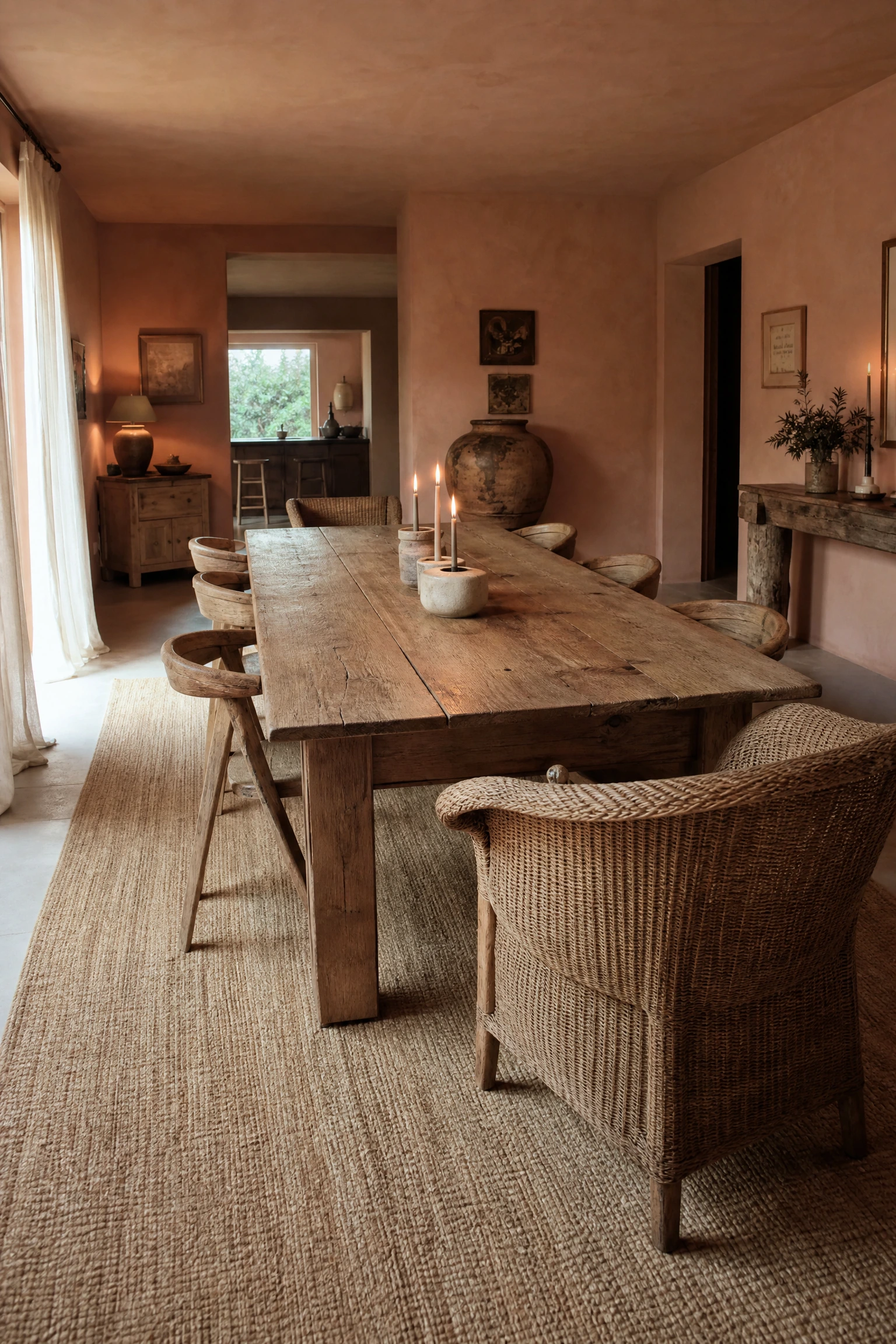
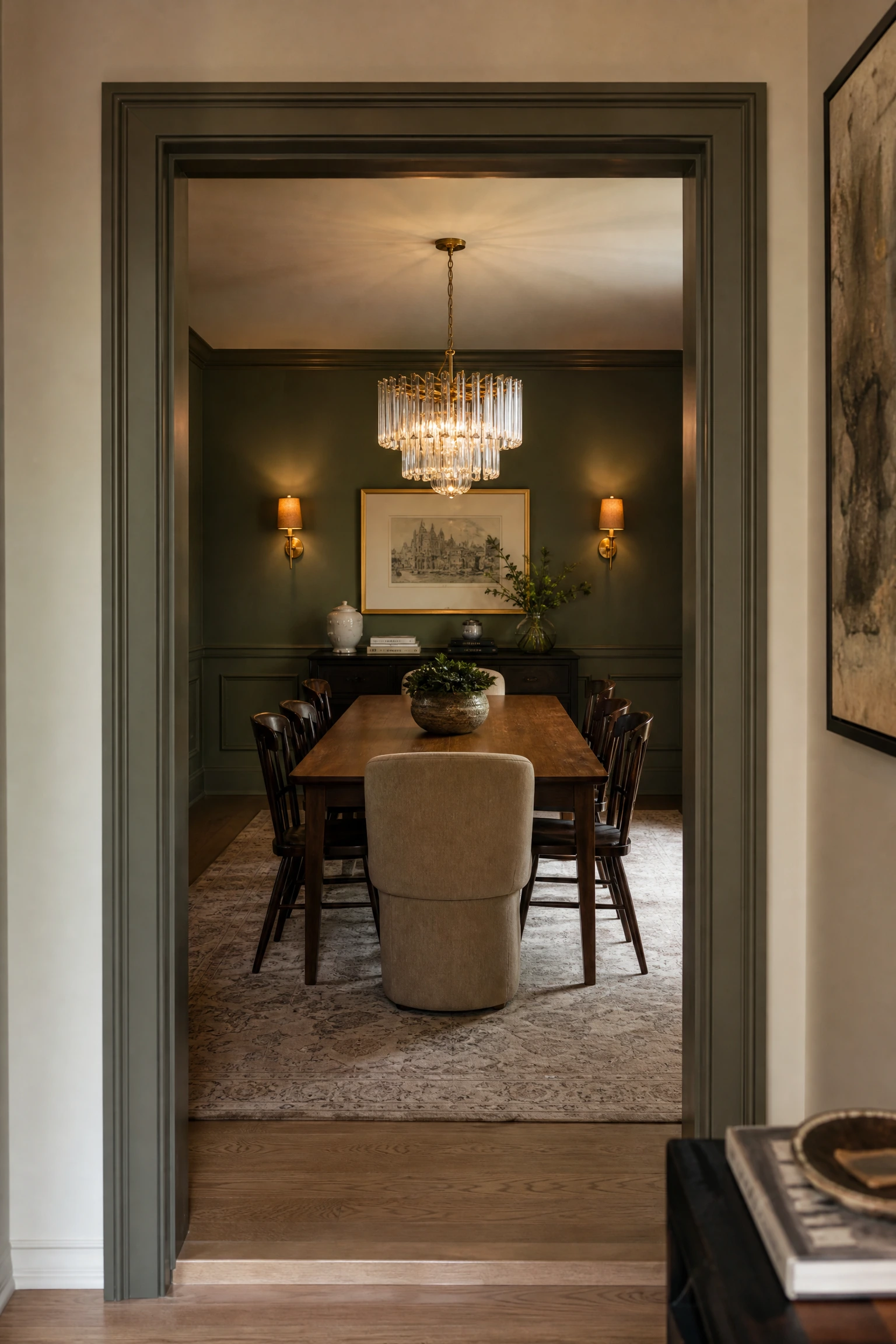
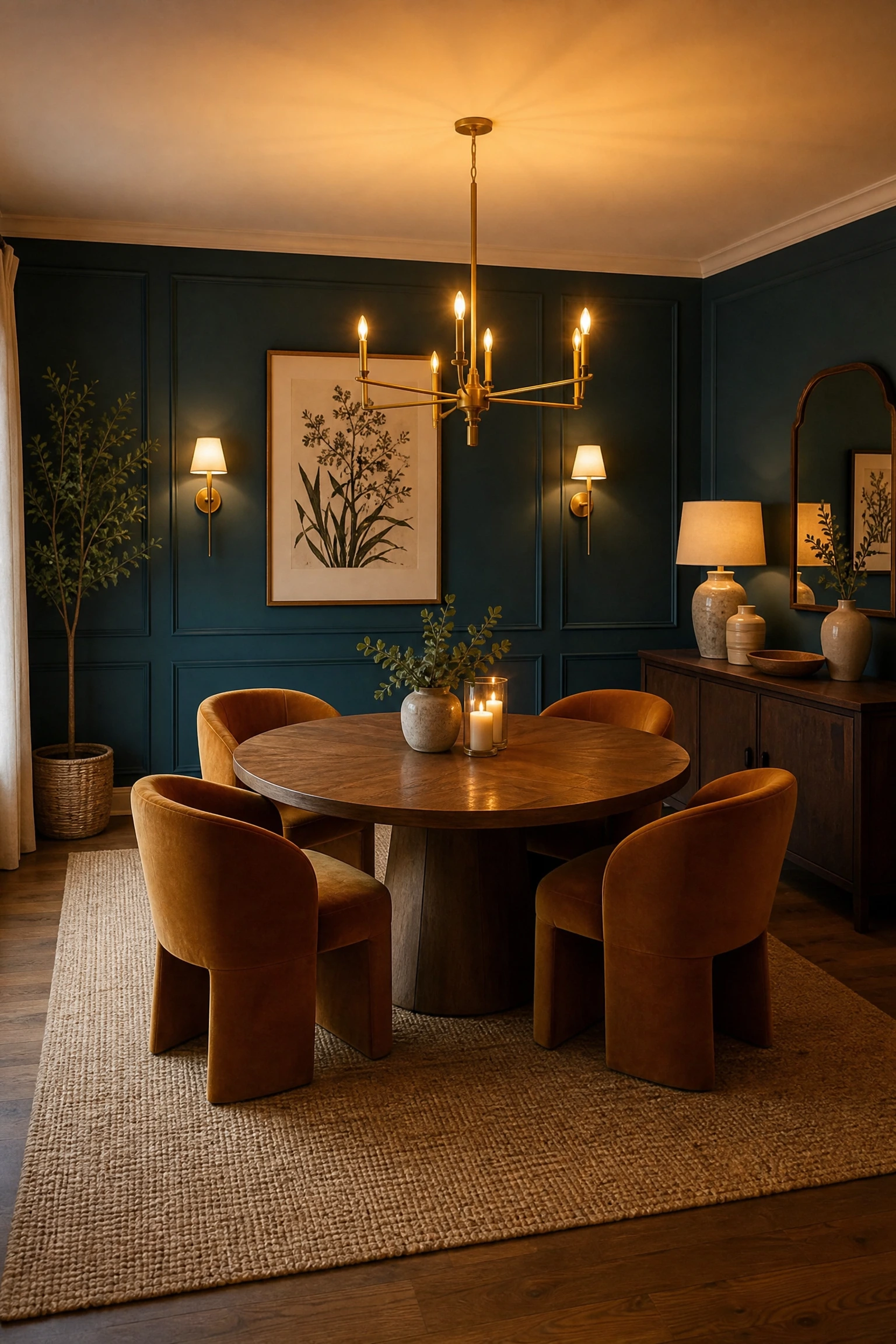
The long run of greige – that safe blend of grey and beige that colonised dining rooms throughout the 2010s – is definitively over. What is replacing it is richer, more committed color: forest green, deep burgundy, inky navy, warm terracotta, and even dusty plum. These are not accent colors. They are being used on all four walls, sometimes on the ceiling as well, in an approach called color drenching that makes the room feel like a fully considered environment rather than a backdrop for furniture. In practice, jewel tones work especially well in dining rooms because the space tends to be used in the evening, when lamplight and candlelight make deep colors come alive in a way that paler shades simply cannot. If you are nervous about going all in, start with the walls in a deep shade and keep furniture and textiles neutral – linen-colored chairs, a natural oak table, brass hardware – and let the color do the heavy lifting without the room feeling overwhelming.
The shift designers keep talking about: Moving away from cool, safe neutrals toward warm, saturated color is not a fleeting micro-trend. It reflects a broader desire to make rooms feel emotionally resonant rather than just inoffensive.
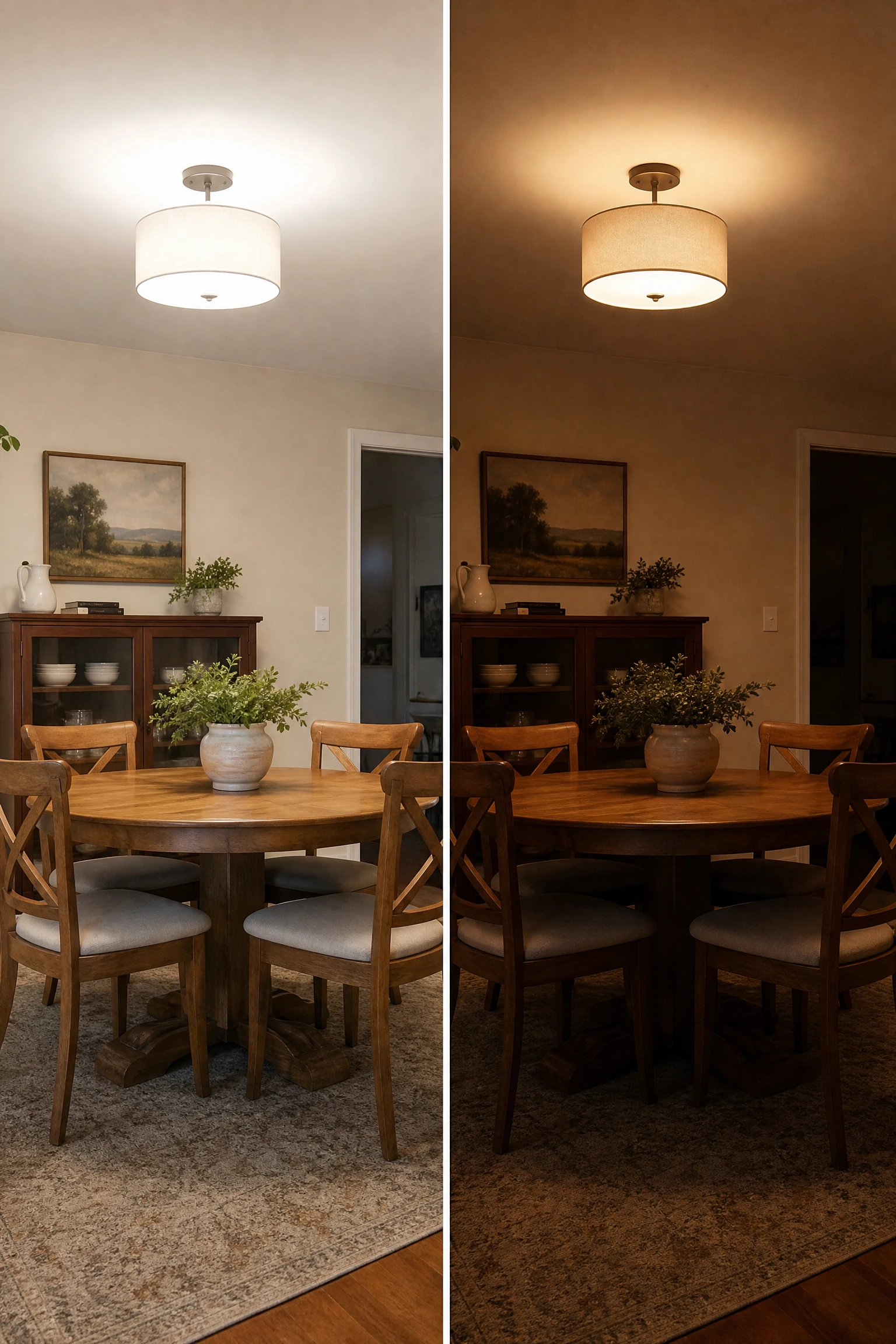
Reality Check: Deep wall colors can make a small dining room feel intimate and cozy rather than cramped, but only if the lighting is warm – cool white LED bulbs will kill the effect entirely, so swap them for bulbs in the 2700K range before you make any color decisions.
Lighting Is Being Treated as Furniture, Not an Afterthought
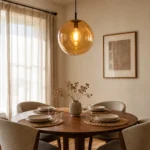
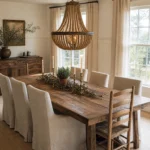
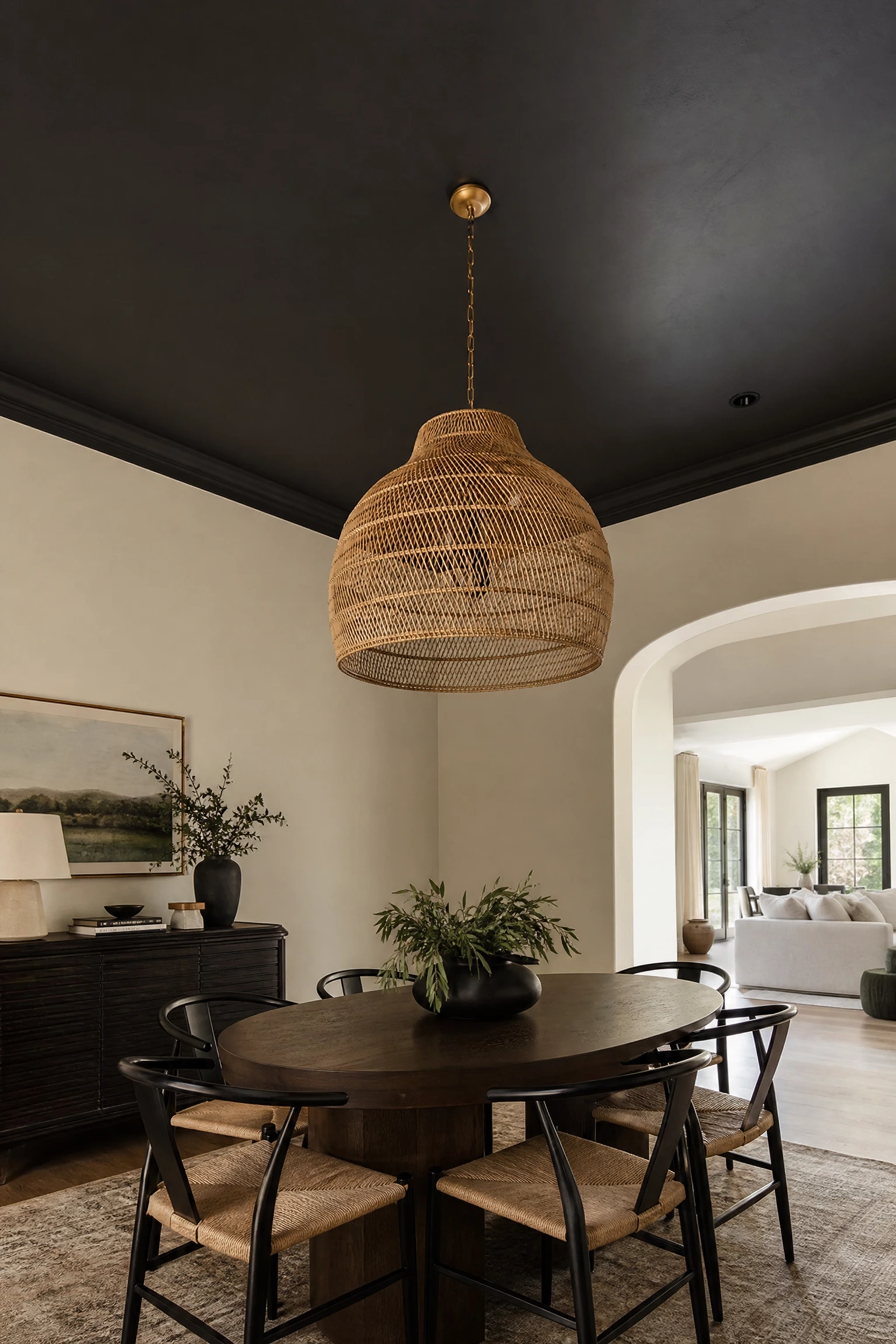
The pendant fixture or chandelier above the dining table has always been important, but in 2026 it is being treated with the same level of intention as the table itself. The trend is moving firmly away from generic drum shades and predictable globe clusters toward sculptural fixtures that read as objects in their own right – aged brass arms with ceramic shades, woven rattan forms, hand-blown glass, layered silhouettes with mixed materials. The key design principle driving this is that a dining room light fixture is one of the few decorative objects in the home that is always on display at eye level when you are seated, meaning it has an unusually high impact on how the room feels. Layered lighting is also gaining ground – a statement overhead fixture combined with wall sconces or picture lights gives the room depth and lets you dial the atmosphere up or down depending on the occasion. Dimmer switches are non-negotiable here.
Pro Move: The bottom of your pendant or chandelier should sit roughly 75 to 85 centimetres above the tabletop – lower than most people hang them. That height creates intimacy and actually lights the food and faces rather than the ceiling.
Curved and Upholstered Chairs Are Replacing Hard Seating
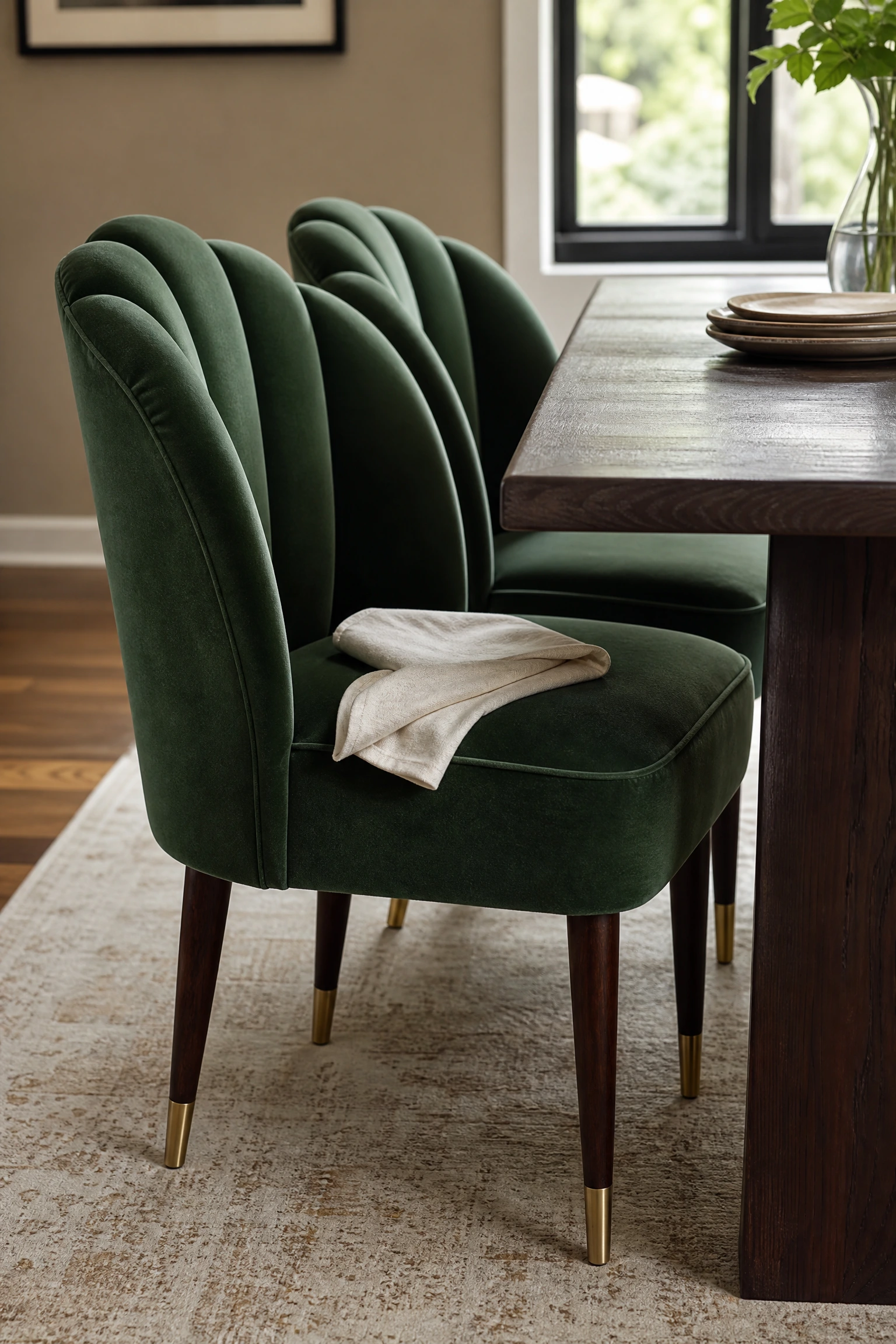
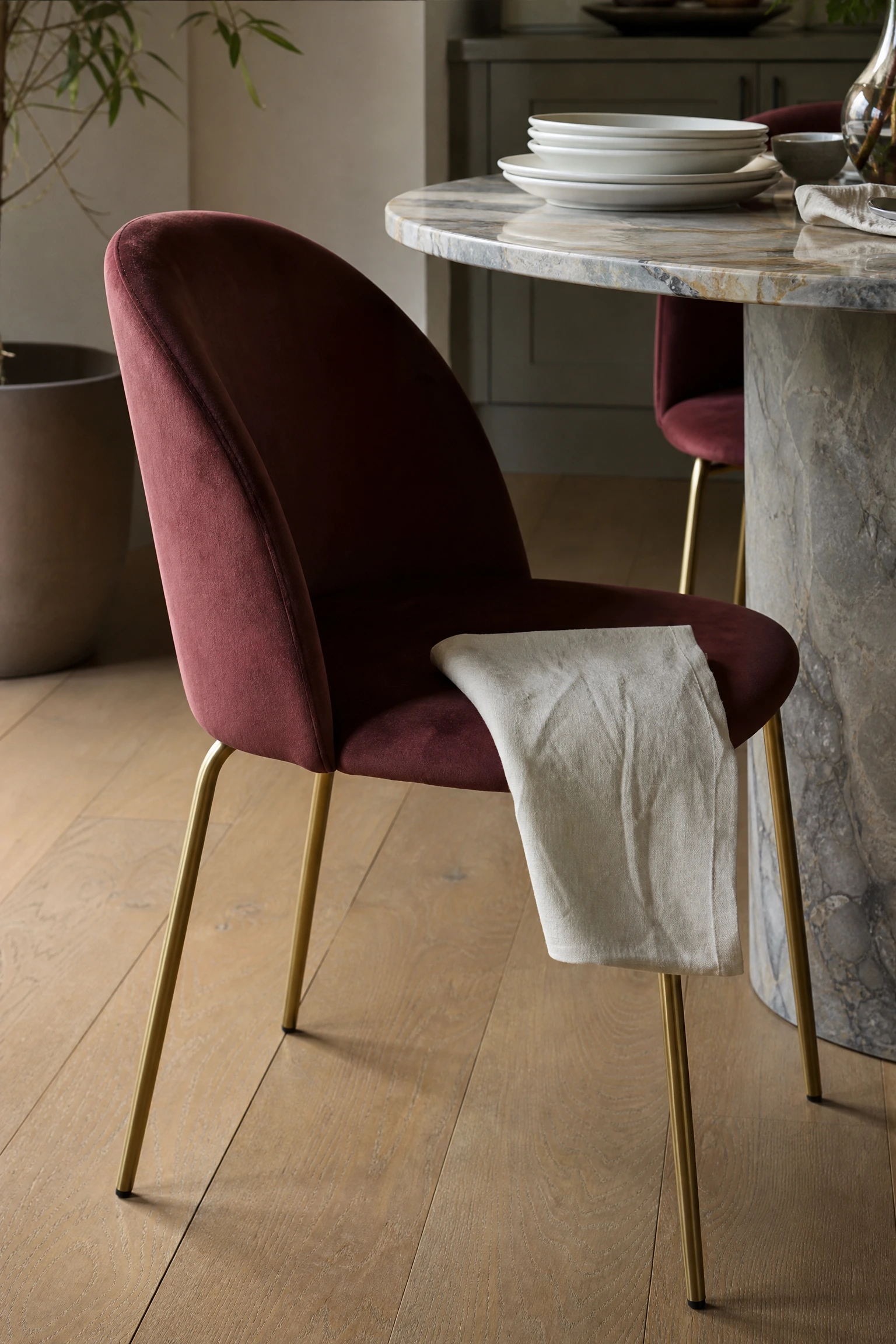
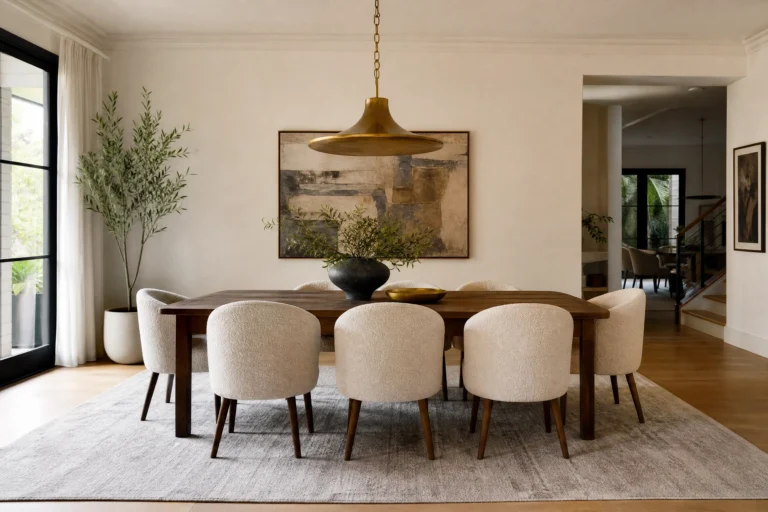
There is a comfort-driven rethink happening with dining chairs right now, and it goes hand in hand with the broader shift toward making dining rooms feel like places people want to linger. Hard wooden chairs, while visually clean, are getting replaced by chairs with curved backs, padded seats, and upholstered finishes – bouclé, velvet, performance linen, and leather are all popular – that make the act of sitting at the table for two hours genuinely pleasant rather than something you endure. Scalloped or rounded chair backs are particularly strong right now, bringing a soft, almost 1970s-inflected shape that works across modern, Japandi, and maximalist schemes. The practical upside is real: when chairs are comfortable, people stay at the table longer, which is exactly what dining rooms are supposed to encourage. For families worried about upholstery and spills, performance fabrics with a tight weave – specifically designed to resist staining – have made this trend genuinely liveable rather than aspirational-only.
Heads Up: Mix your seating for an effortlessly gathered look – upholstered chairs at the sides and wooden or rattan carvers at the heads gives visual variety without looking chaotic, and it also tends to be more budget-friendly than buying eight matching upholstered chairs.
Warm, Earthy Materials Are Edging Out Cool and Glossy
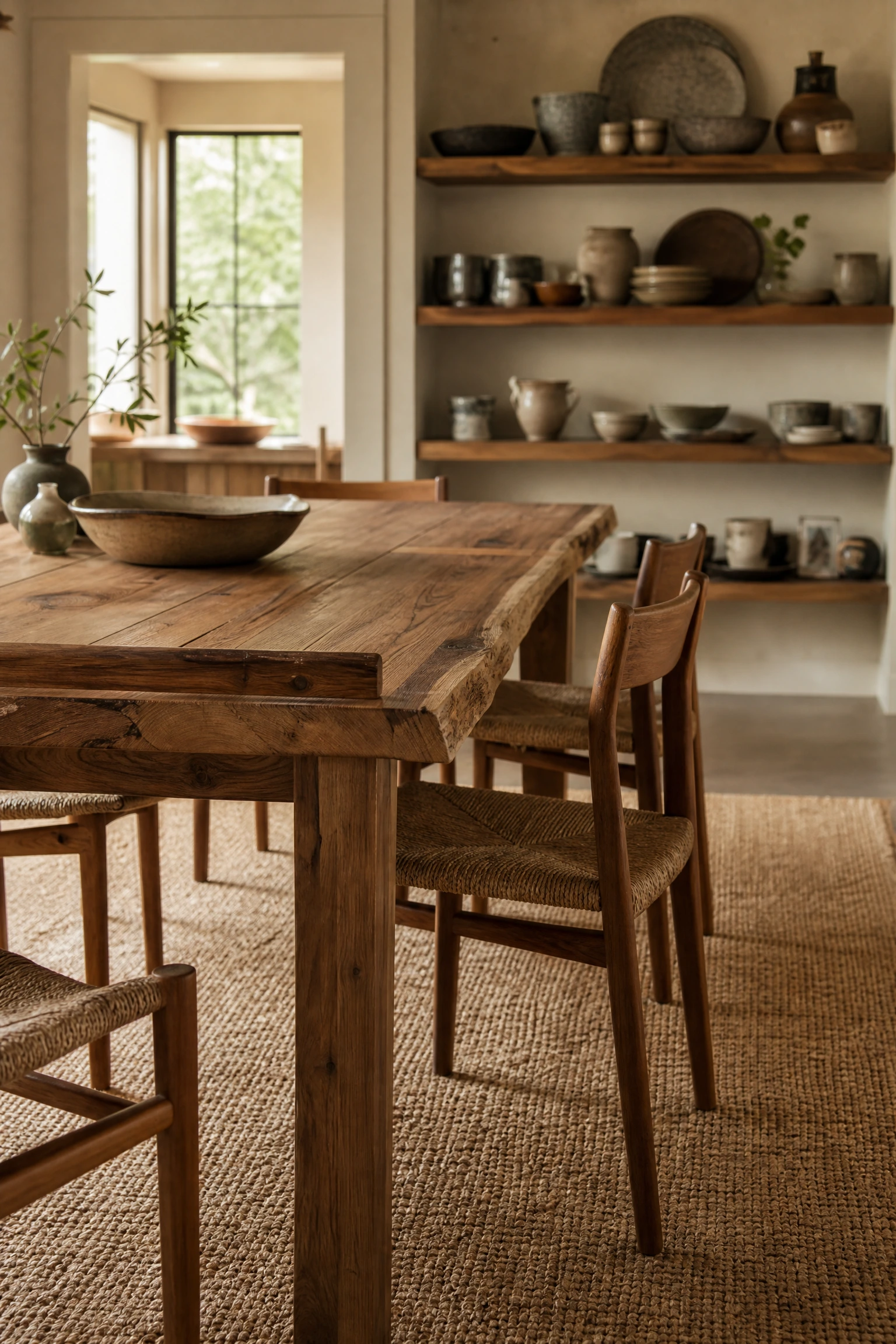
The cool, high-gloss, everything-white aesthetic that defined a certain type of aspirational dining room is giving way to something with more texture and warmth. Travertine tabletops, linen slipcovers, rattan pendants, raw plaster walls, terracotta tile floors, and oiled walnut sideboards are all part of the same shift: materials that have tactile character and feel like they age gracefully rather than showing every fingerprint and scratch. This is sometimes described as the wabi-sabi influence – the Japanese design principle that finds beauty in imperfection and the natural passage of time – translated into Western interiors. The result is dining rooms that feel genuinely lived-in rather than staged, which is also more honest about how these rooms are actually used. Reclaimed timber dining tables are particularly strong right now, with their knots, grain variation, and patina giving a room instant depth that no new piece of furniture can replicate.
Designer Advice: You do not need to buy all new furniture to shift toward this material direction – recovering existing chair seats in a textured linen or bouclé, and swapping out a glass pendant for a rattan one, can move a room meaningfully without a full renovation budget.
Wallpaper Is Back in Dining Rooms, and It Is Making a Statement
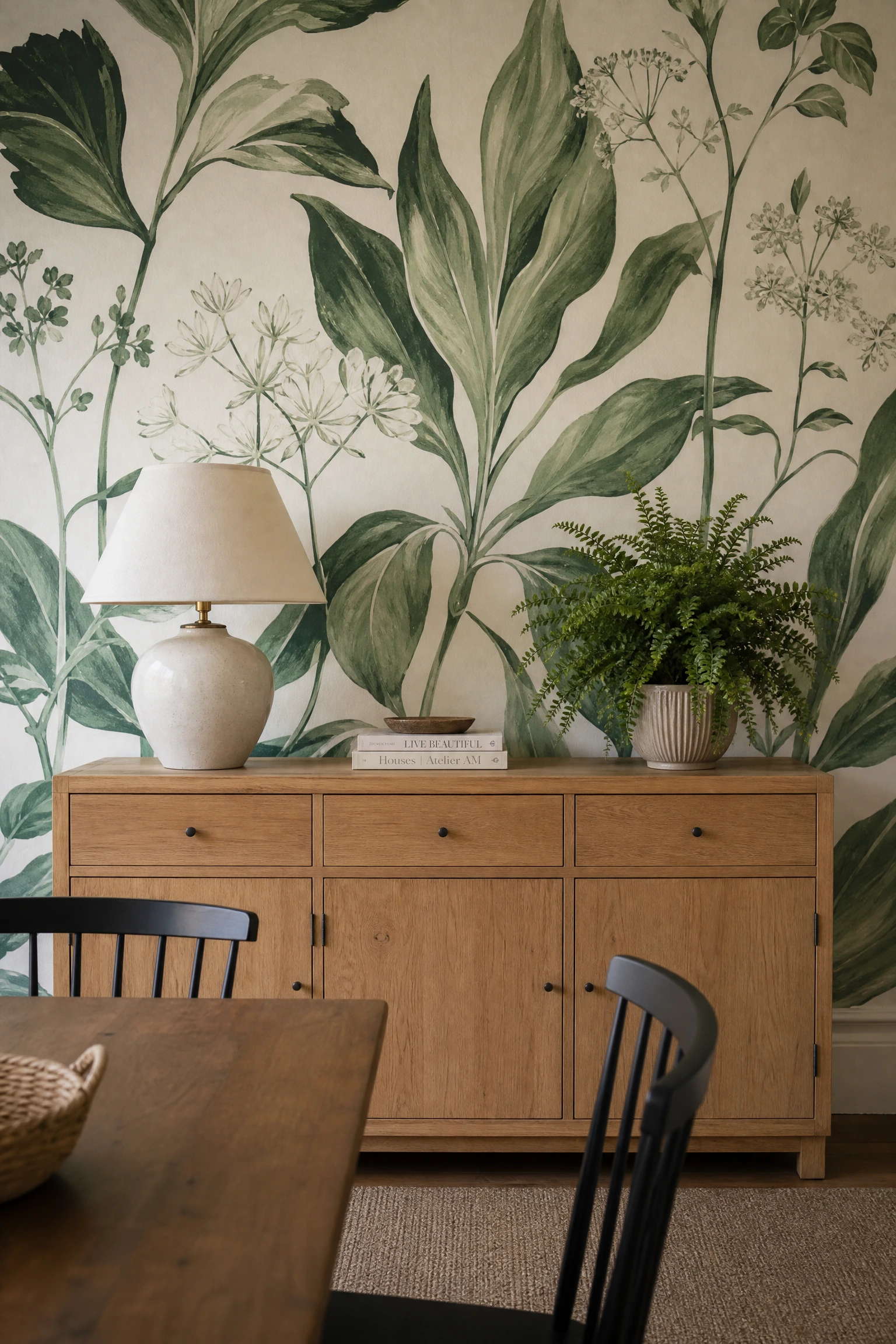
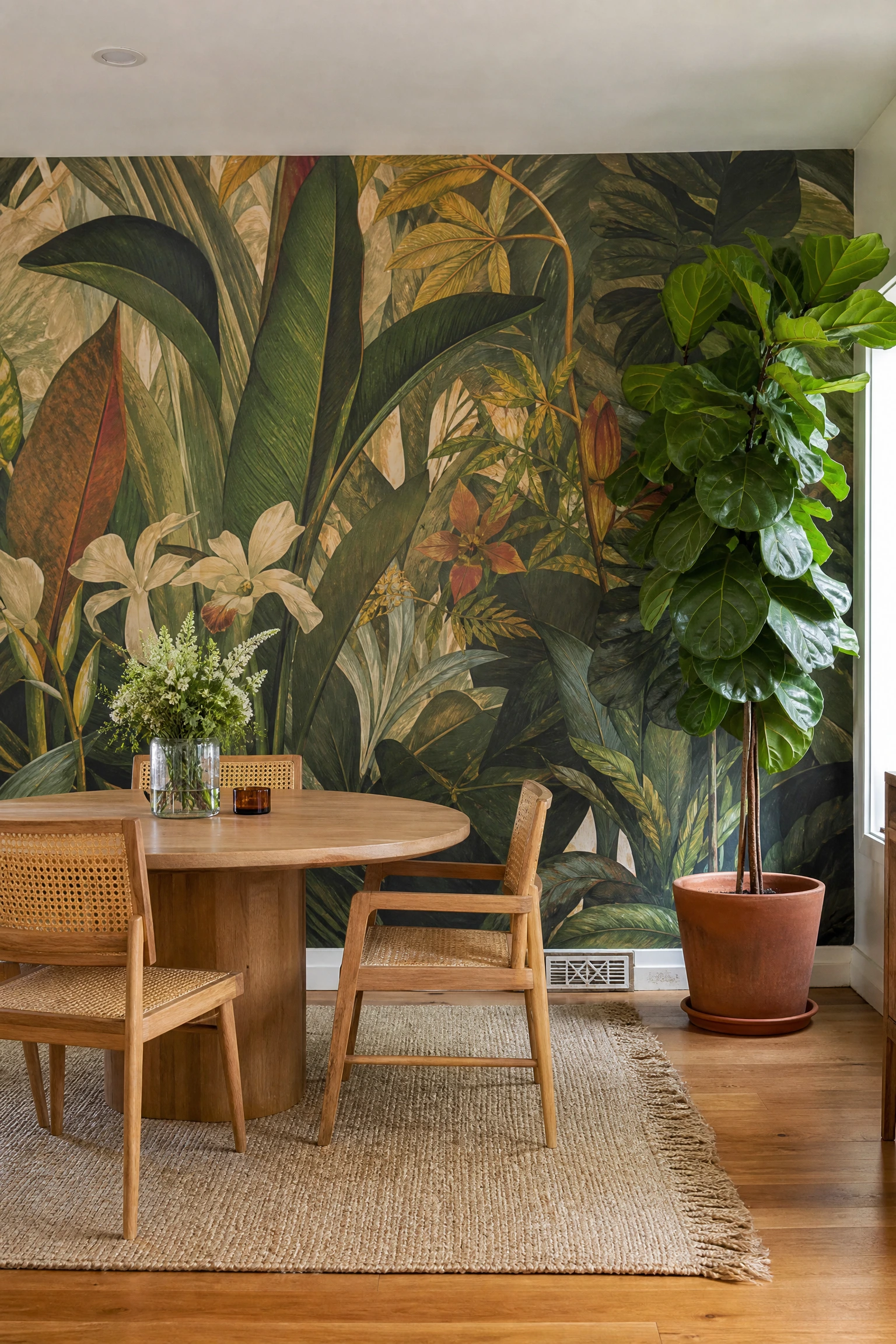
Dining rooms were historically one of the best rooms in the house for wallpaper, and that is being remembered again. The patterns gaining the most traction in 2026 are large-scale botanicals, hand-painted or painterly florals, abstract murals, and grasscloth textures – all of which bring the kind of personality and visual interest that paint alone cannot achieve. The dining room is actually one of the easiest rooms in the house to wallpaper boldly because it tends to have fewer interruptions – no built-ins, no radiators on every wall, fewer doors – which means the pattern gets to breathe. A single wallpapered wall behind a sideboard or a buffet can anchor the entire room without requiring all four walls to be covered, which is a good entry point if you are cautious about commitment. Peel-and-stick wallpaper has also improved enormously in quality and variety, making it a genuine option for renters or anyone who wants to try before they commit to paste.
Quick Tip: Dark-background wallpapers – a deep green or navy ground with a botanical or geometric pattern – read much more richly in a dining room than they do in a living room, because the dining room is smaller and you are sitting closer to the walls, so the detail actually registers.
The Sideboard Is Getting a Second Life as a Design Hero
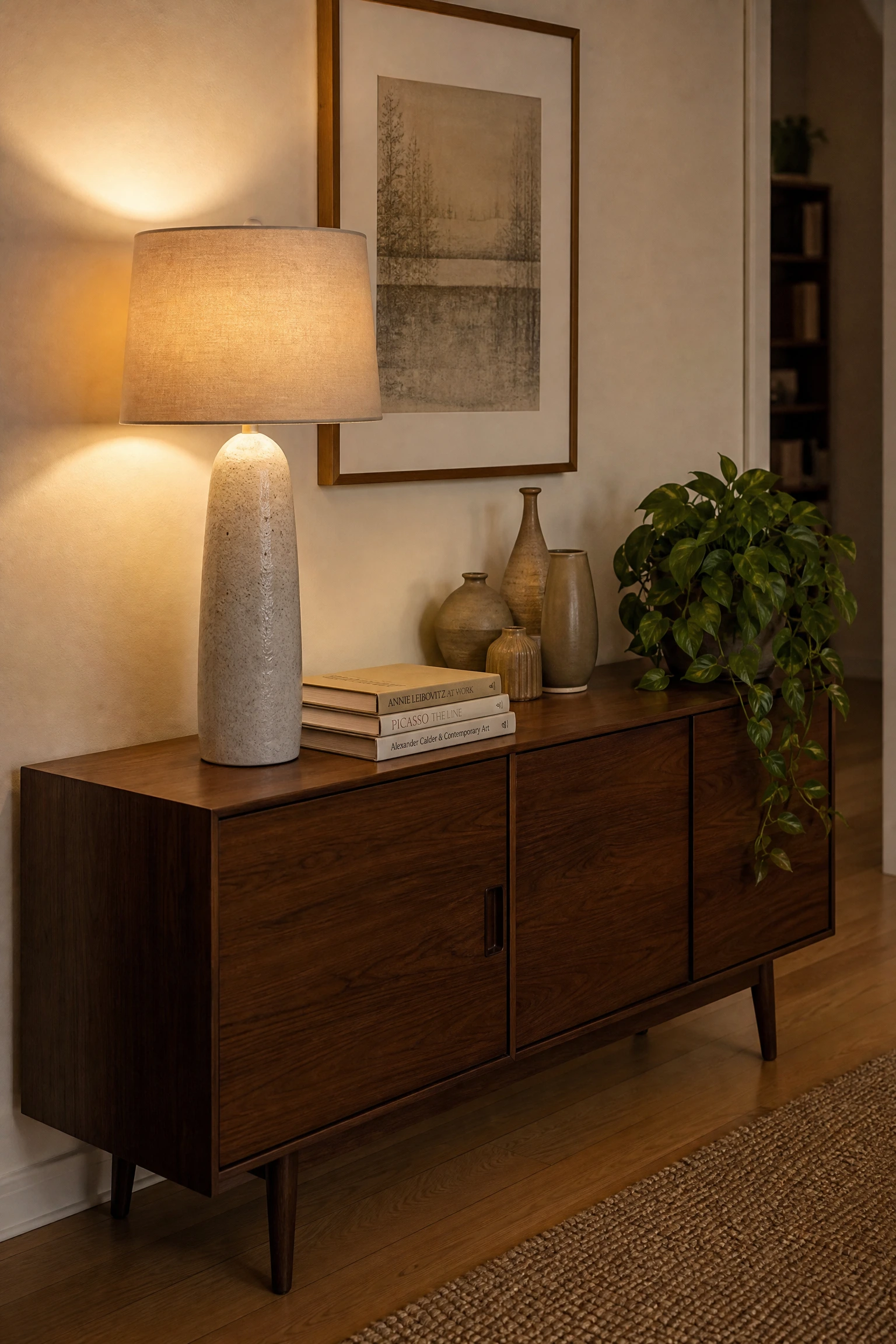
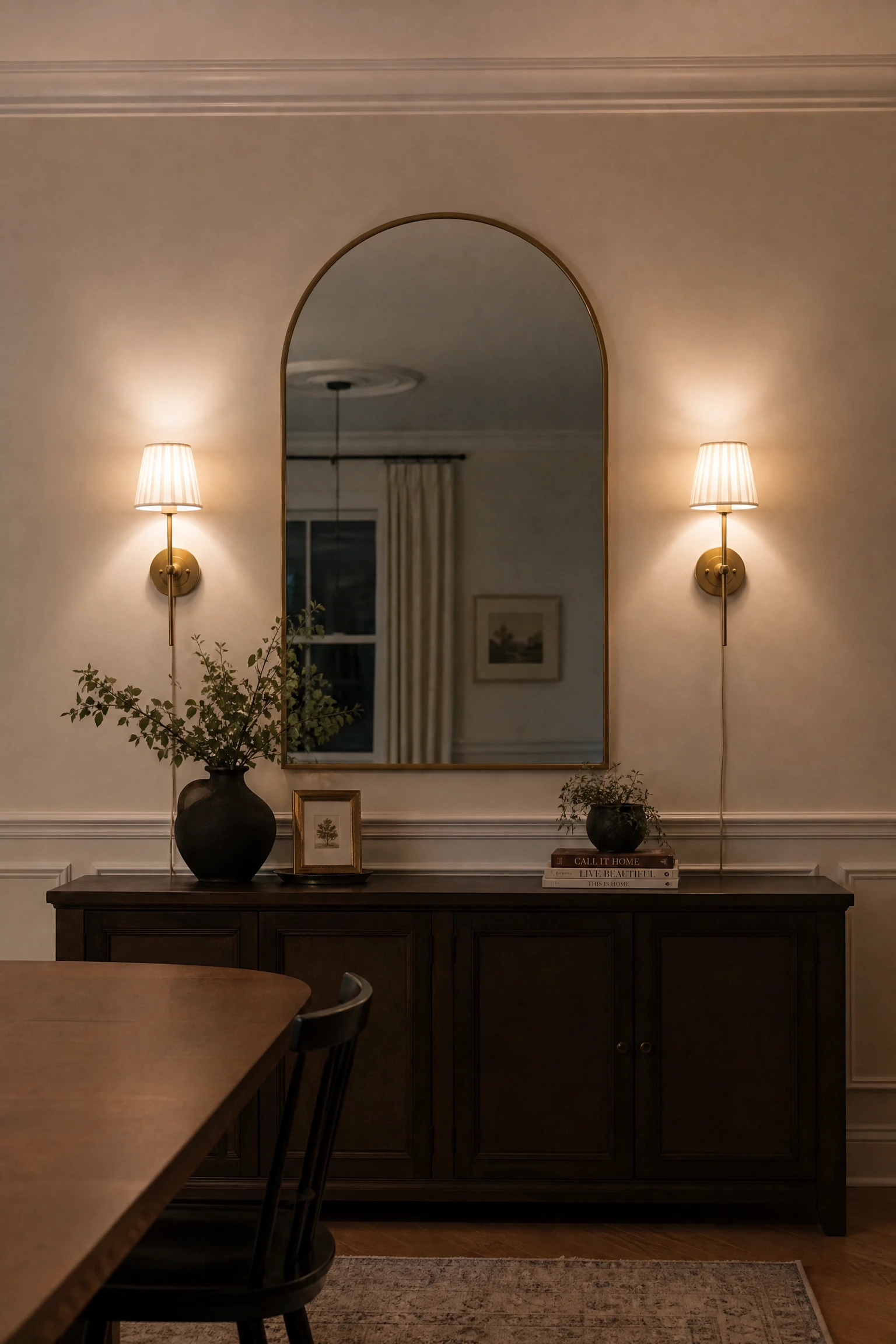
For a while the sideboard felt like a relic – something your grandparents had that nobody under forty wanted in their home. That has completely changed. The sideboard or buffet is now being treated as one of the most important pieces in the dining room, serving as a surface for display, a storage solution for tableware and serving pieces, and a major visual anchor for the room. Contemporary versions range from low-slung mid-century modern forms in walnut or oak to more architectural pieces with fluted fronts, cane inserts, or textured lacquer finishes. What is sitting on top of them matters too – a collected collection of ceramic vessels, a few pieces of interesting glassware, a trailing plant, and a table lamp or two turns a sideboard into something that looks deliberately designed rather than just functional. The lamp on a sideboard is particularly worth noting: it adds a layer of evening light that completely changes the atmosphere of the room at dinner time.
Pro Move: A sideboard lamp on a smart plug or a simple dimmer cord lets you turn it on from the table without getting up – small detail, genuinely satisfying every single time you have people over.
Dedicated Dining Rooms Are Winning Over Open-Plan Everything
This is one of the more significant design shifts of the moment and it is worth understanding why it is happening. For years, open-plan layouts were the aspirational standard – knock down the walls, merge the kitchen and dining and living space, and enjoy the flow. But a growing number of homeowners and designers are pushing back on this, rediscovering the appeal of a dining room that has its own walls, its own atmosphere, and its own acoustic separation from the rest of the house. A contained dining room can be moodier, darker, more dramatic – you can do things with lighting and color that would feel claustrophobic in a combined space. It also just functions better for hosting: guests are not sitting in the kitchen while you cook, and the noise and heat of meal preparation stays separate from conversation. If you cannot wall off an existing open-plan space, defining the dining zone with a large area rug, a lower ceiling treatment like a canopy or beams, and a distinct lighting zone achieves a similar psychological effect.
Reality Check: If you are considering adding a partition or partial wall to reclaim a dining room from an open plan, check whether any walls are load-bearing before you touch anything, and budget for at least one electrical circuit to be moved – it is almost always necessary and rarely cheap.
Architectural Details Are Coming Back Into the Room
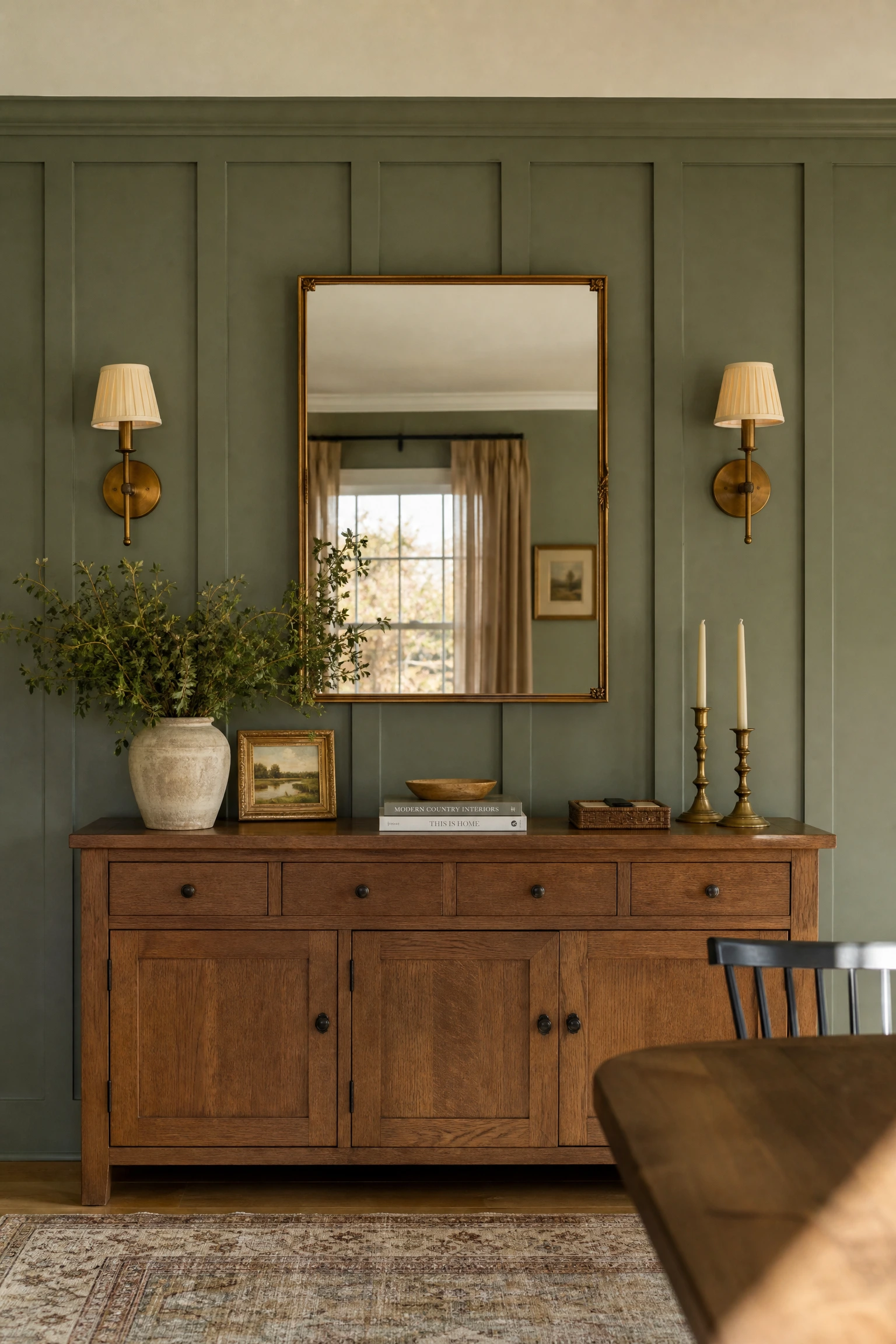
One of the things that made older dining rooms feel special – and that got stripped out in decades of minimalist renovations – was architectural detailing: picture rails, panel moulding, coffered ceilings, dado rails, built-in corner cabinets, decorative cornices. These details are actively coming back, not in a pastiche way but in a version that integrates cleanly with contemporary furniture and color. The reason they work so well in dining rooms specifically is that this is a room where people sit still and look around for extended periods – unlike a hallway or a kitchen where you move through quickly, in a dining room you actually notice the walls and what is on them. Simple board-and-batten panelling painted in a deep tone, for example, adds enormous visual depth and architectural presence for a relatively modest cost, and it is genuinely achievable as a weekend DIY project if you are reasonably handy. Built-in shelving or a glazed china cabinet in an alcove takes it further, adding display space and making the room feel genuinely considered.
Quick Tip: If a full panelling project feels like too much, picture frame moulding kits from hardware stores – applied in a grid pattern and painted the same color as the wall – give an almost identical effect at a fraction of the cost and complexity.
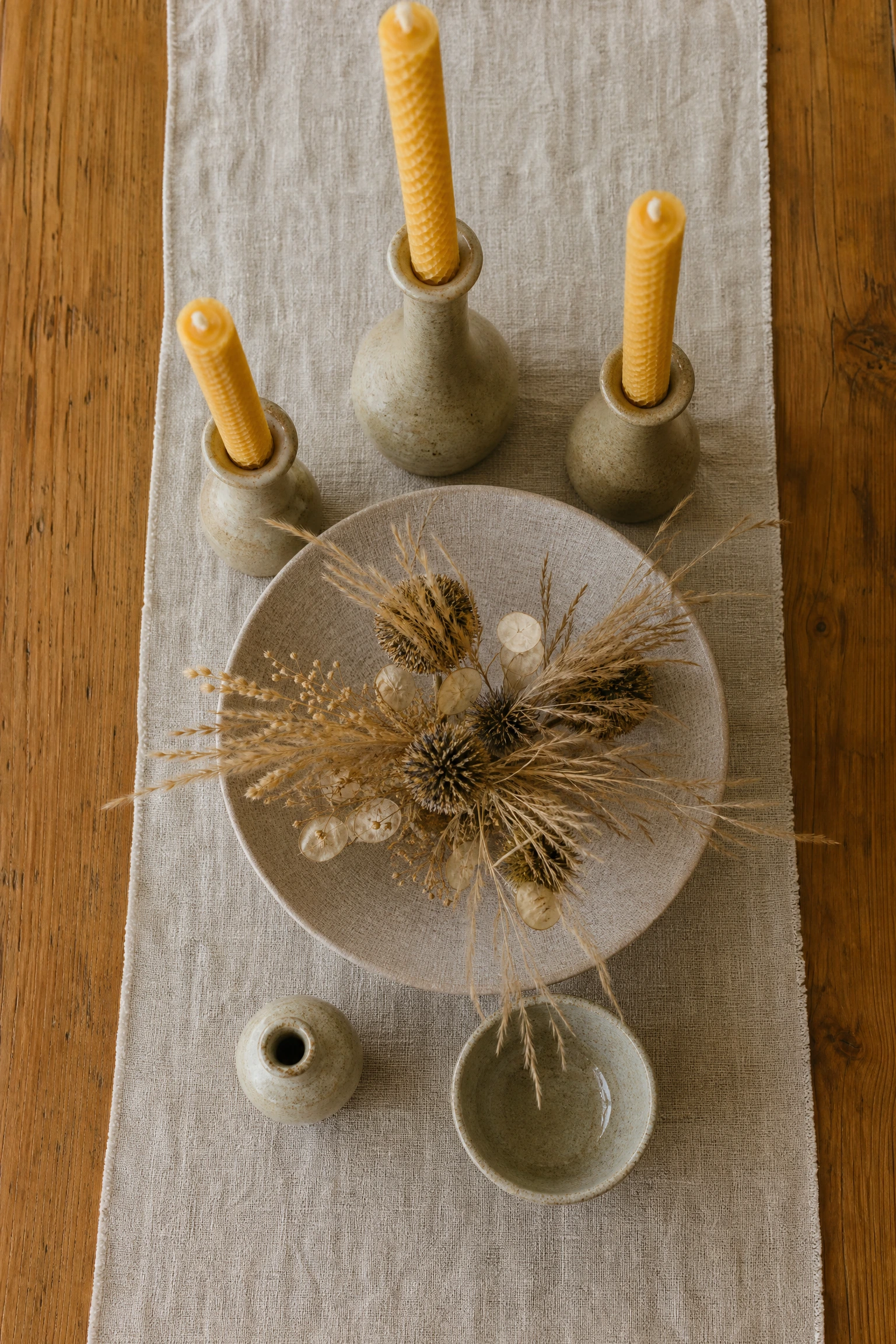
The way a table is dressed when it is not set for a meal has become a real area of focus, and it is worth thinking about separately from the rest of the room’s design. A dining table that sits bare and uninviting for most of the week sends a message about how the room is valued, while a table with a considered centrepiece – a cluster of candles at varying heights, a long low bowl of seasonal greenery, a sculptural object or two, a simple linen runner – makes the room feel ready and welcoming even when no one is eating. The current tendency is away from formal matching centrepiece sets toward something that looks more naturally assembled, mixing materials like ceramic, glass, linen, and organic elements such as dried grasses or real branches. This is also a very low-cost way to refresh the feel of a dining room without changing any of the furniture or paint – seasonal swaps of the centrepiece arrangement can make the room feel genuinely different across the year.
Designer Advice: Group centrepiece elements in odd numbers and vary the heights – three candles of different heights, for instance, will always look more intentional than two of the same size placed symmetrically.
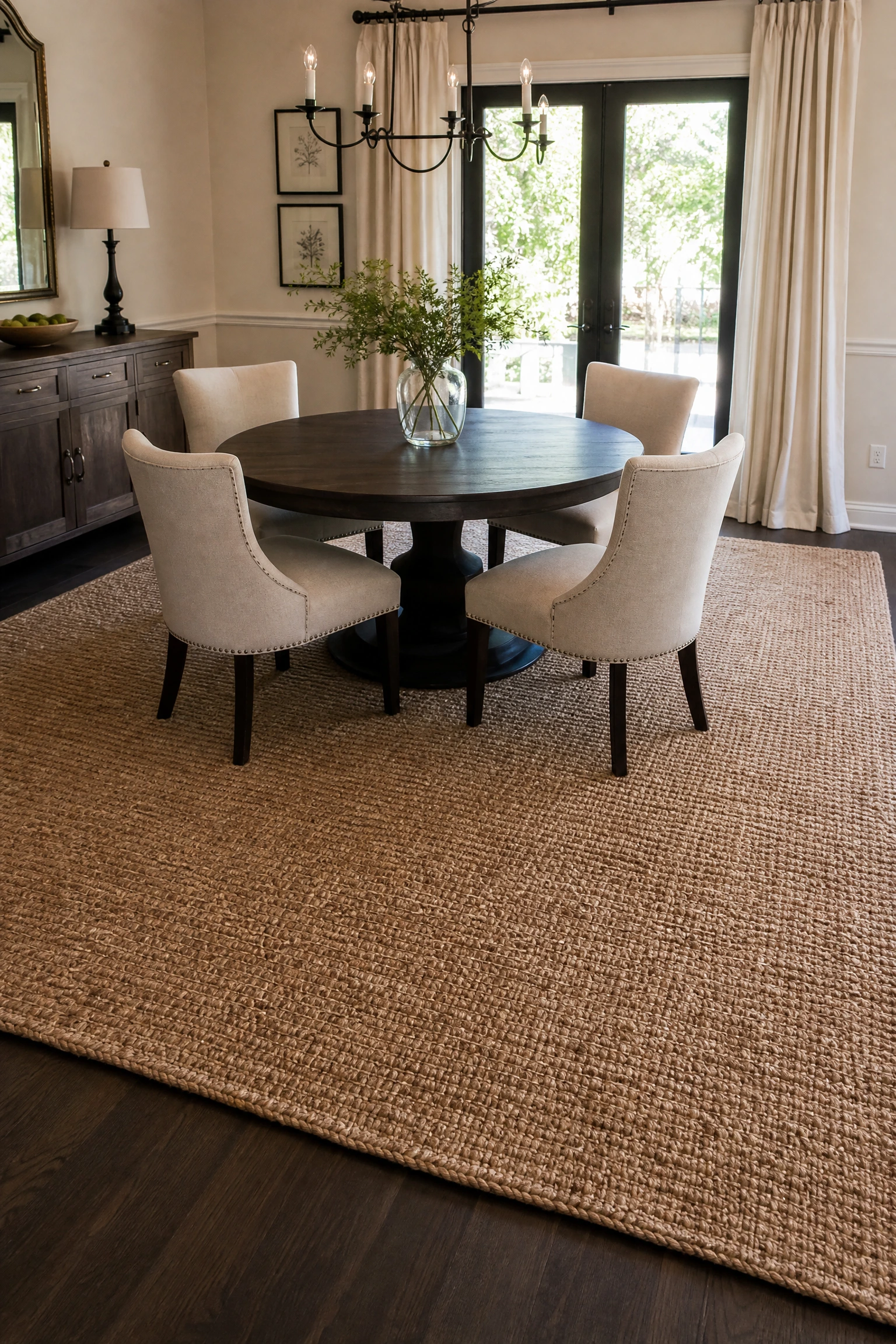
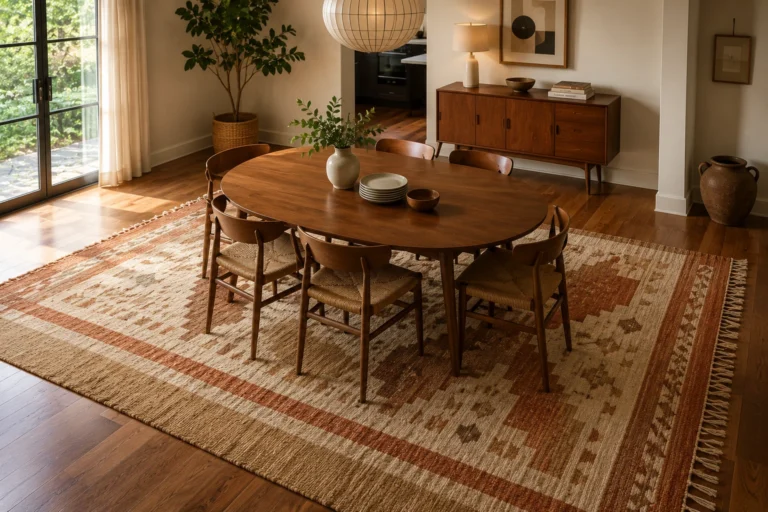
Ask any interior designer what the single most common mistake in dining rooms is, and most of them will say the rug is too small. A rug that does not extend beyond the pulled-out chairs creates an awkward floating effect where chair legs catch on the edge every time someone stands up, and it makes the whole room look unresolved. The correct size for a dining room rug is one where all four chair legs remain on the rug when the chairs are pulled out for sitting – which typically means adding at least 60 centimetres to each side of the table dimensions to arrive at the rug size you actually need. Natural fibre rugs in jute or sisal work well in dining rooms for their durability and the way they complement warm material palettes, but they are harder to clean than a flatweave wool or a low-pile synthetic. For families with young children, a patterned rug in a mid-tone that hides crumbs and the odd sauce splash is the most honest recommendation.
Heads Up: Measure twice before you order a rug online – account for your table dimensions plus chairs pulled out at least 60 centimetres on each side, and then check those total dimensions will actually fit in your room with adequate clearance to the walls.
Natural Light Is Being Treated as a Design Material
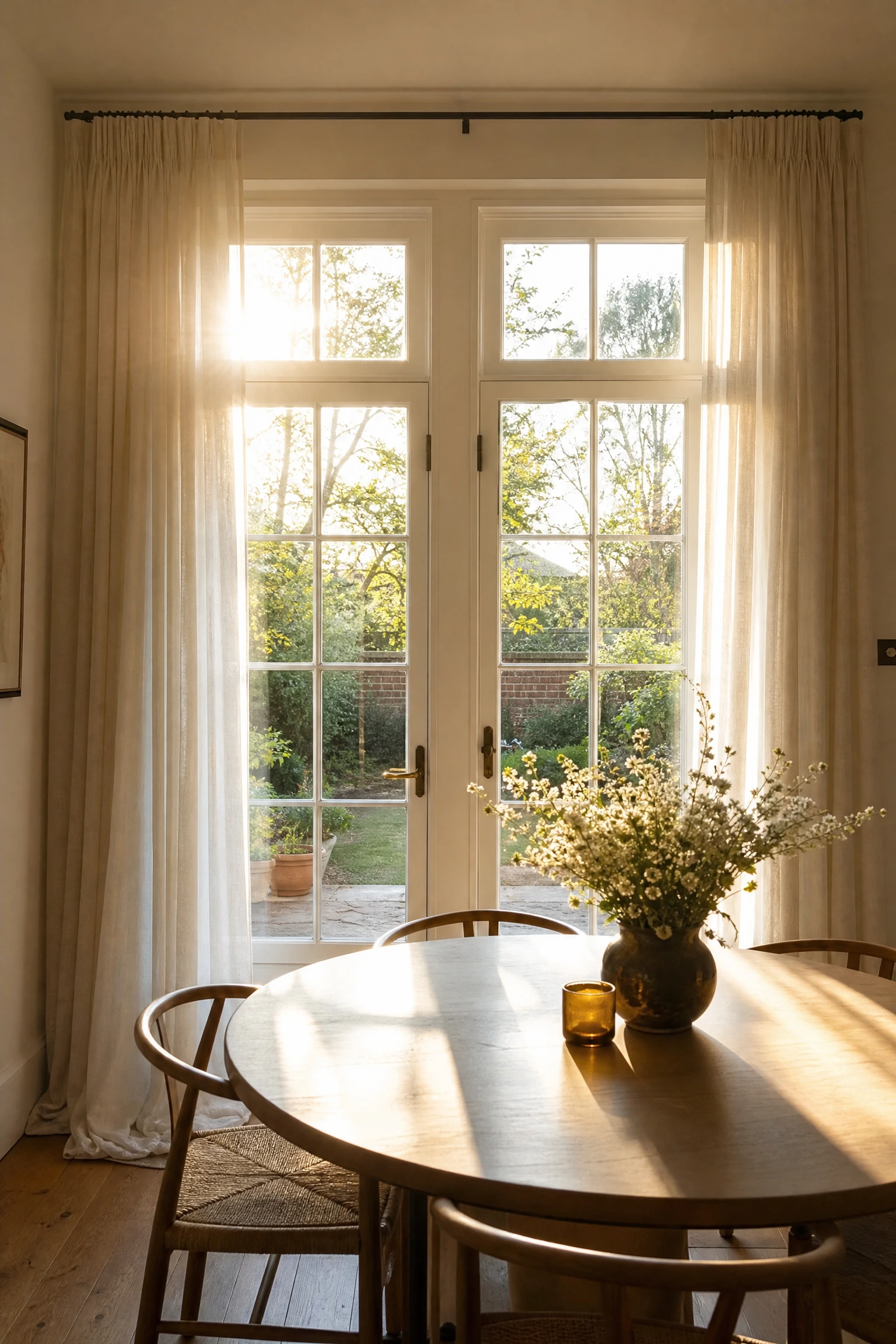
The relationship between a dining room and its windows is getting more deliberate attention in 2026. Rather than covering windows with heavy drapes that block light, designers are working with sheer linen panels that filter natural light beautifully during the day while still providing evening privacy when layered with a simple roller blind behind them. Where dining rooms have garden-facing windows or doors, the design conversation is about aligning the table with the view – a round table positioned to face a garden window or a set of French doors creates a genuinely different dining experience to one tucked against an internal wall. In apartments and urban homes where natural light is limited, the solution is to maximise what exists with light-reflective surfaces – pale stone tabletops, a large mirror on the wall opposite the window, glossy painted ceilings in a warm white – rather than fighting the darkness with overhead lighting alone.
Quick Tip: Sheer linen curtains in an off-white or warm cream that puddle slightly on the floor add softness and an immediate sense of considered design without blocking any of the available light – they work in both traditional and modern rooms.
Mixing Chair Styles Has Become the Default, Not the Exception
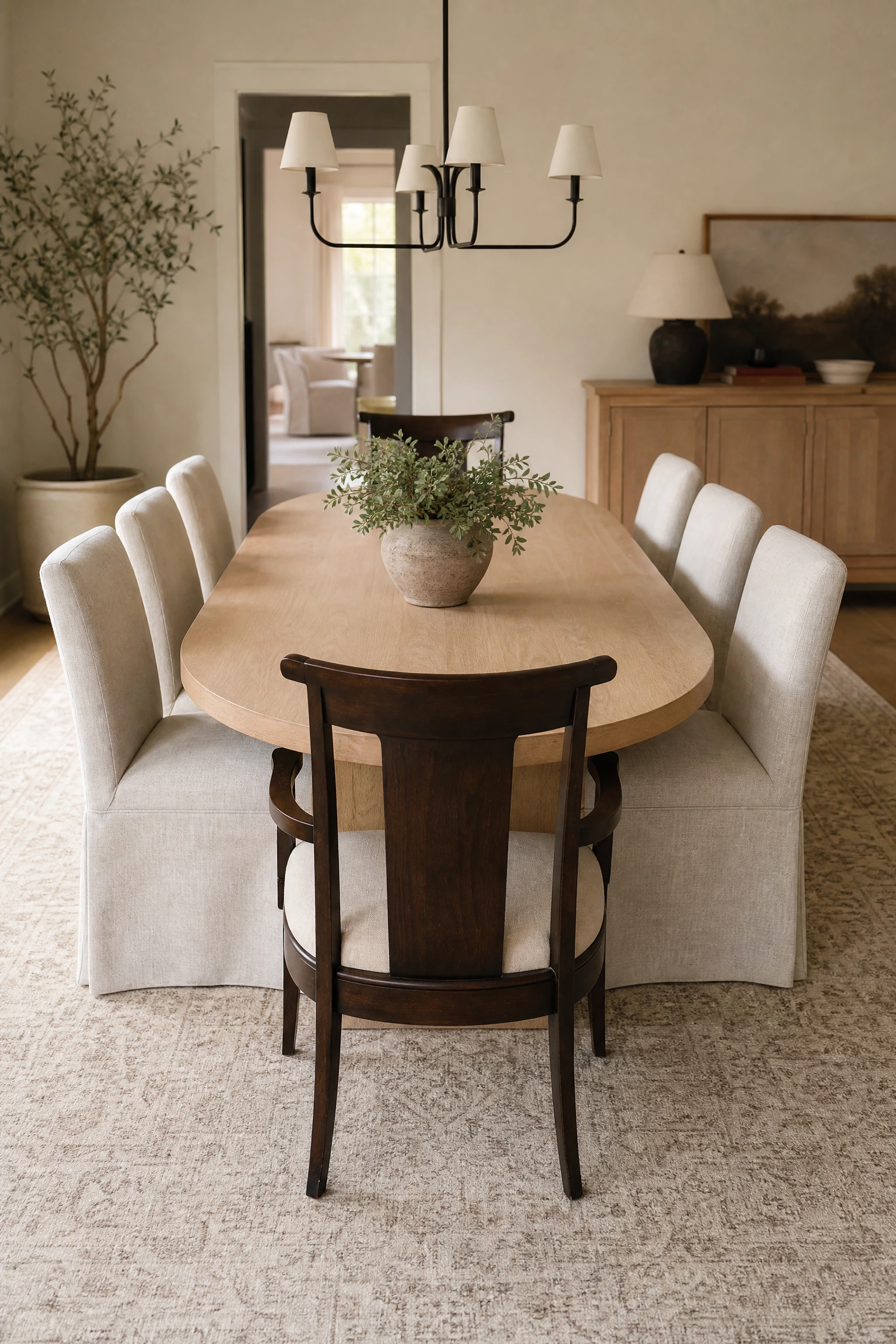
The idea that every chair at a dining table has to match is essentially gone. Mixing chair styles – different shapes, different materials, sometimes different colors – is now so widely embraced that a perfectly matched set of eight identical chairs can actually look like the less considered choice. The most successful versions of this approach have a unifying thread: the same material in different forms (all-wood chairs in different profiles), the same color family across different upholstery fabrics, or the same leg finish tying together chairs with different seat styles. Two carvers at the table heads in a contrasting material – a timber armed chair at each end, for example, with upholstered side chairs running down the long sides – is one of the cleanest and most practical versions of this approach, and it is easier to execute on a budget because you are only buying two of the statement pieces.
Reality Check: Mixing chairs successfully requires at least one strong common element – go for two different chair styles without any unifying thread and it will read as mismatched rather than intentional, so decide your through-line before you start shopping.
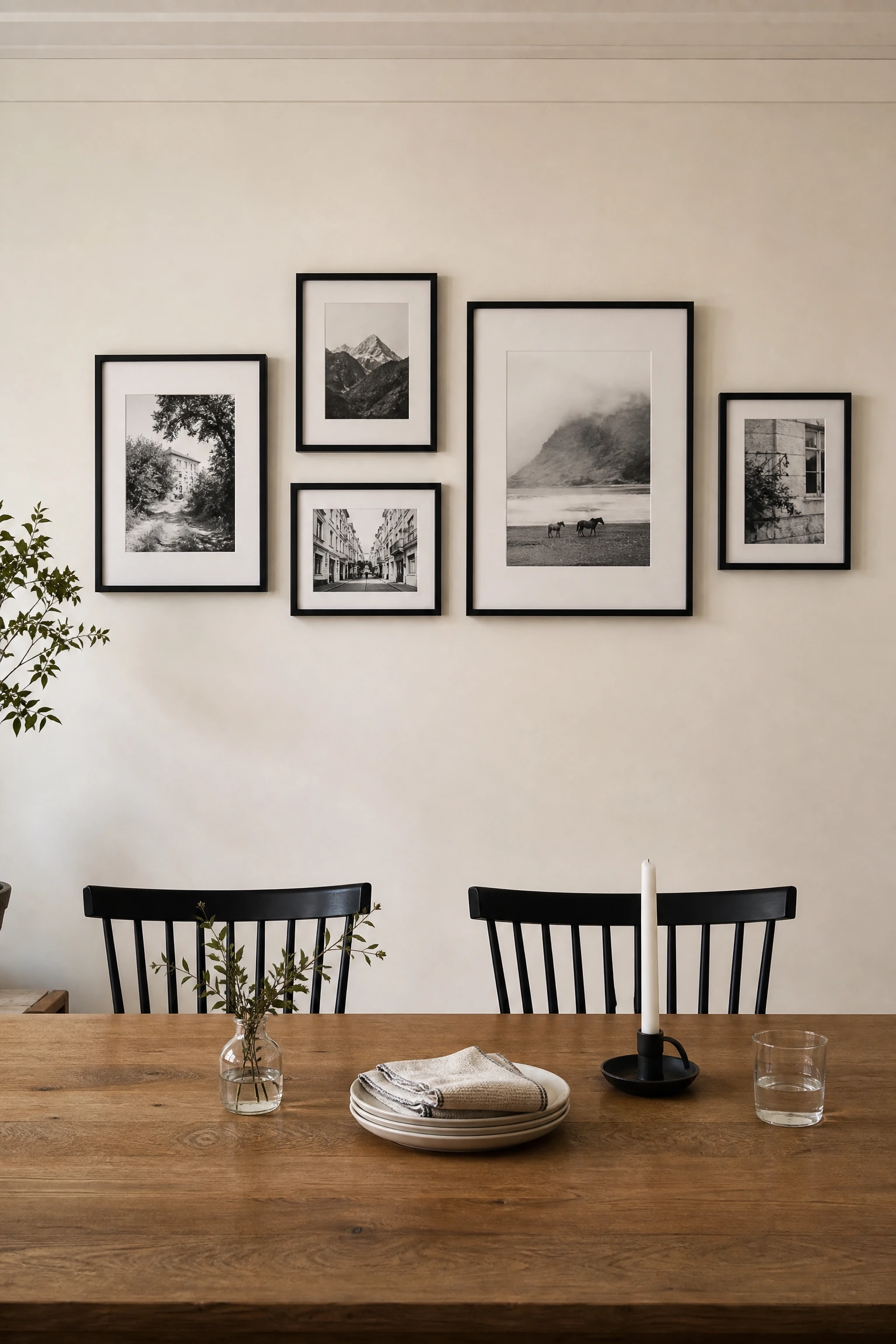
Living rooms have been the traditional home for gallery walls, but the dining room is actually a better canvas for them in many ways. The walls tend to be longer and less interrupted by furniture, and because people sit at the table for extended periods they actually look at the art rather than walking past it. The gallery walls gaining traction in dining rooms right now lean toward a coherent single-medium approach – all framed prints in matching frames, or a collection of paintings in the same tonal range – rather than the anything-goes mashup that characterised the trend in its earlier form. Black-and-white photography in simple black frames is a perennially strong choice for its graphic impact and its ability to work with almost any color scheme. Oversized single pieces of art are also performing strongly as an alternative – one large canvas or framed print that fills a significant portion of the wall often reads more confidently than a collection of smaller pieces that never quite gel.Designer Advice: Before you put a single nail in the wall, lay your intended gallery arrangement on the floor and photograph it from above – it is the fastest way to see whether the composition works before you commit.
Banquette Seating Is Solving Real Dining Room Problems
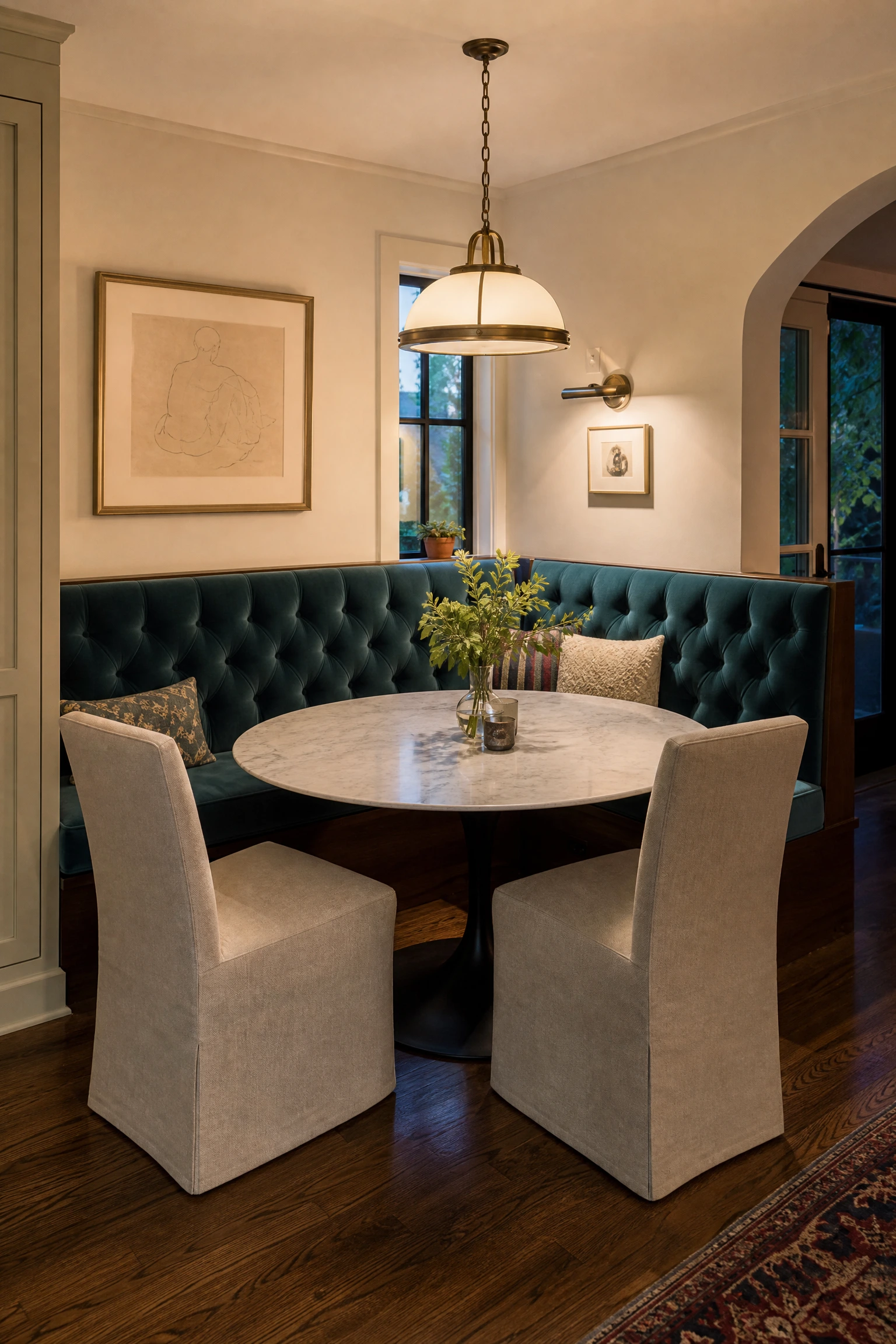
Built-in banquette seating – the padded bench seat built into a corner or along one wall – has been a staple of restaurant design for decades, and it is increasingly appearing in residential dining rooms because it solves several problems at once. It maximises seating capacity in a smaller room (bench seating is roughly 30% more efficient than individual chairs), it adds architectural interest and a sense of permanence, and it creates an immediate sense of cosiness that a table floating in the middle of a room can struggle to achieve. From a design perspective, a banquette with a tufted or buttoned-back upholstery in a durable fabric – a performance velvet or a tight-weave linen – is one of the most high-impact investments a dining room can have. The storage version, with lift-up seat bases that reveal compartments underneath, is particularly practical in smaller homes where dining room storage is always at a premium. Pairing a banquette along one or two walls with loose chairs on the opposite side gives flexibility for everyday use and larger gatherings.
Pro Move: If a full built-in banquette feels like too big a project, a freestanding upholstered bench on one side of the table achieves a very similar visual effect and requires no construction at all – look for ones with legs rather than solid bases to keep the room feeling light.
Color Drenching Is the Most Confident Dining Room Move Right Now
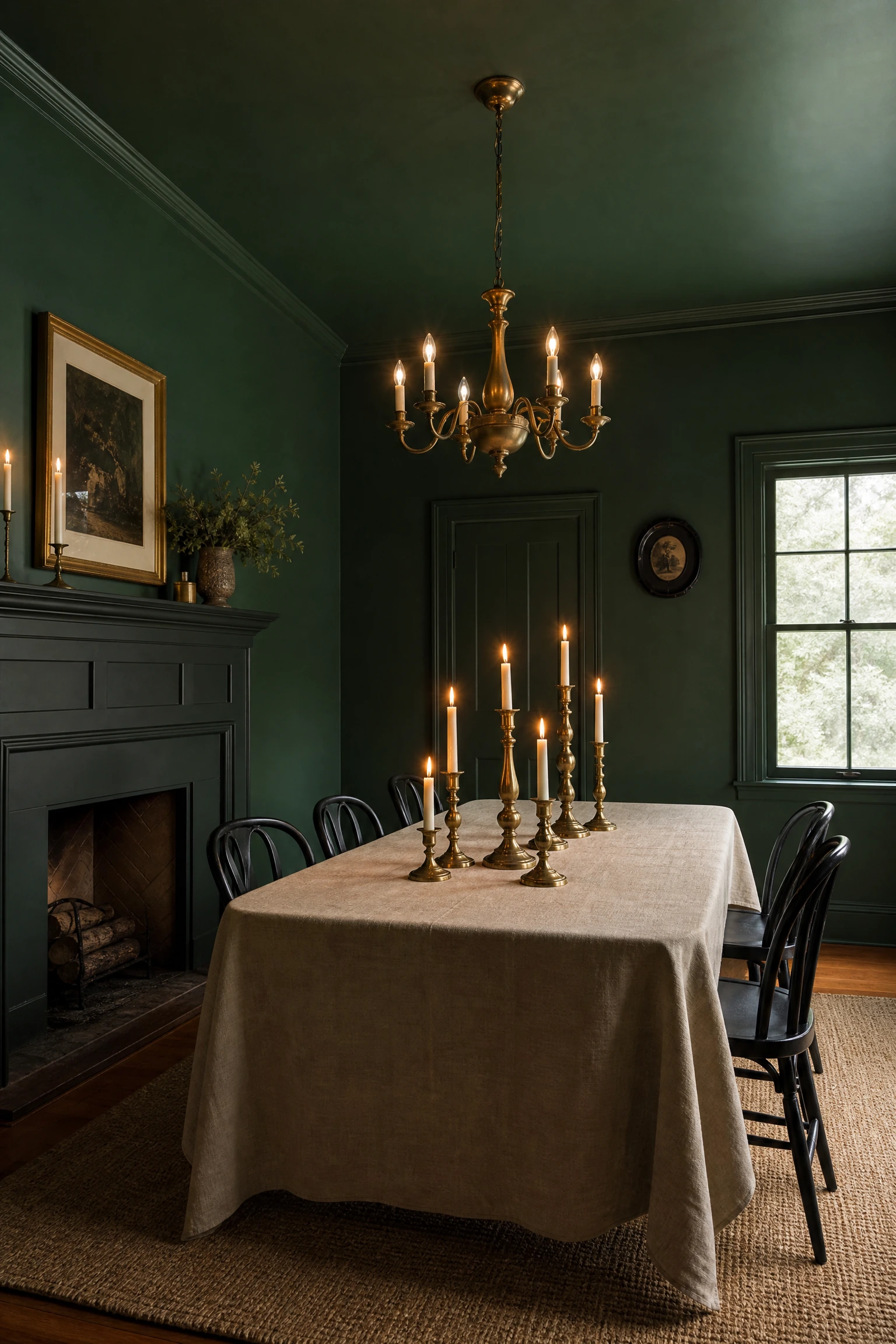
Color drenching – painting the walls, ceiling, trim, and sometimes even the furniture in the same or very closely related tones – is having a significant moment in dining rooms specifically, and it makes sense when you think about how the room is used. The enclosed nature of a dining room means there is more surface area per square metre than in a larger living room, so a deeply saturated tone wraps the space completely and creates an atmosphere that is genuinely unlike any other room in the house. Forest green drenching with aged brass hardware and a natural linen tablecloth, or a deep plum treatment with warm wood furniture and candlelight, both create something you simply cannot achieve in a room with white walls and colored accents. The ceiling is the piece most people hesitate on, but painting it the same color as the walls (or one shade lighter) makes a genuine difference – it lowers the perceived ceiling height slightly, which in a dining room reads as intimacy rather than constriction.
Reality Check: Color drenching works best in rooms that have decent natural light during the day, because at night with the lights on even dark colors feel warm and enveloping – but if the room has very little natural light and you rely on overhead lighting most of the time, test your chosen color at the darkest point of day before you commit to four walls and a ceiling.
Sustainable and Ethically Sourced Furniture Is Becoming a Purchase Priority
The conversation around where dining furniture comes from has shifted meaningfully, and it is showing up in buying decisions rather than just stated preferences. Reclaimed timber, FSC-certified wood, recycled metal frames, and furniture from makers who are transparent about their supply chains are all gaining ground as homeowners become more intentional about what they bring into their homes. This is not purely an ethical consideration – reclaimed and sustainably sourced materials often have superior visual character compared to their mass-produced equivalents, with grain patterns, patina, and construction details that give pieces genuine individuality. Natural fiber seating materials like rattan, seagrass, and solid hardwoods also tend to be more durable than foam-and-particleboard constructions, meaning the initial higher price is often justified by a significantly longer lifespan. Independent furniture makers and vintage and antique dealers are natural places to look for pieces in this space.
Quick Tip: Vintage and antique dining tables are one of the best value propositions in furniture – a solid hardwood table from fifty years ago, refinished with a natural oil, will outperform most new mid-range tables in both durability and character, often for a similar price.
Sconces Are Replacing the Single-Source Ceiling Light
Wall sconces in dining rooms used to feel old-fashioned – the kind of thing you saw in hotel dining rooms with floral prints and heavy drapes. That association has completely gone. Sconces are now one of the most-recommended additions a designer will suggest for a dining room that feels flat, because they solve a specific problem: they put light at eye level rather than only above, which makes faces look better and makes the room feel more like a restaurant and less like a staff canteen. Plug-in sconces – which require no new wiring and simply plug into an existing outlet with the cord hidden by a simple cable cover – have made this trend accessible to renters and anyone who does not want to get an electrician involved. Placed on either side of a piece of artwork, a mirror, or a sideboard, a pair of sconces creates an instant focal point and brings a level of considered layering to the lighting scheme that an overhead fixture alone can never achieve.
Designer Advice: Sconces with a warm-toned Edison-style bulb or a frosted globe bulb at around 2700K will look flattering and atmospheric in a dining room – avoid anything above 3000K in this space, as it reads too clinical for evening dining.
Indoor-Outdoor Connection Is Shaping New Dining Room Layouts
The desire to connect a dining room visually and physically to an outdoor space – a garden, a terrace, a balcony – is influencing not just how dining rooms are decorated but how they are laid out and positioned within a home. Where there is a choice, dining rooms are increasingly being oriented toward garden-facing walls with large windows or glazed doors that allow the two spaces to read as one during warmer months. When literal connections are not possible, the approach is taken indoors: large-scale botanical murals, grasscloth wallcoverings, stone or terracotta floor tiles that continue a material palette from outside, and generous plants placed in corners all create a visual language that bridges inside and out. Trailing pothos in a basket, a large fiddle-leaf fig in the corner, or a collection of ceramic pots with trailing herbs on the windowsill all serve this purpose without requiring major construction – they just need commitment to keeping them alive.
Heads Up: Large indoor plants in dining rooms are high-impact but high-maintenance – if your household does not have a track record with houseplants, start with something genuinely low-effort like a snake plant or ZZ plant before committing to a fiddle-leaf fig that will need consistent watering, light, and the occasional repotting.
Smart Lighting Is Quietly Becoming a Dining Room Essential
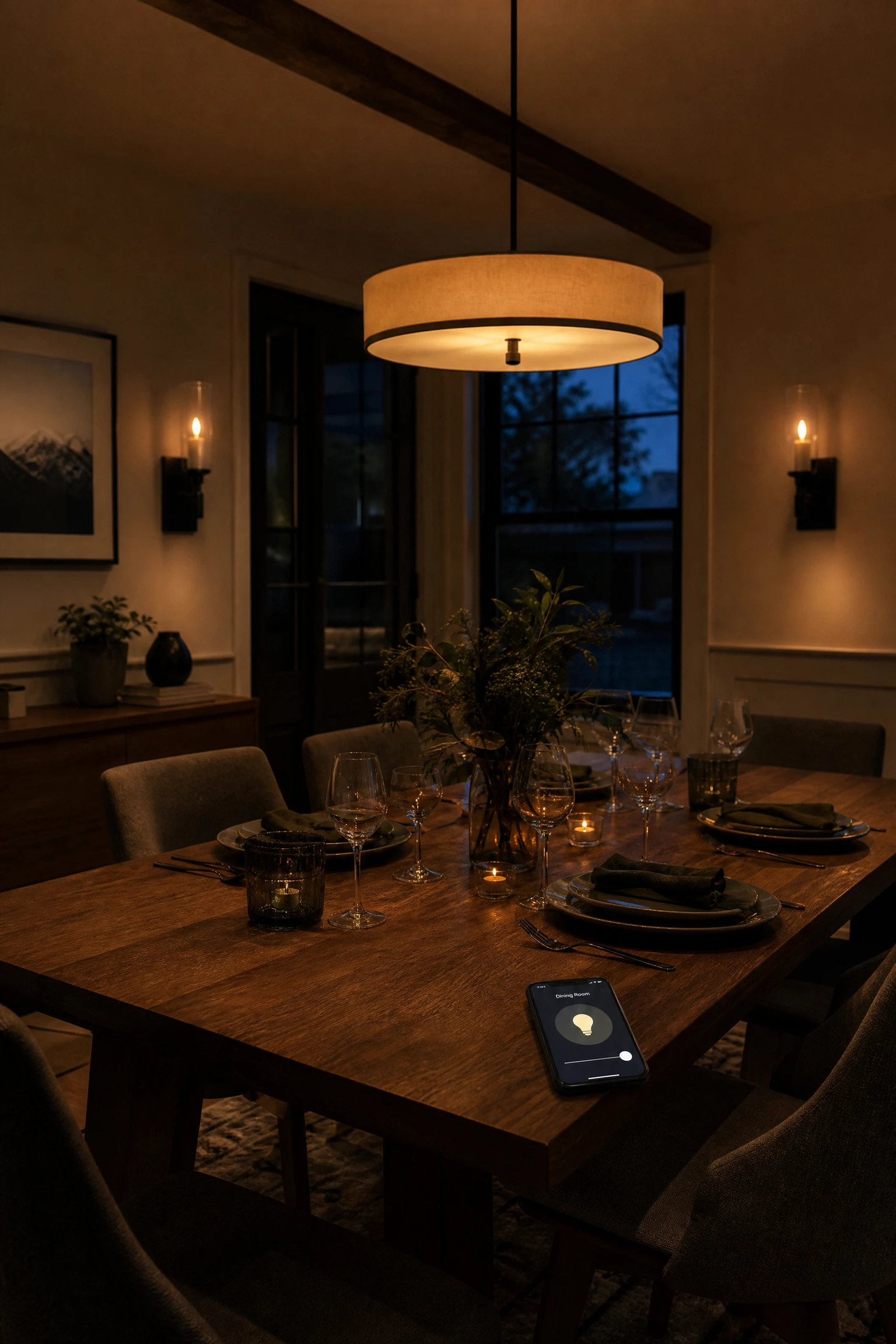
Lighting control technology has reached the point where it is genuinely useful rather than just a novelty, and the dining room is the room in the house where it makes the most practical difference. Being able to shift from a bright daylight setting for afternoon use to a warm, dimmed atmosphere for evening dining without getting up and changing bulbs is a quality-of-life upgrade that is hard to overstate. Smart dimmers that work with existing light switches, smart bulbs in existing fixtures, and programmable scenes that can be triggered with a voice command or a phone tap are all affordable entry points – you do not need a full home automation system to get the benefit. The most useful setup for a dining room is typically two scenes: a bright working scene for daytime and homework use, and a warm, low-intensity scene for evening meals. Getting the color temperature right is important – smart bulbs that can shift from 2700K warm white to a slightly cooler tone give the most flexibility.
Pro Move: Set your dining room lighting scene before guests arrive rather than fiddling with it once they are seated – having the room already lit correctly when people walk in makes an immediate impression that no amount of adjusting afterward can quite replicate.
Textured Ceilings and Fifth Walls Are Getting Attention
The ceiling in a dining room is one of the most underused design surfaces in the home, and that is starting to change. In a room where people are sitting and looking up at a pendant fixture regularly, the ceiling has more visual presence than in almost any other room – so leaving it as a plain white afterthought is a missed opportunity. Exposed timber beams in a room with a pitched or vaulted ceiling add immediate warmth and character. A dark-painted ceiling in a room with lighter walls creates a beautiful sense of enclosure. Limewashed or textured plaster ceilings add depth without requiring color commitment. Even simple timber battens applied in a regular grid pattern give a flat ceiling a sense of considered design. This is one of the trends that is genuinely gaining momentum because it is one of the few things you can do to a dining room that fundamentally changes the feeling of the space rather than just updating the look.
Quick Tip: If a dark-painted ceiling feels like too bold a commitment, try painting the ceiling in the same color as your walls but two shades lighter – it connects the planes visually without the full drama, and you can always go darker later.
Dimmer Switches Are the Cheapest Upgrade in This List
This is not a glamorous trend item, but it deserves its own place on this list because it makes such a measurable difference and so many dining rooms still do not have one. A dimmer switch on the dining room overhead light typically costs between $20 and $60 and takes less than an hour to install (or 15 minutes for an electrician). The difference between a dining room at full brightness and the same room at 40% on a warm-toned bulb is the difference between a space that feels like a school cafeteria and one that feels genuinely considered. Every other lighting investment in this article – the statement pendant, the sconces, the smart bulbs – depends on dimmability to reach its full potential. If your dining room has one overhead light on a standard switch and no dimmer, installing one is the single highest-return-on-investment upgrade you can make before spending a pound or dollar on anything else.
Reality Check: Not all LED bulbs are dimmer-compatible, so check the bulb packaging before you replace the switch – look specifically for “dimmable” on the packaging, or you will get flicker and buzz that defeats the entire purpose.
Vintage and Antique Pieces Are Being Mixed With New
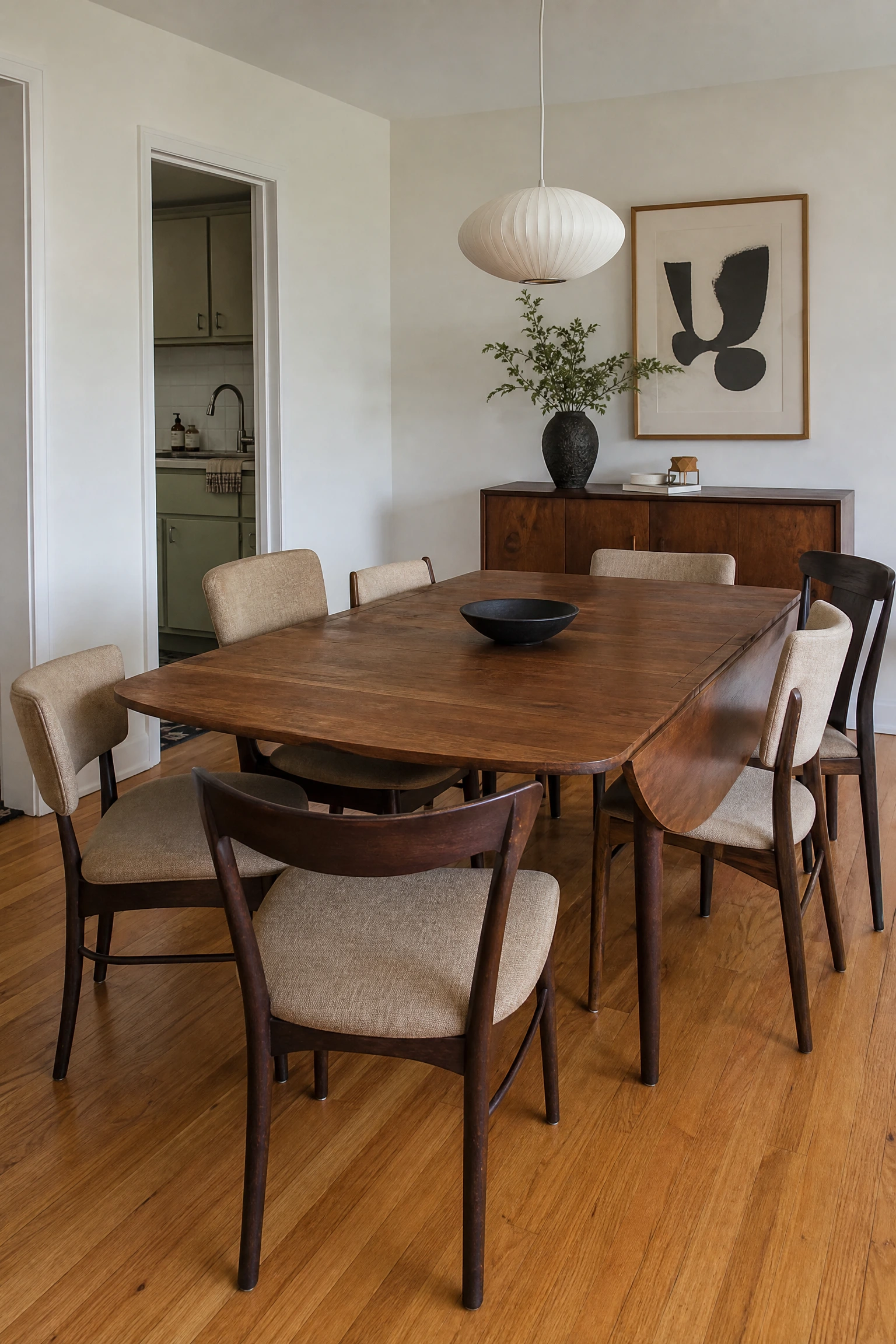
The all-new dining room – table, chairs, sideboard, pendant all purchased from the same collection or the same retailer – is looking increasingly sterile compared to schemes that mix eras and origins. One genuinely old piece – a vintage drop-leaf table, a set of mismatched mid-century chairs sourced from a secondhand market, an antique sideboard with original brass handles – gives a dining room a kind of history and personality that cannot be manufactured. The practical move is to identify one anchor vintage piece and design the rest of the room around it, which is easier than trying to mix several old pieces without a clear direction. Dining chairs are one of the best categories to source vintage because they are plentiful, relatively affordable, and easy to refresh with new upholstery while keeping the original frame. A set of vintage chairs in different finishes, recovered in the same fabric, is a well-established designer move that delivers genuine character without requiring a significant budget.
Designer Advice: Charity shops, estate sales, Facebook Marketplace, and architectural salvage yards are consistently the best sources for dining room vintage pieces – patience is genuinely the main requirement, because the right piece will turn up if you look regularly enough.
Multifunctional Dining Rooms Are Being Designed More Intentionally
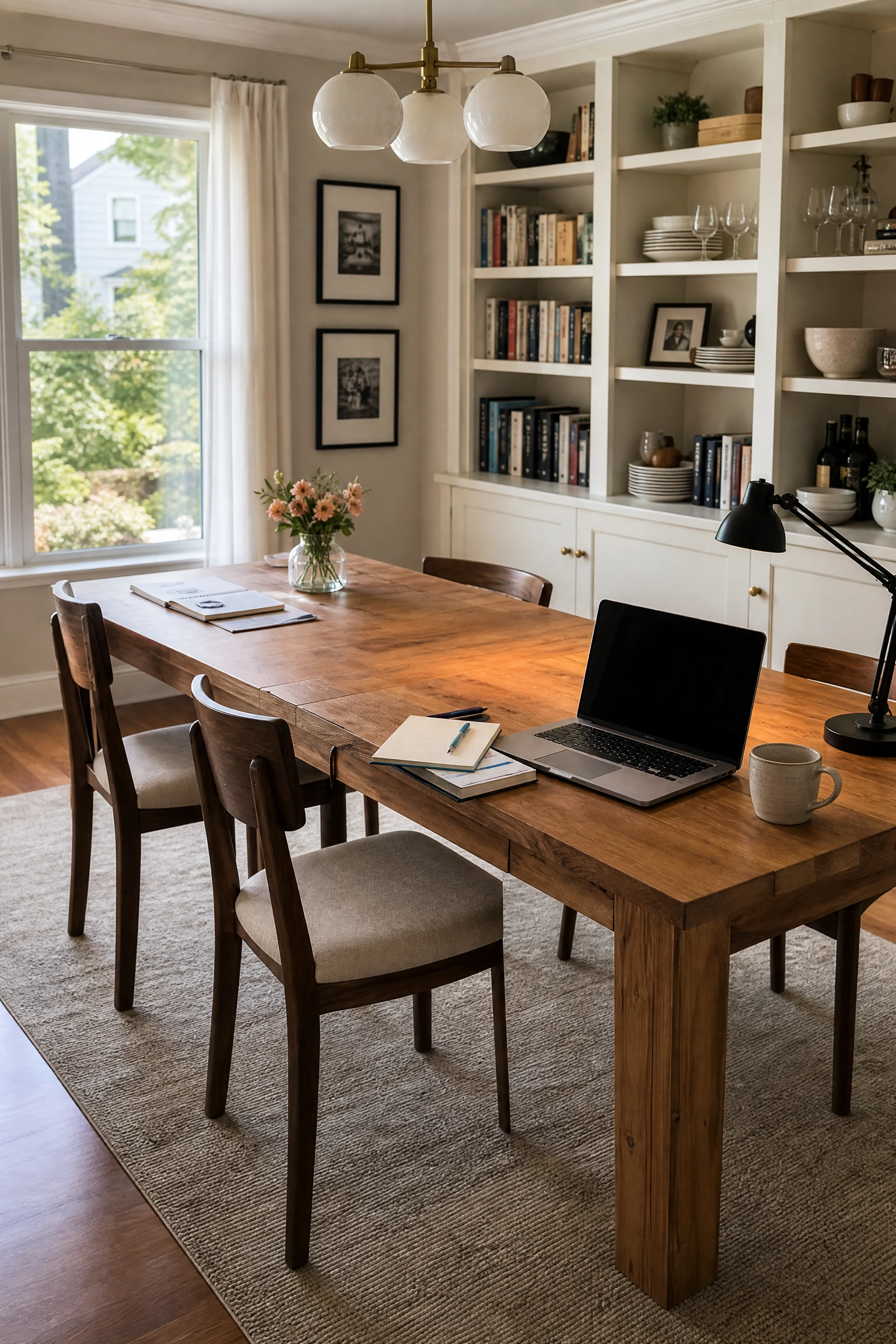
The dining table has always done double duty as a homework desk, a craft surface, and a place to sort the mail – and in 2026 that reality is being designed for rather than apologized for. Extendable tables that collapse to a compact oval for everyday use and expand for hosting, built-in storage that accommodates both art supplies and serving platters, and pendant lights on dimmers that work for both afternoon concentration and evening atmosphere are all part of this more honest approach to what dining rooms actually do day-to-day. The key design principle is that the room should be able to shift modes easily – from homework to hosting, from breakfast to dinner party – without requiring a major reset. That means storage that keeps surfaces clear, lighting that is genuinely flexible, and furniture that is comfortable enough for extended sitting regardless of the activity.
Heads Up: An extendable dining table is one of the smartest furniture investments available in small homes – look for ones with self-storing leaves built into the table base rather than separate leaves that need to be stored somewhere (which always ends up being the back of a wardrobe).
Statement Mirrors Are Earning Their Place at the Table
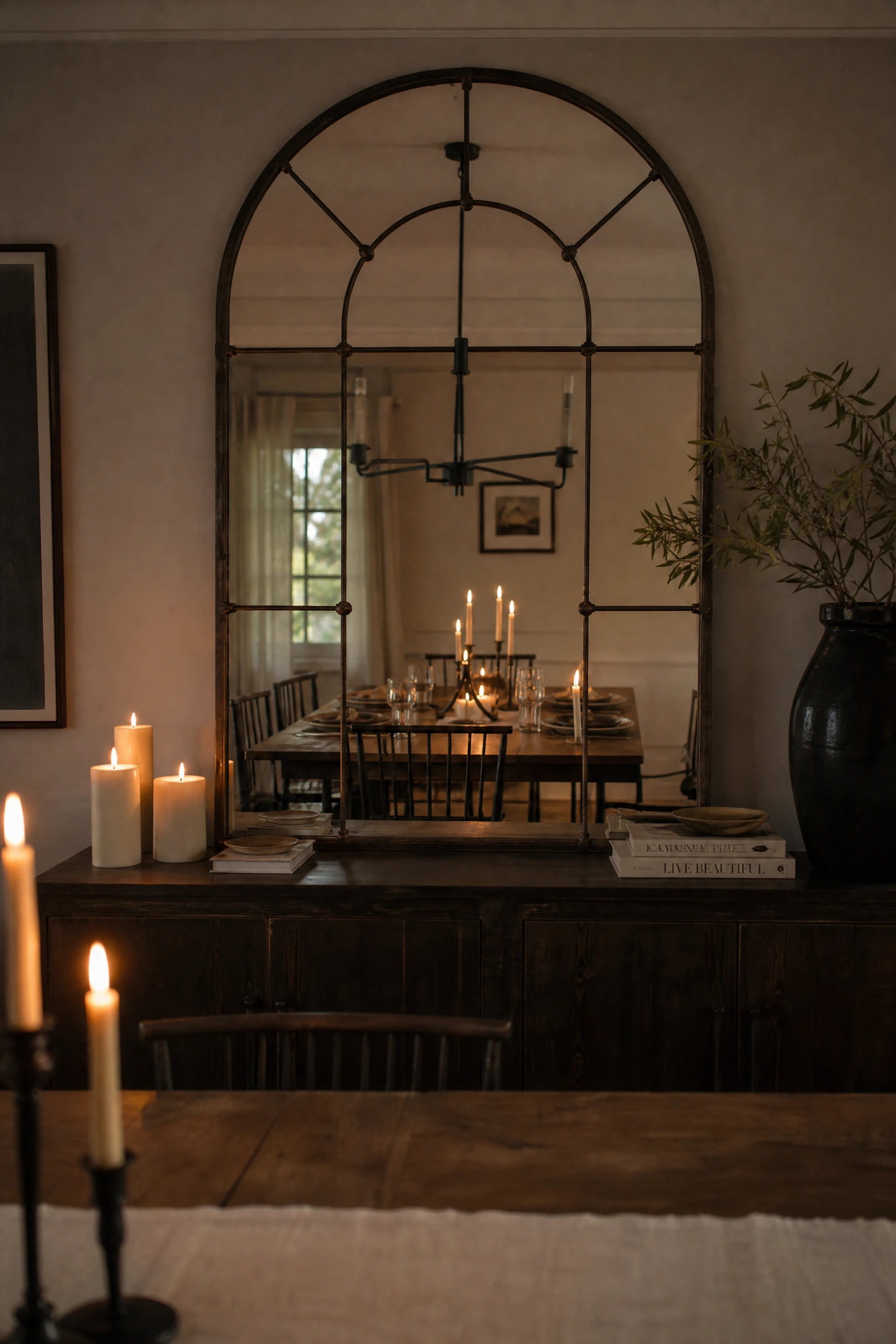
A large mirror in a dining room is one of those design moves that earns its keep in multiple ways simultaneously: it adds visual depth by creating the illusion of more space, it bounces both natural light and candlelight around the room, and a well-chosen frame contributes to the room’s overall aesthetic as a genuine decorative object. Arched mirrors in aged brass or oxidized iron frames are particularly strong right now, combining well with the warm, earthy palette that is dominant across dining room design. Positioning matters enormously – a mirror placed to reflect the window brings daylight deeper into the room, while one positioned to reflect the table itself (with candles or a floral centrepiece on it) creates a beautiful doubling effect that makes the room feel more abundant and alive in the evenings. Oversized mirrors – genuinely large, filling a significant portion of the wall – tend to work better than modest ones, which can look like an afterthought.
Pro Move: A full-length arched mirror leaning against the wall rather than hung – set behind or beside a sideboard – has a relaxed, layered quality that suits the current dining room mood perfectly and avoids the need for wall fixings if you are renting.
Indoor-Outdoor Material Continuity Is Gaining Design Momentum
Beyond simply adding plants, there is a more considered version of the indoor-outdoor trend gaining traction: using the same or closely related materials on both sides of the threshold to create a visual continuity that makes the interior feel like a natural extension of the exterior. Terracotta floor tiles that carry from a courtyard into the dining room, stone tabletops that echo the paving outside, timber ceiling beams that match an outdoor pergola, and natural plaster walls that share a color palette with garden stonework – all of these create a cohesion that feels sophisticated rather than accidental. This is most impactful in homes with direct garden access from the dining room, but the principle applies even without it: choosing materials that have an outdoor or natural character (stone, timber, clay, rattan, linen) automatically creates a room that feels grounded and connected to something beyond its own four walls.
Quick Tip: If you have terracotta, stone, or natural tile flooring in your dining room, leave some floor visible at the room’s perimeter rather than covering it entirely with a rug – the contrast between the natural floor and the rug creates a layered effect that looks much more considered than hiding the floor completely.
The Hosting Mindset Is Shaping How Dining Rooms Are Equipped
One of the quieter but more practical shifts in dining room design right now is the renewed focus on equipping the room properly for hosting – not just looking good, but functioning well when there are eight people around the table and the kitchen is a room away. That means a well-positioned sideboard or console at serving height (ideally 90 to 95 centimetres, which allows dishes to be set down without bending) so food can be plated and staged before it reaches the table. It means a decanter, a wine cooler, or even a small bar cart positioned accessibly within the dining room so drinks do not require constant trips to the kitchen. And it means lighting that can actually be adjusted from the table – via a smart switch, a remote, or a dimmer within reach – so the mood can shift from bright to atmospheric mid-meal without requiring the host to get up and leave the room. These are practical decisions with significant design implications, and they are being thought about earlier in the design process rather than retrofitted as afterthoughts.
Designer Advice: When planning a dining room from scratch or refreshing an existing one, walk through a full hosting scenario in your head before finalizing the layout – where do guests sit, where does the food land, where do the wine glasses come from, and where does the host stand? The answers often reveal gaps that furniture and lighting choices can solve before any money is spent.
Conclusion
Dining rooms are in a genuinely interesting place right now. The trends pulling them forward are not about following a single aesthetic or buying into a coordinated look – they are about making considered decisions across lighting, color, furniture, materials, and layout that add up to a room with real atmosphere and genuine personality. The shift toward warmth, texture, and intentional design in this space reflects something broader: people want their homes to feel like places worth spending time in, and the dining room is one of the most powerful rooms in the house for delivering that feeling when it is done well.
You do not need to act on all twenty-eight trends at once. The most effective approach is to identify the two or three that would make the biggest difference in your specific room – often the lighting, the wall color, and the rug size – and address those first before worrying about the rest. Most of the ideas in this article are scalable across different budgets, and some of the highest-impact moves (a dimmer switch, a repositioned mirror, a correctly sized rug) cost surprisingly little. The dining room is worth the attention. Give it what it deserves and it will become one of the rooms in your home you are most glad you thought about.
Which of these trends would actually make the biggest difference in your dining room right now? Drop it in the comments below – I would love to hear what you are working with and where you are planning to start.
Frequently Asked Questions
What is the biggest dining room design trend for 2026?
The return of the dedicated dining room as a distinct, atmosphere-driven space is arguably the most significant shift. After years of open-plan layouts absorbing dining areas into kitchen-living spaces, homeowners and designers are rediscovering the appeal of a room with its own walls, its own mood, and its own lighting – one that feels like a genuine destination rather than a throughway.
What colors are popular in dining rooms right now?
Deep, saturated tones are having a strong moment: forest green, burgundy, inky navy, terracotta, and dusty plum are all widely recommended. The approach called color drenching – applying one rich tone to walls, ceiling, and trim – is particularly popular in dining rooms because the enclosed space amplifies the effect in a way that feels intimate rather than overwhelming.
Should dining room chairs all match?
Not necessarily, and in fact a perfectly matched set of eight identical chairs is increasingly considered the less interesting choice. Mixing styles, with a unifying thread like the same material, leg finish, or fabric color, gives a room more personality. A common and practical approach is two contrasting carver or armed chairs at the table heads paired with upholstered side chairs along the length.
What size rug do I need for my dining room?
The rug needs to be large enough that all chair legs remain on it when the chairs are pulled out for sitting. As a starting rule, add at least 60 centimetres to each side of your table dimensions to find the minimum rug size – so a 180cm x 90cm table would need a rug of at least 300cm x 210cm. Many people underestimate this significantly and end up with a rug that looks like a postage stamp.
How high should a pendant light hang above a dining table?
The bottom of the pendant or chandelier should sit roughly 75 to 85 centimetres above the tabletop. This is lower than most people instinctively hang fixtures. The reason this height works is that it creates intimacy, actually illuminates the food and faces at the table, and makes the fixture feel like it belongs with the table rather than floating above the room.
Is wallpaper a good idea for a dining room?
Yes – dining rooms are actually one of the best rooms in the house for bold wallpaper because the walls tend to have fewer interruptions than other rooms, and people sit close to the walls for extended periods so the pattern actually registers. Large-scale botanicals, abstract murals, and grasscloth textures are all strong choices. If full commitment feels like too much, a single wallpapered wall behind a sideboard is a very effective starting point.