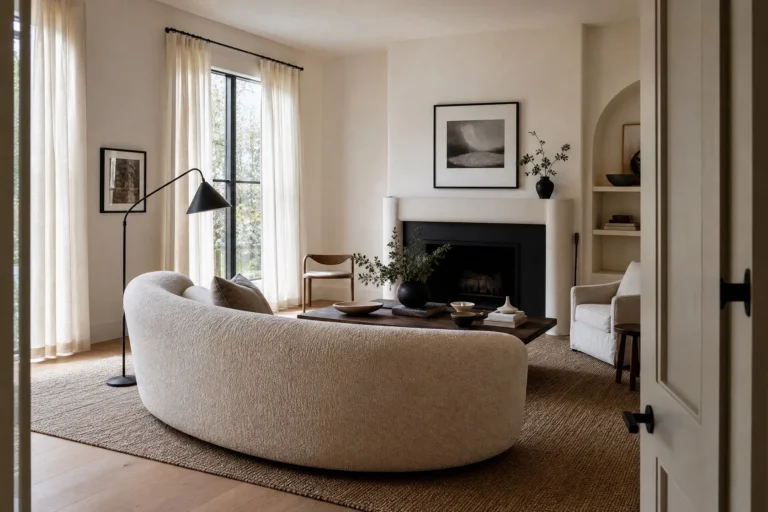
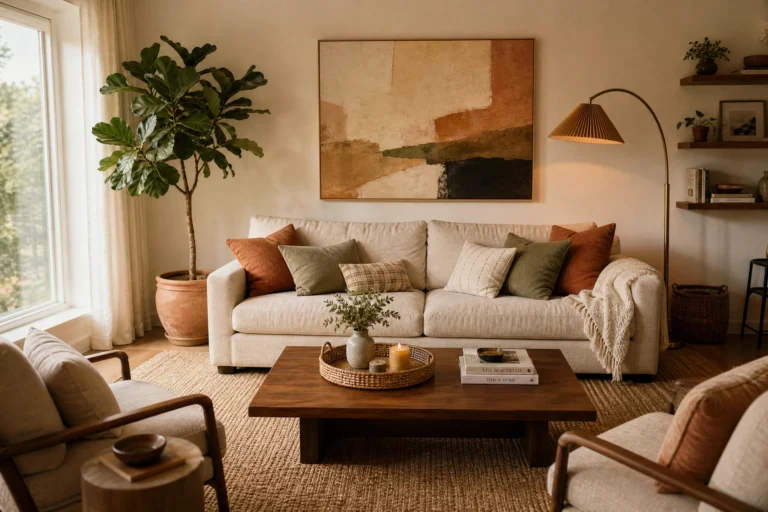
There is a reason mid-century modern keeps showing up in living rooms decade after decade. It is not because people are chasing trends. It is because the style just works. Clean lines, warm wood tones, sculptural furniture, honest materials, and a color palette that feels both bold and grounded. Those things do not go out of style because they were never purely about style to begin with. They were about living well.
The mid-century era ran roughly from the mid-1940s through the late 1960s, and the design coming out of that period was shaped by a real optimism about modern life. Designers like Charles and Ray Eames, Hans Wegner, and Eero Saarinen were making furniture that felt fresh, functional, and beautifully made. The idea was simple: good design should be available to real people living in real homes. That ethos is exactly why the look translates so well today.
What makes mid-century modern especially exciting right now is how flexible it has become. You can play it straight with a full vintage room, or you can blend it with warmer bohemian textures, sleek Japandi minimalism, or even a few maximalist touches. The foundation is strong enough to hold up to all of it. The bones of mid-century modern work in pretty much any living room size, so pick the pieces that make sense for yours and skip the rest.
This article breaks the ideas into four theme categories, each covering a different angle on mid-century modern living. Inside each category, you will find individual ideas with specifics on color, furniture, lighting, materials, and real designer advice you can act on right away. No vague inspiration, just practical direction.
Category One: The Furniture-First Approach
In mid-century modern design, furniture is the story. The silhouette of a sofa, the taper of a leg, the curve of a chair back. These rooms are built around key pieces, and everything else is chosen to complement them. If you are starting from scratch or doing a major refresh, lead with one or two strong furniture choices and build outward from there.
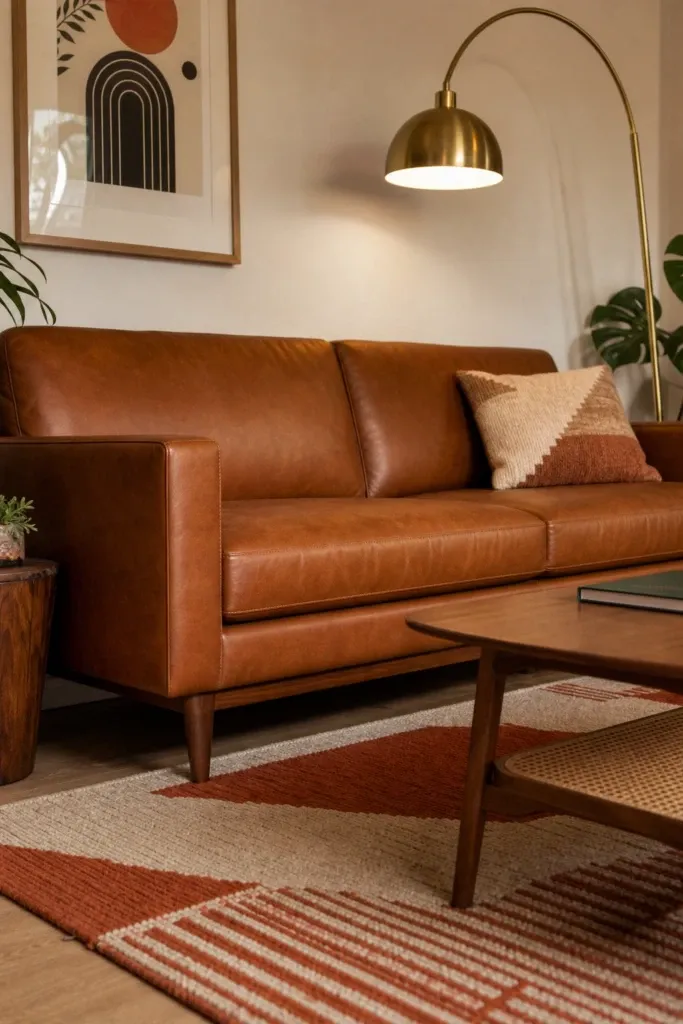
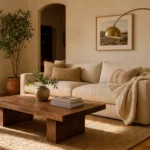
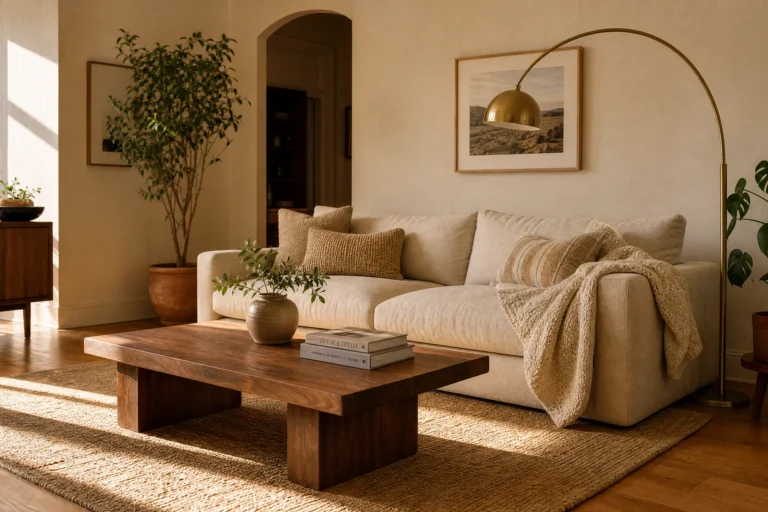
A low-profile sofa is probably the single most recognizable element of a mid-century living room, and for good reason. It creates a sense of horizontal space, makes ceilings feel taller, and gives the room a grounded, composed quality that most contemporary sofas cannot match. Look for a piece in the 28 to 30-inch height range with clean, straight arms and tapered wooden legs in walnut or teak. The legs do a lot of the visual work, so pay attention to them.
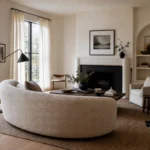
For upholstery, fabric choices matter a lot here. A boucle in warm ivory or oatmeal feels right at home with the style while adding a softer texture. Velvet in olive green, burnt sienna, or dusty teal brings color in a controlled, sophisticated way. If you go with leather, stick to a cognac or caramel tone rather than black, which reads more industrial than mid-century. Pair the sofa with a walnut coffee table that has clean edges and maybe a cane or rattan shelf underneath for a touch of lightness.
Lighting around this sofa setup should feel intentional. A sculptural floor lamp with a brass stem and an arc that reaches over one end of the sofa gives you both task lighting and a strong decorative element. Keep the rug low-pile or flatweave in a geometric pattern, and pull the sofa at least 18 inches from the wall so the space can breathe.
Designer Advice: If your budget is tight, the sofa legs are often replaceable. Buy a secondhand mid-century sofa frame in good structural condition and swap the original legs for walnut tapered ones. Hardware stores and furniture leg suppliers sell them for under $50 a set, and the difference is remarkable.
In mid-century modern living rooms, a great chair is never just extra seating. It is a focal point, a personality piece, a design conversation you can sit in. The Eames lounge chair and ottoman is the obvious choice, but it comes with a significant price tag. Fortunately, there are very good alternatives. Tulip-style chairs, barrel chairs with visible wooden frames, swivel chairs with a low rounded back, and papasan-adjacent occasional chairs with organic shapes all read convincingly mid-century without requiring a second mortgage.
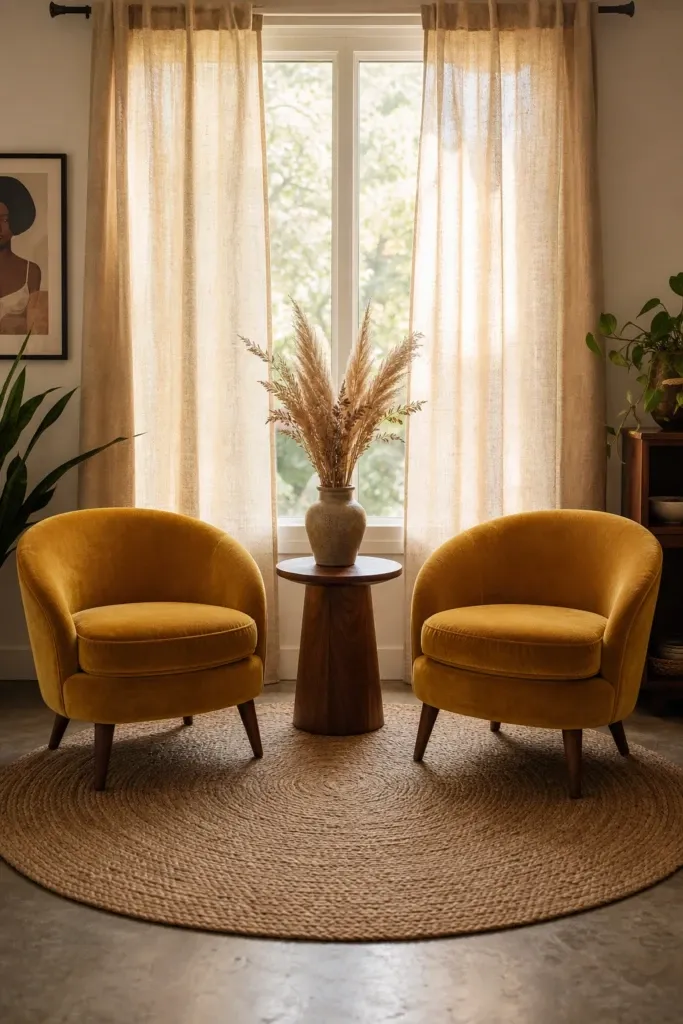
The placement of accent chairs matters almost as much as the chairs themselves. Two matching chairs flanking a fireplace or window create symmetry and a sense of ceremony. A single bold chair in a contrasting color placed at an angle to the sofa creates movement and draws the eye. The key is to avoid pushing everything to the walls. Mid-century rooms were designed around conversation, which means furniture pulled toward the center of the room and arranged with intention.
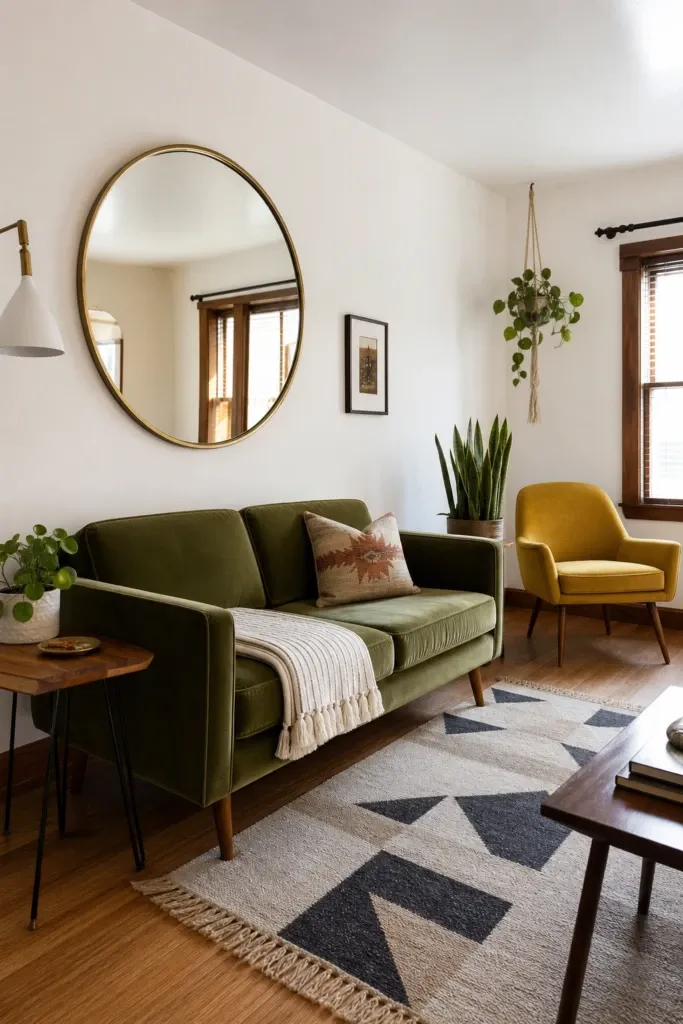
For color, consider going bolder with your chairs than with your sofa. A mustard yellow chair against an ivory sofa and walnut floors is a classic combination that has looked good for sixty years. Burnt orange, paprika red, forest green, and cobalt blue all work beautifully in this role. The chair becomes the color story of the room without overwhelming the whole space.
Designer Advice: When mixing two different accent chairs in a living room, keep one element consistent between them. That might be the leg style, the fabric texture, or the overall silhouette. Even slight variation in that one shared element ties them together without making the room feel like a furniture showroom.
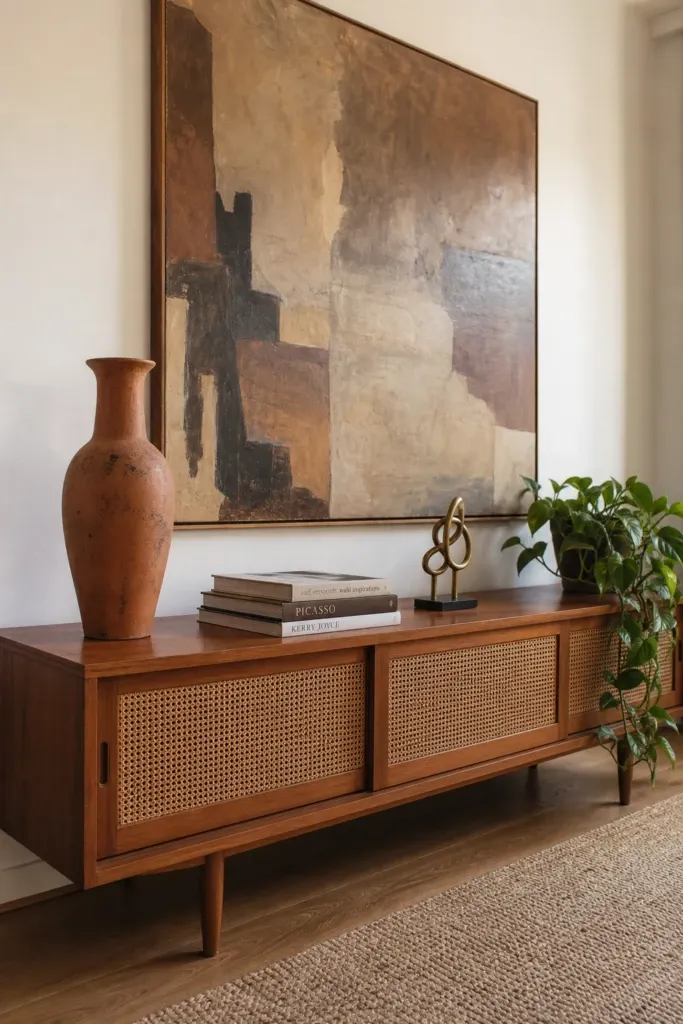
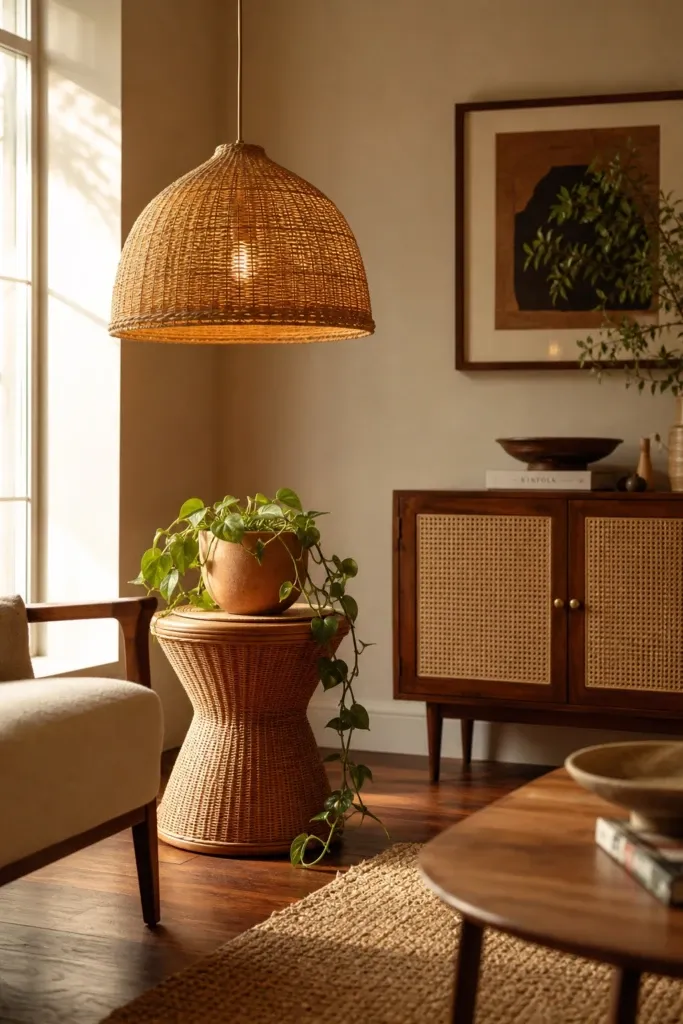
No piece of furniture says mid-century modern quite like a good credenza. Long, low, with tapered legs and clean lines, it works beautifully as a media console, a dining sideboard, or a display surface in the living room. In teak or walnut with sliding doors and cane or rattan panel inserts, a credenza brings warmth, storage, and a strong horizontal line that anchors the wall behind it.
Styling a credenza well is an art in itself. The rule of three works reliably here: group objects in odd numbers, vary the height, and mix textures. A tall ceramic vase, a short stack of art books, and a small sculptural object in brass or stone make for a composition that feels collected rather than arranged. Add a large piece of art above the credenza, hung lower than you might think, so the top edge sits roughly 6 to 8 inches above the surface.
A credenza used as a TV stand deserves special mention. Running cables through the back and hiding them inside the cabinet keeps the clean look intact. If you mount the TV on the wall above, consider a low-profile bracket so the screen sits as close to the surface as possible. The goal is to make the credenza the visual anchor, with the TV as a secondary element rather than the room’s defining feature.
Designer Advice: Authentic vintage credenzas from thrift stores, estate sales, and online marketplaces like Facebook Marketplace can be found for a fraction of retail prices. A piece with solid bones but tired wood finish can be sanded, re-oiled, and fitted with new hardware for a few hundred dollars, and it will look better than most new versions on the market.
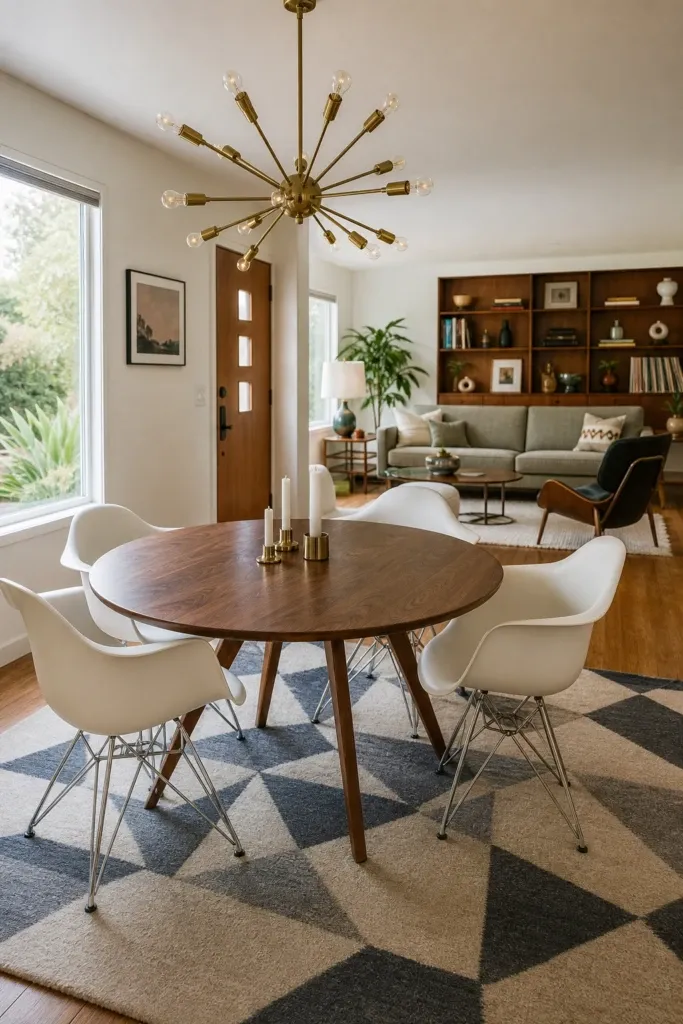
In open-plan homes, the space between the living and dining areas is an opportunity to create a cohesive mid-century modern flow. A round dining table is the perfect bridge. Round tables work better in mid-century rooms than rectangular ones because they echo the organic shapes that define the style. A tulip table in white with a pedestal base, or a walnut round table with a splayed wooden base, both read strongly mid-century and create a visual softness against all those clean lines.
Chair choice around the round table matters. Molded plastic shell chairs on wire bases are the authentic choice and still look genuinely cool. Upholstered dining chairs with a simple wooden frame work equally well and add more comfort for longer meals. Mixing a bench on one side with chairs on the other is a practical and visually interesting solution for families or those who entertain often.
Lighting over a round dining table in a mid-century home should be sculptural. A Sputnik chandelier with brass arms and globe bulbs creates an incredible centrepiece and nails the era perfectly. A woven rattan pendant gives a softer, more organic feel that works well if the rest of the room leans boho-mid-century. Either way, hang the pendant 30 to 34 inches above the table surface for the right scale.
Designer Advice: If your open-plan space makes it hard to define the dining zone, use a bold area rug under the table to create a visual boundary. A geometric or abstract pattern in warm tones works well, and it does not need to match the living room rug exactly, just coordinate with the overall palette.
Category Two: Color and Material Stories
Mid-century modern is not a neutral style. It uses color with intention, either through rich earth tones, saturated accent hues, or the contrast of warm wood against cool white. The materials in this style are equally intentional: teak, walnut, brass, wool, rattan, concrete, leather. Every surface and texture contributes to a room that feels specific and designed, not generic.
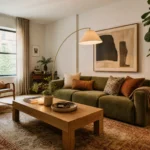
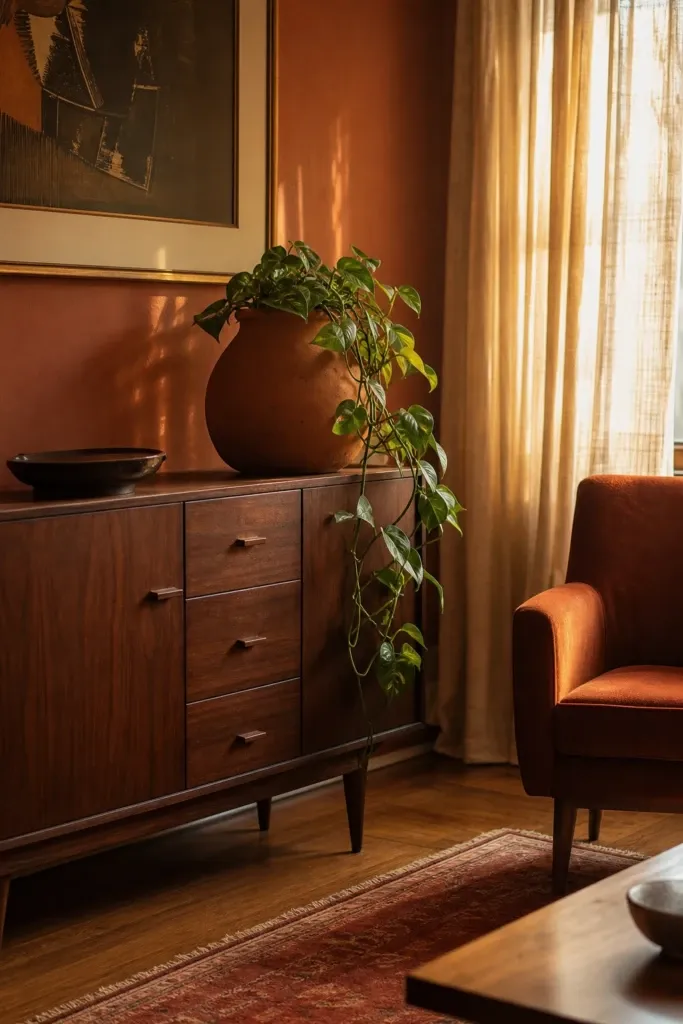
If you want a mid-century modern living room that feels warm, cozy, and immediately livable, start with an earth tone palette and let walnut wood do the heavy lifting. Warm terracotta on the walls pairs beautifully with natural walnut furniture, a cream or oatmeal sofa, and accents in burnt orange, olive, and dusty brown. This is a palette rooted in the natural world, and it creates a room that feels settled and comfortable rather than stark or overly designed.
Walnut wood appears on the coffee table, the credenza, the legs of the sofa and chairs, the bookshelf, and even the window frames if you are lucky. The more walnut you have, the richer and more grounded the room feels. For floors, solid walnut or engineered walnut with a matte finish works best. If you have existing light or neutral flooring, area rugs in rust, ochre, or deep brown can help anchor the palette from the ground up.
Textiles play a crucial supporting role here. Wool throws in mustard or rust, linen cushions in warm cream, a jute or wool-blend area rug with a low pile, and curtains in a natural linen or cotton canvas all contribute texture without competing with the furniture. The goal is a room that feels layered and warm, not decorated for a photoshoot.
Designer Advice: If walnut furniture is out of budget, look for pieces in acacia, mango, or rubberwood finished in a warm mid-brown stain. From a distance, these read very similarly to walnut, and the savings can be redirected to one investment piece, like a solid walnut coffee table that anchors the whole look.
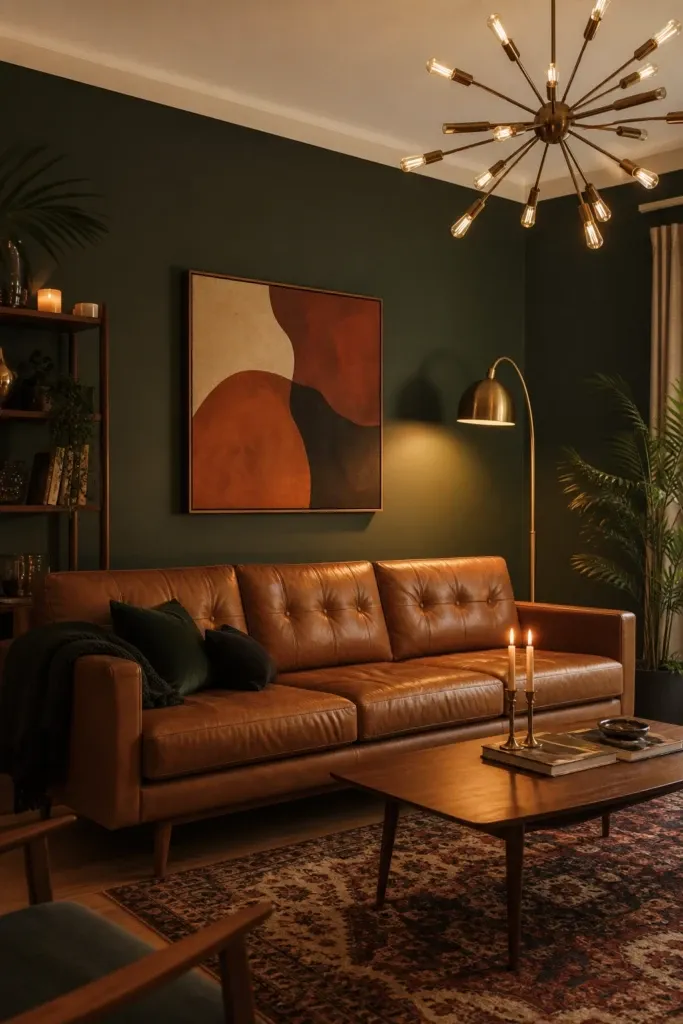
One of the most dramatic ways to bring mid-century modern into a living room is to go dark on the walls. Deep forest green, charcoal, navy, or a warm brown-black creates an intimate, almost cinematic quality that makes warm wood furniture and brass accents absolutely glow. This is not a look for the timid, but it is deeply rewarding when done well. The key is making sure the room has enough light sources to prevent the space from feeling oppressive.
Against a dark wall, a caramel leather sofa looks incredible. So does an olive green velvet chair, or a rust-colored cushion arrangement on a natural linen sofa. The contrast of warm tones against a dark backdrop is a trick that interior designers have used for decades because it creates richness and depth without the need for expensive finishes or complicated layering.
Lighting strategy is essential in a dark-walled room. You need multiple sources at different heights: a floor lamp in the corner, a table lamp on the credenza, sconces flanking a mirror or piece of art on the wall, and perhaps a sculptural pendant in the centre of the room. The more lighting layers you build in, the more control you have over the mood at different times of day. Warm Edison or globe bulbs in the 2700K to 3000K range keep everything feeling cozy rather than cold.
Designer Advice: If you are nervous about committing to dark paint throughout the room, try an accent wall behind the main sofa or credenza first. A single dark wall creates the drama and depth you are looking for without the full commitment, and you can always extend it once you see how the room responds.
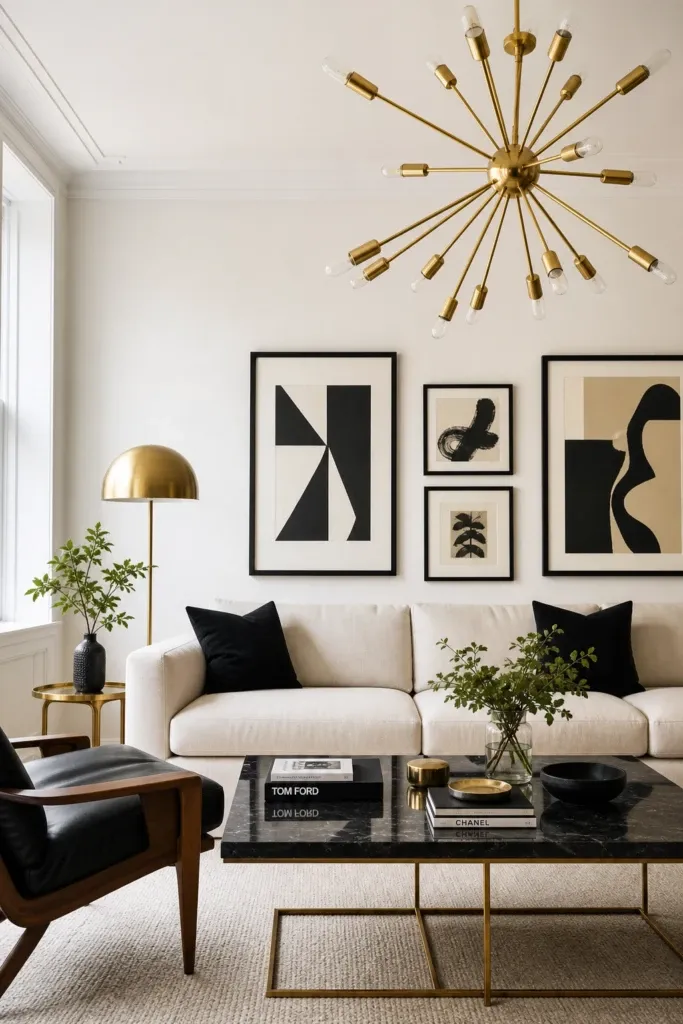
Brass and black is one of the most sophisticated color combinations in mid-century modern design, and it works in every type of space from a compact apartment living room to a large open-plan area. The combination is graphic and elegant at the same time. Think black metal table legs paired with a brass pendant light, or a black marble coffee table surface on a brass base. The contrast is clean and striking without feeling cold.
This palette works best when the rest of the room is anchored in warm neutrals. An ivory or cream sofa, light wood floors, and curtains in a warm white or soft greige create the backdrop. Against that, the brass and black accents read sharply and intentionally. Cushions in charcoal, deep teal, or burgundy add color without disrupting the graphic quality of the metal combination.
Accessories in this palette are easy to source because brass and black are perennially popular. Brass candlestick holders, a black ceramic vase, brass-framed mirrors, and black picture frames with gallery-style art all work beautifully together. The trick is restraint. Pick two or three key pieces in brass and two or three in black, and let them breathe against the neutral background. Too much of either metal makes the room feel like a hardware catalogue.
Designer Advice: Unlacquered brass develops a natural patina over time, shifting from a shiny gold to a warmer, slightly matte finish. If you love the aged look, go unlacquered and let it develop naturally. If you want to maintain the bright finish, choose lacquered brass and wipe it down occasionally with a soft cloth.
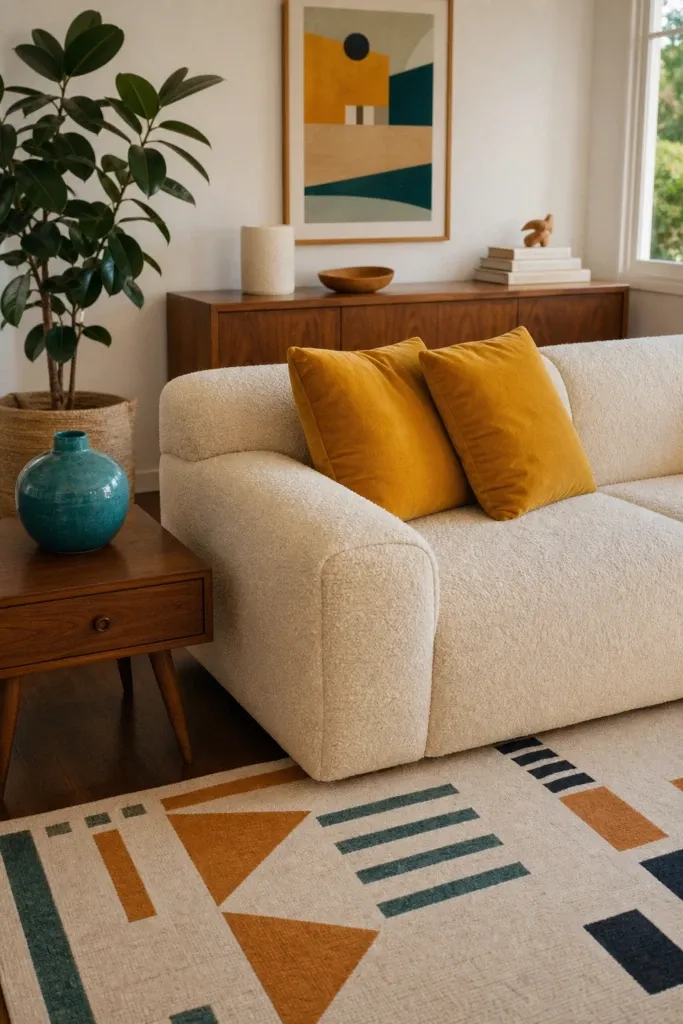
Mustard yellow, teal, and warm cream is arguably the most iconic color trio in mid-century modern design. You have probably seen it in vintage Danish and American interiors from the 1950s and 1960s, and it looks just as fresh today. The combination works because mustard brings warmth and energy, teal brings depth and calm, and cream ties the two together without competing. Add walnut wood to the mix and you have a complete, satisfying palette.
The best way to use this color combination is to let cream dominate. A cream or ivory sofa and walls take up the most visual space. Mustard shows up in one or two accent chairs, or in large cushions and a throw on the sofa. Teal appears in a smaller, more deliberate way: a ceramic vase, a single side table, a piece of artwork, or a table lamp shade. When the proportions are right, the room feels balanced and joyful without looking like a theme park.
For flooring, this palette works beautifully with medium-toned wood or a large area rug in cream or natural jute. Avoid very light wood floors, which can wash out the warm tones, or very dark floors, which shift the room too dramatically toward contrast. Curtains in a warm linen or a lightweight cream cotton let in light while keeping the palette consistent from floor to ceiling.
Designer Advice: If you already have furniture in neutral tones and want to add this color combination without replacing major pieces, start with a set of cushions in mustard and teal, a throw in one of those tones, and one ceramic or glass accessory in the other. You can test the palette before committing to anything bigger.
There is a version of mid-century modern that leans toward simplicity, where white walls form a clean backdrop that lets the furniture and wood tones do everything. This approach is particularly effective in smaller living rooms because it maximizes light, keeps the room from feeling crowded, and lets individual furniture pieces read clearly without visual noise competing behind them.
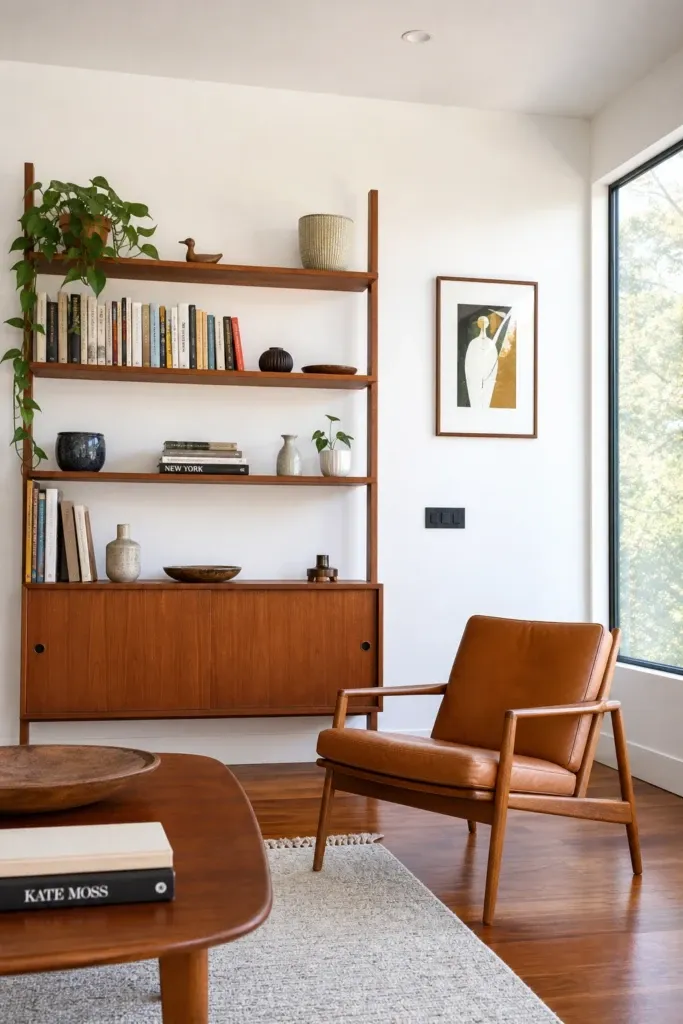
On white walls, warm teak or walnut furniture takes on a sculptural quality. A teak shelving unit filled with plants, books, and ceramics becomes a living installation against a white wall. A leather sofa in cognac or saddle brown looks luxurious and grounded. The contrast between warm, natural wood and cool white creates a tension that is energizing rather than stark, especially when softened with textiles and greenery.
White-on-warm-wood rooms need plants. Not as an afterthought, but as a structural element. A large fiddle leaf fig in the corner, a trailing pothos on the credenza, a few small cacti or succulents on the window ledge. Greenery pulls organic life into the room in a way that connects to the mid-century ethos of bringing nature indoors. It also adds the layered color story that white walls alone cannot provide.
Designer Advice: When working with white walls, pay close attention to undertone. A warm white with yellow or pink undertones will feel cozy and comfortable next to wood furniture. A cool white with blue or grey undertones can feel clinical. Test a sample in your specific light conditions before committing to the full room.
Category Three: Light, Texture, and Layering
Mid-century modern living rooms at their best are never flat. They have a layered quality built from different light sources, textural contrasts, and a thoughtful mix of soft and hard surfaces. This category covers the details that separate a room that looks pulled-together from one that just happens to have mid-century furniture in it.
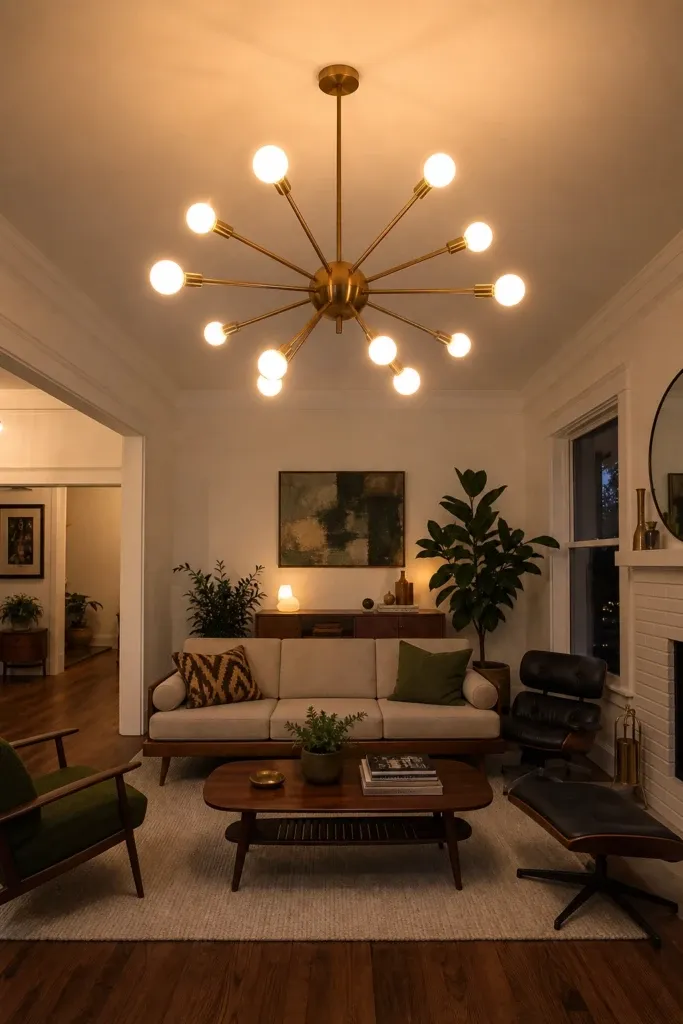
Few lighting fixtures are more definitively mid-century modern than the Sputnik chandelier. Named for the Soviet satellite, it debuted in the late 1950s and has never really gone away. A Sputnik pendant with brass arms and globe bulbs is an instant focal point in any room, and it reads equally well in a small apartment living room or a double-height great room. The key is scale: choose a fixture that is at least one-third the width of your seating area so it registers properly in the space.
In terms of installation, a Sputnik works best hung in the centre of the room over a coffee table or conversation area, rather than pushed to one side. It should hang low enough to feel present without being a head hazard. Generally, 7 to 8 feet from the floor to the bottom of the fixture is the right range in rooms with standard ceiling heights. In rooms with higher ceilings, you can go a few inches lower to pull the fixture into the living zone.
Pair a Sputnik chandelier with softer, warmer supplementary lighting at eye level and below. Table lamps on side tables, a floor lamp in the reading corner, and perhaps a small LED strip inside a bookshelf or along the back of the credenza create a layered effect that makes the Sputnik the star without leaving the rest of the room in shadow.
Designer Advice: Sputnik chandeliers vary wildly in price from under $100 to several thousand dollars. The biggest difference is usually in the quality of the bulbs and the finish. Opt for a version with E12 or E14 candelabra sockets so you can use standard filament or globe LED bulbs easily, and choose a matte or brushed brass finish over polished for a more sophisticated, less popular right now look.
Rattan and cane are the natural texture story in mid-century modern design, and they have made a massive comeback in recent years for very good reason. Cane panels on cabinet doors, rattan pendant shades, rattan side chairs, woven rattan trays, and even rattan-wrapped lamp bases all bring an organic lightness to rooms that might otherwise feel too heavy with solid wood and upholstered furniture.
The material works well in any color palette. Against a white wall with walnut furniture, rattan reads warm and handcrafted. Against dark walls, it glows. Against the mustard-teal-cream palette, it adds a boho softness that keeps things from feeling too graphic. Because rattan is relatively light in color, it functions almost like a neutral: it plays well with almost everything.
For living rooms specifically, the best place to introduce rattan is in a light pendant shade over a reading corner or dining area, in a side table or plant stand, or in a small accent chair. Rattan furniture used sparingly reads as a considered design choice. Used throughout the whole room, it can feel more boho than mid-century, which is fine if that is the blend you are going for but worth knowing in advance.
Designer Advice: If you already have a wood-framed piece of furniture with solid panel doors, like a sideboard or media cabinet, consider retrofitting it with cane panel inserts. You can find pre-made cane webbing sheets online, cut them to size, and attach them to the door frames with a staple gun and trim strips. The project takes an afternoon and completely changes the look of the piece.
Rugs in mid-century modern living rooms do more than cover floors. They define zones, add softness underfoot, and bring pattern and color into the room in a controlled way. A good area rug should be large enough that the front legs of all major seating pieces sit on it, which is typically a 9×12 or 8×10 in most standard living rooms. Going too small with a rug is one of the most common decorating mistakes, and it makes even well-furnished rooms feel disconnected.
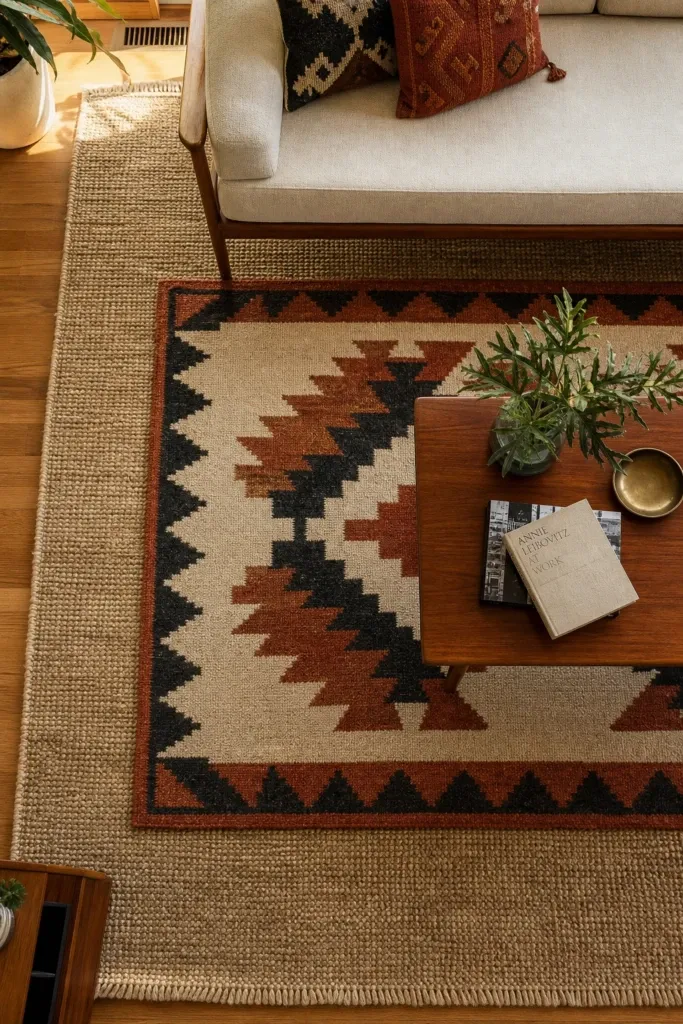
For mid-century modern, the right rug has either a geometric pattern, a subtle abstract design, or a flat solid texture like a natural jute or wool flatweave. Moroccan-inspired geometric patterns work beautifully here because their bold, graphic quality complements the clean furniture silhouettes. A natural jute rug layered under a smaller geometric wool rug creates depth and warmth, especially on hard floors.
Color in the rug is a great opportunity to introduce a tone that appears in smaller amounts elsewhere in the room. If your accent chairs are mustard, find a rug with mustard as one of its colors. If your cushions are teal, look for a rug that pulls teal into its pattern. The rug becomes the visual anchor that makes the whole room feel deliberately planned rather than assembled piece by piece.
Designer Advice: Natural fiber rugs like jute, sisal, and seagrass are affordable and genuinely beautiful, but they can feel rough underfoot and are hard to clean. Layering a smaller, softer wool or cotton rug on top solves both problems. You get the earthy texture of the natural base and the softness of the top rug right where you need it, in front of the sofa or in the seating area.
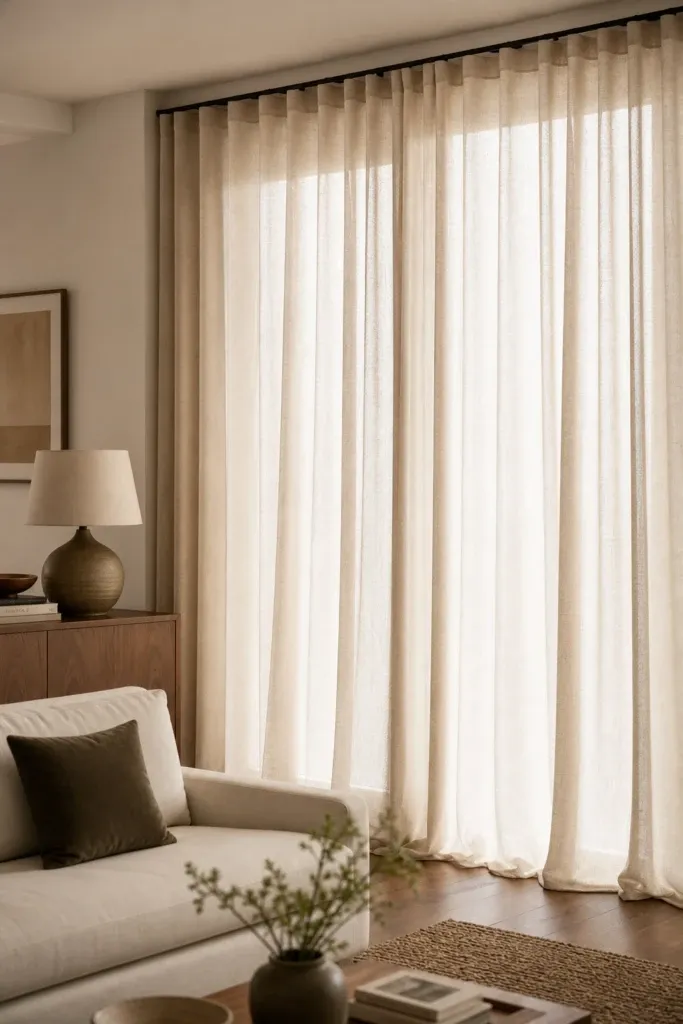
Floor-to-ceiling curtains are not exclusively a mid-century modern trick, but they work particularly well in this style because they add height, drama, and softness to rooms that might otherwise feel very linear and horizontal. In mid-century homes, which were often designed with large windows and connections to the outdoors, long curtains frame those windows beautifully and create a sense of proportion that shorter window treatments simply cannot.
For fabric, linen is the top choice in most mid-century rooms. It is natural, slightly textured, lets in a soft diffused light when closed, and comes in a range of warm neutral tones that coordinate easily with wood furniture and earth tone palettes. Avoid very sheer fabrics that read more contemporary or very heavy blackout materials that feel more bedroom than living room. A medium-weight linen in cream, oatmeal, sage, or terracotta hits the right note in almost any mid-century space.
The hardware for floor-to-ceiling curtains should be simple and strong. A brass or matte black curtain rod installed a few inches below the ceiling, extending several inches beyond the window frame on each side, makes the window look larger and the ceiling look higher. Clip-top rings or a simple eyelet heading keeps the look clean and unfussy, which is exactly what mid-century style calls for.
Designer Advice: To make standard-length curtain panels work as floor-to-ceiling treatments without the cost of custom-length drapes, hang the rod as high as possible and let the fabric pool very slightly on the floor. A small puddle, no more than an inch or two, looks intentional and luxurious. It is a trick used constantly in interior design shoots and showhouses.
Category Four: Modern Blends and Personal Touches
The most interesting mid-century modern living rooms today are not pure period reconstructions. They mix the foundational elements of the style with contemporary influences, personal collections, and updated materials that feel current without abandoning the character of the original aesthetic. This category explores those hybrid approaches.
The overlap between mid-century modern and Japandi, the Japanese-Scandinavian design blend that has been everywhere for the last few years, is more natural than you might think. Both styles value natural materials, functional simplicity, and a restrained approach to decoration. Where they differ is in tone: mid-century can afford to be playful and a bit bold, while Japandi leans quieter and more austere. Blending the two produces something warm, calm, and genuinely beautiful.
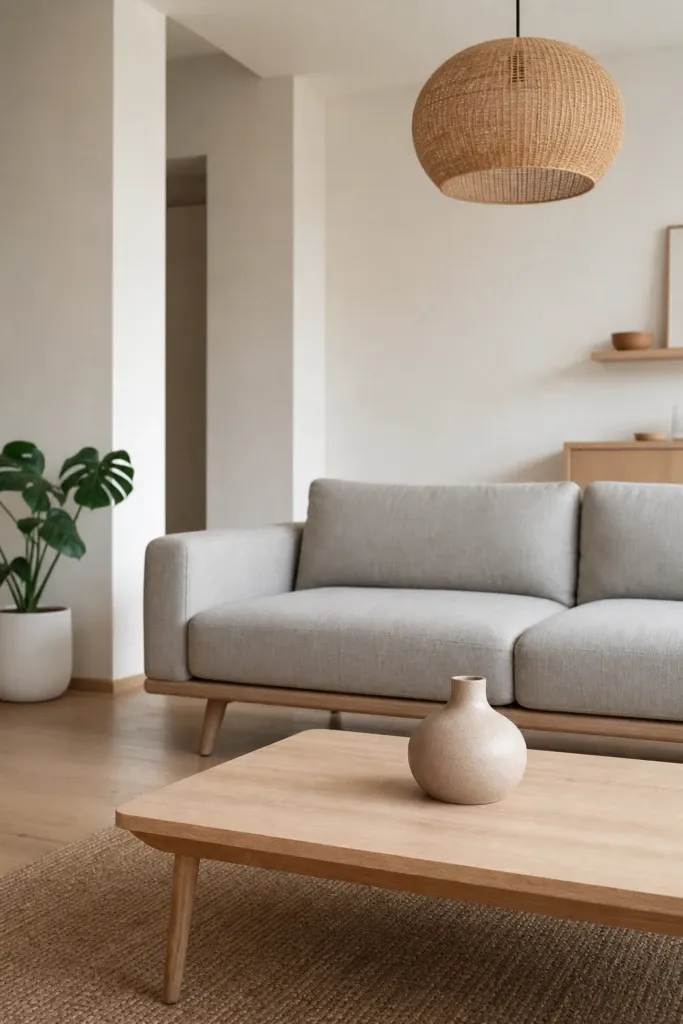
In practice, this hybrid looks like a room with mid-century silhouette furniture in lighter wood tones, muted and natural color palette, very little decorative clutter, and an emphasis on quality over quantity. A low-profile sofa in a soft warm grey linen, a pale ash or maple wood coffee table with tapered legs, and a single statement ceramic object on the mantel. The room breathes. Nothing competes for attention. The overall effect is restful and composed.
Textural layering is especially important in a Japandi-mid-century blend because the color palette is so quiet. A natural linen sofa, a wool rug in ivory or pale warm grey, a rough clay vase, a smooth maple surface, and a woven rattan pendant shade all work together to create sensory interest without visual noise. Green plants are essential in this hybrid: they are the life source of both design philosophies.
Designer Advice: The Japandi blend works best when you resist the urge to add more. Every item in the room should earn its place. Before adding a decorative object, ask whether it adds meaning, beauty, or function. If the answer to none of those is yes, leave it out. Editing is the most underrated design skill.
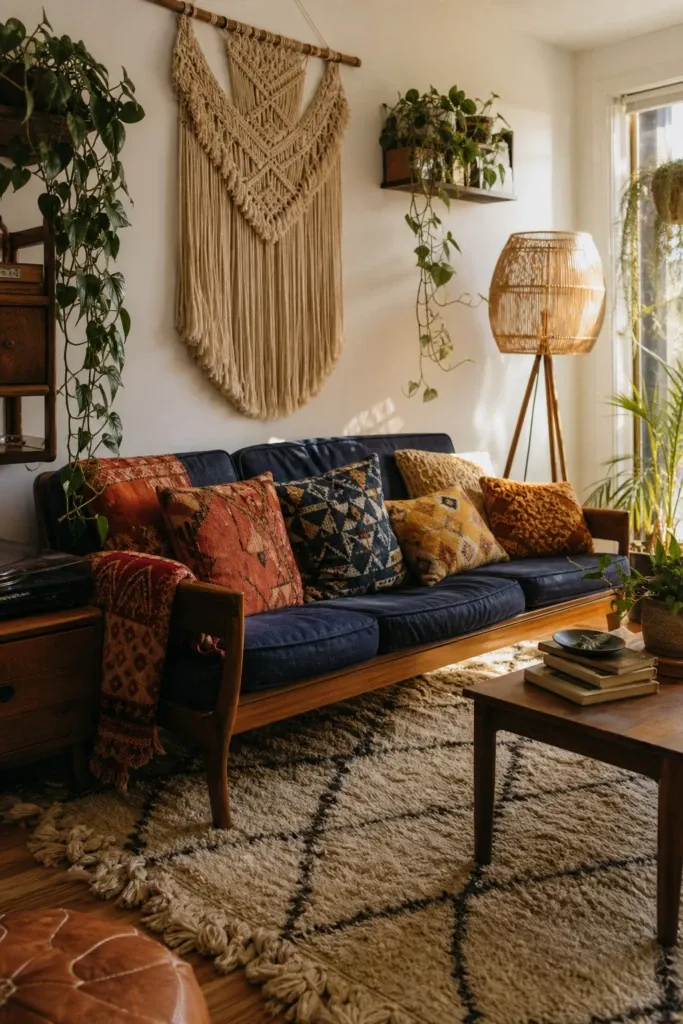
If the Japandi blend leans toward restraint, the boho-mid-century mix leans the other way, toward warmth, personality, and a sense that this room has been assembled over time by someone with genuine taste. Mid-century furniture provides the structural backbone: the low sofa, the walnut credenza, the iconic chairs. Into that framework, bohemian elements add color, texture, and an unstudied quality that prevents the room from feeling too designed.
In this blend, the rug is often the starting point. A Moroccan Beni Ourain or a vintage Turkish kilim in deep reds, oranges, and blues grounds the whole room and tells you immediately what direction the design is heading. From there, layer in macrame wall hangings or woven textiles, mixed-media cushions in multiple patterns, a statement rattan or wicker piece like a large hanging chair or a woven floor lamp, and plenty of trailing and draping houseplants.
The key to making this blend feel cohesive rather than chaotic is keeping the furniture itself relatively simple and true to mid-century form. The more sculptural and boho the accessories, the cleaner the furniture needs to be. A very ornate chair competing with a macrame wall hanging and a patterned rug will look like too much. But a clean-lined walnut sofa and simple teak side tables let the boho layers breathe and take center stage.
Designer Advice: Genuine vintage finds are the best shortcut to the collected, layered quality of a boho-mid-century room. Thrift stores, estate sales, and online vintage shops all carry the ceramic pieces, woven textiles, and small wooden objects that make a room feel intentional over time. Budget $100 to $200 for a few key accessory finds and they will do more for the room than a brand-new decorative set from a chain retailer.
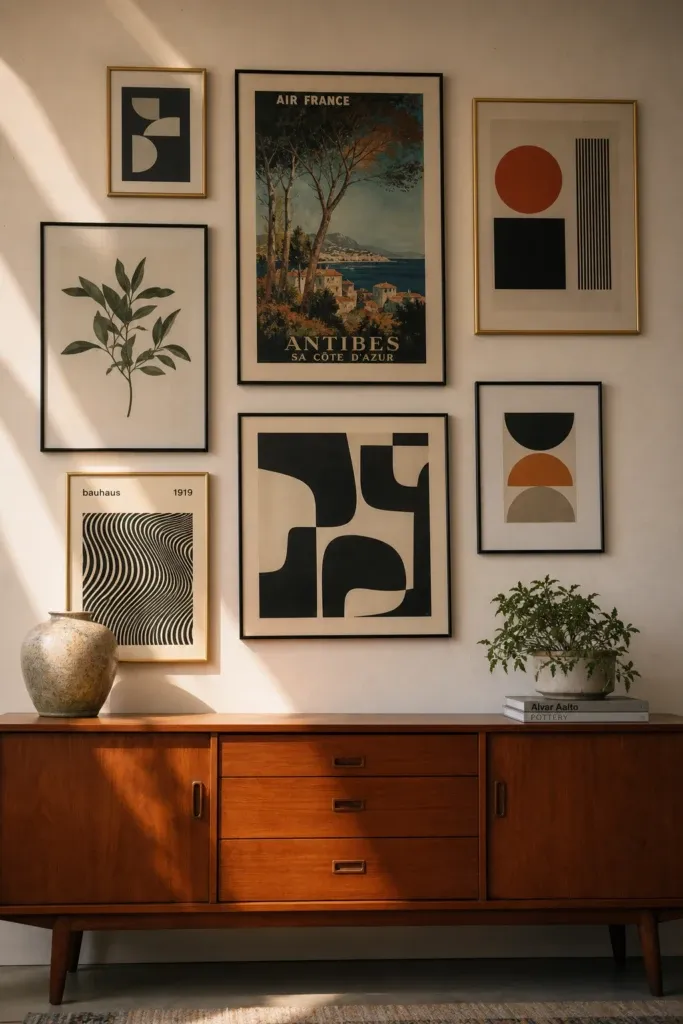
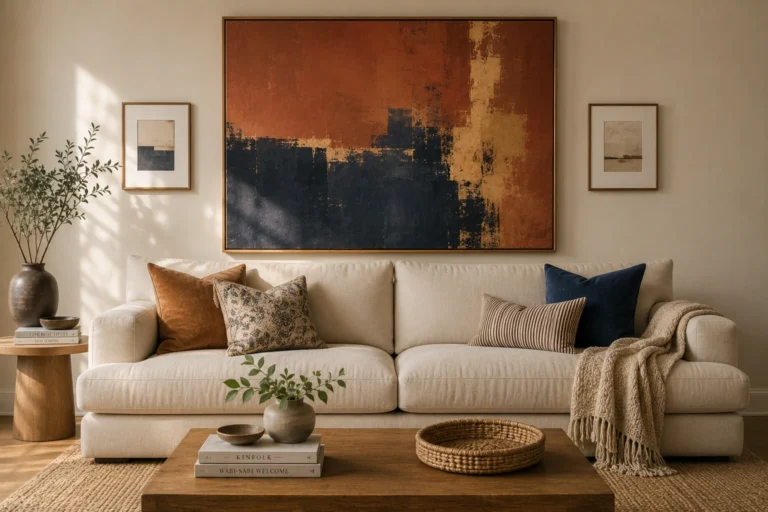
Mid-century modern living rooms are not complete without art, and a gallery wall done in the right spirit is one of the most effective ways to bring personality and visual interest to the space. The key distinction from a generic gallery wall is curation. Mid-century-appropriate art includes bold abstract prints, vintage travel and advertising posters, geometric compositions, botanical illustrations, and original paintings or prints from the era or in that spirit. The frames should be simple: thin wood, brass, or black metal.
For arrangement, the mid-century gallery wall looks best when it follows a horizontal or loosely grid-like structure rather than the asymmetric scatter approach more common in contemporary gallery walls. A row of three matching frames above the credenza is a classic choice. A slightly irregular grid of five or seven pieces, all hung at the same eye level with consistent spacing, reads deliberately organized without being rigid. Keep the spacing between frames tight, around 2 to 3 inches, for a composed, gallery-quality look.
Art does not need to be expensive to look good in this context. Digital art prints downloaded and printed at a local print shop, vintage magazine pages framed behind glass, original works from emerging artists found on Etsy or at local markets, and even oversized photographs or botanical specimens all work beautifully. The frame does a lot of the work in making art look considered, so invest more in a good frame than in the print itself if budget is a concern.
Designer Advice: Before hammering a single nail, lay your gallery wall arrangement out on the floor first. Adjust until the composition feels right, measure the whole arrangement, and then transfer it to the wall using a paper template or painter’s tape. This saves enormous time and prevents unnecessary holes in the wall.
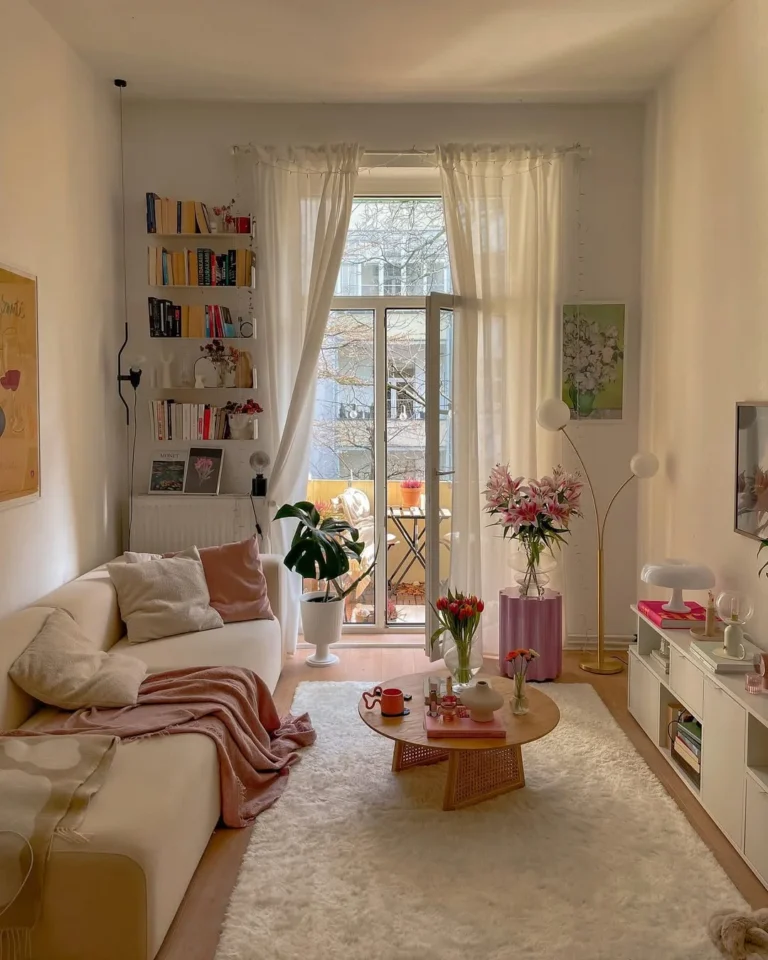
Small living rooms are actually excellent candidates for mid-century modern design, because the style’s emphasis on low-profile furniture, clean lines, and a limited palette works naturally in tight spaces. The worst thing you can do in a small room is fill it with bulky furniture that crowds the floor plan. Mid-century sofas and chairs, with their tapered legs and horizontal silhouettes, lift the furniture visually off the floor and create breathing room even in a compact space.
In a small living room, multifunctional furniture earns its place. A hairpin-leg side table that can double as a desk, a storage ottoman that works as a coffee table and extra seating, a narrow but tall bookshelf that draws the eye upward without consuming floor space. The goal is to furnish the room sufficiently without overfurnishing it, which means being disciplined about what actually needs to be in the space versus what is just filling it.
Color in a small mid-century modern living room should be used strategically. Light walls, especially white or a very warm cream, keep the room feeling open. Introduce color through furniture upholstery, cushions, and a few accessories rather than painting the walls a deep tone. One bold accent chair in mustard or burnt orange becomes the personality of the room without closing the space in.
Designer Advice: Mirrors are your best friend in a small mid-century living room. A large round or oval mirror with a thin brass or wooden frame hung above the credenza or sofa reflects light, adds depth, and looks completely at home in the style. A 30 to 36-inch mirror does the work of a much more expensive design intervention.
18. Bringing the Outdoors In with Biophilic Elements
Mid-century modern design has always had a close relationship with the natural world. The architects and designers of that era were deeply interested in connecting interior spaces to the landscape outside, through large windows, natural materials, and an honest palette drawn from earth, stone, wood, and plant life. Biophilic design, the contemporary idea of intentionally incorporating nature into interiors, is a natural extension of those same principles.
In a mid-century modern living room, biophilic elements go beyond just adding a few plants. Think about natural light as a design material: arrange furniture to maximize how sunlight moves through the room throughout the day. Think about natural materials at every surface: wool rugs, linen curtains, rattan accessories, clay pots, wood furniture, stone coasters. Think about views: if you have a window that looks out onto trees or a garden, orient the seating to take advantage of that view rather than ignoring it.
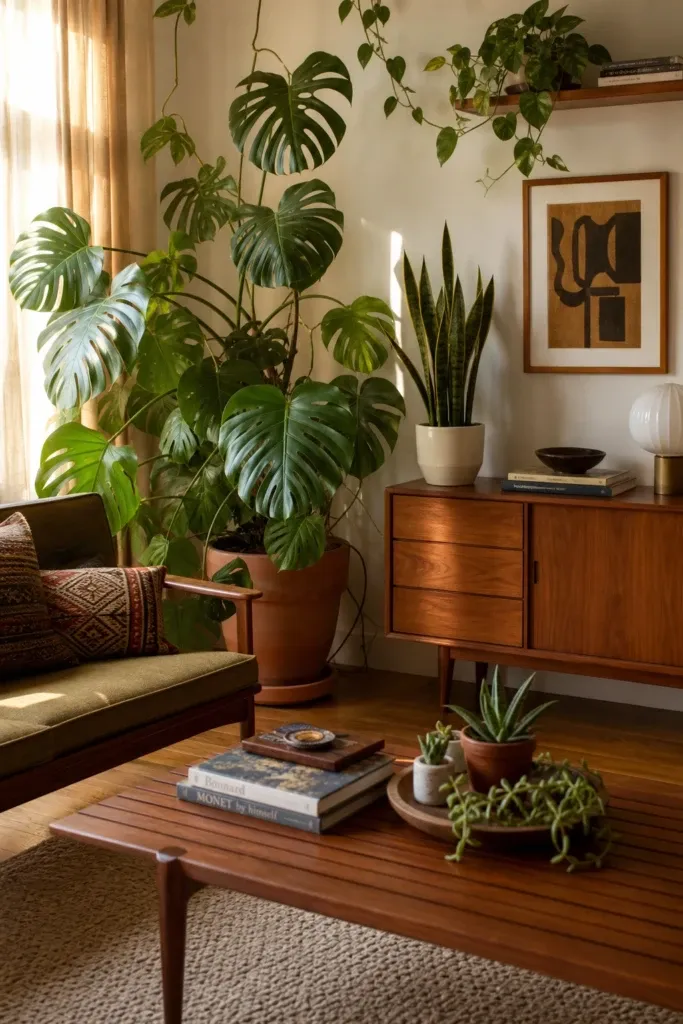
Plants themselves should be chosen for both visual impact and the character they bring to the room. A large monstera deliciosa in a terracotta pot is a mid-century classic. A snake plant in a geometric ceramic pot adds graphic structure. A trailing pothos on a high shelf or credenza adds movement and softness. A low-bowl of succulents on the coffee table adds an earthy moment at eye level when seated. Vary the heights, pots, and plant types so they feel like a collection rather than a matching set.
Designer Advice: If you struggle to keep plants alive, focus on the most forgiving varieties. Snake plants, ZZ plants, pothos, and cast iron plants survive low light, irregular watering, and a fair amount of neglect. They look genuinely good in mid-century modern rooms, and they give you the biophilic quality you are after without becoming a maintenance burden.
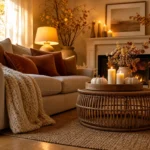
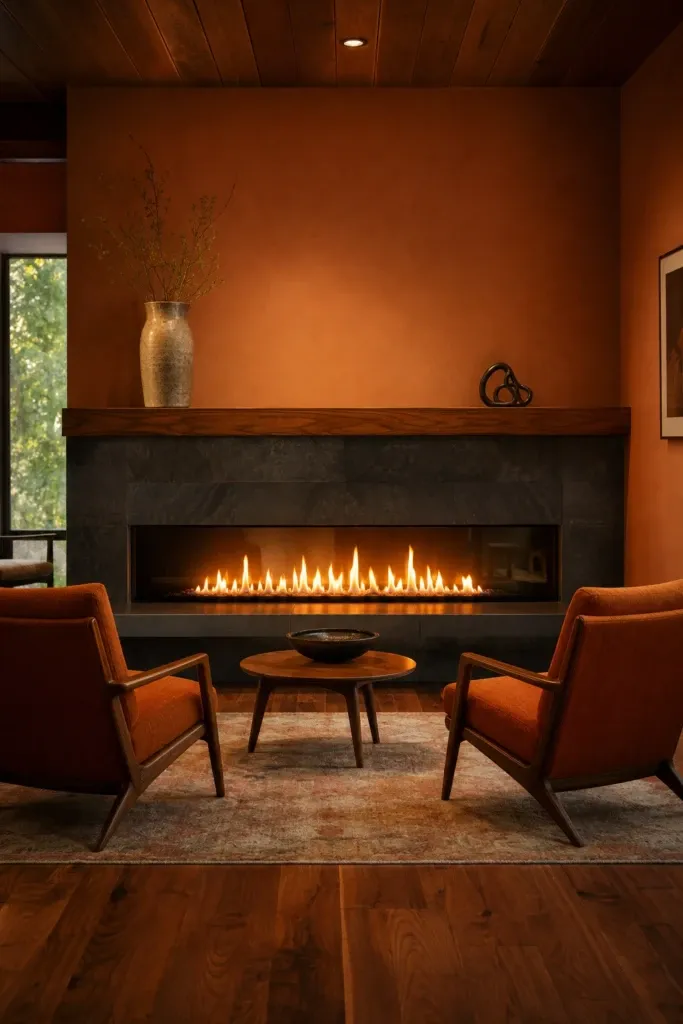
A living room with a fireplace has a ready-made focal point, and in a mid-century modern space, that fireplace wall is an incredible canvas. Many mid-century homes were designed with statement fireplaces, from the ribbon fireplace running low and horizontal across a wall to the circular or cone-shaped freestanding fireplace that sat in the centre of a room. If you have one of these, celebrate it. If you have a more standard box fireplace, there are still ways to give it a mid-century update.
Surround materials make all the difference. Concrete, slate, matte tile, and bare brick all read appropriately mid-century and ground the fireplace without looking decorative or fussy. A wide, low-profile wooden mantel in walnut or teak adds warmth and a display surface. On the mantel, keep things spare and sculptural: two or three objects of different heights, a piece of art above, and nothing more. The fireplace itself is the feature; the mantel styling should support it rather than compete.
The seating arrangement around a fireplace should be conversational and symmetrical. Two sofas facing each other across a coffee table, both oriented toward the fire, is the classic choice. Two chairs flanking a single sofa, all facing the fireplace, works well in longer rooms. Avoid angling furniture toward a TV mounted beside the fireplace: in mid-century modern design, the fire is the entertainment and the room is arranged accordingly.
Designer Advice: If your fireplace surround is outdated but structurally sound, consider tiling over the existing surround with large-format matte tile in a warm neutral. This is a manageable DIY project that can completely update the fireplace without major renovation. Pair with a simple floating walnut shelf above and the result looks genuinely custom.
Mid-century modern design has proven itself through decade after decade of changing trends, and the reason is simple. It is grounded in ideas that are genuinely good: honest materials, functional beauty, a thoughtful relationship between form and purpose, and a warmth that comes from wood, natural fibers, and a considered use of color. Those principles do not expire.
What makes this style so livable today is its flexibility. You can go full vintage with period-authentic pieces and a faithful palette, or you can blend it freely with contemporary materials, bohemian textures, Japandi restraint, or modern art. The foundation is strong enough to support all of those interpretations without losing its essential character. A room that is 70% mid-century modern and 30% something else is often more interesting than a room that is a perfect period reconstruction.
The nineteen ideas in this article cover a wide range of budgets, spaces, and personal tastes. The most important thing is to start with what genuinely appeals to you and let it guide the rest of the decisions. Mid-century modern design has always been about living well, not just looking good. That is a philosophy worth building a room around.
Frequently Asked Questions
What are the key elements of a mid-century modern living room?
The core elements are low-profile furniture with tapered legs, warm wood tones like walnut and teak, a color palette drawn from earth tones and saturated accent colors, clean geometric lines, natural materials like wool, rattan, and leather, and carefully considered lighting. The overall look should feel functional and warm, not purely decorative.
Can mid-century modern work in a small living room?
Absolutely. In fact, the style is particularly well suited to smaller spaces because the furniture is scaled appropriately and the emphasis on clean lines prevents rooms from feeling cluttered. Choose a sofa with tapered legs, use mirrors to add depth, keep the palette light, and focus on a few quality pieces rather than filling every corner.
What colors are most authentic to the mid-century modern style?
The most authentic palette includes warm neutrals like cream, ivory, and oatmeal paired with saturated accent colors such as mustard yellow, burnt orange, olive green, teal, and terracotta. Walnut wood tones are nearly always present, and brass is the metal accent of choice. Modern interpretations sometimes incorporate deep moody tones like forest green, navy, and charcoal, which feel fresh while honoring the original spirit.
How do I mix mid-century modern with other styles?
The key is using mid-century modern as the structural foundation and adding other elements in the accessories, textiles, and art layers. For a Japandi blend, dial back the color and choose quieter, more restrained pieces. For a bohemian blend, keep the furniture simple and let patterned rugs, woven textiles, and collected objects carry the personality. For a contemporary blend, introduce modern materials like concrete or smoked glass alongside classic mid-century furniture.
Do I need to spend a lot of money to create a mid-century modern living room?
Not at all. Estate sales, thrift stores, Facebook Marketplace, and online vintage shops are full of genuinely good mid-century pieces at very accessible prices. Even new furniture in the style can be found at a wide range of price points. The biggest investment worth making is usually in one key furniture piece, like a quality sofa or a real walnut coffee table, while finding complementary pieces more affordably.
What lighting works best in a mid-century modern living room?
Mid-century modern rooms look best with layered lighting from multiple sources. A Sputnik chandelier or sculptural pendant anchors the ceiling. A brass floor lamp provides task and ambient light in a corner. Table lamps on side tables and the credenza add warmth at eye level. Wall sconces can fill in gaps. All lighting should use warm bulbs in the 2700K to 3000K range for a cozy, golden quality that suits the wood tones and earth palette of the style.