Beige terrazzo looks like the safe choice, and mostly it is, until the chip size is wrong for the surface and the whole room reads either speckled noise or blank porridge. The stone chips inside the tile are the pattern, the color story and the cleaning schedule all at once.
These 26 bathrooms show beige terrazzo on floors, shower walls, vanity tops and tub surrounds, with the chip scale matched to each job, plus the grout and sealing rules that keep the beige warm instead of grubby.
On the Floor: Where Chip Scale Matters Most
1. Large Tiles, Quiet Chips, Nothing to Trip the Eye
This ensuite runs big terrazzo floor tiles with a pale cream base and small, sparse chips in grey and tan. Large format tiles mean fewer grout lines crossing the room, and sparse chips keep a small floor from looking busy at ankle level. The white vanity and brushed gold taps sit happily on top because the floor whispers instead of arguing. If your bathroom is under five square meters, this is the safest terrazzo formula there is: light base, small chips, big tiles, grout matched to the base color.
Floor rule one:On floors, smaller chips forgive more. Dirt, hair and water spots all hide inside a fine speckle; big chips show every gap between them.
The floor in this remodel carries medium to large chips in grey, tan and white, irregular enough to feel dug out of the ground rather than printed. Big chips need floor area to spread across; in a wide ensuite like this they read as stone, while in a tiny cloakroom the same tile can look like a spilled mosaic kit. The oak vanity and taupe shower tiles stay plain so the floor gets to be the one loud thing. Keep walls simple when the floor chips run large.
Sample test:Judge a big chip tile from standing height with three tiles laid together, never from one sample in your hand. Chip rhythm only shows at floor distance.
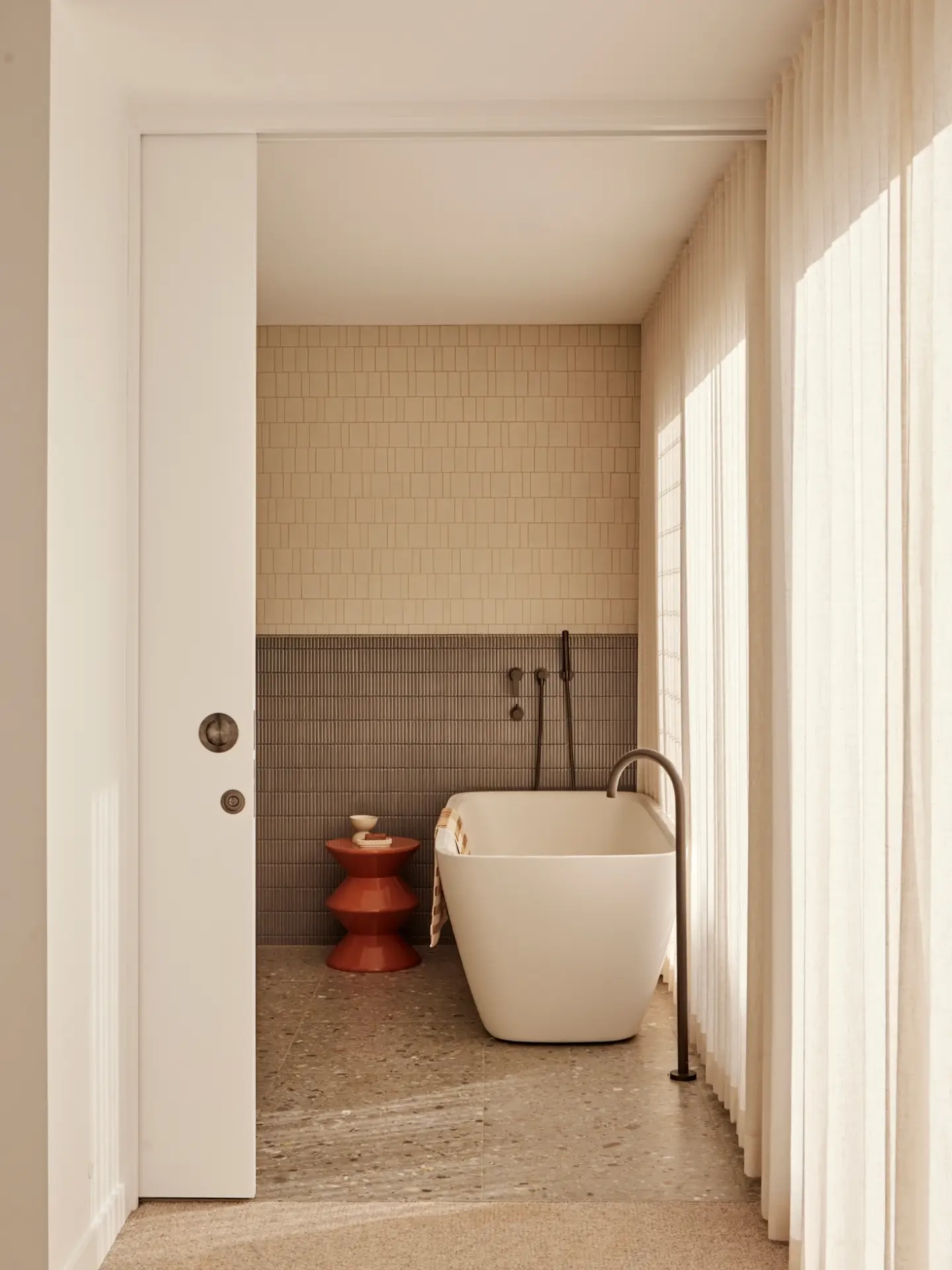
The terrazzo under this freestanding tub is a warm tan mottle rather than a crisp speckle, and that softness is exactly why it works in a calm, spa leaning bathroom. Mottled floors blur the border between clean and needs a mop, which any honest homeowner will tell you is worth money. The beige wall tiles above stay in the same tonal family, so the room feels wrapped instead of layered. Choose a mottle when the rest of the room is textured too; crisp chips can look harsh beside soft plaster and linen.
Tonal trick:Picking floor and wall tiles from the same warm family, even different materials, makes a small bathroom feel larger than a contrasting scheme does.
4. Fine Grain Underfoot in a Working Family Bathroom
A fine grained terrazzo floor runs under this grey tiled ensuite, the kind of surface that swallows toothpaste flecks and hair until the weekend clean. Fine grain is the practical end of terrazzo: the pattern scale is so small that the floor reads almost plain from the doorway and only rewards a closer look. Grey stone look wall tiles keep the room cool, and the round mirror stops it feeling like a corridor. In hard water areas, fine grain in a mid beige hides limescale better than any white floor ever will.
Hard water note:Pale floors show white scale marks; mid beige fine grain hides them between cleans. Choose your floor for your water, not just your taste.
5. The Floor That Refuses to Stop at the Shower Screen
Here the terrazzo floor runs straight through the glass into the shower, with the same tile climbing the back shower wall. One continuous surface makes a modest ensuite feel twice the size, and it removes the visual stumble of a shower tray edge. The catch is slip: floor terrazzo in a wet zone wants a matte or honed finish with real grip, and the fall to the drain has to be cut into large tiles by someone who has done it before. The fluted white bath and timber vanity warm up what could have felt stark.
Wet zone check:Inside a shower, ask for the tile’s slip rating and a honed finish. Polished terrazzo under soapy feet is a beautiful accident waiting to happen.
This close view of a terrazzo floor shows the chips at full size, browns, rust, grey and cream packed tight, with the tiles laid on the diagonal. Diagonal laying makes a narrow bathroom feel wider and turns the grout lines into part of the pattern instead of an apology. It also costs more in cuts and waste, roughly ten to fifteen percent more material, so order accordingly. A busy chip mix like this one earns its keep on the floor of a plain room where nothing else competes.
Order math:Diagonal and patterned lays waste more tile at the edges. Add fifteen percent to the order instead of the usual ten, or the last corner will wait a week.
In this bright ensuite the terrazzo covers the floor and climbs one side wall, in a pale base with very fine grey and beige chips. Stopping the stone at one wall is a budget kindness: you get the wrapped feeling for a third of the tiling bill. Gold fixtures and a navy vanity give the pale room its punctuation, proof that fine terrazzo is a background material and needs partners with opinions. If you copy one thing here, copy the restraint: one stone, one dark cabinet, one metal, done.
One wall math:Cladding a single wall in terrazzo and painting or plain tiling the rest keeps the look and cuts the most expensive line in the quote.
Terrazzo, honestly weighed: the stone earns its price in some rooms and wastes it in others.
For: hides dirt and hair between cleans better than any plain tile.
For: the pattern is inside the material, so it never wears off or peels.
For: pairs with warm and cool schemes alike, because the chips carry several tones.
Against: real cement terrazzo is porous and needs sealing before grouting, after, and every year or two.
Against: polished finishes turn slippery in wet zones; honed is the bathroom finish.
Against: big bold chips can date a small room, and custom slabs carry custom prices.
This bathroom wraps terrazzo across the walls and floor in one warm beige taupe, chips small and close, so the whole room feels carved from a single block. A full wrap is the boldest spend in this article and the one that dates slowest, because there is no second material to fall out of fashion. Dark timber on the vanity keeps the envelope from feeling cold. If you wrap everything, spend on the tiler before the tile; at this scale, wavy grout lines are the only thing anyone will notice.
Wrap warning:Full wraps magnify installation quality. Uneven walls must be made true first, or large tiles will lip at the edges and catch light in the worst way.
Most beige terrazzo keeps its chips neutral, but this one scatters slate blue, rust and tan through a white base across walls, floor and shower. A few colored chips give you a palette to steal for towels and paint without adding another patterned material. The oak floating vanity and black fixtures hold the room together while the stone does the talking. Keep colored chips to a minority share of the mix, as here, or the bathroom stops reading beige at all.
Palette theft:Photograph your tile in daylight and pull towel and paint colors straight from the chip colors. It is the easiest matching system in decorating.
Pale terrazzo with large muted chips covers the shower walls and the vanity splashback in this clean white bathroom, the two wettest wall zones wearing the same stone. Matching the splashback to the shower makes a small room feel planned rather than patched together from leftovers. The chips here are big but pale, so the walls stay calm at standing distance and interesting up close. White sanitaryware and chrome keep the whole thing fresh rather than earthy.
Splashback height:Take a stone splashback higher than the tap splash zone, at least up to the mirror’s lower edge, or the paint line above it will spot within a year.
This plumber finished bathroom runs large pale stone chips through a warm grey beige base on the walls and floor. Big pale chips are the friendly middle path: more character than fine grain, less visual noise than bold mixes, and kind to resale because nobody walks in and flinches. Black fixtures give the soft stone its outline. Note the grout nearly matches the base, so the tiles read as a surface, not a grid; that single choice is most of what makes terrazzo look expensive.
Grout truth:On beige terrazzo, grout one shade deeper than the base color. White grout yellows, dark grout frames every tile, and both mistakes are permanent.
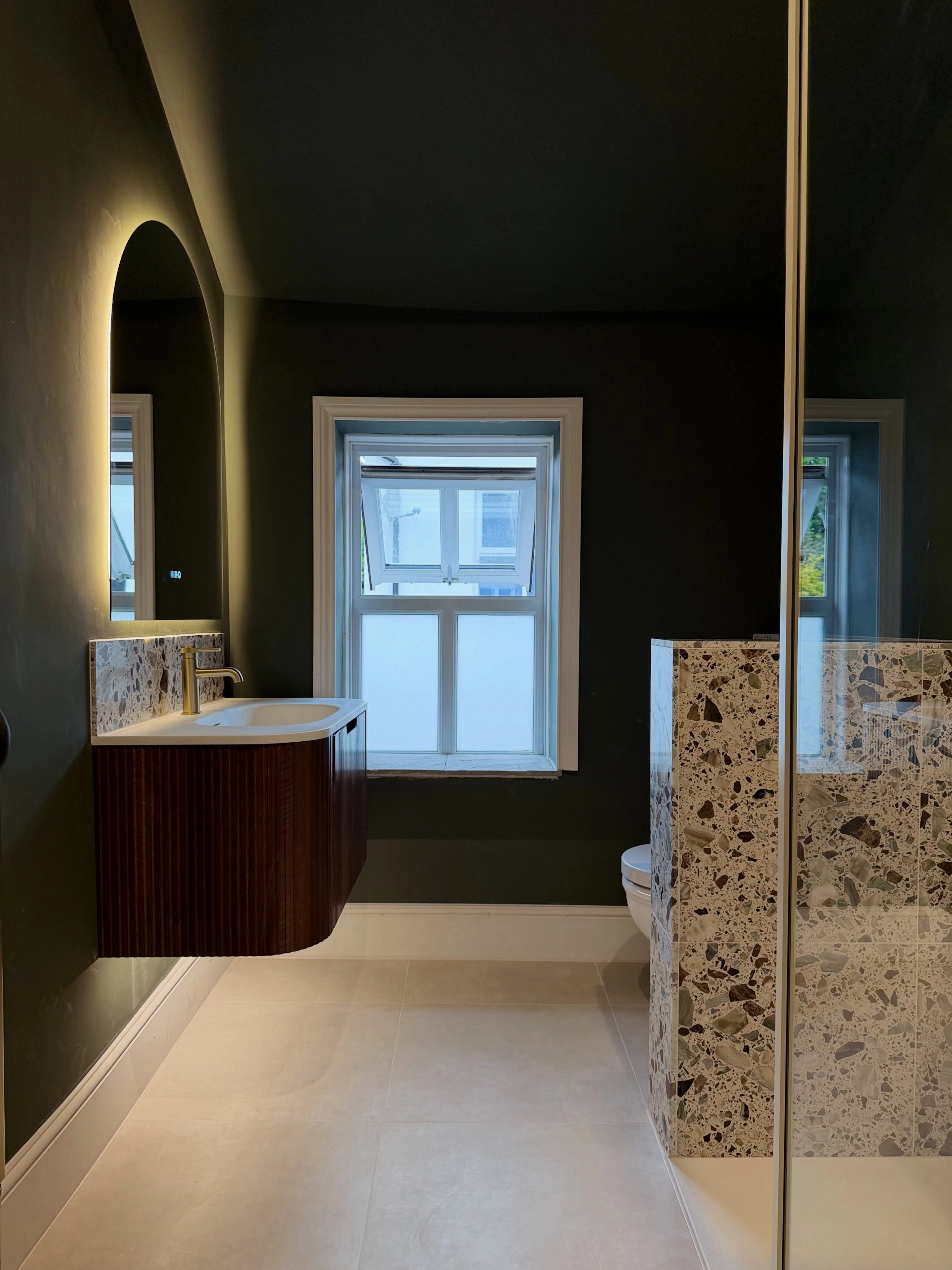
A terrazzo clad partition separates the WC and shower in this dark green bathroom, with the same stone returning as the vanity splashback. A partition is a smart place to spend on stone: it is seen from everywhere, touched by nobody’s elbows, and small enough that the slab bill stays sane. The big beige and grey chips warm the deep green walls around them. Curved timber on the vanity softens the geometry. Small surface, big effect is the whole trick.
Partition logic:Stone on a divider wall does double duty, privacy plus pattern, so it is the first place to upgrade when the budget will not stretch to full walls.
At the dramatic end, this shower pairs very large dark and light chips in a grey beige stone with deep red mosaic side walls and an integrated trough sink in the same terrazzo. Giant chips read almost like marble fragments, and they need a big surface; on a small splashback they would look chopped and accidental. The aged brass pipework keeps the drama grounded in something old and real. This is terrazzo as a statement material, chosen by people who find the quiet versions boring, and fair enough.
Giant chip rule:Chips larger than a coin belong on areas bigger than a door. On small cuts they get sliced mid chip and the pattern looks broken.
Every beige roundup needs its exception, and this powder room wraps the walls in charcoal terrazzo tiles dense with white, grey and beige chips. The beige chips inside the dark base are what keep it in this article: they hand you the exact beige to repeat in towels, flooring or the room beyond the door. A white pedestal sink and sculptural double mirror float on the dark field like gallery pieces. Dark terrazzo hides water spots heroically, which in a powder room used by guests is not a small thing.
Dark base bonus:Soap scum and water marks nearly vanish on dark terrazzo. If cleaning is your sworn enemy, the darkest tile in the shop is your friend.
The install, week by week: terrazzo jobs run smoothly when the order is fixed before the tiler arrives.
Week 1: live with samples in the room’s real light, morning and evening.
Week 2: order tiles with the waste allowance added, fifteen percent for diagonal lays.
Install days 1 to 2: set the tiles and let them cure a full 72 hours.
Day 3: seal the surface before any grout touches it, so pigment cannot stain the stone.
Day 4: grout with a color matched to the base, never a hard contrast on pale terrazzo.
Day 5: final coat of sealer, then 24 to 72 hours of cure before heavy use.
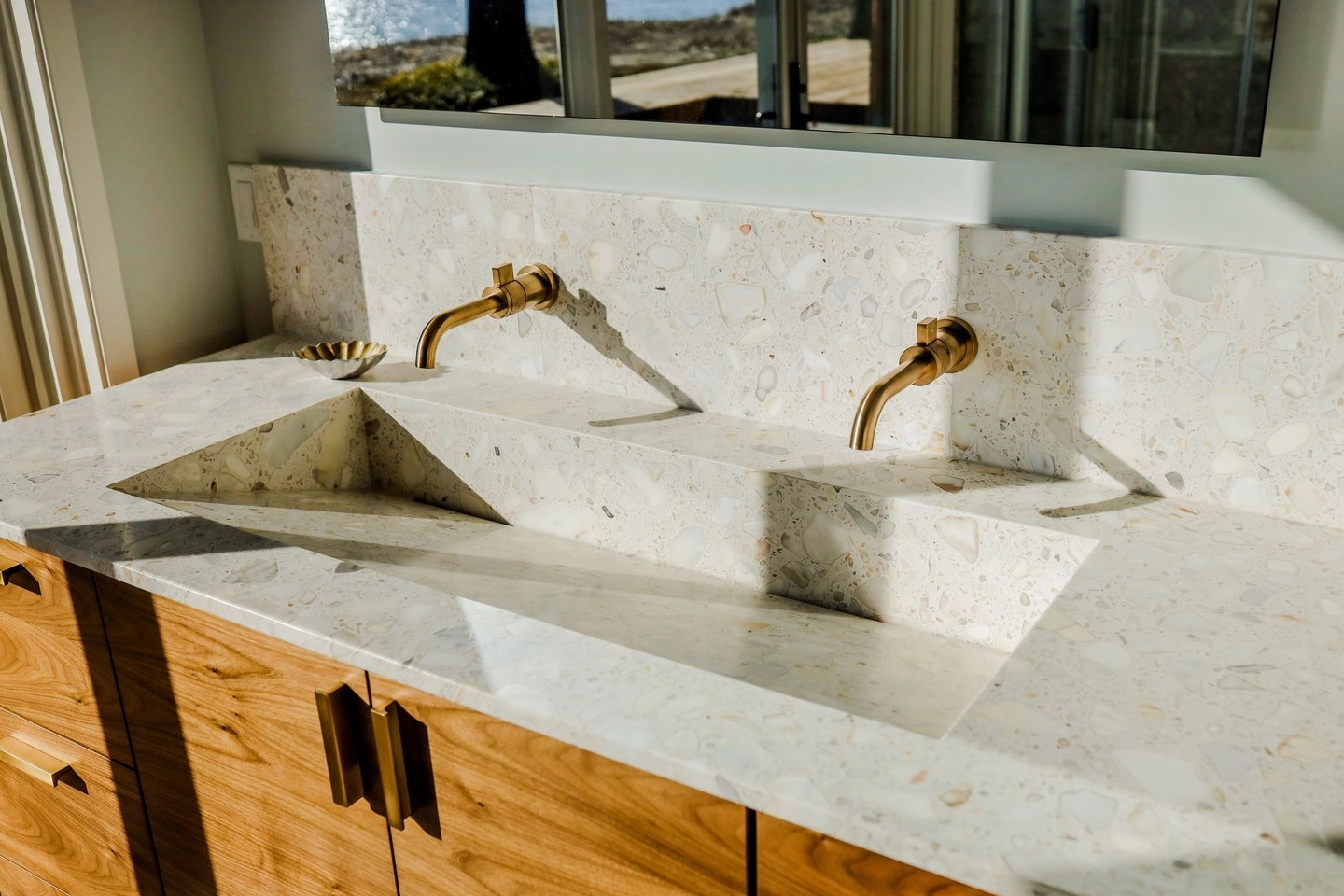
Two sinks are carved directly into a single terrazzo top here, cream stone with large beige and grey chips, the basins sloping into the surface with no rim and no seam. An integrated sink removes the caulk line where every normal vanity eventually goes grubby, and in stone the whole thing can be hosed down like a countertop. Brass wall taps keep the surface completely clear. The honest cost: custom stone work is the priciest idea in this article, and a chipped basin cannot be swapped like a ceramic one.
Seam logic:Every joint in a vanity top is a future dirt line. Integrated stone sinks delete the worst one, which is why they are worth pricing before you dismiss them.
A long terrazzo trough sink with big dark chips runs under a cane framed mirror, deep green finger tiles behind it. The trough shape suits households where two people brush side by side and counter space always loses to water. Dark chips in a light top are the forgiving choice at a sink: toothpaste, makeup and dye all disappear into the speckle instead of announcing themselves. The green tile proves beige terrazzo is not a one palette material; it will sit beside strong color and behave.
Sink speckle:At basins, choose chips with some dark content. Pure pale tops show every mascara dot and coffee ring at guest eye level.
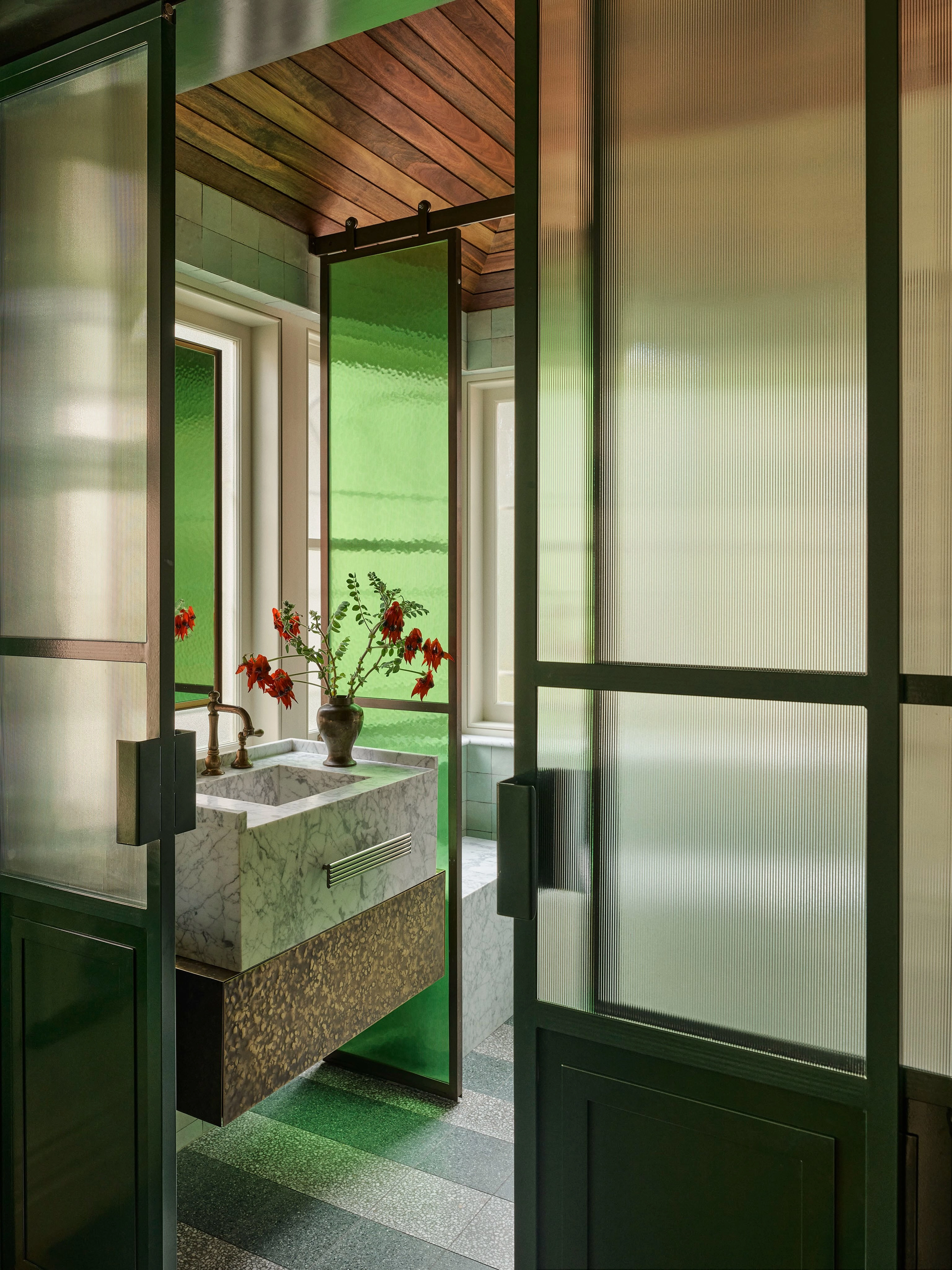
Behind green ribbed glass doors, this vanity is fronted in speckled terrazzo, the cabinet itself wearing the stone rather than just carrying it. Wrapping the vanity front turns furniture into architecture and hides the join between cabinet and top entirely. It also means the vanity must be built for the weight and the stone ordered before the cabinetry is final, a planning order that trips up many renovations. The pale green basin and brass tap keep the front from feeling heavy. Order of operations is the whole lesson here.
Weight note:Stone clad fronts are heavy. Hinges, runners and wall fixings must be specified for the finished weight, not the empty cabinet.
18. Bold Chips on the Top, Plain Stone Everywhere Else
In this large ensuite, the vanity top carries the bold terrazzo, cream with large black, grey and beige chips, while the walls and freestanding bath stay plain beige stone. Putting the loudest material at hand height is smart decorating: it is the surface you actually look at while washing, and the one guests lean over. Everywhere else can relax. The big chips also disguise the water pooling and product rings that a working double vanity collects by Wednesday.
Hand height rule:Spend the pattern budget where eyes and hands actually land. A bold top with plain walls beats bold walls nobody looks at closely.
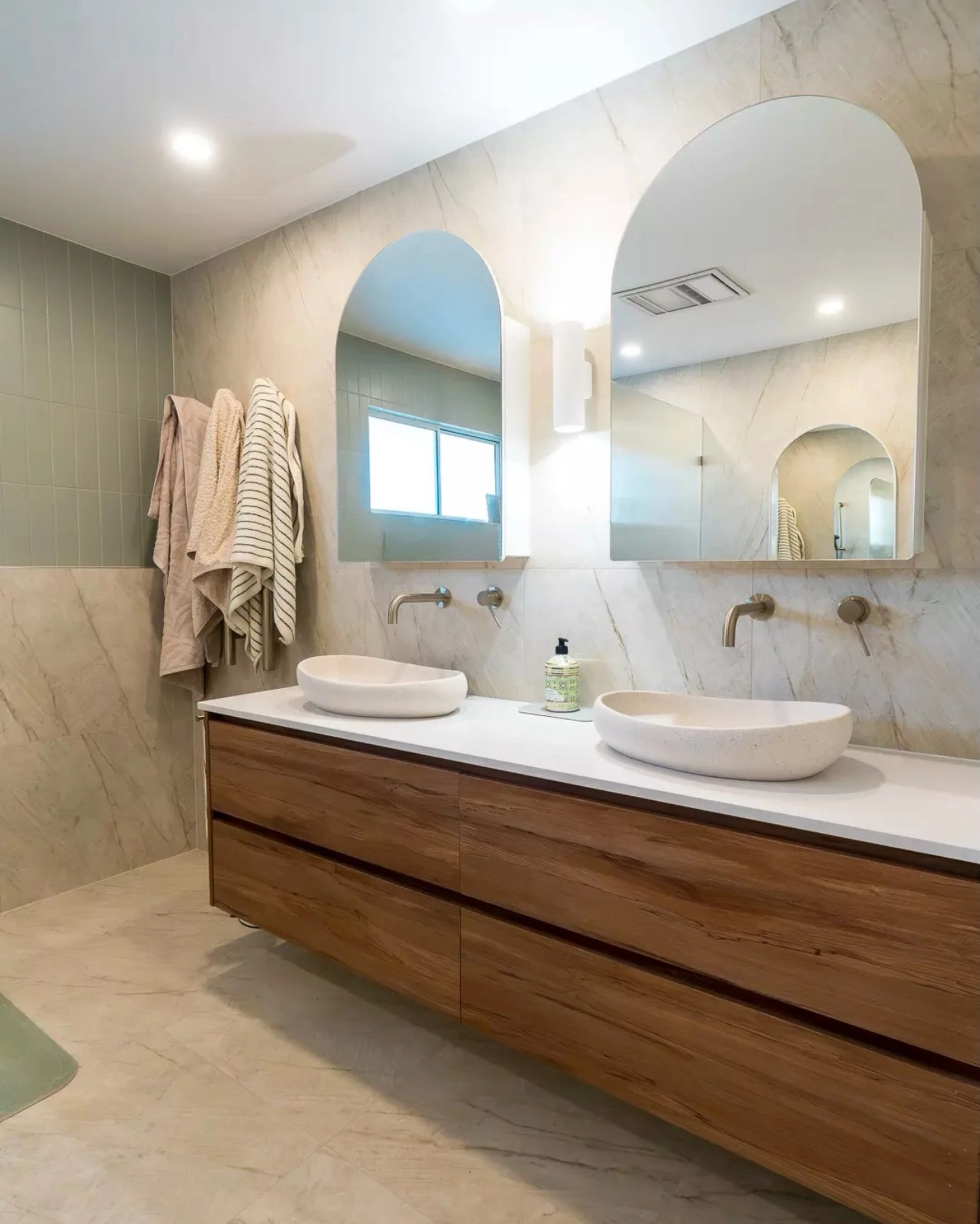
Twin vessel basins and arched mirrors sit over a long timber vanity in this bright bathroom, the terrazzo kept soft and fine around them. Fine speckle near mirrors is flattering in a way bold patterns are not, since nothing competes with your own reflection at the start of the day. The pale scheme relies on timber warmth and good daylight, so steal it for rooms with a window and think twice for windowless ones. In a dark room, this much pale fine grain can read grey and flat by evening.
Window check:Pale terrazzo schemes are daylight dependent. In a windowless bathroom, warm the scheme with timber and 2700K lighting or it will feel like an office.
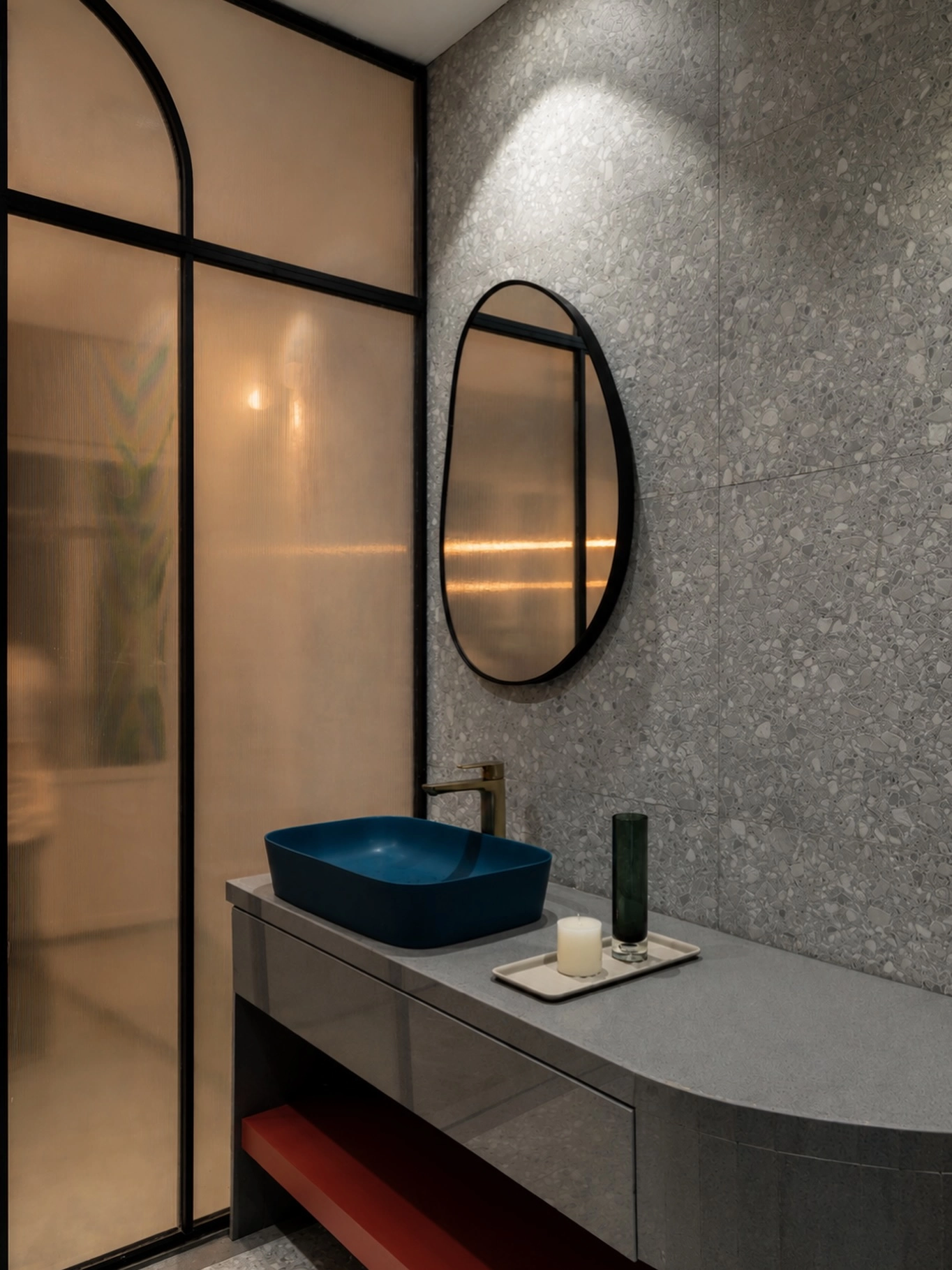
Terrazzo climbs the entire wall behind this vanity, grey leaning chips in a light base, with a dark teal vessel basin standing off it. A full height splashback wall removes the paint line problem forever and gives the mirror something with depth to reflect. It is also the easiest wall to do well, being flat, rectangular and free of niches. The teal basin is the one brave object in the room, and the stone’s quiet pattern is what lets it be brave. Pattern as backing band, color as soloist.
Mirror on stone:Mirrors hung on terrazzo need fixings drilled with a diamond bit and plugs rated for stone. Adhesive alone on a polished surface will let go one humid night.
This bathroom runs two terrazzo mixes side by side: a pale chip top on the vanity and a deep reddish brown around the tub and wainscot. Two tones of the same material feel collected rather than matched, and the shared chip language stops it looking like a mistake. The rule is contrast in the base, family in the chips: both mixes carry pink and white stone, so they argue politely. Timber cabinets and bronze fixtures sit between the two tones and mediate. It is the most designer move in this article and the easiest to get wrong, so sample both stones together in daylight before ordering.
Two tone test:Lay both samples touching, in the room’s real light. If the chips share at least two colors, the pairing will hold; if not, it will jar forever.
Dusty pink square tiles cover the upper walls while terrazzo wraps the floor, tub deck and lower shower walls in this warm bathroom. Pink and beige terrazzo are natural allies: the chips usually carry a blush tone already, so the tiles simply turn the volume up on something the stone was whispering. The built in niche keeps the pink unbroken. If your terrazzo reads slightly cold, a warm pink or clay tile above it is the cheapest correction in this whole article.
Warm it up:A terrazzo that reads grey in your light usually wants one warm partner, pink tile, clay paint or timber, not a different terrazzo.
23. Angular Chips, Copper Plaster and a Pale Vessel
Angular brown, orange and black chips scatter through the pale tiles on the walls and floor of this bathroom, under a copper toned plaster upper wall. Angular chips feel more modern and architectural than rounded river stone mixes, and they suit rooms with straight lines and flat fronted furniture. The light timber vanity and white vessel keep the scheme from overheating. Plaster above tile height is a gentle budget move too, since the expensive material only climbs as high as the water does.
Chip shape:Rounded chips read traditional and soft; angular chips read modern. Match the chip shape to the house, not just the color to the towels.
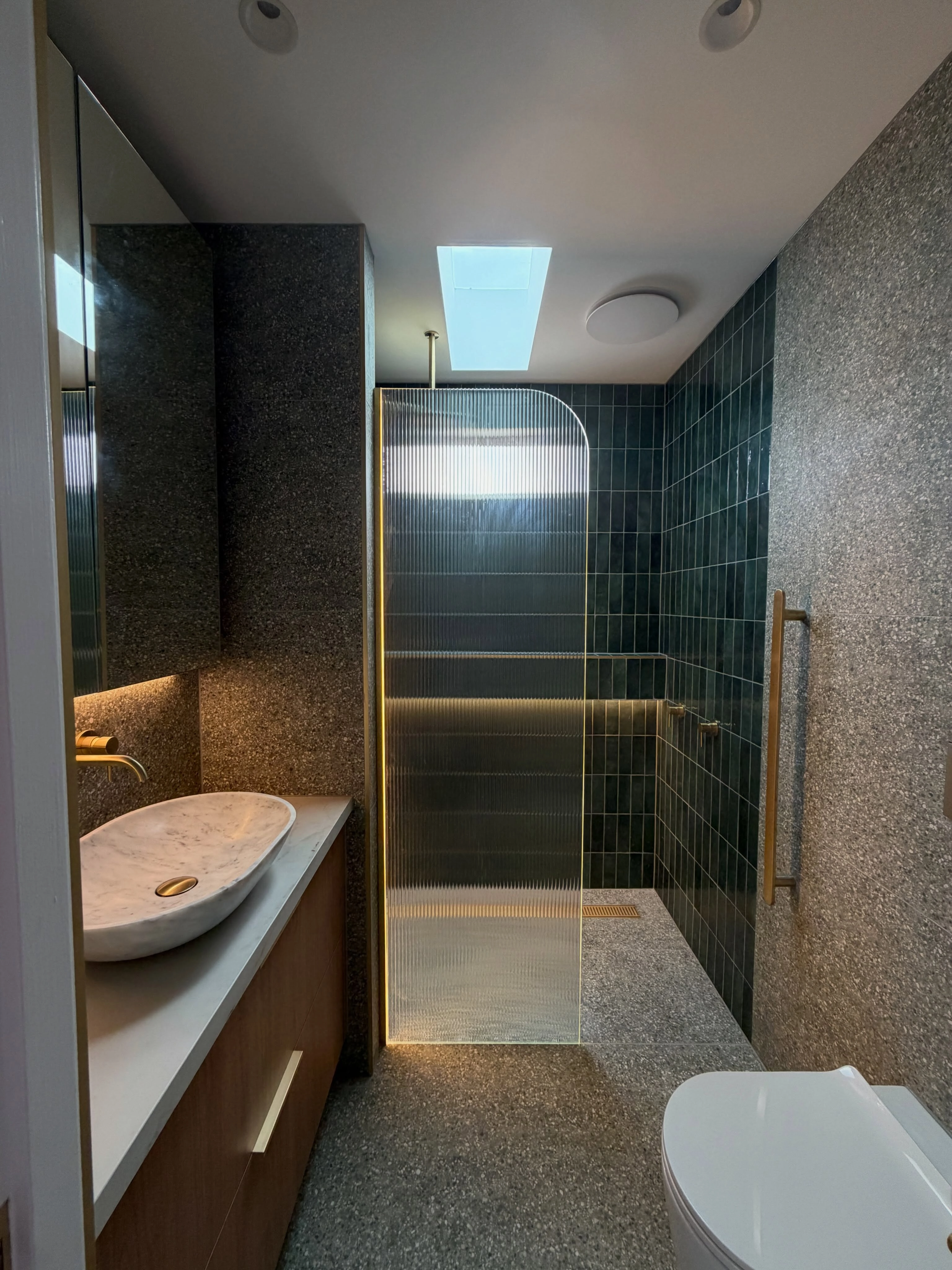
In this new small bathroom, dark grey brown terrazzo look tiles wrap the walls and floor while deep green tiles line the shower, a skylight doing the brightening from above. Dark terrazzo in a small room works when the light is planned, here a skylight, and when one surface brings the color, here the green. The timber vanity keeps a foot in the warm camp. This is the pairing for people who love beige terrazzo’s pattern but find the pale rooms too safe: keep the speckle, deepen the base.
Small and dark:Dark stone in a small bathroom needs one real light source, window or skylight, and pale towels. Without them it closes in by evening.
25. The Moodboard Stage: Chips Beside Timber and Green
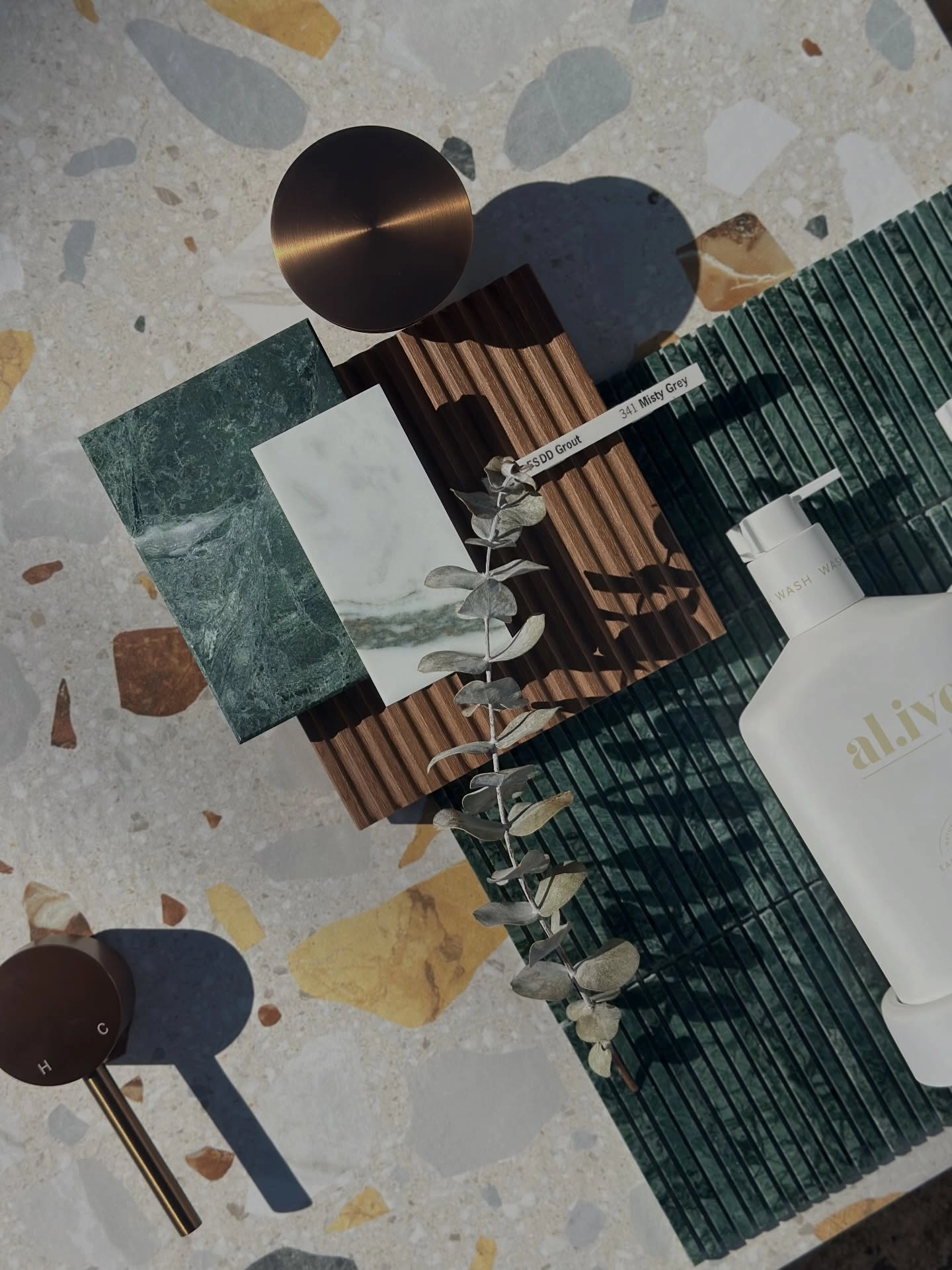
This flat lay lays the whole decision out on a terrazzo slab: large mustard, grey and peach chips in the base stone, with dark green marble, walnut slats and bronze fixtures arranged on top. Every pairing in this section began as a board like this, and making one is not designer theatre; it is how you catch a wrong undertone before it is grouted to your wall. Build yours with the actual tile, a timber offcut, the tap finish and one fabric, and photograph it in morning and evening light.
Board rule:Judge the board by its worst photo, the evening one under warm bulbs. If the beige turns orange or grey there, it will do it every night.
26. A Peach Terrazzo Palette, Close Enough to Touch
The last word goes to a simple material study: a pale peach terrazzo with big cream and tan chips, a sage tile sample and a dark walnut panel. Peach based terrazzo is the warmest of the beige family and the one most likely to flatter skin at the mirror, which is not a trivial thing in a room where faces get inspected. Sage and walnut are its oldest friends. If you take nothing else from this article, take the habit: live with the samples on the bathroom floor for a week before the order goes in.
Week test:Samples that survive a week of being stepped around, splashed and seen at 6am have earned the order. Fifteen minutes in a showroom proves nothing.
[SCROLL-STOPPER: pros and cons block after idea 7; install timeline block after idea 14; sealing fact box before conclusion]
The sealing fact worth memorizing: real terrazzo is stone chips held in cement or resin, and the cement kind drinks like a sponge. Seal it before grouting so grout pigment cannot stain the surface, seal it again when the job is done, and clean it only with pH neutral cleaners, because acids etch it the way they etch marble. The most common permanent terrazzo regret is dark grout on a pale floor; the second is skipping the first seal.
Final Thoughts
Beige terrazzo rewards the people who choose the chip before the tile: small and fine for busy floors and forgiving cleans, large and bold where a surface deserves a close look, and grout matched to the base so the whole thing reads as stone rather than squares. Seal real terrazzo before and after grouting, clean it with neutral cleaners only, and the warm beige you picked will still be warm in ten years. The stone is old, patient material; it just asks to be chosen slowly.