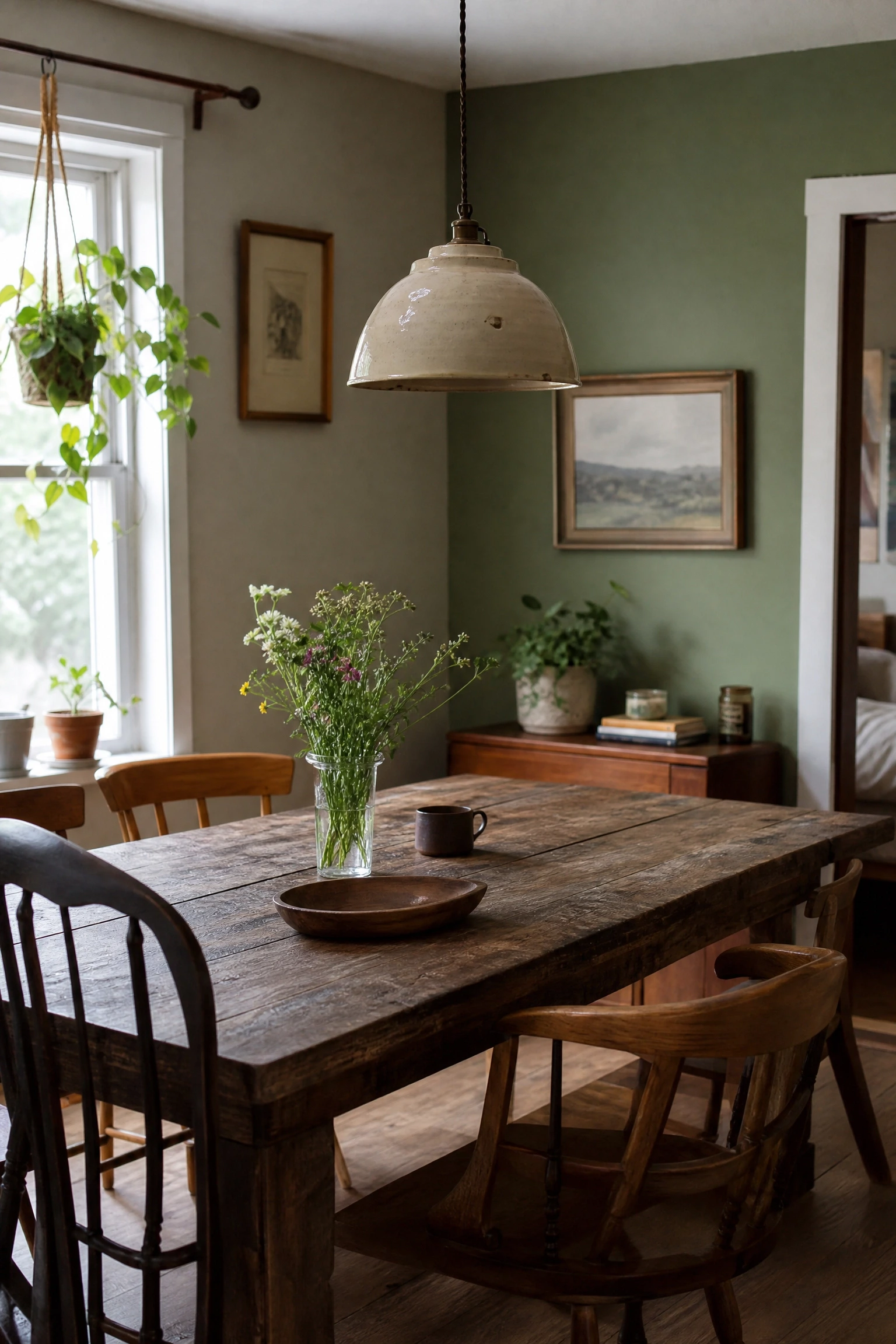
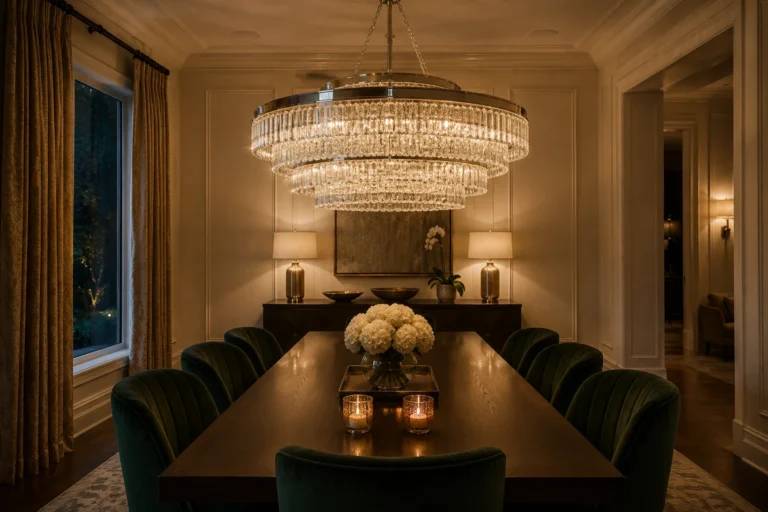
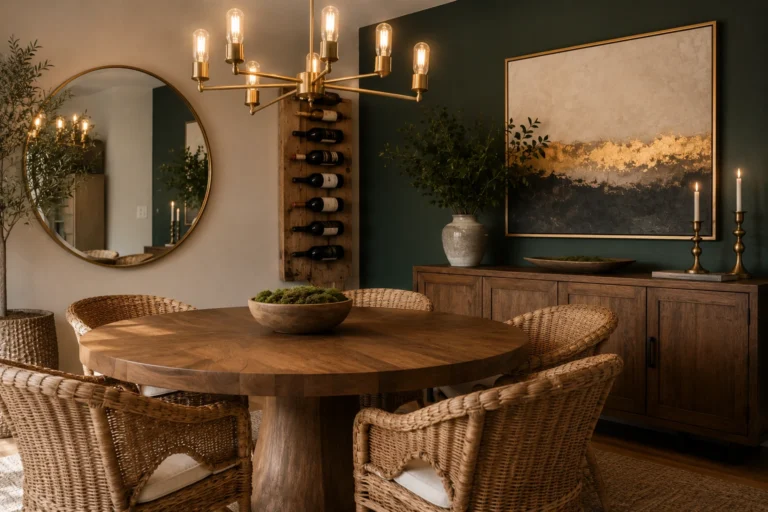
There is something almost unfair about how much a single overhead light can change a dining room. You can have the right table, the right chairs, a great rug, and the whole thing can still feel flat if the pendant above it is wrong – too small, too high, or just completely mismatched to everything else. On the flip side, when you get it right, that one fixture pulls the whole room together in a way that feels like magic, even though it is really just good design thinking.
The challenge is that most guides either throw a list of pretty fixtures at you or drown you in technical rules about inches and diameters. What actually helps is knowing which type of pendant solves which specific problem – because almost every dining room has one. This article is organized around exactly that. Each idea starts with a real scenario you might recognize, then gives you the pendant approach that works, and ends with what you actually gain from making that choice.
1. The Too-Small Room That Needs to Feel Intentional
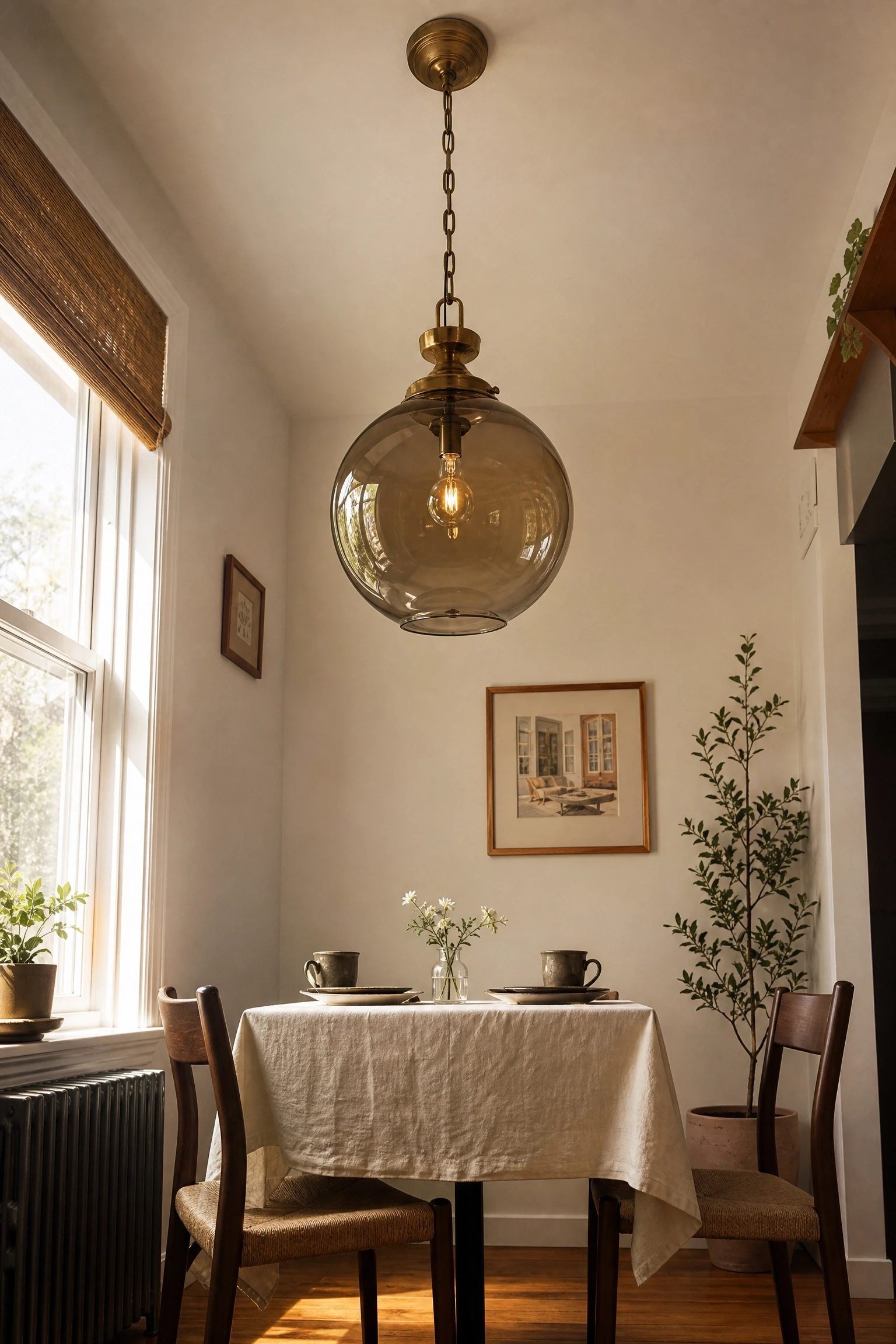
You have a compact dining space – maybe a formal dining room that never quite got the square footage it deserved, or an eat-in kitchen area that is technically a dining room if you squint. The instinct is to go small with the pendant so it does not overwhelm the space, but this is actually one of the most common mistakes in dining room lighting. A pendant that is too dainty for the table underneath it looks accidental, like you forgot to upgrade the builder-grade fixture. What works much better is a single statement globe pendant in smoked glass or aged brass, sized so that its diameter is roughly a third of the table length. It reads as a confident design choice rather than an afterthought, and because globes are open shapes, they do not visually block the room the way a wide drum shade might. Keep the finish warm – antique brass or matte bronze – so the light it casts feels cozy rather than clinical.
Pro Move: In a small dining room, go one size larger than feels comfortable with the pendant – it almost always looks better than playing it safe.
2. The Long Rectangular Table That Gets Uneven Light
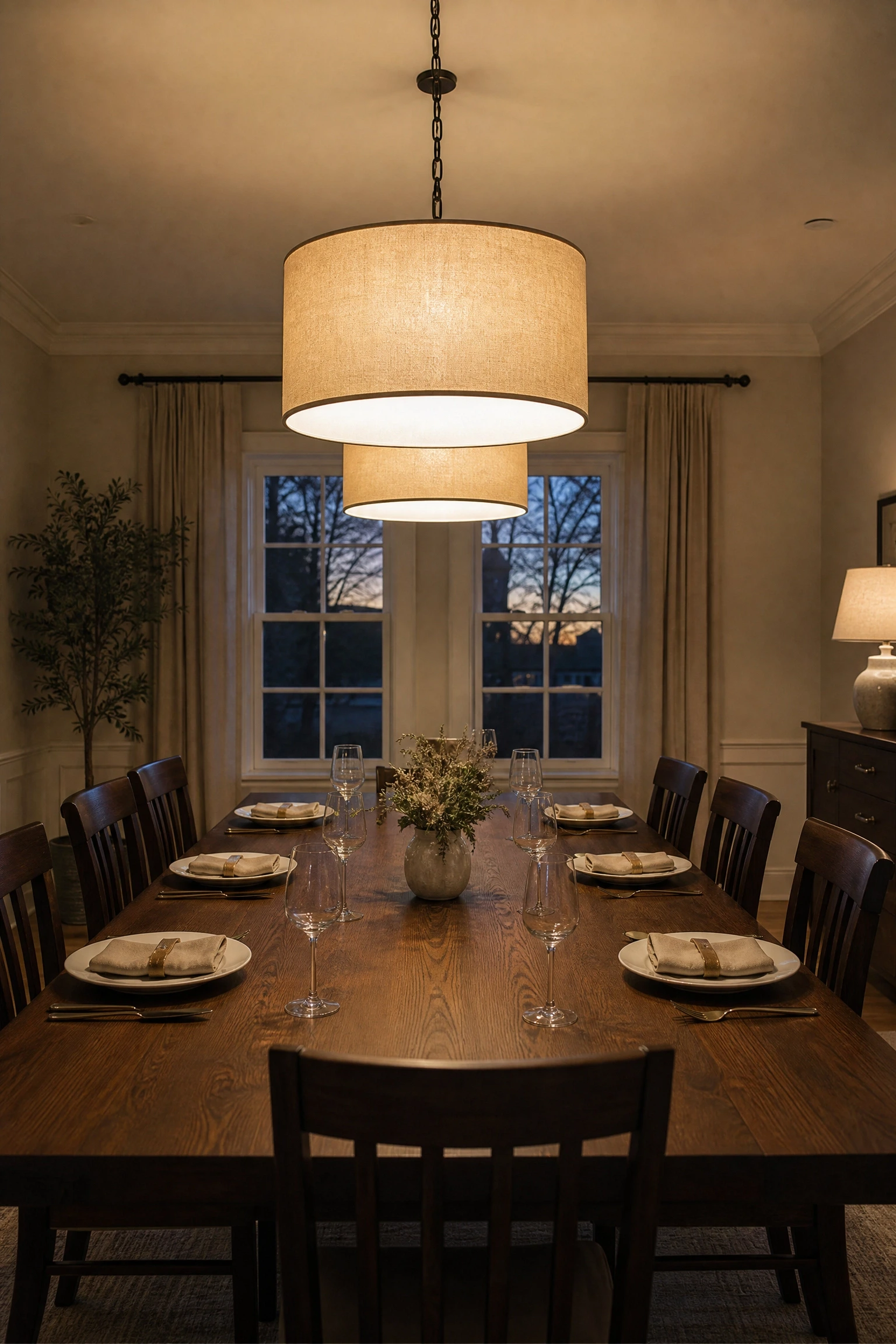
A rectangular dining table that seats eight is one of the most common dining room setups, and it is also one of the most frequently under-lit. A single centered pendant over a long table leaves the ends in shadow, which makes the whole table feel disconnected. The solution that professional designers reach for consistently is a linear suspension pendant or a set of two matching pendants hung in a row above the center of the table. The spacing rule here matters: for a table around 84 to 96 inches long, two pendants spaced roughly 24 to 30 inches apart from center to center gives you even coverage without clustering. Linen drum shades work particularly well in this configuration because they soften the light and add warmth across the full length of the table, and they are easy to find at mid-range price points.
Designer Advice: Hang two pendants so that each one sits roughly above the outer third of the table, not centered – this distributes light where people actually sit.
3. The High-Ceiling Dining Room That Feels Cold and Echoey
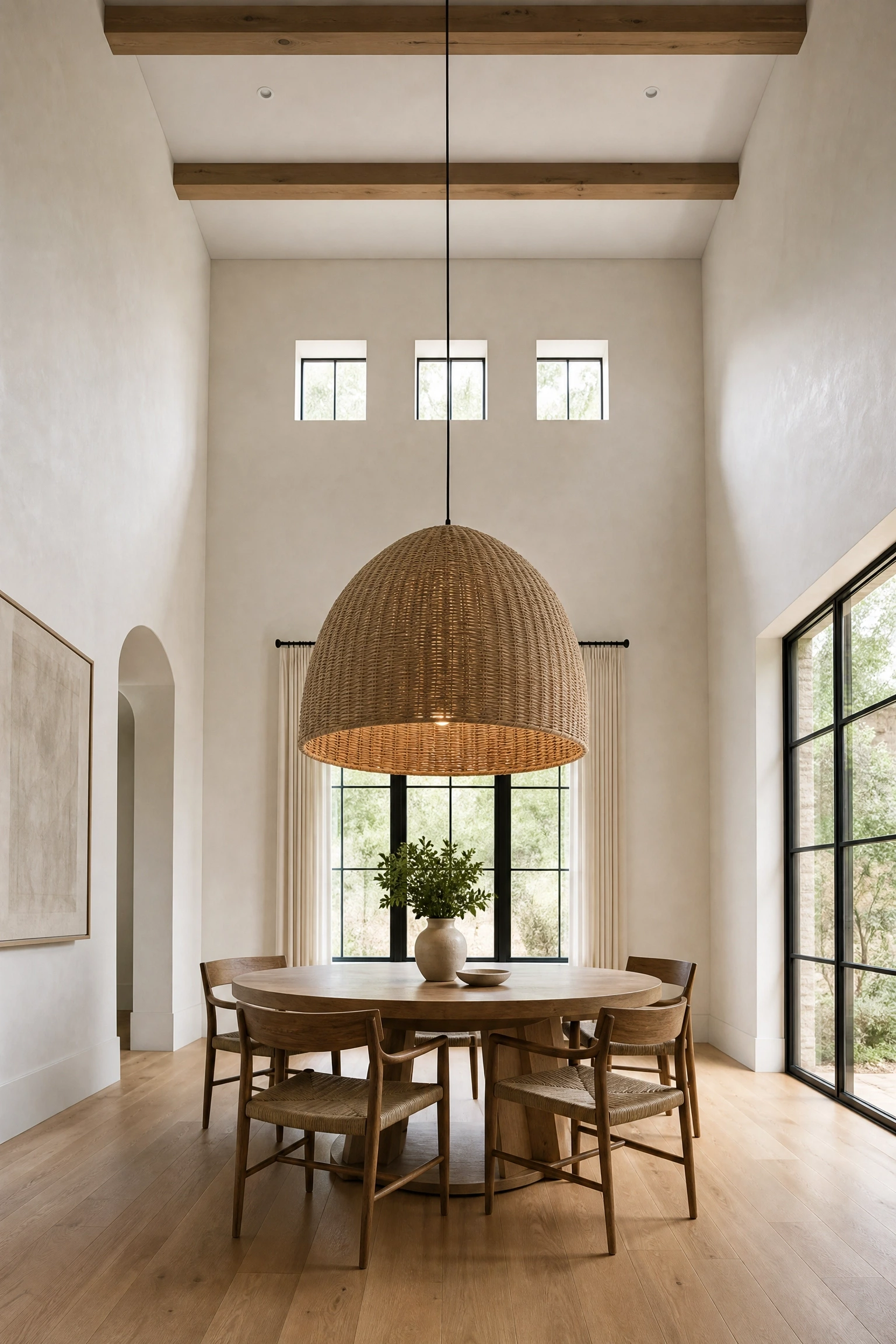
Rooms with ten-foot or higher ceilings are a blessing for natural light and a genuine challenge for intimacy. When a pendant hangs at the standard 30 to 36 inches above the table in a room with a 12-foot ceiling, the fixture looks like it is floating in space with nothing connecting it to the room below. The fix is to use a pendant with visual weight – something with a substantial shade in rattan, woven seagrass, or a large paper mache form – and to actually drop it lower than you think you should. Around 28 to 30 inches above the table surface is not too low; it creates a defined zone that makes the dining area feel distinct and grounded within a tall room. Rattan and woven pendants are particularly good here because their texture catches the eye and brings warmth into a space that might otherwise feel airy in a cold way.
Heads Up: For ceilings above 10 feet, add approximately 3 extra inches of drop for each additional foot of ceiling height beyond the standard 8-foot baseline.
4. The Modern Minimalist Room That Needs One Clear Focal Point
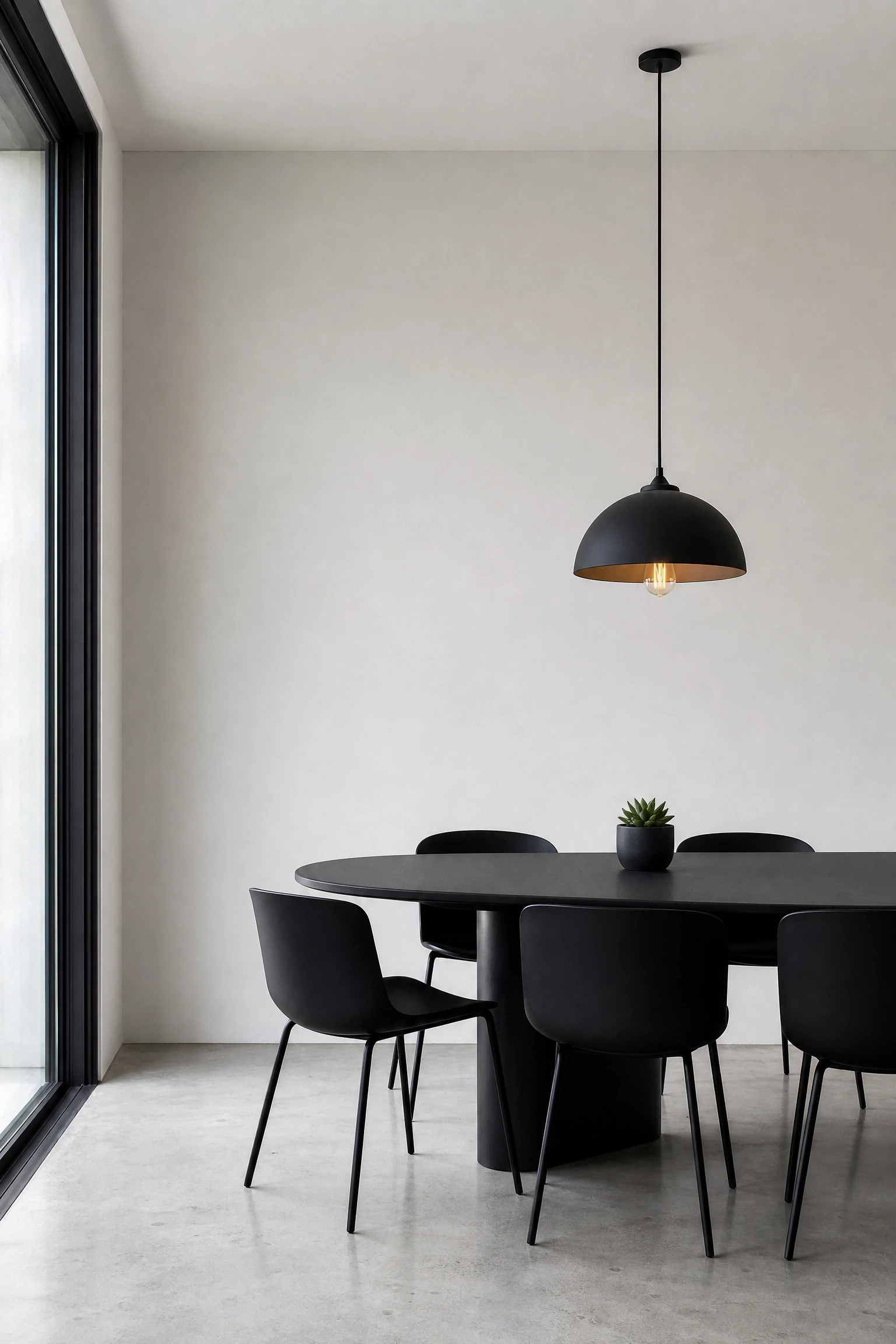
A dining room with clean lines, a neutral palette, and very little visual clutter is only one pendant away from feeling like a design-forward space or a sterile one. The pendant you choose here is doing almost all the decorative work, so it has to be something with genuine sculptural presence. Concrete pendants with exposed Edison bulbs, matte black geometric cage pendants, and simple dome pendants in blackened steel all work well in minimalist spaces because they add form without pattern. The key principle in minimalist dining rooms is visual weight without visual noise: you want a fixture that looks intentional and considered from every angle, with no decorative flourishes or ornate details that would compete with the intentional simplicity of the rest of the room. One good pendant, properly hung, is the difference between minimalist and merely bare.
Quick Tip: In a minimalist room, the pendant cord or rod is part of the design – choose a fixture with a fabric-wrapped cord in a complementary color rather than a plain white plastic cord.
“In minimalist dining rooms, the pendant is not an accessory – it is the statement. Everything else steps back to let it speak.”
5. The Farmhouse or Cottage Space That Wants to Avoid Being Cliché
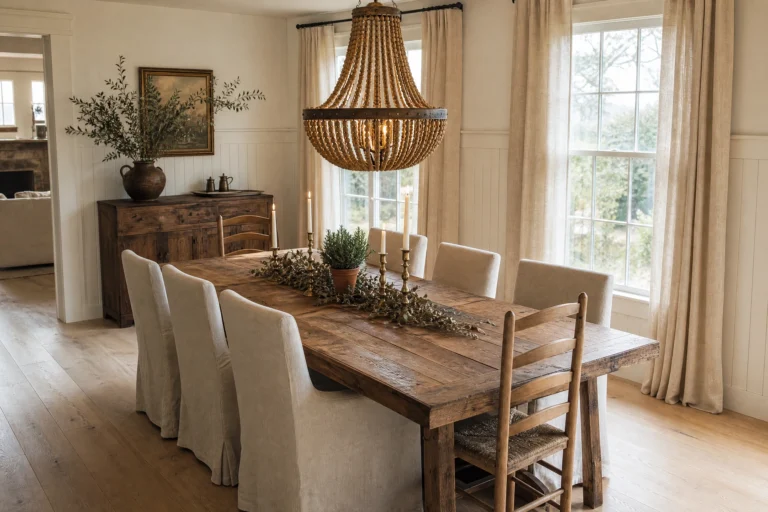
Farmhouse dining rooms have been done so thoroughly over the last decade that the look can easily tip into something that feels more like a catalog page than an actual home. The trick to keeping a farmhouse pendant feeling genuine is to avoid the obvious mason jar and chicken wire fixtures and look instead at hand-thrown ceramic pendants, whitewashed wooden bead chandeliers, or aged iron dome lights with a matte finish. These still read as rustic and warm but carry more handcraft quality, which is what the farmhouse aesthetic is really about at its core. A ceramic pendant with an off-white or warm cream glaze over a reclaimed wood dining table is a genuinely good-looking combination that does not feel like it came flat-packed from a big-box store. Budget note: hand-thrown ceramics can run $200 to $500 for a single pendant, but there are excellent imitations at $60 to $120 that photograph almost identically.
Reality Check: If your farmhouse pendant has a mason jar or Edison bulb cage and nothing else going on, it was popular right now in 2016 – explore ceramic or wood bead options instead for something with more staying power.
6. The Open-Plan Space Where the Dining Area Needs Its Own Identity
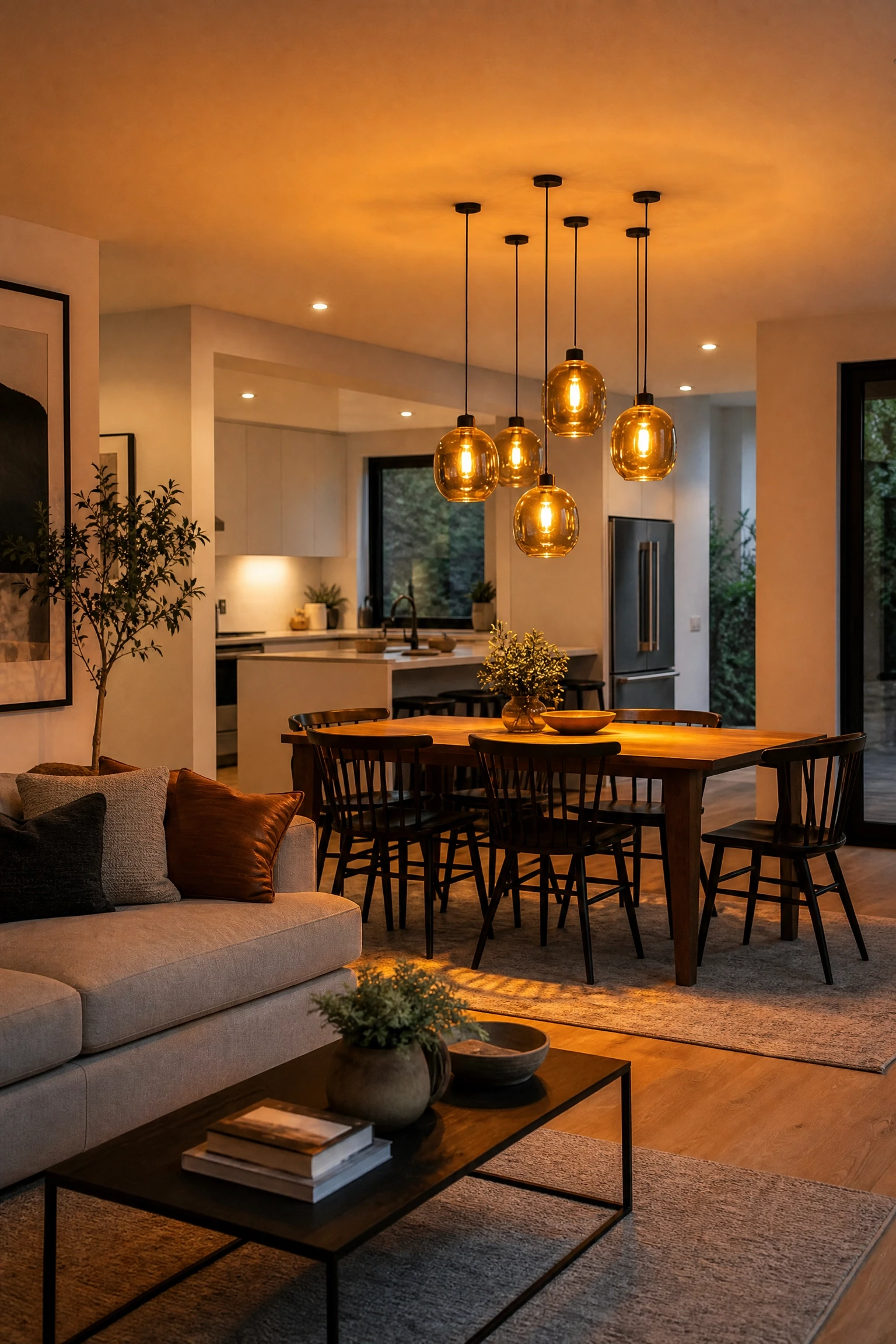
Open-plan living is the norm in a lot of modern homes, which creates a specific pendant lighting challenge: the dining area is not a room, it is a zone, and the pendant light is doing double duty as both a functional fixture and a spatial boundary marker. In this situation, the pendant needs to feel distinct from whatever lighting is happening in the kitchen or living room nearby. A cluster pendant – three or five smaller pendants hung at slightly varying heights from a single ceiling plate – is one of the strongest choices here because the visual grouping clearly says “this is a separate space” without any walls required. Amber glass pendants in a cluster are particularly effective: the warm, golden light they cast pools down onto the table and creates a cozy halo that stops at the edge of the dining zone, reinforcing the sense of separation.
Pro Move: In an open-plan home, use warm-toned bulbs (around 2700K color temperature) in your dining pendant and cooler-toned bulbs (3000K) in your kitchen – the subtle difference helps each zone feel intentional.
7. The Rental or Budget Dining Room That Needs Maximum Impact for Minimum Spend
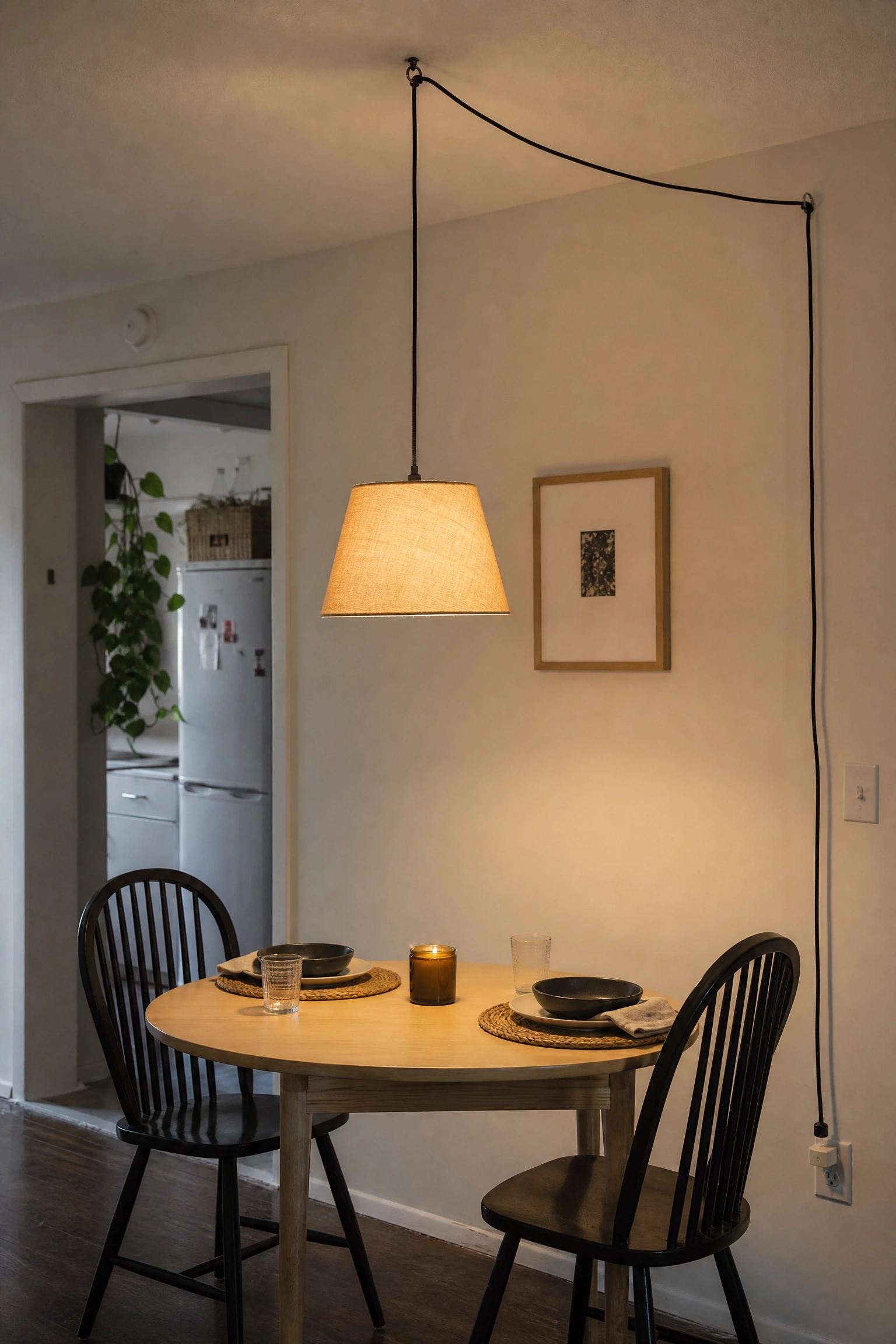
Not everyone can spend $400 on a pendant light, and plenty of people are renting and cannot change the existing wiring anyway. The good news is that some of the most interesting-looking dining room pendant solutions cost very little. Plug-in pendant lights – which literally plug into a standard outlet and use a ceiling hook – have come a long way in terms of quality and style. You can find beautiful linen shade plug-in pendants for $40 to $80 that look indistinguishable from hardwired fixtures in photographs and in person. For renters, a swag kit (a ceiling hook with a cord cover that runs along the ceiling molding) is a clean, damage-free solution. The one area where budget buyers should not cut corners is the bulb: a warm LED filament bulb in the 2700K range will make a $50 pendant look genuinely good, while a harsh white bulb will ruin even a $300 fixture.
Quick Tip: Always buy a dimmer switch with your pendant – a $15 dimmer turns any mid-range fixture into something that feels high-end by giving you control over the mood.
8. The Formal Dining Room That Has Forgotten How to Relax
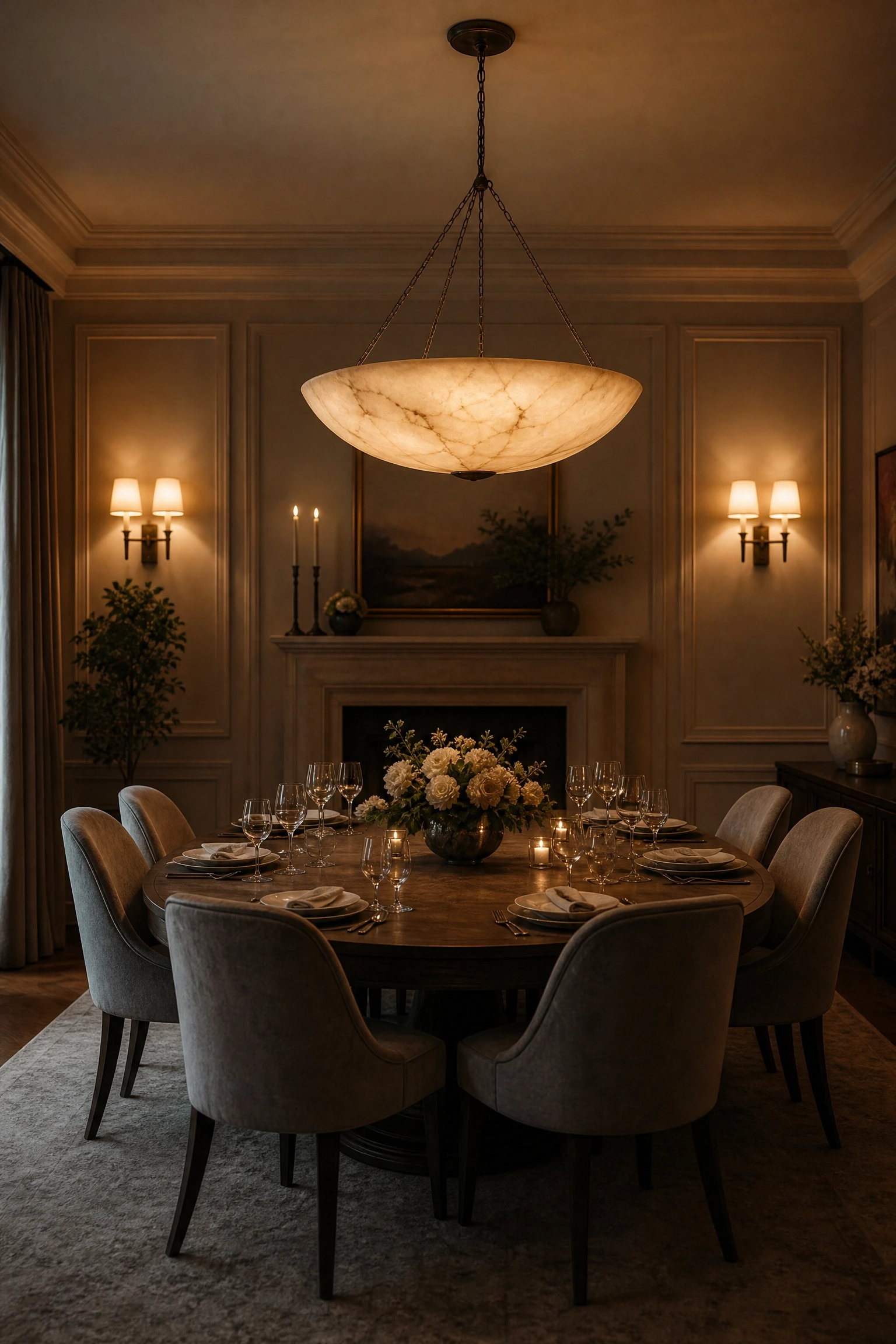
Traditional formal dining rooms often have heavy, ornate chandeliers that suit the space but make it feel like no one actually eats there. If you want to keep the room feeling polished but make it genuinely liveable, the solution is a soft material pendant in a classic shape – think an alabaster stone shade, an opal glass orb, or a pleated silk drum in a warm neutral. These materials diffuse light in a way that is flattering to food, to faces, and to the room itself, and they feel luxurious without the formality of crystal and chrome. Alabaster pendants in particular have had a major moment in professional interior design over the last few years, appearing in high-end projects and design publications regularly. They are investment pieces – expect to spend $300 to $800 for a quality alabaster pendant – but they age beautifully and look genuinely expensive in a way that other materials have to work harder to achieve.
Designer Advice: Alabaster shades look best with a warm-toned filament LED at around 2200K – the slightly amber light through the natural stone creates a glow that no other shade material can replicate.
9. The Mid-Century Modern Room That Deserves a Period-Correct Fixture
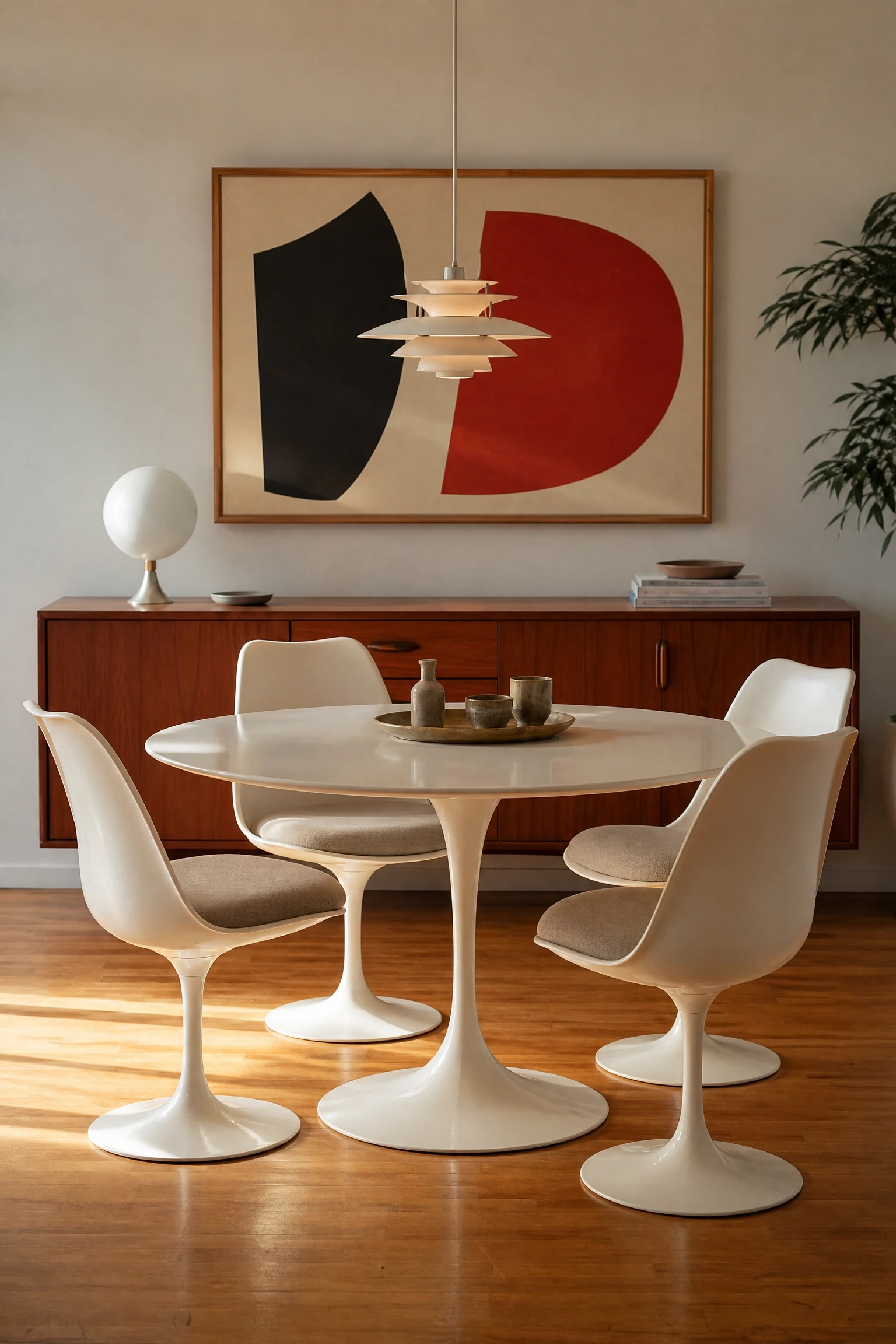
Mid-century modern dining rooms have very specific proportions and a very specific material vocabulary – walnut, teak, low-slung silhouettes, and a clean relationship between function and form. Dropping a popular right now rattan pendant into a room full of Eames chairs and a tulip table is a mismatch that designers notice immediately. What actually fits mid-century modern spaces is a pendant that belongs to the same design lineage: the Poul Henningsen PH 5 is the canonical choice, with its layered aluminum shades directing light downward and eliminating glare in a way that was genuinely revolutionary when it was designed in 1958 and still works beautifully today. If the PH 5 is out of budget (it retails for around $900 to $1,200), look for pendants with similar layered or nested shade structures in spun aluminum or lacquered steel – the principle of shielded, directed light is the thing to replicate, not just the silhouette.
Heads Up: Avoid reproduction or knockoff versions of iconic mid-century pendants from unknown brands – the quality of the shade material and light diffusion is usually significantly worse than the original, which defeats the functional purpose of the design.
10. The Coastal or Mediterranean Dining Room That Wants Texture Without Theme-Park Vibes
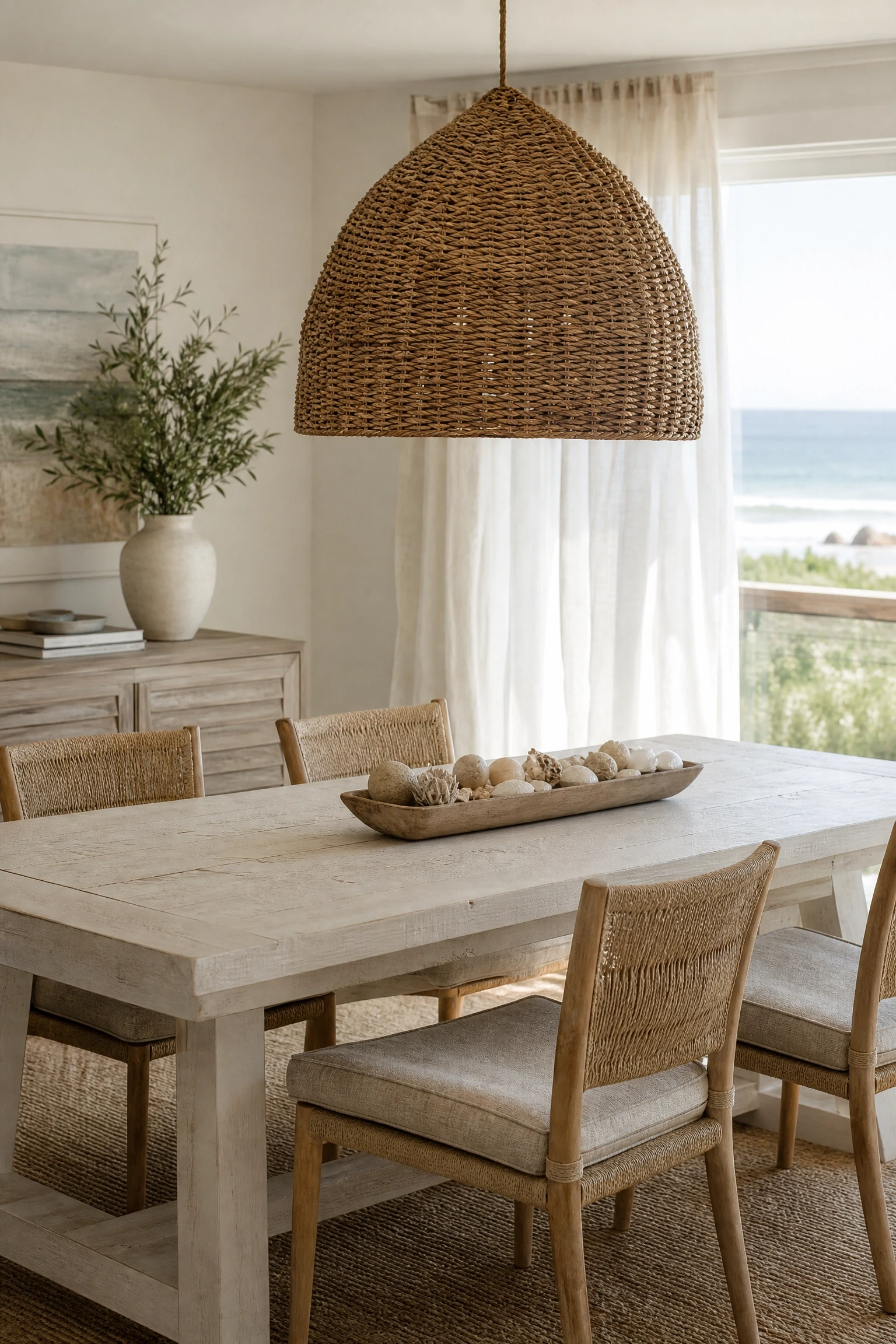
Coastal dining rooms have a tendency to go overboard with anchors, ropes, and seashell motifs that make a room feel like a vacation rental rather than a real home. The better approach is to lean into the material honesty that coastal design is actually built on: natural fibers, light wood tones, and organic forms. A woven seagrass pendant or a pendant with a jute-wrapped frame gives you the texture and warmth of a coastal aesthetic without any of the literal seaside imagery. Pair it with whitewashed wood furniture and linen chair cushions in soft sand or sage tones, and the room reads as relaxed and intentional rather than themed. Seagrass pendants are also one of the best value-for-visual-impact options in the entire pendant lighting category: a good-quality woven pendant can be found for $80 to $150 and it photographs and reads in person as a much more expensive choice.
Reality Check: A seagrass or jute pendant in a dining room works best over a natural wood table – it can look lost or unanchored over a glass or all-white table, where you might want to add a second texture element to the space.
11. The Eclectic Home Where Matching Is Not the Goal
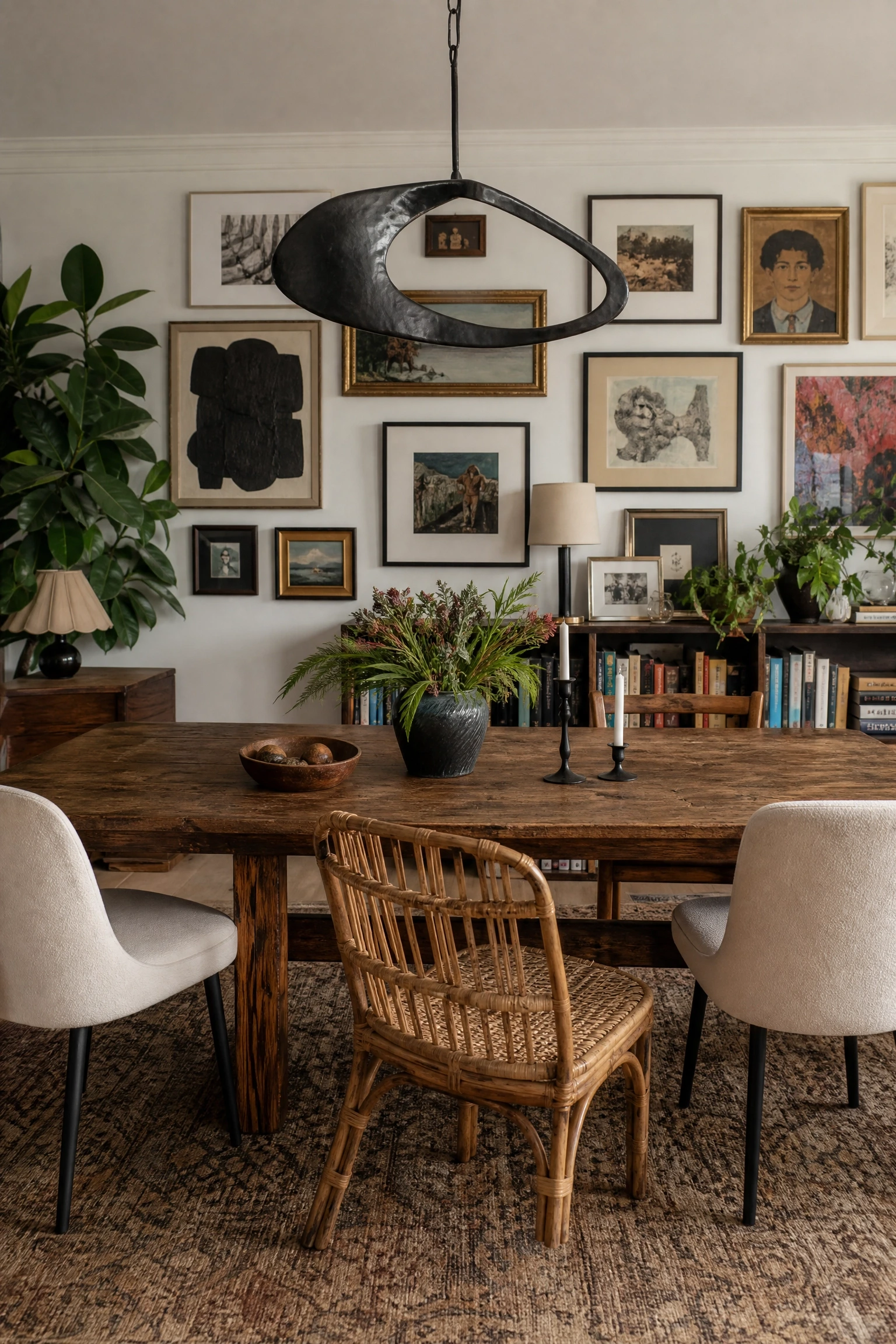
Eclectic dining rooms – the kind that mix a vintage table with modern chairs and artwork from three different continents – need a pendant that is interesting enough to hold its own without trying to match anything. This is actually the most freeing design scenario in pendant lighting, and the place where sculptural or art-pendant lights make the most sense. A hand-forged iron pendant with an irregular, organic silhouette, a pendant made from dyed banana fibre or recycled paper pulp, or a striking colored glass pendant in a bold shape can all work brilliantly in an eclectic space because they add another layer of visual interest rather than trying to harmonize with everything else. The practical rule here is that the pendant should share at least one element – a finish, a material, or a color – with something else already in the room, even if everything else is different. That one thread of connection is enough to make it feel chosen rather than random.
Pro Move: In an eclectic dining room, repeat the pendant metal finish somewhere else in the room – even just in a picture frame or chair leg – to create a sense of intention without forcing a match.
12. The Japandi or Wabi-Sabi Room That Needs Quiet Beauty
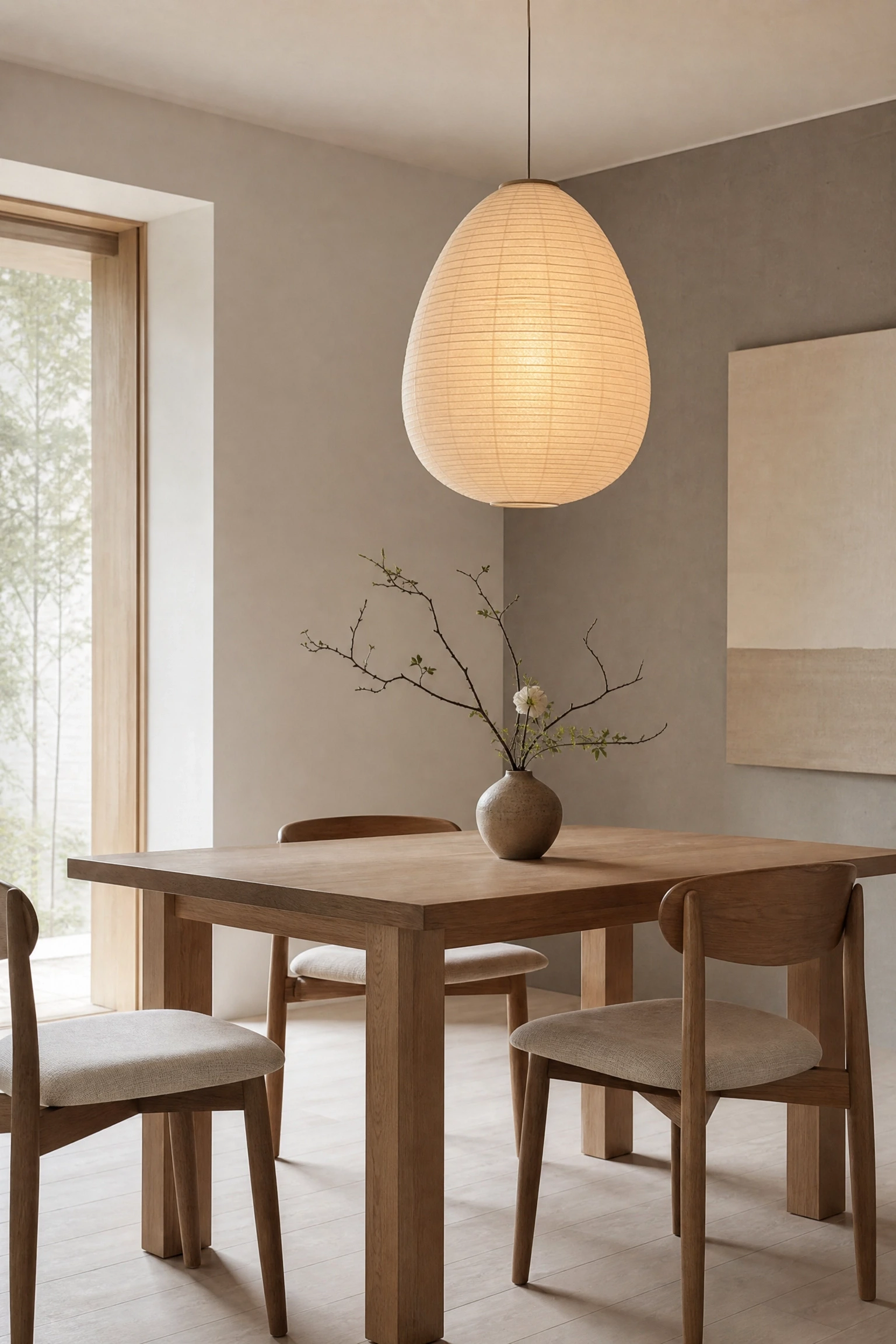
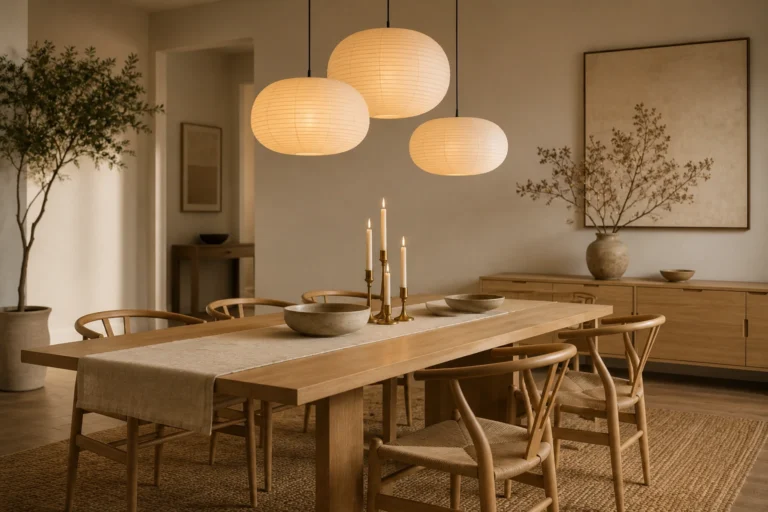
Japandi design – the much-discussed hybrid of Japanese minimalism and Scandinavian warmth – has a very clear set of values when it comes to lighting: natural materials, soft diffused light, and no unnecessary ornament. Pendant lights for Japandi dining rooms should feel almost like they grew there. Rice paper pendants, particularly the classic Akari series originally designed by Isamu Noguchi, are the most commonly cited recommendation, and for good reason: the washi paper diffuses light in a way that is genuinely beautiful and completely in keeping with the wabi-sabi appreciation for imperfect, natural materials. Beyond the Noguchi (which retails at around $500 for a genuine Vitra edition), there are excellent paper pendant options from HAY, IKEA, and numerous Japanese import sources that achieve the same soft, organic quality for significantly less. The key quality to look for is whether the paper has a warm undertone when lit – cool-white paper shades read as slightly clinical, which is exactly what Japandi design wants to avoid.
Designer Advice: A rice paper pendant looks most at home when it is paired with warm LED bulbs at 2700K or lower – anything brighter or cooler will cast a harsh light that fights the natural material.
Rice Paper vs. Rattan Pendant: Which Works for Japandi?
13. The Dark or Moody Dining Room That Should Lean In
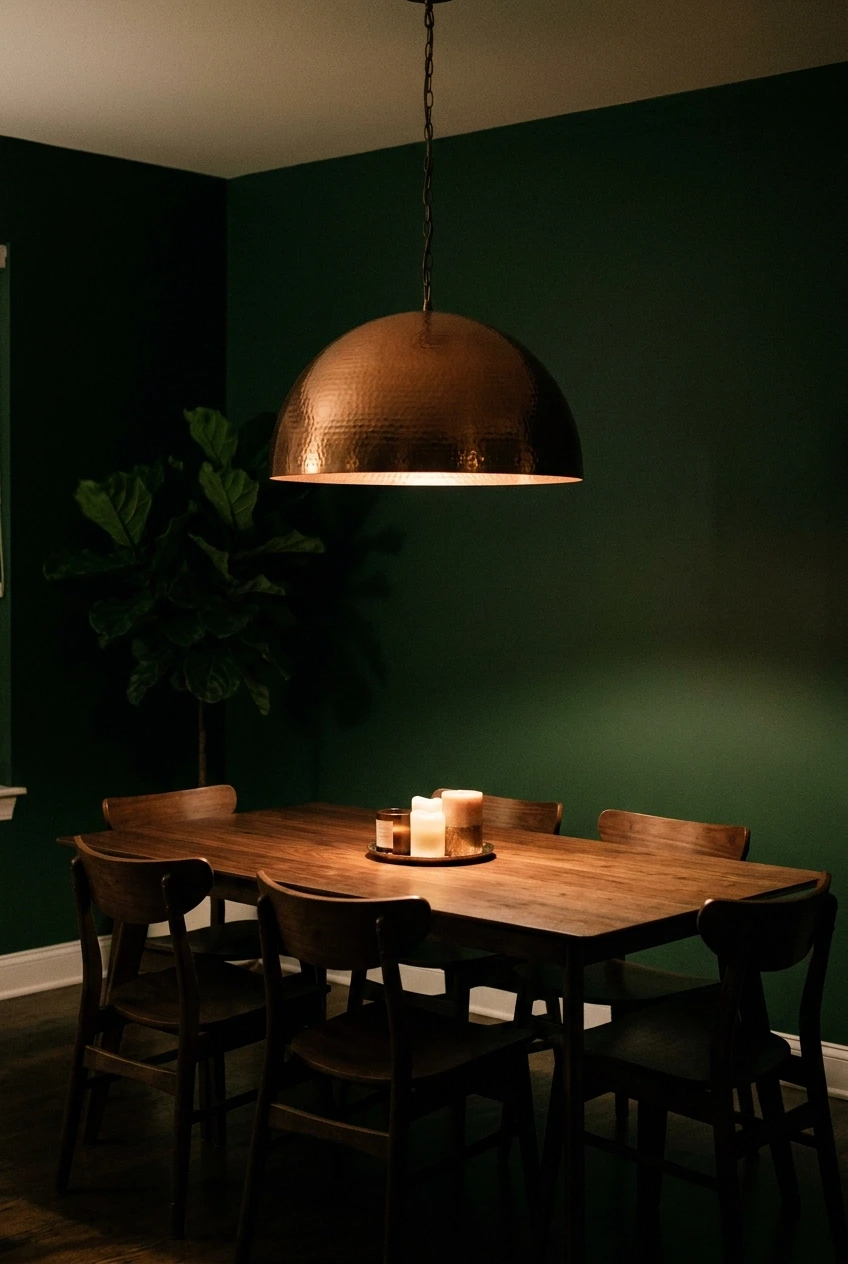
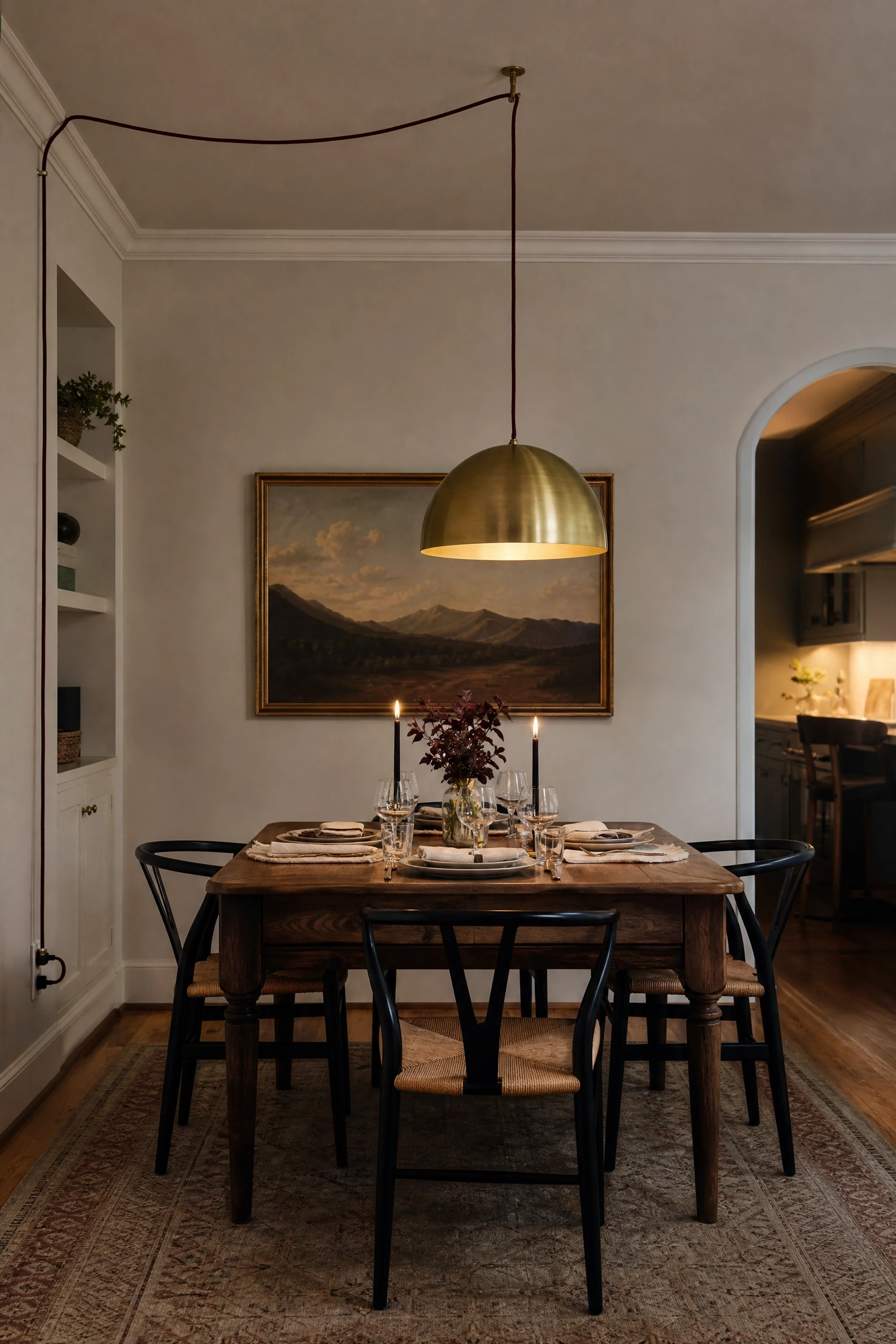
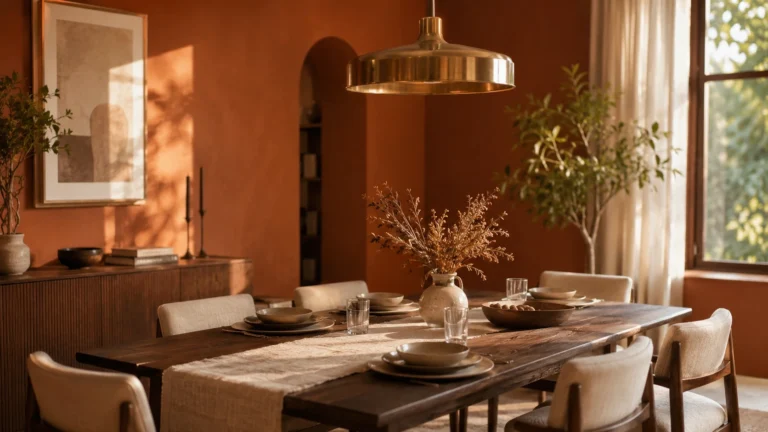
Deep, moody dining rooms with dark walls in forest green, navy, charcoal, or terracotta are having a genuine design moment, and the pendant lighting in these spaces should absolutely lean into the drama rather than trying to brighten it up. Opaque pendants with narrow downward-facing openings – think a blackened brass dome or a hammered copper bowl pendant – concentrate the light onto the table surface and let the walls stay as dark and atmospheric as you want them. This is the opposite approach to a light-filled room where diffused illumination is the goal: in a moody room, the pool of warm light on the table is the point. The contrast between the lit surface and the darker surround creates exactly the intimate, candlelit feeling that people are trying to achieve with dark wall colors. Hammered or textured metal finishes are particularly good in moody rooms because they pick up the ambient light and add a subtle shimmer that feels rich without being shiny.
Heads Up: In a dark dining room, avoid pendants with white or light-colored interior shades – the contrast between the shade exterior and interior reads as cheap and breaks the moody effect you are going for.
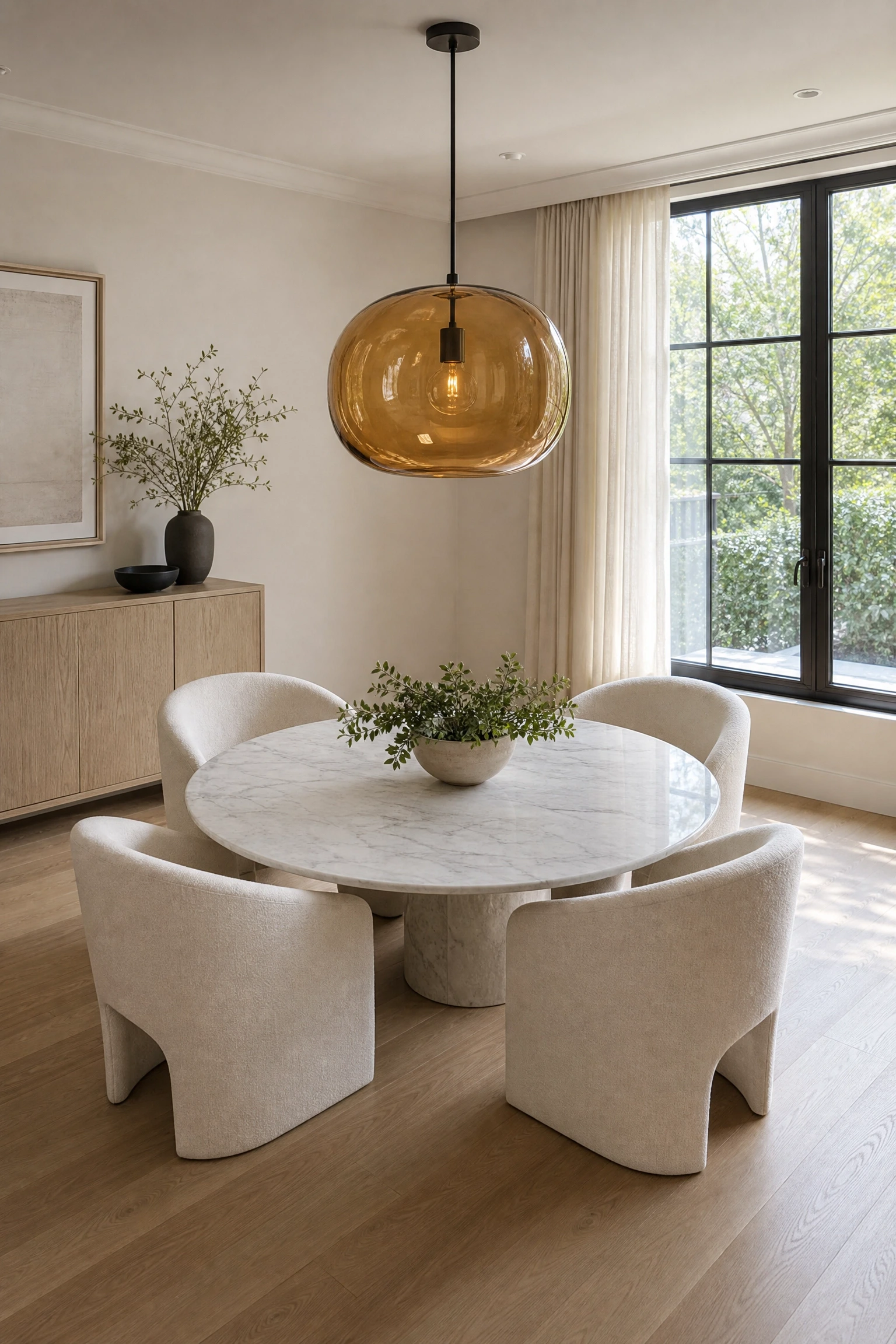
Round tables have a natural visual logic – they are centered, symmetrical, and social – and the pendant above them needs to honor that logic. A single centered pendant that is roughly half to two-thirds the diameter of the table is the standard recommendation, and it is the right one. For a 48-inch round table, a pendant between 24 and 32 inches in diameter sits in perfect proportion. Where people go wrong with round tables is going too narrow: a small pendant over a large round table looks like a question mark, as if someone intended to put a light there but had not quite decided yet. For larger round tables (60 inches and above), a wide drum pendant or an open cage pendant that reads as a single large form is much more appropriate than a cluster or linear arrangement, both of which would look odd centered over a circular surface. If budget allows, a statement pendant – something in hand-blown glass or with a distinctive silhouette – over a round table in an otherwise simple room is a genuinely effective design move.
Quick Tip: For a round dining table, use the formula: pendant diameter should equal roughly half the table diameter, with a minimum of 6 inches clearance on all sides from the pendant edge to the table edge.
15. The Dining Room That Doubles as a Home Office or Homework Space
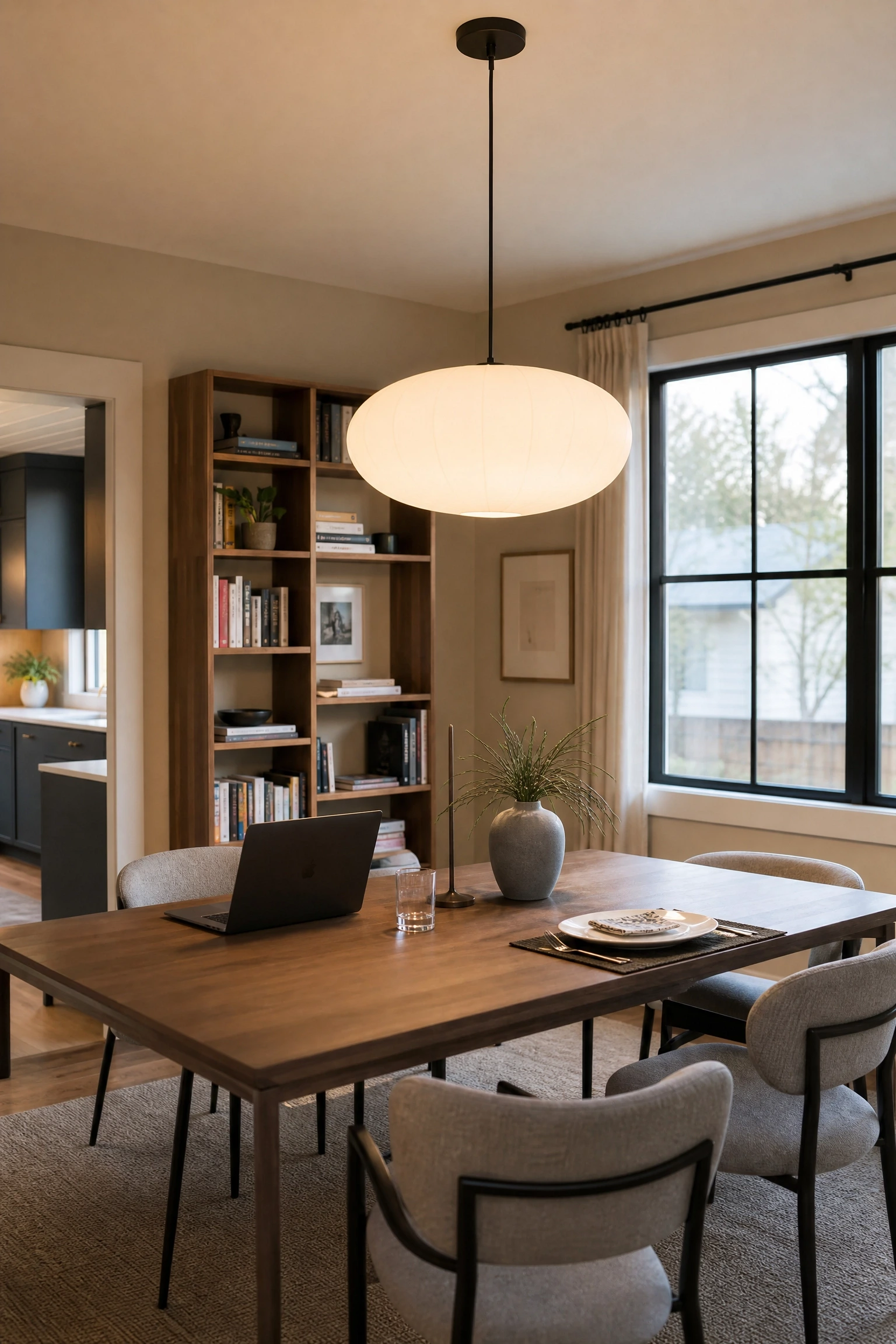
A lot of dining tables are not just for dining anymore – they are where homework gets done, where the laptop comes out on weekend mornings, and where the occasional Zoom call happens in reasonable light. A single decorative pendant that only looks good at dinner is not actually serving this space well. The right approach here is a pendant with a diffused shade that gives good ambient light for daytime tasks, paired with a dimmer switch that lets you drop the brightness to candlelit levels for dinner. Opal glass pendants – the kind with a smooth milky white exterior that completely hides the bulb – are the workhorses of multi-use dining rooms because they cast even, shadow-free light that works for reading, eating, and everything in between. They are also completely inoffensive aesthetically, which means they do not fight with the decor whether the room is set for dinner or covered in school projects.
Reality Check: A pendant without a dimmer in a multi-use dining room is a missed opportunity – a smart bulb or a $15 in-line dimmer switch can be added to almost any pendant and will genuinely change how the room feels at different times of day.
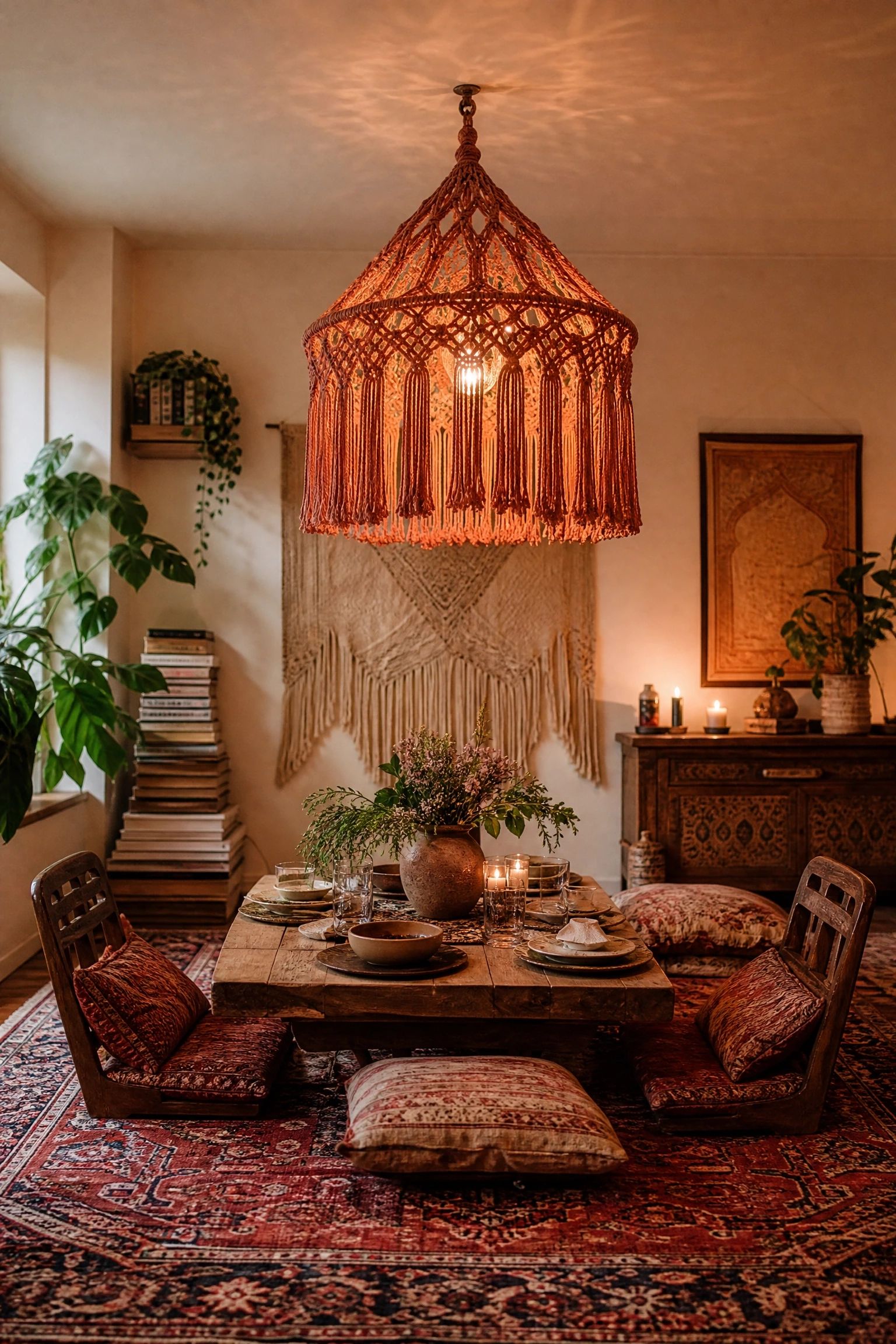
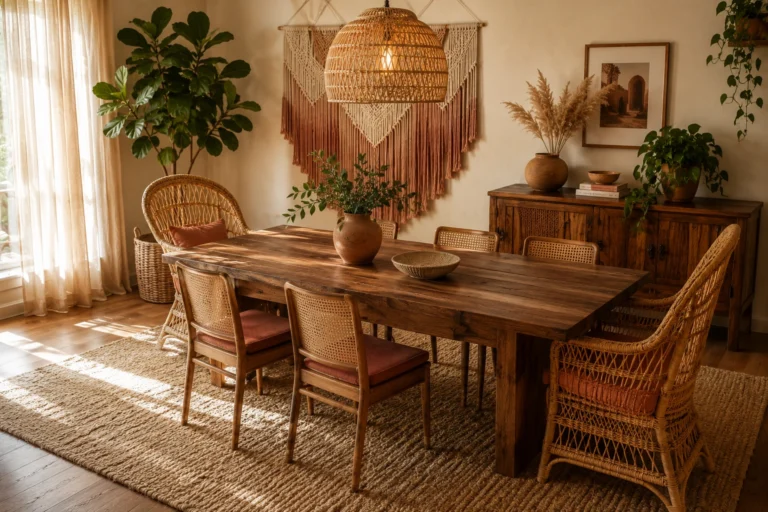
Bohemian dining rooms are the one context where almost anything goes – but that does not mean anything works. The bohemian aesthetic is really about layered richness: multiple textures, warm colors, and a sense that things have been collected over time rather than chosen from a single collection. In this room, a macrame or knotted pendant in a natural or terracotta-dyed fiber is a strong choice, particularly over a table that already has interesting legs or a richly grained wood surface. What makes a bohemian pendant feel intentional rather than random is scale: the pendant should be generous enough to anchor the space, not a small decorative afterthought. A macrame pendant with a 20 to 30-inch spread over a dining table creates a genuinely layered, textural focal point. These are also some of the most affordable artisan-made options in pendant lighting – handmade macrame pendants from Etsy or local craft markets can be found for $60 to $150 and add a genuinely personal, one-of-a-kind quality to the room.
Pro Move: Layer a macrame pendant with a lower-wattage warm bulb (25 to 40 watts equivalent) – the light filtering through the knotted fibers creates patterns on the ceiling and walls that add atmosphere at no extra cost.
17. The Industrial or Loft Dining Space That Wants Warmth
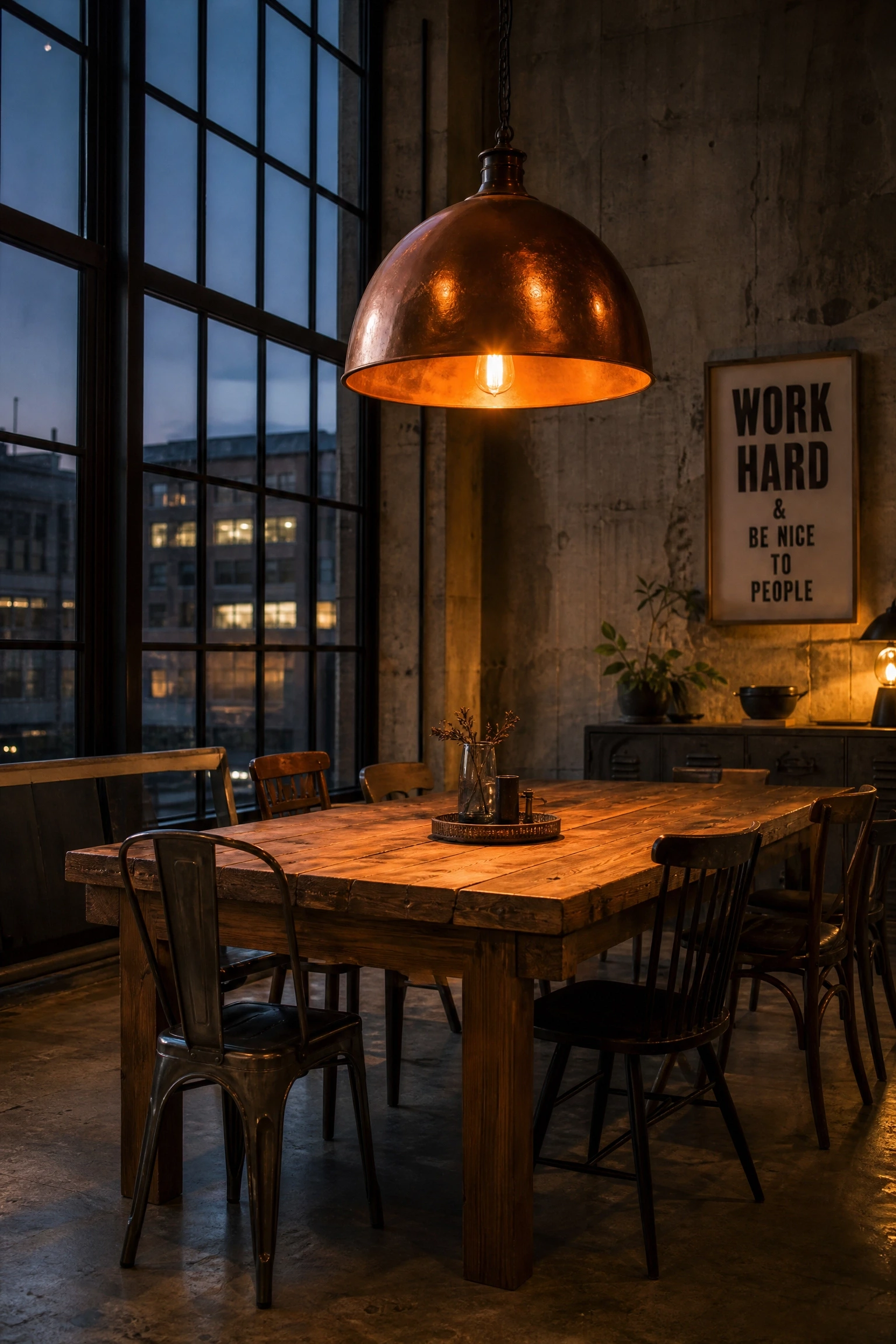
Industrial dining rooms – concrete floors, exposed brick, steel-framed windows – have a coolness to them that is visually interesting but can feel uninviting at mealtimes. The pendant choice in an industrial space should do two jobs simultaneously: fit the aesthetic vocabulary of the room while adding warmth that the architecture does not provide on its own. Copper dome pendants do this better than almost anything else. Copper reads as industrial (it is a raw material with a factory-floor history) while the color and reflectivity of the metal cast a genuinely warm, amber-tinged light that softens the hardness of the room around it. Copper also develops a patina over time, which gets better-looking with age in a way that aligns with the industrial ethos of honest materials. At the mid-range price point, spun copper dome pendants from suppliers like Schoolhouse Electric or West Elm hover around $150 to $300 and are genuinely excellent value for the warmth they add to a hard-edged space.
Designer Advice: In an industrial room, hang copper pendants slightly lower than you normally would – closer to 26 to 28 inches above the table – so the warm light creates a defined contrast with the cooler ambient feel of the space around it.
18. The Traditional Room That Wants to Feel Updated Without a Full Renovation
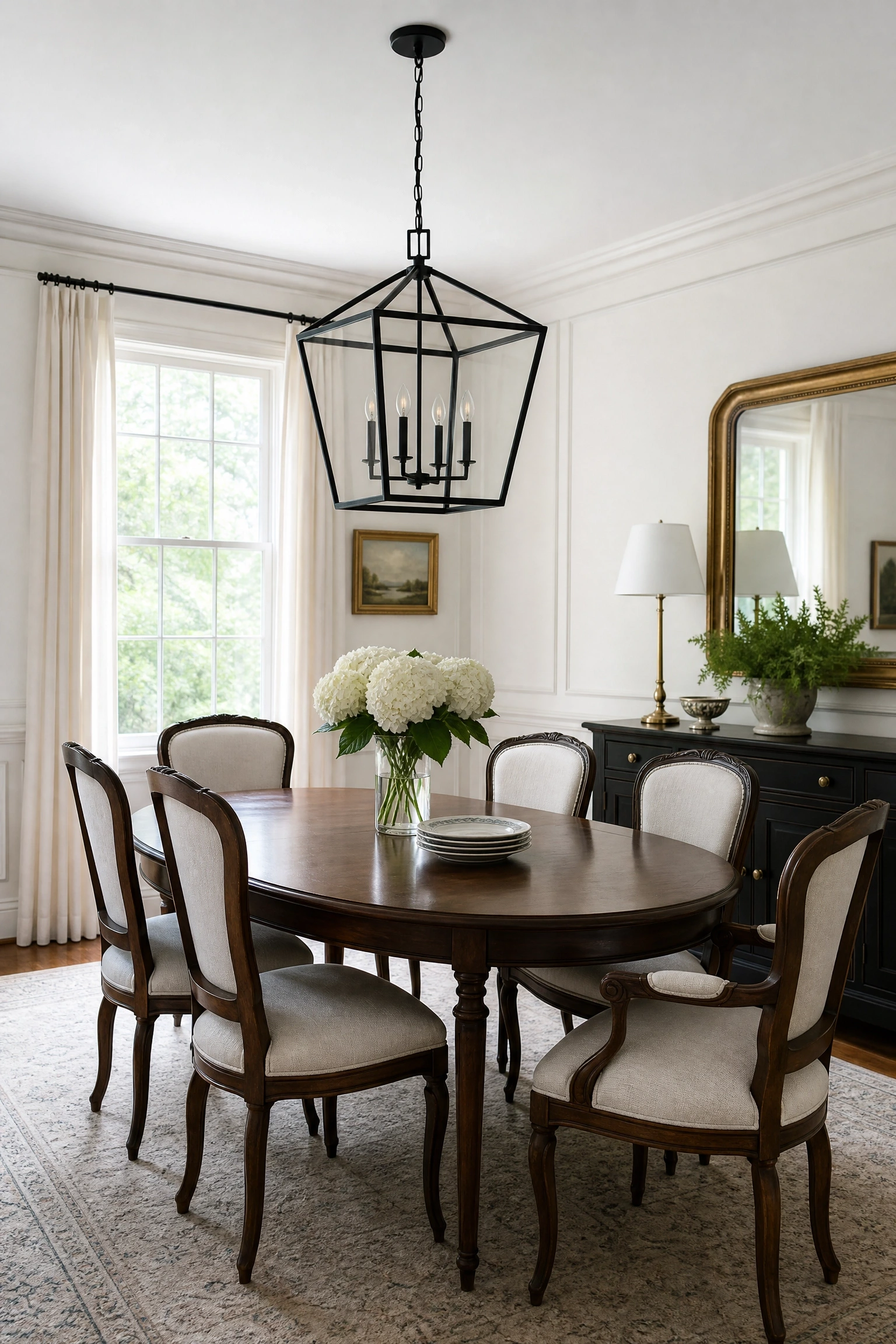
Traditional dining rooms with crown molding, wainscoting, and a classic furniture suite often have a chandelier that has been there since the house was built – and that chandelier is probably either too heavy and ornate, or too small and generic. Swapping it for a transitional pendant (a style that bridges traditional and contemporary design) is one of the highest-impact, lowest-cost updates you can make to a traditional dining room without touching a single wall. Transitional pendants typically have a classic silhouette – drum shade, lantern form, or bell shade – executed in cleaner lines and more restrained finishes than a traditional chandelier. A matte black lantern-style pendant with clear glass panels is a particularly good swap in traditional rooms: it keeps the formality and vertical presence of a classic chandelier while reading as current and considered rather than dated.
Heads Up: When replacing a chandelier with a pendant in a traditional room, make sure the new fixture covers the old ceiling medallion or canopy hole – measure the existing canopy diameter before you order.
19. The Bright, White Room That Needs a Contrast Point
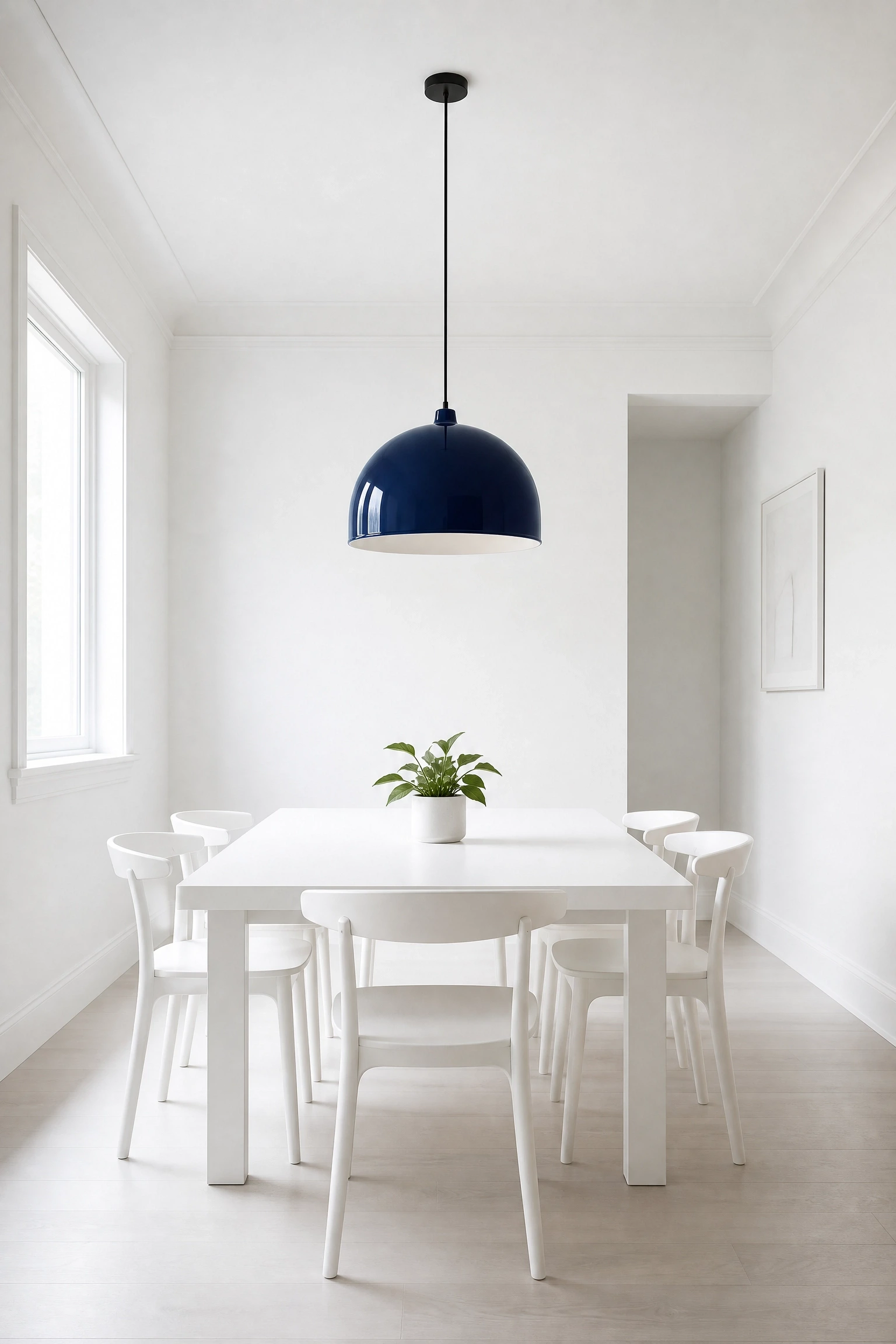
All-white dining rooms are beautiful in theory and can feel a little monotonous in practice, especially overhead. When every surface is white or very light, the pendant light becomes one of the only opportunities to introduce a note of contrast, and it should take that opportunity. A matte black pendant – even something relatively simple in form, like a dome or globe – reads as a strong graphic element in a white room and gives the eye somewhere to land. This is the context where bold color also works surprisingly well: a deep blue ceramic pendant or a forest green enamel dome over a white dining table is a combination that professional designers use regularly in high-end projects because the contrast is clean and confident without requiring any other changes to the room. The pendant does not need to be large or complicated – in a white room, the contrast itself is the statement, so the form can be relatively simple.
Quick Tip: In an all-white dining room, the pendant cord or rod is visible against the ceiling – choose a black, dark bronze, or colored cord cover rather than white to make the contrast intentional.
20. The Room With an Awkward or Off-Center Ceiling Box
Off-center ceiling electrical boxes are a genuine headache, and they affect more homes than most people realize. The instinct is to either hang the pendant off-center (which looks like a mistake) or run a long swag cord across the ceiling (which looks like a rental hack from 2007). The better solutions are either a ceiling canopy extender that lets you relocate the fixture visually without moving the wiring, or a deliberately asymmetric pendant design that makes the off-center placement look like an artistic choice. There is also a third path that more designers are recommending: a plug-in swag pendant with a deliberately visible cord wrapped in fabric, styled so that the cord runs along the ceiling molding as a designed element rather than a workaround. Done well, with a beautiful brass hook and a fabric cord in a complementary color, this can look genuinely intentional and even add character to a room that might otherwise feel generic.
Reality Check: Before buying an expensive pendant for an off-center box, check with an electrician about the cost of relocating the box – in many homes it is a straightforward job that costs $150 to $250 and solves the problem permanently.
21. The Dining Room Where You Want to Mix Metals Confidently
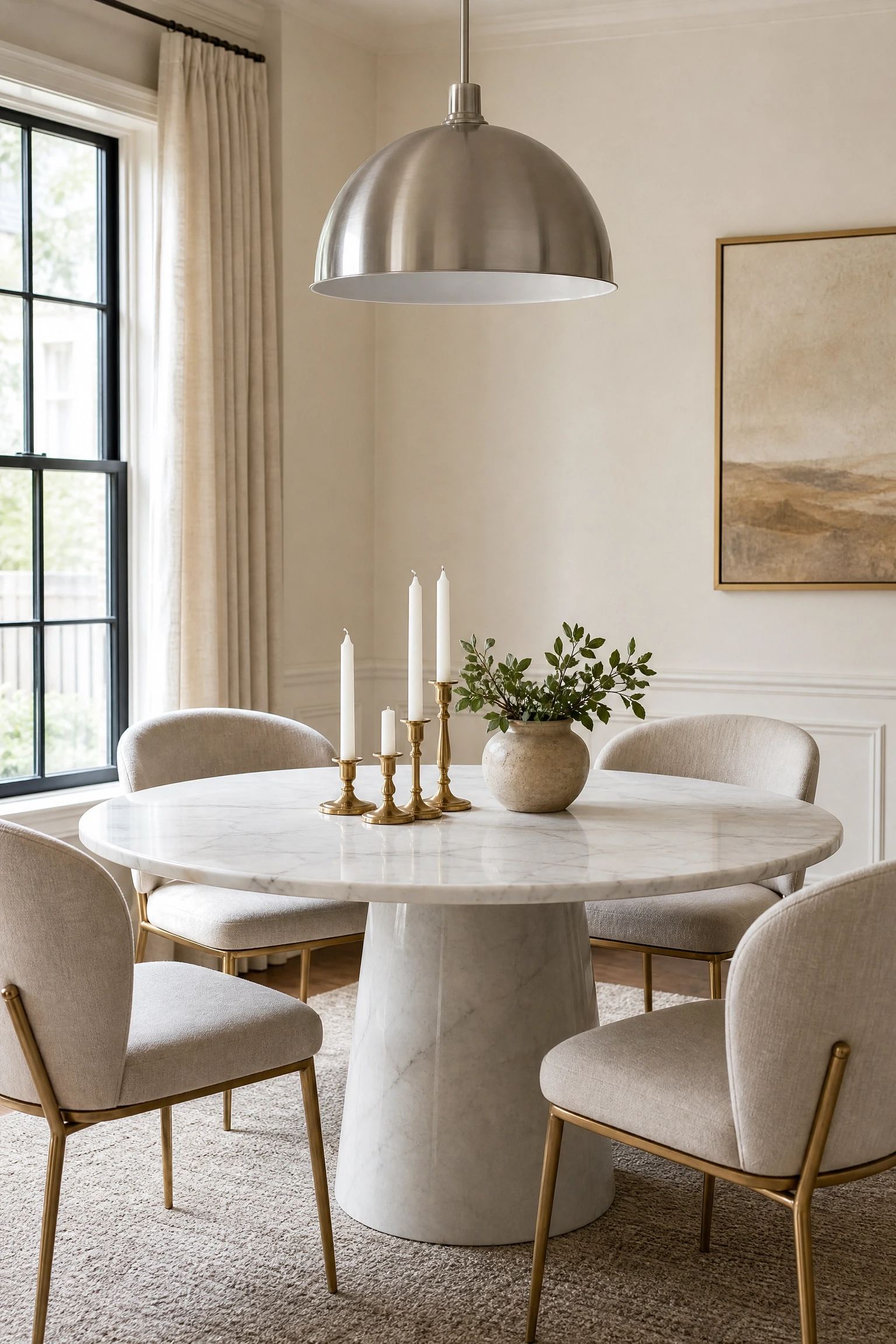
Mixed metals in dining rooms have gone from a design risk to a design recommendation over the last several years, and pendant lighting is one of the best places to try it. The key to mixing metals successfully is to choose two (not more than three) and to make sure one appears more than the other – so you have a dominant metal and an accent. If your dining room already has brass hardware on the furniture and brass-toned chair legs, a brushed nickel or matte silver pendant can be a confident, contemporary choice that adds depth rather than conflict. The rule that designers apply here is that the metals should be in different temperature zones (warm gold tones with cooler silver or chrome) or in different finish textures (polished brass with matte black) – mixing two warm metals of similar finish (like polished brass and antique gold) tends to look like a mismatch rather than a deliberate combination.
Designer Advice: When mixing metals in a pendant with other room fixtures, aim for the pendant to share its finish with at least one other element visible from the dining table – a mirror frame, cabinet hardware, or a candle holder works fine.
22. The Dining Room That Just Wants to Feel Like Home
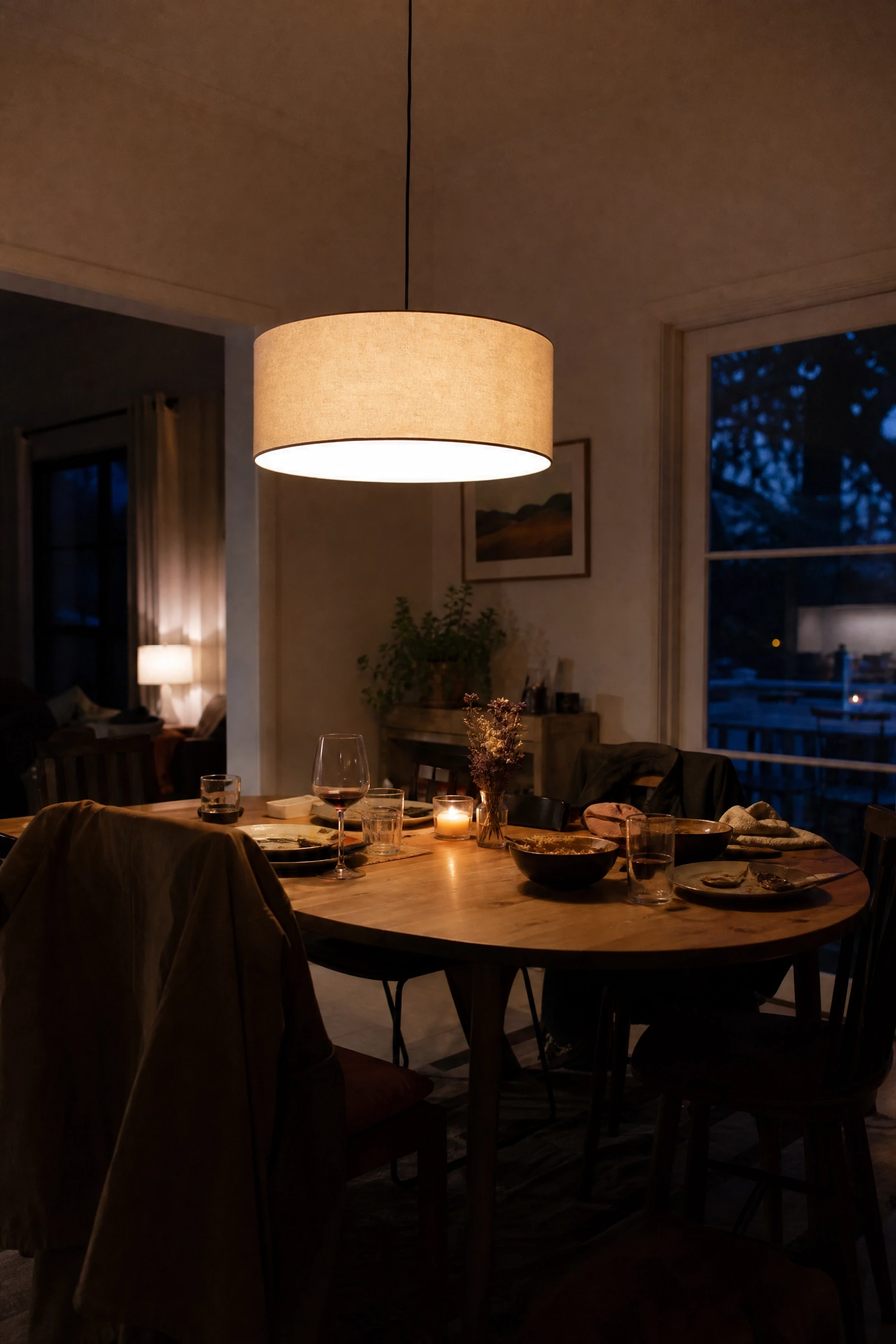
Not every dining room is a design project. Sometimes you just want the room to feel warm, comfortable, and genuinely lived-in – the kind of space where people relax at the table after the plates are cleared and the conversation keeps going. For this room, the pendant should prioritize warmth above everything else. A large, low-hung linen shade with a warm-toned bulb inside is probably the single most universally flattering and comfortable pendant type for a dining room: it casts light that is kind to faces, soft enough to relax under, and clean enough to not compete with anything else in the room. Linen pendants are also one of the most durable and adaptable choices you can make – they look good in traditional rooms, transitional rooms, and modern rooms, they are widely available at every price point, and the shade itself can often be replaced if you want a refresh without changing the fixture. There is nothing flashy about a linen drum pendant, and in a room that is meant to feel like home, that is entirely the point.
Pro Move: For the most flattering dining room light possible, use a warm filament LED at 2200K to 2400K inside a linen shade – the combination of warm bulb and diffusing fabric creates a light quality that is genuinely beautiful for evening meals.
Finding the Right Pendant Starts With Knowing Your Room
Pendant lights are one of the few elements in a dining room that do both jobs at once – they are functional and decorative, practical and expressive, and they set the tone for how the room feels every single time you walk into it. The ideas in this article are meant to help you think about which type of pendant actually solves the specific situation your dining room is in, rather than just picking something that looks pretty in a catalog photo.
The most important practical reminders before you buy: hang the pendant 30 to 36 inches above the table surface as a baseline, size the diameter to roughly a third of the table length for a single fixture, and always – always – add a dimmer switch. Beyond those three rules, trust your instinct about material and finish. The rooms that look best with pendant lighting are rarely the ones with the most expensive fixture: they are the ones where someone thought about the specific character of the space and chose a pendant that fits it honestly.
One well-chosen pendant over your dining table will do more for the room than most people expect, and you do not need to spend a fortune to get it right. The goal is a room where the light feels like it was always supposed to be there – and now you have the knowledge to make that happen.
Which of these scenarios sounds most like your dining room, and which pendant idea are you going to try first? Drop it in the comments below.
Frequently Asked Questions
How far should a pendant light hang above a dining table?
The standard recommendation is 30 to 36 inches above the table surface for rooms with 8-foot ceilings. For every additional foot of ceiling height beyond 8 feet, add about 3 inches to the drop. So a 10-foot ceiling would put you at 36 to 42 inches above the table. The goal is to light the table well without blocking sightlines between people seated at it.
How do I know what size pendant to choose for my dining table?
For a single pendant over a round or square table, aim for a diameter that is roughly half to two-thirds the table diameter. For a rectangular table, the total width of your pendant arrangement (single fixture or multiple) should not exceed the width of the table minus about 12 inches on each side. When in doubt, go slightly larger – undersized pendants are a more common mistake than oversized ones.
Can I use more than one pendant over my dining table?
Yes, and for long rectangular tables it is often the better choice. Two pendants spaced 24 to 30 inches apart from center to center works well for tables between 72 and 96 inches long. Three pendants in a row suits very long tables or creates a particularly strong visual statement. The key is keeping the fixtures at the same height and ensuring they are identical or from the same design family so the grouping reads as intentional.
Do I need a dimmer switch with my dining room pendant?
Not technically, but it is very strongly worth adding one. A dimmer switch changes a single fixture from a task light into an atmospheric one, letting you dial the brightness up for family dinners and down for evening gatherings. A compatible LED dimmer switch costs around $15 to $25 and takes about 20 minutes to install. It is one of the best small investments in dining room comfort you can make.
What bulb should I use in a dining room pendant?
For most dining rooms, a warm LED filament bulb at 2700K or lower is the right choice. The warm color temperature is flattering to food and to faces, and it creates the kind of ambient glow that makes a room feel inviting. Avoid cool-white bulbs (4000K or above) in dining pendants – they create a clinical, cafeteria-like light quality that is comfortable for task work but unflattering for mealtimes. Look for bulbs rated between 400 and 800 lumens for a dining pendant: bright enough to see clearly, low enough to feel relaxed.
What is the best pendant style for a low-ceiling dining room?
For rooms with ceilings at or below 8 feet, look for semi-flush or close-to-ceiling pendant designs that minimize the drop while still offering a decorative element. A shallow dome pendant, a close-fitting globe, or a flush-mount with pendant-style detailing can all work well. The minimum clearance you want from the bottom of the fixture to the table surface is about 30 inches, and from the bottom of the fixture to the floor (for walkway areas) is 80 to 84 inches – keep both of these in mind when choosing the drop length.