A black and silver bedroom walks a narrower design tightrope than most colour combinations. Too much silver and the room turns cold, clinical, and slightly corporate: the aesthetic of a hotel lobby at 2am rather than a bedroom you want to sleep in. Too much black and the room tips into heavy, airless territory where the drama becomes oppressive rather than atmospheric. The balance between the two is what makes this combination genuinely beautiful when it is done well, and it is also what makes it so easy to get wrong when approached without a clear sense of how much of each colour is doing what job.
The ideas in this article are organized by how much silver the idea uses and what role it plays: starting with ideas where silver genuinely leads the surface palette and black provides the grounding contrast, moving through ideas where both colours share roughly equal visual weight, and finishing with ideas where black is firmly in command and silver arrives in fine-line, precise, or textural form as the detail that gives the dark palette its depth and life. The ideas that look most sophisticated in a black and silver bedroom are almost always in the third category, where the silver is doing the most disciplined and specific work. But all three sections have a place depending on the direction you want the bedroom to take.
Silver Leads: Black as the Grounding Contrast
These ideas give silver the larger visual presence in the bedroom. Black arrives as structure, definition, and weight rather than as the primary colour experience. This is the version of the palette most suited to bedrooms that cannot afford to lose light and where the moody drama of a black-dominant room is not the goal.
1. Silver Mirrored Furniture Against a Black Accent Wall
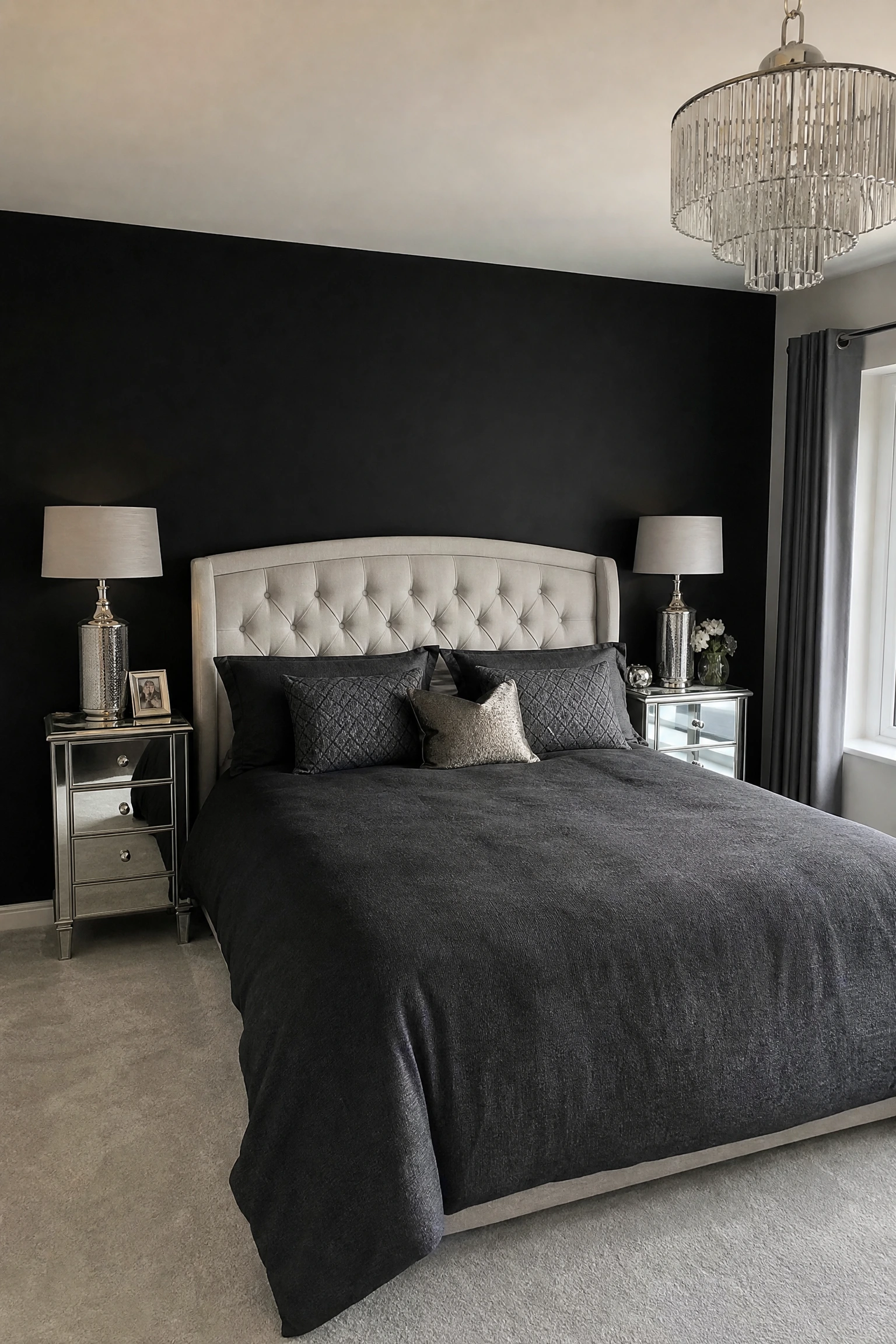
Mirrored silver furniture, whether a pair of bedside tables with mirrored fronts, a mirrored chest of drawers, or a mirrored dressing table, placed against a single black accent wall creates one of the most visually impactful black and silver bedroom arrangements available without requiring any change to the rest of the room. The mirror surfaces of the furniture reflect the black wall behind them and multiply the depth of the dark colour, creating a sense of recession and space that a standard wall would not produce. At the same time, the silver mirrored surface reflects whatever light source is available in the room, including natural daylight and bedside lamps, and redistributes it in a way that keeps the bedroom from feeling enclosed. Mirrored furniture in a bedroom is a long-established trick for making a compact room feel larger, and against a black accent wall it gains an additional dimension: the reflection of the dark wall in the mirror surface creates a moody, atmospheric depth that feels genuinely designed rather than simply reflective.
Heads Up: Mirrored furniture shows fingerprints and dust readily and requires more frequent maintenance than standard wood or lacquered finishes to keep looking polished. In a bedroom that is regularly used and not frequently cleaned, mirrored pieces can become a source of visual noise rather than a design asset. Weekly wiping with a glass cloth is the minimum maintenance requirement.
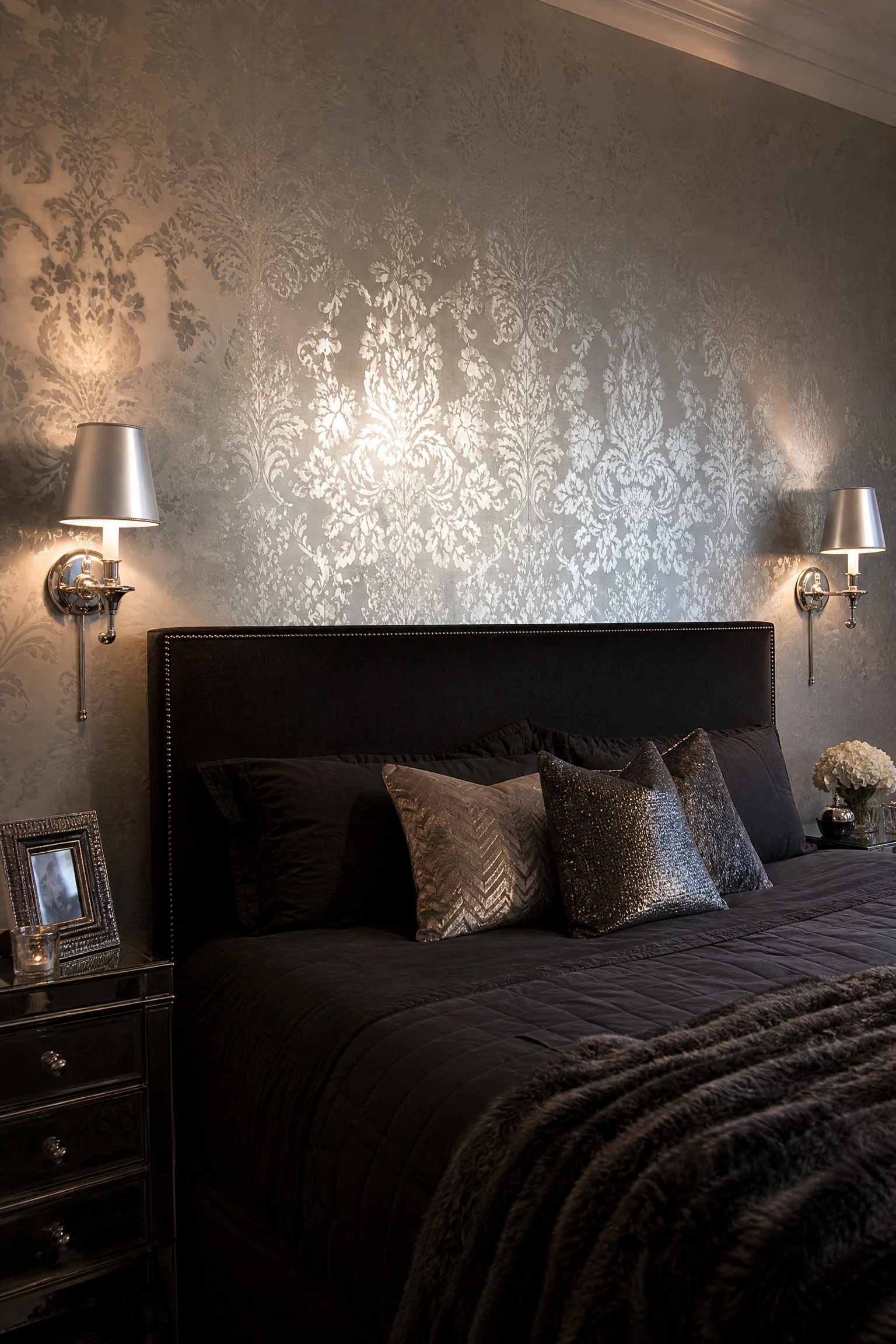
A silver metallic or textured silver wallpaper on the headboard wall creates the most immediately glamorous version of a silver-led bedroom because the wallpaper surface catches and reflects light in a continuous, varied way that painted walls cannot replicate. Wallpapers with a subtle metallic sheen in a tone-on-tone silver pattern, such as damask, geometric, or botanical prints in silver on silver, add texture and pattern while keeping the colour palette controlled. A more overt silver foil or high-gloss metallic wallpaper creates a stronger dramatic effect that suits a bedroom going for a bold, luxurious aesthetic. In either case, black is introduced through the bedframe, the bedside accessories, and the soft furnishings rather than the wall surface, creating a composition where the silver wall does the visual heavy lifting and the black elements anchor it. The practical caveat with metallic wallpaper is that it tends to show every imperfection in the wall behind it: the surface needs to be properly prepared and lined before application, or every bump and hollow will be visible in the reflective surface.
Designer Advice: Keep the ceiling and the three non-feature walls in a soft white or very pale grey when using silver metallic wallpaper on the headboard wall. A ceiling or side wall that competes with the metallic feature wall diffuses the impact of the silver surface and makes the room read as busy rather than dramatic.
3. Silver Bedding With a Charcoal or Black Bed Frame
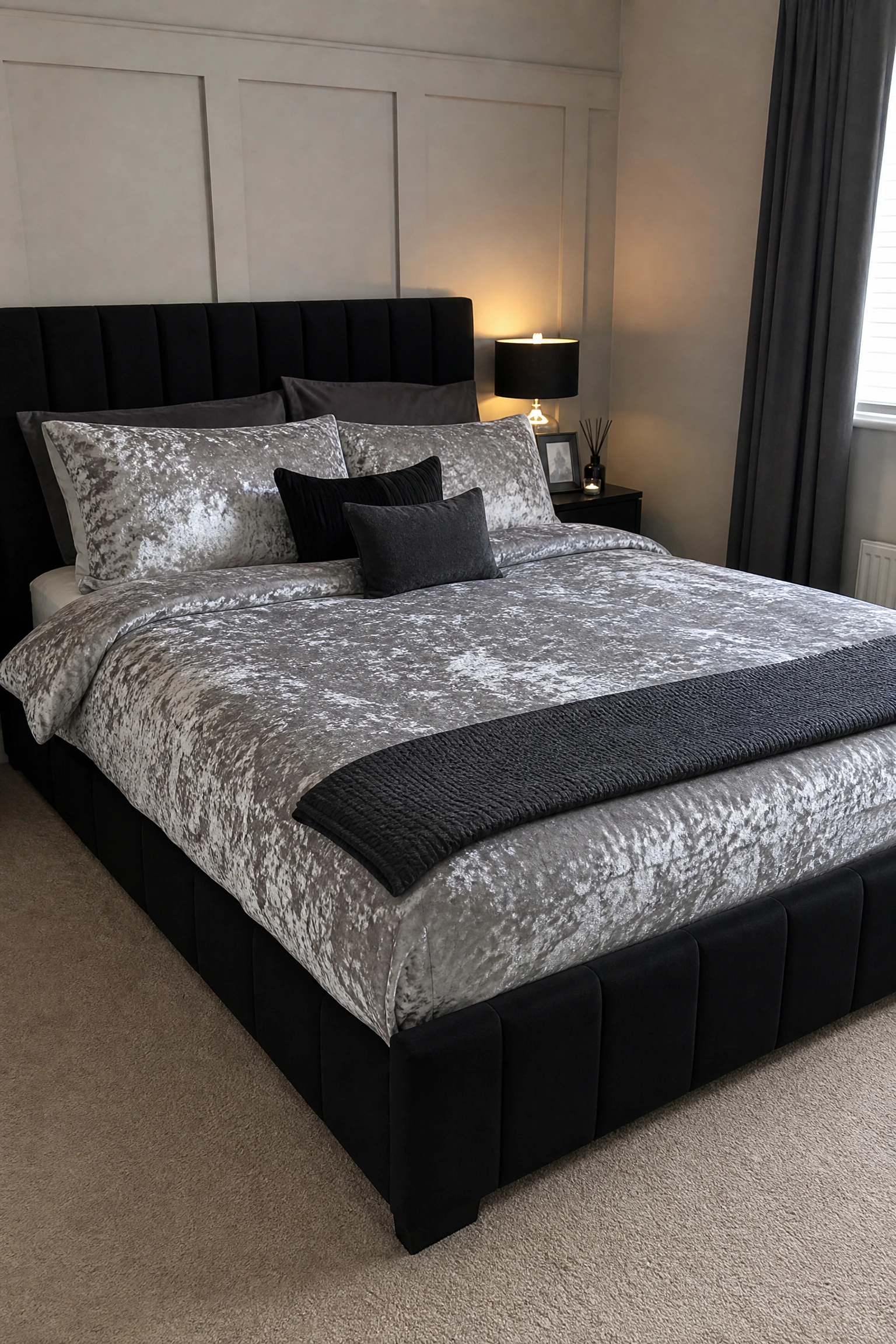
Silver or grey-silver bedding, whether in a silver-tone silk-look fabric, a charcoal and silver jacquard duvet cover, or a set of silver velvet cushions and throw layered over white or pale grey linen, against a charcoal or matte black bed frame creates the most accessible entry point into the black and silver palette. The bed is the largest surface in the bedroom and the one that sets the tonal expectation for everything around it. Silver-toned bedding against a black frame creates an immediate sense of contrast and drama from the most contained and changeable element in the room: the bedding can be swapped seasonally while the frame stays. Crushed velvet in a silver-grey tone is the most visually rich bedding fabric for this combination because the way the pile reflects light from different angles introduces a constant subtle variation across the bed surface that makes the silver appear both darker and lighter depending on the viewing angle.
Reality Check: Very shiny or high-lustre silver bedding fabrics look extraordinary in photographs and considerably less so in the daily experience of living with them: they show creases, body impressions, and wrinkles immediately and require daily straightening to maintain the editorial look. A silver-toned fabric with a matte or velvet finish is dramatically more liveable and looks just as good in person.
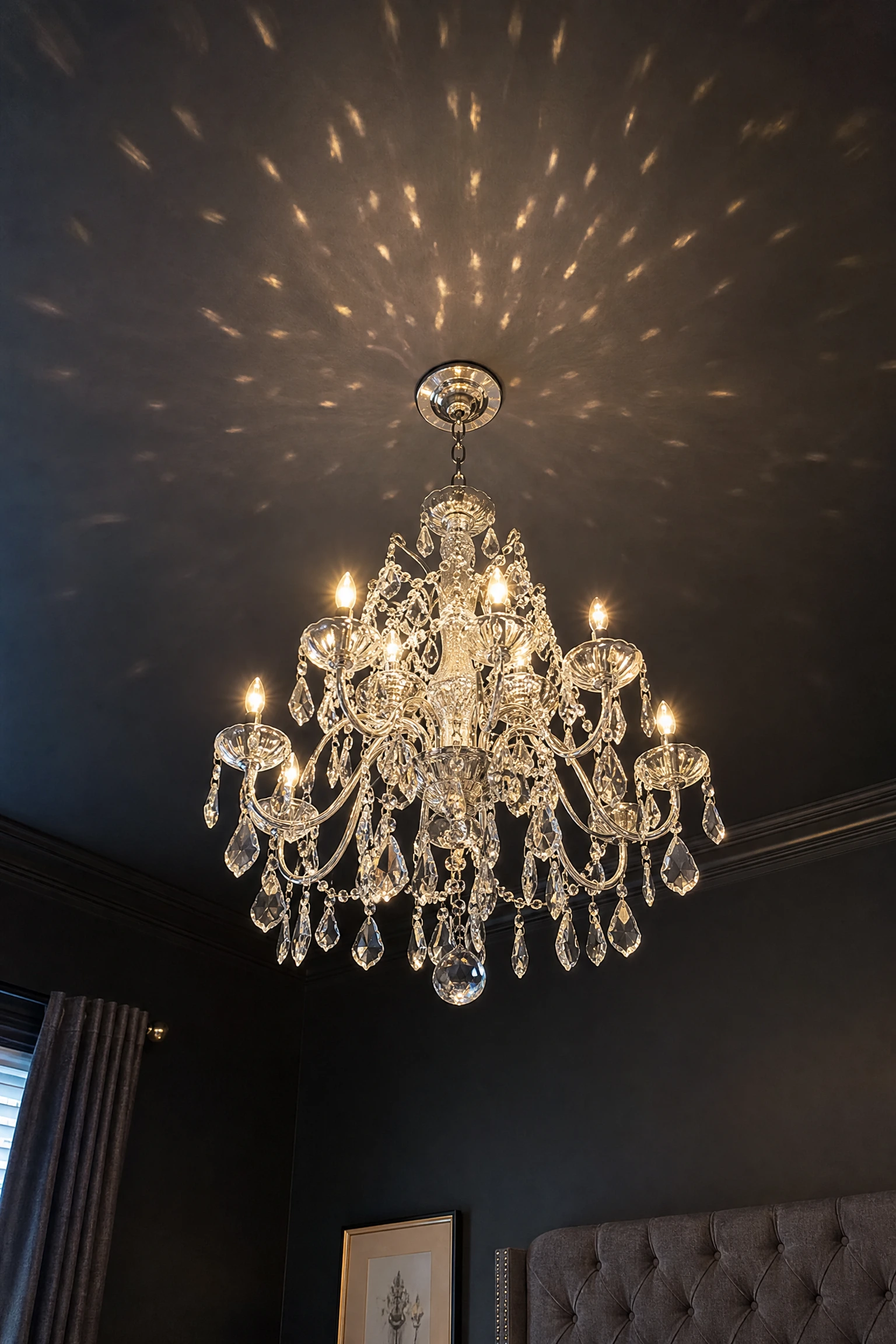
A silver chandelier or statement pendant light in a bedroom with dark walls or dark furniture is one of the most effective applications of silver in this palette because it places the metallic element at ceiling level where it catches the light from every angle and becomes a genuine focal point that draws the eye upward. In a bedroom with deep charcoal or black walls, a crystal and silver chandelier creates a visual moment that simultaneously illuminates the room and decorates it, and the refracted light from crystal drops or polished silver arms creates a light pattern on the dark walls and ceiling that changes through the evening as the light source intensity shifts. A more pared-back alternative is a simple oversized silver pendant in a drum or dome form above the bed: it provides the silver focal point at height without the elaborate quality of a chandelier and suits a more contemporary or minimal bedroom aesthetic.
Pro Move: Install a silver chandelier or pendant on a dimmer circuit rather than a standard on-off switch. The ability to lower the light from the ceiling fitting to a warm ambient level, rather than the full brightness of all crystal drops catching the light simultaneously, is the difference between a bedroom that feels glamorous in the evening and one that feels like a jewellery display case.
5. Silver Curtains or Drapery in a Black and Neutral Bedroom
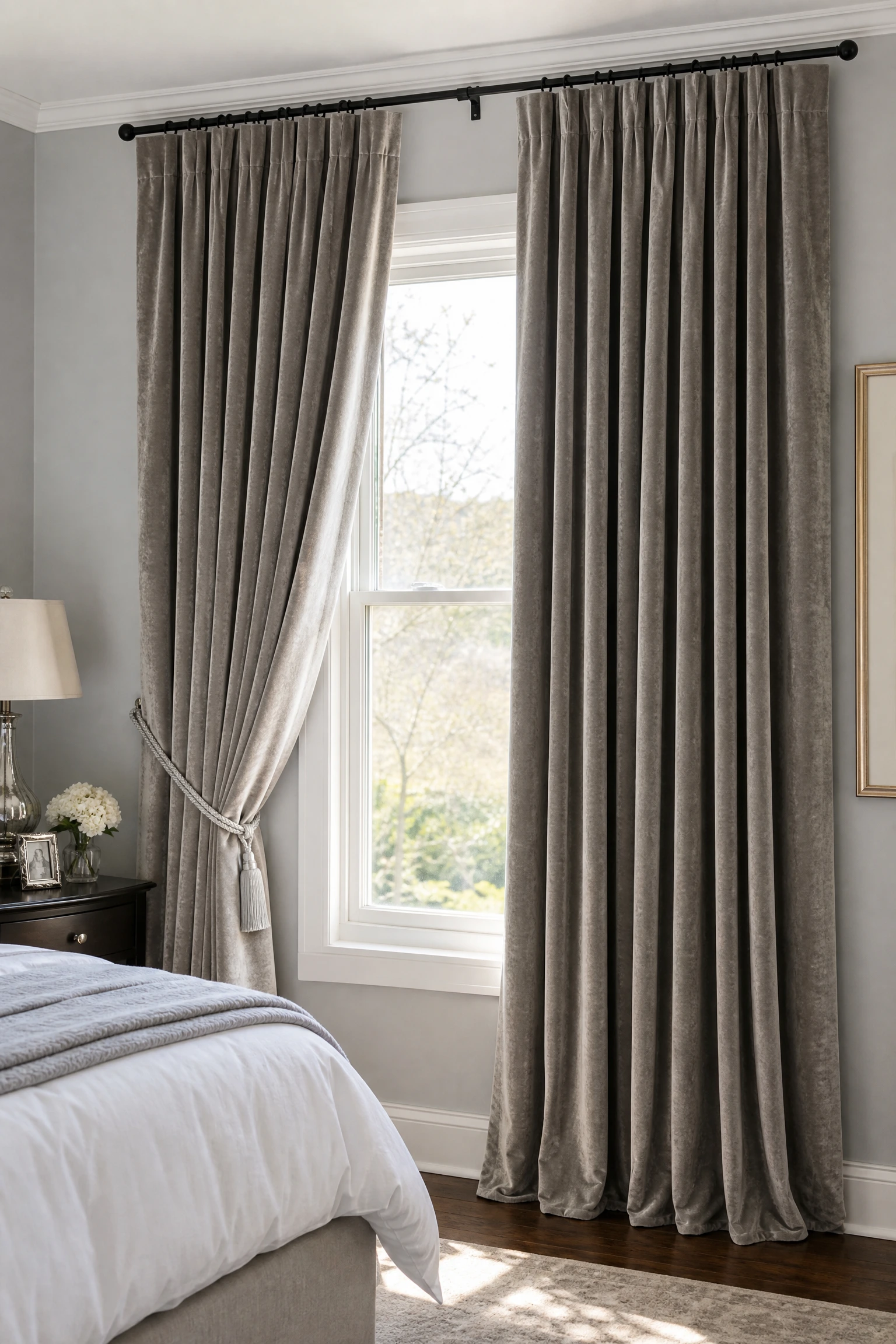
Silver or pewter-toned curtains in a heavyweight fabric, such as velvet, jacquard, or lined faux silk, used as floor-to-ceiling drapery in a bedroom with a black or charcoal colour presence creates a theatrical quality that is most effective in bedrooms with generous ceiling heights and large windows where the scale of the curtain panels can be fully appreciated. Silver curtain fabric in motion, as when the panels are drawn open or closed, changes the way light falls across the surface and creates a fluid, shifting quality that flat wall colour or wallpaper cannot replicate. In a bedroom where the walls are white or pale grey and the bed and furniture are in black or charcoal, silver curtains introduce the metallic note at the perimeter of the room and frame the sleeping space in a way that feels both dramatic and contained. The practical consideration is that silver and metallic-toned curtain fabrics are typically lined and often interlined, making them significantly heavier than standard curtain fabrics and requiring sturdy curtain poles and fittings capable of supporting the additional weight.
Quick Tip: Hang silver curtain panels from a matte black curtain pole rather than a chrome or silver pole. The contrast between the matte black structural element and the reflective silver fabric makes both elements more visible and more interesting than a silver pole that blends into the curtain surface.
6. Silver-Framed Gallery Wall Against Black Painted Walls
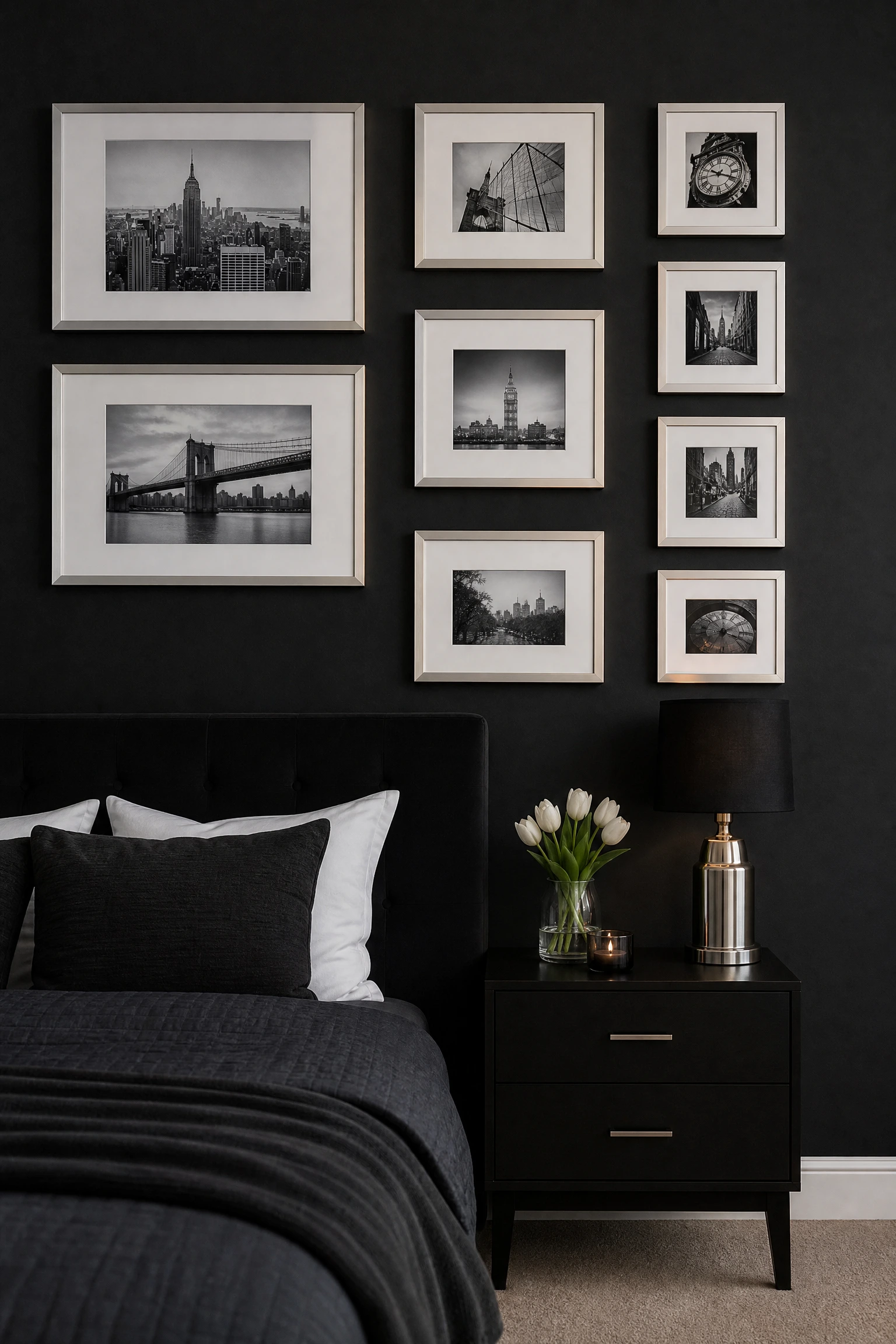
A gallery wall of silver-framed artwork or photographs against a black painted bedroom wall creates a composition where the silver frames register as light against the dark background in the same way that artwork is lit against a gallery wall in a museum or exhibition. The black wall recedes visually and makes the silver frames and their contents appear to float against the dark surface. The arrangement works best when the frames are consistent in finish, all polished silver, all brushed silver, or all matte silver, rather than mixing different metallic tones that create a visual inconsistency against the flat dark background. Black and white photography in silver frames against a black wall is one of the most visually cohesive approaches, because the tonal range of the photographs, from paper white through grey to the deepest black, mirrors the palette of the wall and the frames and creates a unified composition rather than a collection of competing elements.
Designer Advice: Plan the gallery arrangement on the floor before anything goes on the wall. Take a photograph of the arrangement on the floor and study it before committing to any nail or adhesive fixing. A gallery wall that is installed without this step almost always requires adjustment that leaves visible holes in the dark paint, which are considerably more visible on black walls than on white or pale ones.
Silver and Black in Equal Balance
These ideas give both colours roughly equivalent visual presence in the bedroom. Neither dominates entirely, and the room reads as a deliberate two-tone composition rather than one colour with an accent. This is the most technically demanding balance to achieve and the one that looks most fully realized when it works.
7. Black Upholstered Headboard With Silver Cushions and Throws
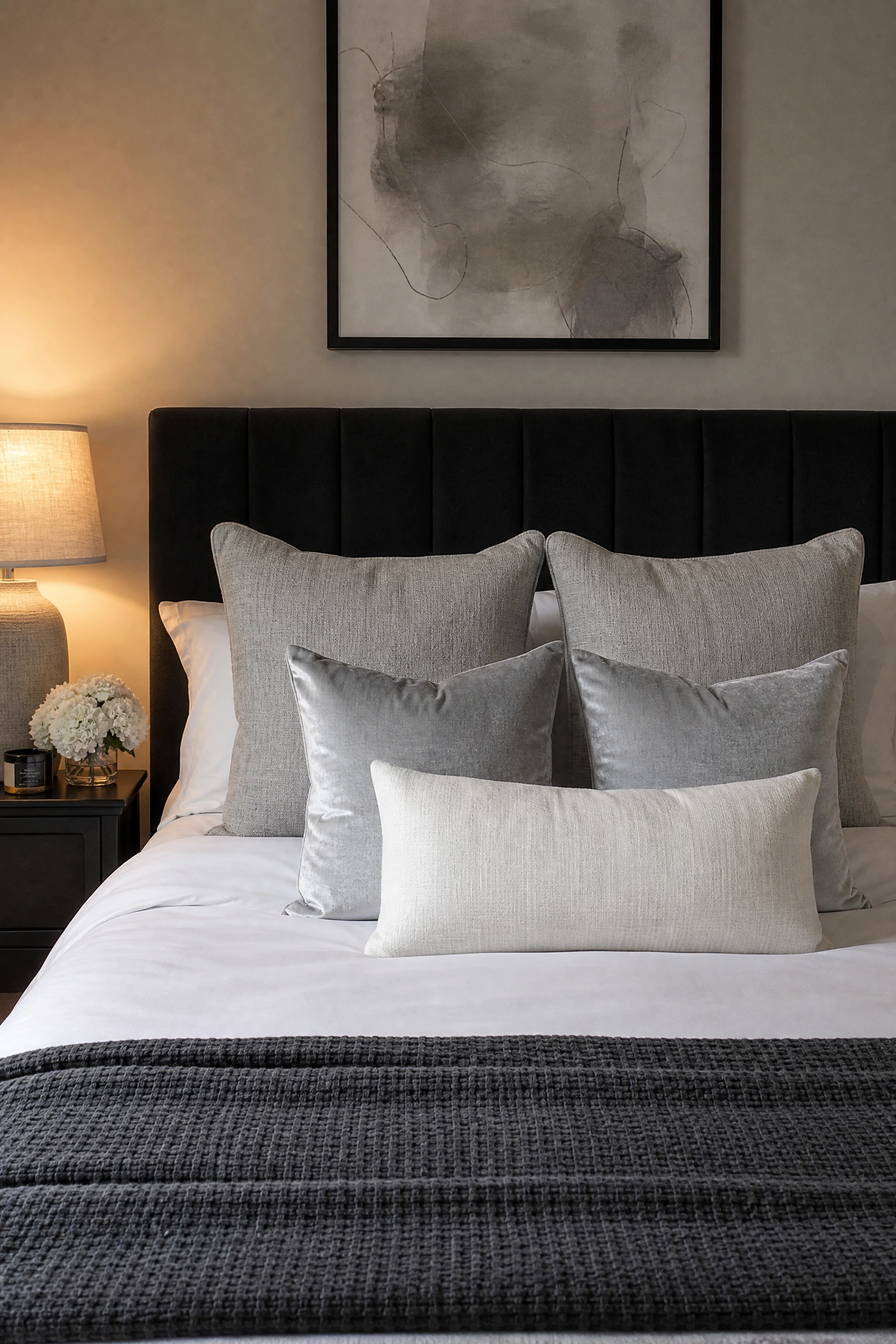
A black velvet or faux leather upholstered headboard paired with a specific cushion and throw arrangement in silver, grey-silver, and white creates the balanced version of this palette at the most central element of the bedroom. The headboard provides the black mass and the textural softness that makes the bed feel genuinely inviting rather than stark, and the cushions and throws in varying silver tones build a layered composition on the bed surface where the silver reads as light caught between folds and textures rather than as a single flat colour. The most successful version of this arrangement uses three tones within the silver range: a warm silver-grey cushion, a cool bright silver cushion, and a white or near-white element that provides the brightest point in the arrangement and prevents the silver tones from merging into each other. A black throw draped casually at the foot of the bed connects the headboard colour to the lower bed zone and frames the silver arrangement within the darker anchoring tones above and below.
Pro Move: Use cushion inserts that are one size larger than the cushion cover. A cushion that fills its cover precisely looks flat and institutional. A cushion that is slightly oversized for its cover creates the plump, full shape that makes a hotel-standard bed arrangement and is worth the small additional cost of the larger insert.
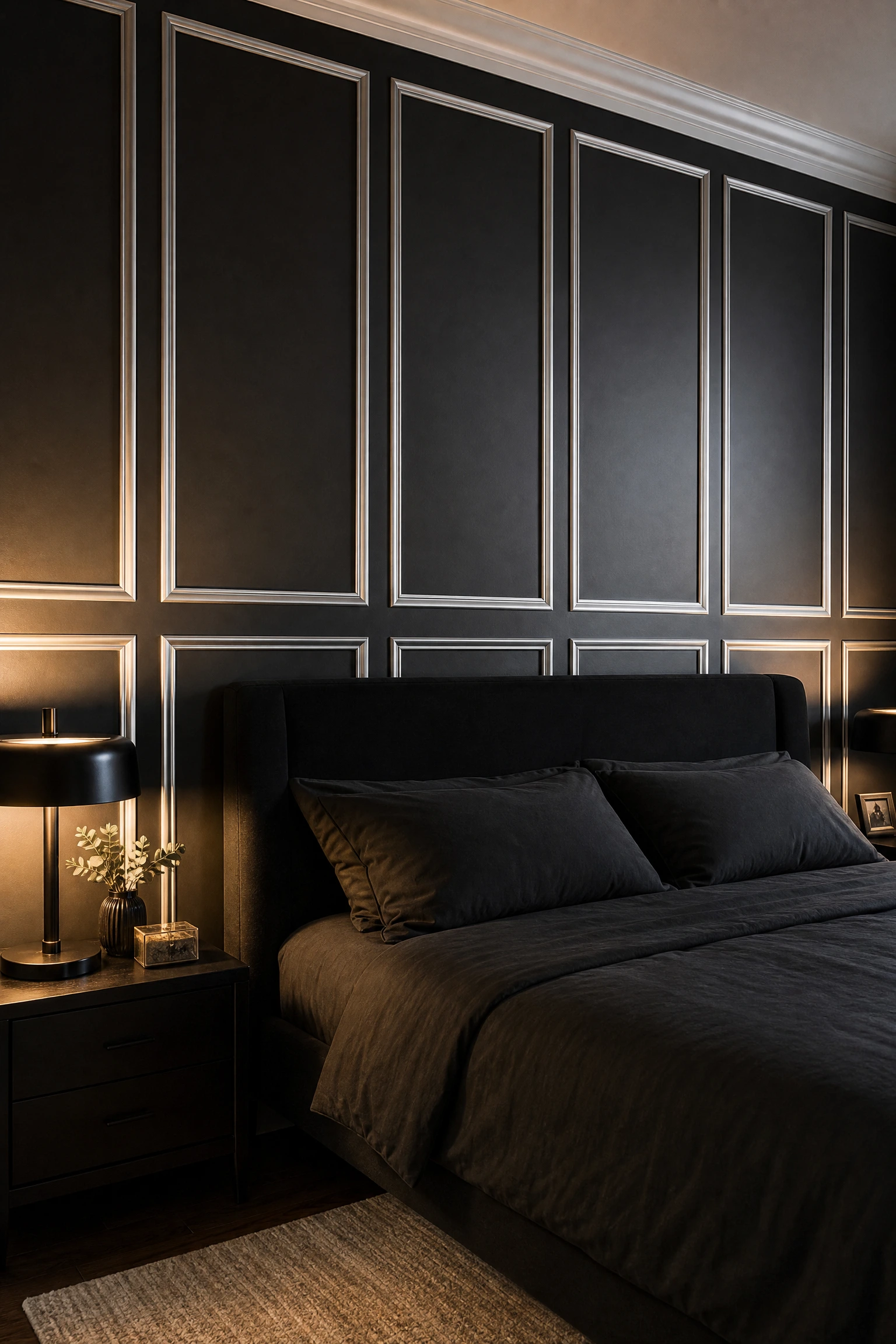
A panelled or board-and-batten wall where the panels themselves are painted or finished in matte black and the frame mouldings around them are painted or gilded in silver creates a two-tone wall treatment that gives the bedroom an architectural quality impossible to achieve with flat paint alone. The shadow lines between the panels, along with the precise metallic highlighting of the moulding profiles, create a wall surface that reads differently at different times of day and under different light conditions: the silver catches direct light and the black panels absorb it, creating a constant subtle contrast that makes the wall genuinely interesting to look at from across the room. This treatment works particularly well on the headboard wall where it is seen from the greatest distance and where the interplay of the dark panels and silver mouldings frames the bed arrangement in a way that feels genuinely architectural.
Heads Up: Silver paint on mouldings within a black panelled wall needs to be applied precisely and with a steady hand: any silver paint on the black panel surfaces will show as a clear line of colour difference that is very difficult to touch up cleanly on a dark background. Use low-tack masking tape along every moulding edge before applying the silver and remove it while the paint is still slightly wet for a clean edge.
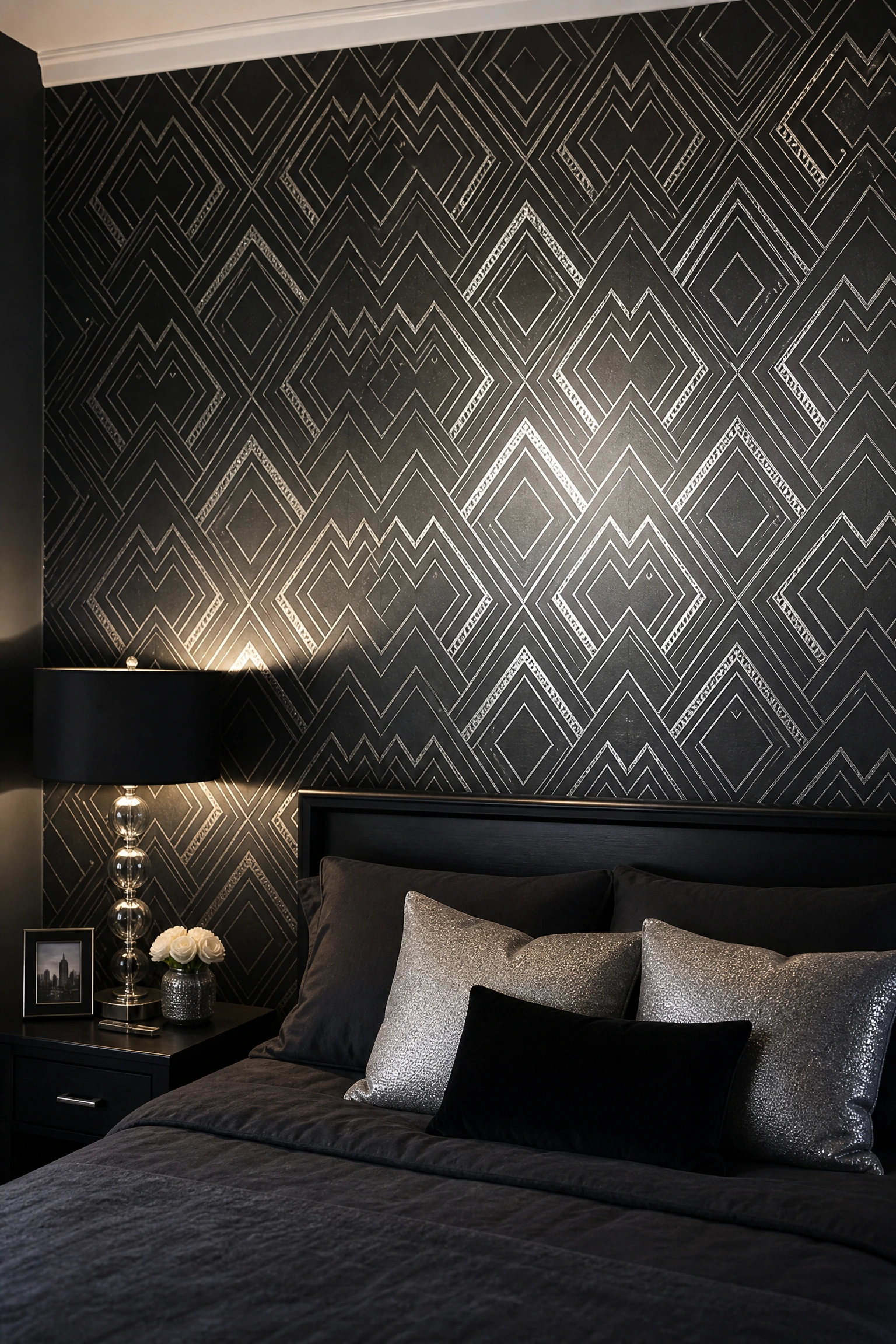
A wallpaper with a geometric pattern in black and silver on a single feature wall introduces both colours simultaneously in a way that a painted wall or a single-colour wallpaper cannot, and the repeating geometric pattern creates visual movement across the wall surface that reads as energy and depth in a bedroom that might otherwise feel static. Geometric wallpapers in this palette range from small-scale Art Deco-inspired patterns in metallic silver on matte black grounds to larger graphic chevron, diamond, or herringbone patterns in equal proportions of both colours. The scale of the pattern matters for the room: small-scale geometric patterns suit compact bedrooms where a large repeat would be cut awkwardly at the ceiling or corners, while a larger-scale geometric pattern needs the wall area to complete enough repeats that the pattern reads clearly and intentionally rather than truncated. A metallic silver ink on a matte black background is the most visually dramatic combination, while a tone-on-tone silver on charcoal is the more restrained version for bedrooms that want the texture without the high contrast.
Quick Tip: Before ordering geometric wallpaper, check the horizontal repeat and ensure the pattern will work across the exact width of the headboard wall without the repeat being cut in a position that draws attention to the room architecture rather than to the pattern itself. Most wallpaper websites now include pattern matching guidance and many offer a sample service.
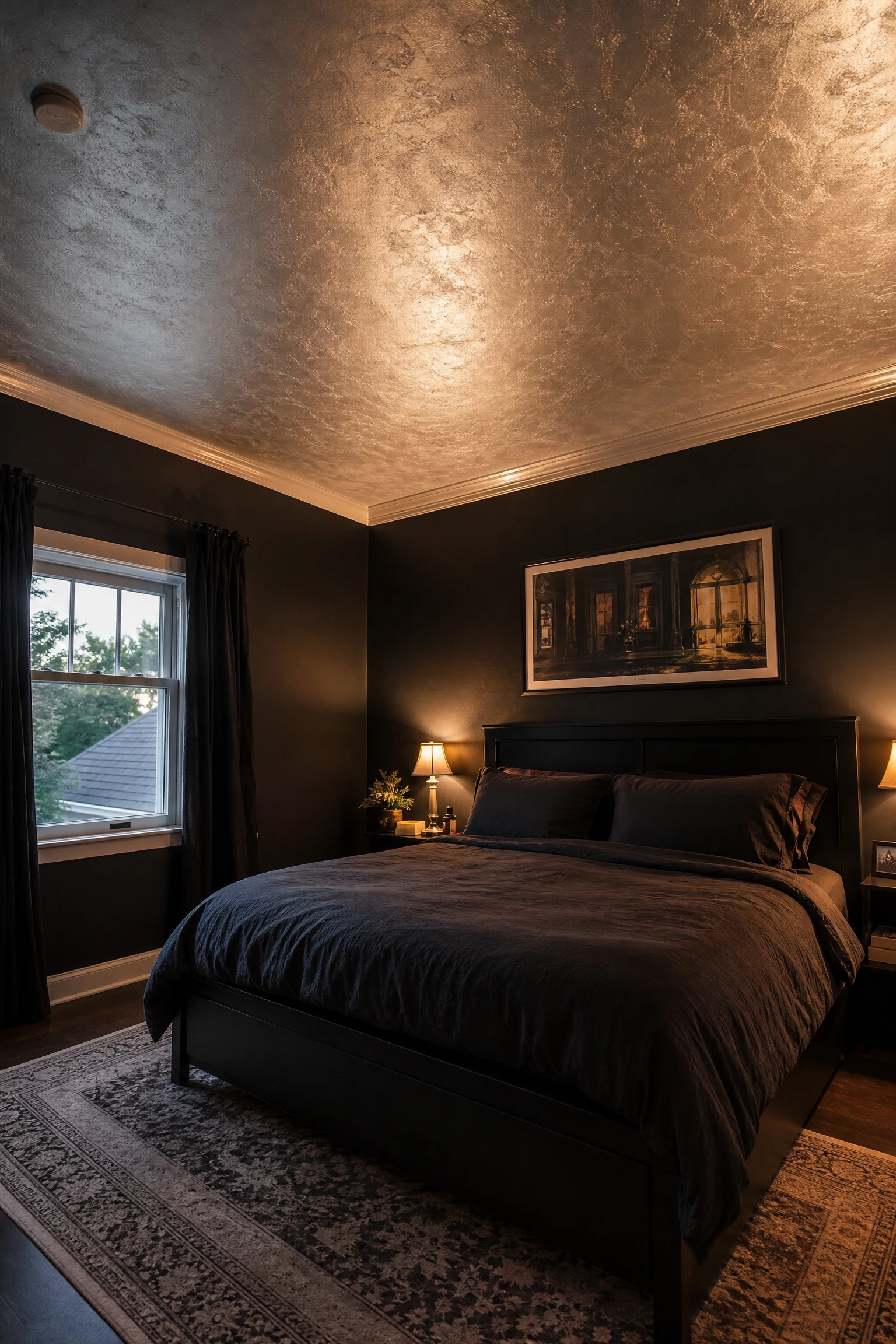
A bedroom with matte black walls and a silver leaf or metallic silver painted ceiling creates one of the most dramatic and unexpected black and silver arrangements available in a bedroom because it places the reflective silver element overhead where it catches and multiplies the light from every source in the room and creates an effect that is genuinely surprising on entering the space. The silver ceiling appears to float above the dark walls, creating a sense of the ceiling lifting away from the room rather than sitting heavily above it, which prevents the all-dark atmosphere from becoming claustrophobic. Silver leaf applied by a decorator creates the richest and most varied surface, with slight variations in the leaf placement creating a hand-applied quality that distinguishes it from simply painting the ceiling silver. A silver metallic ceiling paint is a more affordable alternative that achieves a similar effect at a lower cost and complexity. The important practical note is that silver ceiling finishes require excellent ambient lighting to avoid the ceiling looking flat and dull: the reflective quality only activates when there is something to reflect.
Reality Check: A silver ceiling in a bedroom without adequate lighting will look flat grey rather than luminously silver. Plan the lighting before committing to a silver ceiling: recessed spots angled toward the ceiling surface, uplighting from floor lamps in the corners, or a central fitting that directs light upward will all activate the reflective quality of the ceiling in a way that a single central pendant pointed downward will not.
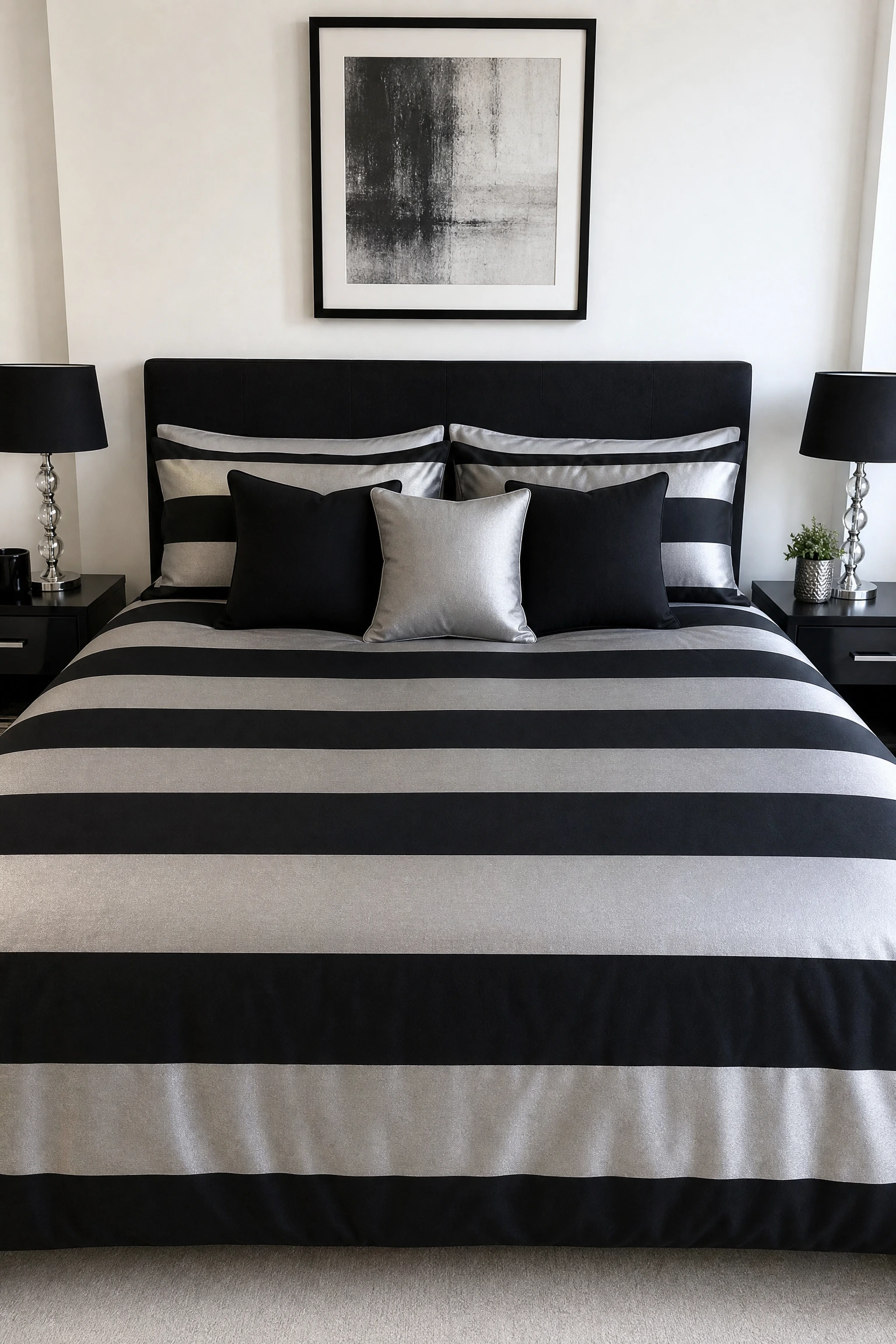
Bedding in a silver and black stripe pattern, whether the stripes are equal width, narrow-and-wide in an unequal rhythm, or hairline-fine against a broader ground colour, introduces both palette colours at once and at the most central and most frequently changed element of the bedroom. The directionality of the stripes matters for the visual effect: horizontal stripes on a bedspread read as calm and expansive, making the bed look wider. Vertical stripes on a duvet cover draw the eye upward and make a lower bed appear taller and more imposing. Diagonal stripes create movement and energy that can read as dynamic or restless depending on the scale and boldness of the pattern. For a bedroom going for a contemporary and graphic look, a bold wide stripe in equal proportions of matte black and metallic silver is the right choice. For a bedroom that wants drama without loudness, a ticking-stripe in fine silver on a deep charcoal ground reads as sophisticated and restrained rather than graphic and demanding.
Designer Advice: Pair striped black and silver bedding with completely plain cushions and throws in the two constituent colours rather than introducing a second pattern alongside the stripe. Two patterns of different scales compete for attention and make the bed arrangement feel busy. One strong pattern surrounded by plains creates a focal point that holds its own.
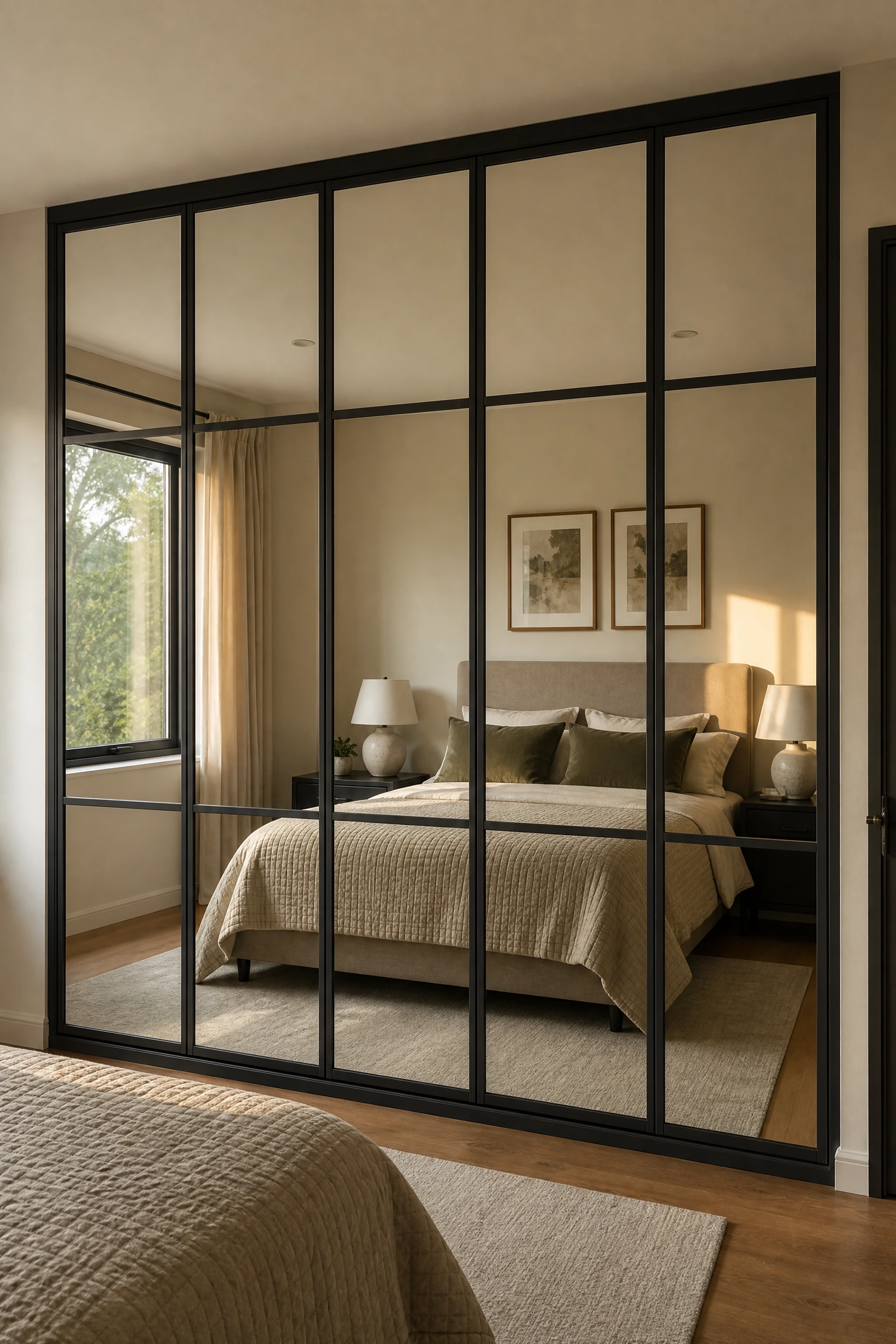
A built-in or freestanding wardrobe unit with matte black frame elements and full-length mirrored doors creates a bedroom storage solution that is simultaneously black and silver in equal proportion: the black structure anchors the unit visually and makes it read as a piece of furniture rather than simply a reflective surface, and the mirrored doors introduce the silver element at the scale of the largest vertical surface in the room, reflecting the entire bedroom back on itself and creating a sense of space and light that unmirrored wardrobe doors never produce. This approach is particularly effective in smaller bedrooms where a full mirror wall would overwhelm and a single mirror would not be sufficient: the mirrored wardrobe provides full-length reflection at the functional scale of the wardrobe without requiring any additional mirror installation. The black frame around the mirrored panels prevents the mirror from looking like a builder-grade fitting and gives it a graphic definition that suits the black and silver palette directly.
Quick Tip: Position the wardrobe unit so the mirrored doors reflect a part of the bedroom that is well-lit and attractively styled, ideally the bed with its cushion arrangement or the window with its curtains, rather than reflecting the back of the bedroom door or an empty wall. The reflection in the mirror is a part of the bedroom design whether you plan it that way or not.
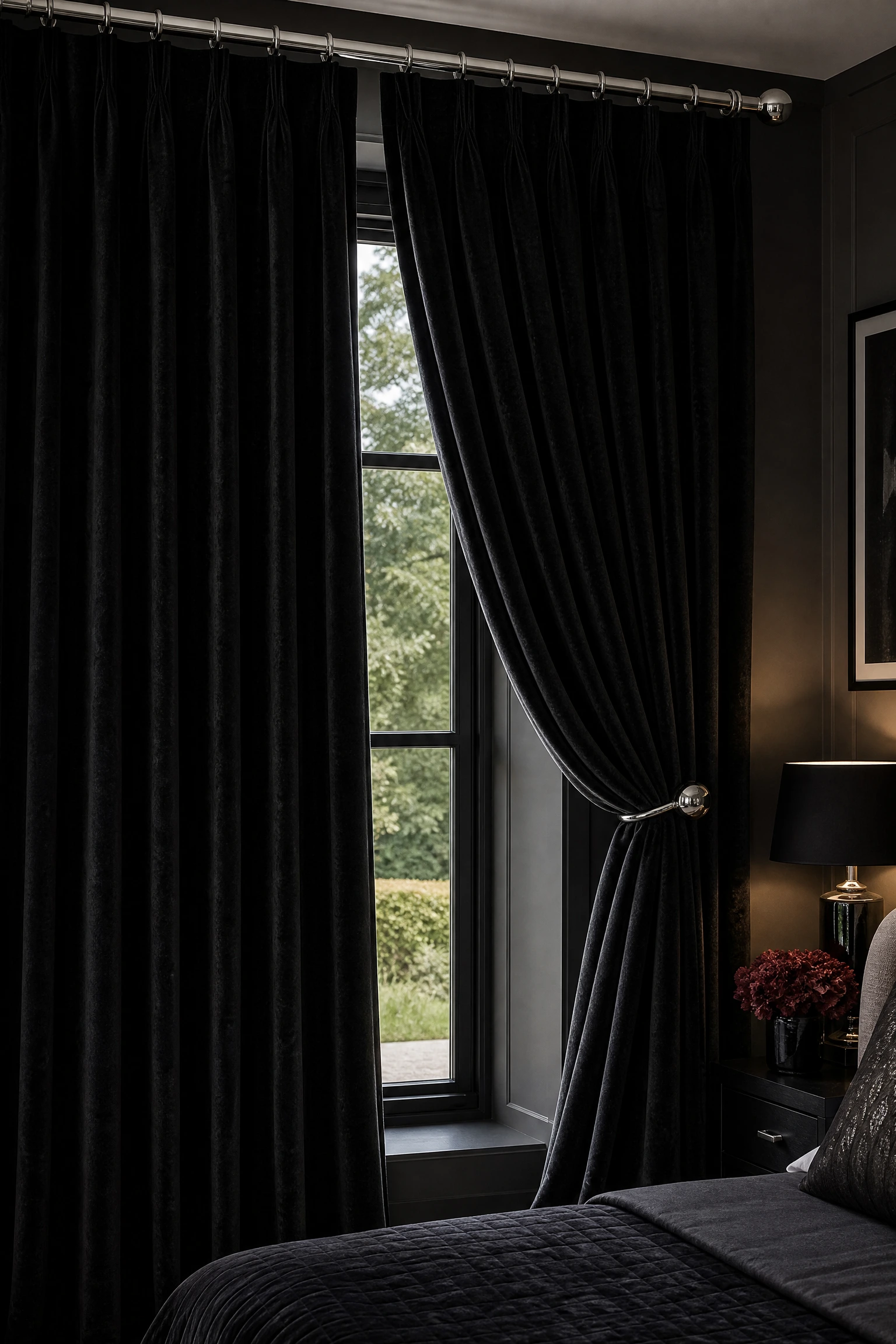
Floor-to-ceiling black velvet curtains with polished silver curtain tie-backs and a silver or chrome curtain pole create a theatrical bedroom window treatment that uses both palette colours at the grandest possible scale. The visual effect of full black velvet drapery in a bedroom is significantly different from black paint or black furniture: velvet absorbs light rather than reflecting it, creating a depth and softness to the dark colour that reads as luxurious rather than heavy. The silver tie-back at a height roughly two-thirds down the curtain length when the curtains are drawn back creates a bright metallic point of interest at eye level that connects the black drapery to the silver metallic elements elsewhere in the room. The pile direction of velvet curtains changes the apparent colour of the fabric when viewed from different angles and distances, which gives a black velvet curtain a liveliness that flat-woven or printed curtain fabrics in the same colour do not have.
Heads Up: Black velvet curtains are among the most high-maintenance window treatments in terms of care: they attract lint and pet hair visibly, fade unevenly if exposed to sustained direct sunlight on one side, and require specialist dry-cleaning rather than machine washing. They are a considered investment for a bedroom where the look they create is worth the ongoing maintenance.
“In a black and silver bedroom, silver is not a colour. It is a behaviour. It is how a surface handles light, and the best applications of silver are the ones that handle it most thoughtfully.”
Black Leads: Silver as the Precision Detail
These are the most sophisticated ideas in the black and silver category. Black takes clear command of the visual palette and silver arrives in specific, disciplined, carefully positioned forms: as a fine line, a hardware finish, a mirror frame, a texture within a fabric. The restraint of silver in this group is what gives it its power. Every silver element here does precise work.
14. Matte Black Walls With Brushed Silver Hardware
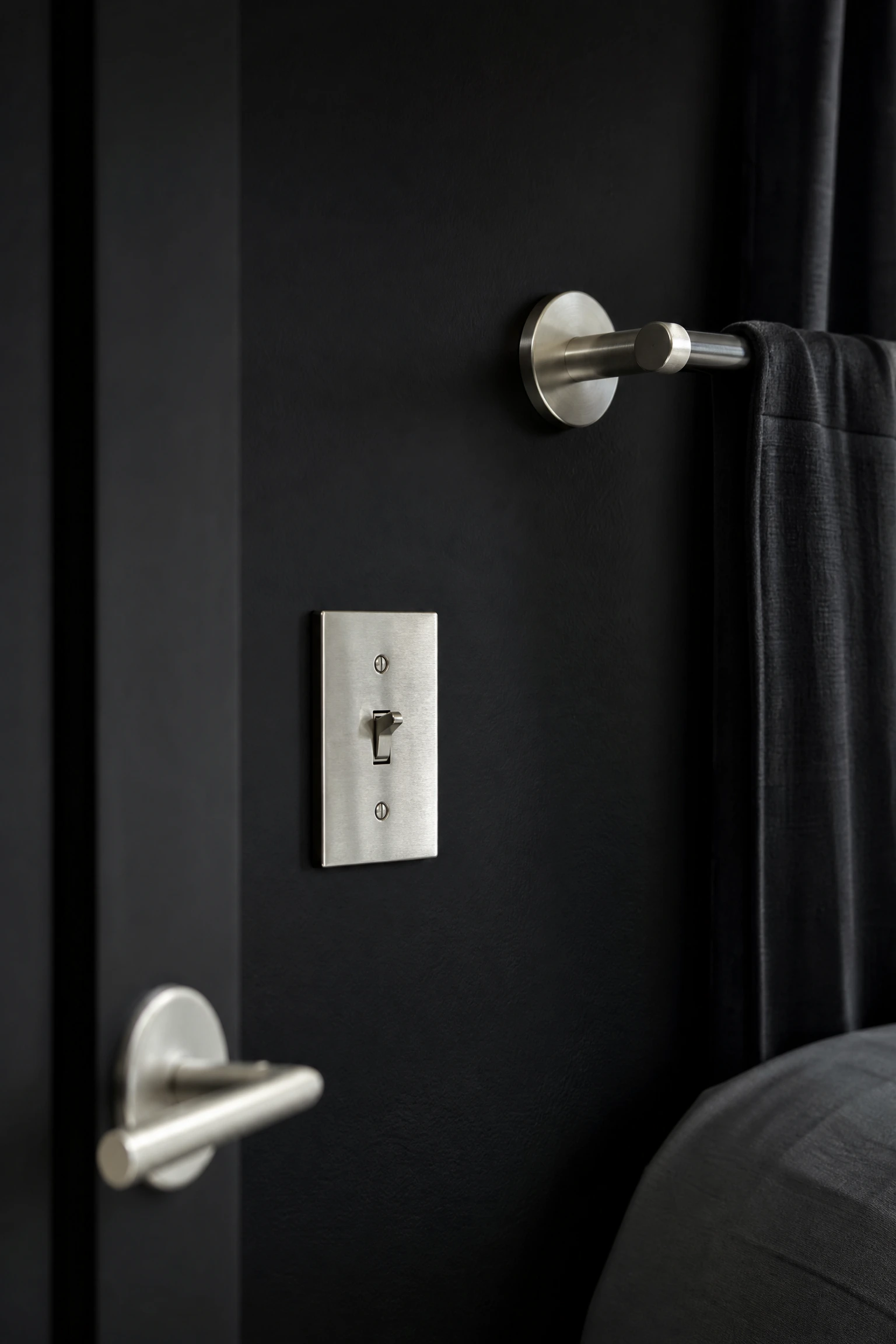
A bedroom with matte black painted walls and brushed silver hardware on every fixed element, door handles, window fittings, curtain poles, light switch plates, and furniture handles, achieves the most refined version of the palette because the silver is present across the full room in a unified and functional way without occupying any significant surface area. The brushed silver hardware catches light in a subdued way that is visible without being distracting, and the visual consistency of having the same silver finish on every metallic element in the room creates a cohesion that makes the bedroom feel genuinely designed rather than assembled. The choice of brushed silver rather than polished chrome is deliberate: brushed silver has a warmer, more matte quality that suits the deep dark atmosphere of a black bedroom better than the colder, harder reflection of polished chrome, which can read as clinical against matte black walls.
Pro Move: Replace the light switch plates and electrical outlet covers with brushed silver versions before painting the walls black. Standard white plastic plates read as incongruously domestic against a sophisticated dark bedroom regardless of how well the rest of the room is designed. Brushed silver plates cost between five and twenty dollars each and take five minutes to swap, and they make the dark bedroom look complete rather than unfinished.
15. Black Bedframe With Silver Nailhead Trim Detail
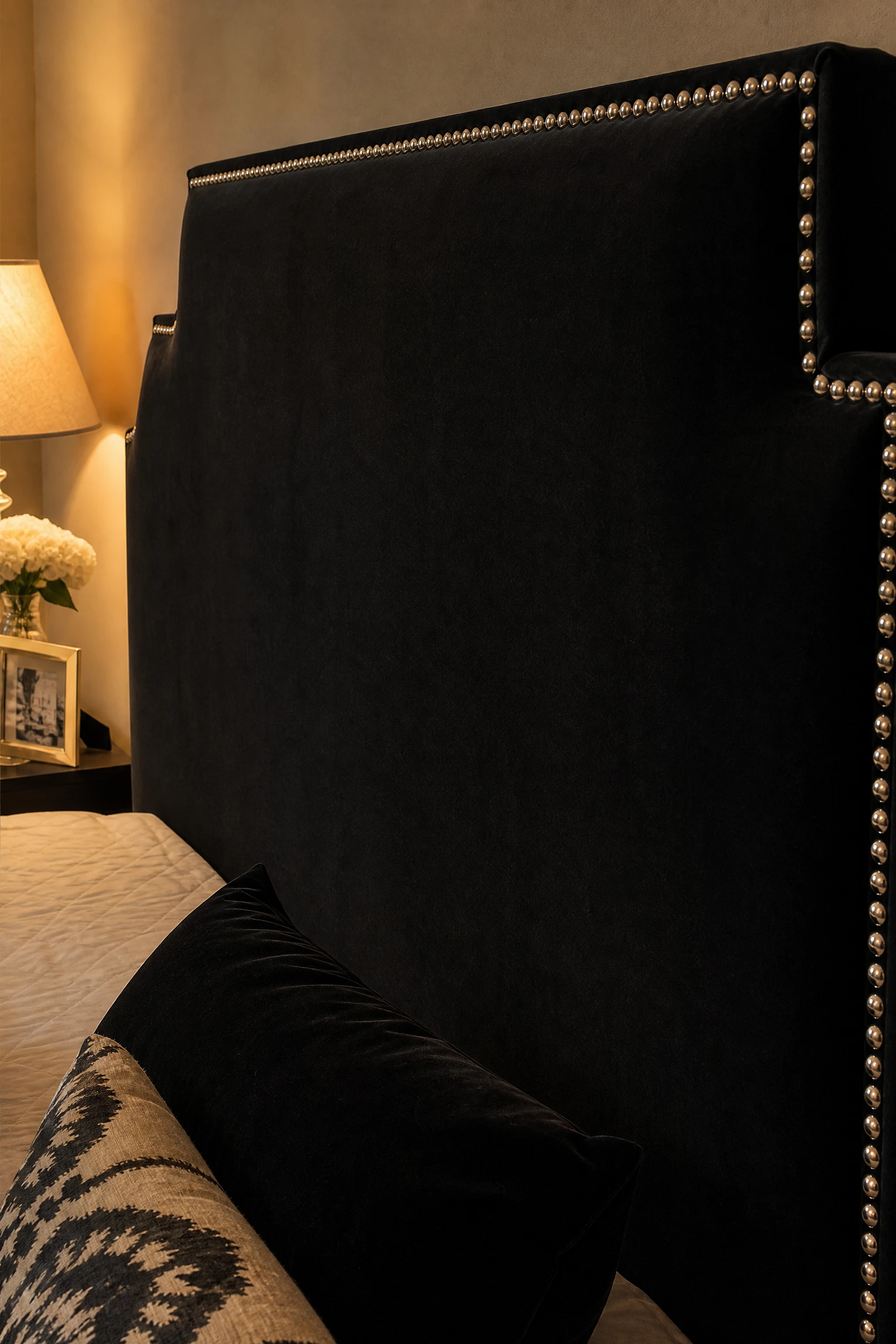
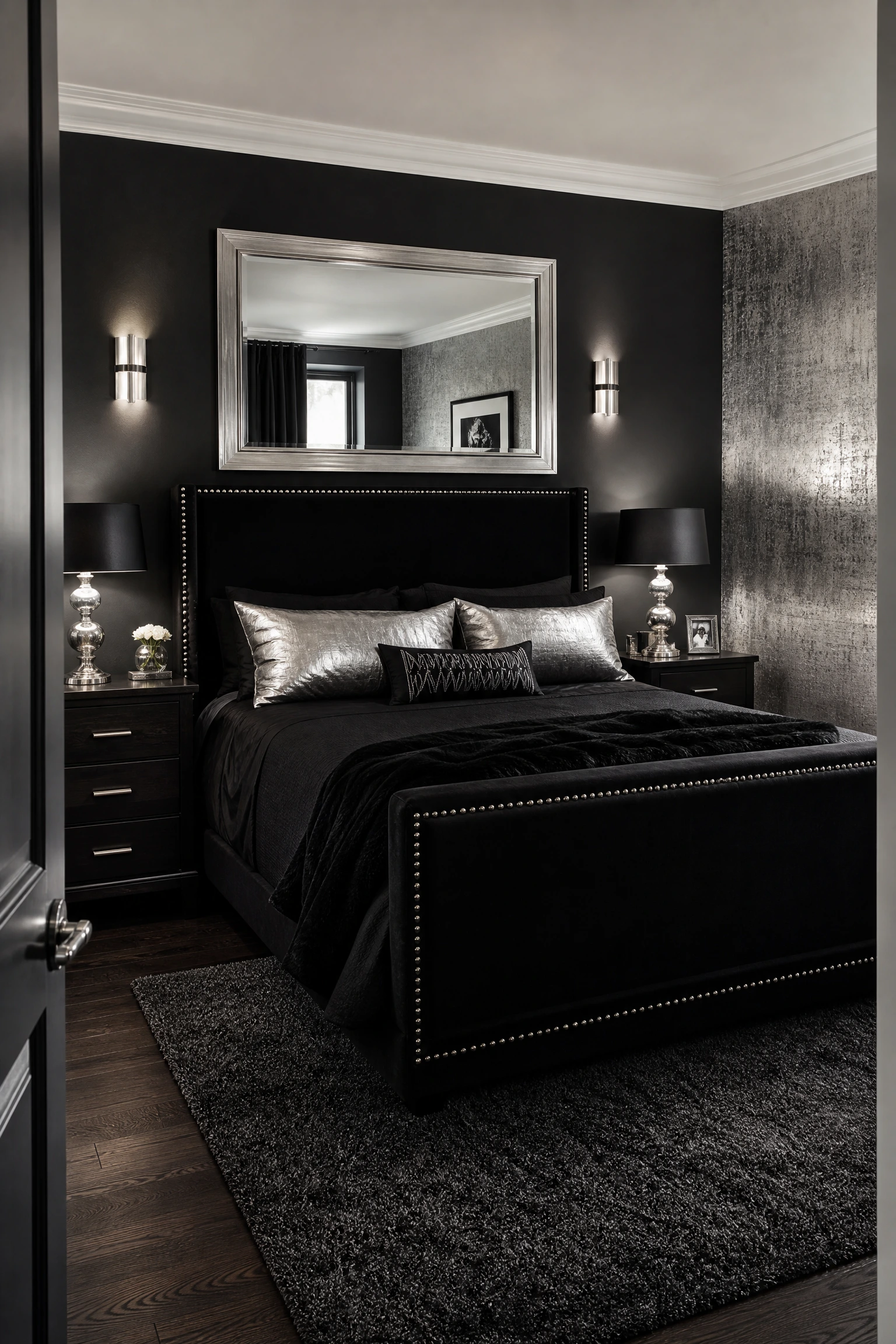
A black upholstered bed frame with silver nailhead trim along the headboard edges and base panel border uses silver in its most precise and structural possible application: as individual dots of metallic light arranged in a linear pattern that traces the geometry of the furniture piece. The nailhead trim on a black headboard creates a precise silver outline that emphasizes the shape of the headboard, makes its dimensions clear from across the room, and introduces the metallic element without adding any surface coverage. This is silver doing the most disciplined design work possible: not filling a surface but drawing the edge of one. The effect is most visible in a bedroom with ambient rather than bright overhead lighting, where the silver nail heads catch the light individually and create a dotted line of brightness around the dark headboard form.
Designer Advice: Choose a nailhead size that is proportional to the scale of the headboard. Very small nailheads on a tall upholstered headboard create a delicate, jewellery-like border. Larger nailheads on the same surface create a bolder, more graphic statement. Both are correct choices depending on the overall aesthetic direction, but mixing small and large nailhead sizes on the same piece reads as inconsistency rather than variation.
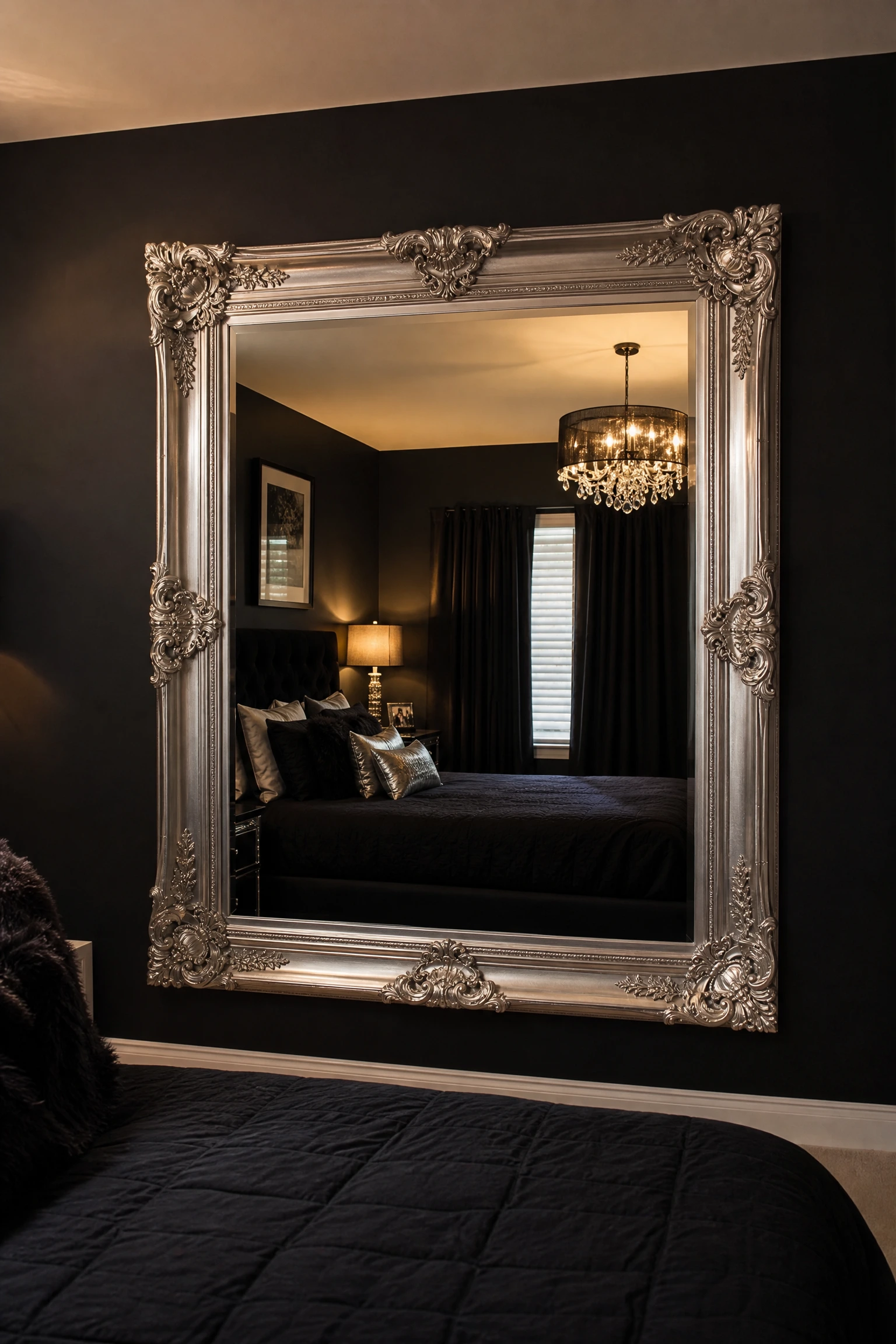
A single large silver-framed mirror on a matte black bedroom wall is one of the most powerful applications of silver in a dark bedroom because the mirror does two things simultaneously: the silver frame introduces the metallic element with the graphic clarity of a single defined object on the dark surface, and the mirrored glass reflects light back into the room in a way that alleviates the potential heaviness of dark walls. An oversized mirror with an ornate silver frame on a black bedroom wall reads as genuinely luxurious. A large mirror with a thin, clean silver frame reads as contemporary and graphic. A vintage or antique silver-framed mirror with slight foxing on the glass reads as collected and personal. In all cases, the position of the mirror matters: hung on the wall opposite the main window, it reflects daylight into the furthest corner of the room. Hung beside the window, it catches the light from the side and distributes it across the dark wall surface.
Reality Check: An oversized mirror on a dark bedroom wall requires appropriate wall fixings capable of supporting the weight of both the frame and the glass. A large mirror is a significant weight: professional installation with a wall plate and multiple anchor points is the only safe approach for mirrors above 60 centimetres in any dimension. Never use a single adhesive strip or a single nail for a large mirror regardless of the stated weight limit.
17. Black Bedroom With Silver Leaf or Chrome Furniture Legs
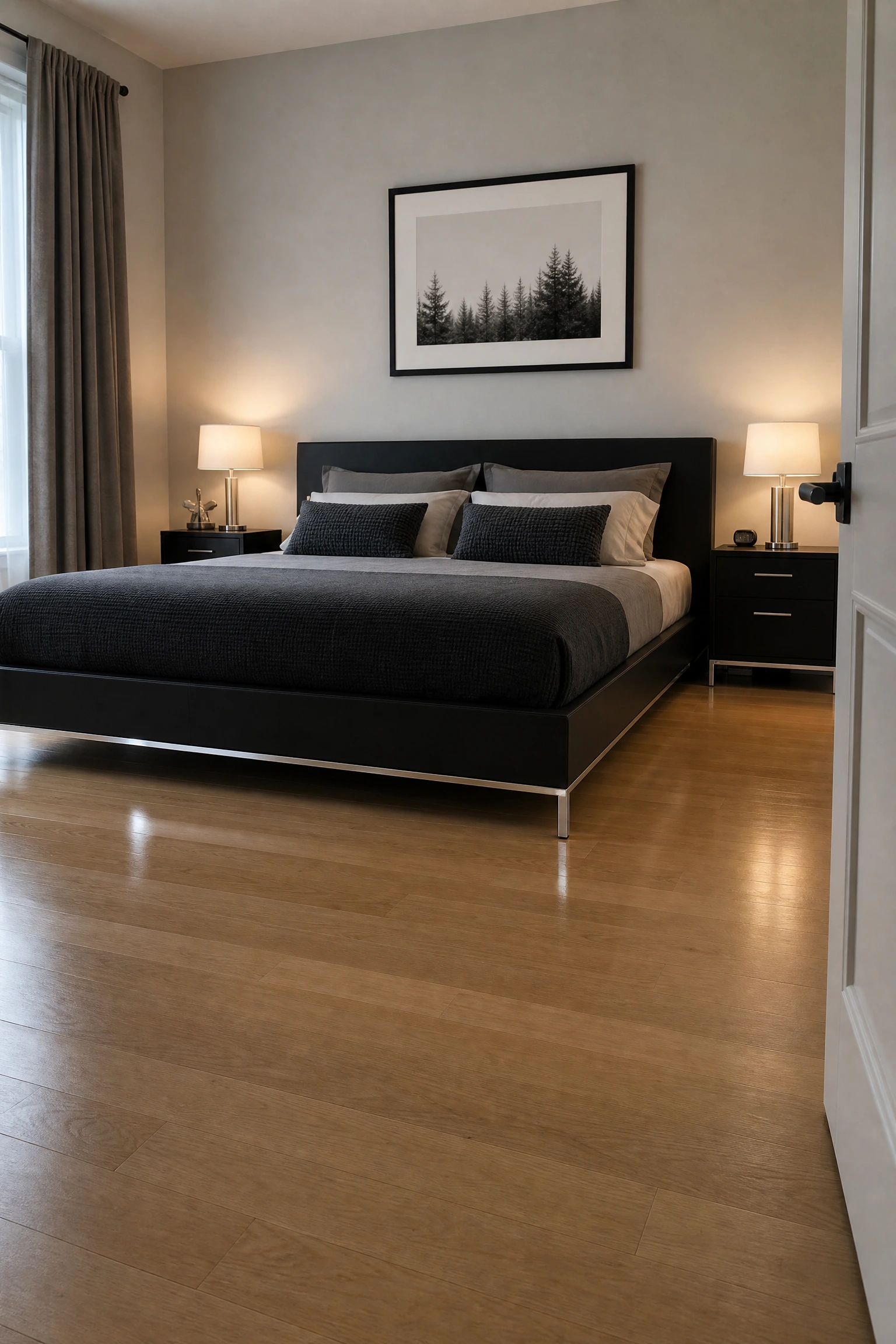
A bedroom where the furniture is black or dark throughout but every piece rests on slim chrome or polished silver legs creates the most architectural application of silver in a black-dominant room. The silver legs separate the black furniture bases from the floor, giving each piece a visual lightness that prevents the dark bedroom from feeling ground-level heavy, and the slim metallic legs create a precise horizon line of silver across the lower section of the room at floor level that reads as a design system rather than an incidental detail. This approach works particularly well with platform or floating-style bed frames, low floating bedside tables, and a dressing table with tapered legs: the consistent silver leg detail across all pieces ties the furniture together as a collection and gives the dark bedroom a mid-century modern quality that suits the palette well.
Quick Tip: Keep the floor in a mid-tone material, light timber, pale grey stone, or a warm dark rug on a lighter floor, when using silver-legged furniture throughout a dark bedroom. A very dark floor alongside dark furniture and dark walls creates a monolithic effect that makes the silver leg detail disappear rather than register as an intentional design element.
18. Black Textured Wallcovering With Silver Thread
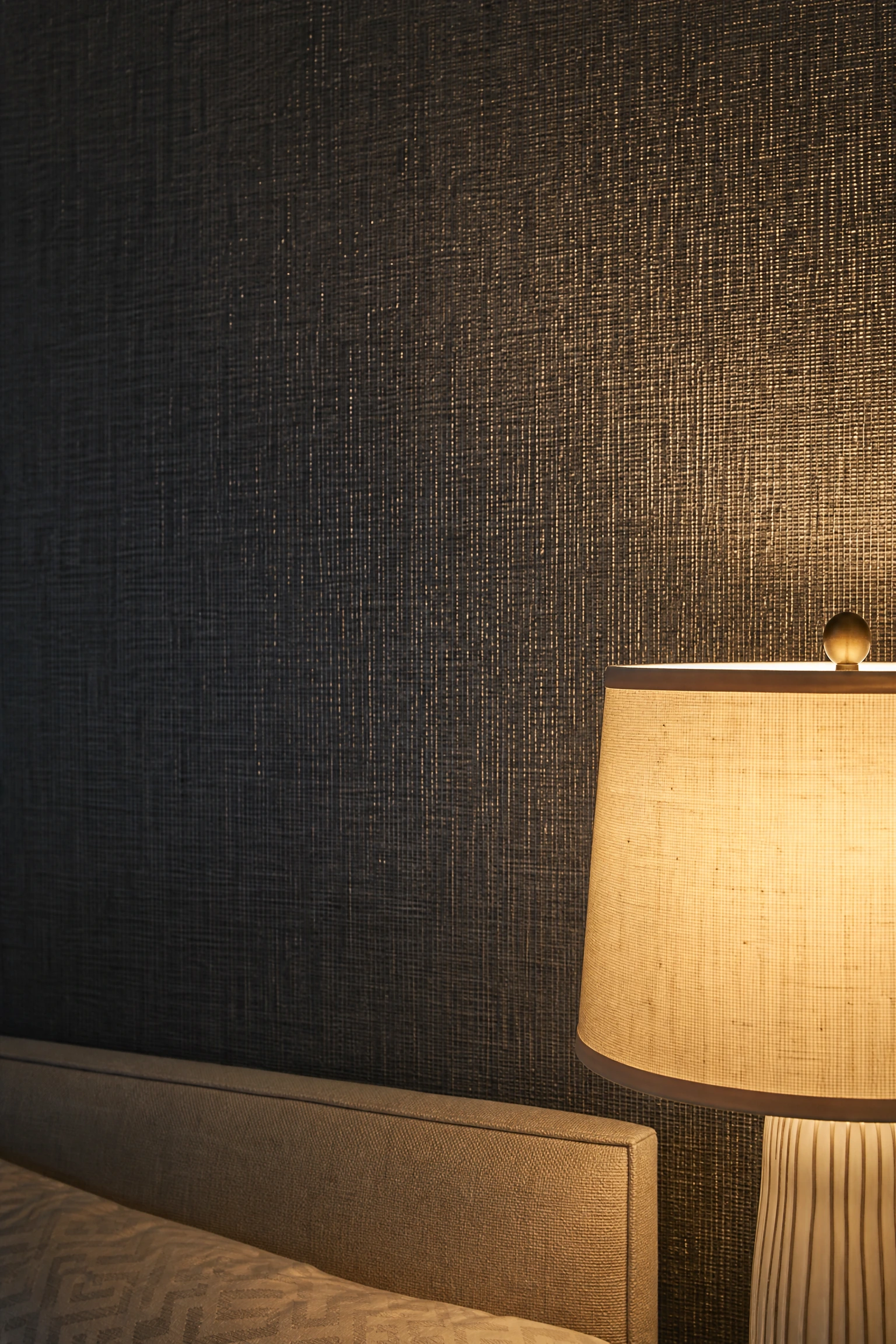
A textured wallcovering in matte black or deep charcoal with silver thread woven through the fabric base creates a wall surface that is primarily dark but contains a constant, subtle shimmer that is only visible when the light catches the thread at the right angle. This type of wallcovering, available in grasscloth, linen, and woven fabric backings with metallic thread content, produces a wall that reads as a single rich dark surface from across the room but reveals a complexity of texture and metallic detail at close range. In a bedroom lit primarily by warm bedside lamps, the silver thread in the wall covering catches the light in the areas closest to each lamp and fades to the dark base further away, creating a natural lighting gradient across the wall that adds to the atmospheric quality of the dark bedroom without requiring any additional lighting effects.
Heads Up: Textured fabric wallcoverings with metallic thread content cannot be easily touched up if damaged because the thread pattern is impossible to replicate with a patch. Position furniture carefully to protect the wall covering from scuffs and scratches, particularly behind the headboard and behind the bedside tables where the wall is most likely to be contacted during regular use.
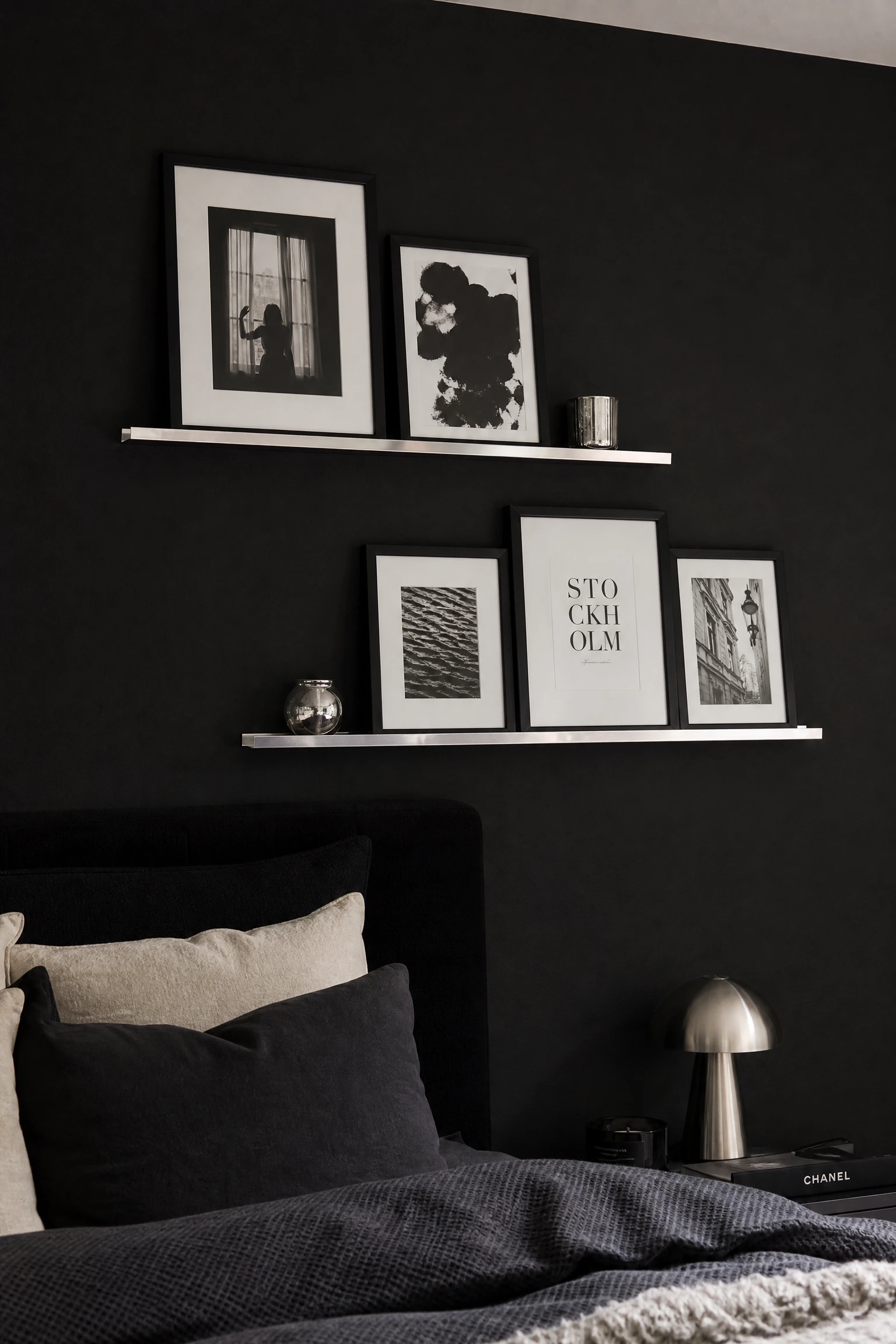
Slim silver picture ledges mounted on a matte black bedroom wall, displaying a collected arrangement of framed prints, small objects, and a few leaning artworks, use silver in both a functional and decorative role simultaneously. The picture ledge itself provides the silver line element against the dark wall, and the items displayed on the ledge can bring in both pale and dark tones that layer within the black and silver palette. A black wall with two or three slim silver picture ledges at staggered heights, each displaying a combination of black-framed prints and one or two silver or glass objects, creates a wall arrangement that is genuinely layered and changeable: the contents of the ledges can be rotated and updated without any wall fixings being disturbed. The silver ledges themselves provide a consistent horizontal structure against the dark wall that reads as architectural even when the display on them is relatively minimal.
Reality Check: Picture ledges on black walls must be precisely level. On a pale wall, a ledge that is very slightly off level is almost invisible. On a dark wall, the eye is drawn to the contrast between the silver horizontal line and the dark background, and any deviation from level is immediately apparent. Use a spirit level and take the time to get the mounting exactly right before fixing permanently.
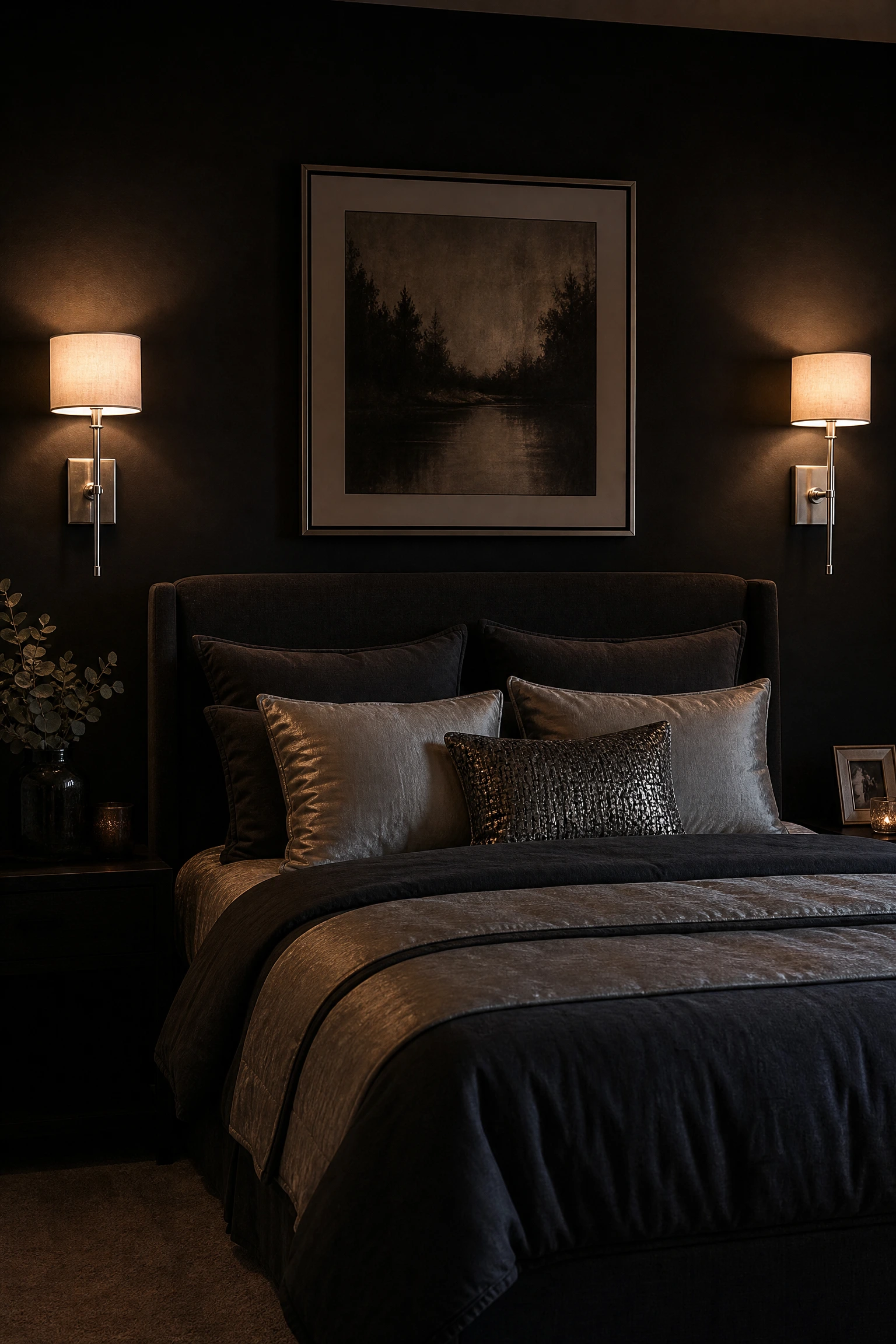
Wall-mounted silver bedside sconces on either side of the bed in a matte black bedroom create a precisely symmetrical lighting arrangement that introduces the silver element in the form of the fittings themselves while also producing the warm, directional light that a dark bedroom needs to feel atmospheric rather than oppressive. Polished silver or brushed silver sconces with a downward or upward-facing shade direction create different effects in a dark bedroom: a downward shade illuminates the bedside table and creates a pool of reading light with a warm ambient diffusion around it; an upward shade creates a wash of light on the dark wall above the fitting that creates a softer, more ambient effect. The sconces as objects register as precise silver points of symmetry on the dark wall surface when they are switched off, and change the atmosphere of the whole wall when they are switched on with a warm-toned bulb.
Pro Move: Choose sconces with an adjustable arm or a flexible shade direction rather than a fixed position fitting. In a bedroom where two people of different heights share the bed, an adjustable sconce allows each side to be positioned for the individual user rather than fixed at a single height that suits neither person ideally.
21. Black Bedroom With a Silver Framed Dressing Mirror
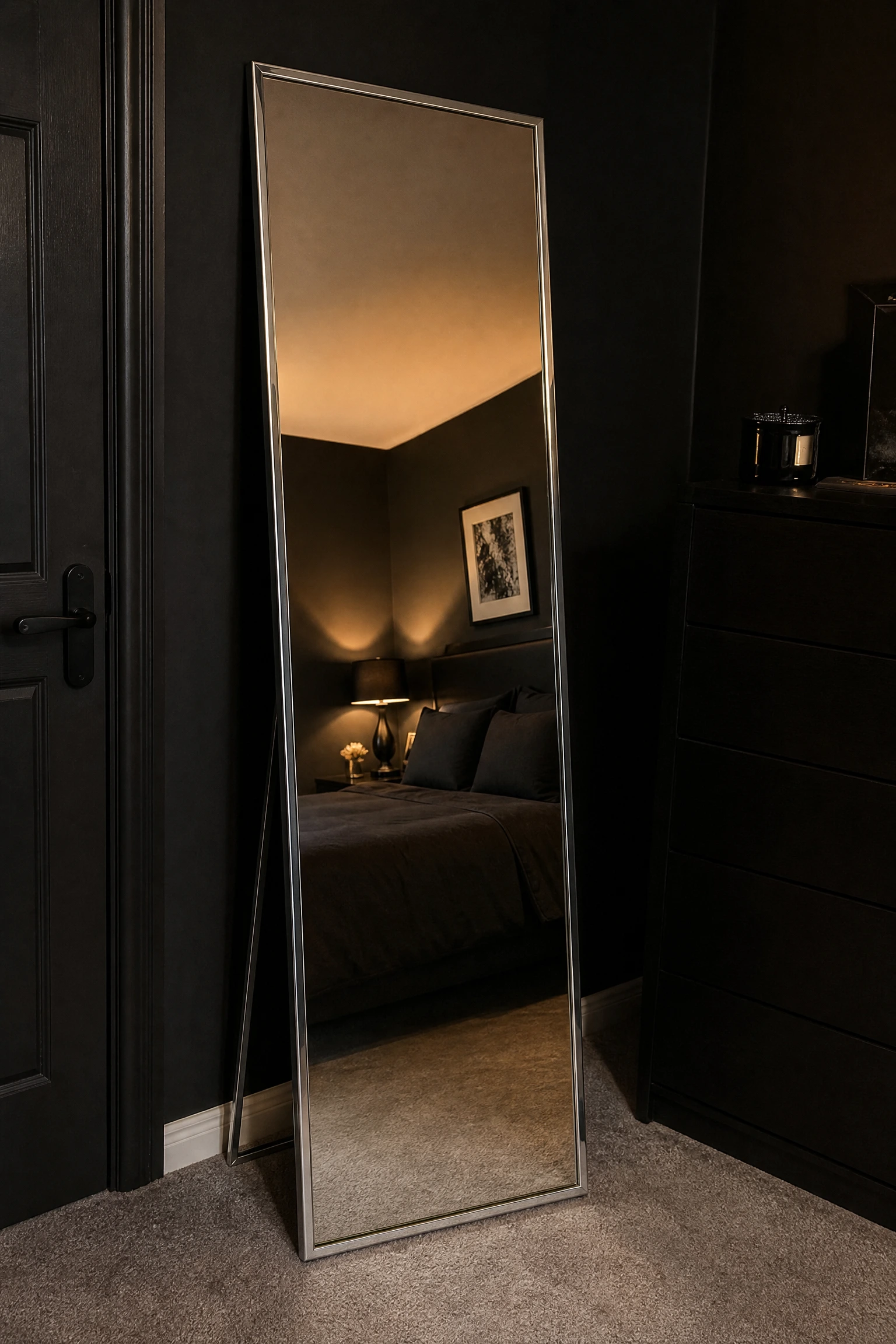
A freestanding full-length dressing mirror with a slim polished silver or chrome frame in a corner of a black bedroom introduces the silver element as a freestanding object that reflects the room and multiplies the available light from within the dark palette. The mirror does not hang on the wall and does not compete with the wall colour or texture: it stands in the room as a distinct object that captures the room and plays it back in a compressed version within its frame. In a bedroom where the walls, furniture, and most surfaces are in black or deep charcoal, the mirror surface becomes the lightest and most luminous element in the room and draws the eye in a way that no accessory or decoration on the dark surfaces can replicate. A silver frame gives the mirror a clean metallic edge that defines its boundary on the dark background of the bedroom without needing any additional styling around it.
Designer Advice: Position a freestanding dressing mirror at a 10 to 15 degree angle from the wall rather than pushed flat against it. A mirror at a slight angle reflects a more dynamic view of the room rather than a straight-on view of the opposite wall, and the slight projection from the wall gives the mirror a presence as a freestanding object rather than making it look as though it is propped in place.
22. Matte Black Ceiling With Silver Recessed Spotlights
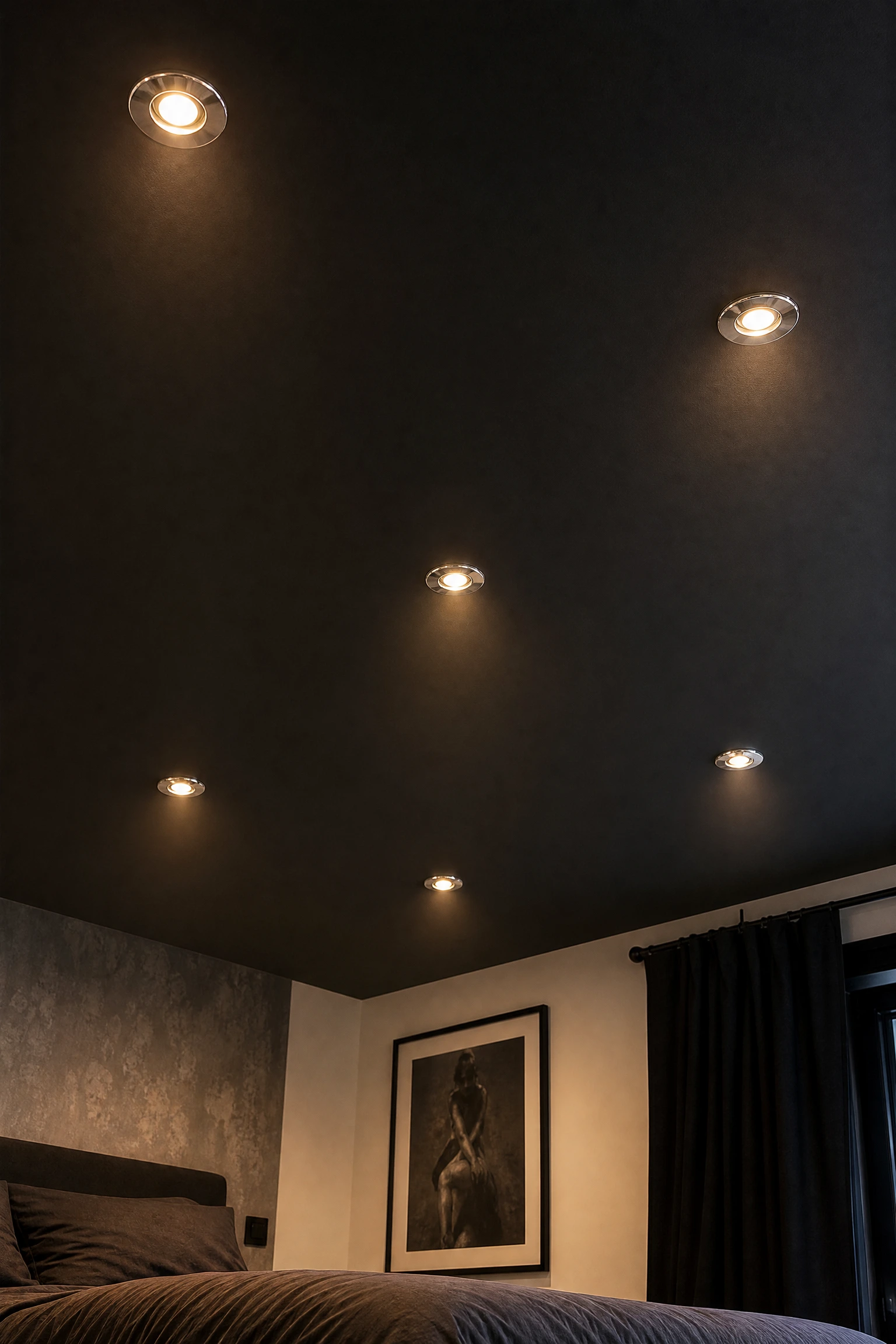
A matte black painted ceiling with silver or brushed steel recessed spotlight rings creates the most understated and most contemporary application of silver in a bedroom ceiling: the spotlight trims are small, circular, and precisely spaced, and against the black ceiling they read as individual points of silver that become sources of light when switched on and precise metallic accents when switched off. The black ceiling reduces the visual height of the room in a way that creates an intimate, enclosed atmosphere, and the recessed lights, rather than adding to the ceiling’s visual mass, appear to open the surface up with small circles of brightness. For the silver ceiling element to read clearly against the black surface, brushed steel or chrome-finish trims work better than matte silver, which can disappear against the dark background. Warm white bulbs at 2700K in recessed bedroom fittings maintain the warmth of the dark bedroom atmosphere; cool white or daylight bulbs undermine it regardless of how well everything else in the room is designed.
Heads Up: Matte black ceiling paint requires significantly more coats than standard white ceiling paint to achieve a flat, even surface because dark paint on a ceiling receives light from below at angles that reveal every roller mark and patch variation. Minimum three coats with proper sanding between coats is the requirement for a black ceiling that looks professionally finished.
23. Black Bedroom With Silver Throw Blanket as the Only Metallic Accent
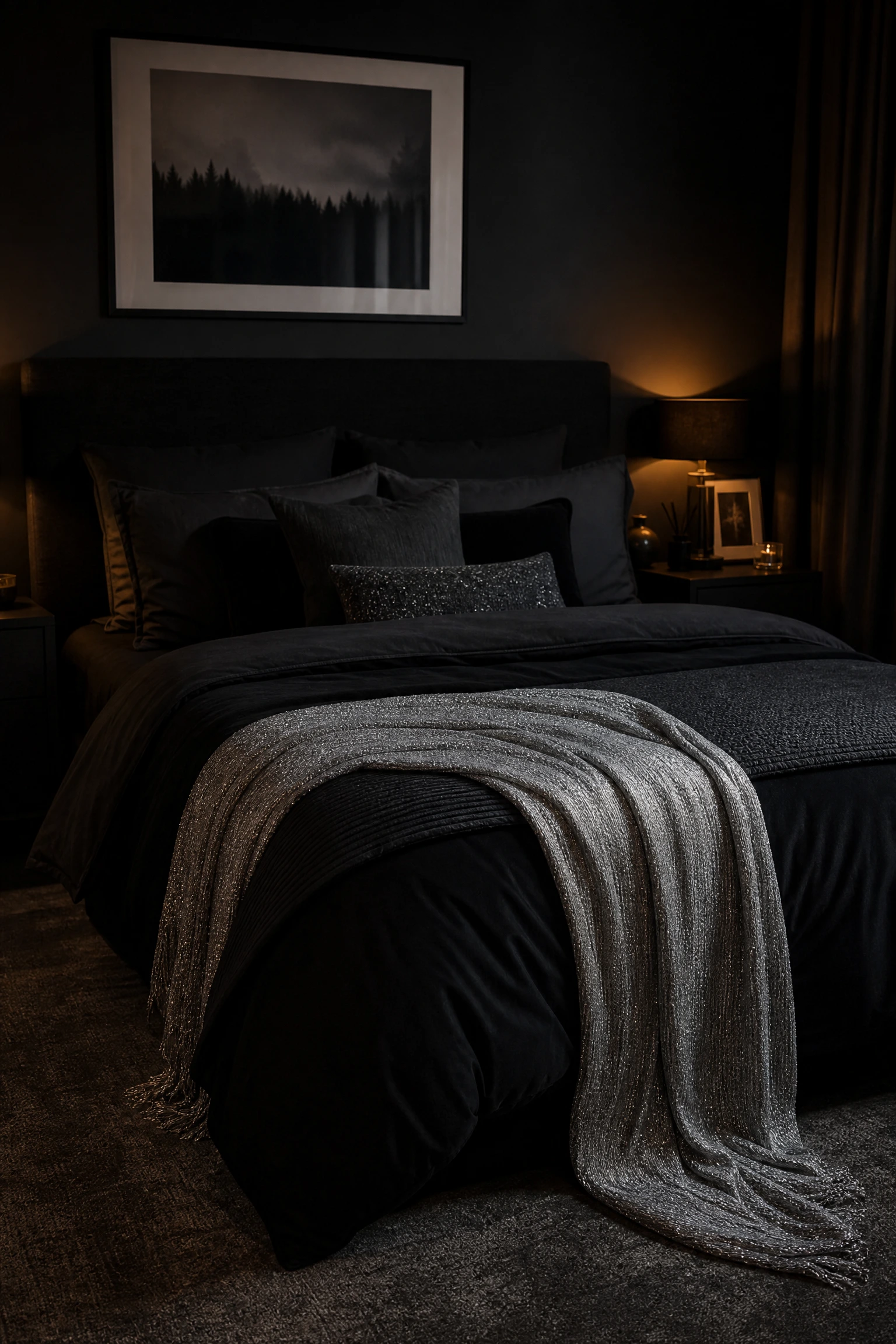
The most restrained and most refined version of silver in a black bedroom is a single silver-toned throw blanket, in a brushed satin, a delicate jacquard weave, or a fine metallic yarn knit, draped over the foot of the bed as the one metallic surface in an otherwise entirely dark and textural bedroom. This approach requires the most discipline because it depends on the quality and position of that single element to carry the entire silver contribution to the palette. The throw needs to be large enough to read as a considered presence at the foot of the bed, not a small folded square but a generous length that pools slightly onto the bed surface and catches light across its width. It also needs to be in a fabric that genuinely has a silver quality in natural and ambient light conditions, not one that only reads as silver in direct flash photography. A single beautiful silver throw in a predominantly black bedroom is the equivalent of the one piece of jewellery that makes a simple outfit feel complete.
Quick Tip: Drape the silver throw asymmetrically across the foot of the bed rather than folding it in a perfect horizontal band. An asymmetric drape that catches the edge of the bed on one side and pools slightly toward the floor on the other creates a natural, effortless quality that a perfectly folded throw never achieves.
24. Black Fluted Panel Wall With Silver Grout Lines
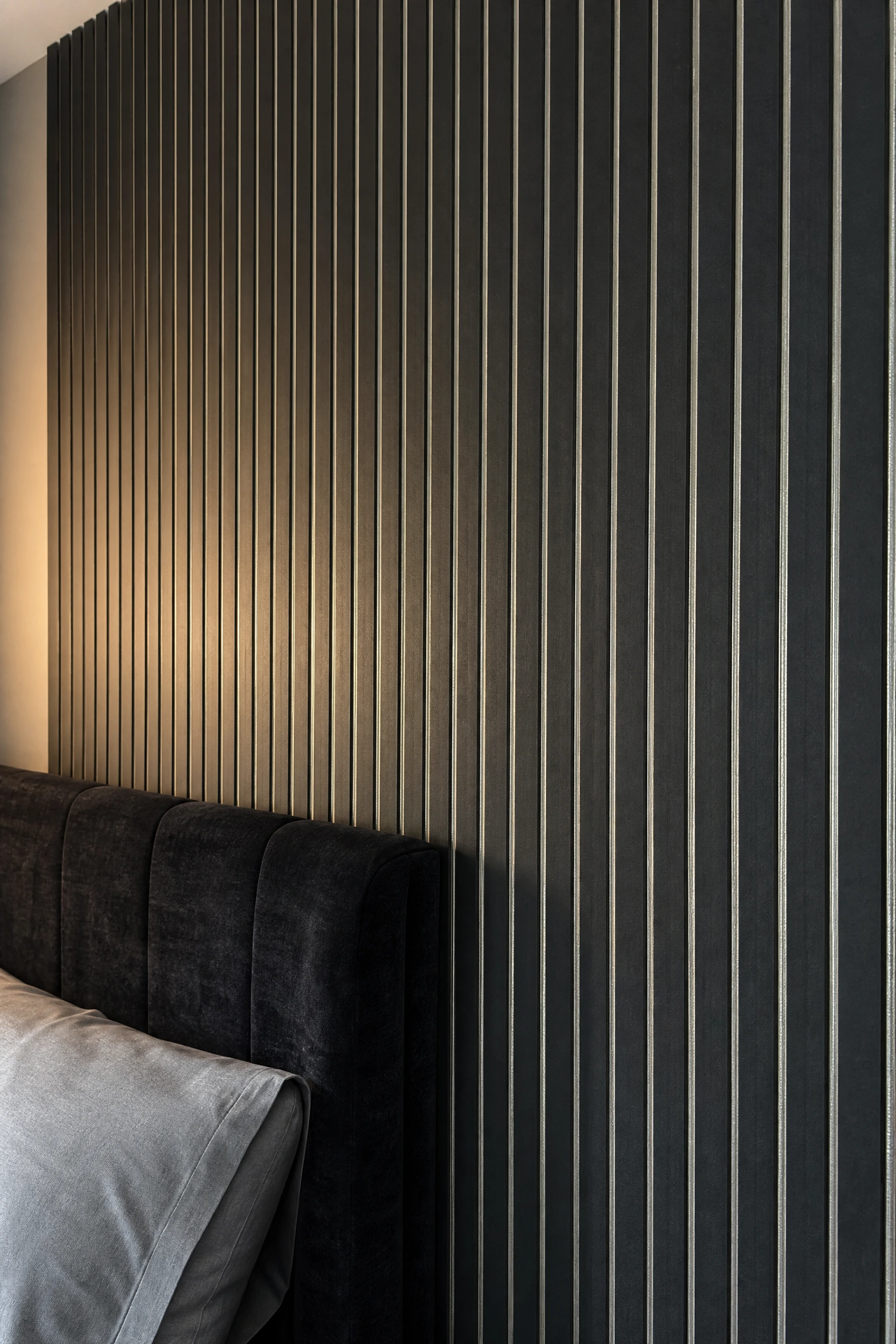
A bedroom wall covered in black fluted or ribbed wall panels, whether in MDF, polished tile, or a plaster relief finish, with fine silver or metallic paint applied in the recessed channels between each flute creates a wall surface where the black is the primary visual experience and the silver appears and disappears depending on the light angle and viewing position. From straight on, the wall reads as primarily dark with a subtle shimmer in the grooves. From an angle, the silver in the channels becomes more visible and the wall takes on a graphic, linear quality that reads as both textural and metallic. This approach to silver in a black bedroom is the most architecturally sophisticated on this list because it makes silver a structural detail of the wall finish rather than a separate applied element: the silver is embedded in the geometry of the surface rather than sitting on top of it.
Designer Advice: Apply silver paint in the fluted channels with a fine artist brush rather than a roller or a wide decorator brush. The channel between flutes is typically only a few millimetres wide and any silver paint on the face of the black panels will read as an error rather than an intentional accent. Patience with this application step is what separates a finished result from an amateurish one.
25. Black and Charcoal Layered Bedding With Silver Pillowcases
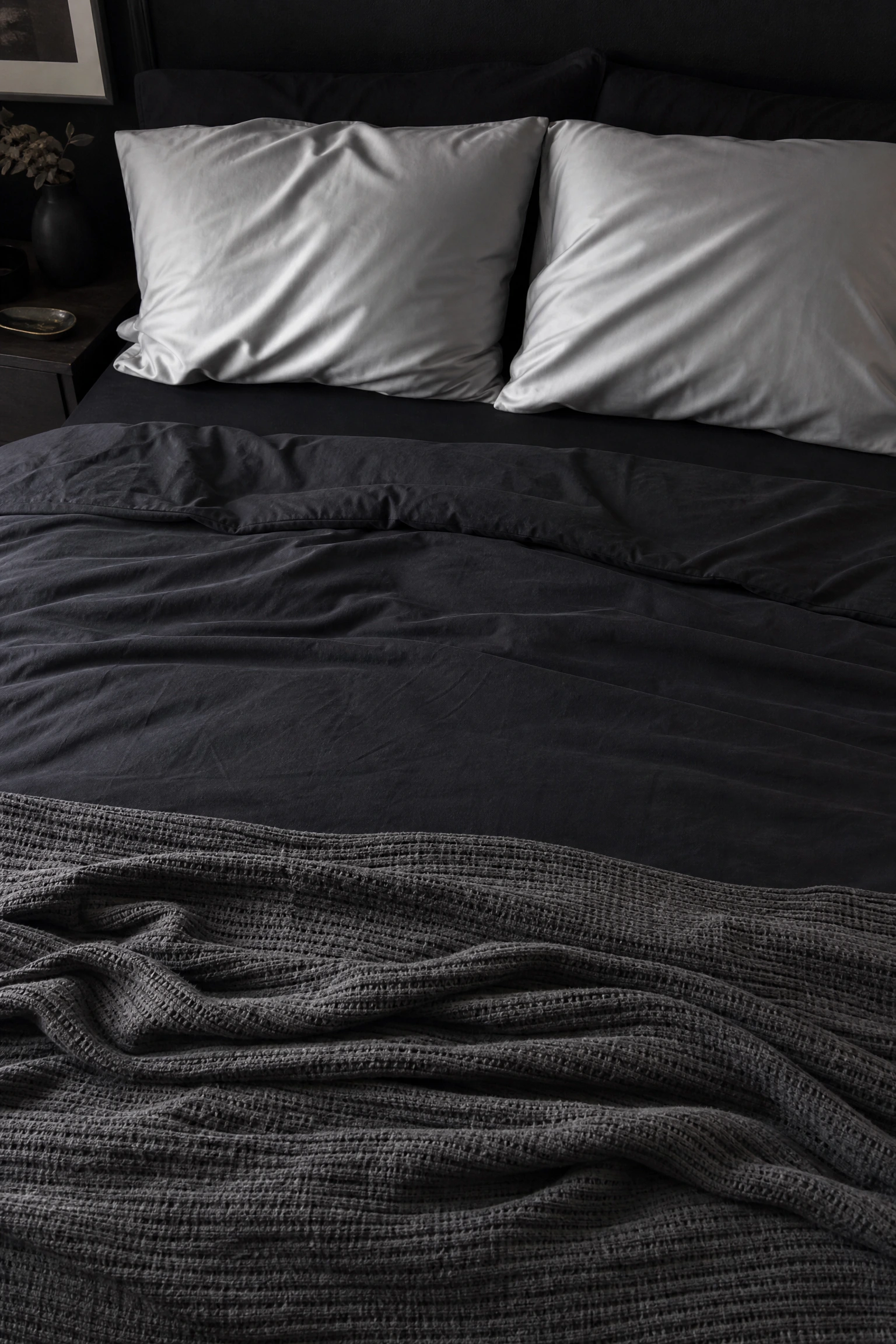
A bed made up in layers of black and dark charcoal bedding, with different textures across each layer (a matte charcoal fitted sheet, a deeper black duvet cover, a ribbed or waffle-weave grey blanket at the foot) topped with a pair of silver pillowcases in a cool pearl or pewter satin, creates a tonal composition on the bed that uses silver in a precisely targeted position: at the top of the arrangement, closest to the eye and the face, where it reads as the lightest and most luminous element in the otherwise dark composition. The silver pillowcases connect to the headboard, providing a visual transition from the dark body of the headboard to the dark bedding below, and they introduce a reflective quality at the most intimate and most detailed area of the bed arrangement. This approach is the reverse of what most people do with a black and silver bed, which is to choose silver bedding with black accents. Going dark in the body of the bed and silver only at the pillow level is a more unexpected and more sophisticated choice.
Reality Check: Satin pillowcases in any colour, including silver, show facial oils and pillowcase crease marks more readily than cotton or linen equivalents. For a bed arrangement that looks as good at the end of the week as at the beginning, silver-toned pillowcases in a cotton sateen (which has a gentle lustre without the high-gloss slipperiness of full satin) are the more practical choice for everyday use.
26. Black Bedroom With Chrome and Glass Bedside Lamps
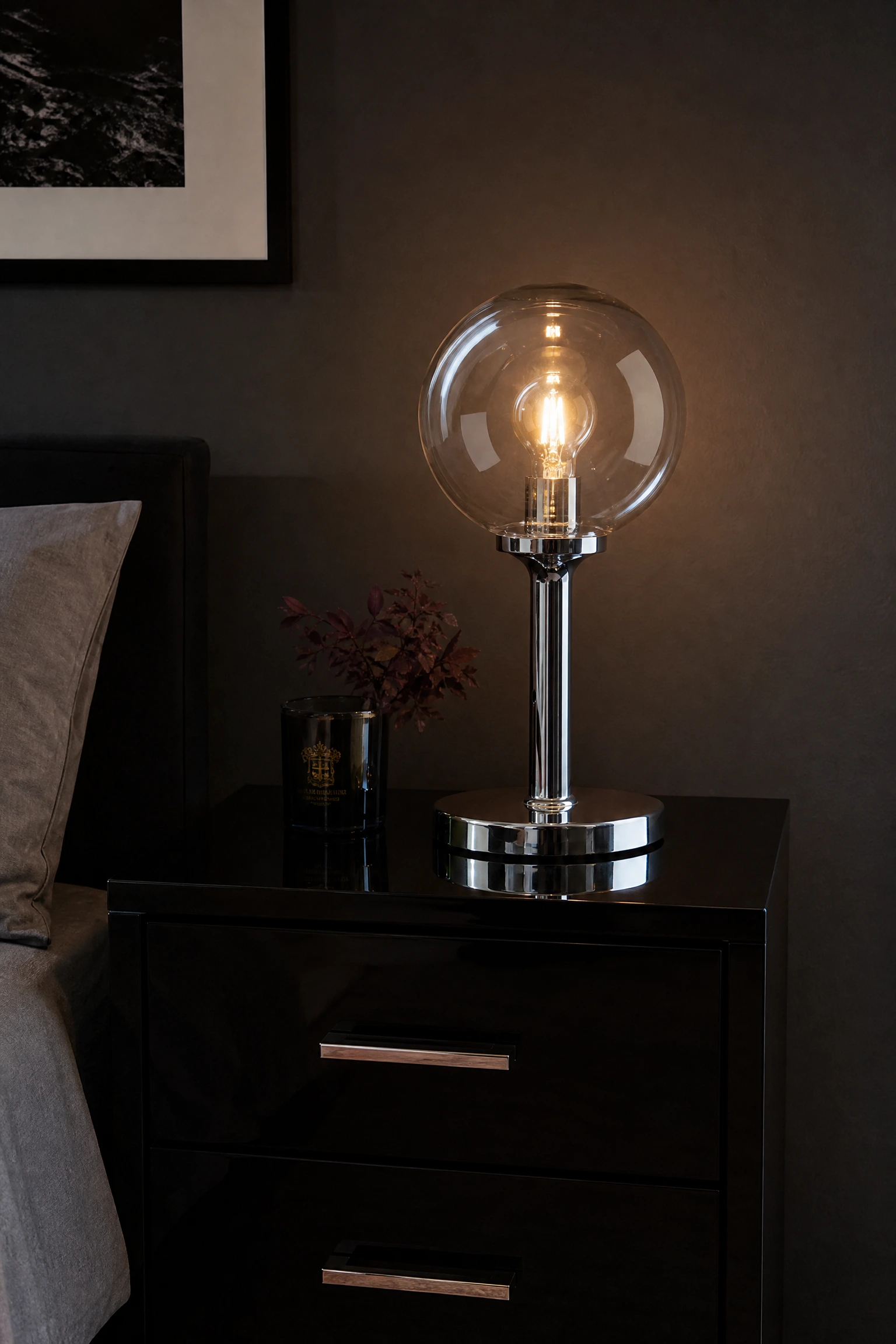
Chrome base bedside lamps with clear glass or frosted glass shades on dark timber or black lacquered bedside tables introduce the silver element in the form of a highly practical and highly visible object: the bedside lamp is the most used and most looked-at accessory in the bedroom, and a chrome finish lamp on a dark surface registers as a clean metallic presence that reads as both contemporary and slightly vintage in a way that suits the black and silver palette across a range of aesthetic directions. Chrome and glass together create the most light-efficient material combination available in a bedside lamp: the chrome base reflects the ambient light of the room back into the space and the glass or crystal shade allows the bulb light to travel in multiple directions rather than being partially absorbed by an opaque shade. In a dark bedroom where every light source needs to work efficiently, this material combination is both aesthetically and functionally well-suited.
Pro Move: Choose bedside lamps with a shade that directs light both downward for reading and upward for ambient ceiling wash simultaneously. A glass or open-top shade achieves both at once. A solid opaque shade, however beautiful, directs all the light downward only, and in a dark bedroom this creates a pool-of-light effect that can make the upper half of the room feel very dark in the evening even with the lamps on.
27. Black Bedroom With Mirrored Mosaic Tile Accent Strip
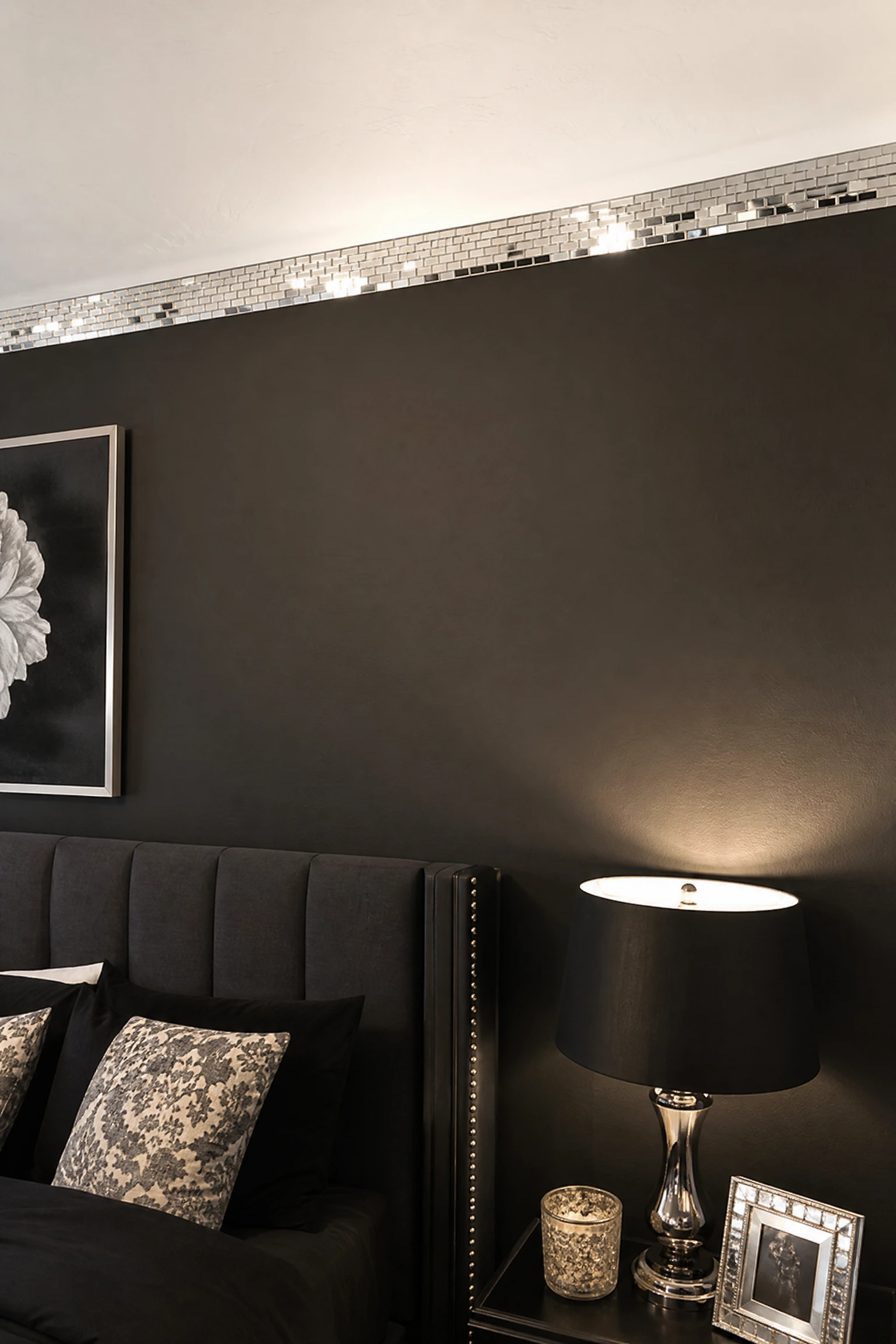
A narrow horizontal band of mirrored mosaic tile or glass tile installed at cornice height, at skirting level, or at a deliberate mid-wall position in a black bedroom creates a thin continuous line of silver-toned reflective surface that traces the geometry of the room and introduces silver as an architectural line rather than a furniture piece or a surface colour. The mirrored tile strip at cornice height, for example, creates a reflective border between the dark wall and the ceiling that catches the ambient light of the room and creates a subtle glowing line at the top of the wall that makes the ceiling appear to separate cleanly from the dark wall surface. At skirting level, the same mirrored tile strip creates a bright reflection of the floor surface that makes the base of the dark wall appear to float above the floor. Both positions use silver with a discipline and an architectural purpose that lifts the dark bedroom beyond decoration into something that reads as genuinely considered in its material and spatial decisions.
Heads Up: Mirrored mosaic tiles at cornice height require a perfectly flat and level surface to read cleanly. Any deviation in the wall surface behind the tiles will create visible reflective distortion across the mirrored surface. Skim-coat plastering of the wall section before tile installation is the required preparation, not optional.
28. The Complete Black and Silver Bedroom: Getting the Proportions Right
A complete black and silver bedroom that draws from all three categories, a silver-led element, a balanced two-tone element, and a black-dominated element with silver as precise detail, achieves the most fully realized version of the palette. In practice, this might be: a matte black headboard wall (black leads), a silver metallic wallpaper on the wall opposite the bed (silver leads), silver nailhead trim on the black upholstered bed frame (silver as precision detail), silver bedside sconces on the black wall (silver as light and detail), dark charcoal and black layered bedding with silver satin pillowcases (balanced), and silver-framed black and white photography on the silver wallpaper wall (silver as frame). The entire room reads as black and silver without any single surface being overwhelming, because the two colours are distributed across different types of surfaces, different positions in the room, and different scales of application. The proportional principle to keep in mind is: more matte black surface area than silver, more silver visible detail than black detail, and more texture across both colours than any single flat or smooth surface that lets either colour read as simple or obvious.
Pro Move: Before finalizing any black and silver bedroom scheme, photograph the room in its current state and use a photo editing tool to sketch the planned changes roughly. The most common failure in a black and silver bedroom is an imbalance that is not obvious in individual product choices but becomes apparent when everything is together in the room. A rough visual mock-up prevents the most expensive mistakes.
A black and silver bedroom is one of the most ambitious colour combinations in bedroom design and also one of the most rewarding when the proportions are right. The combination has genuine range: it can read as glamorous and baroque with a silver chandelier, velvet bedding, and mirrored furniture, or it can read as refined and architectural with matte black walls, brushed silver hardware, and precisely positioned metallic detail. Both interpretations are valid and both can be executed beautifully, but they require very different approaches to which colour leads and what role the other one plays.
The most consistent piece of advice across every strong black and silver bedroom is this: decide which colour is in charge before you buy a single item. If black leads, every silver element should be chosen for its precision and its specific purpose in that particular position. If silver leads, every black element should be chosen as a structural anchor that gives the metallic palette something to rest against. The bedrooms that fail in this palette are almost always the ones where both colours were applied at maximum volume simultaneously with no clear sense of which was primary. Start with the balance you want and let every subsequent decision serve it.
“Which end of the scale are you drawn to: silver-led glamour or black-dominant drama? Drop your answer in the comments below.”
Frequently Asked Questions
Does a black and silver bedroom feel too cold or clinical?
It can, but this is almost always a result of too much polished silver or chrome without sufficient texture or warmth. The most common fix is introducing textural softness through velvet, matte fabrics, and layered bedding in the black and charcoal range, and choosing warm-toned lighting at 2700K rather than cool white bulbs. Brushed silver finishes read considerably warmer than polished chrome and are a better choice for bedrooms where the clinical risk is a concern. A single warm accent, whether a timber surface, a warm-toned rug, or even a small plant, can prevent the cool metallic palette from tipping into sterility.
What colours can I add to a black and silver bedroom to soften it?
White is the most natural addition because it sits within the existing tonal palette without introducing a competing colour. Pale grey serves the same function at a slightly warmer register. For a more impactful addition, deep jewel tones like sapphire blue, emerald green, or plum work beautifully as third colours in a black and silver bedroom because their depth connects to the darkness of the black palette while their richness adds warmth and personality that the silver and black alone do not provide. Avoid warm earthy tones like terracotta, mustard, and warm brown, which fight the cool precision of the black and silver palette rather than complementing it.
How do I stop a black and silver bedroom from feeling too dark?
The most effective approach is layering light sources rather than relying on a single overhead fitting. Wall sconces, bedside lamps, recessed spotlights, and under-shelf LED strips all contribute to a room where light is present at multiple heights and angles and where dark surfaces are illuminated from different directions rather than lit from above only. Large mirrors positioned to reflect available light sources are the second most effective tool. Keeping the ceiling lighter than the walls, in white or pale grey, is the third most important factor: a dark ceiling in addition to dark walls is the most reliable route to a bedroom that feels oppressively enclosed.
What bedding works best in a black and silver bedroom?
The most successful bedding choices in a black and silver bedroom are textured rather than flat: velvet, jacquard, crushed silk-effect, and waffle weave all create surfaces that interact with light in a way that flat cotton does not and add depth to the bed arrangement without requiring additional colours. In terms of colour, a layered approach moving from the darkest tones at the fitted sheet level through to the lightest tones at the pillow level creates the most visually sophisticated bed. Silver-toned pillowcases or cushions in a cotton sateen or matte velvet at the top of the arrangement provide the metallic note at the most visible position without requiring the whole bed to be in silver.
What lighting is best for a black and silver bedroom?
Warm-toned light at 2700K is essential for a black and silver bedroom. Cool or daylight-spectrum bulbs make silver read as cold and harsh and make dark surfaces read as flat rather than deep. Multiple light sources at different heights, including bedside lamps or sconces for intimate evening light and a ceiling fitting with a dimmer for adjustable ambient light, give the bedroom the atmospheric range it needs across different times of day and night. Silver and chrome fittings should be chosen for their reflective quality as well as their aesthetic: a chrome base lamp reflects warm-toned bulb light back into the room and contributes to the ambient lighting of the space even when it is not the primary light source.
Is a black and silver bedroom suitable for a small room?
Yes, with adjustments. In a small bedroom, keep the primary wall colour to deep charcoal rather than true black, which absorbs more light. Maximize the silver and mirrored elements: full-length mirrored wardrobe doors, silver-framed mirrors reflecting the window, and light-coloured bedding that includes silver tones all contribute to making a small dark bedroom feel larger. Avoid very heavy dark window treatments in a small room; instead use sheer silver or white curtains that maintain the palette while allowing maximum daylight. A single silver chandelier or statement light above the bed creates a focal point that draws the eye upward and makes the ceiling feel higher.