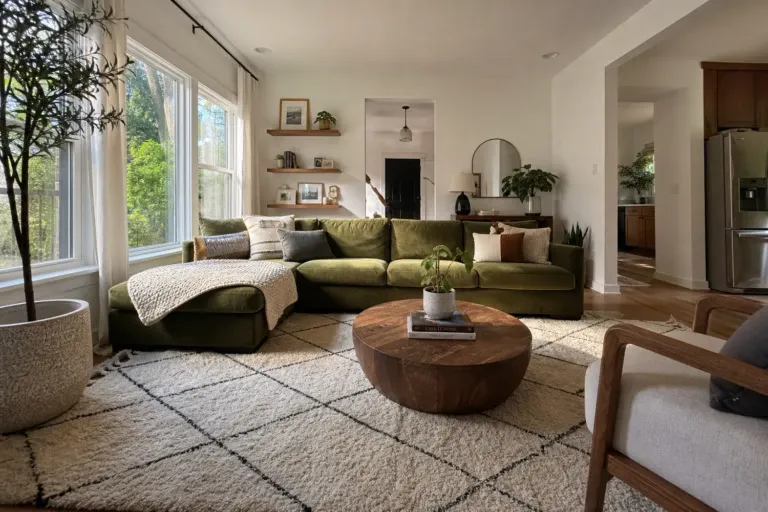
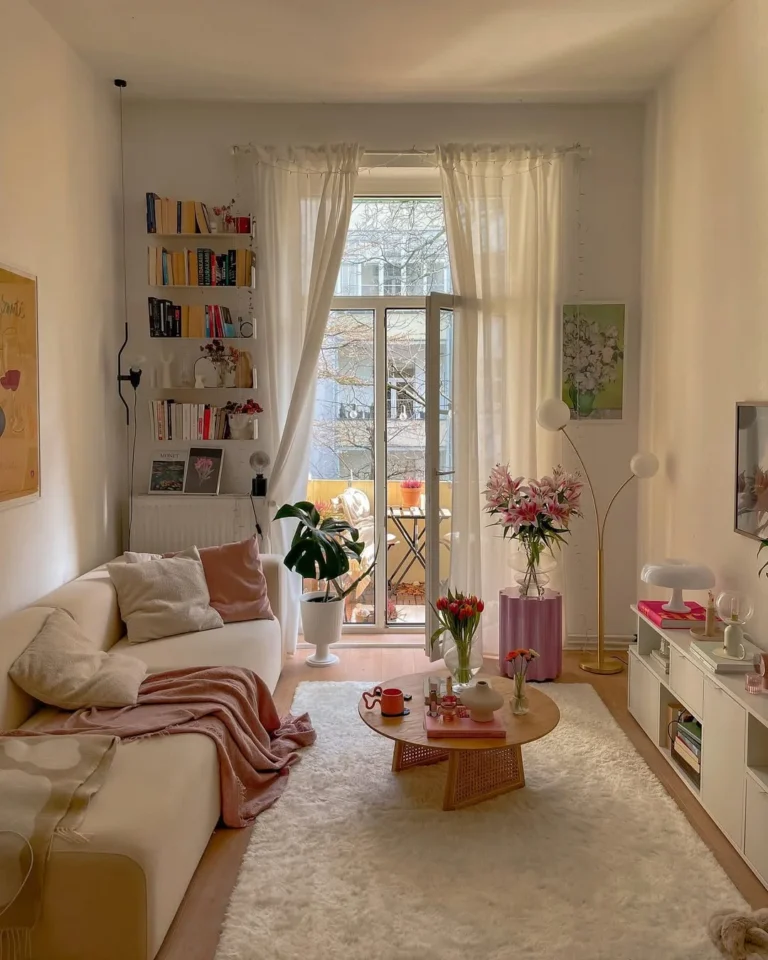
I redid my living room curtains three times before I got them right, and every mistake cost me somewhere between $80 and $300. The first set was too short. The second set was the right length but the wrong fabric for a room that gets brutal afternoon sun. The third set – 108-inch linen panels from Loom Decor, hung on a rod that actually extended past the window frame – finally made the room look like someone lived there on purpose.
Curtains are the cheapest way to change a room whole personality, and they are also the easiest thing to get wrong. Most people buy whatever is 84 inches long because that is what shows up first on the website, hang them right on top of the window frame, and wonder why the room still looks like a rental. So here is everything I have learned about doing it right – fabric choices, hardware, measurements, and the specific situations (bay windows, sliding doors, nosy neighbors) that need their own approach.
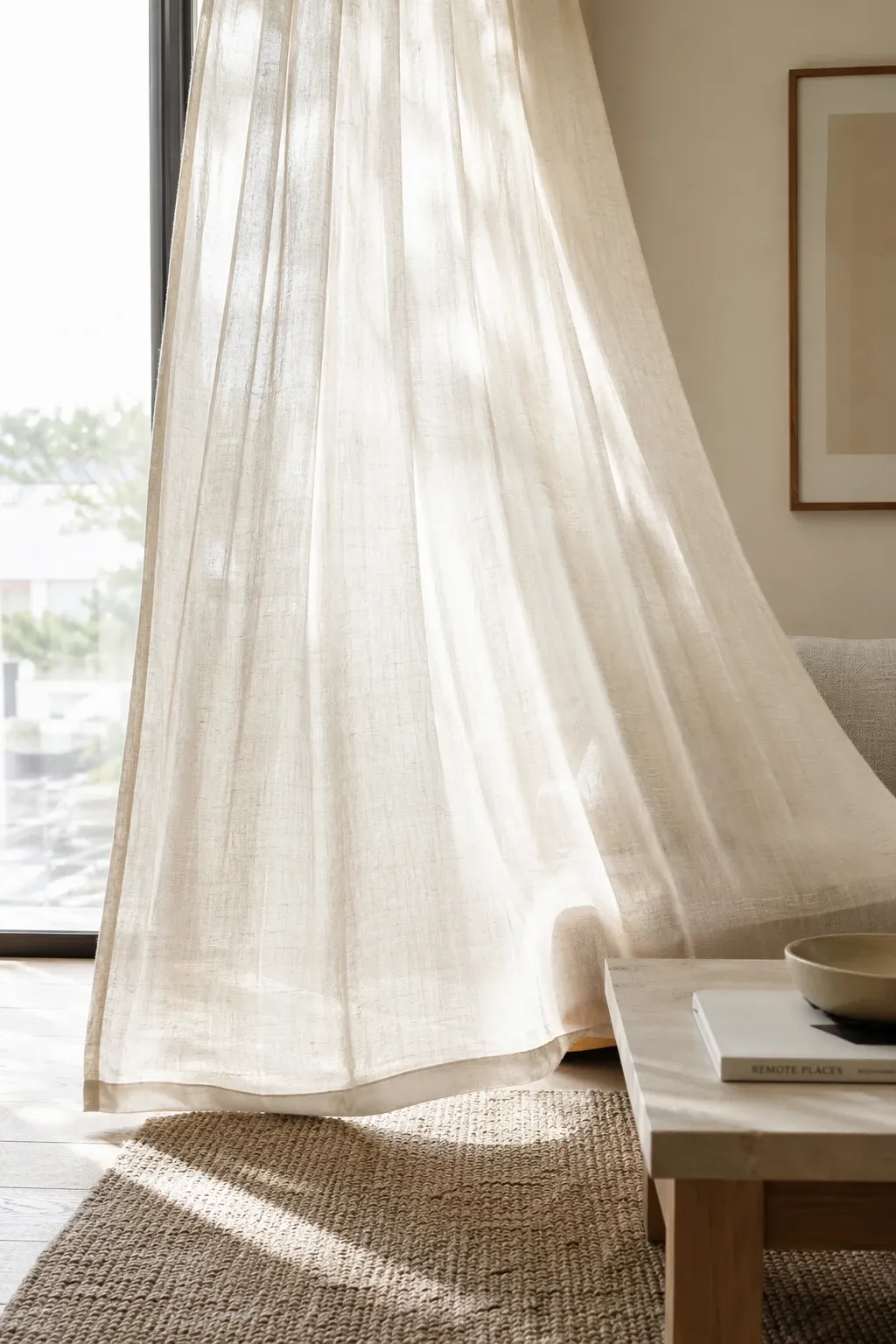
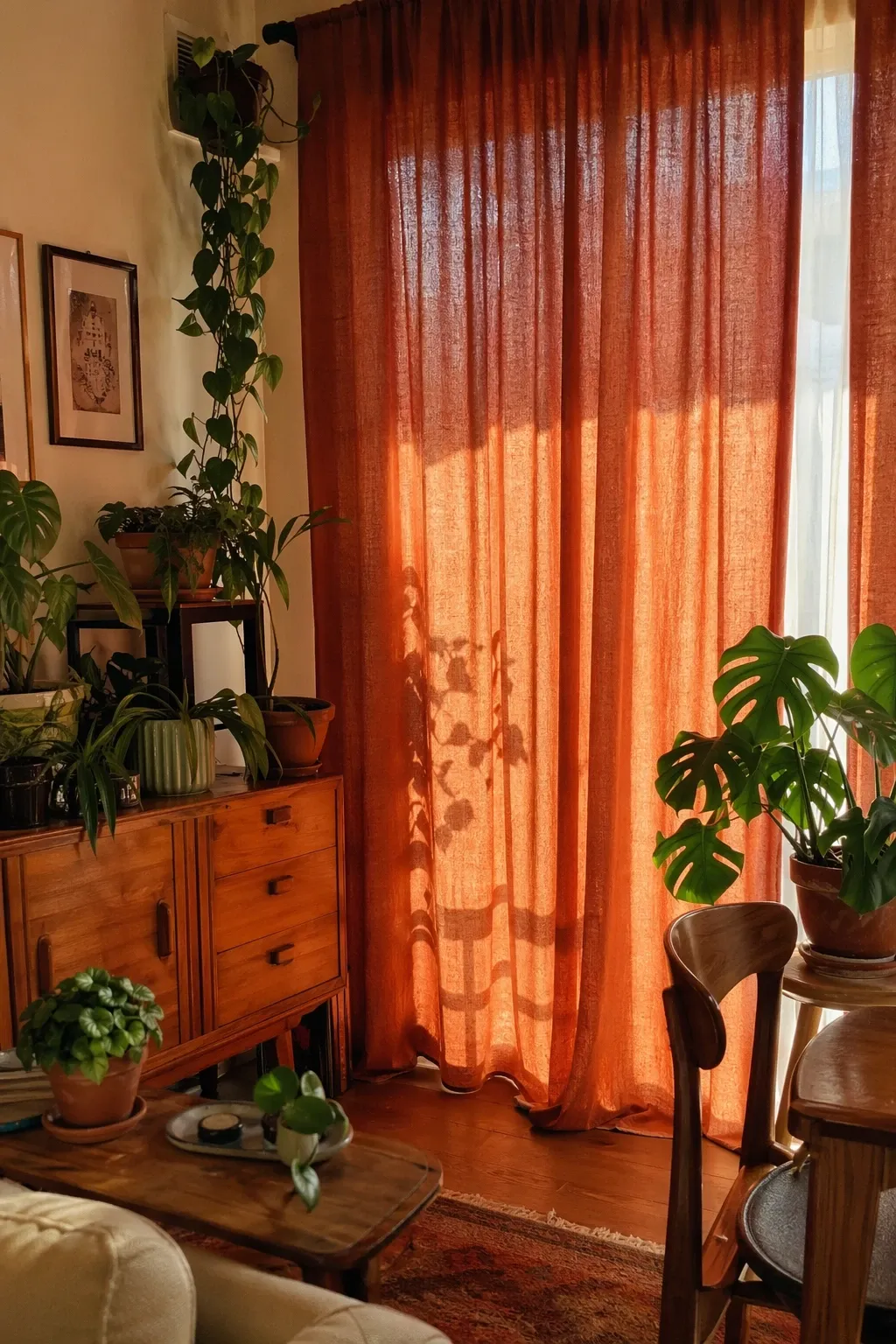
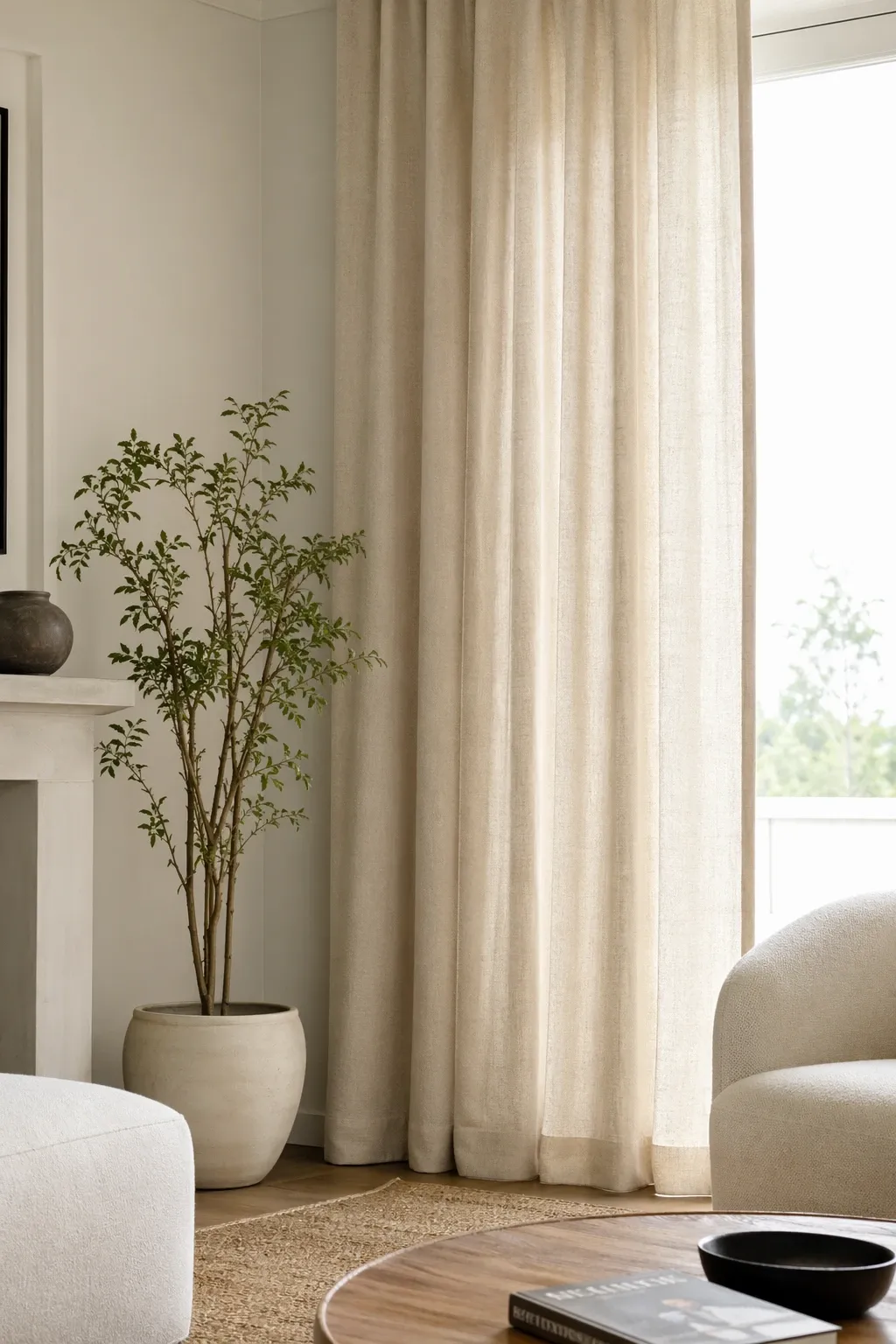
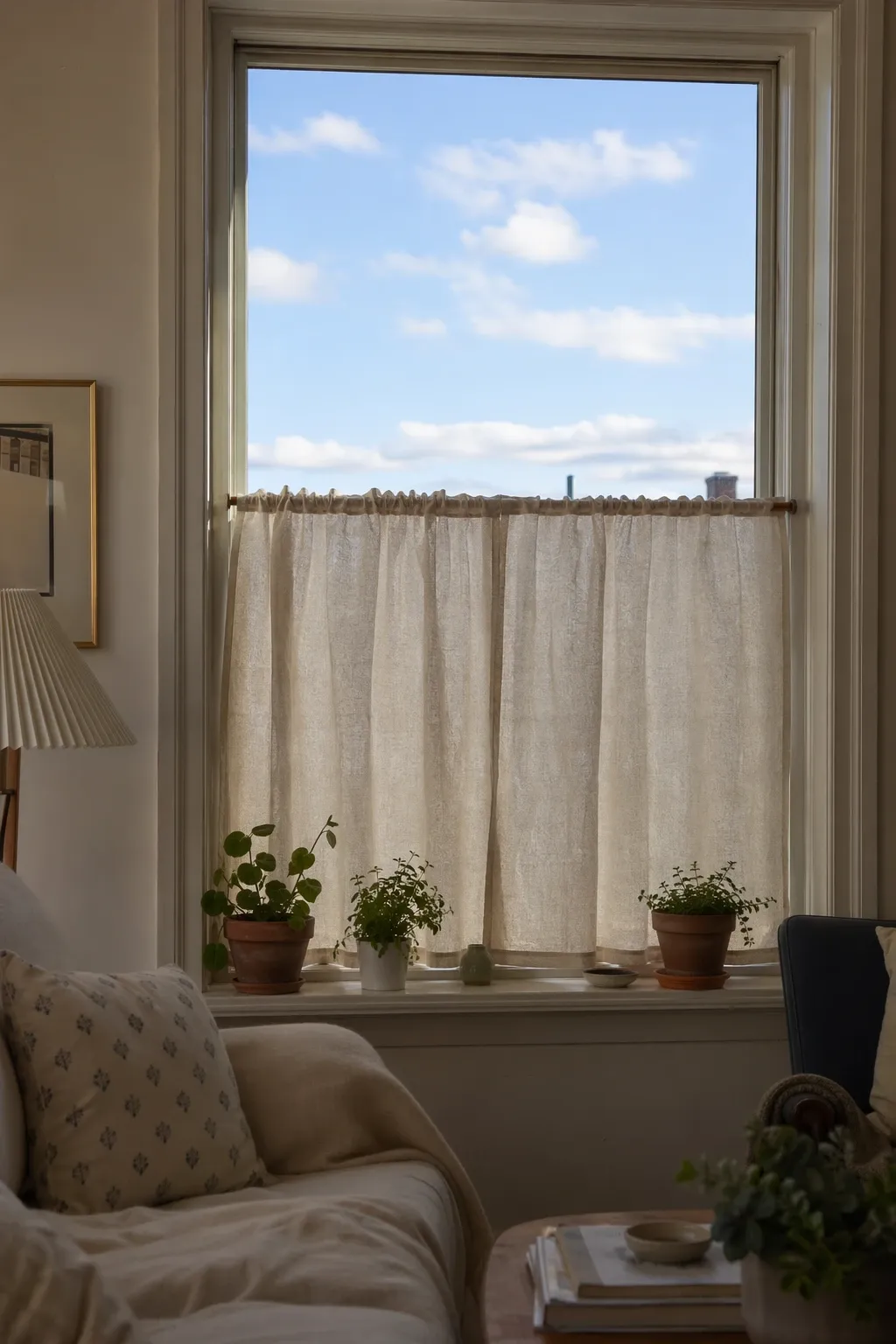
Linen is the fabric I recommend most, and also the one people are most disappointed by if nobody warns them first. It has this slightly rumpled, lived-in texture that makes a room feel relaxed instead of staged – completely different from the stiff, flat look of polyester blends. Light filters through it in a soft, warm way instead of the harsh glare you get with sheers, and it drapes with actual weight instead of hanging like a shower curtain.
The catch: linen wrinkles, and it wrinkles a lot. If you are the type who irons pillowcases, buy the wrinkles now and steam them out. If you are not, buy linen anyway – the wrinkles read as texture, not mess, once the panels are actually hanging. It also does not block light. A single layer of linen cuts glare and softens the view in but will not make a room dark for a 2 pm nap.
Price-wise, IKEA Lenda or Ritva panels run $35-50 a pair and are a legitimate starting point – cotton-linen blend, decent weight, nothing embarrassing about them. If you want the real thing, Restoration Hardware Belgian linen runs $200+ per panel, and Loom Decor custom linen lands around $90-140 per panel depending on width and lining. West Elm linen cotton curtains sit in the middle, around $70-100 a panel.
Designer Tip: Buy linen curtains a size up from what you think you need – linen shrinks slightly with washing and steaming, and you do not want to lose length you were already short on.
2. Velvet for Rooms That Need to Feel Warmer and Quieter
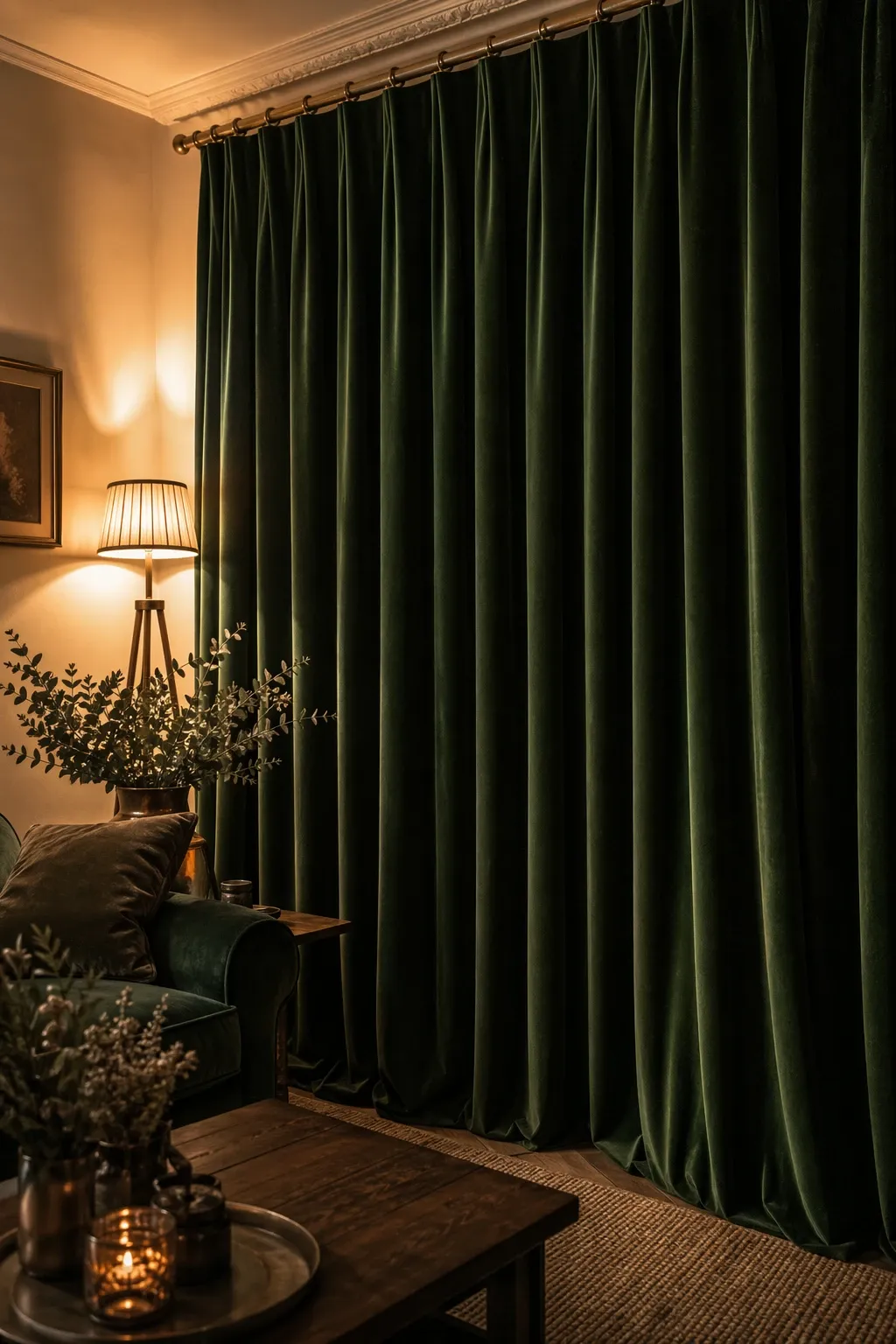
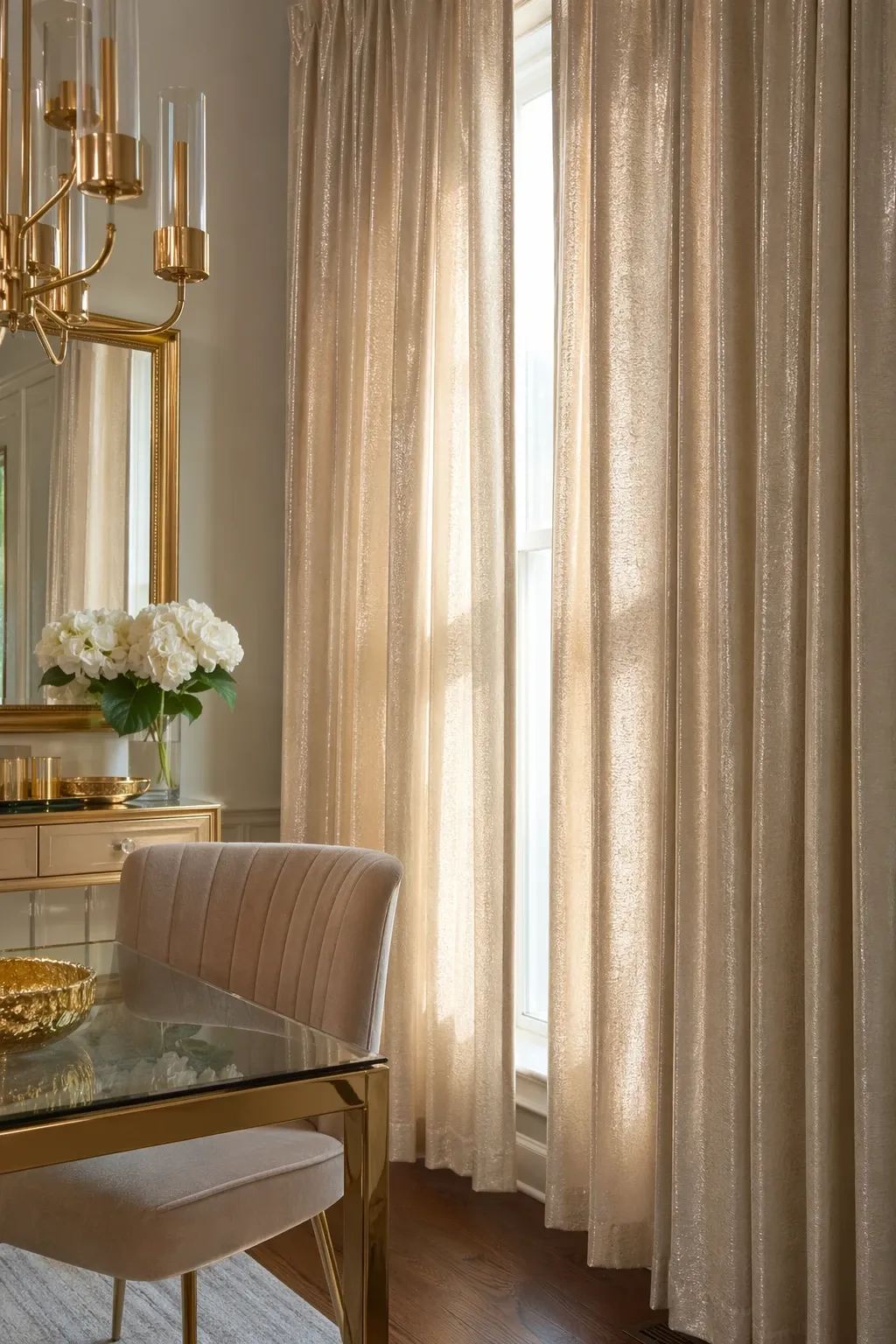
Velvet is the fabric for rooms with hard floors, high ceilings, or a serious echo problem – the weight and pile absorb sound in a way linen and cotton just do not. It also blocks light almost as well as actual blackout lining, and it makes a room feel warmer both visually and literally, since it is a genuinely insulating fabric against cold windows in winter.
The trade-off is dust. Velvet holds onto pet hair and dust like nobody else, and it needs a vacuum with an upholstery attachment run over it every few weeks or it starts looking dingy. It is also a heavier, more formal fabric – gorgeous in a room with dark walls or moody colors, but it can look like a hotel lobby in a bright, casual space with a lot of white trim.
Pottery Barn cotton velvet drapes run about $100-130 a panel and hold their color well. Crate and Barrel has a polyester velvet at a lower price point, around $70-90 a panel, that looks nearly as good and is easier to spot-clean. If you have cats, know that velvet shows claw snags more than any other fabric on this list.
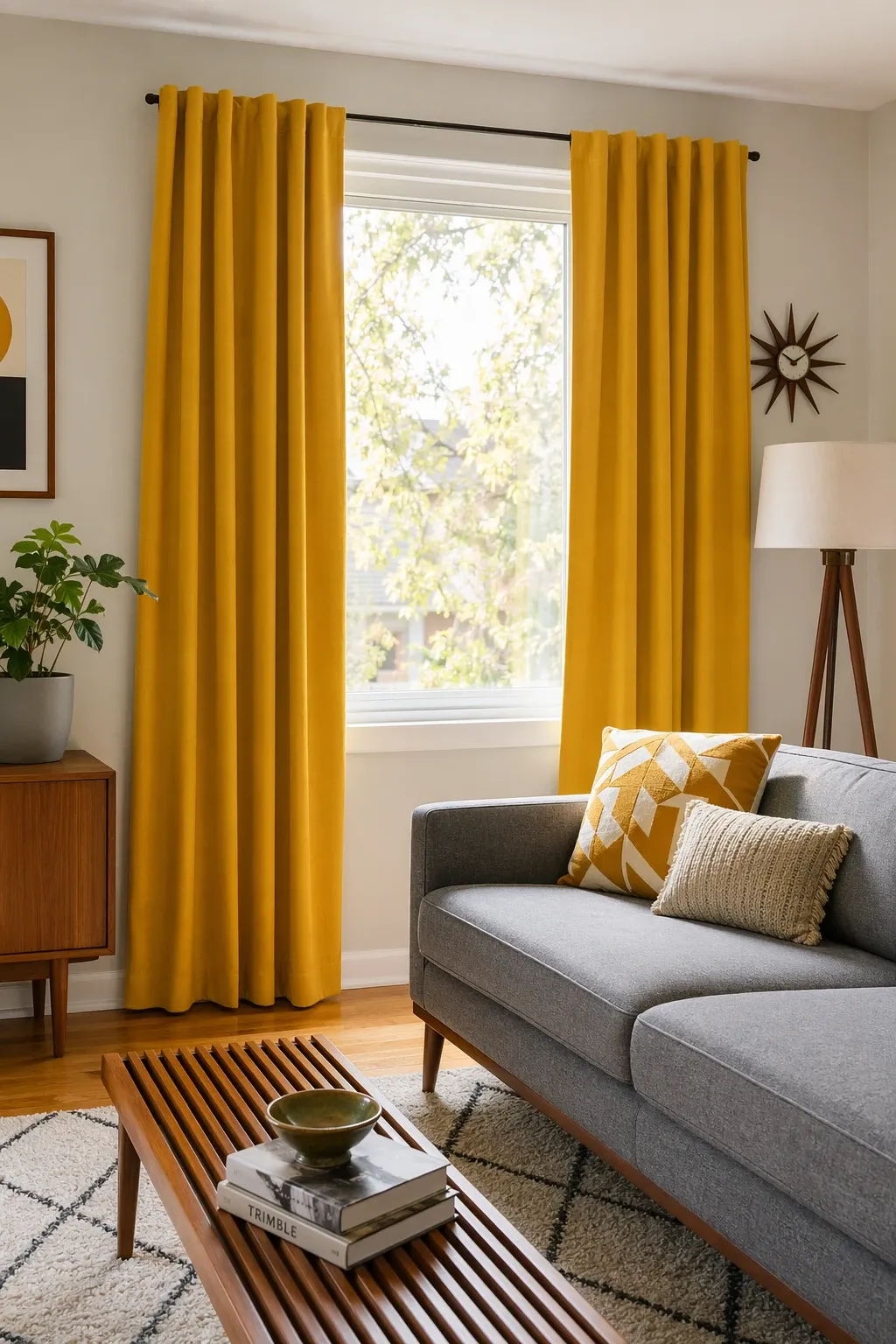
Designer Tip: Stick to jewel tones or deep neutrals with velvet – emerald, navy, rust, charcoal. Pale velvet (blush, cream) shows crushing and wear marks fast and looks tired within a year.
If you have kids who grab curtains to swing on, or a dog who likes to nose through them to bark at the mail carrier, cotton duck or canvas is the one that survives. It is a plain-weave cotton with real structure – heavier than a quilting cotton, lighter than canvas upholstery fabric – and it holds a crisp fold instead of going limp.
It is not a glamorous choice. Cotton does not drape as beautifully as linen or velvet; it holds a straighter, more architectural line. But it is machine washable in most cases, resists sun fading better than linen, and costs less across the board. Target Threshold cotton curtains run $25-35 a pair, and they are genuinely fine for a kid playroom or a mudroom-adjacent living space.
For something a step up, Serena and Lily cotton curtains ($130-160 per panel) come in better prints and a nicer hand-feel, and they are still washable. This is the practical choice, not the beautiful one, and I say that as a compliment – sometimes practical is exactly what a room needs.
Designer Tip: If you are worried about durability, go with a denser weave (look for duck or canvas in the name) rather than a lighter cotton voile, which will pill and thin out fast with regular washing.
Blackout curtains as a category are often disappointing – a lot of them let light leak around the edges and through the top, and the fabric itself can look flat and cheap because the coating that blocks light also kills any natural drape. The better approach for a living room is to buy a nice fabric (linen, cotton, even a printed pattern) and have blackout lining sewn or clipped in separately.
For a living room specifically, full blackout is usually overkill – you want dimming, not a cave, unless you have got a projector setup or the windows face a streetlight. Room-darkening lining (which blocks 80-90% of light rather than the 99%+ of true blackout) keeps some warmth in the room during the day and still knocks down glare on the TV in the evening.
Pottery Barn and West Elm both sell blackout liners separately for around $40-60 that attach to existing curtains with clips or a sewn-in rod pocket, which is the move if you already have curtains you like and just want more light control. Loom Decor and other custom shops will build the lining directly into a panel for an extra $20-30 per panel over the base price.
Designer Tip: True blackout curtains almost always need to be wider than standard – the fabric has to wrap fully around the window frame with no gaps, so budget for panels that overlap 4-6 inches past each side of the window.
5. Sheers for Light Without Losing Privacy Completely
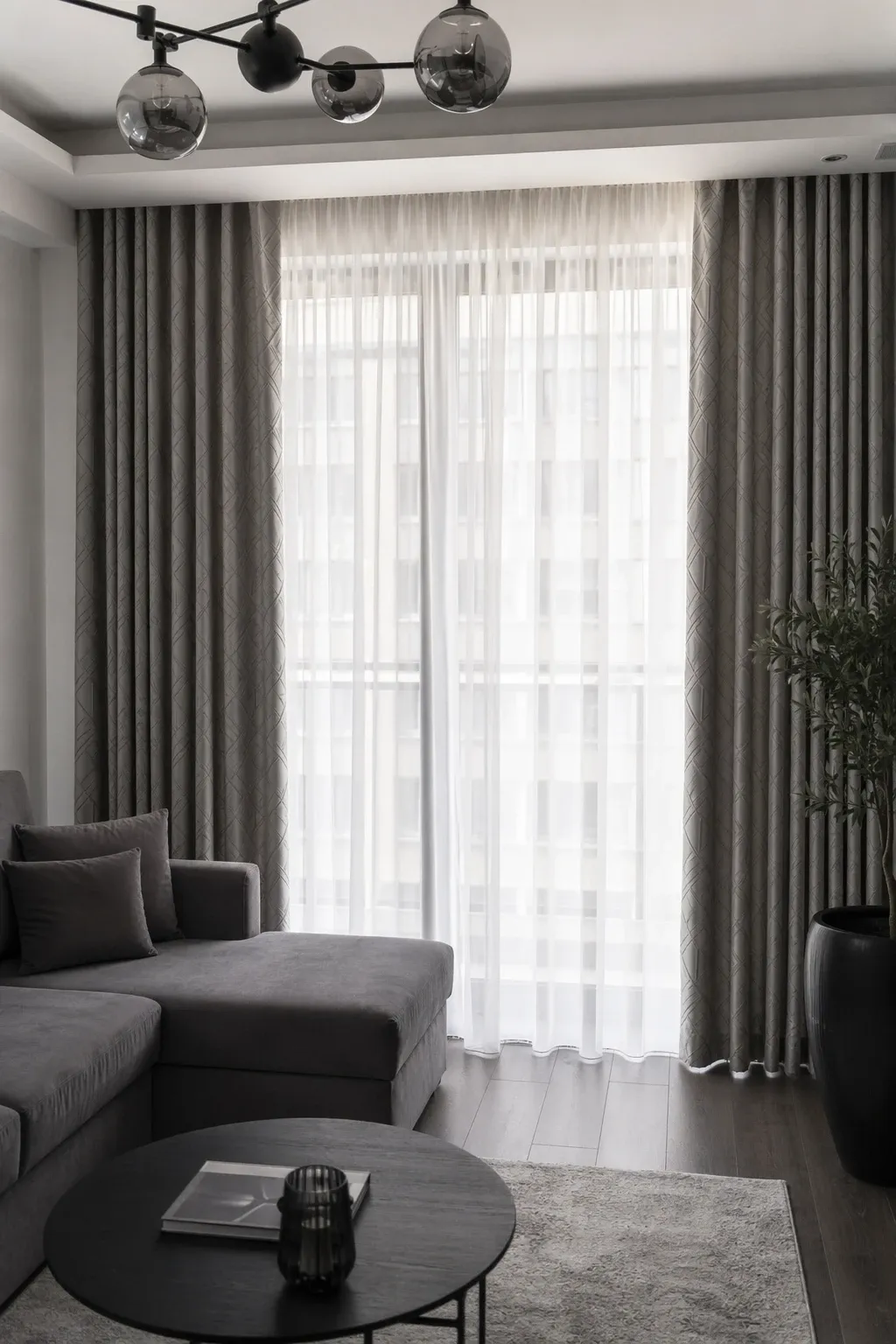
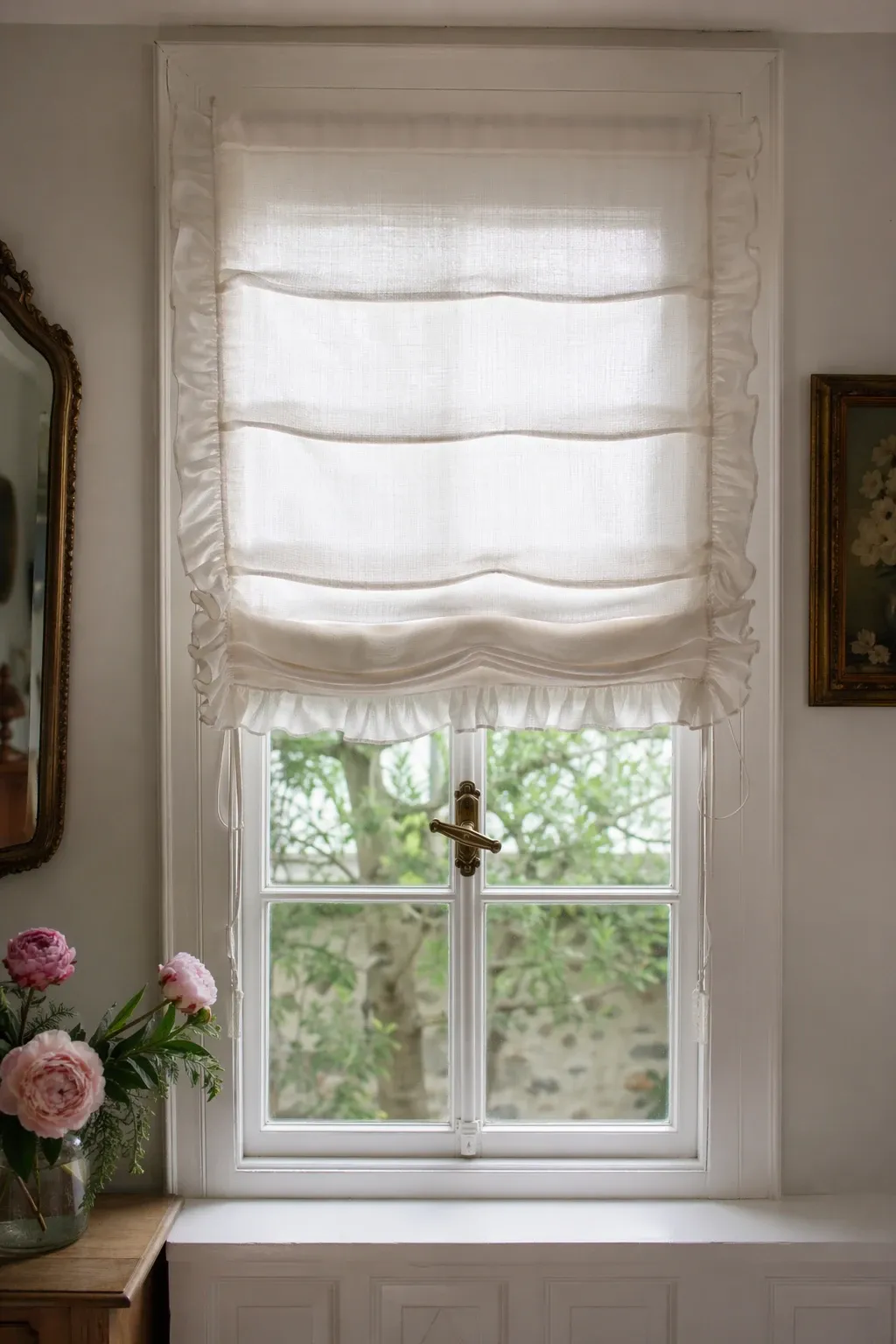
Sheers alone are almost never enough for a living room that faces a street, but layered behind a heavier curtain, they are one of the best moves you can make. During the day, close only the sheer and you get privacy plus soft, diffused light – no need to plunge the room into darkness just because someone might glance in from the sidewalk.
The mistake I see constantly is people hanging sheers on their own as the entire window treatment, expecting them to look airy, and instead getting a room that looks unfinished and offers zero light control after dark. Sheers are a layer, not a solution.
IKEA Lill sheer panels are $15 a pair and are honestly good enough – nobody is inspecting the weave quality on a sheer. If you want a nicer drape, Pottery Barn linen sheers run $50-70 a panel. Hang them on a second, shorter rod mounted a few inches in front of your main curtain rod, closer to the window.
Designer Tip: Buy sheers in a slightly warmer white (ivory or natural) rather than bright white – bright white sheers can look slightly blue or cold once sunlight passes through them.
Color and Pattern
6. Matching Curtains to Wall Color Without Matching Them Exactly
The instinct to match your curtains exactly to your wall color usually backfires – the room ends up looking like a paint swatch stretched across the whole space, with no depth. What works better is picking a curtain color one or two shades off from the walls: if your walls are a warm greige, go with a curtain in oatmeal or soft camel rather than the identical greige.
The other approach that works well is picking curtains in a neutral that matches your trim or ceiling color instead of your walls, which creates a sense that the window treatment is part of the architecture rather than a decor add-on competing with the paint. This is a subtle trick but it is the difference between a room that looks put-together and one that looks like everything was bought separately with no plan.
If your walls are a bold color – a deep green, a moody blue – do not fight it with a competing bold curtain. Go neutral (linen, oatmeal, warm white) and let the wall color be the statement. Two loud colors in one sightline is exhausting to look at.
Designer Tip: Bring an actual fabric swatch home and look at it in your room at both midday and evening lighting before buying – the same beige can look pink under warm bulbs and gray under daylight LEDs.
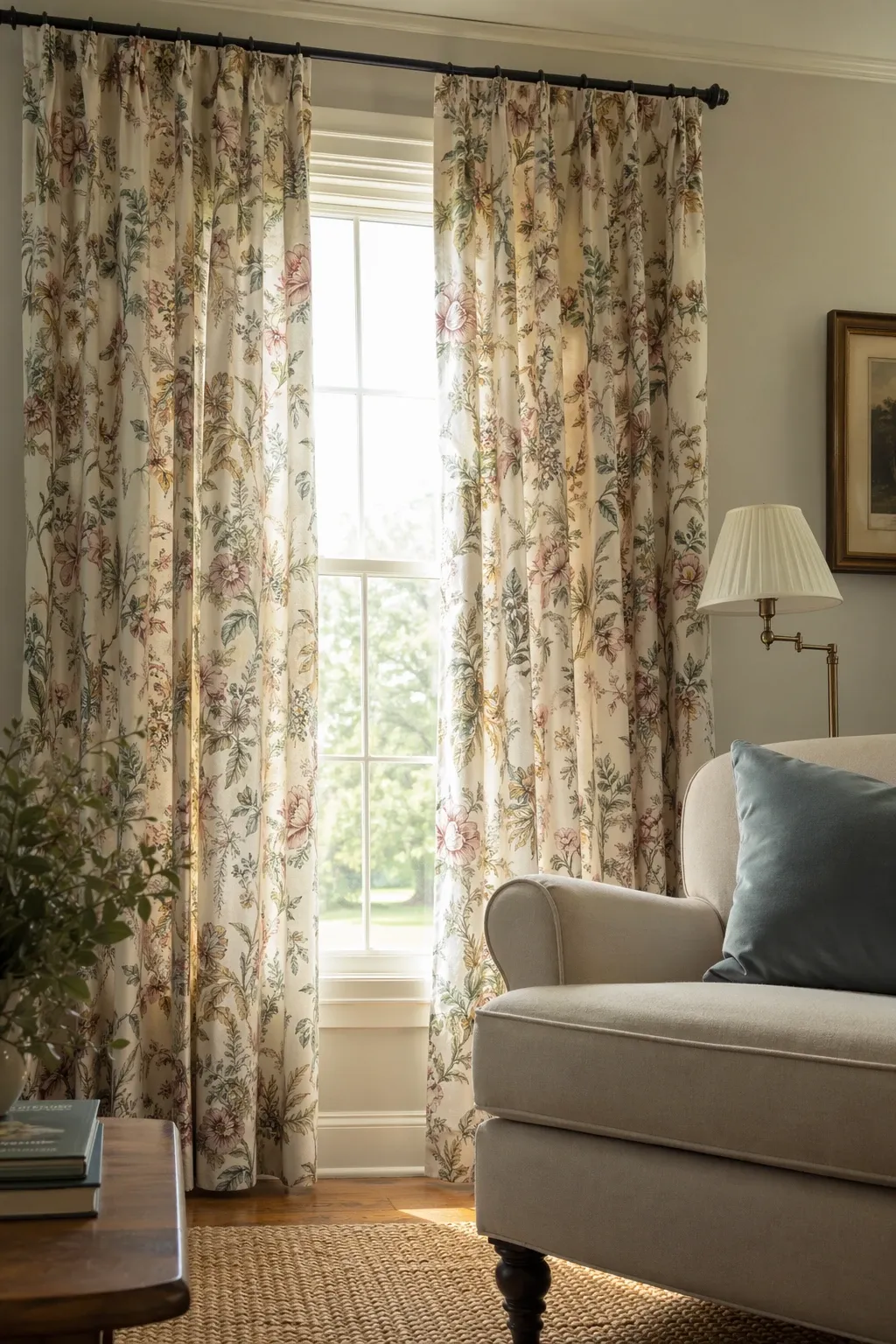
7. Pattern Curtains for a Room That Needs Personality
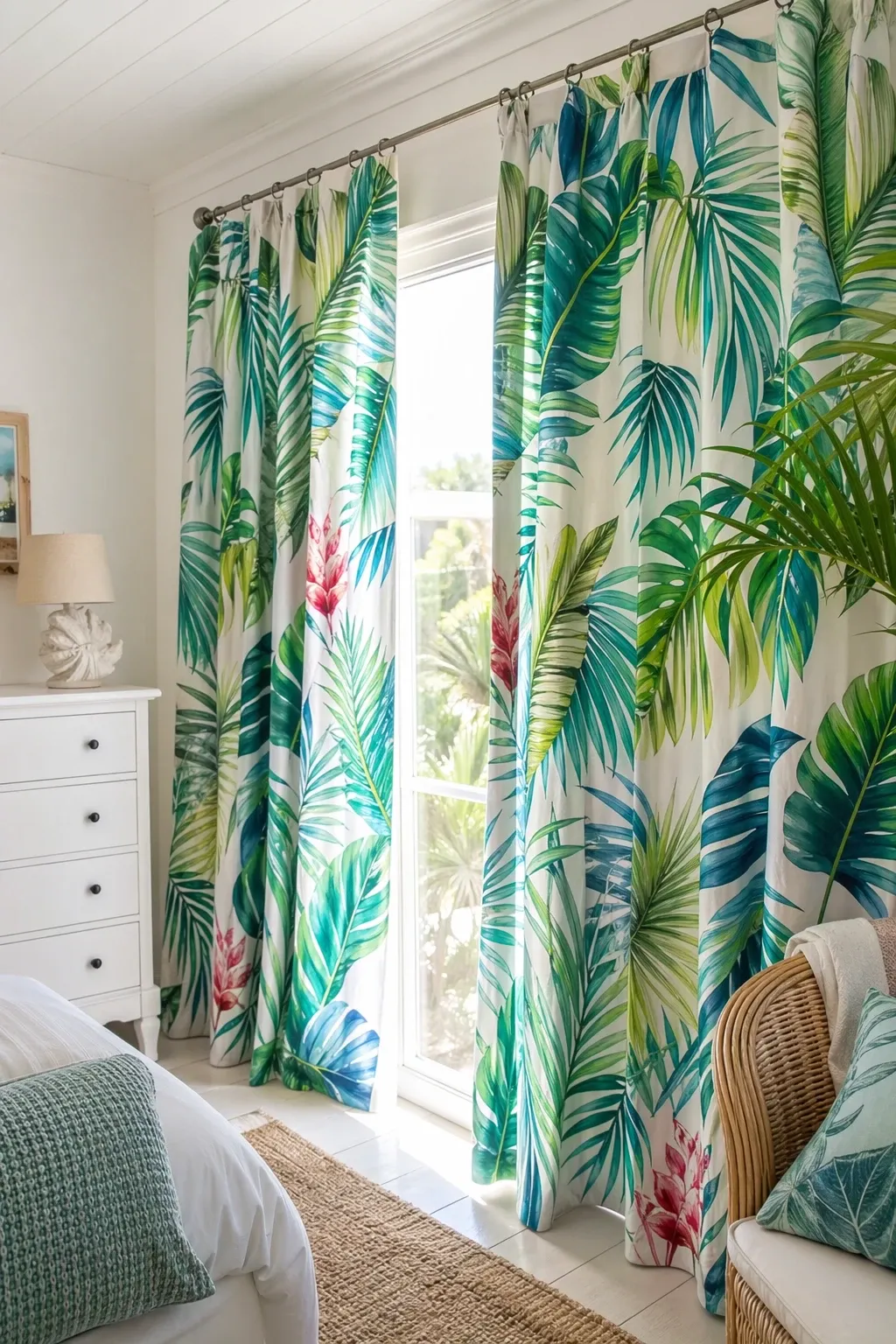
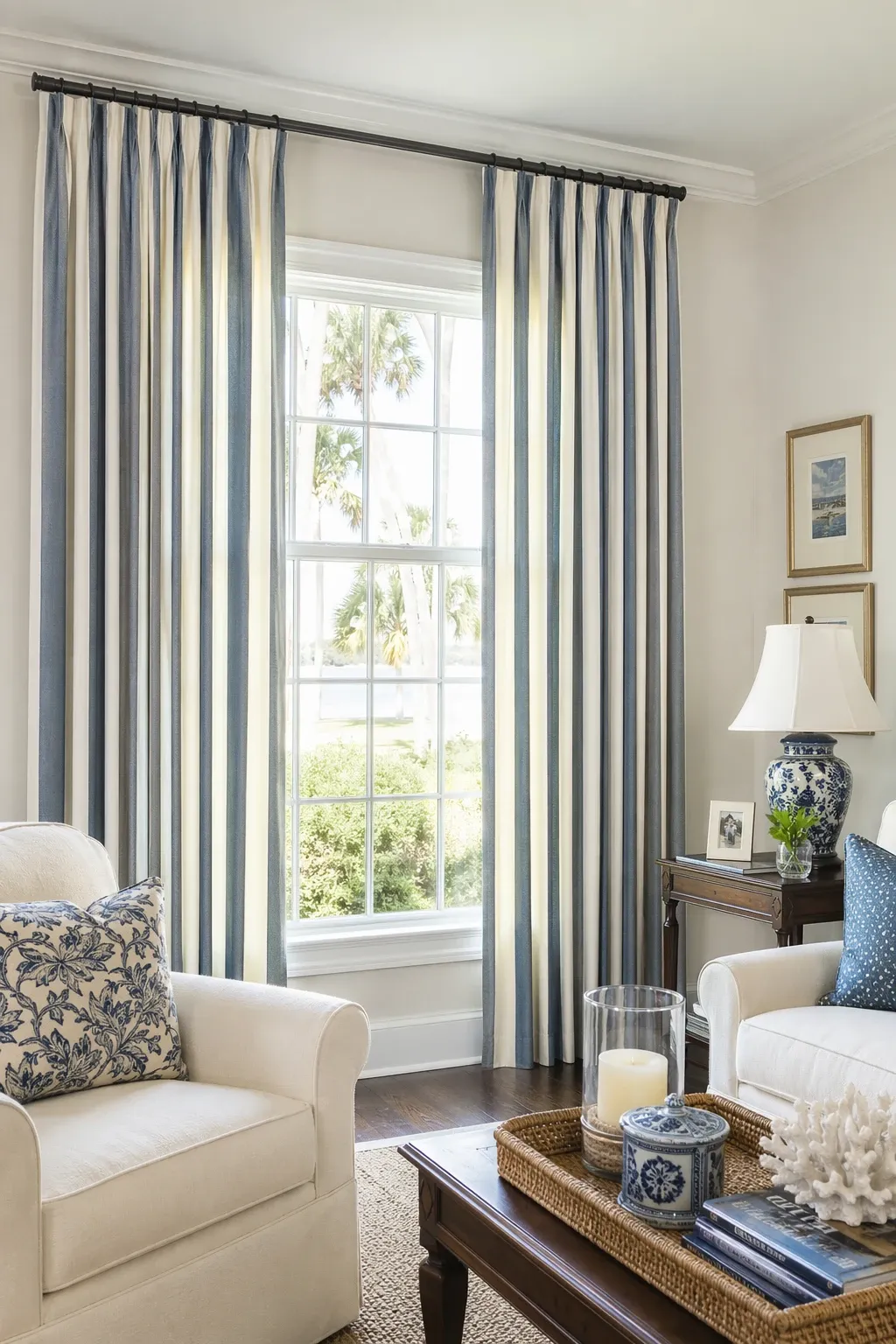
If your living room furniture is mostly solid-colored – a gray sofa, a plain rug, neutral walls – patterned curtains are the easiest way to add personality without redoing the whole room. A botanical print, a subtle stripe, or a block-print pattern gives the eye something to land on and keeps the room from feeling like a showroom.
The rule that actually matters here: if you are going patterned, everything else in the sightline should calm down. One patterned rug and one patterned curtain in the same room, competing for attention, makes a space feel busy rather than layered. Pick one pattern moment and let the rest of the room support it.
Schumacher and Thibaut make genuinely gorgeous printed drapery fabric, but custom curtains in those fabrics run $150-300+ per panel once you add labor. For a lower-cost version of the same idea, Anthropologie and West Elm both carry printed curtain panels in the $80-120 range that get you 80% of the look. Block-print cotton from World Market, around $40-60 a panel, is another solid budget option with actual character.
Designer Tip: Small-scale patterns (ditsy florals, fine stripes) tend to read as texture from across a room and are more forgiving long-term than large, bold prints, which can start to feel dated faster.
8. Using Curtain Color to Fix an Awkward Room Shape
Curtains can visually correct a room proportions in a way most people do not think about. If your ceilings feel low, hang curtains that match your wall color closely and extend them nearly to the ceiling – this creates one uninterrupted vertical line that pulls the eye up. If a room feels too narrow or boxy, curtains in a contrasting color at each window create visual breaks that make the room feel like it has more going on horizontally.
For a room with mismatched or awkward window sizes – say a large window next to a much smaller one – using the same curtain color and hanging height on both, even if the panel sizes differ, unifies them so the mismatch is less obvious. Fighting the mismatch by treating each window totally differently just draws more attention to the inconsistency.
Dark curtains (charcoal, navy, deep green) in a small room are not automatically a bad idea, despite what a lot of advice says – a dark curtain against a light wall can actually make a small window look more intentional, especially paired with a light rug and light furniture to balance it out.
Designer Tip: If a room has an oddly placed window that is not centered on the wall, hang the curtain rod centered on the wall itself rather than the window, and let the fabric fall asymmetrically – it looks more deliberate than a rod centered on the actual window opening.
9. Two-Tone and Color-Blocked Panels for a Custom Look
Color-blocked curtains – where the top third or so is one color and the rest is another, or where a contrast band runs along the leading edge – read as expensive and custom, but a lot of them are surprisingly achievable with basic sewing or even iron-on hem tape if you are not confident on a machine.
The easiest version: buy plain linen or cotton panels in a neutral, then add a 4-6 inch band of a contrasting linen or velvet along the bottom hem or leading edge. This gives you a designer-looking detail for the cost of a yard or two of contrast fabric, usually $15-30 total, on top of curtains you were buying anyway.
Loom Decor and The Shade Store both offer color-blocking or contrast-trim as a custom option, and it is worth the upcharge (usually $10-20 per panel) if sewing is not your thing. It is a detail that photographs well and makes off-the-shelf curtains look like they were made specifically for your room.
Designer Tip: Keep the contrast band a cool, muted color rather than a bright accent – a bright contrast band dates fast, while a muted one (rust, olive, ink blue) ages well with the rest of your decor.
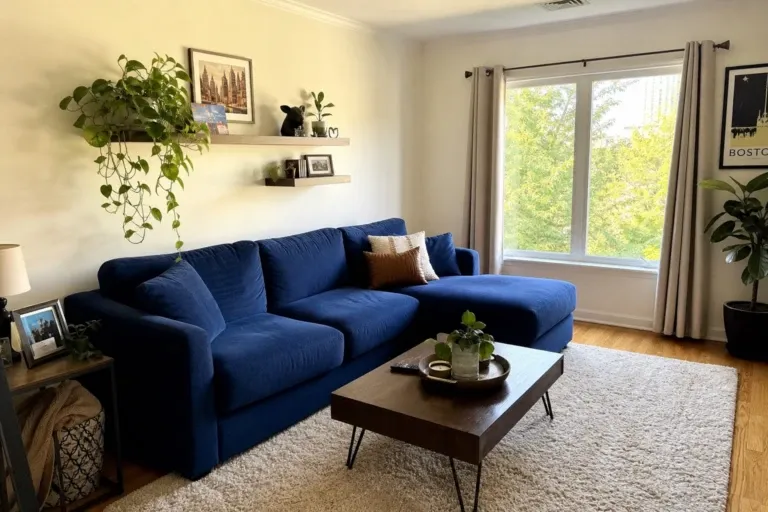
This is the single biggest mistake I see, more than fabric choice or color: curtains hung directly on top of the window frame, at frame width, look cheap no matter how expensive the fabric is. Hang your rod 4-6 inches above the window frame, and if your ceilings allow it, hang it even higher – anywhere up to a few inches from the ceiling. Height makes the whole window, and by extension the room, feel taller.
For width, the rod should extend 6-12 inches past each side of the window frame, not stop right at the edges. This does two things: it lets your curtains stack fully open without covering any glass and blocking light, and it makes the window itself look wider and more substantial. A too-narrow rod is the reason so many curtains look like they are straining, half-covering the window even when open.
For length, you have basically got three options. Floating – curtains that stop an inch above the floor – looks intentional and tidy but shows every measuring mistake. Kissing the floor – just barely touching – is the safest bet for most people and looks clean in almost any room. Puddling – where several extra inches of fabric pool on the floor – looks luxurious in a formal, low-traffic room but is a genuinely bad idea in a living room with kids, pets, or foot traffic; it collects dust and gets stepped on constantly.
Designer Tip: Measure your actual window height, add at least 4-6 inches for the mount, and round up to the nearest standard panel length (84, 96, 108, or 120 inches) rather than the nearest inch – going short is the mistake you cannot fix without buying new curtains.
A basic curtain rod runs $15-30 at Target or IKEA and does the job fine if you are not fussy, but the finial (the decorative end piece) and the rod finish do a lot of visual work. Matte black rods read as more modern; brass or warm gold reads more traditional or eclectic; a simple wood rod, which brands like Rejuvenation and Anthropologie carry for $40-70, fits well in a room with a lot of natural materials already.
Double rods – two parallel rods, one closer to the window for sheers and one further out for your main curtain – solve the layering problem and cost maybe $10-15 more than a single rod. They are worth it in any room where you actually want both light control and privacy at different times of day, which in a living room is most rooms.
For very wide spans – a picture window, sliding glass doors – a single rod can sag under the weight of heavier fabric like velvet. Traverse rods (with a pulley mechanism) or a heavier-gauge rod with a center support bracket handle the weight better. The Shade Store and Smith and Noble both do custom rod fabrication for exactly this situation, usually $80-150 depending on span.
Designer Tip: If your rod will span more than 6 feet, add a center support bracket regardless of fabric weight – even lightweight curtains cause visible rod sag over time without one, and it is a $10 part that prevents a very annoying fix later.
12. Rings, Tabs, and Grommets: The Detail That Changes How Curtains Move
How a curtain attaches to the rod changes its whole movement and look, and it is worth an actual decision rather than defaulting to whatever the panel comes with. Grommets (metal rings sewn directly into the fabric) create clean, even folds and slide open and closed the easiest – good for a room where you are actually opening and closing curtains daily.
Curtain rings with clips are the most flexible option since you can put any panel on any rod without matching hardware, and they let you adjust the hanging height of the fabric independent of the rod height. The trade-off is a slightly less uniform fold than grommets, and the clips can occasionally slip on heavier fabrics like velvet.
Back tabs (fabric loops sewn to the back of the panel, mostly hidden from the front) give the most tailored, expensive-looking result – you do not see any hardware at all when the curtain is closed, just clean fabric folds. Rod pockets, where the rod threads straight through a sewn channel, are the cheapest and most common on budget curtains, but they are also the hardest to open and close smoothly.
Designer Tip: If you want the tailored, no-visible-hardware look of back tabs but still want curtains that open and close easily, look for back tab with hidden rings – a small detail some higher-end brands like Loom Decor offer that gets you both.
Special Situations
13. Bay Windows, Corner Windows, and Sliding Doors
Bay windows need curved or bendable rod hardware, and this is genuinely one of the more expensive hardware problems in this whole list – a custom-bent bay window rod runs $100-250 depending on the angle and span, versus $20-30 for a straight rod. The Shade Store and Smith and Noble both do custom bay rod fabrication; trying to force a straight tension rod into a bay window setup looks awkward and does not hold weight well.
For corner windows – two windows meeting at a 90-degree angle with minimal wall between them – a single continuous rod that wraps the corner (again, custom-bent) looks far better than two separate rods stopping short of each other with a gap. If custom hardware is not in the budget, hanging a single long panel on each side that meets in the middle of the corner minimizes the amount of hardware you need entirely.
Sliding glass doors are their own category because of the width and the fact that people actually need to walk through them. One long panel that stacks entirely to one side, on a rod extended well past the door frame, works better than two panels that each have to be pulled clear of the walking path. Make sure the rod extends at least 24-30 inches past the door opening side so the fully-open panel does not block the doorway at all.
Designer Tip: For sliding doors, weight the leading edge of the curtain (a hem weight or a heavier lining) so it hangs straight and does not blow around every time the door opens – it is a small addition, usually under $10 in hem weights, that keeps things looking tidy.
If your living room faces a busy street, curtains genuinely help with noise – not as much as double-pane windows or acoustic panels, but a heavy, floor-length curtain (velvet is the best performer here, followed by a lined cotton or linen) measurably softens both incoming street noise and the room internal echo. Thin sheers do essentially nothing for sound; this only works with weight and fullness.
For insulation, the fabric matters less than the coverage. A curtain that is wide enough to fully overlap the window frame on all sides, paired with a thermal lining (sold separately by most curtain brands for $30-50, or built into energy efficient curtain lines like the ones IKEA and Pottery Barn both carry), can noticeably cut drafts in an older home with single-pane windows.
For privacy against close neighbors or a street-level window, the sheer-plus-heavier-curtain layering from earlier in this post is the real answer, but if you want privacy during the day without closing anything, look into linen with a slightly denser weave or a privacy sheer – a mid-weight option between a true sheer and a full blackout that blocks the view in without requiring you to close a heavy curtain and lose all your light.
Designer Tip: If noise is the main issue, prioritize fullness over fabric brand – a cheaper velvet curtain with generous fabric width (aim for at least 2x the width of your window, so the fabric has real folds and mass) will outperform an expensive but skimpy panel every time.
Getting It Actually Done
If you are starting from scratch and the budget is limited, prioritize in this order: get the rod height and width right first (free if you already own a drill), then invest in one good pair of panels for the most visible window in the room, and layer in sheers or a second pair later when the budget allows. A single well-hung curtain on the right window does more for a room than four mediocre panels spread across every window.
For most living rooms, expect to spend somewhere between $150 and $800 total on curtains and hardware, depending on how many windows you are covering and whether you go custom or ready-made. IKEA and Target sit at the low end and are perfectly fine for a first apartment or a room you are still figuring out; Pottery Barn, West Elm, and Anthropologie occupy the mid range; The Shade Store, Loom Decor, and custom workrooms handle the high end. The difference between price tiers is mostly in fabric weight, lining quality, and how long the curtains hold their shape after washing.
The best thing about curtains, compared to most other design decisions in a living room, is that they are genuinely reversible. If you pick a fabric you end up hating, you can swap panels without patching walls or moving furniture. So if you are stuck between two options, just pick one – you will know within a week whether it works, and the fix is easy.
Frequently Asked Questions
How long should living room curtains be?
Floor length, almost always. Curtains that stop at the windowsill or mid-wall look unfinished in a living room. The bottom should just kiss the floor or float about half an inch above it. The only exception is if you have a radiator, window seat, or piece of furniture directly under the window that makes floor-length impractical – in that case, stop the curtain just below the sill so it looks intentional rather than like you bought the wrong size.
Should I line my curtains?
For a living room, yes. Unlined curtains look thin from outside (you can see the rod and rings through the fabric when the sun hits), they fade faster from UV, and they do essentially nothing for temperature or light control. A basic cotton lining adds $10-20 per panel and makes even inexpensive curtains hang better and last longer. Blackout lining is optional and depends on whether you need the room dark for TV watching or afternoon naps.
Can I mix different curtain fabrics in the same room?
Yes, but keep it to two fabrics maximum and make sure they share either a color family or a weight class. A common approach that works well: linen on the main windows and a heavier velvet or cotton on a single accent window or flanking a focal point. What looks messy is three or four different fabrics with no visual connection – it reads as indecisive rather than layered.
How do I keep curtains from looking cheap?
Three things matter more than price. First, hang the rod high and wide (the single biggest upgrade, and it is free). Second, use enough fabric – each panel should be at least 1.5x the width of the window it covers so you get real folds, not a flat sheet stretched across. Third, iron or steam the panels before hanging; the fold creases from packaging make even $200 curtains look like they came from a dollar store.
Are blackout curtains worth it for a living room?
It depends on what you use the room for. If you watch a lot of TV or movies during the day, blackout curtains are a genuine quality-of-life improvement – the difference in screen visibility is dramatic. If the room is mostly for hanging out, reading, or entertaining, blackout is overkill and you lose the ability to get soft filtered light through the curtains. A lined but non-blackout curtain gives you 70-80% light reduction, which is enough for most living rooms.
What curtain fabric holds up best with pets?
Tightly woven cotton or polyester blends resist snagging better than anything loose-weave like linen or open-weave sheers, which cat claws will shred in weeks. Avoid anything with a nubby or looped texture – it is a magnet for claws. For dogs, the main issue is usually drool and nose prints on the lower portion; a machine-washable poly-cotton blend that you can throw in the wash monthly is more practical than dry-clean-only silk or velvet. If you really want linen, keep it on windows the pets cannot reach.